You have no doubt heard much about our head native teacher, Jim. At present he is up in northern Rhodesia. His father is expected to die, and Jim is waiting to bury him. I cannot tell you what a help he is to the mission, but will say he is at least worth a well-trained and experienced white worker, and in some ways he is much like a white person. He has a very great burden for the natives for whom we are working, which is saying much considering that he was brought to this country as a slave, he being of an altogether different tribe. I shall try to give you some idea of how great his burden is to see souls saved.
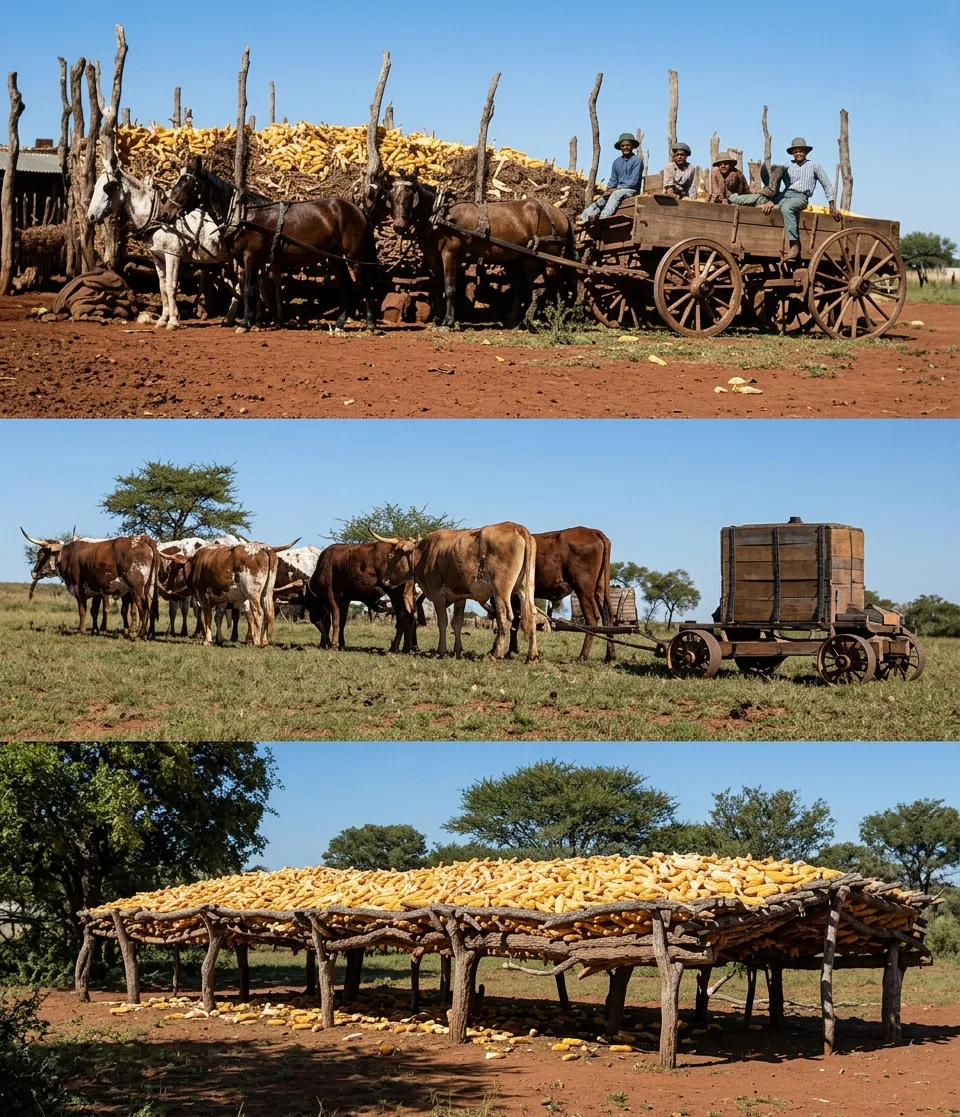
Photos by J. V. Wilson SOLUSI MISSION SCENES
Some time ago he was greatly troubled with his leg and could hardly walk. As he was teaching seven and one-half hours a day in our home school, he could not get out at all during school time. His leg gave him pain night and day, and he was very thin; but when vacation came, he set out to canvass the natives over thirty miles away, trusting in the Lord for strength. Although his leg had been paining him incessantly, as soon as he started out to canvass, the pain ceased, and his leg did not trouble him until he got back home again. He sold all his books, and traveled about one hundred miles. But that is not all. At a certain kraal where he did some canvassing, an old native took him into his cattle kraal and showed him two very nice young heifers, saying he could have them as soon as he sent somebody to get them. The Lord works in a marvelous way, and surely showed Jim he was pleased with his work. He is very anxious to canvass the whole of Matabeleland, and would have started in January had he not been with his father.
Before a native can canvass here, he has to get a license, which costs over fifty dollars. Jim said if the brethren could not see their way clear to buy him the license, he would sell one of his cows and pay for it himself, and also buy a donkey to carry his books for him. One might understand a white person's willingness to do so, but coming from a native it surprises us. Natives think more of their cattle than of their lives, and would almost rather starve than sell a beast to buy food. A few weeks ago I wrote Jim, telling him that Brother Walston was willing to get him the license. This is his reply:—
“I received your letter, and read it, and was very glad to hear the way was opened for me to get a license to canvass. The letter seemed to come from Jesus. The work of selling books is very great, and I love it as I do my food, and want to canvass the whole of Matabeleland.”
This is saying a great deal; for the natives do certainly love to eat. To give you some idea as to how much a native13really likes his mealie meal porridge I shall tell you what one of our native teachers asked me. We were talking about heaven, and he wanted to know if they would have their porridge there. He did not seem to care to go there if he could not have it.
In his letter Jim told how much he enjoyed reading his Bible. He says: “There is only one thing that gives me pleasure now, and that is the Bible. I read and study it hard every day.” Jim has a very remarkable mind for retaining the Scriptures. I have heard many persons, even some of our workers who have preached for years, say they wished they knew the Bible as well as Jim knows it. He can tell the familiar texts one would give for any point of our faith. He is always studying the Bible, and says the more he studies it the more he wants to and the more he sees the need of doing so.
You will notice one of the illustrations is of our water sled. I made it out of native wood, and put in a good pair of axles. It works well, and serves as a wagon. We have to use a good many primitive things here to cut down expenses, but they answer just as well as if they were modern. We have a very good spring about a mile from the house, and the boys inspan a team of oxen to the sled and bring up a tankful of water. We use the water for watering our trees in the yards, and for the children.
En Route to Szechuan, Through the Yang-tze Gorges
By F. A. ALLUM
F. A. ALLUM
Believing that the friends in the homeland will be interested in the journey we have just made, I am writing this account, which will give the story from I-chang to Chung-king. An account of the journey from Shanghai to I-chang has already been published in the REVIEW. I am letting this take the form of notes from my diary.
March 27. We left I-chang by native house boat, which is known in this part of China as a quodza. Some one has said that it resembles not a little a gypsy caravan afloat.
Before leaving I-chang the boat people killed a fowl and spilled the blood on the front of the boat, and also stuck some of the feathers on both sides of the boat at the front, and placed some on each side of the front cabin, and also in the middle. The captain's wife beat a gong vigorously, and at the same time they burned paper money and fired off crackers. They reason that if they only burn paper money and do not fire off crackers, the gods will not know that they are worshiping them. The whole system of heathen worship is to pacify the evil spirits, which are said to make their home in the waters of the great Yang-tze-kiang.
Our boat ascended the stream about one mile, and then we anchored, as the captain had not finished all his preparations for the journey. As he would not come on board until sundown, we shall remain at this place over the Sabbath.
March 28. We spent a very pleasant Sabbath. In the morning we had Sabbath school, and after this I spoke to the crew of our boat, who number eighteen in all. I concluded my remarks with an appeal to them to give up smoking and the drinking of wine. One man decided right away that he would not smoke any more, and immediately threw his pipe into the river. He has not smoked since.
March 29. Leaving I-chang about 6 A. M., we sailed almost due north for about five miles, and at this point turned west and entered the famous I-chang gorge. This gorge is thus described by one who has traveled in nearly every part of the world: “It looked as if we were sailing through a chain of mountain lakes.”
Having a favorable wind, we soon arrived at a place called Hwang Ling Miao. It is thirty miles from I-chang. Here I took a picture of the many rope sheds. There must be at least twenty miles of rope for sale here. These ropes are made out of bamboo, and are used for hauling the boats up the rapids.
About 7 P. M. we came to the first dangerous rapid. It is called Ta Dung rapid. We had already passed two rapids today. It took us over half an hour to pass this rapid and make three hundred feet up the river. We anchored for the night above the rapid. In all, we made 120 li today (about forty miles). This is splendid for China. Truly God has been good to us.
March 30. We left our anchorage above the Ta Dung rapid about 6 A. M. There was a head wind blowing, so we made slow progress. About 9 A. M. we arrived at a place called Tung Ling Tan, where we stayed until 2 P. M. A little after this hour we slowly crossed the Tung Ling rapid. Here the passage is very dangerous, for there are many rocks hidden in these whirling waters, and right in the middle of the stream lies an enormous rock, which may be forty feet above the stream or as much below it, according to the condition of the river. It was here that the German steamer “Sui Hsiang” was lost. She struck this rock, and in a few minutes sank in one hundred and fifty feet of water. Thirty missionaries were on board, but only one foreigner, the captain, lost his life. However, many Chinese were drowned. Among these was the son of a mandarin, who was returning to Wan-hsien. His servant helped him into the “Red Boat” (the Chinese lifeboat), but he, seeing no immediate danger, foolishly returned to the steamer to secure some valuables that were in his trunks. Before he could secure them, the vessel sank, and he was lost. Thus, on the one hand, we see God's special protection over the missionaries, and on the other, the loss of life of those who trusted in uncertain riches.
After ascending the Tung Ling rapid we stayed some time at the Tung Ling village, and finally crossed the first and second rapids at Tsin Tan, and arrived at the third rapid about 6 P. M. This rapid at low water is the most dangerous one on the river. Here many boats are wrecked and lives lost. The loss of life would be greater if it were not that at all dangerous points on the river the Chinese have stationed lifeboats.
We anchored below this rapid for the night, for at 6:30 P. M. there were no less than twelve boats ahead of us, and each boat must wait its turn to be hauled up the rapid, as the passage is not wide.
March 31. We did not try to cross the Tsin Tan rapid until 3:15 P. M. However, when we did try I had about the most thrilling and dangerous experience I ever had in China. Brother Warren had already safely gone up the rapid on another boat, and was on the shore taking pictures of our boat as it ascended the rapid. All the Chinese Christians being on the shore, I was the only one of our party on board. We had seen a good many boats go up safely, and therefore did not think we should have much trouble. However, the captain was on shore directing the efforts of the fifty or sixty trackers who were to pull the boat up the rapid, and the pilot in command made the mistake of launching out too far into the rapid, and so allowed the boat to dip into a whirlpool, and it shipped so much water that all the front compartments were filled, and then it keeled over so badly that all thought it was going to turn over. I climbed with difficulty to the highest side of the boat and prepared to swim for my life. It would have been a terrible swim, for the water was rushing by with such force that it might have ended fatally. However, God's protecting hand was over me, and the man in command cut the tow-line with a hatchet at just the right time, and the boat righted itself. However, the next danger was that it would sink, owing to the large amount of water that it had shipped; but by the frantic efforts of the crew the water was quickly bailed out, and the boat was beached on the shore. During this time I was working hard to get our things out of the hold of the boat in order that they should not be spoiled by the water. On the boat's reaching the shore, Brother Warren assisted me in this work. One of my boxes of books was damaged by water, and our provisions also suffered.
We realize that God's word was fulfilled to us in a wonderful way in this experience. We had just read at our noonday prayer meeting, Isa. 43:2: “When thou passest through the waters, I will be with thee; and through the rivers, they shall not overflow thee.” Surely this scripture was fulfilled to us in a literal way. To him we offer sincerest thanks, for he heard our prayers.
Our Bible woman told me, after it was all over, that her twelve-year-old boy cried bitterly when he saw the danger I was in, and then he prayed to the Lord to save me. He is a fine little fellow, and always give good testimonies in our social meetings. At present, as we have no cook with us, he is acting as our cook, and is rendering good service.
(To be continued)
A Letter From One of “My Girls”
“My girls” are scattered over land and sea. I often think of them by name, and wonder how they are meeting the responsibilities of life. Every now and then a favoring breeze from east or west, or sometimes from over the sea, brings the cheering word that all is well. Not long ago I received one of these welcome letters. One paragraph contained so much good counsel that I pass it on, hoping it may help some other mother. She says:—
“I have a neighbor across the way who has two small children, and who is tired of ‘keeping house’ already, and I shouldn’t wonder. All day long she is screaming to those children, ‘Now stop that,’ ‘Let sister alone,’ ‘Give me that,’ ‘Get off the porch,’ ‘Get out of this house;’ a slap and a kick, anything to get those little babies out of her way. O, if she only knew how to take them in her arms and talk to them, telling them wherein they are wrong, giving them a smile once in a while, and only when necessary whipping them, and never saying a cross word to them, how she would enjoy her home life, and enjoy those babies! I have practiced smiling at my boy from the very beginning, and he has a smile for every one. I have never yet seen him fail to meet every person with a smile. Sometimes when he is just crying and I am not sure whether he wants some one to take him or something is wrong, I go and talk to him a little to see if all is right, and if it is, I let him alone.”
Bargain Counter Goodness Bad Policy
The mother says, “Helen, if you will stop teasing, I will give you a cooky.” Of course Helen will stop teasing; but what will happen when the cooky is eaten? and what is happening all the time to Helen’s character? Such a custom can be only pernicious in its effect upon the child.
Another mother says, “George, I will give you a book if you will be a good boy till I come back.”
Are these good motives to place before these children? Mr. Baldwin, in his “School Management,” says: “Motives are inducements to act. There are high motives and low motives. Parents need to study carefully the motives they set before their children. What motives help, and do not hurt? What motives hurt, and do not help?”
Helen should be taught, without any material reward, not to tease, and George should do right for its own sake. Right doing brings its own reward. The following article, quoted from a daily paper, is credited to the author of “Your Child Today and Tomorrow:” —
“Would you pay your child ten cents a week as a reward for doing his school lessons regularly and neatly?”
“This question came up at a meeting of mothers recently, when one of the mothers told her experience with her eleven-year-old son. The boy was doing very good work in school, but the teacher complained that his home studies were not as carefully and as regularly prepared as they should have been. The mother spoke to the boy; he claimed that he had no time to do what the teacher required of him. After school he had to practice his music for an hour, and he had to play; and he wanted to read. He was very fond of reading, and read a great deal that the school had nothing to do with.
“If I give you ten cents a week,” she had asked him, “will you do your lessons every day?”
“Goody!” the boy had exclaimed; and he was true to his word. In a short time he was at the head of his class, and no one complained.
“A number of the mothers present were delighted with this easy way of getting big results.
“But after a little discussion, we all had grave doubts as to whether the results were really as big as they looked, or whether the price was really as low as it looked.
“Buying Up a Child”
“The first objection that occurs to the mother’s plan of buying the child’s attention to his required work is that of motive. It is often necessary to present to the child a promise of reward for doing something. The first consideration then should be to make the reward in keeping with the character of the task and at the same time of a kind that raises the child’s outlook up to the highest level that he is capable of reaching. . . .
“The Wrong Reward”
“When it comes to doing school work, it may be supposed that the child is capable of appreciating the value of what he is doing. He certainly should not be led to suppose that he is studying for the benefit of his parents or his teacher. The reward for good work ought to be in some way connected with the results of the work, or with the satisfaction of achievement, or with the pleasure of the work itself. When it is necessary to offer a boy or girl money or candy for doing the work required by the school, there is something wrong either with the school or with the home, or possibly with both.
“In the particular case discussed, the boy was bright enough, for the teacher was entirely satisfied with everything except his failure to do the home work regularly and carefully. He was able to get a ‘passing’ mark even without giving home time to his school work. Under the circumstances it would seem that a boy like this could certainly be reached on a higher plane than that of ten cents a week. He could be reached by an appeal to his instinct of workmanship, to the sense for completeness or wholeness in a day’s work. Or he might have been reached by an appeal to his ambition to excel his past records, to show his ability to keep up a high standard; or even by an appeal to the desire for high marks or the approval of the school mentor, his teacher. It might have saved something of the dignity of the work if the reward had been made more remote; for example, the reward in the form of some much-desired object could have been delayed to the end of the term.
“Bribes Useless”
“To pay cash for doing that which a child should learn to do as a matter of course is an almost certain way of debasing his standard of values. A child should learn that some things are done for money or other material reward; but that there are other things whose doing must bring their own rewards, either at once or at some later time. It were15better that some things be not done at all than that the child should acquire the bargaining attitude toward them.
“Here was a boy who claimed he had no time to do what was required of him; and apparently he made out a good argument. However, he was able to find time. Where did this time come from? He had to keep up his music practice, and he would not reduce his reading time. As a result of this bargain, he cut down his outdoor play. Was that worth doing?
“Rewards, like punishments, must do more than accomplish an immediate purpose. We must look ahead to see the effects of our rewards and punishments upon the child’s character, and not merely count for the day’s convenience.”
The Friends That Love Us Always
The friends that love us always
In the good times and the bad;
The friends that love us always
Are the friends that keep us glad.
The friends that cling in tempest
As they do in calms are those
That have made the paths of hardship
Seem the paths of song and rose.
The friends that love us always,
When we go their way or not,
Are the friends that hearts remember
When the others are forgot,
The friends that stick the closest
When the trouble grows the worst;
The friends that love us always
Just the way they did at first.
They are the crowning jewels
Of the coronets we weave
In the dreams of tender moments
When the troubles start to leave;
And we lisp their names forever,
And we see their faces clear;
The friends that love us always,
In the sun or shadows, dear.
— Baltimore Sun.
Conducted by Mrs. C. C. Lewis, Takoma Park, Washington, D. C
By Mrs. C. C. Lewis
Through the columns of this department, hints will be given on all matters pertaining to the home life. Short articles and letters are solicited from home makers, telling of their everyday experiences,—their joys and sorrows, their failures and successes.
Feeding the Baby
MANY little children are lost every summer through improper feeding. There is so much reliable information to be secured these days that it would seem almost criminal not to avail ourselves of its advantages. The United States Department of Health, in a bulletin on “The Care of the Baby,” has this to say on proper feeding:—
“Mixed Feeding
“When the mother’s milk is diminishing, it is advisable to make up the lack with properly prepared cow’s milk. This may be done either by following one or more breast feedings with enough modified milk to satisfy the baby or by giving one or more full bottle feedings in place of a like number of breast feedings.
“The flow of breast milk tends to diminish when the baby nurses less than five times in twenty-four hours. When the baby is being nursed once every four hours and is not satisfied, it is better to give him after nursing enough modified milk to satisfy him, rather than to replace a nursing with the bottle. If, on the other hand, shorter intervals and more feedings are being used, a bottle feeding may take the place of a nursing without so much danger of decreasing the milk supply. Most babies need additional food after the seventh month.
“Bottle Feeding
“Cow’s milk is the most satisfactory substitute for mother’s milk. The best milk (this does not mean the richest milk) is none too good. Get ‘certified’ milk if possible. If you cannot obtain certified milk, get the cleanest and purest bottled milk you can find. Milk sold in bulk, or bottled from the can in stores or by milkmen in their wagons, is likely to be stale and contaminated, and not a proper food for the baby, even though it looks and tastes good. ‘Baby foods’ and condensed milks and the like are not satisfactory substitutes for good cow’s milk, and often harm the baby.
“Raw milk may carry the germs of tuberculosis, scarlet fever, tonsillitis, diphtheria, typhoid, and other communicable diseases. Unless the milk is above suspicion, danger should be prevented by proper Pasteurization of the milk or by boiling or by sterilization.
“Pasteurization.— By Pasteurization is meant heating the milk to about 150° F. for thirty minutes, and then rapidly cooling it. Milk for the baby should always be Pasteurized in the feeding bottle. It may be done as follows: The milk should be mixed and poured into the clean feeding bottles, which should then be stoppered with clean, nonabsorbent cotton. It is then ready for Pasteurization. While a number of satisfactory Pasteurizers may be bought in the shops, a home-made Pasteurizer can be easily constructed.
“Take a wire basket that will hold all the nursing bottles for twenty-four hours, and place this basket containing the bottles in a vessel of cold water filled to a point a little above the level of the milk. Heat the water, and allow it to boil for five minutes. Then run cold water into the vessel until the milk is cooled to the temperature of the running water. The milk is then put into the ice chest, which should be not warmer than 50° F.
“Sterilization.— By sterilization of milk is meant the process of rendering it germ free by boiling it on three successive days or by keeping it for fifteen minutes under pressure at a temperature of 242° F.
“Boiling.— Milk is boiled for one or two minutes in a large vessel and poured immediately into the sterilized bottles, stoppered with cotton, rapidly cooled in running water, and put on the ice. This destroys all living bacteria but not spores or eggs, which will not do harm unless the milk is kept too long after boiling. It should be used within twenty-four hours.
“If the baby’s milk is to be mixed with other ingredients, such as oatmeal, barley water, rice water, sugar, etc., these should be added to the milk before Pasteurization, boiling, or sterilization. When the milk is once prepared, the bottle should not be opened until it is given to the baby.
“Preservation of the Baby’s Milk.— After the baby’s milk has been prepared, it is very important that it be kept cold until it is used.
“A simple ice box can be made as follows: Procure a wooden box about 18 inches square and 12 inches deep. Get two tin boxes, one about 11 inches square and 9 inches deep, the other 10 inches square and 9 inches deep. Cracker boxes will do. Cut the bottom out of the larger box. Place 3 inches of sawdust in the wooden box. Put the larger bottomless box upon the layer of sawdust, and fill the space between the wooden and the outer tin box with sawdust. Fasten the pieces forming the lid of the wooden box together with cleats nailed on the outer surface. Tack about 50 layers of newspapers cut to the size of the wooden box to the inner surface of the lid. Make hinges for the lid by tacking two strips of leather onto the outside of the box, and then tack additional strips of leather to the front edge of the lid to catch on nails driven into that side of the box, in order to hold the lid down tightly.
The ice box is now ready for use. Into the smaller tin box put your wire basket containing the filled and stoppered nursing bottles (or a quart and a pint bottle of milk) and surround them with cracked ice. Place the smaller tin box inside the larger and close the lid. Each morning, remove the inner box, pour out the water, clean, and repack with ice. Keep the ice box in a cool, shady place.
“This ice box, if properly cared for, and kept full of ice, will keep a day’s supply of milk cool and sweet.”
Question Corner
“How can we draw the children nearer to us? MRS. F.”
It ought not to be a difficult task if the children referred to are quite young. Such children are usually affectionate; and if the parents manifest sympathy for them in their plans and in their trials, the children will naturally go to the parents when they need help. Ask the children to help you, and then thank them and show them you appreciate their assistance. Parents often wound the tender, sensitive child by ignoring its desires and treating its opinions as worthless. Each child must be studied, and encouraged or repressed according to its needs.
“I have often wondered what are the results of nagging the children. “MRS. T. R.”
I am not surprised that this query has arisen in your mind, for the habit is so common; but it is none the less pernicious because of its commonness. Nagging, like scolding, never does any good, but always harm. A parent should give directions slowly and clearly, and see that they are followed. Much cause of nagging is hasty and careless assignment of duties, without waiting to see if the child clearly understands the requirement or feels the responsibility of performing the task assigned.
Nagging causes the child to grow careless, lose heart, and develop a “don’t care” spirit. He comes to lose confidence in his own ability to give satisfaction. He therefore becomes morose and irresponsible, and ceases to try to please.
Dr. H. Clay Trumbull says: “Over-training is almost worse than no training.” “Don’t be always don’ting, is a bit of counsel to parents that can hardly be emphasized too strongly.” Many parents pay too much attention to small faults, temporary failings, which will disappear of their own accord if the children are kept in an atmosphere of kindness. Gentle firmness will do more to remove these irregularities than all the nagging in a lifetime.
Afraid of Doing More Than Their Share
“SOME people never succeed because they are afraid of doing more than their share.”
Better Forgotten Than Disagreeable
“It is better to be forgotten than to be remembered for disagreeableness.”
The Iowa Conference
By William T. Knox
THE fifty-first annual session of the Iowa Conference was held in conjunction with its State camp meeting, at Des Moines, May 28 to June 7. The camp was pitched on the beautiful and commodious State fair grounds, one of the large buildings being used as the main pavilion. The excellent sanitary conditions, the comfortable and convenient arrangement of the camp, and the efficient provision for caring for the temporal wants of those in attendance, contributed materially to the success of the meeting.
The conference was well attended by representatives from all parts of the State. In addition to the regular conference workers, the meeting enjoyed the benefit of the labors of the following-named brethren of the North American Division Conference: Prof. Frederick Griggs, educational secretary; Elder F. W. Paup, home missionary secretary; Elder Chas. Thompson, president of the Northern Union; and Elder W. T. Knox.
From the first, there was a deep interest manifested in all the devotional services, every appeal for an advanced move in Christian experience receiving a hearty and general response. The revival services, which were numerous, yielded most encouraging results. This was especially so among the young people. Before the close of the meeting forty were buried with their Lord in baptism. The meetings held during the last Sabbath of the session were especially helpful, the morning service being characterized by a deep spirit of consecration, and a number gave their hearts to God for the first time. In the afternoon, Brethren W. A. McKibben and Geo. R. E. McNay were, with the approval of the conference, set apart to the work of the gospel ministry by prayer and the laying on of hands.
The report of the president concerning the progress of the work of the previous year, contained many interesting and encouraging features, not the least of which was the recounting of some of the many laborers Iowa has furnished, who are now proclaiming the truth in other lands, and occupying positions of responsibility in the leadership of the denomination. Mention was made of the evangelical efforts of the various workers during the year just closed, showing not only a good degree of activity, but also encouraging results in conversions and accessions to the faith. Two church buildings were dedicated.
The financial features of the report showed the tithe for the year as $43,789.68; mission offerings, $22,483.54, the latter being within a few hundred dollars of equaling the entire amount contributed during the previous two years. Of this amount, $3,251.45 was realized from the Harvest Ingathering campaign. The conference association, which carried the obligations of the Oak Park Academy and the Iowa Sanitarium, showed a reduction of its liabilities amounting to approximately $5,000.
The business of the conference was conducted with reasonable dispatch, and with perfect harmony. There were but few changes in the officers. Elder A. R. Ogden was again called to the presidency of the conference. Sister Flora V. Dorcas was chosen secretary, and Brother J. W. Dorcas, treasurer.
One very encouraging feature of the session that received most interested attention, and gives promise of great future benefit to the conference, was the consideration of the home missionary work. The plans adopted, if carried out, cannot fail to result in great benefit to the denomination in the spiritual growth of its members, and in a large increase in its constituency. These plans involved a definite work on the part of all the membership in the circulation of our tracts and periodicals, holding Bible readings, and in all similar Christian activities for winning souls to Christ.
A very aggressive effort was also planned for the coming Harvest Ingathering campaign. A standard of five dollars a member was established as the goal for their solicitation of funds, all conference laborers planning to take a very prominent part in this effort, with one hundred dollars each as their standard.
W. T. Knox.
Montana Conference and Camp Meeting
By H. W. COTTRELL
THE Montana camp meeting and conference were held at Helena, the State capital, June 11-21. The camp, which was in an excellent residential section within the city boundaries, was situated in a beautiful little grove, the use of which was furnished without cost.
There were about one hundred and twenty-five persons in attendance throughout the period of encampment, as some of the people who returned home were replaced by other members of their families.
The people were anxious to obtain a deeper experience in things divine, and the Lord wrought mightily but quietly for them. There were those who had wandered away from God, and had for years been feeding on husks, who gladly returned to the Father's house. There were others who desired a real experience in the things of God, having grown poor while feeding on sentiment. The effect of the working of the Spirit of Christ in the hearts of many of those who sought him, brought to their troubled lives peace, quietness, and assurance, through a personal acquaintance with their divine Lord.
There were twenty-two baptized at the close of the camp meeting, making fifty-two during the conference year.
The number of people attending the meetings who were not of our faith was very gratifying. The evening services were devoted to the presentation of definite points of present truth, and a good interest was awakened to hear God's message for this generation. Elder Ernston and wife, who recently removed from western Oregon to Montana, remained to follow up the interest awakened.
The Sabbath school, young people's, book and periodical, and religious liberty departments of the work were all looked after with care, each receiving its proportionate share of attention. The book and periodical sales during the camp meeting were most encouraging.
There was an increase in trust funds of $1,300 over that of the preceding year, and an increase in the amount received for the sale of literature of $3,500. I understand that there has been an encouraging increase in tithe receipts during the year over that of the preceding year, which is said to be normal.
Ministers and other workers in attendance from outside of the local field were: Elder Flaiz, president of the union conference; Elder Longacre, secretary of the Religious Liberty Department of the North American Division Conference; Professors Kellogg and Lawrence, of College Place; Elders L. F. Starr and Grant Adkins; Brother W. R. Beatty; and the writer. A number of these were present only a part of the time.
Elders Longacre and Adkins, Professor Ragsdale, Brother Beatty, and the writer obtained the privilege of a social interview with Governor Stewart, which was a pleasant occasion, and we believe17a profitable one. The governor very frankly committed himself to the great principle of the God-given, inalienable rights of man, by stating that he was a stanch believer in and supporter of religious liberty.
There will be three tent companies in the conference engaged in evangelistic work during the summer.
Elder U. Bender was reelected to the presidency, and the members of the conference committee remain about as last year.
All enter upon the campaign for another year with renewed courage and brighter prospects for greater results.
H. W. COTTRELL.
New York Conference
By K. C. RUSSELL
It was decided at the recent session of the New York Conference held at Utica, N. Y., to conduct four tent efforts in as many different cities in this conference; namely, Albany, Syracuse, Utica, and Watertown. Elder J. C. Stevens is to have charge of the work in Syracuse, Elder R. B. Clapp in Watertown, Clinton Coon and Prof. C. H. Castle in Utica, and the writer in Albany.
It was a question at first whether I should take charge of an effort in Albany this season so soon after being elected to take the presidency of the conference and before I had become fully acquainted with its affairs, but I finally decided to assume the responsibility, with the aid of a faithful corps of workers.
Whenever the president of a conference assumes this added burden, every church member should do his best in maintaining and increasing the efficiency of the local churches.
Those having relatives or friends residing in any of the cities that are mentioned above should write to them at once, urging them to attend the tent meetings. The Albany meetings will be held at the corner of Central Avenue and Manning Boulevard.
We would solicit the earnest prayers of our people in the New York Conference in behalf of these meetings. It has been recommended that each one set apart some time each day when he shall in a definite way remember our tent companies, that the Lord may abundantly bless the efforts of his consecrated servants. My address is 288 Morton Ave., Albany, N. Y. K. C. RUSSELL.
Colporteurs in the New York Conference
By C. J. Tolf
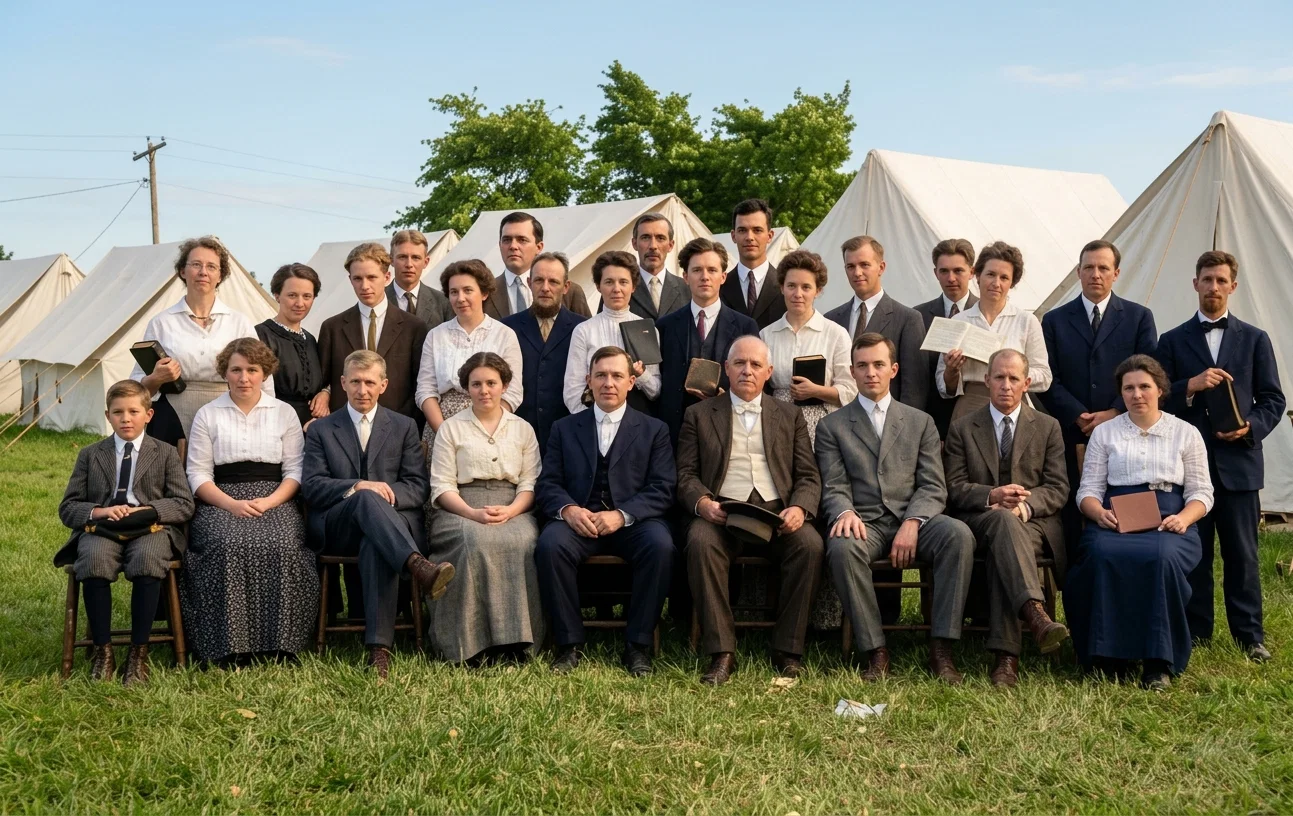
THE accompanying illustration shows a number of the colporteurs in the New York Conference.
COLPORTEURS IN THE NEW YORK CONFERENCE
It was a meeting long to be remembered when eighteen of these colporteurs sat on the rostrum at the camp meeting held at Utica, N. Y., and told how the Lord had led and blessed them in his service.
On the extreme left is the youngest of these workers, Harold Stevens, son of Elder J. C. Stevens, of Syracuse. He expects to earn a scholarship to the South Lancaster Academy, as do some of the others in this picture.
The colporteur work is onward in this conference, under the leadership of Brother E. E. Covey, the field agent, and many will surely hear and obey the message brought to them by these self-sacrificing workers. C. J. TOLF.