[All questions to this department will be answered which to the editors will seem to minister to the good of the readers and to the mission of the paper. The same question can not be answered repeatedly in the same volume. The name and address must accompany question, not for publication, but as an evidence of good faith, and that answer may be made by letter if deemed advisable. It is well always to enclose a stamp for reply.]
2290.—The Matter of Tithe.
When I owe debts and I do not make enough to pay them, how much tithe would I be in duty bound to pay? Should I pay a tithe on what I make or a tenth of what I clear?
A SUBSCRIBER.
It is a tenth of the income, of what the individual makes; that is, if only the man himself is concerned. It is a tenth of what he receives. If he has others connected with him in the work, of course he pays them first. They are supposed to tithe what they receive. For instance, here is a man who owes a debt of $3,000. He conducts a farm from which he receives $2,000. He hires help to the extent of $500, and pays interest, $150. His own work is the $2,000 minus the $650. He deducts that $150 of interest as representing a part of the farm which he does not own, which the man who receives the interest should pay tithe upon. He deducts what he pays for labor, which the man who labors should pay tithe upon, and he pays tithe upon the rest. If he owes twice that amount, that does not affect the matter at all. The tithe is not his; it belongs to God; and one who will truly relate himself to God, who will truly become a steward for God, will find, as thousands have found, that the nine-tenths will go farther with God's blessing than the ten-tenths will without. The Lord will help a man who will truly be a steward for Him so to plan his debts and obligations and so to economize in time and means, that he will be better able to meet his obligations in paying tithes than in retaining them. The law of tithing is found in Leviticus, chapter 27. See also Mal. 3:10.
2295—
2293.—Laying on of Hands.
Please explain the passage in Acts 19:6, and others which speak of laying on of hands. It seems to me plain in these passages that this ordinance is right in the church. H. A. B.
Certainly, we know of nothing against it. There were times when the Spirit of God was given to His believing children thru the laying on of hands. That seems to have been the case in the setting apart of men to special service, as in the case of the deacons, and that has been followed in the Christian church to the present time. There were times also when the Spirit of God came upon persons without the laying on of hands. It would seem that the Lord is willing to give it with or without that, as, for instance, Acts 10:44-47. How much and how fully it should be practised must be determined by the Spirit of God and the light that is given to men in His word. We certainly have instances of the Lord's pouring out His Spirit without it; we also have instances of where the Spirit of God moved upon His servants to impart the Spirit thru the laying on of hands, and in the matter of ordination of His ministers and special workers that seems to have been the regular course taken.
2289.—The Mediator of the New Covenant.
Please explain Heb. 8:6, 7. A Disciple minister claims that the Ten Commandments were destroyed or annulled, nailed to the cross, and we only have to keep those mentioned in the New Testament, and that the fourth is not mentioned. He also refers to Heb. 10:9; Rom. 6:14; 7:1-4; Gal. 3:23-29; Col. 2:13-17, etc., etc. W. E. P.
All these scriptures and others will be troublesome to us until we can settle upon the great principle of God's government; first, that God is all-perfect, all-wise, omniscient; that because of this He is unchangeable; that His government is always the same, His moral requirements are always the same, under all circumstances, in all ages, through His dominion; that His requirements in one age for the development of character are just the same as in all other ages; that He is no respecter of persons; and that Jesus Christ is simply God's manifestation of love to bring men back to the great and wonderful unity that there is in God.
Because of man's sin, God has given certain object-lessons through all the ages, and these object-lessons have changed as human circumstances have changed, but the one purpose of the object-lessons has always been to bring man back to God. In Abel's day it was the simple sacrifice of the lamb upon the altar. In Israel's day these object-lessons were made fuller and more complex in all the great symbols and types, offerings and sacrifices, imposed on them until the time of the reformation. Heb. 9:9-11. There were necessarily laws regulating these types and offerings which all pointed forward to Jesus Christ. When He came, the type reached the antitype, the symbol the thing symbolized, the lamb and the kid vanished before the Lamb of God that taketh away the sin of the world; the shadow reached the substance, and all those laws and ceremonies by virtue of that very fact expired by limitation and were nailed to the cross. But God's Sabbath existed before sin ever entered, or before type or symbol was ever made.
God's Decalogue, written on tables of stone, was eternal, and it would be a perversion of language to speak of tables of stone being nailed to the cross.
Jesus Christ did not come to give a new law or set forth a new plan. He declared, "I and the Father are one." John 10:30. He came to bring men back to God, as expressed by Paul, "God was in Christ reconciling the world unto Himself." He Himself had not changed, the sinful world had changed, and sin is the transgression of the law. The old covenant, resting on men's promises, could not enable man to keep the law, but Jesus Christ, the very personification of all the Ten Commandments, the one perfect Sabbath-keeper, in men's hearts, could enable them to observe God's law. Christ takes away all the self-righteousness of sin and establishes in the heart the obedience of faith. All Scripture is in perfect harmony with this. The Scriptures are full of absurdities and contradictions and confusion looked at from every other standpoint. God becomes a changeable being, one no longer to be trusted, and His government is a matter of the whim of the sinful subject and not the great perfect order of divine procedure.
"But one in a certain place testified, saying, What is man, that Thou art mindful of him? or the son of man, that Thou visitest him?" Who spoke the words there found? To whom did he speak them, and what is meant by "the son of man"?
W. B. W.
You will see by the marginal reference that the words are found in the eighth Psalm. The words were spoken there by David. They are found in that Psalm which was designed to be sung by every one. They express David's language to the Lord, "What is man, that Thou [God] art mindful of him? and the son of man [that is, himself evidently, and so every one], that Thou visitest him?" The writer of Hebrews applies it not only to man in general, but to the One who became the Son of Man, Jesus Christ.
It depends on what is meant by this question. Does our inquirer mean, Do they fast as the Lord indicated, or as the Lord tells us that they should fast? Presumably those who fast, fast as the Lord has instructed, as do Christians of other denominations. We have known of many who fast, but they wash their faces and comb their hair the same as usual, making no public show of it.
2294.—Tree of Knowledge of Good and Evil
Was the tree of knowledge of good and evil good for food? H. A. B.
It is said of the Garden of Eden that “out of the ground made the Lord God to grow every tree that is pleasant to the sight, and good for food; the tree of life also in the midst of the garden, and the tree of knowledge of good and evil.” We know no reason why it was not good for food, and yet the Lord reserved that for Himself. There seems to have been placed in that tree that which would enable man to discern between the good and evil, or which would quicken his senses in some way so that he could perceive the more clearly; yet it was God’s plan that man was to learn that by simple faith in his Creator. Therefore God reserved that tree unto Himself. Man must not touch it. When man did touch it, did partake of it, he broke the relationship between himself and his Creator. The evil which followed was not the result of the fruit, but the result of man’s rejecting the command of his God and breaking His law. It would seem that there would come a time when that prohibition would have been lifted, when man had developed right character by simple faith.
2295.—Unclean Meats.
Please explain Lev. 11:21, 22. The Bible says that the swine is unclean; it tells also of other beasts that shall not be eaten, and of others that are good to eat, like the locust. Now if we obey by not eating swine, should we not obey by eating the things spoken of? C. E. O.
If you will read again the scripture over which you ask the questions, you will see that the instruction is not mandatory, that is, it is not a command, that thou shalt eat of this, or that, or the other thing, but it is permissive; “these may ye eat of every flying creeping thing.” Man need not eat anything mentioned in that chapter. There are certain things which he should not eat because in their very nature they are unclean, unwholesome, unfit for food. There are certain other things that are permitted to be eaten and which as food are wholesome, of which it is said John the Baptist ate, and of which many of the poor natives of the Eastern lands eat to-day. They are not the best foods by any means, but they do not seem to be unwholesome foods. The best food is not animal food of any kind, but that which God gave man originally. Vegetarianism may be called a fad, may be said to be an unbalanced diet, but there are thousands who have found health in following it when their digestions have simply been ruined by mixed and flesh diets; and there are thousands of others who have maintained and are maintaining good health, under the hardest kind of work, who are vegetarians. By this we mean fruits, grains, and vegetables. God’s ideal diet when He brought His people out of Egypt was manna, not an animal food; but His people cried for the flesh-pots of Egypt; therefore the instruction which He gave in regard to the wholesomeness and unwholesomeness of flesh foods.
Can you tell me what prophet it was that said Jesus would be called a Nazarene, as stated in Matt. 2:23?
There is no record which states this in so many words. It is true, however, that there have been writings of prophets which have not come down to us. We read in different parts of the Old Testament of the writings of this one and that one, but which in the lapse of ages have been destroyed. Presumably a very small part of what has been written to God's children has come down to us. Others, however, have seen a reference to this in Zech. 6:12, "Behold the Man whose name is the Branch." Nazarene comes from nazor, a branch, and the reference in Matthew is supposed to be to Zech. 6:12. This is the best light that has yet been thrown upon the passage.
The Gospel and Its Power.
THE word of God is the Gospel which was preached by the apostles and early Christians. It knew naught of any of the subtle philosophies of the schoolmen, none of the interpretation of creeds, none of the traditions of men, none of the errors of paganism. It presented God's law as the great moral mirror which revealed sin. It pointed to the history of the past as the record, not of human devices and victories, but of God's ruling and overruling providences, despite human plotting and ambition. It predicted by the inspiration of the Infinite wisdom the fall and rise of kingdoms, empires, nations, and the ultimate triumph of Christ over all sin, even as He was the mighty Creator who brought all things into existence. And above all, it presented the love of God to a rebellious world, manifest in the Lord Jesus Christ,—God with us,—who took upon Him man's nature, who lived our Example, died our Sacrifice, and now lives, a pitiful, all-sufficient High Priest, a mighty Redeemer, a present Helper, one able to save to the uttermost all who would come to Him. This was the Gospel preached by the early church.
BEFORE that Gospel,—the simple facts of the Bible,—sent home by the Spirit of Christ, Jewish traditions were swept away like cobwebs, pagan gods crumbled into dust, pagan shrines melted away, and by the love and mercy of God in it, pagan hearts were won and transformed from sin to righteousness. The life in that word, the life of God from above, regenerated men. It changed the heart. It found them in sin and sinning; it saved them from sin and sinning. The disobedient to God's law were made obedient; and the law which condemned in every particular became a blessed witness to the perfection of the righteousness placed upon and wrought within the character and life of every one who accepted by faith Jesus Christ as the Saviour. Rom. 3 : 21, 22.
Signs of the Times.
“But as we were allowed of God to be put in trust with the Gospel, even so we speak; not as pleasing men, but God, which trieth our hearts.”
"O Give Thanks unto Jehovah"
It is good to give thanks to God; for he that offereth praise glorifieth God. It is good to have a day of thanksgiving, when together God's people can meet to recount His praises and blessings. It is good that that day should come when the harvests and fruits of the year are gathered, and the blessings of God are more manifest tho not more real than at other seasons. For all the fruitage of autumn is but the ingathering of the year—the frost and snow of winter, the rain and seeding of spring, and the warmth and fulness of summer.
Not the best of crops in all things has the year given us. Many apple barrels will be empty, and potato bins will run low. But notwithstanding the failure of a few crops and the partial failure of others, still in this great, prolific country there is plenty for all at home and much to be spared for the devouring millions of earth's lands beyond the seas. For all this we should thank God.
Thank God for liberty of conscience, liberty to worship God as His word and conscience dictate, with none to molest, none to hinder, none to overawe the timid or stir the resolute and determined. And yet these conditions are not absolute. While many of us have known or seen nothing of intolerance or religious tyranny in our own experience, yet in several places in this broad land Christians have suffered and are suffering fine and imprisonment for working and resting as did their Master. Such things ought to stir the very soul of every true American. Yet we thank God for the freedom there is; thank Him that there are still those in legislative halls who throw their influence against every measure which fetters conscience or circumscribes Christian liberty.
Thank God that despite the corrupting influences of immense predatory wealth and colossal law-breaking combinations, there are still those whose acts are open and honest as the day, who are God's salt in the seething corruption.
Thank God for every victory true temperance has gained during the year in staying the awful tide of drunkenness and its ever-constant attendants—vice and crime and poverty and misery.
Thank God that notwithstanding the infidelity manifest in religious circles, there are still voices of faithful watchmen crying His warnings, preaching His word, proclaiming His Gospel of grace as the only power to save.
Thank God that He has given us that great panacea for all earth's ills—the everlasting Good Tidings, clear, pure, and strong-laden with the life and love of God.
Thank God for the light of His word, and especially His prophetic word which gives us light in the midst of the gloom and uncertainty of this world.
Thank God that beyond all the misrule, corruption, and tyranny of earth He is coming again, coming to reward justly and to reign righteously over all the earth.
Thank God that His Gospel has lost none of its recreative, regenerating power. Notwithstanding all the hypothesis of evolution, the aberrations of Christian Science or New Thought, that Gospel is still the power of God unto salvation to every one who believes. It can make of the drunkard a sober man; of the liar, a truth-teller; of the covetous and stingy man, one generous and charitable; of the hater of men, a lover of men; of the dissolute and idle, the diligent and industrious; of the vicious, the virtuous; of the sinner, a saint. There is hope for the despairing, strength for the weak, courage for the fearful, salvation for the lost.
For all these and many other blessings in home and public life, for the great, common, every-day-and-hour blessings, we "give thanks unto Jehovah; . . . for His loving-kindness endureth forever."
But let not our thanksgiving be for an hour in a day or for one day in a year. Rather let it be day by day, hour by hour. The pouring out of thanks to God will enlarge the heart and make it an inviting channel for greater blessings. Let us show how grateful we are to God by rendering to others who are needy and despairing.
"That man may last, but never lives
Who much receives, but nothing gives;
Whom none may love, whom none can thank,
Creation's blot, creation's blank!
"But he who marks, from day to day,
In generous acts his radiant way,
Treads the same path his Saviour trod,
The path to glory and to God."
"O give thanks unto Jehovah; for He is good;
For His loving-kindness endureth forever."
"It is a good thing to give thanks unto Jehovah,
And to sing praises unto Thy name, O Most High;
To show forth Thy loving-kindness in the morning,
And Thy faithfulness every night."
"O give thanks unto Jehovah, call upon His name;
Make known among the peoples His doings.
Sing unto Him, sing praises unto Him;
Talk ye of all His marvelous works.
Glory ye in His holy name:
Let the heart of them rejoice that seek Jehovah.
Seek ye Jehovah and His strength;
Seek His face evermore."
"Blessed be Jehovah, the God of Israel,
From everlasting even to everlasting.
And let all the people say, Amen.
Praise ye Jehovah."
Studies in Prophecy
The Lesson of History.
AUTHENTIC history is not to the Christian student a mere enumeration of dead facts. It is not a mere record of the struggles and changes, the defeats and triumphs, the gains and losses of men and nations. If we see only one or all of these in the history of men and nations, our view is indeed limited and we have failed to learn its lesson.
In a strange land, fraught with dangers and difficulties seen and unseen, filled with numerous foes, who lurk in ambush and lay hidden snares for our feet, it is wise now and then to ascend some high hill, to climb to the top of some lofty and commanding eminence, whence we may review the ground already traversed, and behold as best we can the perils and pitfalls, the dangers and difficulties, which await us in the future. If to be forewarned is not wholly to be forearmed, it is a necessary step to that end; for he will make no preparation to meet perils or difficulties who believes that there is no danger.
History is one of the lofty eminences from which we may view the past, but not in its own light. For he who studies history from any other view-point than that of the divine, misses the great lesson which history teaches.
God's invitation to Moses is applicable here: "Come up to Me into the mount, and be there;" or to Ezekiel: "In the visions of God brought He me, . . . and set me down upon a very high mountain, . . . and the Man said unto me, Son of man, behold with thine eyes, and hear with thine ears, and set thine heart upon all that I shall show thee; for to the intent that I might show them unto thee art thou brought hither; declare all that thou seest;" or to Isaiah: "O thou that tellest good tidings to Zion, get thee up into the high mountain."
He who would rightly judge the past, understand the present, or discern the future, needs, like the prophet of old, to get up into the high mountain, to the "top of the rocks" "of Pisgah" and "of Peor," if he would see the Israel of God; if he would know God's purpose in calling them out; if he would understand their victories over opposing powers, and their latter glory under King Immanuel. He must see in the vision, or seeing, of God. To God's outlook of vision, to His seeings, these studies invite the reader. The watch-tower—the mountain—is the sublime heights of the prophecy of God—history in advance—written by the pen of Inspiration as kenned by prophet and seer.
God in History.
God is in history, whether His name be named or not. Tracing it thru the ages with that thought dominant, chaos becomes cosmos, confusion becomes order. The indefinable to human wisdom may be seen to have been ordered of God; while despite all the machinations of men and the efforts of hostile powers, the divine Master works to the one great end,—the establishment of the kingdom of righteousness, and the gathering out from the wickedness of a corrupted world all those who in Him are worthy to inhabit that kingdom forever. "The Most High ruleth in the kingdom of men."
In thus reading history, the clear-sighted student may see, often repeated, God gathering from seeming defeat, utter ruin, and nothingness, the most glorious victories, the grandest structures, and the mightiest impulses, forces, and movements earth has ever known.
Two Great Witnesses.
The great theme of these studies is God revealed in history and prophecy. In the prophecy He reveals in word and symbol Himself and the future, which He works out despite of sin. In history is the same word and symbol developed in deed and monument, in man and nation, in movements and changes, and in some form or way ever revealing the working of God.
Prophecy and History are two agreeing witnesses which God gives to the truthfulness of His word—two witnesses between which there can have been or can be no collusion. The former is written oftentimes long before with the pen of Inspiration: "Declaring the end from the beginning, and from ancient times the things that are not yet done, saying, My counsel shall stand, and I will do all My pleasure." Isa. 46:10. The latter—History—worked out despite the sin, the corruptions, the efforts of Satan thru the overruling of God, writes again in after years, centuries, ages, the things which Prophecy recorded.
Concerning God's purposes among the children of men, His word declares: "Surely the Lord God will do nothing, but He revealeth His secret unto His servants the prophets." Amos 3:7. Concerning what He thus reveals thru His prophets, His apostle Peter declares: "We have also a more sure word of prophecy; whereunto ye do well that ye take heed, as unto a light that shineth in a dark place, until the day dawn, and the day-star arise in your hearts. . . . For the prophecy came not in old time by the will of man; but holy men of God spake as they were moved by the Holy Ghost." 2 Peter 1:19-21.
We are now in the long, dark night of sin. Many lights are gleaming, but few, indeed, mark the pathway of life. Many are but the combustion of the noxious gases rising from the miasma of pestilential morasses which lead the hapless wanderer into sloughs of despond, where they leave him in total darkness to perish. Myriads are now wandering in the mazes of doubt, skepticism, error, and political uncertainties. Blessed be God that He has given us the sure, clear light, that shines in the darkness, and illuminates the path of the just even to the end.
With these divine assurances, dear reader, may we not in humility, ever by faith asking God to grant us the guidance of that Spirit who inspired the prophecy, undertake its study with the assurance that we shall there find God revealed—a Teacher, a Guide, a Helper, a Saviour, and an everlasting King?
W.
Christianity a Warfare.
HE who would be most like Christ must pay the cost. If a furnace is needed to purify and brighten you, do not shirk the furnace. Patience is an admirable grace; but it is not oftenest worn by those who walk on the sunny side of the street in silver slippers. It is usually the product of headwinds and hard fights, of crosses carried and of steep hills climbed on the road to life. "The trial of your faith worketh patience." So it is with all the noblest traits of a robust, healthy, and symmetrical character. No man is rocked into godliness in a hammock. Christ offers you no free ride to the kingdom in a cushioned parlor-car. John Bunyan sent his sturdy "pilgrim" to the Celestial City on foot; and some pretty rough walking and hard conflicts did he encounter before the pearly portals welcomed him to the streets of flashing gold. His piety was self-denying, stalwart, and uncompromising; he relished even the stiff severities of duty, and was never coddled with confectioneries. Self-indulgence is the besetting sin of the times; but if you long to be a strong, athletic Christian, you must count the cost. It will cost you the cutting up of some old favorite sins by the roots, and cutting loose from some entangling alliances, and some sharp set-tos with the tempter; it will cost you the submitting of your will to the will of Christ.—Dr. T. L. Cuyler.
Humility Is the Road to Greatness
One of the chief objects of man is to make for himself a name—a reputation. But when Christ became a man, He "made Himself of no reputation, and took upon Him the form of a servant." The word says to the Christian, "Let this mind be in you, which was also in Christ Jesus." As our Example, "He humbled Himself," and what was the result?—"Wherefore God also hath highly exalted Him, and given Him a name which is above every name." So all who follow Him in humble obedience to the commandments of God will inherit eternal life and a part in the honors attaching to His name. Then humility of heart and life is the sure road to a truly great name.
The Change Christ Brings
“When one takes Christ into his life, a change takes place. There is a change in his desires, in his thoughts, in his convictions, in his affections, in his principles, in his aims, in his hopes, and in his influence over others.” “Therefore if any man be in Christ, he is a new creature; old things are passed away; behold, all things are become new.” 2 Cor. 5:17.
IN our studies last week the first fifteen verses of the first chapter were considered. The next statements of the chapter are the following:
"For I am not ashamed of the Gospel: for it is the power of God unto salvation to every one that believeth; to the Jew first, and also to the Greek. For therein is revealed a righteousness of God from faith unto faith: as it is written, But the righteous shall live by faith." Rom. 1:16, 17. A.R.V.
The apostle makes a clear statement of what the Gospel is. In the first place he tells us that the Gospel is the power of God. It is not that there is a power concealed somewhere in the Gospel; but the Gospel itself is power. And not only so, but it is the actual power of the all-powerful Father in heaven.
This is the Gospel which Paul tells us in the first verse that he was "separated unto;" this is the Gospel to proclaim which he gave himself a "servant to Jesus Christ"—literally, as in the margin, a "bond-servant"—but it is the bond-service that has no slavery in it, it is the greatest freedom of all the universe. This Gospel, as in verse four, is concerning Him who "was declared to be the Son of God with power, according to the Spirit of holiness, by the resurrection from the dead."
Our Lord and Saviour Jesus Christ was declared to be the Son of God with power, even the power of the resurrection from the dead. Jesus arose from the dead, and the mighty power that thus declared Him to be the Son of God is the power that Paul tells us is the Gospel. These are wonderful facts. They are soul-stirring, and fill one with strength and hope and courage. The power thus manifested is strikingly shown in the following verses:
"God, having of old time spoken unto the fathers in the prophets by divers portions and in divers manners, hath at the end of these days spoken unto us in His Son, whom He appointed heir of all things, thru whom also He made the worlds; who being the effulgence of His glory, and the very image of His substance, and upholding all things by the word of His power, when He had made purification of sins, sat down on the right hand of the Majesty on high." Heb. 1:1-3. A.R.V.
The power, according to the foregoing verses, that is exercised by the Son of God is the same power that was exercised in the creation of the "worlds," and is still exercised in "upholding all things by the word of His power." God, thru Christ His Son, launched the worlds in space, and there they ever move in their majestic orbits, with an infinite precision and at the expenditure of infinite power. The finite mind may think of the great power required to do this great work, but it is impossible for man to comprehend it.
This is the power, however, that was exercised in declaring our Saviour to be the Son of God by His resurrection from the dead. That power has fixed the fact of the divinity of Christ in the minds of millions. That power has kept a knowledge of Christ before the world all thru the ages. That power has enabled Christ to hold His rightful place in the minds of men in the face of the most torturing and relentless persecutions, and amidst the deepest and grossest darkness and ensnaring delusions and superstitions.
False religions have wielded great influence for a time in limited sections of the world; but they have not inspired men to unceasing efforts in carrying them to the ends of the earth. Not so with those who have in their minds and hearts a personal knowledge and acquaintance with the Son of God. The true Christian receives the Spirit of his Master and he can not rest, he must carry the benefits of what he knows for himself to every one he can reach.
And so He who was declared to be the Son of God with power has wielded His mighty influence in the minds of men all thru the ages. This power in the Son of God has even withstood the storms of ridicule and abuse of unbelievers who have hurled their sarcasm and satire against the Gospel because of the hypocrisies and the superstitions that millions of misguided and deluded souls have held in the name of Christ. The power is infinite, and it triumphs over every obstacle and sweeps on with the same majestic movement that characterizes the planets in their measureless orbits.
And this power is the Gospel. Observe further that "it is the power of God unto salvation to every one that believeth." The Gospel is power unto salvation to those who do believe, whether we believe it or not. It goes right on saving them. And the Gospel is so kind and impartial that those who may have been indifferent to it, or who may even have doubted and fought it, are immediately saved by it as soon as they cease their rebellion and turn to the Lord.
This saving power of the Gospel brings salvation because in it "is revealed a righteousness of God from faith unto faith." The Gospel is so perfect that it does not leave man to work up or manufacture a righteousness of his own, but it gives him the very righteousness of God Himself. The individual that accepts the Gospel as it is in Christ Jesus has a power for right-doing imparted6to him that is absolutely unobtainable in any other way. And this imputed and imparted righteousness is caused by the same power of God to cover the past as well as to act in the present. But this phase of the subject is more fully considered later on in Paul's Roman letter, so it will not be considered further in this article.
Returning to the subject of the power of the Gospel, we find some very precious promises. Said the Master as He was about to ascend to His Father at the close of His earthly ministry:
"But ye shall receive power, when the Holy Spirit is come upon you: and ye shall be My witnesses both in Jerusalem, and in all Judea and Samaria, and unto the uttermost part of the earth." Acts 1:8.
In a preceding verse the "promise" of the Holy Spirit is mentioned as follows:
"Being assembled together with them, He charged them not to depart from Jerusalem, but to wait for the promise of the Father, which, said He, ye heard from Me: for John indeed baptized with water; but ye shall be baptized in the Holy Spirit not many days hence." Acts 1:4, 5.
An individual may hold the Gospel as a theory and thus make a profession of Christianity. But he who yields himself completely to God has the promise of the Holy Spirit, and the Spirit brings the power of the Gospel into the life. And with this power in the life, Christian duty is no longer an irksome task. It is this power that sustains the true Christian in the face of every trial and every difficulty. It is this power that enables him to give up home and friends in his native land and endure the hardships and the privations that are incident to the missionary in foreign heathen lands. It is this mighty power that enables men to do in so many ways and under so many conditions the seemingly impossible.
O that every one who has taken the name of Christ would so yield to Him that they may have the baptism into the Holy Spirit and thus be clothed with the mighty power of the Gospel.
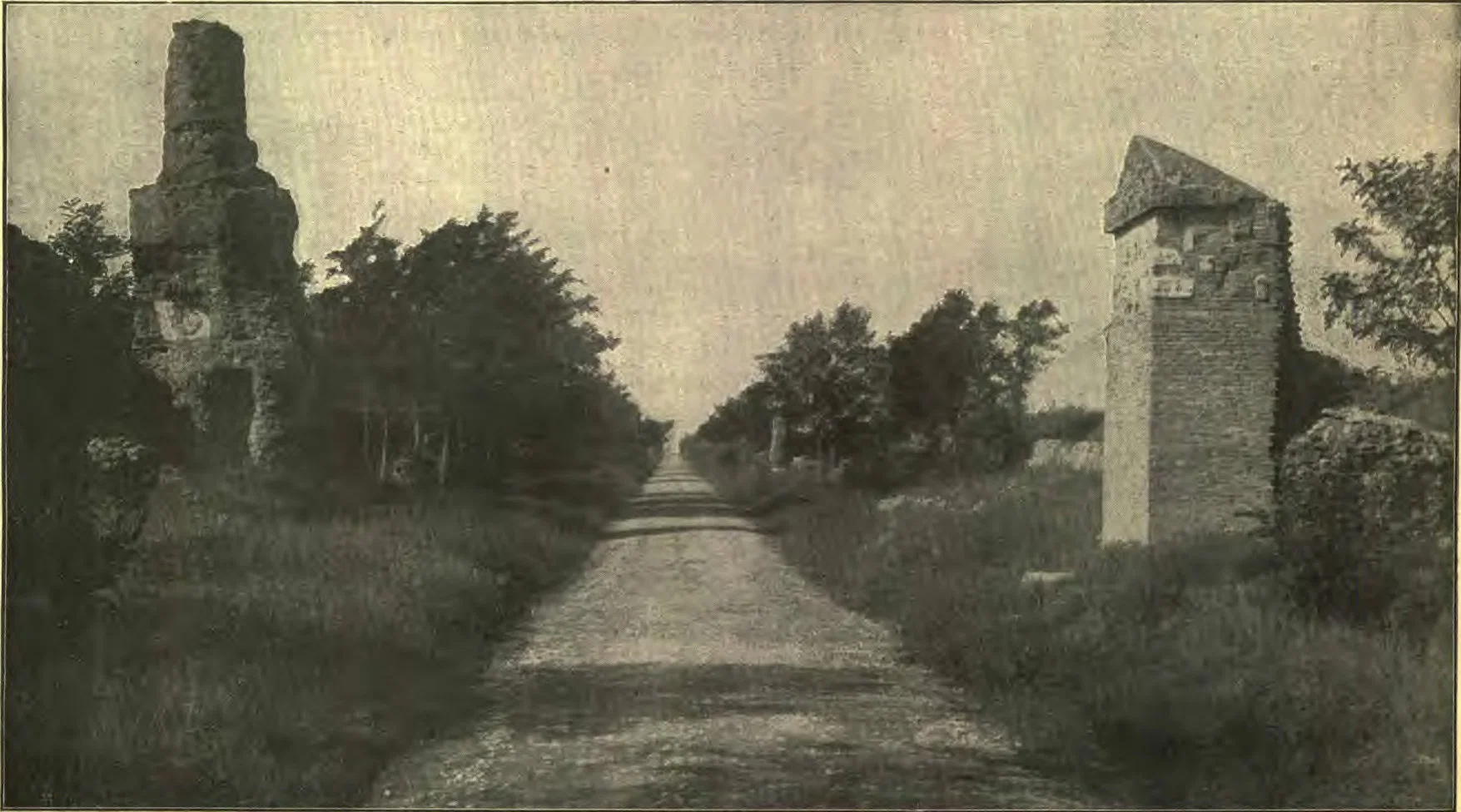
The Appian Way, near Rome, where Paul met friends and "thanked God, and took courage." Acts 28:15.