Signs of the Times, Vol. 34, No. 16.

With Our Inquirers

Signs of the Times

Pacific Press Publishing Association

With Our Inquirers

“If ye will inquire, inquire ye.”
[All questions to this department will be answered which to the editors will seem to minister to the good of the readers and to the mission of the paper. The same question can not be answered repeatedly in the same volume. The name and address must accompany question, not for publication, but as an evidence of good faith, and that answer may be made by letter if deemed advisable. It is well always to enclose a stamp for reply.]

2462.—Hardening Pharaoh’s Heart.

Will you kindly explain the following:
“And the Lord hardened the heart of Pharaoh,” as in Ex. 9:12?
If our inquirer had read the notes on the Bible Band in the SIGNS of January 15 and 22, she would have found suggestions that would help her on the expression, “hardening Pharaoh’s heart.” Right in this connection we would like to advise all our Bible students, who are able, to secure a copy of the American Standard Revised Version, published by Thomas Nelson & Sons, New York. It is the invariable experience that those who study it and read it are more and more attached to it. Its renderings are much more uniform and very often clearer. In the Lord’s dealings with Pharaoh we have first the prophecy in Ex. 4:21, “I will harden his heart, and he will not let the people go.” The prophecy is again given in chapter 7:3, “I will harden Pharaoh’s heart, and multiply My signs and My wonders in the land of Egypt.” The fulfilment of this is given in chapter 9:12; 10:1, 20, 27; 14:4. The Lord softens men’s hearts by sending His Holy Spirit; He hardens men’s hearts by the very opposite of this, withdrawing His Spirit. The Lord did not arbitrarily harden Pharaoh’s heart; really Pharaoh had shown himself to be stubborn, self-willed, and obstinate; so the Lord could do nothing else except to withdraw His Spirit from him, and thus, and thus only, the Lord hardened his heart. From the time the last prediction is given, in chapter 7:3, to chapter 9:12, we have the expression used over and over, “Pharaoh’s heart was hardened” (7:13); “Pharaoh’s heart is stubborn” (7:14); “Pharaoh’s heart was hardened” (7:22); “When Pharaoh saw that there was respite, he hardened his heart” (8:15), etc. It was Pharaoh’s own resistance of the Spirit of God that hardened his heart, and when at last the Lord left him entirely, of course his case was hopeless.

2463.—This Generation. Matt. 24:34.

Will you please explain Matt. 24:34?
If you will read from verse 29, you will see that the Lord is speaking of the last days and His second coming, and the signs that shall precede His second coming. Verses 32 and 33 enforce these teachings by a parable of the fig-tree, that when it puts forth leaves, we may know that summer is near; and so when all these various signs which Jesus mentioned are coming to pass, we may know that He is near. And then He affirms that by declaring that the generation which sees these things, in which these signs are preached, shall not pass till all things be accomplished; or in other words, till Christ comes. That generation is parallel with the great Threefold Message of Rev. 14:6-14. The Lord knew that when the time came that His coming was at hand that all the various signs which He had given in His word would be preached, not only those mentioned in Matthew 24, Mark 13, Luke 21, but all the other various signs mentioned elsewhere, signs which culminate in this generation which go with the last great Threefold Message, and the generation which sees these things fulfilled and fulfilling would not pass until Christ came.

2464.—Eating Oysters.

Are oysters wholesome as a diet? Some doctors advocate their use. Are they good to eat?
When the Lord distinguished between clean and unclean creatures for food for His people, He laid down no arbitrary distinction; rather the distinctions made existed in the very nature of the beasts themselves. For instance, the swine is not to be regarded as unfit for food simply because the Lord said so, but the Lord said so because the swine in the very nature of the case is unfit for food. So it is in regard to everything else that is forbidden in the eleventh chapter of Leviticus. Among these are various kinds of shell-fish. Whatsoever had fins and scales in the water He permitted His people to use, but He tells us that of all the living creatures that are in the water that have not fins and scales “they shall be an abomination unto you; they shall be even an abomination unto you; ye shall not eat of their flesh, but ye shall have their carcasses in abomination. Whatsoever hath no fins nor scales in the waters, that shall be an abomination unto you.” When the Lord calls it an “abomination” four times, it would seem that that ought to settle it for those who have faith in the bill of fare which He gave His people anciently. It is a noted fact that the oyster is a scavenger of the sea, and this has been demonstrated again and again, so that decided steps have been taken in some localities against the use of oysters from the mouths of great rivers or bays into which the sewage of cities is emptied. There have been not a few cases of fatal ptomaine poisoning from the use of oysters. There may have been many cases of poisoning which were not fatal, and which were so mild outwardly as not to be noted at all, laid, perhaps, to some fruit that was eaten in connection with the oysters. There are those who like them, and who will eat them; but God has given us so many things infinitely better that we do not know why people should want to use the bivalve scavenger of the sea.

2465.—Tempted and Tried. Gen. 22:1.

Why did God tempt Abraham when Abraham was doing God’s will? Gen. 22:1.
Here again the Revised Version gives the better sense, “And it came to pass after these things, that God did prove Abraham.” Abraham’s faith must be tested. He did not meet the first test when the Lord made the promise that his seed should be a blessing to the world. Abraham said, “It must be thru Eliezer, my steward.” In the second test Abraham thought that it must be by some device of his, thru Hagar his bond-servant; so he failed again. The next test was met, and Isaac was born. And now the Lord proved him again; not that God might see whether his faith was genuine or not, but that even Abraham himself might be blessed in the proving. God does not tempt to evil; James tells us that very decidedly; but He does prove His children, and this was to prove Abraham, in order that his faith might be more precious, he himself made strong.

2466.—B. B. No. 1174.—Deut. 14:21.

It seems to us that the text is very clear, “Ye shall not eat of anything that dieth of itself.” A thing that dies of itself retains the blood within it, the germs of disease, and the poisons, and God would not have His people eat it. And yet there were people around them on every side who did eat of just such things as that. They felt that it was perfectly proper to eat of such things. God’s people did not injure them in any way in giving them such flesh; it was in nowise deceiving them. Or it could be sold to the foreigner in the same way. The foreigner saw nothing wrong in it, had no conscientious scruples against it; it was food, and therefore could be sold to them for food. But Israel themselves must not eat of it. The last clause of the verse, “Thou shalt not seethe the kid in his mother’s milk,” is, some authorities tell us, based on a common usage of boiling a kid in its mother’s milk when the crops were gathered in, and sprinkling with the milk the fruit-trees, fields, and gardens, as a charm to insure the crop of the coming year. Against this use of charms and superstition God warned His people; it is a prohibition of the practise of magic. There are other explanations, one of which classes the prohibition with Lev. 22:28 and Deut. 22:6, that the cow and her calf or a ewe and her lamb shall not be slaughtered the same day, nor should a bird be taken with the young in her nest; this were unnecessary cruelty.

2467.—Theosophy.

Will you please explain what Theosophy is?
The word “theosophy” comes from two words: Theos, God, and sophos, wise; meaning God-Wisdom. Theosophy, like other cults and religions outside of the Bible, makes these essentials inherent in man, man himself is possessed of this God-Wisdom. In the ultimate, Theosophy, like Christian Science, Buddhism, etc., is self-salvation, salvation within the man, by good works or inner contemplation, and thru successive incarnations, etc., etc. The only salvation that there is for poor, lost humanity is to be found in Christ Jesus; not a salvation that comes from within, but which comes from above within, and is given in response to faith.

2468.—The Tenth of Isa. 6:13.

Kindly explain Isa. 6:13. Can this tenth in any way refer to the tithe?
Of course a tenth is a tithe, that is what tithe means, a tenth; but this does not refer to a tithe which the Lord asks of men. The subject in question is the depopulation of the land on account of sin. Cities will be made waste, without houses, as without men, the land to become waste, forsaken generally, and yet if there should be even so much as a tenth left, even that would be destroyed. In other words the land would become utterly desolate.

2469.—The Dressing of the Hair.

We find no rule in 1 Corinthians 11 as to just how women should wear their hair now, at least the writer sees none there. Idolatrous women and foolish women and low women had their manner of dressing in those days, even as now. The heathen priestesses had their customs. The Lord told His handmaids how they should dress so as not to be confounded with those who were idolaters and were disorderly. The lesson which we may gain from it, and which we at the present time should heed, is that the dress of the Christian women, and men, too, should be simple, modest, commendable, befitting.

2470.—A. E. E.—The Wise Men.

The true term for the wise men in the original Greek is “Magi.” See Matt. 2:1, A.R.V. Why they are spoken of as three is simply traditional. Tradition has come down to us that they were three kings belonging to the ancient Magi. For this there is no Scripture or evidence whatsoever save the tradition. They evidently belong to the ancient Magi, or cult of magicians, the center of which was in Babylon and Persia. They learned of Christ’s coming perhaps by the prophecies of Balaam and Daniel.

2471.—B. B. No. 698.—Regarding Lev. 19:23, “Ye shall count the fruit thereof as uncircumcised.”

It refers to the first three years of fruit-bearing trees. Just the same as the nations who dwelt in the land were sinful and God destroyed them because of their evil sinfulness, even so the very fruit which the land first bore was to be counted by the people. You will notice all thru the books of Moses that it was the Lord’s endeavor to impress upon Israel the holiness of His worship and service.

2472.—The Sermon on the Mount.

Really, it would seem to us as tho our questioner could find but one answer to the query, “Was Christ’s Sermon on the Mount a Gospel sermon?” Jesus Christ preached nothing but the Gospel; God’s word brings nothing to us but the Gospel; all the promises and commands and blessings in it are of the Gospel.

That Marvelous Transmigration

By Emma Hildreth Adams
R EADER, you are eighty years of age perhaps. You have destroyed neither your brain nor your stomach by long use of whisky, tobacco, tea, or coffee. You have not shortened your days by dark, iniquitous living. On your long journey you have not overtaken that mysterious being named "Second Childhood." You have had opportunity, suitable and multiplied, for forming opinions of matters, decisions on questions, judgments of happenings and events.
Therefore, we ask you to look into the subject which forms the heading of this brief paper, and decide if you have ever seen or known or read of a transmigration so marvelous, so worthy of your most thoughtful attention, so freighted with loftiest instruction, so laden with high reward for your effort, so stirring in mind, heart, and soul.
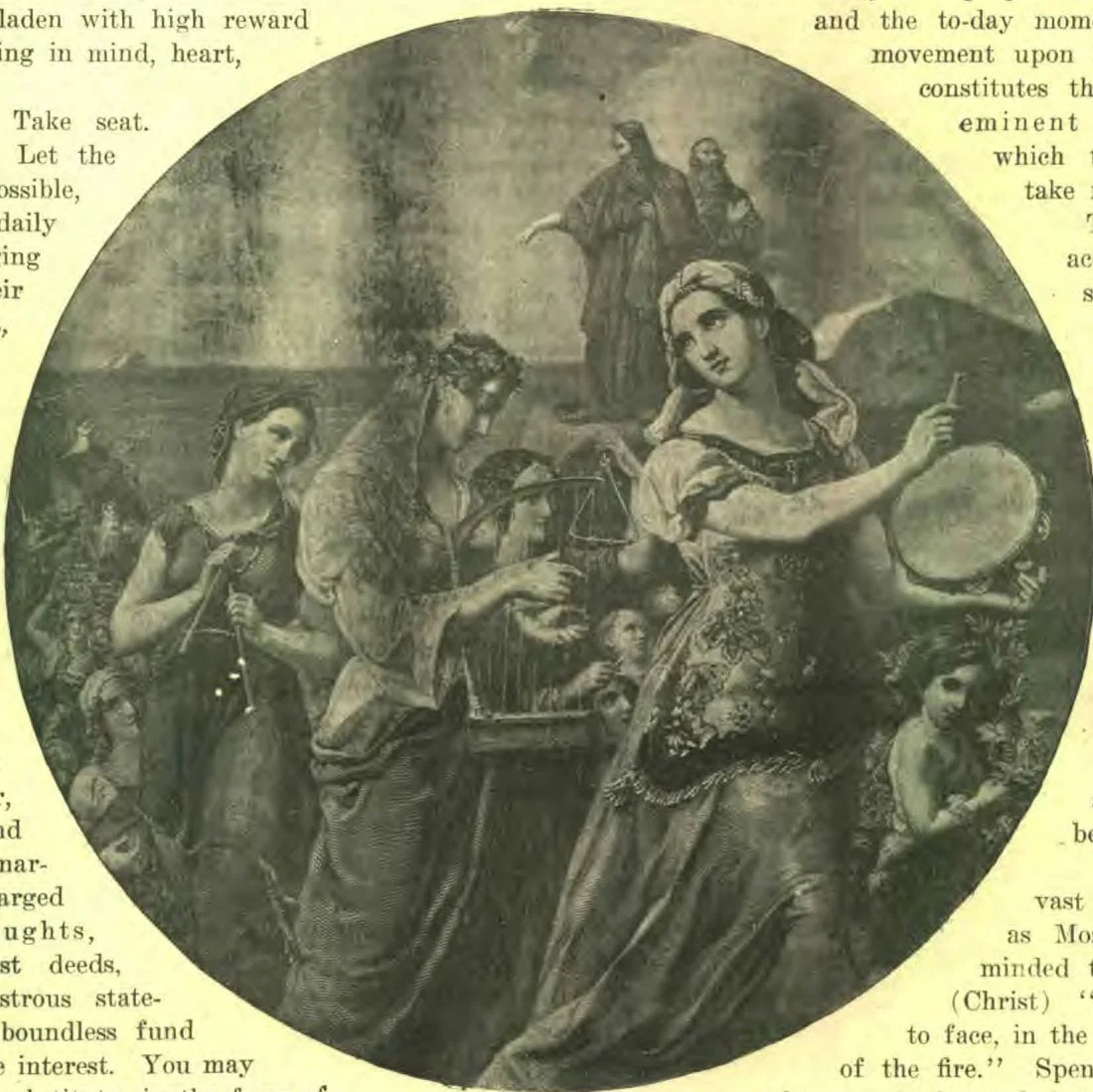
"And Miriam answered them, Sing ye to the Lord, for He hath triumphed gloriously."
Take your Bible. Take seat. Be alone if you can. Let the time be evening if possible, since, then, usually, daily labors are ended, urging duties have ceased their calling. Bid all clubs, lodges, theaters, casinos, merry-go-rounds, all inviting amusements, and even some friends, wait, wait, until you make sure of the gold in the rich-paying mine at whose entrance you stand ready to dig, to delve.
Now, begin at Genesis, first chapter, first verse. Read three, four, or five chapters, with mind intent upon the unique narrative—a narrative charged with profoundest thoughts, crowded with greatest deeds, gemmed with most lustrous statements. You will find boundless fund for reflection, for intense interest. You may thrust aside all Satan's substitutes in the form of evolution, for the facts set forth are eternal, undeniable.
You will indeed find therein plenty of material for new thought, but it will not be the commodity now being so liberally weighed out in the semi-religious markets of to-day. It will be thought which will make you crave oneness with Him who "makes the hungry soul glad, who feeds the famished soul with goodness."
But let this reading, which pledges such high rate of interest, continue thru Genesis, Exodus, Leviticus, Numbers, and Deuteronomy. Include two or three chapters every evening, if you can take the time, shutting out the world, thinking, thinking, as you read. You will encounter results that will astonish you.
You may have read these books studiously in past years, but, unless your present intake from them differs greatly from that of the writer, you will often drop your book upon the table before you in dumb amazement over the astonishing facts you see, over the burning ideas and truths flashed into your mind.
Of course, the total theme of the four latter books is the wonderful deliverance of an oppressed nation from grievous bondage in Egypt, and its introduction into Palestine, the land promised Abraham, Isaac, and Jacob.
But so marvelous and so thrilling, almost continuously, is the history of that deliverance, with the forty years' life of punishment led by that people on the peninsula of Arabia, and the to-day momentous influence of that movement upon the human race, that it constitutes the most impressive, most eminent migratory journeys of which the annals of mankind take notice.
The clear, strong, intense account of Israel's compulsory release from the hand of Pharaoh, the many astounding displays of God's power in the sore punishments inflicted upon his family, people, and country, together with the final outgoing of the captive nation, rich in cattle, in jewels, and other spoils asked of their oppressors, exhibit a piece of portraiture done in colors lasting as time, vivid as sunlight, eloquent as best trained mortal tongue.
Encamp now with the vast host before Sinai, where, as Moses afterward often reminded the wanderers, the Lord (Christ) "talked with you, face to face, in the mount, out of the midst of the fire." Spend that whole year with them at the base of that mountain, twin in fame and honor with that upon which the same Christ was transfigured centuries later. Think of them as pupils of God at school on a desert; fed with food from heaven; taking lessons amid thunders and lightnings and dark clouds of the sky.
Observe the people during the careful, exact, obedient building of that remarkable tabernacle; during the construction of its costly and beautiful furnishings, including the ark of the covenant, to become the place of God's presence in their midst. Note the vast quantity of gold, silver, brass, oil, spices, silk, fine wool, and precious stones they contributed toward that singular structure, until they were told by Moses to cease from giving! What an object-lesson for God's children to-day!
But the hour came for the great multitudeto move forth from Sinai. It was now the second month of the second year after its hasty farewell to Egypt. In exact order appointed by the Lord, Israel marched out toward the wilderness of Paran with heart eager for the beautiful land long before promised to their fathers. The year had been spent in busy industry, in adroit carpentry, in dexterous cutting and polishing of precious stones, in skilled weaving and embroidery, on the part of many for the wonderful tabernacle.
Now read the total saddening story of their various mistakes, errors, and sins until they arrived at Kadesh-barnea, including the fatal venture of Nadab and Abihu; the foolish murmuring of Miriam and Aaron against Moses, and the striking result to Miriam; the unjust and lamentable report of ten of the representatives of the people who were sent out to traverse the promised possession and to bring report thereof; the intensely afflicting consequences of that report upon the waiting Israelites. Continue until the grievous tale of their bitter complaint against Moses and Aaron is remembered as long as you live; until you see the whole congregation eager to stone Caleb and Joshua for their comforting report of Canaan's wealth in large and rich cities, in goodly mountains and hills, in sweet vales and laughing streams; until you behold that entire great army of men, women, and children turned back into that "great and terrible wilderness," there to live, suffer, and die, until "not one of the men of that evil generation, who, at Kadesh wailed over their removal from Egypt, believed the disastrous report of the ten faithless spies, but "did not believe the Lord their God."
But read the total history. It is a tale instructive, interesting beyond words to tell. It has power to educate, to beget faith, to lure from like dangers.

The Cross Draws Men to God.

CHRIST is before us as the perfect Man. The accusations of His enemies have left no impression on the world. He stands alone. Men admire, they praise, but they live on in sin.
Christ is before us as the great Teacher. Never man spake as this Man. No false lesson of right was ever taught. No revelation of God not sustained by the world's conscience was ever made. No unworthy motive was ever offered to stimulate men to do His will. No word of His wisdom has been set aside by the world's philosophy. No addition has been made to His ethical code. And yet men live on in sin, far away from the life of Jesus.
But Jesus on the cross draws men to Him. His word, `God so loved the world, that He gave His only-begotten Son, that whosoever believeth in Him should not perish, but have everlasting life,'' speaks to the heart. His miracles amaze us, but Thy sins be forgiven thee,'' speaks to the secret chambers of the soul. The people said, Never man spake like this Man,'' but the centurion said, Truly this was the Son of God.'' It is not Jesus the Man, not Jesus the Great Teacher, but Jesus the Saviour of men, that draws men to God. The Lord hath laid on Him the iniquity of us all.'' It is this, Jesus bearing our sins, the Son of God making atonement for our guilt, that meets the need of the soul and draws men to Him. The atonement must ever be the central thought in the message of the church to men. `God be merciful to us,'' is the cry of the world. It bursts from the lips of those notoriously guilty; it is uttered by the refined, for as we come near to God, we are overcome with a sense of sin. It is answered by Jesus on the cross—Jesus lifted up that all may see the love of God, Jesus bearing our sins in His own soul, dying for us. This, and this alone, draws men to Christ and God.—United Presbyterian.

The Bible Valued by Agnostics.

THE observances of the Society for Ethical Culture are worthy of attention, tho they sometimes speak of practical matters in connection with the Christian religion, of which they have but partial knowledge. There is considerable theoretical matter made by them to have the force of indubitable fact, but they are not far from the fact when they say that the tendency is to eliminate the Bible as a literary and educational force. The reason for this, said one of the speakers, is plain. “Being no longer regarded as a book that must be read, it is simply a great book which may be read.” Then he asks, “And who reads great books?” “The Bible is going as other great things are going.” He deplored this and affirmed that “it is absolutely necessary to keep in touch with the great classics of the past,” and the “Bible is the greatest classic of conduct, the legacy of a people with a sublime passion for righteousness.”
Moreover, he declared, “English literature is so full of Biblical allusions that it is impossible to understand it without knowing the Bible. Otherwise the force of these great reverberations is lost.”
He proposes to select such passages as are literary units, and to give no opportunity for doctrinal teaching. The foregoing is true, but it is a specimen of the one-sided view of a collection of books that are pervaded by a spirit which can not be accounted for without the influence of a Higher Power, imbuing prophets and apostles with aspirations and the spirit of discernment between the transient and the permanent, the spiritual and the material, and the realization of things invisible and of a life eternal. All that is said truly of the Bible as literature is meager in comparison with what may be truly said by those whose spiritual eyes have been opened to perceive its glorious truths, its supporting promises, its revelation of God and immortality.—N. Y. Christian Advocate.

Prayer

Prayer.
WHEN my heart is hard and stony, Full of doubt and sinful lust, Lead me, Saviour, then to seek Thee, Let me in Thy mercy trust. When my heart is filled with darkness, Filled with sins that grieve Thy heart, Saviour, O my Saviour, hear me, Thy own light to me impart. When I wander from Thy precepts In the dark, forbidden way, When my heart is void of feeling, Teach me, Saviour, then to pray. Let me bow before Thee boldly— Search my heart, remove the sin,— At the portal of Thy mercy, Saviour, bid me enter in. Welcome in Thy presence give me, I to Thee my all resign, Thine for strength and life and keeping— For Thy service wholly Thine. MAX HILL.

What America Needs.

What America needs more than railway extension and western irrigation and low tariff and a bigger wheat crop and a merchant marine and a new navy is a revival of piety, the kind mother and father used to have—piety that counted it good business to stop for daily family prayer before breakfast, right in the middle of the harvest; that quit field work a half-hour earlier on Thursday night, so as to get the chores done and go to prayer-meeting; that borrowed money to pay the preacher's salary, and prayed fervently in secret for the salvation of the rich man who looked with scorn on such unbusiness-like behavior. That's what we need now to clean this country of the filth of graft, and of greed, petty and big; or worship of fine houses and big lands and high office and grand social functions. What is this thing we are worshiping but a vain repetition of what decayed nations fell down and worshiped just before their light went out? Read the history of Rome in decay, and you will find luxury there that could lay a big dollar over our little doughnut that looks so large to us. Great wealth never made a nation substantial or honorable. There is nothing on earth that looks good that is so dangerous for a man or nation to handle as quick, easy, big money. If you resist its deadly influences, the chances are that it will get your son. It takes greater and finer heroism to dare to be poor in America than to capture a battery in Manchuria.—Wall Street Journal.

Study the Scriptures.

THE word of God is the water of life; the more we lave it forth, the fresher it runneth. It is the fire of God's glory; the more ye blow it, the clearer it burneth. It is the corn of the Lord's field; the better ye grind it, the more it yieldeth. It is the bread of heaven; the more it is broken and given forth, the more it remaineth. It is the sword of the Spirit; the more it is scoured, the brighter it shineth.—Bishop Jewel.

Persecuted for His Sake.

SHALL we not trust in the One who said, "Blessed are they which are persecuted for righteousness' sake, for theirs is the kingdom of heaven"?
Need we think it strange who are followers of Christ Jesus if we are persecuted for doing that which is right? This same Jesus said that "men shall revile you, and persecute you, and shall say all manner of evil against you;" but, thank the Lord, it is falsely. And why do they do such things?—Because we are doing the will of God for Jesus' sake.
Are we to be sorrowful and down-hearted because we have to pass thru these things?—No, the Lord said that we should "rejoice, and be exceeding glad; for great is your reward in heaven; for so persecuted they the prophets which were before you."
A man or woman, or boy or girl, who is a Christian, a Christlike person, will experience these things as long as sin and Satan are in the world, which will be until we behold Jesus (the same personal Jesus who was on earth, a babe born in the manger of Bethlehem, who grew up to manhood, who was persecuted and at last nailed to the cruel cross, and who had the spear thrust into His side; the One who, after His resurrection, said unto Mary, who was seeking her Lord, "Woman, why weepest thou? whom seekest thou? . . . Touch Me not; for I am not yet ascended to My Father; but go to My brethren, and say unto them, I ascend unto My Father, and your Father; and to My God, and your God") coming in the clouds of heaven the second time without sin unto salvation; until we see Him coming at that time with all His holy angels and in His Father's glory. What a glorious scene that will be to the Christian! What a terrible scene it will be to those who have not been doing the will of our Father which is in heaven!—so terrible that they will cry to the rocks and mountains, "Fall on us and hide us from the face of Him that sitteth on the throne, and from the wrath of the Lamb; for the great day of His wrath is come; and who shall be able to stand?" I am thinking that they will then wish they had built their faith and doctrine upon the solid Rock, which is the Word of God, Jesus Christ, instead of the sands of sin and strife, and the pleasure of this world, instead of the doctrines and commandments of men which are false and like the quicksand!
O, there is so much that could be said along this line, which would take too much time to tell you now, but I do hope that these few words will help some poor soul to look unto the Lord and be saved. It is now high time that all who are expecting to be saved in the kingdom of God and of our Christ, should be sure that their names are recorded in the Lamb's book of life, and that we should be looking unto Jesus continually every moment, every hour and day of our lives; for by so doing we shall be saved.
"Look unto Me, and be ye saved, all the ends of the earth; for I am God, and there is none else."
"Look to the cross, sinner, believe it, Look to the cross, healing is there; Pardon is thine, only receive it, Look to the cross in prayer.
"Leave all thy sin, humbly confessing, Truly forsake, turn and obey; Jesus will give freely His blessing, Ask and receive to-day.
"Ask of the Lord, now He is willing, Strength to impart, grace to bestow; Promises sweet, ever fulfilling, Prove the great debt we owe.
"Look to the cross, trusting in Jesus, Mighty to help, mighty to save; From all our guilt gladly He frees us, For us His life He gave." F. E. GIBSON.

No Foreign Field.

ONLY in one sense can it be said that there is a foreign field with God. "All have sinned, and come short of the glory of God." Sin has alienated all men from the love of God, so far as man himself is concerned; but, after all, the love of God has made it possible in the wonderful gift of His Son for all to return. His love has reduced every corner of the earth to a home field, a family circle, and sinful man is but the erring member of the household.
God is no respecter of persons. "The God that made the world and all things therein, . . . made of one every nation of men to dwell on all the face of the earth." Acts 17:24-26. Then it is true that to Him, the Creator of all, there is no foreign field. His love is for all; His life is for all. Not a nation of all the earth may be excluded from the gifts of His love, the greatest manifestation of which is the gift of His Son, which brings salvation to all who accept, of whatever nation.
How narrow the conception of man is! His affection is limited to so few, centering in himself or those nearest him, while the needs of those without the favored circle claim little of his thought and less of his solicitude. But "God so loved the world, that He gave His only-begotten Son;" and that Son "gave Himself for our sins;" and "the same Lord is Lord of all, and is rich unto all that call upon Him; for, Whosoever shall call upon the name of the Lord shall be saved." Surely man should not discriminate between the nations of earth, the worthy and the unworthy, if God does not.
H.

The New Birth Illustrated.

In your school-days you worked over your problem and found the answer was not right. But when you found that it was wrong, you changed a figure here, another there; and when finally you could not make it come right you took your sponge and wiped it all out and said, "I am going to begin over again."
Now that is what Christ said to Nicodemus: "Begin over again as a child. Don't do it as an old man; begin to grow up into the childhood toward God, and then when it comes time to go to heaven you will simply go home."
I asked my little girl one day when she came home at noon, "Why did you come in here?" She opened her great eyes and looked at me; she did not know what I meant. I said, "Why didn't you go into the doctor's next door?" Finally she said, "Why, this is my home."
Yes, it is home; that is the reason you are going to heaven—you are going to your Father's home. It must be a home. You have to be a child of God if you wish to enter the Father's home.
There is not a man living who does not need this new birth. There are a great many men living to-day who need to have their lives turned back to the very source and to be born again into a real childhood, and fitted for the home that is in heaven. So I say it is one of the gladdest and most joyous things in the whole Gospel. To think of it, my friends, that a man can be born again! Think of it, that your life with all its blunders can be wiped out; that your sins can all be cast into the sea; that you can start all over again and prattle as God's child, and work as God's child, and finally go home, because heaven is your Father's house. Surely the story of the new birth is good news to the men and women of this day.—Dr. Alexander McKenzie.

Taking God's Promises in Vain.

"I should no more dare to fret than to curse and swear," said John Wesley. A writer in commenting on this remark justifies Wesley by saying that to swear is to take God's name in vain, and to fret is to take God's promises in vain. Read the Bible to find its "fear nots," and see how often God uses these words in speaking to His children, even in the midst of danger and sore trouble. Resting on the promises is far wiser, far nobler, than fretting; it is living with "God o'erhead."—The Wellspring.

The Meaning of Life's Little Tasks

It is while you are patiently toiling at the little tasks of life that the meaning and shape of the great whole of life dawns upon you. It is while you are resisting little temptations that you are growing stronger.—Phillips Brooks.
Continue reading: The Outpouring of the Spirit