[By the Rev. Homer C. Stuntz, Superintendent Methodist Mission in the Philippines, in the Independent.]
THE Manila courts have decided that church buildings built for and used by the Catholic Church prior to American occupancy belong to the church, and can not be alienated from its ownership by those who gave the funds for their erection, even when they have all become Protestants.
The decision is not altogether a surprise to those who contended most earnestly for the opposing view, and is a matter for gratitude to not a few of the warmest friends of Protestantism, as it puts us in the right attitude toward the church which has held undisputed sway here for so many centuries. If congregations could have transferred the church edifices which their money erected to Protestant bodies, such transfer would have been attempted in many cases, and thus Protestantism would have appeared in the unlovely rôle of a receiver of cast-off ecclesiastical properties, an almoner upon the list of Rome.
Gagalangin is a suburb of Manila. In that suburb a small wayside chapel was built years ago for the convenience of the neighborhood. In this building christenings, weddings, and funerals of those living in the immediate vicinity were held. Priests from the large Tondo church, about a mile away, would come down to this little chapel, for a consideration always, and baptize, or marry, or say mass. For many years the chapel had been practically unused. It had fallen into the state of “innocuous desuetude” of which a certain president once wrote. Then came the insurrection. Insurgents used it for “cover.” The priest no longer dared venture forth so far on ghostly errands. Then followed the unhappy disagreement between the American and Filipino forces, with the war that is hardly yet closed. All the Gagalangin suburb was fought over. The little chapel suffered sorely. Soldiers stripped it of all they could use. Thieves, who always follow in war’s wake, left little that was movable, even going to the length of removing part of the corrugated iron roof. Then came peace in that end of the city. American arms had driven the insurgent forces north, past Malabon, Caloocan, Calumpit, Malolos and on, as the world well knows.
Then came Methodism into that part of the city. Many dwellers in this low-lying, bay-fronting suburb became converted. Looking about for a place in which to hold services for the many who came to hear the Word, what more natural than to use the deserted building? Their money had built it. In it they had been accustomed to worship in the days that were earlier. No priest now ventured near it. Hence forty or more heads of families united in a written request for the Methodists to take possession. This they did. And then there was trouble! Bitter opposition was at once aroused. Roman Catholics saw in this act on the part of their one-time flock at Gagalangin a possible precedent which might well come home to plague them unless it were promptly and vigorously opposed. Complaint was made to the Provost-Marshal. He sent one of his inspectors, who reported it illegal for Protestants to occupy the chapel. A priest or friar went out and locked the shattered door, forbidding further use as a place of Protestant services. But the stout objectors laughed at priestly lock and forbearance, calmly entered by a roomy breach in one of the rear walls, and went on with their services. Then action was begun looking to a decision of the matter by the courts. The decision is now published, and is in substance what was stated in the opening sentence of this article.
The decision sets forth the peculiar method of holding property for church use which prevails in episcopally-governed churches. In such churches all church edifices are held in trust for the corporate body and are not owned by the local society, much less the local neighborhood, which furnished the needful funds for their erection. It sets forth the fact, which is not well known in many Protestant circles, that all properties of the Roman Catholic Church are held by the archbishop of the diocese for the church. The moment a building is set apart by the rites of the church for use as a Roman Catholic building, that moment the title is vested in the archbishop ex officio. If there are taxes to pay he pays them out of diocesan funds. If there are titles to convey afterward, he conveys on behalf of the church. That being the case, there was nothing for the courts to do but to decide that in law the Methodist occupants of the building were in error and must cease their use of it. The title is vested in the archbishop of the diocese of Manila, and tho it stand idle until it falls to a heap of dust, Protestants must desist from using it.
The congregation still fails to see the law point. The equity of the matter fills all their vision. But they have dropped it. I went out at once, called them all together and had it carefully explained that the decision was in exact conformity to the law, and that we must be law-abiding and comply with the mandate of the courts, for the powers that be are ordained of God. Then I said to them that personally I was glad that it had been decided that we could not hold the building, nor any other building built for and used by the Roman Catholics. I told them what I really believe, that as Protestants we did not need to be pensioners upon Catholic funds; that our new Protestant wine would keep much sweeter in new ecclesiastical bottles, and that I hoped they would rally at once and raise among themselves the funds needed to build a neat, commodious church in which the rites of Rome had never been performed. I promised to furnish part of the funds—$50—if they would find as much more. They have already met their part of the contract, and the church is now being built. It is made of bamboo, and will have a thatch roof of nipa palm—neat, cool, clean, and roomy and wholly destitute of associations that lead men and women to cross themselves when they enter, or look about for holy water or for the mysteries connected with a candle-studded altar. It will be a clean, wholesome Methodist church, with a neat bamboo altar, and seating for two hundred and fifty people. When it is done, we shall plan for a series of meetings in Gagalangin that will warm the hearts of the people who have so bravely borne what was to them a deep disappointment. By the time this is in print, these meetings will probably be in progress.
The wider question of the titles to properties in Manila and elsewhere, claimed alike by the government and the church, will soon be tossed into the judicial arena here. The new courts are grinding. Distinguished American judges are clearing the swamped dockets of Courts of First Instance with a rapidity that is as gratifying to Americans as it is bewildering to Spaniards and Filipinos. The new Attorney-General, Judge Willfley, of St. Louis will look after the interests of the government. The property at stake runs away up into the millions.9The decision of it will finally rest with the Supreme Court of the United States. Neither party will be willing to abide by the decision of local courts. The American people may look for a battle of giants when this wider issue is once joined.
Manila, Philippine Islands.
A PLEA FOR PEACE.
By Lewis E. Stout
An Open Letter from Western Yearly Meeting of the Friends Church, Composed of 15,000 Members in Western Indiana and Eastern Illinois.
To our Brethren in Christ of Other Denominations:—
God seems to have committed to us as a church a testimony against violence of every description. There are times when particular doctrines need special enforcement. We believe that now is a moment when we should appeal to you.
God said to Noah, ‘The earth is filled with violence through them [men]; and, behold, I will destroy them with the earth.’ Gen. 6:13. Does it not look as if, between armament, conscription, lust for gold, and like selfishness, we are approaching a condition almost as bad as that in Noah’s time?
The evil of armament is fastened upon the United States, and may be closely followed by coast fortification. Steel rails at $30 a ton are of no interest to an eight-million-dollar business combination in comparison with armor plate at $400 a ton. And unless the Christian people lift up their hearts to God and their voices to men to check this greed upon the public treasury coast fortification will follow, with its attendant evils.
England is now being schooled, too, and in all human probability will shortly have to accept conscription to fill her depleted military ranks.
Listen to what the defenders of conscription admit regarding it in France. Mr Drumont, the editor of the Libre Parole, a leader of the Nationalist Party, says:—
Compulsory military service, far from being a school of morals, is a school of drunkenness, idleness, and debauchery. I deem the universal military service one of the greatest, and it is sometimes one of the saddest sacrifices that our country calls upon us to bear. I know of few spectacles more saddening than that of the young peasant taken from his field or his village and thrown for three years into the barracks. These sons of the soil, who would in time have married some honest woman and given to France a new race of strong and wholesome men, return to their homes all more or less diseased, having lost all notions of God and respect for women, having lost the taste for their former honest work by the wearisome and meaningless fatigues of the barracks.
Even the Roman Church father, Forbes, said, ‘The family in France gives to the army a young man clean in mind and body; the army gives back that same young man steeped to the very lips in debauchery, suffering from disease and degrading vices.’ And the Abbé Crestey, in a work entitled, “Without God,” calls the barracks ‘a hot-house of corruption and moral infection.’
The United States is being deluged with a foreign element; how necessary that we fulfil every rule the Lord Jesus left us and are kept perfect under His blood, our sins being remembered no more against us forever. Do we not believe that Jesus Christ’s blood was the last drop that was necessary to be spilled for the race?
Ought not all Christians to testify to this by both word and practise?
On undisputable authority we know of the refined cruel methods resorted to in the South African War “to subjugate” the “conquered Christians.” On good authority we are informed that to satisfy the lust of soldiers at Manila, the United States Government’s medical department is licensing and periodically examining those who ought to be sisters, wives, and mothers. Ought not these things almost to put both these governments beyond the pale of Christianity? and should not all followers of the Lord Jesus everywhere blush with shame if they do not enter a protest against such actions?
Our church, the Friends, when we think of the mighty power of God, should be humiliated and humbled under a sense of the little we have done to extend the knowledge of Him. But we as a people must freely admit and testify to the greatness of the testimony against violence that Christ taught, and we thank Him continually that the wars of all kinds have been waged among and around us for the past two hundred and fifty years yet He had spared the lives of our loyal members, almost without exception, and enabled us at this time to bear this testimony before you, our fellow-comrades in the work of the preparation of the bride of Christ.
Some will say we must aid in the governments of the world.
Our Lord said: ‘I pray not for the world but for them which Thou hast given Me, for they are Thine. They are not of the world, even as I am not of the world. Sanctify them through Thy truth.’ John 17: 9, 16, 17.
Wars, violence, etc., may continue until “the kingdoms of this world are become the kingdoms of our Lord, and of His Christ.” Rev. 11:15. But we believe our Lord Jesus Christ never by word or act aided or abetted or showed Himself responsible for any violence. And He said, ‘As Thou hast sent Me into the world, even so have I also sent them into the world. Neither pray I for these alone, but for them also which shall believe on Me through their word.’ John 17: 18, 20.
This links us of the present completely with Him when on earth, and calls upon us ever to continue His conquest in this earth.
We are yours in Christian fellowship and in all the intensity of the love of the Gospel.
LEWIS E. STOUT, Clerk for the Meeting.
News Notes
Recently numerous cases of death from lockjaw have been reported from different parts of the country, where school children had been compelled to submit to vaccination. At Camden, N. J., seven children have died from lockjaw, or tetanus, following vaccination, and two others are expected to die. At Atlantic City, N. J., three children have succumbed to this disease following vaccination. At Philadelphia several cases have developed from the same cause. A few weeks ago we reported the death of twelve school children in St. Louis, Mo., who had been vaccinated with a fluid containing the germs of tetanus. These children were vaccinated to guard against diphtheria, a much less dangerous disease than the one which the vaccination developed.
General Leonard Wood has purchased for the United States Government the principal portion of the San Juan battlefield. The tract comprises 200 acres, and cost $15,000. It will be considered a United States reservation, and the government will lay out a park there.
Twenty-seven men were killed, most of them terribly mutilated, by the explosion of a boiler in Detroit, Michigan, on November 26, and 27 others were seriously bruised or burned.
The Colombian Government has issued a decree declaring that diplomatic relations with Venezuela have ceased, and that the Colombian legation in Caracas has been withdrawn. The minister of war then makes the significant declaration that Colombia has 80,000 men armed for action. This may not mean war between the two South American States named; but it is thought in some quarters to be but preliminary to a declaration of war. There is strong probability also of trouble between Germany and Venezuela over the financial claims of certain German subjects which Venezuela seems to have given scant consideration. In view of the unsatisfactory negotiations between the United States and Venezuela over the claims of certain American citizens, it seems probable that the United States will make no protest against Germany collecting her claims from Venezuela.
A meteoric shower similar to the one witnessed in 1833 has now been promised for three years in succession, and has failed to materialize. Now there are those who predict that the shower will take place next year or the year following. So far the attempt to prove that the great star shower of 1833 was simply the recurrence of a celestial event which takes place every 33 years has proved a signal failure. The falling of the stars was a sign given by the Lord Himself to tell that His coming was near. The usual annual flight of meteors was seen during the present autumn, as during every other autumn; but the falling of the stars in 1833 was a sign given for a purpose, and does not occur every 33 years.
On November 28 a conference was held on board the United States gunboat Marietta, in the harbor of Colon, Colombia, between representatives from the Colombian Government forces and representatives of the rebels who were then holding Colon. The conference resulted in the surrender of the rebels to Captain Perry of the Iowa, who in turn handed them over to the representatives of the Colombian Government. Thus the surrender of the city was accomplished without the necessity of a bombardment. The American marines have returned to their ships, but the vessels will remain in the harbor until conditions on the Isthmus are more settled.
France has invited the other nations of Europe to an international convention at Paris, whose object will be to devise some means of “stopping the traffic in white slaves;” in other words, the buying and selling of white women and girls for immoral purposes. It has recently been discovered that there existed an organized exportation of Polish women to Argentina for that purpose. The traffic is also said to be carried on extensively in Bohemia and Hungary, and the alluring of English girls of good families to Holland, Belgium, and France is reported to be going on as steadily as it was some years ago when exposed in the Pall Mall Gazette by W. T. Stead.
The Supreme Court has handed down its decision in the “Fourteen Diamond Rings Case,” which is the case involving the right of the United States to collect duty on goods brought into this country from the Philippine Islands. The court decides that no duty can be collected on importations from these islands until Congress shall legislate in the matter; that the islands became American territory as soon as Spain transferred title; and that Congress has power to declare a tariff for the islands. This makes it necessary for the government to refund about $1,800,000 which has been collected from importers under protest.
A collision occurred on San Francisco Bay near Alcatraz Island on the evening of November 28 between the ferry boats San Rafael and Sausalito, in which the former was sunk. Both boats were well loaded with passengers, but so far as known only four lost their lives. As soon as the collision occurred the two boats were made fast with ropes, and the passengers of the San Rafael were transferred to the Sausalito. Many of the frightened passengers jumped into the water, but most of these were rescued by boats launched by the two steamers.
Two passenger trains on the Wabash road met at high speed near Seneca, Michigan, on November 27, resulting in one of the most terrible collisions on record. The number of the dead seems difficult to determine; but there seems reason for placing it as high as 80, while 150 were more or less mangled and bruised. One of the engines exploded, and thus added to the horror of the situation, and to the list of killed and injured. The wreck was described by witnesses as presenting one of the most frightful scenes imaginable.
A peculiar phenomenon was witnessed in Chicago on November 28. What appeared to be a comet, with a well-defined head and long, luminous tail, appeared in the sky and was visible for several hours. That it was not a meteor was evidenced by the fact that it maintained the same position in the sky, and that it was not a comet was shown by the fact that it was seen nowhere but in the vicinity of Chicago. Astronomers have given no solution of the phenomenon.
The cordial reception granted Marquis Ito, of Japan, by the czar of Russia, on November 28, is interpreted to mean a change of policy in the dealings of these two nations with each other. After the czar’s reception, a great dinner was given by the foreign minister to the distinguished visitor, and he was decorated with one of the highest orders in the gift of the czar.
Both Argentina and Chile are laying in a supply of arms and ammunition. Three cargoes were recently shipped from Hamburg, Germany, to South America, two of them for Chile and one for Argentina. All three cargoes were from the same firm, and were shipped by the same agents on telegraphic instruction from South America. There has been tension between these South American States for some time, and they seem to be constantly drifting toward a clash.
The new party in Cuba has protested to Secretary of War Root against the interference of American officials in the political matters of the island. Secretary Root denies that the American officials are interfering, and declares that it is far from their intention to meddle in the politics of that island. The elections will soon be held, and Governor-General Wood is now in Washington to perfect arrangements for the transfer of the island to the Cubans.
A procession estimated to number 50,000 persons paraded the streets of London on December 1 to show their sympathy for General Buller, whom the War Office had forced into retirement. It was considered the biggest affair of its kind that has occurred in England for many years, and was an expression of the dissatisfaction with which a large portion of the people look upon the South African war policy.
An English inventor has perfected a new rapid-fire gun which is arresting the attention of military circles. This new gun is capable of firing bullets as fast as the Maxim gun, but with a range of 6,000 yards or nearly three and one-half miles. This is but another step in the preparation of the world for its last great battle.
From Atlanta, Georgia, comes what seems to be an authentic report of the successful treatment of a case of aggravated cancer by the use of the cathode rays. The rays were applied directly to the exposed parts for fifteen minutes at intervals of three days, and the treatment extended over a period of six weeks.
The 57th Congress convened at Washington on December 2, with David B. Henderson of Iowa speaker of the House, and Senator Frye of Maine occupying the post of speaker pro tem of the Senate. It was estimated by officials of the House that over 3,000 bills had been introduced before 12 o’clock.
There have been rumors during the week that both Miss Stone, the captured missionary, and her companion, were dead; but later advices seem to indicate that both are alive and well, tho no agreement has been reached between the brigands and the friends of the missionaries.
A bill to permit railroad pooling will be introduced into Congress during the present session, and will be strongly backed by the great railroad interests. It is a trust measure, and if passed will add greatly to the power of the trust, practically destroying railroad competition.
There is war again in Chinatown, San Francisco, between the members of two Chinese societies, and several shootings have occurred. Influential Chinamen are seeking to arbitrate the difficulty, but the fighting members of the tongs are still demanding blood.
The special commissioner sent to the Philippines to investigate the condition of the currency there has reported to Secretary of the Treasury Gage, advising the issue of a distinctively Philippine coin, to be called the peso, and to be worth fifty cents in gold.
The British Government has decided not to reimburse British subjects in South Africa for damages which they have sustained on account of the Boer war, as “the amount required would be so enormous that the idea could not be entertained.”
Herr Gibler, a German manufacturer, claims to have invented a process by which steel can now be made twice as hard as by the famous Krupp process. It is asserted that actual tests prove the claims of this inventor.
A systematic robbery of the bank of Liverpool has just been brought to light. The bank has been victimized by worthless checks to the amount of $850,000. The principals in the robbery are now in custody.
The United States army transport Wright ran on an uncharted rock in the Straits of Darmen, Philippine Islands, and sank. This is the fourth transport which has met with mishap in the Philippine service.
Arizona, New Mexico, Oklahoma, and Indian Territory have all held constitutional conventions, and will be applicants for admission to statehood during the present session of Congress.
A remarkable tidal wave is reported to have occurred on the eastern coast of England, on November 29, doing much damage.
The South Carolina Interstate and West Indian Exposition was opened at Charleston, S. C., on December 1.
On account of martial law in South Africa, no one will be allowed to land after January 1 without a permit.
One million dollars is the estimated damage of a fire which occurred in New York City on November 28.
The British Government has given Australia jurisdiction over the island of New Guinea.
GROWTH OF MORMONISM.
ACCORDING to “Apostle” Clawson, as given in the Salt Lake Tribune of October 5, the present standing of the Mormon church is as follows:— “There are fifty-one stakes in the Mormon Church, fourteen foreign missions, 260,000 souls in the stakes of Zion, and 50,000 in the missions, a total of 310,000; 85,000 children under 8 years of age; the First Presidency and twelve apostles, 200 patriarchs, 6,800 high priests, 9,737 seventies, 20,000 elders, making a total of 36,744; 4,800 priests, 4,900 teachers 16,000 deacons, a total of 25,700, constituting the lesser priesthood, or a grand total of 62,444 bearing the priesthood of God. Connected with the auxiliary associations of the church are 30,150 members of the Relief Society, 10,000 officers and teachers in Sunday-schools and 15,000 children; 28,000 in the Y. M. M. I. A. and 25,000 in the Y. L. M. I. A.; 4,060 officers and 31,988 children in the primary association, about 20,000 belonging to the religious classes of the church, the total of those belonging to the auxiliary associations reaching 264,204. Of the 20,000 farms owned by Latter-day Saints, Apostle Clawson said that 18,000 are absolutely free from debt. He closed by telling of the increase in the Methodist, Congregational, and Presbyterian churches of the United States in 1897, which, out of a total membership of 4,000,000 amounted to 50,000. The Latter-day Saints, he said, in that year numbered a little over 250,000, and their increase was 20,000 souls.”
THAT CLAMOR AGAINST THE TURK.
It is difficult to understand wherein the soil or atmosphere of Europe is so much more sacred than that of Asia that the Turk must be driven from the one into the other. The strangest part of the anomalous demand is that Americans should be so solicitous for the banishment of the Turk, as tho the interests of America would be any better subserved by having the Turk in Asia than in Europe. There is little doubt that affairs in the region of the Hellespont and the Bosphorus are more peaceful than they would be if the Turks were driven into Asia. The ludicrous side of the assumed inferiority of the Turk, and that therefore he is not fit to live in Europe, is shown by the following bit of recent news:—
A violent conflict arose the other day in the Church of the Holy Sepulcher at Jerusalem between Franciscans and Greek orthodox monks, which the Mussulman authorities finally stopped!
On this announcement the Christian Work facetiously remarks: “How long will such anomalous ‘conditions’ prevail in ‘the holy city’? Probably until the Turk is driven out of Europe.” After all it may be possible that a concentration of Turkish power in Palestine will be needed to preserve the peace between the warring “Christian” denominations of Europe. We can see no other reason why Americans should be so anxious to see the instrument of peace-preservation driven into Asia.
SOUND
By Frederick Griggs
SOUND is produced by the vibration of some object. A sliver on a rail in a windy day sets up its song, but it will not sing unless the wind sets it in motion, causes it to vibrate. These vibrations, or regular movements of the object, set the air in motion, and it is by means of the air that the sound reaches the ear. When a stone is thrown into a pond of water, the water moves out in rings. When a bell strikes, the air moves in rings similar to those of the water, when the stone is plunged into it. The ear is so delicately adjusted that the waves of air striking on it are conveyed over the nerves to the brain, and we hear.
A little experiment, that of the Æolian harp, which can readily be carried out, will not only serve to give an understanding of what sound is, but will at the same time create something of an interest in music. It may be constructed as follows: Take a dry pine board about six or eight inches wide by one half inch in thickness, and cut it so that it will easily slip into the window when the sash is raised. Drive about ten tacks or small nails into each end opposite each other, letting the heads project about an eighth of an inch. Small screw-eyes are better than nails, as by means of them the strings can be readily tightened up or loosened. Beginning at one side, stretch from the first nail to the opposite one in the other end a silk thread which has been well waxed. Then twist two threads; wax them and stretch between the second pair of nails, and so on increasing each thread by one cord of silk. Next make two bridges of hard wood of the same size and shape. Their length should be equal to the width of the board, and they should be about one and one half inches wide at one end, and three quarters of an inch wide at the other. The upper edge, which supports the strings, should be beveled to a sharp edge. Slide the bridges on their sides under the strings near the middle of the board, and then turn them up properly and slip them along toward either end of the board until the strings are quite taut. Raise the sash high enough to clear the bridges, and place the board in the window. Some most pleasing musical sounds will result from a very slight breeze. These sounds will last, with many changes, while the wind blows.
The sounds which we hear from the harp come from the vibrations of the strings. A few narrow strips of paper about half an inch long folded and dropped across the middle of different strings will reveal the vibrations of the strings more clearly. It will be seen that the heavier strings vibrate more slowly. Lay a small stick across the middle of the strings, and note the effect it has upon the music of the harp. Place the stick upon different strings. The sound ceases. Why? Some of the strings give a high sound, and others a low. Discover the reasons for this difference. They are not hard to find. Some of the strings emit a louder tone than others. What causes this? Do the strings which give out the high tones make them louder? Do not take anything for granted, but observe. May the same strings produce both soft and loud tones? and what makes the difference between the soft and loud tones? Move the bridges, and note the effects. Note whether the harp will play as well at the top of the window as at the bottom. Also note whether the opening in the window will make any difference in its playing. On every hand one hears sounds which are produced in the same manner, or according to the same laws, which we see working in the Æolian harp.
On a small piece of wood, not more than half an inch square, place a pane of glass ten or twelve inches square. Directly over the block of wood place a glass rod supported vertically by the hand. Sprinkle fine sand evenly over the pane of glass, and rub the vertical rod with a cloth which has been well powdered with rosin. As the result of the rubbing, a sound will be produced. Now we know that this sound is caused by the vibrations of the glass. As the result of these vibrations, the sand on the pane of glass will move into ridges in various forms. The same results can be obtained by drawing a violin bow across the side of the pane of glass; and different effects will be produced by drawing the violin bow across different parts of the pane.
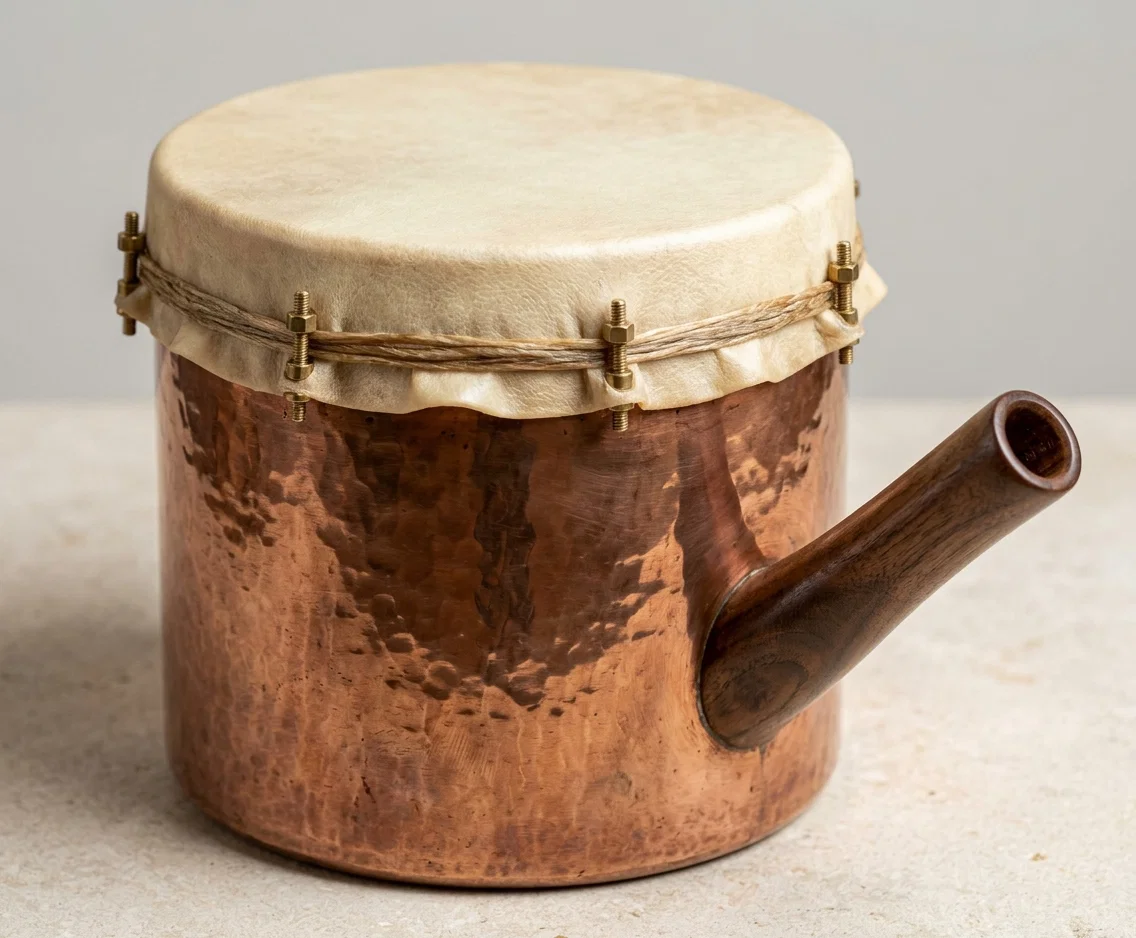
This brings us naturally to voice-pictures. The vibrations of the human voice will produce pictures. Take a can and have stretched over it a thin diaphragm or membrane, say of rubber or a silk cloth. Into this can, let the human voice be introduced through a pipe like the spout of a teakettle, seen in the illustration. Place on the diaphragm a layer of exceedingly fine dust. The human voice, when singing in one steady tone, will cause the dust to take definite shape. These voice-pictures are generally representations of trees and bushes. However, the lower forms of animal life are often made to appear. The dust should be very slightly moistened so as to hold the shape, which it is made to assume, but not so damp as to prevent its being moved readily by the vibrations of the voice, which should be a continued singing sound rather than a sudden, short noise. The pictures will differ according to the voice, and the size, and shape of the vessel over which the membrane is drawn.
When one thinks that the human voice can thus produce definite forms, the mind does not have to stretch far to comprehend the fact that the great God could create the worlds by a word—by the breath of His mouth. Man's word has no life in it, but God's has. He speaks of those things which are not as tho they were. With His speaking, they exist. It is by His word that He speaks a clean heart as well as a world. But He has spoken the word 'clean heart' to every one now—already—but each must claim the word as belonging to himself. He not only creates the worlds by His word, but He upholds them by the same word of His power; and He not only creates the clean heart, but He renews a straight or constant purpose in it by the same word. He is called the Word.
One readily notices the relation of sound to light through the idea of vibration, and indeed some scientists take the position that they are the same only the vibrations differ in intensity.
We have seven primary colors and seven primary tones. In many other respects do they closely resemble each other. God's word spoke the world into existence, which word, together with another manifestation of His power in His spirit of light, brought into existence the various forms of life on the globe. These vibrations, as seen in His word and His light, are the vibrations of life; for He is the Fountain of Life.
FREDERICK GRIGGS.
South Lancaster, Mass.
MOTHER'S VACATION.
EVERYBODY in the house, even father, had had a vacation, and now, half-way through September, the circle was again complete around the table, and one after another took up the thread of narrative, and told of pleasant experiences. Hilda had been camping by the shore; she was brown and plump, and the salt-water bathing and sea air had made her all right for her work again. Hilda taught school. Bob had gone to the mountains. Louise had visited her Grandmother Jenkins at Riverside. Father had taken a trip to town to sell some meadow-land. He hated to part with it, but the price paid was so liberal that he felt rich. Mother only had not had a day's change all summer, nor, for that matter, an outing in ten years. Somehow they all expected mother to be always there, in her place, like Gibraltar or the Sphynx.
“It’s fine to be at home again, and nobody going away for the next six months,” said Bob.
“You are mistaken, Bobby,” said a soft, decided voice. “I’m going now; it’s my turn.”
Hilda gasped in amazement.
Father set down his teacup and stared at mother as if she had suddenly gone crazy. There was a dead silence, and the clock struck six in the middle of it.
“Why, Susy!” said father. “Where are you goin’? You could have gone to town with me. I vow I didn’t ’spose you’d go.”
“You didn’t ask me, Cyrus,” said mother. “But I’m going now home to the old Farwell place, to see Phebe, Ann and Polly and Brother Dave. I shall be away three months. I’m not coming home till I’m rested, till I want to see my own folks again, till I’ve been round all my kin up home. No, there’s nobody going to take me. I’m settin’ out on this trip alone. If I want you to come after me, husband, I’ll send for you. My trunk is packed. Martha Sansom is coming over here to keep house. And my ticket’s bought.”
A bomb-shell exploding in the sitting-room would not have been more stupefying. Hilda recovered first. “Mother,” she said, reprovingly, “you haven’t got a thing that’s fit to wear.”
“What’s been good enough for me at home, will do very well when I’m visiting.”
“I can’t let you wear that old alpaca dress, and that straw bonnet with the faded cornflowers, at Uncle Dave Farwell’s,” said Hattie, resolutely. “What trunk have you packed?”
“My little old hair trunk, dear.”
“Hattie,” said father, “you pack your trunk for mother, and put in your black silk and your gray foulard, and a nice bonnet; and I’ll give you money for more for yourself. And I’ll take her, and she’ll go in the parlor car, and when she’s good and ready I’ll go after her and bring her home. Land’s sakes, but we’ve been dumb and selfish, all thinking of what we wanted and never considering her. I’m sorry, Susy,” he said, and the blue eyes under the wrinkled forehead twinkled with a glint of boyish mirth. A pair of steadfast brown ones, under silver hair, responded, and the two old folks clasped hands. The children stole out of the room and left them together.11
“To think of it,” said Bobby. “Mother starting off on a vacation. Mother!”
“I can’t see why not,” ejaculated Hilda.
And so mother went, and when she came back, in three months’ time, she looked twenty years younger.—Christian Herald.