Your ShelfYour Projects

Signs of the Times, Vol. 25, No. 27.

Forthcoming

Signs of the Times

Jul 4, 1899

Pacific Press Publishing Company · Oakland, California · Jul 4, 1899

Forthcoming

Publications

The following publications are in preparation and will be issued during the summer. Particulars concerning exact date of delivery will be given later. We invite correspondence concerning them.
Heralds of the Morning, German Edition Same reading and illustrations as the English edition. Price $1.25 in Cloth with Marbled edges, and $1.50 in Cloth with Gilt edges.
A Friend in the Kitchen, Or What to Cook and How to Cook It. An economical and hygienic Cook Book by Mrs. Anna L. Colcord. About 128 pages. Illustrated. Price will be announced later.
Pagan Counterfeits in the Christian Church. By C. A. S. Temple. Will contain about 160 pages. Paper covers, price 25 cents.
Return of the Jews. By H. P. Holser. It will contain 32 pages and will be illustrated. Apples of Gold Library No. 62, price $2.00 per 100.
Seal of God and Its Counterfeit. By J. O. Corliss. It will contain 24 pages and will be illustrated. Bible Students' Library No. 157, price $1.50 per 100.
A New Bible Catalog is also being issued by our Company, and will be sent free to any reader of this paper.
Pacific Press Publishing Co. OAKLAND, CALIFORNIA

American

Sentinel

Over thirteen years ago the publishers of the American Sentinel foresaw that certain influences were at work in this government, which would, unless checked, cause it to repudiate its principles of absolute freedom.
The Sentinel has stood as a beacon of warning against these influences all these years, and to-day is the only paper published in the United States entirely devoted to the defense of conscience and the complete separation of Church and State.
The spirit of imperialism now manifesting itself so openly is the result of growing departures from the American doctrine of government, and the real principle of the situation is discussed more ably in the Sentinel than anywhere else. Every American citizen should read it.
It is a 16-page weekly journal. Subscription price $1.00 per year. Send for a free sample copy. Address:
American Sentinel
39 Bond St., New York City

You Have Been Wanting

A College Education

Do You Want One Still?

Then Read Our Offer

We will give you a free scholarship of one year, including board, room, and tuition, in any one of the following colleges or academies:—
  • Union College, Lincoln, Nebraska
  • Walla Walla College, College Place, Wash.
  • Healdsburg College, Healdsburg, Cal.
  • South Lancaster Academy, S. Lancaster, Mass.
  • Mt. Vernon Academy, Mt. Vernon, Ohio
  • Keene Industrial Academy, Keene, Texas
  • Southern Industrial School, Graysville, Tenn.
Upon the condition that you secure for us a certain number of yearly subscriptions for THE SIGNS OF THE TIMES, at one dollar ($1.00) each.
The number of subscriptions required to entitle you to a scholarship in Union College, Healdsburg College, Walla Walla College, South Lancaster Academy, Mt. Vernon Academy, and Keene Industrial Academy, is 140. One hundred subscriptions will entitle you to a scholarship in the Southern Industrial School, at Graysville, Tennessee. These subscriptions must be accompanied by the cash, $1.00 for each subscription, and must be sent to us direct.
If you are interested in securing an education without financial expense to yourself, write us for particulars and instructions. We are making you an offer of great intrinsic value,—an offer whose acceptance will mean much in your future usefulness, whatever your field of labor. Send for catalogues to the schools named above, and write us at once in order that you may begin work without delay.
Address, SIGNS OF THE TIMES, Subscription Dept Oakland, Cal.

GET A NEW ONE

If your old one is worn out.
You can not get better worth for the money than we offer you in our

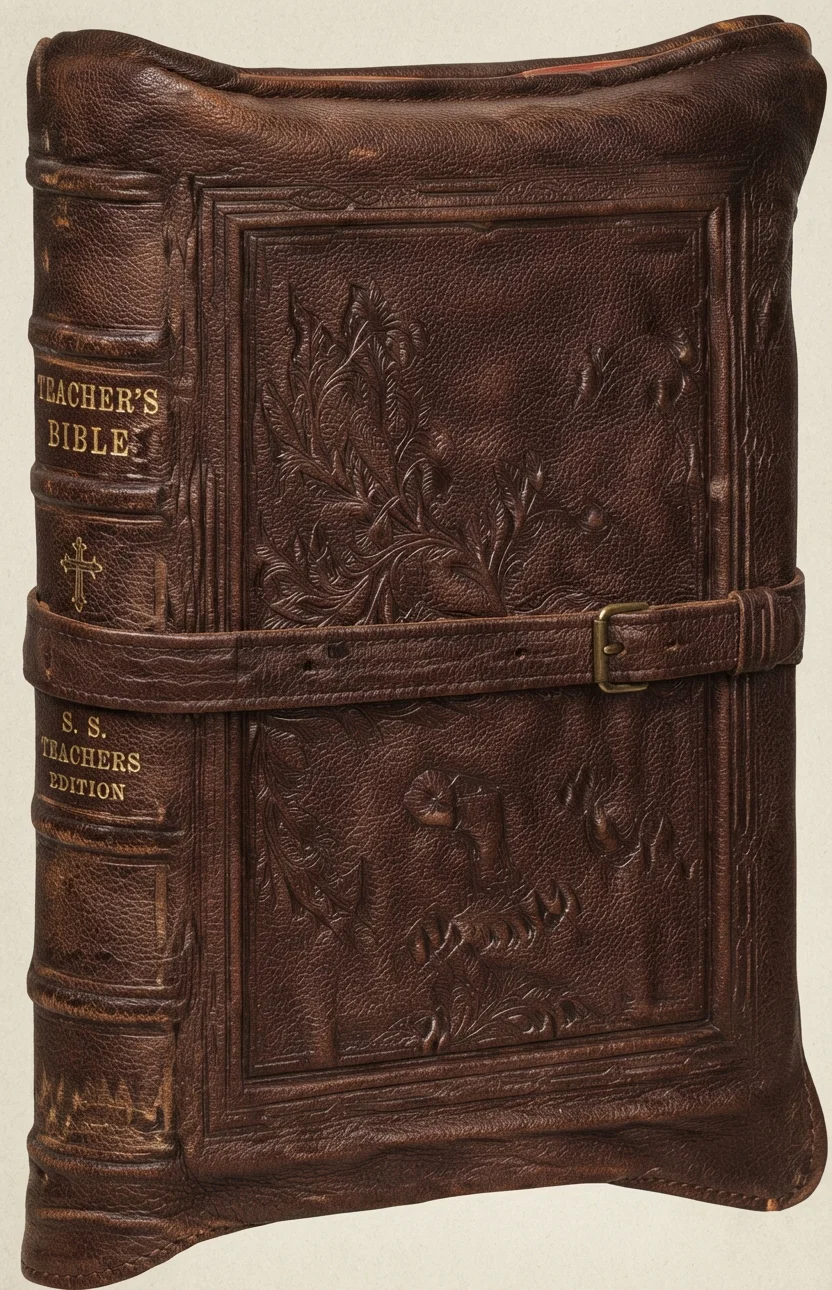
S. S. Teacher's Bible

This Bible is substantially bound in morocco, leather lined to edge has divinity circuit (over-lapping cover), round corners red under gold edges, Minion type, and contains over 650 pages of finely illustrated Helps, over 300 of which comprise a specially handy concordance and subject index, with pronunciation of proper names arranged alphabetically in one list.
We have sold hundreds of these Bibles already, and have only a few left.
We offer the Bible, post-paid, with the "Signs of the Times," one year for only $2.75
Bible sent free on receipt of seven new names and $7.00
Address SIGNS OF THE TIMES Oakland Cal.

Parker Jointless Fountain Pen

NO
Screw to Break
Nozzle to get "Stuck"
Joint to Leak
THE JOINTLESS, LUCKY CURVE GEO. S. PARKER FOUNTAIN PEN THE SUCCESS OF THE PEN AGE.
THE JOINTLESS, LUCKY CURVE GEO. S. PARKER FOUNTAIN PEN
THE SUCCESS OF THE PEN AGE.
We consider this a remarkable offer for anyone desiring a first-class, high-grade, up-to-date gold fountain pen.
You may have your choice of either black or mottled holder, and of fine, medium, or coarse points. This pen is fully guaranteed, and we send it by registered mail, post-paid.
Regular price No. 020............$2.50
SIGNS, one year....................1.00 The two together for only $2.50
The pen free for five new yearly subscriptions and one renewal at $1.00 each.
SIGNS OF THE TIMES
OAKLAND, CAL.

Liberty.—Jesus Christ came to give liberty. He is the only one who can make men truly free.

Liberty in this World is a relative term. It is commonly used to denote freedom from outward restraint. Its highest type, politically, has been presented to the world in this our country.

Only in Part.—But the most that any government can do is to grant liberty only in part. Civil government may secure to men equal political and religious privileges so far as outward restraint is concerned. This is good; and blessed is the nation where these principles exist. But civil government can do no more. It may secure these human rights to its citizens, yet at the same time its citizens may be slaves of the worst tyrant that earth ever knew.

That tyrant is Satan. That slavery is the bondage of sin. "Know ye not, that to whom ye yield yourselves servants to obey, his servants ye are to whom ye obey; whether of sin unto death, or of obedience unto righteousness?" Rom. 6:16. And this bondage includes the whole human race; for "whosoever committeth sin is the servant [slave] of sin;" and "all have sinned, and come short of the glory of God." John 8:34; Rom. 3:23. And there is no difference. The form of service may vary, but the tyrant is the same.

Man can not free himself.—He is "without strength." "None of them can by any means redeem his brother, nor give to God a ransom for him." Ps. 49:7. Listen to a free-born one of earth, yet bound in this bondage of sin. "That which I do, I allow not; for what I would, that do I not; but what I hate, that do I. . . . For the good I would, I do not; but the evil which I would not, that I do." And further on he tells us that he is in "captivity to the law of sin which is in my members." And he cries aloud in his anguish: "O wretched man that I am! who shall deliver me from the body of this death?" Rom. 7:15-24. And this has been and is the experience of countless millions.
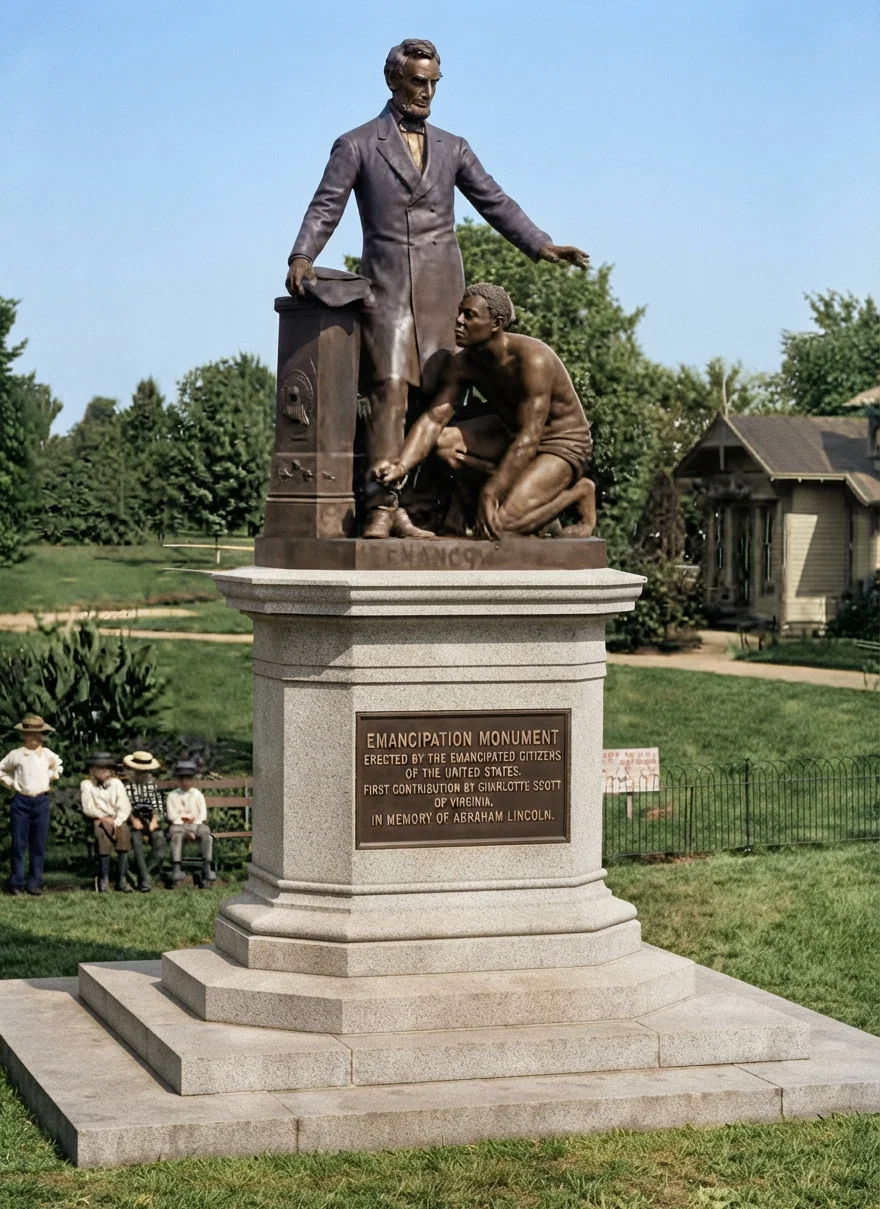
EMANCIPATION MONUMENT, WASHINGTON, D. C.

The Terrible Curse.—But some may say: "I do not feel that. I am in the world and happy." This may be true. There are persons who die from poison at ease and quiet. That which causes death benumbs their sensibility. We have read of men who had spent so many years in prison for crime that, when their term was ended, and they were released, begged to be taken back. They had been in bondage so long that they could not appreciate liberty. They had looked upon prison walls so long they could not appreciate God's mountains, valleys, rivers, trees, sunshine, and sky. So men who love sin are blinded by sin to its evil till they reap its full harvest in this life or that to come. This is the worst phase of its curse; Satan deceives his victims till they love the slavery of sin.

The Pleading.—But there come times in the experience of every slave of sin when he longs to be free; he longs to break the bonds of habits of evil. He longs to be patient instead of impatient, to be reverent instead of profane, to be sober instead of drunken, to make a happy home instead of a hell, to love and not hate, to have peace and rest instead of strife and tossing to and fro. All the evil is the fruit of sin. All the longings for the better are from God. It is the pleading of God for your soul. It is His wooing to win you from strife to rest, from sin to righteousness, from death to life.

Who can bestow all this?—Jesus Christ, the Friend, the Redeemer, the mighty Saviour of men. Said he from whom we before quoted as one in bondage, in answer to "Who shall deliver me?" "I thank God through Jesus Christ our Lord." Rom. 7:25. Yes, Christ Jesus, the Son of God, is the mighty, eternal Saviour of all who will come unto Him; for He saves such "to the uttermost." Heb. 7:25.

That is Christ's mission— to deliver. Hear Him: "The Spirit of the Lord is upon Me, because He hath anointed Me to preach the Gospel to the poor; He hath sent Me to heal the broken-hearted, to preach deliverance to the captives, and recovering of sight to the blind, to set at liberty them that are bruised, to preach the acceptable year of the Lord." Luke 4:18, 19. And "behold, now is the acceptable time; behold, now is the day of salvation." 2 Cor. 6:2. He is a present Saviour; He saves, and saves now, if you desire it. He will not force your freedom. America, doubtless, released slaves that did not want to be released; but Jesus sets those free who long for His freedom; who will simply ask for it in faith. Nay, more, He has purchased all; your freedom is already bought, without money or price on your part, at infinite sacrifice on His part. Will you accept it? Will you not, sinner, accept the great, glad boundless freedom of God in Christ Jesus? "Forgive my sins?"—Yes, He will. "Break their shackles which have bound me?"—Yes, He will do that. "He delighteth in mercy." "He will subdue our iniquities." O, let Him do it for you!

And, O, the blessedness of this freedom! "If the Son therefore shall make you free, ye shall be free indeed." Men may arrest you, defame you, shut you up in prison, put you in stocks or chain-gang; they may behead you or burn you at the stake; they can not destroy your liberty in Christ. In bondage of iron you have more liberty than your persecutors. At the most they suspend it but a little while. He is Lord of life and death. The grave could not hold Him. It can not hold one child of His upon whom is His righteousness when He calls. And He will call every soul who is His to glorious immortality, to an eternal land of the free, forever free. "Brethren, ye are called unto liberty."

TRUE FREEDOM.

Men! whose boast it is that ye Come of fathers brave and free, If there breathe on earth a slave, Are ye truly free and brave?
If ye do not feel the chain When it works a brother's pain, Are ye not base slaves indeed, Slaves unworthy to be freed?
Is true Freedom but to break Fetters for our own dear sake, And, with leathern hearts forget That we owe mankind a debt? No! true Freedom is to share All the chains our brothers wear, And, with heart and hand, to be Earnest to make others free.
They are slaves who fear to speak For the fallen and the weak; They are slaves who will not choose Hatred, scoffing, and abuse, Rather than in silence shrink From the truth they needs must think; They are slaves who dare not be In the right with two or three.
—James Russell Lowell.

WHAT THE FOUNDER OF THE CHRISTIAN RELIGION SAID.

"My kingdom is not of this world: if My kingdom were of this world, then would My servants fight, that I should not be delivered to the Jews; but now is My kingdom not from hence."
"Render to Cæsar the things that are Cæsar's, and to God the things that are God's."
"And, behold, one of them which were with Jesus stretched out his hand, and drew his sword, and struck a servant of the high priest, and smote off his ear. Then said Jesus unto him, Put up again thy sword into his place; for all they that take the sword shall perish with the sword. Thinkest thou that I can not now pray to My Father, and He shall presently give Me more than twelve legions of angels?"
"And if any man hear My words, and believe not, I judge him not; for I came not to judge the world, but to save the world. He that rejecteth Me, and receiveth not My words, hath one that judgeth him: the word that I have spoken, the same shall judge him in the last day."
"Therefore all things whatsoever ye would that men should do to you, do ye even so to them; for this is the law and the prophets."
"And it came to pass, when the time was come that He should be received up, He steadfastly set His face to go to Jerusalem, and sent messengers before His face; and they went, and entered into a village of the Samaritans, to make ready for Him. And they did not receive Him, because His face was as tho He would go to Jerusalem. And when His disciples James and John saw this, they said, Lord, wilt Thou that we command fire to come down from heaven and consume them, even as Elias did? But He turned and rebuked them, and said, Ye know not what manner of spirit ye are of. For the Son of man is not come to destroy men's lives, but to save them."
"This is the word of the Lord, . . . . Not by might, nor by power, but by My Spirit, saith the Lord of hosts."—Zechariah.
"Knowing therefore the terror of the Lord, we persuade men."—Paul.

THE BASIC PRINCIPLES OF TRUE AMERICANISM.

Liberty and the Declaration of Independence.

[By William N. Glenn, Editor of Our Little Friend.]
THERE can be no true idea of liberty without a recognition of the equality of man. It is God's design that all men shall be free; for He gave His Son to die for that very purpose, and "is no respecter of persons." "If the Son therefore shall make you free, ye shall be free indeed." John 8:36. But does not that refer to spiritual freedom, which any one may enjoy tho in bodily bondage to another? True; but the greater the degree of spiritual freedom among the people of any State the more general will be the enjoyment of civil liberty. It is the Spirit of Christ that engenders a real respect for the rights of others, wherever and in whomsoever that sentiment may be found.
The Reformation that began in Luther's time indicated the solution of the problem of true civil liberty by proclaiming the doctrine of religious liberty. But the true idea of civil liberty did not develop into an actual governmental experiment until the Declaration of Independence was issued by representatives of the American Colonies of Great Britain. July 4, 1776, marked the beginning of a new order of things—"novus ordo seclorum"—which was accomplished in the Revolution. The doctrine of that Declaration is thus expressed:—
"We hold these truths to be self-evident; that all men are created equal; that they are endowed by their Creator with certain unalienable rights; that among these are life, liberty, and the pursuit of happiness. That to secure these rights governments are instituted among men, deriving their just powers from the consent of the governed; that when any form of government becomes destructive of these ends, it is the right of the people to alter or abolish it, and to institute a new government, laying its foundation on such principles, and organizing its powers in such form, as to them shall seem most likely to effect their safety and happiness."
One of the leading spirits in the framing and in the promulgation and establishment of the foregoing Declaration was Thomas Jefferson, who also enunciated the doctrine of "equal and exact justice to all men of whatever State or persuasion, religious or political."
These are the basic principles upon which our government is founded. Now if it is a fact that "all men are created equal," then no man or combination of men has a right to disturb this equality. In what does this equality exist? It is not in stature, nor in color, nor in intelligence, nor in disposition. However equal, or similar, these conditions might have been in all men had sin not entered to disarrange for the time the harmony of God's work in the earth, is not the question. Civil government is concerned with the best temporal good of man as he is. Then it is here and now that we hold, as self-evident truth, that "all men are created equal." So in the condition of man as he is here and now, there is but one point of view from which this God-designed equality is apparent, and that is in the matter of rights. And here is the place where the framers of the Declaration stood when, in laying the foundation of this government, they acknowledged as self-evident truth the proposition that "all men are endowed with certain unalienable rights."
The government which they proposed to establish was not designed to create rights, but to "secure" the free exercise of the rights with which the Creator had already endowed them. The government to which the colonies were then subject was denying this exercise of rights, hence the colonists declared for "a new order of things"—a government having for its object to provide for the best good of all the people. The idea prevails to a great extent to-day that the government is designed to provide for the best good of the majority; but that is a perversion of the true spirit of government, for it ignores the rights of a part of the people. It is but a slight modification of the monarchical rule that government is established for the special benefit of rulers and their friends, be they ever so few in number.
The particular feature of rights to which the Declaration pledges government security is included in "life, liberty, and the pursuit of happiness." As the theory and the language of the Declaration guarantees such protection to "all men," every individual citizen and every individual accepting the guarantee even temporarily, is under obligation to acknowledge and respect the right of every other individual. The government is a compact of individuals for this purpose. In no other way can the rights of all be made secure in a selfish, and consequently sinful, world. For this reason, purpose, object, "the powers that be [civil government] are ordained of God." Rom. 13:1. The obligation being mutual between individuals, the claim to security in what would ordinarily be deemed personal right is logically forfeited, or limited, when the individual fails to regard the rights of others. For instance, when a person's actions become a menace to the lives and liberty of others (not when his "persuasion, religious or political," is repugnant to them), it is the province and the duty of the government to restrain him, or to restrict his liberty of action (not of sentiment or conscience) to the extent that is necessary to the security of others in the exercise of their rights. "For rulers are not a terror to good works, but to the evil." Verse 3.
Perhaps in no sense was there a greater necessity for reformation in governmental function than in the protection of men in their right to the "pursuit of happiness." And no element ever was so inclined to interfere with the free enjoyment of this right as the votaries of religion. Furthermore, this interference never has been carried to such an extreme as by those who have professed adherence to the Christian religion. This, too, in face of the basic Christian principle, "All things whatsoever ye would that men should do to you, do ye even so to them."
It has been in the matter of the "pursuit of happiness" that the advocates of civil-law religion have ever deemed it their prerogative, through the machinery of government, to dictate bounds of action on the part of their fellow-men. Religious zealots—whether Roman Catholic, professed Protestant, Greek Church, Mohammedan, or the generally-recognized heathen of whatever name—have always deemed it essential to good government to restrain the non-religionist in his idea of pursuing happiness, and to compel him to at least formally acknowledge the essential importance of their religious dogmas. So extensively grounded had this idea become that a government without an establishment of religion was indeed "a new order of things," and in the Old World was deemed as near of kin to anarchy.
Many attempts have been made to establish government that would be void of tyranny, that would recognize the rights of all the people; but, prior to A. D. 1776, all such attempts fell short because someparticular kind of religious faith was recognized in the civil law. The government, however liberal in other respects, would set up and endeavor to maintain at public expense some form of religion. And it has ever been a fact that the enforcement of the observance of religious creed by law has worked oppression and limitation of the exercise of civil rights by those who were conscientiously opposed to the State religion.
But through the vista of history and experience by the light of true Gospel principle, there dawned the true idea of civil government—the complete separation of Church and State, and the recognition of the equality of men. This was the perfect ideal as seen by the framers of the Declaration of Independence, and later by those who constructed and adopted the Constitution. That the ideal has not been fully put into practise is due to the innate selfishness and bigotry of individuals and classes who have been enabled to wield a certain degree of deteriorating influence. But the ideal was set up by our forefathers, in the providence of God, for the first time in the history of nations. And it is yet professedly held up in the letter of the Constitution, and in the formal heralding of the principles embodied in the Declaration of Independence—on the Fourth of July. W. N. GLENN.

EXTRACTS FROM JAMES MADISON'S REMONSTRANCE TO THE ASSEMBLY OF VIRGINIA.

"It is proper to take alarm at the first experiment upon our liberties. We hold this prudent jealousy to be the first duty of citizens, and one of the noblest characteristics of the late Revolution. The freemen of America did not wait till usurped power had strengthened itself by exercise, and entangled the question in precedents. They saw all the consequences in the principle, and they avoided the consequences by denying the principle. We revere this lesson too much soon to forget it. Who does not see that the same authority which can establish Christianity in exclusion of all other religions may establish, with the same ease, any particular sect of Christians, in exclusion of all other sects?"
"The proposed establishment is a departure from that generous policy which, offering an asylum to the persecuted and oppressed of every nation and religion, promised a luster to our country, and an accession to the number of its citizens. What a melancholy mark is this bill, of sudden degeneracy! Instead of holding forth an asylum to the persecuted, it is itself a signal of persecution. It degrades from the equal rank of citizens all those whose opinions in religion do not bend to those of the legislative authority. Distant as it may be in its present form from the Inquisition, it differs from it only in degree. The one is the first step, the other is the last in the career of intolerance."

THE TRUE MAN.

"He stood upon the world's broad threshold wide, The din of battle and of slaughter rose; He saw God stand upon the weaker side, That sank in seeming loss before its foes; Many there were that made great haste and sold Unto the cunning enemy their swords; He scorned their gifts of fame and power and gold, And, underneath their soft and flowery words Heard the cold serpent hiss; therefore he went And humbly joined him unto the weaker part; Fanatic named and fool, yet well content So he could be the nearer to God's heart, And feel its solemn pulses sending blood Through all the wide-spread veins of endless good."

AN UTTERANCE OF 1776.

[From the address of the Presbytery of Hanover, Va., and the Baptists and Quakers to the General Assembly of Virginia, 1776.]
"IN this enlightened age, and in a land where all of every denomination are united in the most strenuous efforts to be free, we hope and expect that our representatives will cheerfully concur in removing every species of religious as well as civil bondage. Certain it is that every argument for civil liberty gains additional strength when applied to liberty in the concerns of religion; and there is no argument in favor of establishing the Christian religion but may be pleaded with equal propriety for establishing the tenets of Mohammed by those who believe the Alcoran; or, if this be not true, it is at least impossible for the magistrate to adjudge the right of preference among the various sects that profess the Christian faith WITHOUT ERECTING A CLAIM TO INFALLIBILITY, WHICH WOULD LEAD US BACK TO THE CHURCH OF ROME. . . .
"Neither can it be made to appear that the Gospel needs any such civil aid. We rather conceive that when our blessed Saviour declares His kingdom is not of this world, He renounces all dependence upon State power, and as His weapons are spiritual, and were only designed to have influence on the judgment and heart of man, we are persuaded that if mankind were left in quiet possession of their inalienable religious privileges, Christianity, as in the days of the apostles, would continue to prevail and flourish in the greatest purity by its own native excellence, and under the all-disposing providence of God.
"We would also humbly represent that the only proper objects of civil government are the happiness and protection of men in the present state of existence, the security of the life, liberty, and property of the citizens, and to restrain the vicious and encourage the virtuous by wholesome laws, equally extending to every individual; but that the duty which we owe to our Creator, and the manner of discharging it, can only be directed by reason and conviction, and is nowhere cognizable but at the tribunal of the Universal Judge."
Continue reading: DEPARTURE FROM THE BASIC PRINCIPLES OF THE GOVERNMENT IN ITS ATTITUDE TOWARD RELIGION