Your ShelfYour Projects

Signs of the Times, Vol. 23, No. 36.

The Great Shepherd

Signs of the Times

Sep 16, 1897

Pacific Press Publishing Company · Oakland, California · Sep 16, 1897

The Great Shepherd

Editorial
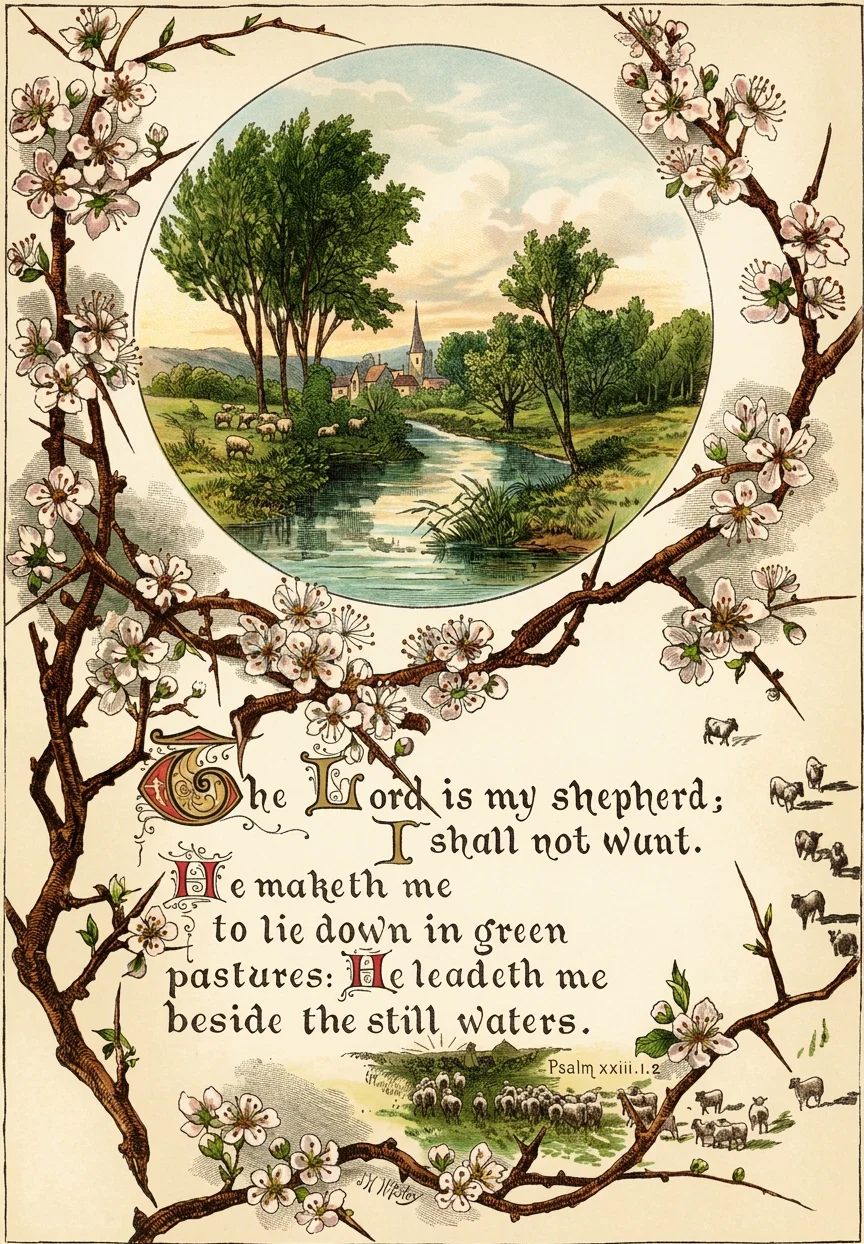
The Great Shepherd.—There is no vocation in life which develops more true tenderness and sympathy, more hardihood and courage, than that of an oriental shepherd. His flock becomes as his family.
David, the ancestor and a type of our Lord according to the flesh, and who wrote the twenty-third psalm, was a shepherd. He searched out the best feeding ground for his flock. He found for them the richest and most verdant valleys. In leading them to these places the pathway often led over rough hills and rugged mountains and stony paths. Here he manifested tender care for his flock. He led them slowly on account of the feeble ones. He bore the lambs in his bosom. He carried the bruised and wounded sheep upon his shoulder. And when he reached the shady side of some green-bordered lake or stream, he let them rest till fitted to resume their journey.
They were as his own kin. For them he risked his life. “Thy servant kept his father's sheep; and when there came a lion, or a bear, and took a lamb out of the flock, I went out after him, and smote him, and delivered it out of his mouth; and when he arose against me, I caught him by the beard, and smote him, and slew him.” I Sam. 17:34, 35, R. V. The record is not that the shepherd did this once, but whenever there came a beast of prey he risked his life to save his flock. Tenderness, patience, and kindness toward his flock, courage and fortitude in protecting and defending them, were ever manifest. As expressed by Jacob,—“In the day the drought consumed me, and the frost by night; and my sleep departed from mine eyes”—thus was the life of the shepherd, and identified with his sheep. How intimate, how dear, the relation!
“The Lord.”—He, says the psalmist, speaking by the Spirit of Christ and for every one who trusts, is my Shepherd. Not the lord Baal, but the great Jehovah, the Creator of heaven and earth. He has identified himself with the children of men, and every one may say, “We are the sheep of his pasture.” O, what a shepherd! How tender and kind and patient is he! “The bruised reed will he not break, the smoking flax will he not quench.” He will not cast aside the wounded, weary, stumbling sheep, worthless tho it seems. Nay, he will lift it upon his shoulder and carry it over the steep, rough places. He loves “with an everlasting love.” He “so loved the world that he gave his only-begotten Son;” he gave himself in that Son, for “God was in Christ reconciling the world unto himself.” And “he that spared not his own Son, but delivered him up for us all, how shall he not with him also freely give us all things?” Rom. 8:32. Yea; this is the Shepherd, the “good Shepherd,” that “giveth his life for the sheep,” when “the hireling fleeth.” The Lord—Jehovah—is his name. To Moses, another shepherd, the Lord thus revealed its meaning: “Jehovah, Jehovah, a God full of compassion and gracious, slow to anger, and plenteous in mercy and truth; keeping mercy for thousands, forgiving iniquity and transgression and sin.” This is the Lord; he is the Shepherd.
“My Shepherd.”—He is not simply a shepherd, or the Shepherd, or the great or good Shepherd merely; he is all these, but he is a personal Shepherd. Jehovah is my Shepherd, and I am one of his flock. He cares for me. He placed in jeopardy his life for me. He counted me as the lost sheep whom he left the glories of heaven to save. He is the Shepherd of others also, and for that we are glad, because he is ours. Reader, can you say, “Jehovah ismy Shepherd”? If so, you can also say,—
“I Shall Not Want.”—Why?—Because he can and will supply me. All power is his; he is “the Lord God omnipotent.” He made the earth, and stretcheth out the heavens as a curtain, and spreadeth them out as a tent to dwell in. “Lift up your eyes on high, and behold who hath created these things, that bringeth out their host by number; he calleth them all by names by the greatness of his might, for that he is strong in power; not one faileth.” This is the power of our Shepherd. He is omniscient; he knows everything. “Great is our Lord, and mighty in power; his understanding is infinite.” “There is no searching of his understanding.” He is full of knowledge and wisdom. More than this, he loves with “an everlasting love.” “His mercy endureth forever.” He so loved the world that he gave his only-begotten Son. Now, given a great and good Shepherd who has all knowledge, and all wisdom to use that all knowledge, who loves his children in infinite love, and who possesses all power to do what he will, is it not true that the sheep of his fold “shall not want”? All that we need, the Shepherd will provide. “Seek ye first the kingdom of God and his righteousness, and all these things shall be added unto you.”
In All Places.—“He maketh me to lie down in green pastures; he leadeth me beside the still waters.” In the green pastures are we fed, and lie down satisfied in his goodness. By the still waters we rest. But not always in the green pastures and by the still waters does he lead us. The way leads over the rocky steeps of hard labor, through the thorny paths of trials and perplexities, over the burning sands of persecutions, under the thick storm cloud of the desolating tempest, in the wilderness where abound the demons of prey. But in all these places the Shepherd has preceded us, nay, he goes with us. His footprints may be found in every step of the way. The paths of persecution are marked with the blood drops from his thorn-crowned head and spear-riven heart. Yea, even down to the Dark Valley of the Shadow of Death the way often leads; but even there he does not leave us alone; for tho “I walk through the Valley of the Shadow of Death, I will fear no evil; for thou [the great Shepherd] art with me; thy rod and thy staff [the instruments of guidance, defense, protection, and chastisement] they comfort me.” God's blessed healing and strength are given in all places.
“At All Times.”—“He restoreth my soul.” Not once only does he restore the soul. Not alone in the green pastures and by the still waters, but “at all times,” daily. Our Shepherd is a “hiding-place from the wind, and a covert from the tempest; as rivers of water in a dry place, as the shadow of a great rock in a weary land.” “When the poor and needy seek water, and there is none, and their tongue faileth for thirst, I Jehovah will hear them, I the God of Israel will not forsake them. I will open rivers in high places, and fountains in the midst of the valleys; I will make the wilderness a pool of water, and the dry land springs of water.” He will carry the lambs in his bosom, and gently lead those that are with young. At all times, in all places, the great Shepherd is with the sheep.
“Paths of Righteousness.”—“He leadeth me in the paths of righteousness,” not because we desire it, not because we pay him for it; but “for his name's sake.” It is because he loves us, and the paths of righteousness will be all the way, at all times. O wonderful Shepherd, who would not rejoice to say, “For he is our God; and we are the people of his pasture, and the sheep of his hand”? “Know ye not that Jehovah he is God; it is he that hath made us, and we are his; we are his people, and the sheep of his pasture.”

CHRISTIAN CITIZENSHIP.

What It Is; Its Blessings.

The word “Christian” comes from Christ, and means “relating to or derived from Christ or his doctrine; professing or belonging to the religion established by Christ.”—Standard Dictionary.
The word “citizenship” means “the status of a citizen with its rights and privileges.” A “citizen” is literally “the resident of a city or town who enjoys civic privileges; a member of a nation or sovereign state, especially of a republic; one who owes allegiance to a government and is entitled to protection from it; opposed to alien.”—Id.
As Christian is that which relates to Christ, or is derived from his doctrine, so Christian citizenship is the citizenship of Christ, the citizenship derived from him. The true citizenship of the Christian, the citizenship to which he lays claim, to which he will appeal, is the citizenship derived from Christ Jesus.
There is a common way of using citizenship, which pertains to nearly all men, especially in countries like the United States and England. Men are born in these lands, grow up to manhood, and by virtue of their dwelling in the country are citizens, entitled to the civic rights of citizens. So Paul was “a Jew of Tarsus, in Cilicia, a citizen of no mean city.” Acts 21:39, R. V. He was born and reared there; he was not the Egyptian he was supposed to be. “In the eye of the law, all Roman citizens were equal,” says Gibbon, “and all subjects of the empire were citizens of Rome.” But this citizenship had naught to do with Paul’s Christian citizenship. That is, a Christian who was a citizen of Rome did not by that possess Christian citizenship; for the lowest slave in the Roman Empire who was a Christian was as truly a possessor of Christian citizenship as was Paul. Mr. Gage is by his physical birth a citizen of America. He is also a Christian. Mr. Kowalski lands to-day in Castle Garden from Poland. He is not a citizen of this country, and can not be for years. But Mr. Kowalski is a Christian, and he is by virtue of that fact as much a Christian citizen and possesses Christian citizenship as truly as does Mr. Gage.
Civil citizenship may be ours by accident or by choice. It is ours by accident when we are born and reared to it, as in the United States. It is ours by choice when, born and reared in a foreign land, we relinquish our allegiance to the government under which we are born and comply with the conditions of citizenship in a land of our choice. Civil citizenship is made and regulated by law. To possess it we must meet the conditions, or comply with the forms prescribed by statute. If it come to us by accident of birth and residence, to accept it fully, we must choose to do so by identifying ourselves with the interests of the commonwealth and the responsibilities it involves.
He who thus truly chooses citizenship in a country identifies his interest with that government, and appeals to it for the position it may give and the protection it is bound to give if able. Wherever he goes he is a citizen of that commonwealth, and an alien in every other commonwealth. He can not constitutionally be a loyal citizen of two civil governments at the same time. He must choose one among the many. But as soon as he chooses one, he relinquishes citizenship in the others. This would be evident at once in case of war among the nations.
Should we grant that a fully enlightened and devoted Christian could be a citizen of a civil government, it is clearly evident that his civil citizenship is no different from that of the citizenship of an unbeliever. That of both or each is based on the same statute law. To illustrate: Mr. Smith may be a Christian and a citizen of this country. Mr. Jones may be an unbeliever, and also a citizen. But if Mr. Smith should go to Great Britain his Christianity would not make him a citizen of that professedly Christian nation. If Mr. Jones went with him they would stand precisely on the same footing, that of aliens. And should they wish to become citizens each would have to comply with the same requirements of statute law. One’s Christianity does not, therefore, affect the nature of one’s civil citizenship; it can not from the simple fact that Christianity is a matter of motive, heart, essence, and life, while civil citizenship is a matter of civil law and the outward observance of the forms thereof. A living law of Christianity is, “Thou shalt not covet,” mighty through faith in Christ to accomplish all that is commanded, but if it were placed upon the civil statute-book it would not be a Christian law. It would be merely a form of words without the life, having no more relation to the living law of God than would a statue of Jesus to the living eternal Son of God.

What Is Christian Citizenship?

Christian Citizenship is the citizenship derived from Christ, that which we get by virtue of our relationship to him. He is from above. He is “the only-begotten Son, which is in the bosom of the Father.” John 1:18. He was the One who “came down from heaven, even the Son of man which is in heaven.” John 3:13.
He came to a world which had revolted against heaven, and was ruled over by Satan, “the god of this world” (2 Cor. 4:4), “the prince of the power of the air, the spirit that now worketh in the children of disobedience” (Eph. 2:2). And while God overrules in all the kingdoms of men, yet in the principles and policies which obtain, in the selfish ambitions which control, in all the imperfection of government in its very nature and essence, the kingdoms of this world are not the kingdoms of our Lord and his Christ. The time whenthat shall be will not occur till all earthly rule is utterly destroyed, the kingdoms of the world broken as the dust, and upon a renovated earth, in a city built without hands, shall Jesus Christ begin his own perfect, eternal reign of love and life. Ps. 2:7–9; Dan. 2:34, 35, 44; 7:27; Heb. 11:10; 13:14; Rev. 11:15; 22:3. It need scarcely be said that the word “heathen” in Ps. 2:1, 8 means “nations,” the original word being translated nation and nations more than three hundred times, among which are Ps. 33:12; Isa. 26:2; Zeph. 2:1. See also Revised Version.
The object of Jesus Christ in coming to this world, of sending his Gospel, his messengers, his ambassadors to the nations of earth, is “to take out of them a people for his name.” Acts 15:14. “But as many as received him, to them gave he power to become the sons of God, even to them that believe on his name; which were born, not of blood, nor of the will of the flesh, nor of the will of man, but of God.” John 1:12, 13. Here is the foundation of Christian citizenship. It comes not by physical birth, not by the choice of the flesh, not by the wills or laws of men. It comes from a heavenly birthright, by being begotten of God, “born from above.” John 3:3–5.
To such Jesus said: “If ye were of the world, the world would love its own; but because ye are not of the world, but I chose you out of the world, therefore the world hateth you.” John 15:19, R. V. “They are not of the world, even as I am not of the world.” John 17:16. How Jesus Christ was not of the world as respects the kingdoms and governments of men is shown in his words to Pilate: “My kingdom is not of this world; if my kingdom were of this world, then would my servants fight, that I should not be delivered to the Jews; but now is my kingdom not from hence.” John 18:36. He was not in any way to be involved in the politics or methods of civil government. See John 6:15; Luke 12:13, 14; Matt. 26:51–53.
He was from above. More than this, while sojourning in earth he dwelt “in the bosom of the Father,” “the Son of man which is in heaven.” There was his citizenship, his country, in nature like his own. To that heavenly commonwealth he calls all the sinful of earth, now aliens as respects his government. To those who receive that call he says by inspiration: “But ye are a chosen generation, a royal priesthood, an holy nation, a peculiar people; that ye should show forth the praises [of this or that nation? this or that party? this or that policy?—No, but] of HIM who hath called you out of darkness into his marvelous light.” 1 Peter 2:9. While in the world unconverted, God says to them, “Ye were . . . aliens from the commonwealth of Israel, and strangers from the covenants of promise, having no hope, and without God in the world; but now in Christ Jesus,” having his one Spirit, “ye are no more strangers and foreigners, but fellow-citizens with the saints, and of the household of God; and are built upon the foundation of the apostles and prophets, Jesus Christ himself being the chief corner-stone.” Eph. 2:12–20. This is the citizenship of Jesus Christ, this is Christian citizenship. It is because of this heavenly birthright and due allegiance that we are exhorted to love God with all the heart, might, mind, and soul, and to love our neighbor as ourselves; for thus loving God and sustaining such a relation to the kingdom of heaven, we would seek to win our neighbor to the same blessed allegiance. Loving God with all the heart, might, mind, and soul, we have not time to dabble in the politics of the world. “For our citizenship [politeuma] is in heaven; from whence also we wait for a Saviour; the Lord Jesus Christ; who shall fashion anew the body of our humiliation, that it may be conformed to the body of his glory, according to the working whereby he is able even to subject all things unto himself.” Phil. 3:20, 21, R. V.
What then?—“Only let your manner of life [politeuo, your action as a citizen] be worthy of the Gospel of Christ; . . . with one soul striving for the faith of the Gospel.” Phil. 1:27, R. V. This is to walk as Christ walked. “Because as he is, so are we in this world.” “He that saith he abideth in Him ought himself also so to walk, even as He walked.” 1 John 4:17; 2:6. This is Christian citizenship, the teachings and example of Jesus Christ. It is not to justify our desires by the mistakes or the work of his servants in past generations. The question should be, What does the Gospel teach? What was the example of Jesus Christ? What would he do according to that example and teaching were he here now? What would Jesus Christ—the same yesterday, to-day, and forever—do? It is not, What did Paul do on a special occasion? It is not, What did Daniel, the captive servant, do when put in certain positions by the kings of Babylon and Persia? It is, What did Jesus Christ do? What does his Word teach me to do?
Those in whom that Word wrought in the past counted not themselves citizens of any country. They “confessed that they were strangers and pilgrims on the earth,” that they sought “a country,” “a better country, that is, an heavenly; wherefore God is not ashamed to be called their God; for he hath prepared for them a city.” Heb. 11:13–16. Of that country and city they are citizens, and to that citizenship they invite all, irrespective of race or nation.
What a blessing is this to the Christian! He is tied to no race or land. Like Abraham of old, he is called out from his country, from his kindred, and from his father’s house. Gen. 12:1. He is a friend to all, he is prejudiced against none. He will work and pray for white and black, for brown or yellow, for American or Chinese, for Armenian or Turk. All are the purchase of Christ’s blood; to all is the Christian a debtor to tell them of the better land, the better city, the better citizenship, the better King.
“Narrow” is such a view?—Nay, it is as broad as heaven. “Cramping” to ideas is it?—Nay, it is a glass from God’s own laboratory, which corrects all the aberrations of political science or political expedients or schemes. It shows the political games, in which men see so much or so little, just as they are seen in the light of God’s truth. And over and above all, it reveals God’s working among men for the salvation of his people, despite all the political schemes of Satan—a work as much greater than all political work as eternity is greater than time. He who possesses this heavenly citizenship is of more value to a country, tho he never vote or belong to a political party, than the most active politician. He carries on his heart the salvation of all. He labors to lift all from selfishness and carnality to the high plain of rectitude and spirituality. The effect of his life and example are ever uplifting. Grand, glorious, and eternal is the kingdom of our God, and of it all may, through Jesus Christ, be citizens.

OMINOUS UTTERANCES.

LIKE the low mutterings of thunder before the breaking of the storm-cloud are some of the utterances of the organized but helpless hosts of labor, at the recent convention in St. Louis. One of the leading speakers of the convention was Eugene V. Debs, whose sentiments, it is reported, dominated the assembly. Below are some of his utterances:—
“I believe the gravity of the industrial situation in this country is well understood. It is quite evident the delegates to this convention recognize the fact that civil liberty is dead in America. I have said, and say again for the last time, I have appealed to the courts for justice and shall appeal to them no more. The A. R. U. expended $45,000 to have the question of civil rights tested in the Supreme Court of the United States, only to be told that we have no rights that capital was bound to respect. Shall we appeal to the Supreme Court again?—No. We appeal to this convention and the country for an uprising of all the common people in every walk of life to beat back the courts and re-enthrone the rights of the American people. . . .
“Labor is the cheapest commodity on God’s earth, and yet there are those who would have it at a lower price. . . . From justice of the peace to justice of the Supreme Court of the United States, all the judicial powers of the United States are directed against the laborer. All the organized sources of society are against the laborer, and if labor expects emancipation, labor itself must do it.
“The time has not quite come to incite the population, but we are on the eve of another meeting in Chicago which will be attended by all branches of labor. That convention will take up these same questions and will institute agitation and keep it going until the public conscience and the public heart is aroused.” Then will come such an uprising as the world has never seen. Never in my life have I been more hopeful than now. . . . When the people are ready, and that day is not far off, my friends, there will be a spontaneous uprising. The Supreme Court will be abolished, Congress dispersed, and the sacred rights of American citizens and American freedom will be enthroned.
“On bearing arms, I hope in this march of common intelligence we will reach a point where we will be able to settle these questions without appealing to the sword or bullet. I can not tell. Certain it is there are thousands of our fellow-citizens suffering, and certain it is this can not last. The time will come to incite this populace. When this time comes you can depend on me. I will not stand in the rear and ask you to go ahead. I will be in front, and say to you, ‘Come on.’
“I shrink from bloodshed, but if this is necessary to preserve liberty and our rights, in that event I will shed the last drop of blood that courses through my veins. . . . We no longer have a republic. There is not a vestige of it left. The judiciary of this country has placed a padlock on my lips, forbidden me to walk on the public highways, and destroyed all of my rights.”
As Mr. Debs finished, says the report, the delegates jumped on theirhats in the air, and crowded forward to greet the speaker.
The sixth resolution passed by the convention read as follows:—
“Resolved, That no nation in which the people are totally disarmed can long remain a free nation, and therefore we urge upon all liberty-loving citizens to remember and obey Article II. of the Constitution of the United States, which reads as follows: The right of the people to keep and bear arms shall not be infringed.”
That labor has its just grievances every candid man knows. The conditions of the underpaid miners who are making their losing strike, reveals a state of things which ought to arouse the sympathy of every true man or woman. And the injunction of courts under judge-made law are certainly not assuring. In such a battle as is now being waged, the laboring man is sure to lose. And the great corporation king who will not listen to the reasonable demands made by labor, will have himself to blame for bringing about a state of things which he can not control. Our sympathies are ever with the oppressed; our principles are to abide by every law, even tho it be unjust and oppressive, as long as it does not infringe the rights of conscience. It is better to commit every righteous cause into the hands of a righteous God. But when men, both rich and poor, do not believe in God, are taught, both by precept and example, to live in, and look to, only the now, if peaceable remedies will not accomplish a long-desired end, violent means will be resorted to. We do not guess at this. The causes in operation in the fall of the Roman Empire and in the French Revolution are now operative; and, more than this, the prophetic Word of God has forewarned us of the evils to come.
“Go to now, ye rich men, weep and howl for your miseries that shall come upon you.” See James 5:1–6.
“Shall not all these [the nations of earth] take up a parable against him, and a taunting proverb against him, and say, Wo to him that increaseth that which is not his! how long? and that ladeth himself with pledges! Shall they not rise up suddenly that shall bite thee, and awake that shall vex thee, and thou shalt be for booties unto them? Because thou hast spoiled many nations, all the remnant of the peoples shall spoil thee. . . . Wo to him that getteth an evil gain for his house, that he may set his nest on high, that he may be delivered from the hand of evil!” See Hab. 2:1–17, R. V.
“And the songs of the palace shall be howlings in that day, saith the Lord God; the dead bodies shall be many; in every place shall they cast them forth with silence. Hear this, O ye that would swallow up the needy, and cause the poor of the land to fail.” See Amos 8:3–8, R. V., margin.
Thus it is that God gives faithful warning to the rich oppressor. But to the oppressed poor among his people, he says, “Be patient therefore, brethren, unto the coming of the Lord.” James 5:7.

Disgrace and Accusation

The only disgrace that can come to any man in this world is the commission of sin. It is not the exposure and punishment of crime, but the crime itself, whether known or not, that constitutes the disgrace. Therefore the fact that a man has committed gross sin, is not necessarily a disgrace to him. That depends wholly upon whether or not he has repented of the sin. If he holds to the sin, the disgrace still clings to him; if he has repented, the disgrace is removed; because the grace of God removes the sin of him who repents, and where the grace of God abounds, there can be no disgrace. This is self-evident. This shows that there is no disgrace to the repentant sinner in the fact that people who do not know the grace of God still remember his previous misdeeds, and despise him. It is not what others think of us, but what we are, that determines whether or not we suffer disgrace. And so it is no disgrace for a man to be unjustly suspected or accused. The disgrace rests upon the false accusers alone. Many people will say, even after a falsely-accused person is proved to be innocent, “There must be something wrong that gave rise to the suspicion.” Such persons should remember that Christ, “who knew no sin,” was accused of the grossest misdeeds. He himself has said, “Blessed are ye, when men shall revile you, and persecute you, and shall say all manner of evil against you falsely, for my sake.” E. J. W.
Continue reading: CLEANSING THE TEMPLE