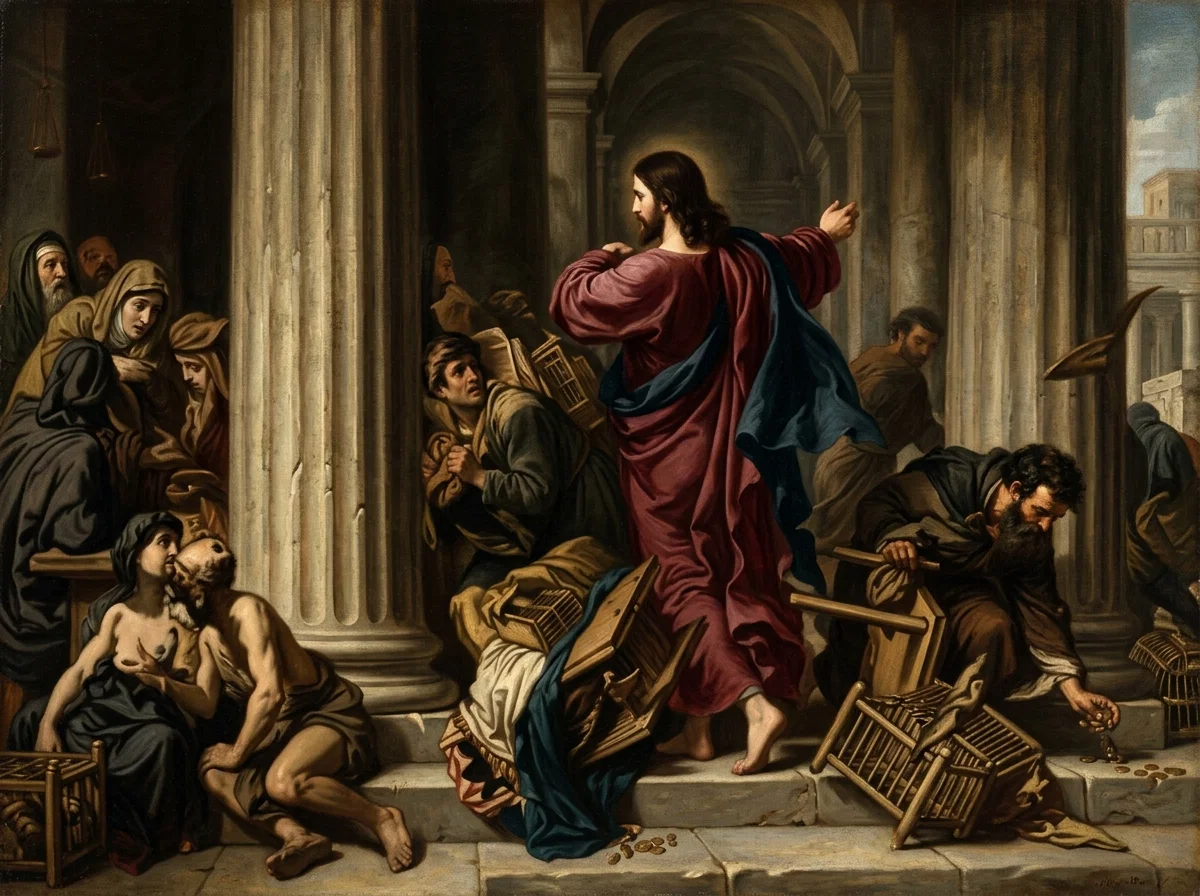
“And the Jews’ Passover was at hand, and Jesus went up to Jerusalem, and found in the temple those that sold oxen and sheep and doves, and the changers of money sitting.” Christ went to the temple, the place where God should have been worshiped, where heart-searching prayers should have been made, and thanksgiving offered to God for the great ransom he had provided. But the scene that met his eye was strangely different from this.
The Jewish leaders had instructed the people that at Jerusalem they were to be taught by precept and example to worship God. Here, during the Passover week, large numbers assembled from all parts of Palestine, and from distant lands. Many were unable to bring with them the sacrifices which were to be offered up as typifying the one great Sacrifice. For the convenience of these, animals were bought and sold in the temple courts. Here all classes of people assembled to purchase their offerings. Here foreign coins were exchanged for the coin of the sanctuary.
The dealers asked exorbitant prices for the animals sold. And the priests and rulers, as well as the dealers, enriched themselves at the expense of the people. They gathered riches by selling to the worshipers, who had been educated to believe that the blessing of God would not rest upon their children or their lands if they did not offer sacrifice. The animals sold at a high price; for after coming from so far, they would not return whence they came without performing the act of devotion for which they had come.
The precincts of God’s temple should have been regarded as holy. The temple was dedicated to the Almighty, and should have been jealously guarded. But in contrast to this, it was made a market-place, and a house of merchandise.
The priests and rulers should have kept the fear of God before their eyes. The buying and selling should have been carried on with an eye single to the glory of God. The dealers should have sold their oxen, sheep, and doves at a just price. They should have been able to appreciate the situation of the purchasers, and been willing to help those who were not able to buy the required sacrifices. But this565they did not do. The spirit of avarice, the desire to accumulate riches, by unfair means, had become more and more common.
There came to this feast those who were suffering, who were in want and distress. The blind, the lame, the deaf, were there. Some were brought on beds. Many came who were too poor to purchase the humblest offering for the Lord, too poor even to buy food with which to satisfy their own hunger. These were greatly distressed by the statements of the priests. The priests boasted of their piety and compassion; they claimed to be the guardians of the people; but they were without sympathy or compassion. The sick, the suffering, the dying, made their vain plea for favor. Their suffering did not awaken any pity in the hearts of the priests.
As Jesus came to the temple, he took in the whole scene. He saw the unfair transactions. He saw the distress of the poor, who thought that without shedding of blood there would be no forgiveness of their sins. He saw the outer court of his temple converted into places of unholy traffic. The sacred inclosure had become one vast exchange.
Christ saw that something must be done. Numerous ceremonies were enjoined upon the people, without the proper instruction as to their import. They offered their sacrifices without understanding that they were typical of the only perfect sacrifice. And among them stood the One symbolized by all their service. He was the foundation of the whole Jewish economy. He had given directions in regard to the offerings. He understood their symbolic value, and he saw that they were now perverted and misunderstood. The temple service had become a mere form. Spiritual worship was fast disappearing. No link bound the priests and rulers to their God. Christ’s work was to establish an altogether different form of worship. He had come to the world as a man, that he might meet humanity where it was, and show men what constituted true worship.
With searching glance Christ took in the scene before him, as he stood upon the steps of the temple court. With prophetic eye he looked into futurity, and saw not only years, but centuries and ages. Indignation, authority, and power were expressed in his countenance. Instantly every voice was hushed. The eyes of those engaged in their unholy traffic were riveted upon his face. They could not withdraw their attention from him. It was as if they were arraigned before the Judge of the whole earth.
Divinity flashed through the garb of humanity. When Christ had made a scourge of small cords, “he drove them all out of the temple, and the sheep, and the oxen; and poured out the changers’ money, and overthrew the tables; and said unto them that sold doves, Take these things hence; make not my Father’s house an house of merchandise.” He drove out the sacrilegious robbers, saying, “It is written, My house is the house of prayer; but ye have made it a den of thieves.” Overpowered with terror, the priests and rulers fled from the temple courts, and from the searching glance that read their hearts. Christ looked upon the fleeing men with yearning pity for their fear, and their ignorance of what constituted true worship. In this scene he saw symbolized the dispersion of the Jewish nation for their wickedness and impenitence.
Why did the priests flee from the temple? Why did they not stand their ground? He who commanded them to go was a carpenter’s son, whom they regarded as a poor Galilean, without earthly rank or power. Why then did they not resist him? Why did they leave the gain so ill acquired, and flee at the command of One whose outward appearance was so humble?
Christ spoke with the authority of a king, and in his appearance and the tones of his voice, there was that which they had no power to resist. At the word of command, they realized as they had never realized before their true position as hypocrites and robbers. When divinity flashed through humanity, not only did they see the expression of indignation on Christ’s countenance, they realized the import of his words. They felt as if before the throne of the eternal Judge, with their sentence passed upon them for time and for eternity. For a time they were convinced that Christ was a prophet; and many believed him to be the Messiah. The Holy Spirit flashed into their minds the utterance of the prophets concerning Christ, “The zeal of thine house hath eaten me up.” Would they yield to this conviction?
Repent they would not. They knew that Christ’s sympathy for the poor had been aroused. They knew that they had extorted from the people more than what they had sold
Repent they would not. They knew that Christ’s sympathy for the poor had been aroused. They knew that they had extorted from the people more than what they had sold them was worth. Because Christ discerned their thoughts, they hated him. They would challenge him as to the power by which he had driven them forth, and who gave him this power.
Slowly and thoughtfully, but with hate in their hearts, they returned to the temple. But what a change had taken place during their absence! When they fled, the poor remained behind; and these were now looking to Jesus, whose countenance expressed his love and sympathy. With tears in his eyes, he said to the trembling ones around him, Fear not; I will deliver thee, and thou shalt glorify me. For this cause came I into the world.
The people pressed into Christ’s presence with urgent, pitiful appeals, Master, bless me. His ear heard every cry. With pity exceeding that of a tender mother, he bent over the suffering little ones. All received attention. Every one was healed of whatever disease he had. The dumb opened their lips in praise; the blind beheld the face of their Restorer. The hearts of the sufferers were made glad.
As the priests and temple officials witnessed this great work, what a revelation to them were the sounds that fell on their ears! The people were relating the story of the pain they had suffered, of their disappointed hopes, of painful days and sleepless nights. But when the last spark of hope seemed to be dead, Christ had healed them. The burden was so heavy, one said; but I have found a Helper! He is the Christ of God; and I will devote my life to his service. Placing palm branches in their children’s hands, parents said to them, He has saved your life; lift up your voice and praise him. The voices of children and youth, fathers and mothers, friends and spectators, blended in thanksgiving and praise. Hope and gladness filled their hearts. Peace came to their minds. They were restored, soul and body, and they returned home, proclaiming everywhere the matchless love of Jesus.
At the crucifixion of Christ the voices of those who had thus been healed did not join with the rabble throng in crying, Crucify him, crucify him. Their sympathies were with Jesus; for they had felt his great sympathy and wonderful power. They knew him to be their Saviour; for he had given them health of body and brought light to their souls. They listened to the preaching of the apostles, and the entrance of God’s words into their hearts gave them understanding. They became agents of God’s mercy, and instruments of his salvation.
So Christ fulfilled the words of prophecy: “The Lord hath anointed me to preach good tidings unto the meek; he hath sent me to bind up the broken-hearted, to proclaim liberty to the captives, and the opening of the prison to them that are bound. . . . To appoint unto them that mourn in Zion, to give unto them beauty for ashes, the oil of joy for mourning, the garment of praise for the spirit of heaviness; that they might be called trees of righteousness, the planting of the Lord, that he might be glorified.” MRS. E. G. WHITE.
FULNESS OF JOY.
By Ellet Joseph Waggoner
“THESE things have I spoken unto you, that My joy might remain in you, and that your joy might be full.” John 15:11. There is something wonderful in these words, especially when we consider the circumstances under which they were spoken. “These things have I spoken unto you, that My joy might remain in you.” That shows us that by receiving and retaining what Jesus says to us, we receive and retain his joy. Joy comes by believing the words of the Lord, as we read, “The God of hope fill you with all joy and peace in believing.” Rom. 15:13. Notice, it is “all joy” in believing, just as Jesus says: “that your joy may be full.” By receiving his words we get fulness of joy—perfect joy.
But that shows us also that he had perfect joy—fulness of joy; for it is his joy that we are to receive. “These things have I spoken unto you, that My joy might remain in you, and that your joy might be full.” We get fulness of joy through Jesus, simply because his joy is perfect. As men sometimes express it, his cup of joy was full. When was it that he expressed the wish that his perfect joy might remain in his disciples?—The very night when he was betrayed; while he was on the way to the place where he knew that he would be delivered into the hands of cruel men, to be mocked, and beaten, and scourged, and crucified. Ah, that is joy worth having,—a joy that is perfect in distress and affliction, a joy that is perfect in itself, and does not depend on circumstances! It is the possession of such joy, and that alone, that enables one to endure affliction. Jesus, because of the joy that he had continually before him, and present with him, “endured the cross, despising the shame.” Heb. 12:2.
This joy is found, not in doubting, not in experimenting, but in trusting. There are millionaires that would give all their possessions for such joy, that delivers from painful anxiety, when the poorest man can have it by simply taking the words of the Lord and letting them work out their fulfilment in him. How can Christians be otherwise than glad, when they serve a Master who is gladness itself? E. J. W.
“BE YE SEPARATE.”
By Annie Sherwood Hawks
O yes, we must be separate
From the great world's ebb and flow;
For at the Master's bidding we
Must ever come and go!
His a peculiar people are,
And tried; for His name's sake;
We may not tread the open paths
Which others freely take.
And if we will not turn away
From self and worldly ties,
He breaks the secret cords which bind
The tempting springs He dries.
In mercy and in tenderness,
Vain hopes He brings to naught,
Oft turns our sweet to bitterness:
In place of what we sought,
Himself, more fully, He reveals,
Surprises more and more;
Until, for loss, we count our gain
A never-failing store.
ANNIE SHERWOOD HAWKS
Bennington, Vt.
THE PROTESTANT FLAG OF TRUCE.
By W. N. G.
The efforts of leading ministers of the Church of England to unite with Rome, and their solicitude that their clerical orders be recognized at the Vatican as valid, is well known to the reading public of the world. So also are the repeated advances of the National Reform forces of America to join hands with Rome in seeking enforced Sunday observance and other religious legislation in this country, as well as in the British provinces wherever they exist.
But a contributor to the Christian Work, George S. Mott, D.D., would have us believe that the difference between Roman Catholicism and Protestantism is merely one of adherence to different translations of the Scriptures. He discusses the importance of uniting the flag and the Bible in the public schools, and says:—
We would cordially invite our Roman Catholic citizens to unite with us in placing the Bible alongside of the American flag. There has been a remarkable advance among them in honoring the flag ecclesiastically. . . . And why will not their ecclesiastical superiors unite with Protestants in giving the Bible a place in the common school, such as is now accorded to the flag? We do not ask them to put King James' Version there. There is no Protestant Bible, nor Roman Catholic Bible. To talk in that way is misleading. There is only one Bible. King James' translation, which bears the name of Protestant, and the Douay, which receives the sanction of the Roman Catholic Church, are from the same sources, and the difference is restricted to a few words. Each side affixes its own exegesis, but the original is virtually the same. Let us recognize this. Let us admit that we do agree more than we are conceding. If we honor the Bible in our hearts, it will be an easy matter to select from these two versions copious portions of Scripture appropriate for our schools. And so will this long controversy come to a happy termination. For if Protestants and Catholics agree in6this matter the contention is ended. And thus will the Bible have its birthright place in our country, and so will the flag receive renewed honor.
But Protestantism was not reared on a pedestal of objection to the version of the Bible then in use, but rather on the fact that the church had practically discarded the use of the Bible altogether. It was the study of the Bible, that which the Roman Church recognized as the Bible, that led Luther to rebel against justification by works, and to preach justification by faith. There was at that time no English version recognized by the Roman Church. The version that Luther studied in the monastery was the Latin Vulgate, from which was translated the English version known as the Douay, called by some the Catholic Bible. As D'Aubigne says, “The Reformation lay hid in that Bible.”
Moreover, the protest of the German princes at the Diet of Spires, from which came the appellation of “Protestants,” was not against any version of the Bible, but was an appeal to the Bible, as it was in existence at the time. Here is a declaration from the protest:—
There is no true doctrine but that which conforms to the Word of God. The Lord forbids the teaching of any other faith. The Holy Scriptures, with one text explained by other and plainer texts, are, in all things necessary for the Christian, easy to be understood, and adapted to enlighten. We are therefore resolved by divine grace to maintain the pure preaching of God's only Word, as it is contained in the Scriptures of the Old and New Testaments, without anything added thereto.
There was no question as to which version of the Bible the Protestants would be governed by. True, Luther translated the Scriptures into the German language in order that the people of that country might have access to it in their own vernacular. There were several versions of the Scriptures then extant, but they were not in general circulation, and the Roman clergy endeavored by all means to keep them from the common people. Protestantism, however, by such a diligent study of the Scriptures as had been unknown for centuries, and by the discovery of better Hebrew and Greek texts, brought out various improved translations in the English language. These have been ignored by Rome, because they were the product of Protestant scholars and not authorized by Roman authority.
When any one assumes that there is no practical difference between Protestantism and Roman Catholicism but the mere variation between the King James and the Douay versions of the Scriptures, we maintain that such presentation is “misleading” in the extreme. If this is all the practical difference between the two establishments, to the extent that each can agree to place the scriptural exegesis of the other in the schools attended by the children of both, then what excuse has Protestantism for an existence at all? It is just such advances toward Romanism as is set forth by Dr. Mott and many others, that enables smart Roman priests to effectually lampoon the masses of so-called Protestants of the present day with the very scriptures upon which they profess to rely for doctrine.
It is the tendency of degenerate Protestantism to trust in the arm of flesh, the powers of earth, that calls for the protection of the Bible by the Stars and Stripes, as tho' God's Word were not more powerful than all the flags of earth. This is the way in which it is proposed to secure a revival of the Word:—
And now we ought to have a revival of the Bible. . . . In almost every house we might wrap the Bible in the Stars and Stripes, and that is the most costly and the most significant cover the Bible can have.
It is this tendency, we repeat, to lean upon the power of man instead of the arm of God, that inclines an apostate Protestantism to seek so many pretexts for uniting with Rome and with the secular powers of earth. It was this tendency, this “mystery of iniquity” that did “already work” even in Paul's day (2 Thess. 2:7), which lowered the church to such a degenerate spiritual condition as to make the Reformation a necessity. And, therefore, from the fallen Protestantism of the latter times there must needs arise a new reformation. Such a reformation also lies hidden in the Bible, which also predicts it. See Rev. 14:6-12. By the outpouring of the Holy Spirit in the time of the latter rain (James 5:7) may the Bible have its birthright place in the hearts of the people, rather than in the folds of any worldly banner. W. N. G.
THE LIFE OF LOVE.
By W. A. Alway
God’s life of love can never be reduced to writing as an abstract thing. Words may, or may not, express to man the power of that life, according as the man is or is not connected, by an inner experience, with the Source of that life. When God himself came down to earth and proclaimed his law, he did not attempt to reduce to words, spoken or written, the eternal principles of love and positive virtues demanded of all intelligent beings, but simply enunciated the prohibitions which marked the boundary line between sin and righteousness, and life and death. As well might the artist attempt to reproduce God upon the canvas, as language to express the fulness of love. Love is a life, and is to be lived, not written.
The apostles wrote a few chapters from the life of Him who was the living manifestation of the Father’s love, but when the last one had completed his task he added: “And there are also many other things which Jesus did, the which, if they should be written every one, I suppose that even the world itself could not contain the books that should be written.” John 21:25. That was a life of love. It could not be written out, yet it could be lived; for said Paul, “I am crucified with Christ; nevertheless I live; yet not I, but Christ liveth in me; and the life which I now live in the flesh I live by the faith of the Son of God.” Gal. 2:20. He desired that every thought should be brought into captivity to that life. Glorious captivity of love! To be a captive of love is to be eternally free.
Love is a perfect law: “For all the law is fulfilled in one word, even in this: Thou shalt love thy neighbor as thyself.” Chapter 5:14. The first and great commandment of the law is, “Thou shalt love the Lord thy God with all thy heart, and with all thy soul, and with all thy mind.” All that there is of man is swallowed up in that first requirement. It is the captivity of the soul to God. It is necessarily first because the fulfilment of the second is impossible without the fulfilment of the first. He who does not first love God, and love him completely, can not love his fellow-men as himself; but he who does possess that love will love the universe, because God’s love is universal. It will even extend to his enemies; for “God commendeth his love toward us, in that, while we were yet sinners, Christ died for us.” Rom. 5:8. “For God so loved the world, that he gave his only-begotten Son.” John 3:16. The manifestation of love toward our brother is but the reflection of God’s love that fills the whole being when wholly surrendered to him. “And this commandment have we from him, That he who loveth God love his brother also,” and, “If God so loved us, we ought to love one another.”
Absolute Submission the Foundation of Perfect Love.
Where perfect love exists there will be found the complete submission of both parties of the compact the one to the other, not a forced but a willing submission. Many feel an aversion to the use of that term as indicating a condition of weakness or slavery. There are perhaps no scriptures more often criticized than those that speak of the submission of the wife to the husband in the marriage relation—as tho it were possible to know the joy of true love without submission. We forget also that the command that follows, “Husbands, love your wives, even as Christ also loved the church, and gave himself for it,” implies the complete submission of the husband to the wife. It is only when life is thus swallowed up in life, by a complete and mutual submission, that the union of love is possible. It is impossible to truly love without the surrender of the life, with all its powers, to the object of that love. The smallest reserve may destroy the joy of such a union.
Is this, therefore, the basis of God’s love to man? We answer, Yes. In the creation of man God poured out the fulness of his own life. It was the union of the Creator with the creature, through a mutual submission in a union of everlasting love. This surrender of life came first on the part of God, for “he giveth to all life.” Was this surrender complete on the part of God? Let Calvary answer. Let the blood-sweat of Gethsemane answer. Let Joseph’s new tomb answer. Let God himself answer. For “he that spared not his own Son, but delivered him up for us all, how shall he not with him also freely give us all things?” Rom. 8:32. “All things are yours; whether Paul, or Apollos, or Cephas, or the world, or life, or death, or things present, or things to come; all are yours; and ye are Christ’s; and Christ is God’s.” 1 Cor. 3:21–23. It is therefore plain that the demand of the submission of his creatures is but the reflection of a primary and greater submission on his own part. Calvary did not bring into existence the principle of submission in the character of God; it simply revealed more clearly what had always been from eternity the actuating motive of his being.
True submission is not weakness; it is strength. To submit is godlike; to rebel is Satanic. If we could but catch a glimpse of the true meaning of godly submission, it would cease to have any unpleasant sound to the ear. It is the point at which the human and divine meet. Through it man is united with a power that is above every principality and power. By means of it man opens the door of his heart to the real presence of the life of God. It is the point of distinction between genuine faith and obedience, and the false. A faith that does not submit is merely the belief possessed by the demons of darkness; for they believe and tremble, but never have submitted. It is through the complete submission of the soul to Christ that he is crowned Lord of all, and given his rightful supremacy in all things.
The intrinsic value of any action depends not so much upon the outward form of the act itself as upon the motive that prompted it. For “tho I bestow all my goods to feed the poor, and tho I give my body to be burned, and have not charity, it profiteth me nothing.” 1 Cor. 13:3. Paul was forced to declare that all his outward display of righteousness was loss before he could7win Christ. He shows that the failure of his brethren, the Pharisees, to attain to the righteousness of God lay in the fact that they would not submit. All works wrought at the point of the complete submission of the life to God, and therefore the production of love, are as eternal as God, by whose Spirit they are wrought. They may be unnoticed and unpraised by the children of men. The instrument through whom they are wrought may be despised, and covered with ignominy and scorn, yet when the veil of futurity is drawn aside, and all things appear as they really are, those humble deeds will flash forth as diadems of eternal glory.
Influence of Submission upon Character.
It is often urged that it was necessary that sin should exist in order that character should be perfectly developed. It is argued that man would be weak if it were not for his resistance to temptation. Strength of character does not come from resistance of the evil, but from the choice of the right. Submission to the good must precede the triumph over evil; for it is the good alone that can overcome evil.
All that is necessary, therefore, in order that character may be perfectly developed, is the opportunity to submit by a willing choice to the Author of all good. This opportunity was granted to man in the beginning, and through a constant exercise of submission it was possible for Adam and all his posterity to have revealed continually the eternal character, power, and goodness of the Creator. As the angels “do always behold the face of our Father which is in heaven,” receiving from that glorious presence, life and power, so that wherever his Spirit was to go, there they went as the appearance of a flash of lightning, so man was to live in the presence of God, which, in his innocence and purity, was to be to him fulness of joy and pleasures forevermore. That presence was to be to him life,—wisdom and righteousness working through the human instrument reflecting the glory of the Creator.
W. A. Alway.
THE APOSTLES AND THE LAW OF GOD.
By W. L. Iles
Third Proposition.
Man never can become holy or righteous by his own works or by the “deeds of the law.” This proposition makes it necessary to consider the object of the law.
“I do not frustrate the grace of God; for if righteousness come by the law, then Christ is dead in vain.” Gal. 2:21.
Righteousness comes by Christ, and not by the law, and yet the righteousness we are to have is the righteousness demanded by the law.
The law may make certain demands, and still not give that which it demands. The object of the law to the sinner is not to give righteousness, but to present to the world a true standard of righteousness. Because the law will not give righteousness, some have concluded that it is of no good in this dispensation, and that it was abolished at the cross. Shall we consider the law abolished because it will not do for us that for which it was not given? The law being the standard of righteousness, it will reveal that which is not righteousness, or that which is sin. “Therefore by the deeds of the law there shall no flesh be justified in his sight; for by the law is the knowledge of sin.” Rom. 3:20. So long as people need to know that they are sinners, just so long will there be need of the law. It was the law that revealed to Paul that he was a sinner. “I had not known sin, but by the law; for I had not known lust, except the law had said, Thou shalt not covet.” Rom. 7:7. When Paul found himself a sinner, by a look into the law he received righteousness through Christ. He put on God’s righteousness, and the law bears witness to that righteousness. Rom. 3:21.
“Knowing that a man is not justified by the works of the law, but by the faith of Jesus Christ, even we have believed in Jesus Christ, that we might be justified by the faith of Christ, and not by the works of the law; for by the works of the law shall no flesh be justified.” Gal. 2:16.
The faith that Jesus had while upon earth is that by which we are justified. The faith of Jesus benefits those that believe in him, because they put on a robe of righteousness, woven by the “faith of Jesus.” If we try to weave our own garment by the “works of the law,” then we have no need of Christ.
“Therefore we conclude that a man is justified by faith without the deeds of the law.”
“Do we then make void the law through faith?” God forbid; yea, we establish the law.
Faith in Christ does not affect the law only as it establishes it. Faith that makes void the law of God is not a true faith. “For Christ is the end of the law for righteousness to every one that believeth.” Rom. 10:4. The word “end” in this text has the meaning of object, or purpose, as in James 5:11. The object of the law is to get a man to Christ, where he will find a robe of righteousness, which he puts on by faith. Many suppose that this text proves that the law ends, or is abolished, at the cross. How could this be true, when it is only to those that believe? Then the law has not ended yet to those who do not believe. And the unbeliever must keep the law, but the believer can break it. This is a logical conclusion, this false theory.
Where to Get Righteousness.
There is only one place to obtain righteousness, and that is in Christ; and there is only one way to get it, after we find where it may be obtained, and that is by faith. There is no other way. It is not by “works;” it is by “faith,” and faith only. “But to him that worketh not, but believeth on Him that justifieth the ungodly, his faith is counted for righteousness.” Rom. 4:5. We may try to get out of the bondage of sin some other way than by faith, but we always fail. We are shut up under the dominion of the law, because of transgression, until we accept of pardon through Christ.
If we transgress the law, we are condemned by it, and its penalty hangs over our heads. If a man commits a crime in civil government, and he knows he is guilty, and condemned by the law, he should expect to pay the penalty of his crime, or be pardoned by the governor. The law, by refusing to release its claims upon the individual, until the penalty is paid, or until pardoned, causes the sinner to look for some one who has the power to pardon, and so he is directed to Jesus. As “all have sinned, and come short of the glory of God” (Rom. 3:23), all are guilty and condemned by the law. Then all must pay the penalty of their sins, or look to Jesus for pardon. Christ is the desire of all nations. He alone can satisfy the guilty soul.
“That ye may know that the Son of man hath power upon earth to forgive sins (he said unto the sick of the palsy), I say unto thee, Arise, and take up thy couch, and go into thine house.” Luke 5:24.
Christ proved by this miracle that he could forgive sin. The individual who has not been pardoned is under the condemnation of the law. He is not free, but “shut up,” until the penalty is paid, or until pardoned. “For sin shall not have dominion over you; for ye are not under the law, but under grace.” Rom. 6:14. What is it to be “under the law”? Let the Bible answer: “If ye be led of the Spirit, ye are not under the law.” Gal. 5:18. “There is therefore now no condemnation to them which are in Christ Jesus, who walk not after the flesh, but after the Spirit.” Rom. 8:1.
Placing the thoughts of these texts together, we have the following,—to be “led of the Spirit” and to “walk after the Spirit” is a condition of “no condemnation,” and a condition of “not under the law.” Therefore those under condemnation are under the law. “For as many as are led by the Spirit of God, they are the sons of God.” Being the sons of God, we are led by the Spirit of God, and being led by the Spirit of God, we are not under the law. Therefore all who are not the sons of God, or who are unconverted, are under the law, or condemned by the law. When the condemnation is removed, and we are pardoned through Christ, then we are under grace. The only way for us to be in a condition free from sin, and free from condemnation, was for Jesus to take our sin and condemnation upon him. “He hath made him to be sin for us, who knew no sin; that we might be made the righteousness of God in him.” 2 Cor. 5:21. We are condemned because we have sinned. We are made free from condemnation because he was “made sin for us.” Jesus bore the condemnation of sin, altho he never sinned. The penalty of the law rested upon him, that we might be free. “He bore our sins and carried our sorrows.” Jesus was then “under the law,” under condemnation, because he bore our sins.
“But when the fulness of the time was come, God sent forth his Son, made of a woman, made under the law, to redeem them that were under the law, that we might receive the adoption of sons.” Gal. 4:4, 5.
W. L. ILES.
(To be continued.)
“LET EVERY MAN.”
By F. H. Tripp
“One man esteemeth one day above another; another esteemeth every day alike. Let every man be fully persuaded in his own mind.” Rom. 14:5. This text is quoted more frequently by those opposed to the Bible Sabbath than any other one in the Scriptures, and it is always quoted in a way to give the hearer to understand that he has no right to interfere with any other man’s religious belief.
Well, that is all right. We fully agree with it; but are the men who pervert this scripture as consistent as they claim to be? Do they not rather seek to turn men away from the truth in every possible way, and, while quoting the above text, strive to hinder men from being persuaded?
Another text often quoted, and that fully agrees with the above, is this: “Let no man therefore judge you in meat, or in drink, or in respect of an holy day, or of the new moon, or of the sabbath days.” Col. 2:16. While saying, “Let no man therefore judge you,” it seems to me that some men do judge, and that very severely. Our Saviour said, “If any man hear my words, and believe not, I judge him not; for I came not to judge the world, but to save the world.” John 12:47. This he said of his first advent into this world. When he comes the second time, it will be to judgment: “And before him shall be gathered all nations, and he shall separate them one from another.” Matt. 25:31–46. Here is vividly portrayed the great judgment scene.
In perfect accord with this, Paul says, “For we must all appear before the judgment-seat of Christ; that every one may receive the things8done in his body, according to that he hath done, whether it be good or bad.” 2 Cor. 5:10. “Therefore judge nothing before the time, until the Lord come, who both will bring to light the hidden things of darkness, and will make manifest the counsels of the hearts.” 1 Cor. 4:5. “But why dost thou judge thy brother or why dost thou set at naught thy brother? for we shall all stand before the judgment-seat of Christ.” Rom. 14:10.
What will be the rule in that judgment? what the standard by which men will be judged? In this world the standard of judgment is the law of the land. When men who have violated the law are brought to trial, they are judged by the law. So men who have broken God’s law must be judged by the same law which they have violated, as it is written, “As many as have sinned without law shall also perish without law; and as many as have sinned in the law [knowing the law] shall be judged by the law.” When?—“In the day when God shall judge the secrets of men by Jesus Christ according to my Gospel.” Rom. 2:12, 16.
We are told in 1 John 3:4 that “sin is the transgression of the law!” and, according to the foregoing texts, men are to be judged by the law. How important, then, that every man should be let, or allowed, to “be fully persuaded in his own mind,” and that no other man should judge him, or tell him it makes no difference whether he keeps God’s law or not! For that is really what is said by many in regard to the fourth commandment. God says, “The seventh day,” men say, “It makes no difference which day.” Whom shall we believe, God or man?