Your ShelfYour Projects

Review and Herald, Vol. 85, No. 42.

The Reward of Obedience

Review and Herald

Oct 15, 1908

Review and Herald Publishing Association · Takoma Park Station, Washington, D. C. · Oct 15, 1908

The Reward of Obedience

Thus saith the Lord, Keep ye judgment, and do justice: for My salvation is near to come, and My righteousness to be revealed. Blessed is the man that doeth this, and the son of man that layeth hold on it; that keepeth the Sabbath from polluting it, and keepeth his hand from doing any evil. Neither let the son of the stranger, that hath joined himself to the Lord, speak, saying, The Lord hath utterly separated me from His people: neither let the eunuch say, Behold, I am a dry tree. For thus saith the Lord unto the eunuchs that keep My Sabbaths, and choose the things that please Me, and take hold of My covenant; even unto them will I give in Mine house and within My walls a place and a name better than of sons and of daughters: I will give them an everlasting name, that shall not be cut off. Also the sons of the stranger, that join themselves to the Lord, to serve Him, and to love the name of the Lord, to be His servants, every one that keepeth the Sabbath from polluting it, and taketh hold of My covenant; even them will I bring to My holy mountain, and make them joyful in My house of prayer: their burnt-offerings and their sacrifices shall be accepted upon Mine altar; for Mine house shall be called an house of prayer for all people. Isa. 56: 1-7.

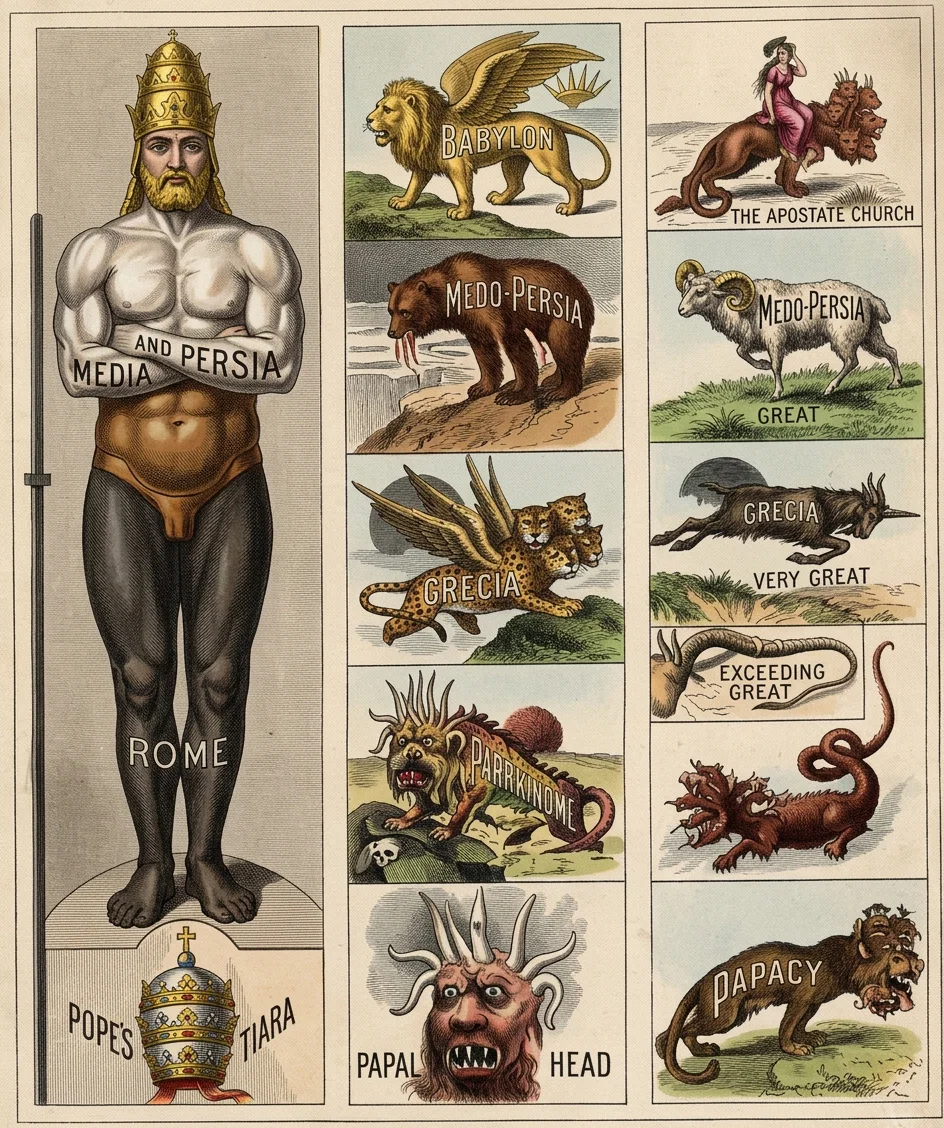
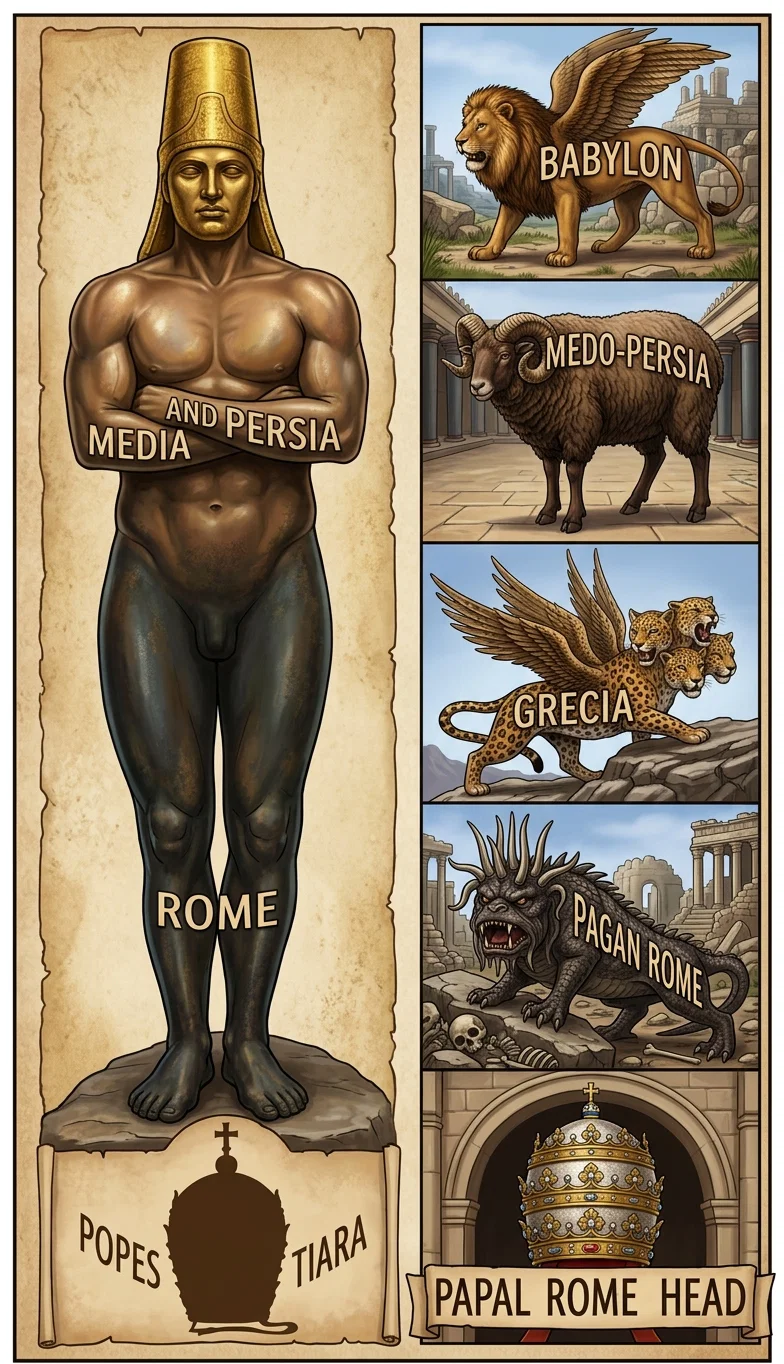
THE NEW PROPHETIC CHART

Fig. 3
Fig. 3
Fig. 2
Fig. 2
Fig. 1
Fig. 1
Fig. 4
Fig. 4

Explanation

Figure 1 shows the chart folded to show only the image of Daniel 2. Figure 2 gives Daniel 2 and 7, thus making a comparison of the two chapters easy. Figure 3 shows Daniel 2, 7, 8. Figure 4 is a reproduction of the whole chart one-twelfth actual size.
By this arrangement each subject may be presented separately without showing the balance of the chart. Thus the audience is not confused by a large number of symbols which have not been explained, but is led step by step through the whole series.

Special Features

The chart measures 48 x 72 inches (twice the size of the old prophetic chart).
It takes up no more room in the suit-case or grip than a Bible, and weighs only 8 ounces.
It is printed on a fine quality of unglazed muslin which can be folded as many times as desired without hurting the appearance of the chart.
It can be folded to show each set of symbols separately, or so as to compare similar chapters—as Daniel 2, 7, 8.
The characters are large enough to be seen from any point in an ordinary lecture-hall or tent.
Price, only $2.75, post-paid
Published by

Review and Herald Publishing Association

32 Union Square East, New York City
TAKOMA PARK, WASHINGTON, D. C.
Battle Creek, Michigan
Order of any Tract Society or Publishing House

The Surety for Righteousness

RIGHTEOUSNESS is the condition of entrance into the kingdom of God, and this righteousness must be after the divine standard. To the people gathered about him on the mountainside, Jesus said, “Except your righteousness shall exceed the righteousness of the scribes and of the Pharisees, ye shall in no wise enter into the kingdom of heaven.”
The outward evidence of the possession of such righteousness is obedience to the commandments of God. “He that doeth righteousness [“All thy commandments are righteousness”] is righteous, even as he is righteous.” It follows therefore that there must be obedience to the commandments of God on the part of those who are citizens of the heavenly kingdom.
If this were all, and if no provision had been made whereby we are enabled to render obedience to the requirements of God, our case would be indeed hopeless; for it is not only true that “there is none that doeth good, no, not so much as one,” but it is also true that our very nature has been so depraved in consequence of sin that we have in ourselves no power to do good. Our desires may be for the things that are excellent, our purpose may be to conform to the highest standard, and our ambition may be to lead a life free from imperfection; but the experience of every man demonstrates his inability to meet such ideals. All this was recognized in the statement of Jesus, “Apart from me ye can do nothing,” and was illustrated in the experience of the apostle Paul, who said, “The good which I would I do not: but the evil which I would not, that I practise.”
There is a clear application of these principles in the case of the two covenants. In the old covenant the people readily promised the required obedience to the law of God, without appreciating their own inability to fulfil their agreement, and consequently without availing themselves of the provision, already in existence, to make obedience possible through the assisting grace of God in Christ. The need of something further than good intentions and unsecured promises was soon demonstrated by the lapse of the people into the gross idolatry by which they had been surrounded in Egypt.
The new covenant is upon an altogether different basis, having been “enacted upon better promises,” and provision has been made through which the obedience required may be rendered. There was no surety of the old covenant, and the need of one was not recognized by those who promised obedience, but the utter uselessness of unaided human effort was soon made manifest. In marked contrast with this is the new covenant, of which Jesus is both the mediator and the surety. Of this we learn in these words: “But now hath he obtained a ministry the more excellent, by so much as he is also the mediator of a better covenant, which hath been enacted upon better promises.” “And inasmuch as it is not without the taking of an oath (for they indeed have been made priests without an oath; but he with an oath by him that saith of him, The Lord sware and will not repent himself, Thou art a priest forever); by so much also hath Jesus become the surety of a better covenant.” A surety is “one who has made himself responsible for another.” Jesus “is surety of the covenant on both sides, — surety to us that God will keep his promise, and give us his life and law and Spirit in our heart,— surety to God for us; he will ensure our obedience and our keeping the covenant.” “Christ is called a surety . . . because God on his part gave him to the human race as a surety for the actual fulfilment of his covenant promise.”
As our sacrifice Christ “through the eternal Spirit offered himself without blemish unto God;” as our substitute he stood in our behalf to pay the penalty for sin which was due from us; as our surety he becomes the power in us, overcoming evil and enabling us to render obedience to all the commandments of God.
In this last generation, when the new covenant will be fully accomplished, there should be such a manifestation of conformity to the perfect and complete will of God as would clearly distinguish those who are enjoying the blessings of the new covenant from those who are depending upon inherent goodness or their own ability to reveal a Christlike character. This is plainly implied in the words of the Revelator, who spoke of that company who should be on the earth during the closing experiences of the gospel, in these words: “Here is the patience of the saints, they that keep the commandments of God, and the faith of Jesus.” It is only through “the surety of a better covenant” that such experiences can be attained, and it is therefore of the utmost importance that both the fact and the meaning of such a surety should be made known in the clearest terms.

Fulfilling Before Us

THE remarkable revival of the discussion and exploitation of spiritualistic manifestations is a sign of the times. Magazines of all classes, scientific, domestic, and general, have seemed with one accord to join in teaching the reading world that these wonders come through the spirits of the dead. It is as if some central bureau had planned to use all the periodicals simultaneously as mediums for spreading the ideas of Spiritualism.
In Van Norden’s Magazine, for September, Mr. Gustavus Myers reviews the development of the movement. He says:—
Not until 1847 did the modern psychological movement begin. It really had its origin in the manifestations displayed in the presence of two American girls, the Fox sisters, Margaret and Katherine, then living in the town of Arcadia, N. Y. In that year they began to hear strange noises and see strange forms. These phenomena, it became certain, were not produced by human causes.The Fox sisters asserted that they soon learned by raps to communicate with invisible intelligences whom they called spirits. The age was a severely incredulous one; the wave of materialism was at its height; and the claims of the Fox sisters met with general derision.
At that time, when the world was scoffing at the manifestations, and scientific men declared there was nothing to them, it was shown to the advent believers through the spirit of prophecy that these manifestations were deeply significant. In a view given in 1849, it was said:—
I saw that the mysterious knocking in New York and other places, was the power of Satan, and that such things would be more and more common, clothed in a religious garb so as to lull the deceived to more security.—“Early Writings,” page 35.
From its obscure beginning modern Spiritualism has grown and spread and flourished until now it is taking the world captive with its fascinating philosophy and its evident exhibitions of a supernatural power. Now it is indeed “clothed in a religious garb.” We see fulfilled and fulfilling before us exactly what the spirit of prophecy described in those early days.
Truly everything is shaping for the crisis. The present marked and worldwide revival of interest in the wonders of Spiritualism is evidence that Satan is preparing the way for this agency to act its destined part in the closing scenes. Thank God for the third angel’s message that bears the clear warning against every form of error in these last days.
W. A. S.

Editorial

Good words and good works are the fruit of a changed heart and not the means of changing the heart.

Salvation Received Through Faith

WE are not saved by works, not even by the works of faith. Salvation is the gift of God, received through faith in Christ, and revealed in the works of faith. We can not purchase this gift.

The Rise and Fall of Religious Liberty in America

State Constitutions and Freedom of Conscience (Continued)

The first State to respond to the invitation of the Continental Congress in the matter of adopting a constitution was New Hampshire. The date of this, the first of the State constitutions, was Jan. 5, 1776, antedating the Declaration of Independence by five months. This constitution, however, said nothing in reference to freedom of conscience. It remained the supreme law of the State until June 2, 1784, when a new constitution was adopted. Articles II and III of this constitution speak of the natural rights of man. Article IV deals with one of these natural rights as follows:—
Among the natural rights, some are in their very nature unalienable, because no equivalent can be given or received for them. Of this kind are the rights of conscience.
Articles V and VI deal with the matter of religious liberty, and read as follows:—
5. Every individual has a natural and unalienable right to worship God according to the dictates of his own conscience and reason; and no subject shall be hurt, molested, or restrained in his person, liberty, or estate for worshiping God, in the manner and season most agreeable to the dictates of his own conscience, or for his religious profession; provided he doth not disturb the public peace, or disturb others in their religious worship.
6. As morality and piety, rightly grounded on evangelical principles, will give the best and greatest security to government, and will lay in the hearts of men the strongest obligations to due subjection; and as the knowledge of these is most likely to be propagated through a society by the institution of the public worship of the Deity, and of public instruction in morality and religion; therefore to promote those important purposes, the people of this State have a right to empower, and do hereby fully empower, the legislature to authorize from time to time the several towns, parishes, bodies-corporate, or religious societies within this State, to make adequate provision at their own expense for the support and maintenance of public Protestant teachers of piety, religion, and morality. . . . No subordination of any one sect or denomination to another shall ever be established by law.
The above-quoted articles were an attempt to establish religious equality; but they did it for a portion of the people only—those of the Protestant persuasion. Article VI, while declaring that no denomination shall be subordinated to another, does specifically, in its own provision, subordinate the Catholic to the Protestant. More than that, the constitution declares, in so many words, that no man will be eligible to the presidency (governorship) of that State “unless he shall be of the Protestant religion.”
Another constitution was adopted in 1792 (September 5), which embodied all the foregoing provisions, and added another which reads:—
SECTION 29. Provided, nevertheless, That no person shall be capable of being elected a senator who is not of the Protestant religion, and seized of a freehold estate, etc.
It is thus evident that it was the purpose of the framers of both constitutions that Protestant Christianity should be the dominant form of religion in New Hampshire, notwithstanding the declaration of that same constitution that no sect or denomination should be subordinate to another.
In order of date the next constitution adopted was that of New Jersey,—July 2, 1776. While this constitution, by Article XVIII, seems to grant the utmost freedom of conscience, it is plainly shown by Article XIX that the freedom of conscience there guaranteed is the freedom of Protestant conscience only. The two articles read as follows:—
18. That no person shall ever, within this colony, be deprived of the inestimable privilege of worshiping Almighty God in a manner agreeable to the dictates of his own conscience; nor, under any pretense whatever, be compelled to attend any place of worship, contrary to his own faith and judgment; nor shall any person, within this colony, ever be obliged to pay tithes, taxes, or any other rates, for the purpose of building or repairing any other church or churches, place or places of worship, or for the maintenance of any minister or ministry, contrary to what he believes to be right, or has deliberately or voluntarily engaged himself to perform.
19. That there shall be no establishment of any one religious sect in this province, in preference to another; and that no Protestant inhabitant of this colony shall be denied the enjoyment of any civil right, merely on account of his religious principles; but that all persons professing a belief in the faith of any Protestant sect, who shall demean themselves peaceably under the government, as hereby established, shall be capable of being elected into any office of profit or trust, or being a member of either branch of the legislature, and shall fully and freely enjoy every privilege and immunity enjoyed by others their fellow subjects.
This constitution remained in force until 1844, when a new constitution was adopted. By the time this new constitution was adopted, the people seemed to see the inconsistency of Article XIX of the previous constitution; and while Article XVIII of the older document became Article III of the new one, Article XIX was changed to read thus:—
4. There shall be no establishment of one religious sect in preference to another; no religious test shall be required as a qualification for any office or public trust; and no person shall be denied the enjoyment of any civil right merely on account of his religious principles.
Thus altered, the constitution of New Jersey is consistent with itself, and stands upon the broad principles of true religious liberty.
The Virginia constitution followed New Jersey in point of date. The Bill of Rights adopted on June 12, 1776, became a part of Virginia’s constitution, although the Virginia constitution proper was adopted seventeen days later, June 29. That Bill of Rights contained this declaration:—
SECTION 16. That religion, or the duty which we owe to our Creator, and the manner of discharging it, can be directed only by reason and conviction, not by force or violence; and therefore all men are equally entitled to the free exercise of religion, according to the dictates of conscience; and that it is the mutual duty of all to practise Christian forbearance, love, and charity toward each other.
In 1830 another constitution was adopted, in which it was expressly declared that the “declaration of rights” made on June 12, 1776, should bear the same relation to that constitution as it had to the previous constitution. In the year 1850 a new constitution was adopted, and of this also the “declaration of rights” was made a part, with Section 16 intact. In the Virginia constitutionof 1864 the “declaration of rights” appears just as it did in the constitution of 1830. In the constitution adopted in 1870 the bill of rights was amended by inserting two additional sections, the old Section 16, dealing with religion, now appearing as Section 18, but without changing it in any particular. Virginia, unlike some of the other States required no religious test for her governors or senators. The long struggle of her oppressed peoples seem to have taught her legislators the importance of keeping the church and the state separate.
The constitution of Delaware was proclaimed Sept. 21, 1776. It says nothing about governments’ deriving their just powers from the consent of the governed, about the equality of man, or about freedom of conscience. On the contrary, Article XXII contains the following provision, which is entirely subversive of the principle of religious liberty:—
Article XXII. Every person who shall be chosen a member of either house, or appointed to any office or place of trust, before taking his seat, or entering upon the execution of his office shall . . . make and subscribe the following declaration, to wit: “I, A B, do profess faith in God the Father, and in Jesus Christ, his only Son and in the Holy Ghost, one God, blessed forevermore; and I do acknowledge the Holy Scriptures of the Old and New Testament to be given by divine inspiration.”
Article XXIX of this constitution declares:—
There shall be no establishment of any one religious sect in this State in preference to another; and no clergyman or preacher of the gospel, of any denomination, shall be capable of holding any civil office in this State, or of being a member of either of the branches of the legislature, while they continue in the exercise of the pastoral function.
The framers of the last clause doubtless feared that some denomination might succeed in getting enough of its ministers into the legislature to enact legislation favorable to that denomination, and antagonistic to other sects. Other States had a similar provision.
In the year 1792 Delaware adopted a new constitution, and the first two sections of Article I of this constitution read as follows:—
SECTION 1. Although it is the duty of all men frequently to assemble together for the public worship of the Author of the universe, and piety and morality, on which the prosperity of communities depends, are thereby promoted; yet no man shall or ought to be compelled to attend any religious worship, to contribute to the erection or support of any place of worship, or to the maintenance of any ministry, against his own free will and consent; and no power shall or ought to be vested in or assumed by any magistrate that shall in any case interfere with, or in any manner control, the rights of conscience, in the free exercise of religious worship, nor a preference be given by law to any religious societies, denominations, or modes of worship.
SECTION 2. No religious test shall be required as a qualification to any office, or public trust, under this State.
There seems to have come about a complete revulsion of sentiment since the adoption of the previous constitution, which required the strongest kind of religious test for the holding of public offices. The constitution adopted by Delaware in 1831 re-enacts the two sections above quoted practically word for word.
On Sept. 28, 1776, Pennsylvania adopted its State constitution. Article I of that constitution declares the equality of men. Article II is very explicit in the matter of freedom of conscience, so explicit, in fact, as to deny, in effect, what it pretends to grant; while Section 10 of the “Frame of Government” practically nullifies whatever of Article II is not already nullified by its own provisions. Article II reads:—
That all men have a natural and undeniable right to worship Almighty God according to the dictates of their own consciences and understanding; and that no man ought or of right can be compelled to attend any religious worship, or erect or support any place of worship, or maintain any ministry, contrary to or against his own free will and consent: nor can any man, who acknowledges the being of a God, be justly deprived or abridged of any civil right as a citizen, on account of his religious sentiments or peculiar mode of religious worship.
The latter portion of Section 10, above referred to, reads:—
And each member [of the house of representatives], before he takes his seat, shall make and subscribe the following declaration: viz.:—
“I do believe in one God, the Creator and governor of the universe, the rewarder of the good and the punisher of the wicked. And I do acknowledge the Scriptures of the Old and New Testament to be given by divine inspiration.”
And no further or other religious test shall ever hereafter be required of any civil officer or magistrate in this State.
When the constitution of 1790 was adopted, Article II of the constitution of 1776 was divided, and a clause was added to the first portion in the seeming endeavor to make freedom of conscience more secure. The amended article appears as Sections 3 and 4 of Article IX in the constitution of 1790, and reads:—
SECTION 3. That all men have a natural and indefeasible right to worship Almighty God according to the dictates of their own consciences; that no man can of right be compelled to attend, erect, or support any place of worship, or to maintain any ministry, against his consent; that no human authority can, in any case whatever, control or interfere with the rights of conscience; and that no preference shall ever be given, by law, to any religious establishments or modes of worship.
SECTION 4. That no person who acknowledges the being of a God and a future state of rewards and punishments, shall, on account of his religious sentiments, be disqualified to hold any office or place of trust or profit under this commonwealth.
The clause concerning “no further or other religious test” does not appear in this constitution. It is evident from the two sections that a religious test is made, and that it is the rights of the Christian only that are guaranteed by this constitution. The constitutions of 1838 and of 1873 are identical with the above in these particulars.
C. M. S.
(To be concluded)

In the Near East

THE recent developments and changes in Turkey are of special interest to those who are watching the fulfilment of prophecy, and looking to the solution of the “Eastern Question” as one of the special signs of the times. In the current number of the Missionary Review of the World there is a thoughtful editorial estimate of the present situation and its meaning, from which we have taken the following liberal extract:—
The “Eastern question,” with all its clear complications, has always centered in the treacherous sultan of Turkey. In 1879 pressure was put upon him by the British government to reduce him to submission; and since that time he has shown himself master of the art of diplomacy, displaying a measure both of capacity and of sagacity in the conduct of his government and the management of his numerous “entangling alliances” that has excited at once the admiration and apprehension of all Europe, if not of all Asia as well.
His methods, however, are subtle, oftentimes to the borders of the diabolical. Those who, like missionaries at the Golden Horn, are in closest contact with his court, quite unanimously agree that a worse man never perhaps occupied the seat of empire. His mental powers seem to be the slaves of ambition, avarice, selfishness, and sensuality. In many matters it is difficult so to penetrate the veil of secrecy that surrounds him as to know the facts; but, with the utmost charity of judgment, it is still more difficult to accredit him with any sincere and unselfish motive. Hence the general consensus of opinion that even these [latest] concessions are to be distrusted unless they have been forced upon him. If granted of his own free will, we could not but think that they are only a cover to his duplicity. We hope, but our hope is mingled with fear.
The situation in Turkey is just now sufficiently tumultuous. The powers have decided not to press Macedonian reforms, but meanwhile watch developments, leaving Turkey free to solve the Macedonian problem herself, but there is a lurking suspicion that it was to hoodwink these powers and stave off action, that the sultan has promised these reforms in the empire.
Meanwhile ministerial changes in Constantinople are moving forward with rapid pace; in fact, the rapidity itself is alarming, as it threatens reaction. The “Young Turk” propaganda in the army in favor of autonomy for Macedonia is so wide-spread and outspoken that already almost all the leaders are in the attitude of mutiny. The reform has already assumed the character and dimensions of a revolution. Bulgaria is likely to find in the present disturbances in the army in Macedonia her opportunity to adjust her controversies with the Porte. The cry, “Turkey for the Turks,” is ambiguous, and may prove misleading. Punch reminds us that the motto of the French Revolution, “Liberty, Equality, Fraternity,” was practically interpreted as, “Infantry, Cavalry, and Artillery.”
The young party of Turkish revolutionists are liberal to the verge of recklessness. They have so far broken loose from the fetters of the ancient régime as to demand even for non-Mussulmans a place in the ministry of the empire! The sultan has not been altogether above admitting even Christian men to his councils, now and then, compelled to recognize in them both wise and impartial judges, as was the case with Schwartz in India and Verbeck in Japan; but to admit outsiders to a place in his cabinet is quite another thing.
The remarkable and almost revolutionary changes which have occurred within a short time in the far East, in Russia, in Persia, and in Turkey are all its clear indications of the rapidity with which the old established can give way to new situations, and constitute in themselves the evidence that in these closing years neither the stagnation of ignorance nor the opposition of barbarism can prevent a quick fulfilment of the divine purpose. These are certainly days fraught with unusual interest, while the blank spaces in the field of fulfilled prophecy are being so clearly and so speedily filled out. It only remains for believers to act well their part in the program.

The Thanksgiving Number

THOSE who have seen the special Thanksgiving number of the REVIEW agree that this will be the most striking review of our work that we have ever had to place in the hands of the people.
Just at this time, it seems apparent, this document, graphically showing what the message is actually accomplishing, will be a stronger testimony to our neighbors and the public than a paper filled with doctrinal articles. These latter we must always keep circulating; but for this Thanksgiving season the thing that seems to fit the time and the occasion exactly, the shaft that will go true to the mark, is just such a paper as this in preparation.
Menelaus, a Grecian warrior, was famous in ancient time for his ability to shoot three arrows from the bow at one time, each finding its separate mark. The effort with this Thanksgiving special is to accomplish three things at one stroke:—
1. It will prove a blessed experience to those who go out with the paper to leave it as a missionary souvenir with those who contribute to foreign missions.
2. It will gather in thousands of dollars for the missionary cause from those who otherwise would have no chance to give to this work.
3. It will be a blessing to the people who give, and will call their attention to the truth for this time in a very definite way.
This new plan comes to us in the very year when the growth of our work demands that from some source extra means must be forthcoming. Who can not see that such a plan has come to the front by special providence for such a time as this? W. A. S.

Shelving the Gospel

REV. W. L. WATKINSON, of the Wesleyan Church, gives the following reason for the loss of several thousand members in that denomination during the last year: “It was through preaching politics in the pulpit and absorption in socialistic themes.” Concerning this admission the editor of the Christian Herald says:—
Those preachers in whose congregations the decline was most pronounced were men who, if they did not forget the gospel, at all events put it on the shelf for a time, while they undertook to instruct their people on politics, sociology, and various other extraneous topics, which the hearers felt could be more skilfully and far more appropriately discussed in the pages of some magazine or weekly publication. When a pulpit is secularized, its spiritual influence instantly declines; it loses its power to draw men when it fails to lift up Christ.
This is a correct diagnosis of the trouble, and if such pastors could see the mistake, and turn their feet into the right path, we might reasonably expect to see the evil complained of eradicated. The tendency, however, is in the other direction. The secularization of the pulpit goes on unabatedly; hearts that might have been won by the preacher of the gospel remain unconverted; and, to add to the sorrowful picture, those who do attend are taught to look for faults and contradictions in the only Book that unerringly points out the way of life.
Continue reading: Note and Comment