Your ShelfYour Projects

Review and Herald, Vol. 88, No. 27.

The Blessed Life

Review and Herald

Jul 6, 1911

Review and Herald Publishing Association · Takoma Park Station, Washington, D. C. · Jul 6, 1911

The Blessed Life
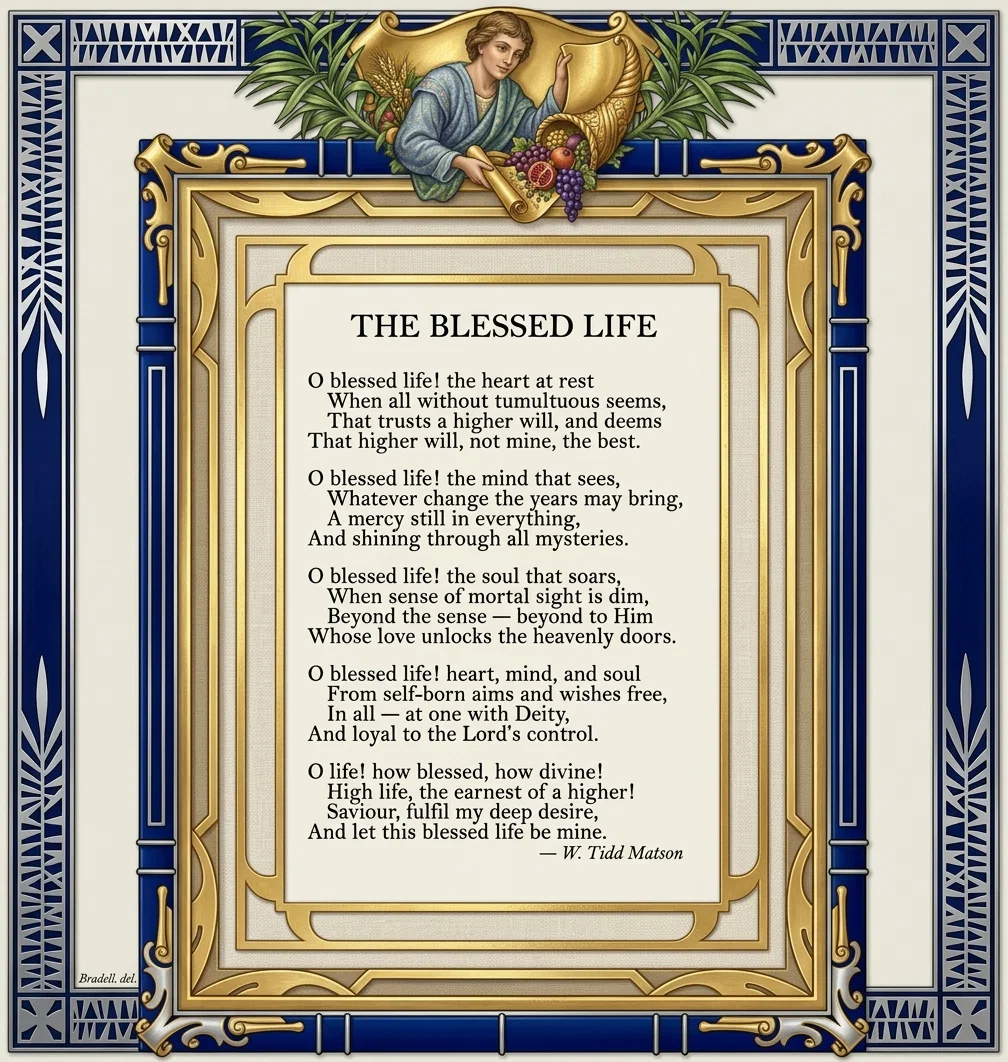
O blessed life! the heart at rest When all without tumultuous seems, That trusts a higher will, and deems That higher will, not mine, the best.
O blessed life! the mind that sees, Whatever change the years may bring, A mercy still in everything, And shining through all mysteries.
O blessed life! the soul that soars, When sense of mortal sight is dim, Beyond the sense — beyond to Him Whose love unlocks the heavenly doors.
O blessed life! heart, mind, and soul From self-born aims and wishes free, In all — at one with Deity, And loyal to the Lord's control.
O life! how blessed, how divine! High life, the earnest of a higher! Saviour, fulfil my deep desire, And let this blessed life be mine.
— W. Tidd Matson

THE WORK AND THE WORKERS

MR. ROOSEVELT acknowledges with thanks our courtesy in sending him a bound volume and current issues of the Protestant Magazine.
THE manager of the Postal Telegraph-Cable Company in one of the largest cities of the South has just ordered 25 copies of the Protestant Magazine, No. 2, 1911.
IN case you are in doubt as to which of our magazines to handle, send twenty-five cents in postage-stamps for a sample copy of the latest numbers of Life and Health, Liberty, and the Protestant Magazine.
As a special favor to us, and to avoid confusion in the assignment of territory, we are asking all our agents for Life and Health, Liberty, and the Protestant Magazine to order through their home conference tract society.
THUS far during this season eight members of our “Travelers’ Club” have sold 13,640 copies of Life and Health, in 46 of the leading cities of 13 States. These “Travelers” go from one city to another, and arrange with our tract societies in advance for supplies of magazines, territory, etc.
PASTOR W. A. SWEANY, of the Bahamas, has just given us an order to send Liberty and the Protestant Magazine one year to 75 of the most prominent people in those islands. The list includes the names of the governor, chief justice, colonial secretary, attorney-general, receiver general, leading pastors, etc.
PLEASE help us to reach 19,977,820 public-school pupils and college students through their 534,450 teachers and instructors. You can do this by sending $1.50 to your tract society office to pay for mailing Liberty or the Protestant Magazine for one year to ten of these teachers. Or, we will mail the beautiful Educational number of Liberty or the latest number of the Protestant Magazine to 30 of these educators for the same amount. Send the money through your conference tract society, and we will do the rest. We have the names and addresses of these teachers.
A LIST of the names of the prominent persons who read Liberty, the Protestant Magazine, and Life and Health, would more than fill this entire page. It would include such notable persons as the ex-president of the United States, numerous governors of States, university and college presidents and professors, judges, sheriffs, mayors, aldermen, editors, physicians, librarians, clergymen, political leaders, teachers, attorneys, etc. Kindly help us to extend the influence of these magazines still farther. Ask your tract society secretary how you may do this at but little cost on your part.
‘But,’ you may say, ‘I live in a country village, and could never sell many magazines here, for I have no territory.’ Perhaps you might follow the plan adopted by one of our agents in South Carolina. Although she lives in a small country village, she sells on an average 100 magazines a week. She writes: ‘I spent three days selling 100 magazines in the cities near by, and then returned home. I hope to sell 100 copies every week. I sold 250 copies in one week.’ Why not try this plan?
A NUMBER of our subscription book agents are finding out that it pays them to sell copies of Life and Health, Liberty, and the Protestant Magazine Saturday evenings. This enables them to pay their room rent with Life and expenses while they are waiting to make their deliveries. Speaking of this plan, Brother I. G. Bigelow, missionary secretary of the Columbia Union Conference, says:—
‘I am advising our city workers to pay their room rent with Life and Health, and those who are trying it find it works all right. After closing the canvass on their book, and as they arise to leave, they incidentally mention the fact that they have an interesting magazine on health themes for the home, and ask the party to take one copy. This is done generally when the worker fails to get an order for his book. It takes only about two minutes longer, and is almost always successful.’

Where the June “Life and Health” Went

THE following list of our conferences shows the number of copies of the June Life and Health ordered by each:—

2,000 or More Copies

(1) Northern Illinois; (2) Massachusetts; (3) Iowa.

1,000 to 2,000 Copies

(4) North Missouri; (5) Ohio; (6) Eastern Colorado; (7) Southern New England; (8) Western New York; (9) California-Nevada; (10) Northern California; (11) Southern California; (12) New Jersey; (13) Florida; (14) West Kansas; (15) Minnesota; (16) Indiana; (17) Greater New York.

500 to 1,900 Copies

(18) Virginia; (19) Wisconsin; (20) Southern Oregon; (21) West Michigan; (22) Alberta; (23) Ontario; (24) Southern Illinois; (25) New York; (26) St. Louis.

Less Than 500 Copies

(27) West Pennsylvania; (28) Mississippi; (29) Western Oregon; (30) Southern Missouri; (31) North Dakota; (32) Georgia; (33) Montana; (34) Texas; (35) Louisiana; (36) East Michigan; (37) South Carolina; (38) District of Columbia; (39) Arkansas; (40) Manitoba; (41) Central California; (42) West Virginia; (43) Northern New England; (44) New Mexico; (45) Cumberland; (46) Nebraska; (47) Maine; (48) North Carolina; (49) Alabama; (50) Chesapeake; (51) Kentucky; (52) North Michigan; (53) Oklahoma; (54) Eastern Pennsylvania; (55) Southern Idaho; (56) Western Colorado; (57) East Kansas.

Special Sale of Old Books

HERE is an opportunity to purchase books that have been on the shelves for a long time, and consequently are shelf-worn, but for all practical purposes just as good as they ever were, and to secure them for a small amount of money.

“Breakfast, Dinner, and Supper”

A cook-book containing scores of valuable recipes; 550 pages; cloth; regular price, $2.25; special sale price, 75 cents.

“Drummond’s Addresses”

Besides a historical sketch of the author, the book contains six chapters, as follows: (1) Love, the Supreme Gift, the Greatest Thing in the world; (2) The Perfected Life; the Greatest Need of the World; (3) Dealing With Doubt; (4) Preparation for Learning; (5) The Study of ‘the Bible; (6) “First;” an Address to Boys. Cloth binding; 138 pages. Regular price, 75 cents; special sale price, 40 cents.

“Scriptural Index to the Writings of Mrs. E. G. White”

A valuable little book for locating in the writings of Mrs. White what she has written explanatory of texts of Scripture previous to the date of the book. It contains 114 pages, besides blank pages for making notes. Cloth binding, regular price, 30 cents; special price, 20 cents. Leather, regular price, 50 cents; special price, 30 cents.

“The Nonesuch Professor”

“This is a wonderful book. It contains hundreds of seed-thoughts. Christianity is here dressed in the white linen of purity.” Cloth; 367 pages. Regular price, $1; special sale price, 50 cents.

“The Glad Tidings”

A commentary on the book of Galatians, the key-note of which is “The just shall live by faith.” Cloth binding; 264 pages. Regular price, 60 cents; sale price, 35 cents.

“Golden Grains”

A set of ten little booklets containing some interesting as well as uplifting stories for children. Price of the set, 50 cents; special sale price, 25 cents.

“The Federal Government of Switzerland”

This is a very interesting book, giving a general description of the government of this little republic, which places no restriction on the religious profession of its people. It gives not only a geographical description of the country, but particularly a history of the legislative body, and an outline of the rights and privileges of the people. Cloth binding; 256 pages. Regular price, $1; special sale price, 50 cents.

“Battle Hymn of the Kingdom”

A beautiful little booklet describing in verse and picture the mighty conquests of our God as he goes marching on. The grandeur of the scenes described is an inspiration to the reader to be more closely allied to the all-powerful One. Leatherette binding, 25 cents; reduced price, 15 cents. Cloth, 30 cents; reduced price, 20 cents.
Address the Review and Herald Publishing Association, Takoma Park, D. C.

The Better Way

WORTHIE HARRIS HOLDEN
Of the ruts in the road are you telling,— The thistles beside the way, The weeds that contend for the garden, And the clouds that obscure the day?
If the road can be traveled, be thankful; Thorns and briers soon vanish for aye; The weeds we may banish with labor, And the clouds veil the heat of the day.
Each life that we meet hath its highway,— Hath its thorn-griefs and briers of pain; There are flowers ’mong the weeds in the garden, And its clouds are not sun-kissed in vain.
Could we joy in the good of our pathways, Could we know for each thorn there’s a rose, How much sweeter the toil in life’s garden! How much blessing our clouds would disclose!
In the paths that we cross on life’s journey, We may see more to charm and delight; For we find what we seek as we travel, And the mind holds the key of our sight.
Not a highway nor trail on life’s mountain, Not a dark day unknown to our God; And no labor that’s wrought for the Master Will fail of its harvest-reward.
Portland, Ore.

“Sanctify Them Through Thy Truth”

MRS. E. G. WHITE
Before Jesus went forth to his final conflict with the powers of darkness, he lifted up his eyes to heaven, and prayed for his disciples. He said: “I pray not that thou shouldest take them out of the world, but that thou shouldest keep them from the evil. They are not of the world, even as I am not of the world. Sanctify them through thy truth; thy word is truth. . . . Neither pray I for these alone, but for them also which shall believe on me through their word.”
The burden of Jesus’ request was that those who believed on him might be kept from the evil of the world, and be sanctified through the truth. He does not leave us to vague surmising as to what the truth is, but adds, “Thy word is truth.” The Word of God is the means by which our sanctification is to be accomplished. It is of the greatest importance, then, that we acquaint ourselves with the sacred instruction of the Bible. It is as necessary for us to understand the words of life as it was for the early disciples to be informed concerning the plan of salvation. We shall be inexcusable if, through our own negligence, we are ignorant of the claims of God’s Word. God has given us his Word, the revelation of his will, and has promised the Holy Spirit to them that ask him, to guide them into all truth; and every soul who honestly desires to do the will of God shall know of the doctrine.
The world is full of false teaching; and if we do not resolutely search the Scriptures for ourselves, we shall accept the world’s errors for truth, adopt its customs, and deceive our own hearts. Its doctrines and customs are at variance with the truth of God. Those who seek to turn from its service to the service of God, will need divine help. They will have to set their faces like a flint toward Zion. They will feel the opposition of the world, the flesh, and the devil, and will have to go contrary to the spirit and influences of the world. Since the time when the Son of God breasted the haughty prejudices and unbelief of mankind, there has been no change in the attitude of the world toward the religion of Jesus. The servants of Christ must meet the same spirit of opposition and reproach, and must go “without the camp, bearing his reproach.”
The mission of Jesus was demonstrated by convincing miracles. His doctrine astonished the people. It was not the contradictory jargon of the scribes, full of mysticism, burdened with absurd forms and meaningless exactions; but it was a system of truth that met the wants of the heart. His teaching was plain, clear, and comprehensive. The practical truths he uttered had a convincing power, and arrested the attention of the people. Multitudes lingered at his side, marveling at his wisdom. His manner corresponded with the great truths he proclaimed. There was no apology, no hesitancy, not the shadow of a doubt or uncertainty that it might be other than he declared. He spoke of the earthly and the heavenly, of the human and the divine, with positive authority; and the people “were astonished at his doctrine; for his word was with power.”
He had declared himself to be the Messiah, but the people would not receive him, though they saw his wonderful works and marveled at his wisdom. He did not meet their expectation of the Messiah. They had been instructed to look for earthly pomp and glory at the advent of their Deliverer, and they dreamed that under the power of “the Lion of the tribe of Judah” the Jewish nation would be exalted to preeminence among the nations of the world. With these ideas they were not prepared to receive the humble Teacher of Galilee, although he came just as the prophets had foretold that he would come. He was not recognized as “the Truth,” the “Light of the world,” although he spoke as never man spoke; for his appearance was humble and unpretending. He came without attendants of earthly pageant and glory. There was, however, a majesty in his very presence that bespoke his divine character. His manners, though gentle and winning, possessed an authority that inspired respect and awe. He commanded, and disease left the sufferer. The dead heard his voice and lived, the sorrowing rejoiced, and the weary and heavy-laden found rest in his compassionate love.
Spies watched him with suspicious glances, ready to put an evil construction on any word or action that was in the least questionable. They were continually lying in wait to find whereof they might accuse him. He was the central object of observation and scrutiny to the people of Judea. His steps were thronged with curious multitudes that waited for a sign. The lame, the blind, the palsy-stricken, and leprous, and those afflicted with all manner of diseases, came to him, and he healed them all. Those who had come to criticize and condemn, heard the people glorifying God; and his fame spread from city tocity.
Heaven indorsed his claims with mighty manifestations; but the evil hearts of men, filled with unbelief born of prejudice, thrust aside the tokens of his truth, and clung to their empty traditions. They were not prepared to acknowledge him as the long-looked-for Messiah, because of their false conceptions as to the manner of his advent and the character of his mission. They walked in the obscuring shadow of man-made theories.
The Word of God, as they professed to believe, stated plainly every detail of his ministry, and again and again he quoted from the prophets, and declared, “This day is this scripture fulfilled in your ears.” But the minds of the Jewish people were so concentrated on the hope of earthly power and national elevation that they despised the humble Nazarene, and would not have him to reign over them. Had they earnestly searched the Scriptures, and brought their theories and expectations to the test of God’s Word, Jesus need not have wept over their impenitence. He need not have declared, “Behold, your house is left unto you desolate,” “because thou knewest not the time of thy visitation.” They might have been acquainted with the evidences of his Messiahship, and the calamity that laid the proud city in ruins might have been averted. The minds of the Jews had become dwarfed and narrowed by their unjust prejudices and unyielding bigotry. The practical lessons of Christ revealed the deficiencies of their characters, and demanded thorough repentance. If they accepted his teaching, their practises must be changed, their thoughts enlarged, and their cherished hopes relinquished. They would have to sacrifice the honor of men, in order to be honored of heaven; and if they obeyed the words of this new “Rabbi,” they would have to go contrary to the opinions of the great teachers and thinkers of the time.
Many wonder at the unwillingness of the Jews to receive Christ as the promised Messiah. Why did they cling to their false creeds, empty forms, and useless ceremonies, when the truth of heaven waited their acceptance? They spent their money for chaff and husks, when the living Bread was within their reach. Why did they not go to the Word of God, and search diligently to know whether or not they were in error, and to discover to Jesus the absurdity of his claims and the evidences of his deception? The cause of their rejection of Christ was the same as that which keeps men in error to-day: they “loved darkness rather than light, because their deeds were evil.”
Truth was unpopular in Christ’s day. Truth is unpopular in our day. It has been unpopular ever since Satan first gave man a disrelish for it by presenting bewitching fables that lead to self-exaltation. Do we not meet theories and doctrines that have no foundation in the Word of God? Men cling tenaciously to them, as the Jews clung to their traditions and delusions. We have
the same difficulties to meet and resist as had the Redeemer of the world.
The Jewish leaders were filled with spiritual pride. Their desire for the glorification of self manifested itself even in the services of the sanctuary. They loved the highest seats in the synagogues and the praise of men. They loved greetings in the market-places, and were gratified with the sound of their titles on the lips of men. As real piety declined, they became more jealous for their traditions and ceremonies. Do we not see the same perverseness in the Christian church of to-day? Those who love God with sincere hearts should the more earnestly desire the truth as it is in Jesus. They should search the Scriptures with humble hearts, intensely desiring to know what is truth; for Christ prayed that his disciples might be sanctified through the truth.
The Jews, because their understanding was darkened by selfish prejudice, could not harmonize the strange power and authority of Christ’s convicting words with his humble life and appearance. They did not appreciate the fact that real greatness can afford to go without display. This man’s poverty and humility seemed wholly inconsistent with his claims to the great honor and power of the Messiah. That he should announce himself as the Son of God, they deemed intolerable blasphemy. They questioned, If he were the Messiah, why was he so unpretending? What would become of their nation if he were satisfied to be without force of arms? When and how would the glory and power, so long anticipated, bring the nations as subjects to the city of the Jews? Had not the priests taught that they were to bear rule over all the earth? and could it be possible that the great religious teachers were in error? The Lord had answered their query through Isaiah: “O my people, they which lead thee cause thee to err, and destroy the way of thy paths.”
The scribes, Pharisees, and Sadducees had wandered away from the truth, and Jesus exhorted the people to study the Scriptures for themselves. God has endowed men with intellect, and has made it possible for them to be enlightened by the Word of life; but to-day, as then, people will accept the teaching and doctrines of men, rather than obey the plain Word of God. They choose to take the broad road that leads to death, rather than bear their cross, and follow the blood-stained path that leads to eternal life.
Pharisees, Sadducees, and Herodians joined to oppose the Son of God. Their rejection of the truth influenced many to turn from the Saviour. Those who cherish enmity to the pure principles of heaven are acting in concert with the rulers of the darkness of this world. When Christ met with success in his ministry, those who hated truth and rejected light manifested the spirit of opposition, and sought to silence him. The same spirit is apparent to-day,
wherever the truth is brought in contact with long-established error or custom. With mad prejudice, men bitterly condemn that which disturbs their preconceived opinions. It is a matter of the highest importance and interest to us that we understand what truth is, and our petitions should go forth with intense earnestness that we may be guided into all truth.
David appreciated the divine enlightenment, and recognized the power of the Word of God. He declared, “The entrance of thy words giveth light; it giveth understanding unto the simple.” Let those who desire light search the Scriptures, comparing scripture with scripture, and pleading with God for the illumination of the Holy Spirit. The promise is that those who seek shall find.

Showers of Blessing

H. A. ST. JOHN
PENTECOST was the former rain. That refreshing from the glorified Jesus enabled his disciples to obey the great commission, and give to the whole world the gospel in a few brief years. These disciples were favored with showers of blessing before the day of Pentecost. These showers were received under different circumstances, at different times, and by one, two, or more persons; but in each instance the shower revealed the living Christ, filled the receivers with great joy, and put into their mouths the inspiring message, “He is risen.” To Mary Magdalene came the first shower, revealing to her the blessed Lord, and sending her with swift steps and joyful heart to the disciples, with the glad message, “He is risen.” Other women, two disciples on the way and at Emmaus, Peter alone, and the apostles, all but Thomas, the same day and the evening following were favored with like showers of blessing, revealing Christ in each instance, and filling their souls with the same glad message, “He is risen.” By these showers, by learning to love one another, and by earnest prayer and strong faith, the believers came up to the day of Pentecost. Then was fulfilled the promise of a great refreshing from on high; and they were thereby filled, and fitted to do the work required by the great commission of their divine Lord.
We have now come to that period of the world’s history when the gospel season is closing. The time is come for the gospel message in all its fulness of blessing, light, and power, under the same great commission, to go to all the world—to every nation, kindred, tongue, and people. Showers of blessing are due now, in order to prepare ministers, doctors, teachers, missionaries, and all to receive the latter rain, the refreshing from on high, which will surely and quickly follow. These showers will fall on one, two, or more, here, there, and in many places, wherever souls prepare the way by zealous repentance. The recipients of these showers will get new views of Christ, as the chiefest amongten thousand and the One altogether lovely. This new revealing of Christ will fill and thrill the whole being with a joyful, inspiring message,—not, “He is risen,” but, “He is coming.” This will very soon lead up to the greater Pentecost, the latter rain, the greater refreshing from the glorified and soon-coming Jesus.
Then the remnant church of Christ, with their backslidings all healed, filled with all the fulness of God, will joyfully accept the great gospel commission with all its obligations and precious promises. In demonstration of the Holy Spirit and with great power, clothed with the armor of light and righteousness, they will quickly go everywhere revealing every truth of the glorious gospel in the light of a living and soon-coming Christ. Thus will the earth be lightened with glory; the work of the Lord will be cut short in righteousness; and the harvest of the earth will be ripened. Then will appear the great Reaper, with a sharp sickle, accompanied by all the holy angels, to reap the harvest. All the saints, with bodies fashioned like unto Christ’s glorious body, will be gathered by the angels to meet Jesus, and go with him to the place prepared for them in the Father’s house of many mansion’s. Shall I, will you, be there?
Sanitarium, Cal.

Its Angelic Connections

Tracings of the Prophetic Gift—No. 9

Its Angelic Connections

J. O. CORLISS
While it is true that the utterances of prophets are said to have been inspired by the “Spirit of the Lord” (2 Sam. 23:2), and that the “Spirit of Christ” was in their heaven-sent messages (I Peter 1:11), there seems to have been an acknowledgment by some of the prophets that their communications were from angels, who were delegated by heaven to bring them to the world through the prophets as intermediaries.
This was especially the case with the Old Testament prophet Daniel. While in the second chapter of his book the prophet says that Nebuchadnezzar’s secret was revealed to him in “a night vision” (verse 19), he is more specific in the seventh chapter, saying that his view of the four beasts was through “a dream and visions of his head.” It seems, however, that the interpretation of this vision was made known to him in plain words by one that “stood by,” to whom the prophet appealed for the understanding of it. Verse 16.
In the vision relating to the sanctuary cleansing in chapter eight, it will be noticed that the prophet simply listened to what purports to be the conversation of two “saints.” Verses 13, 14. All that he heard from them seemed shrouded in the deepest mystery. But as the prophet entered upon an anxious search for the meaning of the words uttered, at once there appeared before him the figure of a man. Then a voice was heard from above the river Ulai, calling to this distinguished personage, saying: “Gabriel, make this man to understand the vision.”
This new companion of the prophet was thus identified as a prominent heavenly being, who was to make Daniel and succeeding generations understand what was meant by the mysterious conversation carried on by the two “saints” on the banks of the river of Elam. Gabriel began the fulfilment of his mission; but on account of Daniel’s consternation at meeting so exalted a being, and his consequent illness, the angel desisted until such time as the prophet might calmly consider the matter. So in answer to earnest prayer, Gabriel appeared once more to reveal to the prophet the interpretation of the vision before given. Dan. 9:21-23.
The revelation which followed gave the date of the Messiah’s appearance, and the limit of Jewish ascendancy, with relative intervening incidents. Later, at another riverside (Dan. 10:4, 5), apparently the same heavenly visitant came to talk with the prophet, and explained that he had been sent to reveal what was to befall Daniel’s people in the “latter days.” Verse 14. Then before leaving the prophet to fulfil another part of his mission, the secret was confided to Daniel that no other being held these things in common with him but Michael, the heavenly Prince. Verse 21.
The word “Michael” means “who is like God.” It is he who stands, or pleads, for the children of God, and who will stand up to deliver his people in the last great conflict the world is to witness between the forces of good and evil. Dan. 12:1. He is the mighty Archangel (Jude 9), whose voice is to call forth to life the sleeping dead at the second coming of the Lord Jesus. 1 Thess. 4:16. That voice is none other than the voice of the blessed Master himself, as we learn from his own statement in John 5:25-29. Then returning to the thought that only Michael and the angel Gabriel held in common a knowledge of future events, it seems clear that Gabriel holds the exalted position of being the Lord’s special message-bearer between heaven and earth.
Following on to the days when Messiah was about to appear, we find Gabriel once more commissioned to make known events of the immediate future. This time he appeared to a childless old man who, with his wife, was “well stricken in years.” The occasion was when the man Zacharias, as priest, was serving his course in the temple. Luke 1:5-11. Like Daniel of centuries before, the aged priest was stricken with fear upon perceiving a shining angel stand by the side of the altar of incense. After reassuring Zacharias, the angel was not long in delivering his message. Stated in a sentence, it was that Elizabeth, the elderly wife of the priest, was to bring into the world the forerunner of the Messiah.
This was too much for the priest to receive without question. In answer to the query as to how such a thing could be possible, the announcement was made that the visitor was none other than Gabriel, the exalted one, who had been sent from God to make known a predetermined event. Sentence was then pronounced upon the priest, for his unbelief, that he must be dumb until the fulfilment of the prediction. Should every present-day doubter of God’s prophetic promises be stricken dumb, as was Zacharias, like him also they would not transfer doubt from their lips to the hearts of others, and the world would consequently be far better off spiritually.
But the appearance of Gabriel to the Judean priest Zacharias was not his last recorded visit to earth. Banished to the wild, rocky island of Patmos for his loyalty to truth, was the lonely but beloved disciple John. To this cheerless prison the angel of God came on a certain Sabbath day to bring a message from the Lord Jesus to John, for the whole world. Rev. 1:1. That this messenger was indeed Gabriel, may be concluded from the statement of Christ in the opening and closing chapters of the revelation, delivered thus: “The revelation of Jesus Christ, which . . . he sent and signified by his angel unto his servant John” (Rev. 1:1); and again: “I Jesus have sent mine angel to testify unto you” (Rev. 22:16).
These expressions, compared with the statement of Gabriel himself to Zacharias that he was the angel who stands in the presence of God, as if waiting to receive a message and commission for its delivery, also his statement to Daniel that none but Michael stood with him in the knowledge of the things being revealed, would go to show that Gabriel is the angel who delivers to men, through the prophet, the testimony of Jesus. Rev. 1:2.
But the point under consideration relates itself more to the thought that an angel, some angel, has been conspicuous in bringing to the prophets the messages they have borne to the world. In the case of John on Patmos, he says that the voice of the one who spoke to him was like the sound of a great trumpet. During the interview recorded, the angel pointed out all the great earth movements which were to affect the interests of the church. Coming to the close of it all, he gave a most vivid description of the Lord’s descent to earth, together with the assembling of the white-robed saints to the marriage supper, at which point John fell down in worshipful attitude before the angel. Rev. 19:10.
The angel, seeing the prophet’s intention, forbade the act, declaring that he was not the one to claim worship, since he was but a fellow servant of John, and of his brethren in the same calling. This was virtually to say that he had done for all other prophets the same that he was then doing for the exile of Patmos.
This being true, the same arrangement must obtain to the latest message God desires to communicate to his people. God will still speak to them, in the time of trouble, probably through the same medium as ever before.
Mountain View, Cal.

Comfort One Another

T. E. BOWEN
THESE words, addressed to the followers of Jesus, occur again and again in the Bible. “Wherefore comfort yourselves together, and edify one another.” “Wherefore comfort one another with these words.” “Comfort the feeble-minded, support the weak.” “Now our Lord Jesus Christ himself, and God, even our Father, which hath loved us, and hath given us everlasting consolation and good hope through grace, comfort your hearts, and stablish you in every good word and work.”
Webster defines “comfort” as “assistance; relief; support; encouragement; solace; consolation in trouble; also, that which affords consolation.”
To be actually a dispenser of assistance, relief, support, encouragement, solace, or consolation to our brethren, then, is to comfort them; and we can not do these things without love. And this love is shed abroad in our hearts by the Holy Ghost given unto us, whose work it is to administer comfort to believers; hence one of his names is “The Comforter.”
Without knowing it, we are liable to become exacting, picking up little things in the lives of our brethren and sisters, friends and neighbors, which never should be noticed; and thereby we fail in comforting one another in the close range of daily activities in the home or the church. It will be observed of those persons the most comfortable to live with, that they studiously ignore the thousand and one little things that might be noticed, but which would make others uncomfortable. And, further, it will be observed that these are the sweet, unselfish souls from whose lives there constantly goes out the fragrance of Christlike helpfulness. It is not so much justice that we need to cultivate, in seeking to comfort one another, as mercy.
“How little do we enter into sympathy with Christ on that which should be the strongest bond of union between us and him,—compassion for depraved, guilty, suffering souls, dead in trespasses and sins! The inhumanity of man toward man is our greatest sin. Many think that they are representing the justice of God, while they wholly fail of representing his tenderness and his great love. Often the ones whom they meet with sternness and severity are under the stress of temptation. Satan is wrestling with these souls, and harsh, unsympathetic words discourage them, and cause them to fall a prey to the tempter’s power.”—“Ministry of Healing,” page 163.
God comforts us. Jesus was a comfort to all those about him. When he left, he promised another Comforter—the Holy Ghost. He is here, and will remain with us unto the end. Shall we not cooperate with him by being of assistance to some needy soul,—by relieving some aching heart; supporting some one who is weak; encouraging that one cast down; bringing solace to some troubled soul; offering consolation to that one on the verge of despair? All these friends are met in our daily round. They may work at our elbow in the shop, in the mill, toil with us on the farm, or hurry past us on the street, seeking to hide their real heart burdens, but at the same time needing heavenly comfort. If our hearts have been comforted by our Heavenly Father, shall we withhold comfort from others? Shall we not rather in some of the many ways mentioned above “lend a hand” in our association with one another, and thus actually “comfort one another”?
Washington, D. C.

MRS. S. A. V. YOUNG

Kindlings

MRS. S. A. V. YOUNG

Did you ever try to start a fire on a rainy day after everybody had been too busy the night before to see that wood and kindlings were under cover? If so, you know how you searched the wood-box for the few tiny splinters that were left there. You remember how glad you were to find a few small slivers hanging to the split sticks of damp wood, or a little bark you could pull off from some of the pieces of hickory. What you wanted was small stuff to set fire to the bigger wood. If any one had asked you if you preferred to have kindling-wood exclusive of the larger sticks, you would have said: “Certainly not; the larger wood holds heat much longer, but I like the little kindlings to ignite the larger wood.”
To me this homely picture illustrates the usefulness of those humble, willing-hearted workers to whom is imparted no great gift, but without whose help the strong and talented workers would be greatly handicapped. Ministers come into our neighborhoods to hold meetings. They preach sermons that abound with good doctrine, but the people are not interested. They preach Christ. The people have heard of Christ, but have never seen him. They preach the love of Christ. That, too, they have heard of, but they have never seen it nor felt its power. Why?—Because none of Christ’s little ones have been before them, visiting the sick, clothing the naked, feeding the hungry, sympathizing with those in distress, opening their doors to the outcast, and by so doing gaining the love and confidence of their neighbors. In other words, the kindling has not been prepared; the little Christians have been too busy.
We can not all preach; we can not all fill responsible positions. Some of us are carrying heavy responsibilities in trying to make an honest living, and provide for our families. We feel that we have no time and no extra strength, and amount to nothing in the cause of God; but we can all live such lives among our neighbors that they will see the Christ spirit, and feel the warmth of the love that goes out from us to them. Then when the minister talks of Christ, they will know what he means; for they will have seen him in our lives. When he tells of his great love, they will understand; for they have felt its power. So if we who feel that our work is small, and that we amount to almost nothing in the cause of God, will each whittle our own little bunch of kindlings, and not allow the element of selfishness to dampen them, but keep them under the shelter of love, there will be nothing to hinder the preached word from reaching the people in all its warmth and power. The kindlings will be all ready for the coal from off the altar.
Siloam Springs, Ark.
Continue reading: The Good Shepherd