Christ Preached a Divine Kingdom — Does He Tell Where It Is to Be Located?
By ALLEN MOON
“From that time Jesus began to preach, and to say, Repent: for the kingdom of heaven is at hand.” Mat. 4:17. This was not a new doctrine, but it was one that could now be preached with new emphasis. The heavenly King had come to earth—the Lamb without blemish, the acceptable Sacrifice, man’s Substitute.
Having accomplished His mission, He ascended up on high, to receive the kingdom that had been temporarily usurped by Satan (Micah 4:8), and to continue the curtailing of the power, and limit the freedom, of the adversary, by casting him out of heaven, preparatory to his final destruction on earth.
THE WORLD IS THE FIELD
To repeat: Jesus preached, not a new truth, but an old one. It is said, “Another parable put He forth unto them, saying, The kingdom of heaven is likened unto a man which sowed good seed in his field.” Matt. 13:24. This is recognized as the parable of the wheat and the tares; and in the interpretation of this parable, Jesus said: “The field is the world; the good seed are the children of the kingdom; but the tares are the children of the wicked one.” Matt. 13:38.
From the beginning, the children of the kingdom have been in the world. In other words, the Son of man, who sowed the good seed in His field, has in all ages had loyal subjects on earth, in whose hearts He reigned supreme. We read that “Enoch walked with God.” Gen. 5:24. He was a loyal subject of God’s kingdom. Also of Noah it is said, “Noah was a just man and perfect in his generations, and Noah walked with God.” Gen. 6:9. Of Israel it was said, in the inspired parable of Balaam: “He [God] hath not beheld iniquity in Jacob, neither hath He seen perverseness in Israel: the Lord his God is with him, and the shout of a king is among them.” Num. 23:21. And again: “He shall pour the water out of his buckets, and his seed shall be in many waters, and his king shall be higher than Agag, and his kingdom shall be exalted.” Num. 24:7. This language was uttered concerning the true Israel of God. The true Israel is composed of men and women in the flesh. Thus the kingdom of heaven is a very literal thing, and not merely a spiritual kingdom.
ISRAEL FOREVER
When Israel demanded a man to be set over them as king, Samuel said: “When ye saw that Nahash the king of the children of Ammon came against you, ye said unto me, Nay; but a king shall reign over us: when the Lord your God was your King.” I Sam. 12:12. The Lord regarded Israel as His nation, whether they had over them an earthly ruler or not. The psalmist was inspired to write, “When Israel went out of Egypt, the house of Jacob from a people of strange language; Judah was his sanctuary, and Israel His dominion.” Ps. 114:1, 2. This language is beautifully poetic, but at the same time expresses a great truth.
The prophet likewise utters the same truth in very forceful language, saying: “Thus saith the Lord, which giveth the sun for a light by day, and the ordinances of the moon and of the stars for a light by night, which divideth the sea when the waves thereof roar; the Lord of hosts is His name: If those ordinances depart from before Me, saith the Lord, then the seed of Israel also shall cease from being a nation before Me forever.” Jer. 31:35, 36. Since these have not departed from before the Lord, and are established as perpetual ordinances, therefore the Lord has a nation still that He reigns as King. Testimony could be multiplied on this subject.
KINGDOM GIVEN TO OTHERS
But of the seed of Abraham Jesus said, “The kingdom of God shall be taken from you, and given to a nation bringing forth the fruits thereof.” Matt. 21:43. This shows that the natural seed of Abraham was regarded by the Lord as His kingdom.
The earth is the Lord’s by right of creation, but He gave it to man for a dwelling place. This possession went into the hands of the usurper, but was purchased by the Redeemer, to be restored to man; as it is written: “And thou, O Tower of the flock, the Stronghold of the daughter of Zion, unto Thee shall it come, even the first dominion; the kingdom shall come to the daughter of Jerusalem.” Micah 4:8. The dominion comes to the second Adam, and the kingdom to the church as an inheritance through Him. And “when the Son of man shall come in His glory, and all the holy angels with Him, then shall He sit upon the throne of His glory: . . . and He shall set the sheep on His right hand, but the goats on the left. Then shall the King say unto them on His right hand, Come, ye blessed of My Father, inherit the kingdom prepared for you from the foundation of the world.” Matt. 25:31-34.
KINGDOM EVERLASTING
The kingdom and the dominion prepared for the children of God, lost in the fall, redeemed by the Son of God, restored to the redeemed people of God—this is the story of redemption. And then will be fulfilled the promise of the prophetic Word: “And the kingdom and dominion, and the greatness of the kingdom under the whole heaven, shall be given to the people of the saints of the Most High, whose kingdom is an everlasting kingdom, and all dominions shall serve and obey Him.” Dan. 7:27.
With this agrees the language of the Son of God, in expounding the parable of the wheat and the tares. He said: “The field is the world; the good seed are the children of the kingdom; but the tares are the children of the wicked one; . . . the harvest is the end of the world; and the reapers are the angels. As therefore the tares are gathered and burned in the fire; so shall it be in the end of this world. The Son of man shall send forth His angels, and they shall gather out of His kingdom all things that offend, and them which do iniquity. Then shall the righteous shine forth as the sun in the kingdom of their Father.” Matt. 13:38-43.
SURE GUIDE CONCERNING THE TERRITORY
The Saviour has given us, in this interpretation of the parable, a sure guide as to the territory of the kingdom. He said, “The field is the world.” The good seed of the kingdom was sown in the world. The tares were sown in the same field. The tares will be gathered out of the kingdom, and burned. The good seed will still remain, and shine forth as the sun in the kingdom.
The children of the kingdom do not shine at all times in this present state, but that will be changed in the Lord’s own time. John the Baptist said of the Lord, “He will thoroughly purge His floor, and gather His wheat [the good seed] into the garner; but He will burn up the chaff with unquenchable fire.” Matt. 3:12.
Our Lawgiver and Judge
By Mrs. Iva F. Cady
“For the Lord is our Judge, the Lord is our Lawgiver, the Lord is our King; He will save us.” Isa. 33:22.
Since the Lord is our Lawgiver, and our Judge as well, what standard of righteousness will He be sure to use in the Judgment? Will it not be that law which He spoke with His own voice on Sinai, and then engraved with His finger on tables of stone?
Then our only safety is in accepting that law as our standard of right and wrong, and conforming our lives to it. We should not adopt any change that man has sought to make in the law of God; for this same Lord who is our Lawgiver and our Judge, is also our King and our Saviour. But it would be presumption to expect Him to save us in His kingdom, if we are not loyal and obedient to Him here. Mrs. Iva F. Cady.
Spiritualism in the Heathen World
By Walter E. Gillis
Superstitions Taught for the Benefit of the Priests—Barbarous Torments Threatened in the Next Life, for Those Who Refuse to Obey
The Tree Is Known by Its Fruits
By WALTER E. GILLIS
THE Western world has ever looked upon the continent of Asia as the stronghold of heathenism, the unevangelized East, the lands of idealism and idols. From their superior outlook as Christian nations, these Western peoples have deemed it to be their duty to send men and means, at hazard of life and fortune, that the great yellow races might partake of the benefits of the gospel.
HOW CAN GOD PERMIT IT?
As one passes through the native haunts of these teeming millions, one is often led to wonder how it is that a beneficent God can ever permit such degradation, such ignorance, such villainy, such injustice, to continue. The student of the Holy Scripture can see but one explanation.
When Satan was cast out of heaven instead of being immolated upon the altar of his own iniquity, it was that he might demonstrate his theories, and thus forever seal up the possibility of another rebellion arising in a realm where individual liberty and absolute right are the key to its symmetry and existence.
The great nations of Asia have been the most fruitful centers of his activities. Here his schemes for a kingdom have been permitted to take root and bear their fruit for centuries.
SPIRIT OF REBELLION AND SELF-EXALTATION
On the plains of Shinar, he would inspire his followers to rear a tower whose pinnacle would cleave the clouds. Thwarted in that, he attempted a counterfeit of Paradise, and built the world-renowned Babylon; and the record says that the rulers of that splendid city and kingdom looked to the magicians, astrologers, and sorcerers for guidance and occult wisdom. See the first chapters of Daniel.
As these various Heaven-daring schemes ripened, the Lord dispersed the nations; but they carried with them, in their dispersion, the same spirit of rebellion for the exaltation of self, and have continued to develop the plans of their spirit chieftain, as revealed through the magicians and the sorcerers, who everywhere maintain an ascendancy over the people, and thrive upon their credulity and moral ignorance.
In India, China, and Japan, the story repeats itself. Wherever you go, the ancient legends of the people determine their common origin; for they tell of the forbidden fruit, and of the loss of virtue and good fortune that followed the eating of it. And these are the countries where man believes in his ability to save himself. These are the countries where the dead are worshiped, and spiritualism revels in the superstitions of the inhabitants. Wherever you may go, you will see the towers dedicated to the spirits of the dead, processions and ceremonies for their propitiation, and fantastic arrangements for the outwitting of the spirits of devils, whose malign influence the wily hierarchy judiciously advertises as a means of maintaining a constant flow of coin into their ever hungry treasury. Spiritualism in all its subtler forms is maintained as a prerogative of the priestly caste.
CRUELTIES IN THE WORLD TO COME
For the educated, the soul-tempting philosophies of the esoteric weave a spell that must inevitably lead him into the toils of sheer devil worship. For the ignorant, a cruder school suffices.
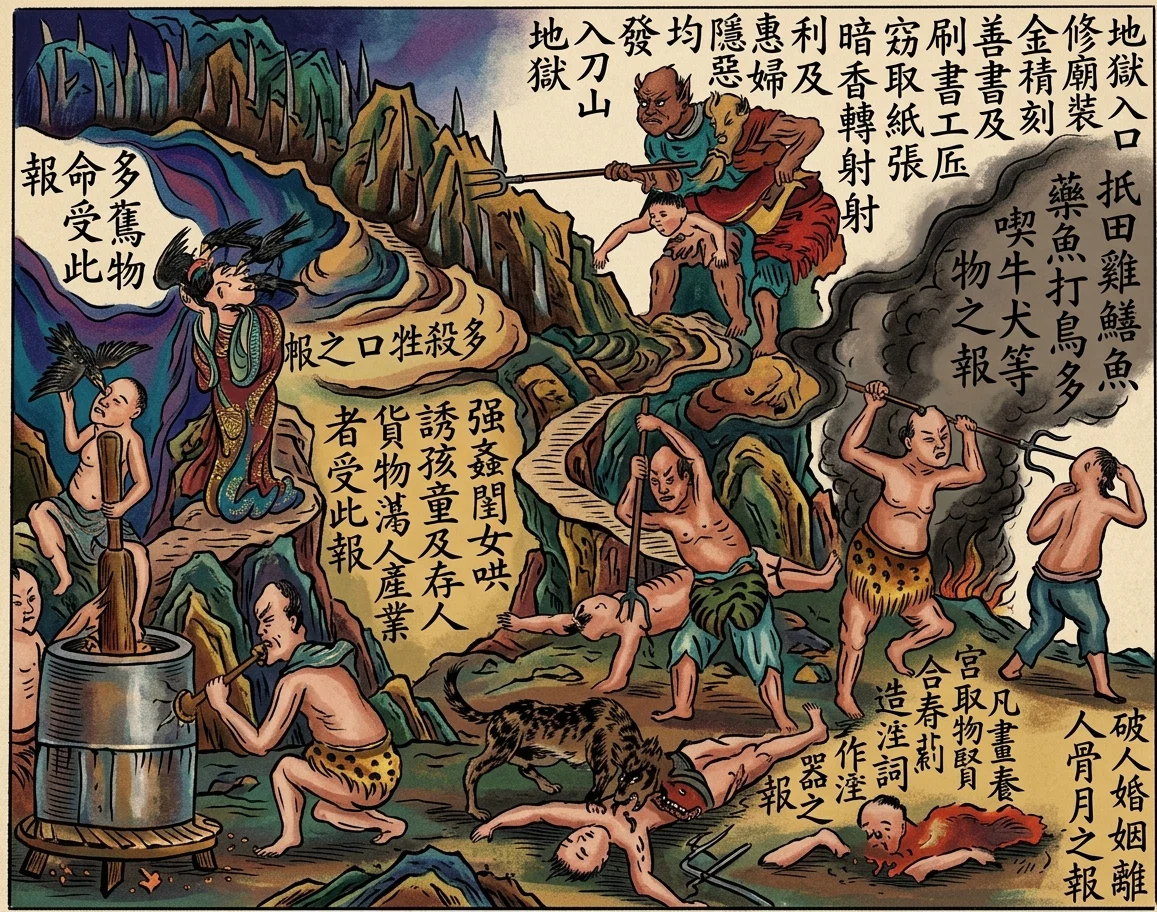
Images, and sculptured allegory of the supposed scenes of the nether world, adorn their temples. Frowning deities sit in judgment upon the cowering representations of disembodied souls. And then in horrid panorama appear the meted punishments. Because a soul dared to allow itself to be born into the world without the authorization of the gods, he is condemned to the misery of transmigration through the insect world. Here an unfilial son, who has failed to worship faithfully the departed shades of his ancestors, is sawed into sundry chunks and slices by two fear-inspiring imps of hades. There an unfaithful wife is taken by a sturdy son of hell and brutally jabbed against the broken-off limb of a tree, and left to wriggle in anguish for ages. Or it may be, for failing to reverence and obey her mother-in-law, she is dismembered, and each portion, sensitive as the whole, is nailed to a post, to endure such agony as can be imagined from the circumstances. For thieves and deceivers is provided a hell of broken ice, over the surface of which the shivering culprits painfully make their way. In a boiling pot of oil one sees those who have been remiss in worship of idols and service at the temple.
It is an endless tale, and the evidence of its infamy is found in the lives of its devotees.
It is an axiomatic statement that “a people approximate to the ideals of their religion.”
The illustration expresses some ideas of the Chinese about the tortures endured by the spirits of the dead.
The more intimate one’s acquaintance with heathenism, the more one is confirmed in the belief that the great heathen East is primarily and essentially spiritualistic, and that spiritualism is naturally the handmaid of idolatry, whether it be worship of self or of idols. Idolatry is the antithesis of Christianity. Therefore spiritualism is antichristian. As the Scriptures say of the backsliding Hebrews, “They left all the commandments of the Lord their God, . . . and used same as that of Paul, when in self-sufficiency he persecuted the church of God: ‘The good that I would I do not; but the evil which I would not, that I do.’ Why is it?—Because of that fallen spirit who in the beginning said, ‘Ye shall not surely die,’ and who has ever since induced men to trust in their own efforts for salvation; whereas the Scriptures say: ‘O Lord, I know that the way of man is not in himself: it is not in man that walketh to direct his steps.’ Jer. 10: 23.
Ostensibly in quest of truth as a balm for their troubled souls, they make their “ego” the judge of what is truth. Thus each, as it were, defines himself by making himself his own savior, to the end that he may at last be lost in the personality of an impersonal god. Truly these, as the Saviour said, worship they know not what. While they believe in incarnation, it is the reincarnation of the selfsame “ego”; whereas the Scriptures provide for the incarnation of the Son of God at the new birth, when in triumph the former victim of despair exclaims: “I am crucified with Christ: nevertheless I live; yet not I, but Christ liveth in me: and the life which I now live in the flesh I live by the faith of the Son of God, who loved me, and gave Himself for me.” Gal. 2: 20.
Much has been said about the beautiful663philosophies and rules of conduct of the great modern teachers; but they are infinitely feeble when compared with the Bible. The heathen literature of Greece and Rome brings to us the intelligence that man’s ultimate end is absolute satiety, apathy. The great heathen cults of the East to-day teach that man’s ultimate end is absorption into Nirvana—which is another way of stating the philosophy of the Stoics.
How manifestly superior is the teaching of the Bible, that in this life man’s ideal state is found in glorifying his Maker and being a blessing to his fellows; that in the life to come, he will through the eternal ages increase in knowledge and wisdom, his capacity for the enjoyment of eternal life ever increasing!
Those modern dabblers in spiritualism who wish to know what to expect from the present renaissance of this first of curses, would do well to study its fruit in its ancient citadel. The tree is known by its fruit. The fruit of spiritualism in heathen lands is a malevolent fruit. Indolence and ignorance, licentiousness and vice, are its products, and the quality of mercy gives place to expediency and cruelty.
MOCKERY OF THE SYSTEM
The mockery evident in the whole system is graphically portrayed in the diabolical punishments devised for those who transgress, the addition of time to the spirit equation being about all the difference made
Attack on Buddhism by the Japan press as translated in China Press, Shanghai, April 16, 1915:
“If examined closely, there are a great many more cases of corruption throughout the Buddhist religious organization.
“Aside from the question of which is superior as religion, we are obliged to judge from practical results that Christianity is far better than Buddhism. What are the Buddhist monks going to say in reply to this? They use vile language against Christianity, but they do not exert one tenth part of what the Christians do. Instead, they only live idly, without caring for the religious duties before them. No matter how profound the Buddhist religion may be, the mortal people will never be able to get the benefit of it through the monks.”—The Hochi (a prominent newspaper), Tokyo, Japan.
in the punishment of the living and the dead culprit.
The systems of spiritism are based on the unattainable; namely, moral perception by human effort. As the Scriptures truly say, “Which things have indeed a show of wisdom in will worship, and humility, and neglecting of the body; not in any honor to the satisfying of the flesh.” Col. 2: 23.
The daily plaint of the sin-sick heathen is the same as that of Paul, when in his
The Gospel in the Old Dispensation
By Henry E. Miles
Do We Need a Twentieth Century Religion?—The Gospel Taught by the Old Testament Prophets—The Jews Perverted Their Own Religion; Those Who Followed the Prophets Closely, Saw
By HENRY E. MILES
The question has been asked by modern theologians, “What is to be the religion of the twentieth century?” They make no direct answer, but set about to write a new theology. And what are we getting? To try to name the latest product of the theologians might be puzzling. Religion, like the fashion in dress, changes with man’s conceptions.
The historian is weary of recording the many religions. He views paganism in its various forms, and sees as much harmony in that as he sees among the diverse creeds held by people professedly of the Christian faith. Still, the manufacture of religion goes on; for men allege that, owing to the progress of civilization and scientific research, religion must be remolded—we suppose, to meet the needs of modern social life; or perhaps the idea is that it may be more in harmony with modern thought, in better harmony with the modern school, which, although modernized, teaches the quite ancient theory of evolution.
Such are the propositions of people of no less rank than Mr. Campbell, of England, and others of like caliber, whose mental faculties we are bound to respect.
ORIENTAL PHILOSOPHIES AND RELIGION
And it is evident, in view of the fact that the present-day system of education is based largely on Greek philosophy, which is adverse to the teachings of the Scriptures, that we need at least to revise our religion. That our system of education paves the way for such a revolution may be suggested from the fact that in several American cities, Buddhist temples have been erected. And among the converts from Christianity are graduates from prominent universities. That is a long step backward, but perhaps it is consistent with the training of the students.
We not only find Buddhism gaining a foothold in what is alleged to be “Christian” America, but pantheism has invaded the ranks of many educational circles. This is perhaps as consistent as some other dogmas of more recent origin that have American birth.
“LET HIM BE ACCURSED”
But Paul declares the gospel of Jesus Christ to be “the power of God unto salvation.” He also says that any man who teaches any other gospel than that which Paul taught should be accursed.
We are aware that any one professing to believe in Christ as the Messiah will say Amen to that. But not a few have been led to disregard many of the requirements of God, by a perverted idea of what constitutes the gospel.
IS THE OLD TESTAMENT DEAD?
It has been announced that since we are living under the new covenant, in a new dispensation, the Old Testament Scriptures have become a dead letter. Thus many have come to look upon the Christian religion as contrary to that which the Jews had. One quite prominent divine made the statement, before his congregation, that the religion of the Jews was never intended to be the religion of the human race.
It may be well to turn the searchlight of Scripture on such assertions, that we may see the gospel in its true light; that we may consider the true religion which was, and is, and shall be hereafter; that we may view the only gospel that ever has saved or ever will save a human soul from the curse of that law which was the government of heaven before the world began, that gospel of redeeming love into which the angels desired to look. It is an exhaustless theme, and will be “their science and their song throughout eternity.”
WHAT ADVANTAGE TO THE JEW?
Paul is regarded as pretty good authority by all who believe the Bible; and lest his followers, most of whom were gentiles, get the idea that they had a new religion, and one different from that of the Jews, he said: “What advantage then hath the Jew? or what profit is there in circumcision?” And his reply was: “Much every way: chiefly, because that unto them [the Jews] were committed the oracles of God.” Rom. 3:1, 2.
Ah, yes! God had given the Jews a religion which, if properly exercised, would save every man, woman, and child born into this world. And in this statement is contained the conclusion reached in this whole argument.
Paul declares that to the Jews were committed the oracles of God; and while each reader may be perfectly familiar with the definition of the word “oracle,” we are so likely to overlook the significance of our language, especially when it is associated with preconceived ideas, that we may well pause and consider the full meaning of that term. Our best dictionaries define the word “oracle” as follows: “The medium by which a god reveals hidden knowledge, or makes known a divine purpose.” Again, “A place or medium of communication from the God of Judaism and Christianity.”
THE RELIGION FOR THE HUMAN RACE
Therefore we find that Paul declares that the Jews were the very people through whom God made known the whole gospel; for he does not say that God gave them oracles, or an oracle, but the oracles, the same as he speaks of the gospel, implying some definite thing or things. And to make that thought more explicit, he says that in all his teachings, he has told them nothing but what all the prophets had taught. Acts 26:22.
According to this, it looks very much as though the Jewish religion were intended to be the religion of the human race, and as though such a religion were the Christian religion, too.
But the Jews failed to profit by this advantage, and became narrowed, and so bigoted that they thought they were the only people to be saved—so selfish, and void of the spirit of Christ, that they never even extended an invitation to any one among the gentile nations to come and worship with them.
WRONG INTERPRETATION TO BLAME
By a little investigation, we shall find that the trouble with the Jews was not in their religion, but in their interpretation of it. They had so perverted the religion of the Scriptures by their traditions, that when Christ came and called attention to the great truths with which they should have been perfectly familiar, even Nicodemus, a teacher in Israel, did not know what Christ was talking about.564
Since the Jews had failed to retain the principles of their religion, which we shall see was none other than the religion of Jesus Christ, and had failed to discern the significance of the round of ceremonies which was to keep vividly before their minds the great sacrifice that would cleanse from sin, it is quite natural that they should not discern the Antitype of which their ceremonies were but a type.
But Paul, in his letter to the Hebrews, makes this matter very plain when he says: “Now of the things which we have spoken this is the sum: We have such an High Priest, who is set on the right hand of the throne of the Majesty in the heavens; a Minister of the sanctuary, and of the true tabernacle, which the Lord pitched, and not man.” Heb. 8:1, 2. And in speaking of the ministry of the earthly sanctuary, he says: “Who serve unto the example and shadow of heavenly things, as Moses was admonished of God when he was about to make the tabernacle: for, See, saith He, that thou make all things according to the pattern showed to thee in the mount.” Verse 5. And again he says: “The way into the holiest of all was not yet made manifest, while as the first tabernacle was yet standing: which was a figure for the time then present.” Heb. 9:8, 9.
GOVERNOR SPRY, OF UTAH
TYPICAL OF THINGS IN HEAVEN
Thus we see that the ceremonies under the old dispensation were a type of the heavenly. And by these ceremonies, the people showed their faith in a Saviour who was to come. But when type met antitype, it ceased to be; for then they had no more need of the type, because their hopes of the coming Messiah had been met. Therefore in place of the ceremonies of the Jews was instituted the ordinance of the Lord’s Supper, which we observe to show our faith in the same atoning blood.
As the blood of bulls and of goats, which was only figurative of the blood of the Christ who was to come, had in itself no virtue to cleanse from sin, so the taking of a little bread and a little wine as emblems of the body and blood of the Christ who did come and shed His blood to atone for us, has in itself no virtue to cleanse from sin. Christ says concerning this ordinance, “This do in remembrance of Me.” So the offerings in the old dispensation were in remembrance of the promises made to Abraham and confirmed by all the prophets.
Hence it is the law or ordinance pertaining to the sanctuary service, the ceremonial law, which was nailed to the cross, and not the moral law of God. For had it been possible for the moral law to be changed, or done away, as some have asserted, Christ need not have died.
THE GOSPEL AND GOD’S LAW
That we may fully understand the significance of the gospel, we must consider the nature of God’s law; for without the law, there would be no need of the gospel. Paul declares that where there is no law, there is no sin. Rom. 5:13. And after discussing the matter of being under grace, and not under the law, since God’s grace is sufficient to pardon through the merits of the atonement of the blood of Christ which we accept through faith, he says: “Do we then make void the law through faith? God forbid; yea, we establish the law.” Rom. 3:31. Also Christ says: “Think not that I am come to destroy the law, or the prophets: I am not come to destroy, but to fulfill.” Again He says, “Till heaven and earth pass, one jot or one tittle shall in no wise pass from the law, till all be fulfilled.” Matt. 5:17, 18. And again Paul said: “Wherefore, as by one man sin entered into the world, and death by sin; and so death passed upon all men, for that all have sinned: (for until the law sin was in the world: but sin is not imputed where there is no law. Nevertheless death reigned from Adam to Moses.)”
NO SIN WITHOUT LAW
Therefore it follows that where there is no law, there is no sin; and as death is the result of sin, and Paul said death had passed upon all, because all had sinned, and as death reigned from Adam to Moses, it is very certain that the law existed away back in the patriarchal age, and that people of that time needed salvation. And since Paul declares that this is the only gospel that can save men (Acts 4:12; Gal. 1:8), evidently those people had the gospel.
Yea, the law always existed, although not on tables of stone in an earthly sanctuary, but in the true sanctuary in heaven (Rev. 11:19), and in principle; and as soon as it was violated, the gospel came into force, as we shall see.
THEY ALL KNEW THE GOSPEL
Peter, in that noted sermon recorded in Acts 3, said: “And He shall send Jesus Christ, which before was preached unto you: whom the heaven must receive until the times of restitution of all things, which God hath spoken by the mouth of all His holy prophets since the world began. . . .”
Yea, and all the prophets from Samuel and those that follow after, as many as have spoken, have likewise foretold of these days.” Verses 20, 21, 24. They all knew about the gospel then, did they not?
But read farther: “Ye are the children of the prophets, and of the covenant which God made with our fathers, saying unto Abraham, And in thy seed shall all the kindreds of the earth be blessed.” Verse 25. Again we read, in Gal. 3:8, “And the Scripture, foreseeing that God would justify the heathen through faith, preached before the gospel unto Abraham.”
MOSES AND ABRAHAM BELIEVED IN CHRIST
Thus we find that every prophet since the world began, has been trying to make the people know about the gospel, and that it was preached to Abraham by God Himself. And we find that Moses was not without the gospel; for Paul, in his letter to the Hebrews, tells us something of his experiences with it: “By faith Moses, when he was come to years, refused to be called the son of Pharaoh’s daughter; choosing rather to suffer affliction with the people of God, than to enjoy the pleasures of sin for a season; esteeming the reproach of Christ greater riches than the treasures in Egypt.” Heb. 11:24-26. A very good experience indeed! He knew enough about Christ to be willing to suffer for Him. And Jude, in his epistle, makes note that Enoch, the seventh from Adam, was so well versed in the plan of redemption that he prophesied of the second coming of Christ, for which we are still looking. Verse 14.
YET HE LEARNED IT FROM THE PROPHETS
By laying all prejudice aside, we can easily see that the gospel has existed ever since sin came into the world, and that it was well known through both the patriarchal and the Jewish age. This is emphasized by Paul’s statement that he was determined not to know anything among them but Christ and Him crucified, while, as we have seen, he declared that he had told them nothing but what all the prophets had taught. We need only to examine the Jewish ceremonies, to see that they were figurative of Christ’s ministry.
After Israel had been in bondage for many years, with little opportunity for spiritual and mental development, and surrounded by the attractive display of Egyptian idolatry, it was quite expedient that God establish among them a system of ceremonies which would ever keep before their minds the true worship of God and the hope of the Redeemer. Abel had the same way of expressing his faith, as is shown by Heb. 11:4, although to a much more limited extent, as also did all the people of the patriarchal age.
WHAT CHRIST SAID OF THE JEWS
God is a God of order. Hence when He called the Israelites out of Egypt, He organized them under a theocracy; and He gave them, in type, a full ministry of the heavenly sanctuary, that they might be a blessing to the world. Although they lost sight of the true significance of their system of worship, so that they became a byword to other nations, who knew not God, yet Christ declared that salvation is of the Jews. To them, as we have seen, were committed the oracles of God.
Ah, yes! To them was committed that great trust of communicating to the entire world the good news of salvation, which we have seen was well known to patriarchs and prophets before there ever was a Jew in existence. When the Jews became so blinded by their traditions that they knew nothing of the significance of their form of worship, and hence, as a nation, rejected Christ, those of their number who did know the meaning of their religion said, “Lo, we turn to the gentiles.” And the gentile nations have been carrying the good news ever since.
The Veneer of Society
By Eliza H. Morton
ByELIZA H. MORTON
We meet men and women casually, in the various walks of life, who appear to be courteous, kind, and obliging, and some of them really are thus; but the majority, on a close acquaintance, display a selfishness, a greed, and a desire for personal exaltation, which, to say the least, make them disagreeable companions. We learn that society manners are not an index of character. We discover, by sad experience, that “things are not what they seem.” That which causes a man or a woman to smile, to speak flattering words, and to wear the garb of a friend, may be the polish of the villain,—the veneer of society.
The saddest thing of all is that Christianity is often used as a cloak to cover wickedness. A prophecy for the last days is that “evil men and seducers shall wax worse and worse, deceiving, and being deceived.” 2 Tim. 3: 13. These will have “a form of godliness,” but none of its power. Verse 5.
This condition of the world is due to the natural depravity of the human heart, which “is deceitful above all things, and desperately wicked.” Jer. 17: 9. The condition of the natural man is well portrayed in Isa. 1: 5-7. Nothing could be more loathsome than a body covered with open sores. The veneer of society may cover it, but the corruption is still there.
The only hope for the individual is Christ Jesus. He, and He alone, can change the heart,—change the current of the thoughts, and make the life truly beautiful. The measuring rule must be God’s holy law. The power must come from outside the man, even from the heavens above. When men make void God’s holy law, it is time for Him to work. They did this in the days of Noah (Gen. 6: 5), and they are doing it to-day,—changing the letter of the fourth commandment, and doing violence to other precepts. When God makes bare His arm, awful judgments will fall upon the ungodly. Men’s hearts are even now “failing them for fear, and for looking after those things which are coming on the earth.” Luke 21: 26.
The veneer of society will soon crumble away, the outward polish will be removed, and the sinfulness of the sin beneath will be revealed. That individual only is safe who has a close connection with God, who is surrounded by angels from heaven, and who sets his face “as a flint Zionward.” The only sure place of refuge is beneath the everlasting wings.
Be true, O fellow man, be true,
Be honest, pure,
Unselfish in thy daily life!
Truth will endure.
Life Through Eternity
LIFE is before you,— not earthly life alone, but life—a thread running interminably through the warp of eternity.— Holland.