“For this cause I bow my knees unto the Father.” Verse 14. Note 1.
2. How extensive is this fatherhood of God?
“From whom every family in heaven and on earth is named.” Verse 15. Note 2.
3. What did he pray that God would grant?
“That He would grant you, according to the riches of His glory, that ye may be strengthened with power through His Spirit in the inward man.” Verse 16. Note 3.
4. What intimate relation with Christ did he desire?
“That Christ may dwell in your hearts through faith.” Verse 17. Note 4.
5. What was the object of this indwelling?
“To the end that ye, being rooted and grounded in love, may be strong to apprehend with all the saints what is the breadth and length and height and depth, and to know the love of Christ which passeth knowledge.” Verses 17-19. Note 5.
6. And how is his prayer summed up?
“That ye may be filled unto all the fulness of God.” Verse 19. Note 6.
7. What is God able to do for His children?
“Now unto Him that is able to do exceeding abundantly above all that we ask or think, according to the power that worketh in us.” Verse 20. Note 7.
8. What does he ascribe to this wonder-working God?
“Unto Him be the glory in the church and in Christ Jesus unto all generations forever and ever. Amen.” Verse 21. Note 8.
Notes
1. “For this cause.”—Not the tribulations referred to in the verse previous, but the great plan of God, the revelation of the unsearchable riches of Christ, the bringing of all men to the great, eternal purpose of God. “For this cause” embraces all this wonderful revelation which the apostle has been giving, and because of this it is that he bows to the great Father of all in pleading for his disciples. Our Common Version has “the Father of our Lord Jesus Christ,” and so has the Syriac, but the best Greek copies omit this. Whether it belongs to the text or not, does not make any change in the theology. God is called elsewhere “the Father of our Lord Jesus Christ,” emphasizing the brotherhood of man with Him. But it is to the Father, in either way, that the apostle bowed his knees, and that we would do well to bow ours, and plead that the same prayer which he prays may be fulfilled in our behalf.
2. “Every family.”—The margin reads “every fatherhood.” God’s great universe is one. There are not various universes and various gods; but there is one God, the Father of all, the One from whom all things come, the One who rules over all; and every other community of sentient, rational, responsible creatures in all His universe had their origin and being in Him. Just now there is a break in His plan, seemingly, because of sin. Families in heaven and earth seem not to be united. Earth is separated from the great continent of heaven by its gulf of rebellion. Nevertheless this has all been bridged by Jesus Christ, and sometime it will be fully restored. And then the fatherhood of God as regards the entire universe will be seen in the fulness and clearness of which men can only dream now.
3. “That He would grant,”—grant not according to our poor needs, or our poor conceptions, or the little faith that we may have. The apostle’s prayer reaches out beyond all this, and prays that God may grant according to “the riches of His glory,” grant according to an inexhaustible fount from which to draw. Giving does not impoverish God. The mighty creative power which is in Himself is an all-supply at all times for all that He bestows; and God would have our faith grasp that thought,—that He gives according to His riches in glory, and out of these riches of glory, to strengthen God’s children with His power through the mighty Spirit in the inward man. We may not look elsewhere for the fulfilment of this prayer. We may not expect that it will be carried out through worldly organizations, or political schemes, or plans of men. It comes by His Spirit, “the Spirit of Him that raised up Jesus from the dead.” Rom. 8:11. See also Eph. 1:20, 21. It is infinite power for which the inspired prayer petitions.
4. “That Christ may dwell.”—The Spirit is the Spirit of Christ, and the indwelling of the Spirit in the inward man is the indwelling of the Christ; but it is faith which opens the door, it is faith which bids the Saviour come in, it is faith which holds Him there. The Syriac connects the last clause of verse 16 with verse 17. After praying that God’s children might “be strengthened with might by His Spirit,” this follows the semicolon: “That in your inner man the Messiah may dwell by faith, and in your hearts by love, while your root and your foundation waxeth strong.” The thoughts are in a way parallel,—the Spirit in the inner man, and Christ dwelling in the heart. The heart is the seat of the affections. Christ dwelling in the heart gives us the love of Christ. The Spirit is the life and the power; and that, dwelling in the inner man, gives us power over sin.
5. “To the end.”—There is a purpose in Christ’s dwelling in our hearts. It is not simply for the joy and comfort of God’s children. It is not simply to make it easy or pleasant. But it is that the child of God may be rooted and grounded in love, may sink the great pillars of his faith down to the solid rock, may strike roots through all surface desert, and take hold upon the very springs of unseen life and love, that his heart may be established in God, and thus rooted and established, may be strong to apprehend with all the saints what is the breadth and length and height and depth of His goodness and power. The Syriac has, instead of “apprehend,” “explore.” It is a beautiful thought. Exploring expeditions are always of interest to the live, healthy soul; and God wants His children to be ever exploring the breadth and length and height and depth of His great love. They will never reach the end. They will never find limitation in any direction. And He would also have them apprehend, not comprehend. To comprehend is to understand on all sides, be able to examine all around. We comprehend human things, because we can encompass them, but not so the love of God and the power of God; but we may apprehend, lay hold upon it. We may make it ours; we may seize it in the strong grasp of simple faith, and hold it with us. And this embraces the love of Christ which passeth knowledge. The prayer is an inspired prayer. It is designed for fulfilment. It prays that we may search the unsearchable, that we may know the unknowable, that which passeth knowledge,—not that we may know of it, not that we may know all there is in it, but that we may truly know it. Jesus says, “My sheep hear My voice.” They know His voice. They do not know all its possibilities, all its depths, all its beauty; but they do know it so as to know its character and what it means. Christian men know the love of Christ, know it so that they will never be swerved from it. Never will they comprehend it until eternity is past.
6. “May be filled.”—This is the climax. It is the summing up of the prayer,—that God’s children “may be filled unto all the fulness of God.” That does not mean that the human soul can include all the wisdom and the knowledge and the power of God; but it does mean that all that there is of him will be filled to its fulness with the divine. As much as he is capable of receiving, God designs that he shall receive; and not only that, but the reception of these divine things will enlarge heart and mind, and enable him to grasp more and more. The power over sin will be complete. The fulness of God will enable him to meet all the temptations of the enemy, and rise victor over all the power of sin. Such is the inspired prayer which God has given for His children.
7. “Him that is able.”—All that He has promised directly or impliedly, He is able to perform,—nay, beyond our poor asking, because we can only ask for what we see, and we can not see the infinite things which God has for us. We can ask only what we would think, but the human thought is exceedingly limited. It can not think the great, infinite things of God, only in the most limited way, while God is able to do exceeding abundantly above all that we ask or think; and all this which God is able to do for us He will do according to the power that works in us, which is the power that raised our Lord Jesus Christ from the dead.
8. “Unto Him.”—Unto the One who has loved with an infinite love, who has sacrificed even life itself, who has given us all things that we enjoy,—“unto Him be the glory in the church”—not only in the church militant, but in the church triumphant—“and in Christ Jesus unto all generations forever and ever,” or, as the margin reads, “all the generations of the ages.” Surely to all this we can respond, with the apostle, “Amen.”
The Happiness of Missionary Life
“If any one is in doubt as to the happiness of a missionary life, I would say, Try it.”
The Sixty-Second Congress and Sunday Legislation
By W. A. Colcord
How Questionable Laws Are Being Secured Through “Riders” to Various Bills
From Our Washington Correspondent
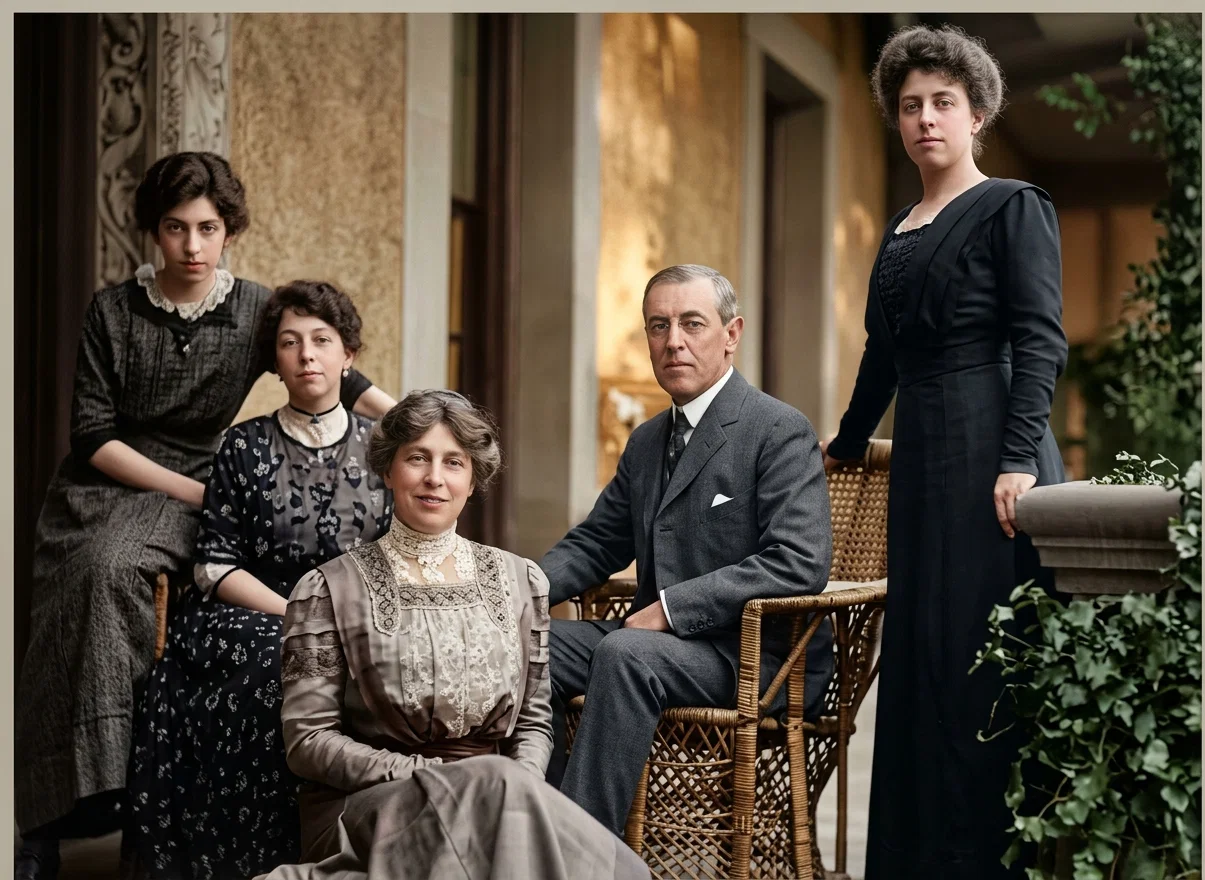
PRESIDENT WOODROW WILSON AND FAMILY
THE sixty-second Congress, which closed March 4, 1913, should be marked, and must go down in history, as a notable one for having taken some advanced steps in the matter of Sunday legislation.
During the month of August, 1912, near the close of the second session of this Congress, a law was passed closing all first- and second-class post-offices throughout the country on Sunday. An account of the enactment of this measure, the passing of which reversed the long record of Congress in refusing to enact such a law, was given in the “Signs” of September 24, 1912.
During the closing hours of the last session of this Congress another piece of Sunday legislation was passed, this time in the form of a law prohibiting the sale or supplying of liquor in hotels, restaurants, and clubs, in the District of Columbia, on Sunday.
Both laws were introduced and passed as “riders” to other bills; the first as a rider to the post-office appropriation bill, and the second as a rider to the District excise bill, regulating the sale of liquor in the District of Columbia.
Section 9, paragraph 2, of this excise law provides that “not more than three saloons or barrooms other than in hotels or clubs shall be permitted on one side of a street between intersecting streets.” In other words, by this law, not more than twelve saloons to the square block (three on a side) are allowed in the District of Columbia, the capital of the nation.
The Sunday-Law Rider
Paragraph 6 of this same section of this law says:
“No licensee under this section shall sell, give away, or dispense any intoxicating liquors to any person between the hours of one o’clock A.M. and seven o’clock A.M., nor on Sundays or Inauguration Day; and between said hours, and on Sundays and Inauguration Day, every barroom and other place where intoxicating liquors are sold shall be kept closed.”
The law of which this is a part was approved March 4, or just shortly before the hour of the final adjournment of this Congress, and goes into effect July 1, 1913.
It is no doubt a good thing to have in Washington, the capital of the nation, a “safe and sane” Inauguration Day, which occurs but once in four years. Secured upon its merits apart from religious bias, it would doubtless be well also to have a sober, safe, and sane day in Washington once a week, which would mean fifty-two such periods in a year, or two hundred and eight in four years. But granting the wholesomeness of these things, why would it not be a splendid thing also to have EVERY DAY of every year in Washington, a sober, safe, and sane one?
And if Congress has the right and the power to forbid the sale and the serving of intoxicating liquors on ONE day in the week, why has it not also the right and the power to prohibit the sale and the serving of such liquors altogether on ALL days? Why prohibit it simply on SUNDAY? To prohibit the sale and serving of liquor on SUNDAY ONLY, is virtually to SANCTION its sale and serving on EVERY OTHER DAY. And this is what this law actually does in fact, even to the allowing of as many as twelve saloons or barrooms, besides hotels and clubs, in a single block in the business section of the city, and limiting the number of places in the District where intoxicating liquors may be sold, to “three hundred” by November 1, 1914. Evidently it is the DAY rather than the DEED that such legislation as the Sunday clauses here referred to is chiefly concerned with.
Those who oppose Sunday legislation upon principle, have sometimes been accused — tho wrongfully so, we are glad to say — of being in league with the saloon element; but it can not be denied that the Sunday legislation here quoted is very closely linked with legislation which actually permits and authorizes the running of saloons and barrooms, and the public sale of intoxicating liquors. It is certainly found in bad company in this instance.
Prohibition One Day in Seven
Commenting upon this latest Sunday legislation on the part of Congress, the Washington “Evening Star” of March 6, 1913, under the caption “Sunday to Be Dry,” says:
“Washington will be a prohibition city one day out of seven after July 1 next. With the going into effect on that date of the District of Columbia’s new excise law, hotels, restaurants, and clubs will be prohibited from serving drinks with meals Sundays. This is one of several radical changes provided for by the law. Officials of the excise board were surprised to-day to find how far-reaching the legislation is.”
Thus, by piecemeal, and by riders adroitly attached to various bills, Congress is now being committed to Sunday legislation.
The Insidious “Rider” in Disfavor
Like the barnacle on the ship, the insidious “rider” is frequently attached to measures to the general character and object of which it is quite foreign, and legislation is thus secured which could not be obtained if allowed to stand alone and upon its own merits. For this reason the “rider,” like the proverbial “joker” in bills, is very naturally and very properly looked upon with suspicion and disfavor. The merits and the propriety of any legislation which is dependent upon such means for enactment may well be questioned.
An editorial in the Washington “Herald” of March 12 comments upon this subject thus:
“It is gratifying to perceive that President Wilson has expressed himself as strongly averse to ‘riders’ on appropriation bills. This he made clear in a conversation with Mr. Fitzgerald, chairman of the House Committee on Appropriations. Mr. Taft had to veto three of these supply bills because of general legislation attached to them in the shape of ‘riders.’”
It would have been well if the two measures passed by the last Congress, containing Sunday-law riders, had been held up until these insidious and unconstitutional “riders” had been unhorsed.
An Interesting and Illuminating Incident
On Monday, February 24, only a few days before Congress adjourned, an interesting incident occurred in the House of Representatives, which forcibly recalled the passing last August of the rider amendment, introduced by Mr. Mann of Illinois, closing the post-offices on Sunday, and clearly demonstrated the fact that those who are foremost in prescribing the religious conduct of others by law, are not always careful to practise what they preach.
A measure appropriating $10,000 for experiments in the development of aviation for naval purposes was being discussed in the House on the Monday here referred to, when the following conversation took place:
Mr. Mann: I noticed in one of the Washington newspapers yesterday what purported to be a statement made by Captain Chambers, which is impudent and impertinent to the highest degree. I do not know whether he made the statement or not; but if he made the statement attributed to him he ought to be court-martialed and dismissed from the navy.
Mr. Roddenbery: Did I understand the gentleman from Illinois to say that he read the Washington Star yesterday?
Mr. Mann: I did.
Mr. Roddenbery: On Sunday?
Mr. Mann: I did. I read the Post too.
Mr. Roddenbery: On Sunday?
Mr. Mann: Yes; and then afterward I read the Times.
Mr. Roddenbery: When we had up the bill to prohibit the delivery of mail at the post-office on Sunday, I thought I heard the gentleman from Illinois say he did not read any mail on Sunday, and that he did not even read the newspapers.
Mr. Mann: I did not read any letters yesterday, and I did not open any mail yesterday; and if the gentleman should spend no more time reading the papers than I do on Sunday, he would not spend very much.
Mr. Kendall: That was Sunday’s Star, but it11was read this morning before breakfast. The gentleman misunderstood the gentleman from Illinois.
Mr. Mann: I did not so state. Being a man who is not afraid of what he has done, however foolish it may be, I read the Star, in the way that I read the papers, and afterward I read the Post, and then by inadvertence in the afternoon I read the Times.—“Congressional Record” for February 24, 1913, page 3952.
Congress in Session All Day Sunday
Another item of interest in this connection is the fact that this very Congress which thus twice committed itself to the enforcement of Sunday observance upon the part of others by law, spent the whole of the last Sunday of its closing session at its usual work of making laws for the people. An article in the Sunday afternoon Washington “Times” of March 2, was headed, “Congress Holds Sunday Session—Both Houses Wrestling with the Rivers and Harbors and Public Buildings Bills.” Another article in the same paper shows that the very bill which contained the Sunday-closing rider for the District of Columbia, was passed by the House on this day.
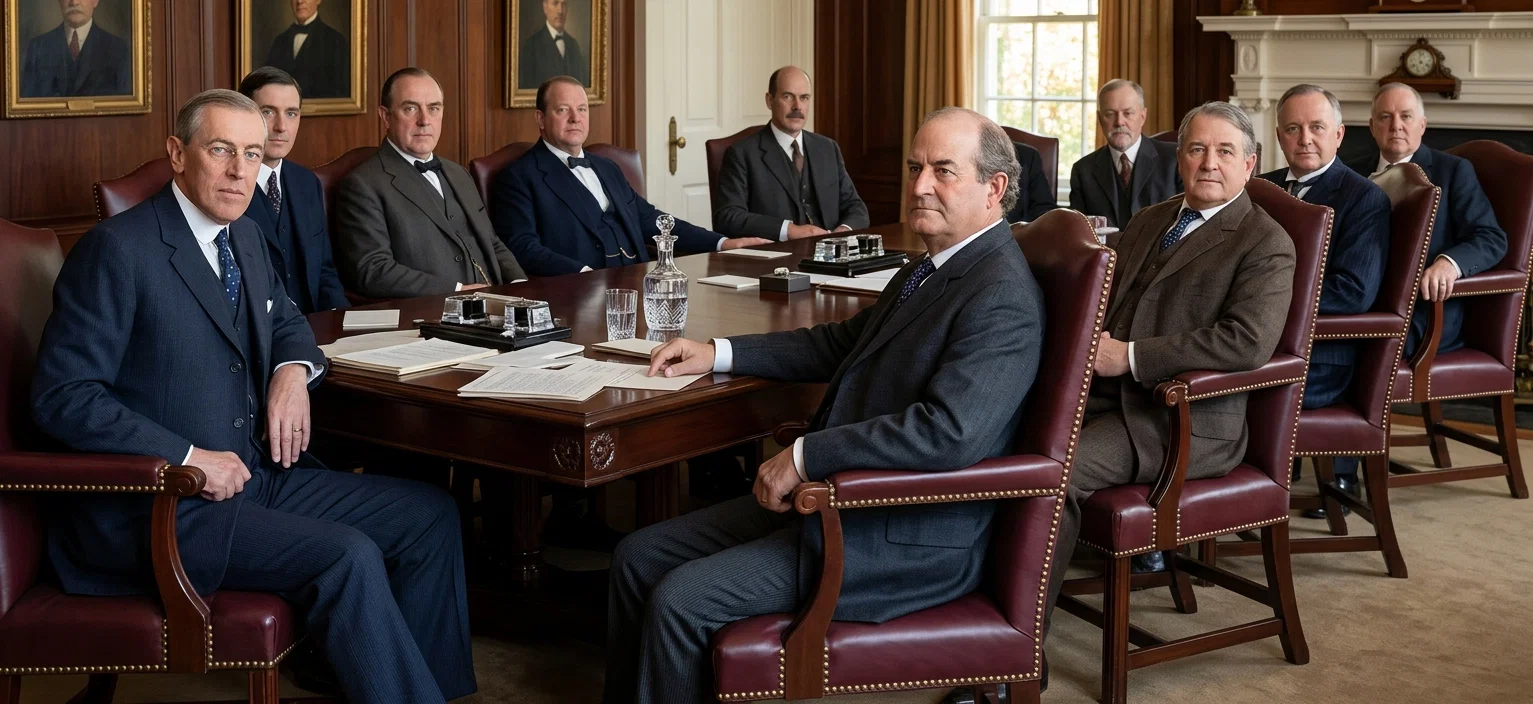
President Wilson and his cabinet. From left to right around the back of the table: President Wilson; William G. McAdoo, secretary of the treasury; James C. McReynolds, attorney-general; Josephus Daniels, secretary of the navy; David F. Houston, secretary of agriculture; William B. Wilson, secretary of labor; William C. Redfield, secretary of commerce; Franklin K. Lane, secretary of the interior; Albert S. Burleson, postmaster-general; Lindley M. Garrison, secretary of war; William J. Bryan, secretary of state.
The first paragraph of the article reads thus:
“After a battle which has lasted for nearly a year, and a fight which was one of the most bitterly contested in the history of Congress, the House at an early hour this morning adopted an amended form of the Jones-Works excise bill, inserted as a rider by the Senate on the District Appropriations Committee, and sent the district budget to conference with a definite agreement on the form which the new excise law should take.”
It would be well to remember this, when, as we may expect in the near future from the present trend of affairs, Congress enacts still more stringent legislation requiring men generally, either in the District of Columbia or elsewhere, to cease their ordinary work on Sunday, and observe it as a day of rest and worship. If it is proper for Congress, at its own pleasure and discretion, thus to continue at its ordinary work on Sunday, why should not every citizen in the country be accorded the same right to decide for himself whether he will do the same? What right has a legislative body which WORKS on Sunday, to require men to REST upon that day?
What the President and President-Elect Did on Sunday
Not only were both houses of Congress busily engaged in the work of lawmaking on this last Sunday of the session, but from the following items taken from the Washington “Herald” of Monday, March 3, it would appear that both the president and the president-elect spent at least a portion of the day in a similar manner.
Taft’s Last Sunday at the White House
“7:30 A.M.—The president arose. “8:30 A.M.—Took breakfast. “9 A.M.—Went to work in the library, and put in time until 10:45 A.M. reading his mail and considering a small grist of bills.
“Princeton, N. J., March 2.— . . . Sunday was a busy day for the president-elect and his family. The little cottage was thoroly dismantled by evening. Everything but the carpets and furniture had been packed in trunks and valises and hand-bags, and express wagons ran back and forth to the railroad station all afternoon. The president-elect packed everything he had in the line of clothing in bags and wore a frock coat all day, even when assisting in the packing.”
Attention is called to this, not to question the right of either of these honored men to do as he did, but to ask why every other citizen in the country should not be granted the same right and privilege to follow the dictates of his own conscience as to what he does or what he does not do on Sunday. No one for a moment would think of either of these men being fined or imprisoned for doing what he did on Sunday. Why, then, should laws be enacted, either by state or by nation, fining and imprisoning men in the humbler walks of life for engaging in honest work or business on Sunday?
District Sunday Barbers’ Law Declared Void
The matter of Sunday legislation for the District of Columbia has been made a still further subject of agitation by the law closing barber shops in certain sections of the city of Washington on Sunday having recently been declared void by Judge Pugh, of the District Police Court. As a result of this decision, nearly all the barber shops of the city were open on the first Sunday after inauguration. This will doubtless be made the occasion for a demand for still further Sunday legislation from Congress.
All these perplexities and inconsistencies are but the natural results of men’s attempting to legislate for God in religious things. If the question of Sabbath observance were left where God Himself has left it—with the law of God, the Bible, and the individual conscience—no occasion would be found for calling upon the state to enact laws compelling men to observe Sunday. Men would soon discover that Sunday is not the Sabbath of divine appointment, and that even tho it were, its proper observance could not be secured by the enactment of human laws.
W. A. COLCORD.
The Toll of the Big Tornado
By T.
The destructive work of the tornado that struck Omaha, and the like storms that were in operation in other places at the same time, are commented upon in a few suggestive editorial paragraphs in the New York World. The paragraphs follow:
“Not for seventeen years has a tornado taken such costly toll of human life as that which wrecked Omaha on Sunday. To find its parallel we must go back to the St. Louis storm of May 27, 1896, when more than 300 lives were lost and property valued at $12,000,000 was destroyed.”
“The unseasonable weather of Saturday and Sunday produced storm conditions favorable to the development of local tornadoes. Two distinct tornadoes swept down upon Omaha and Council Bluffs. It is not clear that either of them struck Woodbine, Iowa, where another disaster took place. Still other local disturbances were accountable for the havoc wrought at Terre Haute, Indiana, and in Missouri. It will not be strange if a dozen storms are found to have been generated on the same day by the exceptional conditions.”
“Lulled by long security, the Middle West had almost forgotten its cyclone-cellar period. Perhaps it fancied that it had outgrown tornadoes. This bitter experience will remind it that the wind is untamable and that like conditions will always bring like consequences. There has not been one of the seventeen years since the St. Louis storm when tornadoes of destructive power have not occurred. But when their field is narrow, and good luck places them in open country, where the destruction done is relatively slight, we hear little about them.”
“The material wants of the thousands made homeless will be promptly relieved. As for the stricken towns, they are not American if they are not at once rebuilt.”
The foregoing utterances give simply the facts of this storm period. And the unusual prevalence of these storms shows us that this old world is becoming more and more unsteady and unsafe. One of the remarkable things about these storms is the few lives that are lost when we come to compare the number killed with the destruction of property. Hundreds of cases are reported where large buildings occupied by human beings are broken all to pieces and yet but very few are killed. Men and women should awake to the fact that there is a connection between these destructive storms and the immorality of the world. Men are defying God by their wicked conduct, and destruction is being visited in consequence. Thousands of good people are12seeing this and acknowledging it. Every one ought to be able to see it.
Murders, and suicides, and graft, and divorces, and the white slave trade, and commercialized crime, are a part of the list of evils that have become so rampant as to make great world problems. Men try to minimize these things, and try to have us believe the world is getting better; but those who are familiar with the facts know better.
The conditions in society throughout all the world to-day are identical in principle with the conditions that have invariably preceded the downfall of every empire and kingdom that has crumbled into decay and been stricken from the map. But until the last hundred years, we have had but very limited facilities for intercommunication, and so the evil was confined to some limited territory. But to-day the railroad, the steamship, and electricity have made the world one vast neighborhood, and the iniquities of the time are prevailing everywhere. Good men and women are grappling heroically with these problems of evil, but they are not able to stay the tide. The greed of the time is bearing everything down before it, excepting a few stalwarts here and there in church and state who can not be corrupted.
God has given plainly the warning of His word. He has given us the example of what He will invariably do with gross wickedness.
“For if God spared not the angels that sinned, but cast them down to hell, and delivered them into chains of darkness, to be reserved unto judgment; and spared not the old world, but saved Noah the eighth person, a preacher of righteousness, bringing in the Flood upon the world of the ungodly; and turning the cities of Sodom and Gomorrah into ashes condemned them with an overthrow, making them an ensample unto those that after should live ungodly; and delivered just Lot, vexed with the filthy conversation of the wicked: (for that righteous man dwelling among them, in seeing and hearing, vexed his righteous soul from day to day with their unlawful deeds;) the Lord knoweth how to deliver the godly out of temptations, and to reserve the unjust unto the day of judgment to be punished: but chiefly them that walk after the flesh in the lust of uncleanness, and despise government. Presumptuous are they, self-willed, they are not afraid to speak evil of dignities. Whereas angels, which are greater in power and might, bring not railing accusation against them before the Lord.”
“But these, as natural brute beasts, made to be taken and destroyed, speak evil of the things that they understand not; and shall utterly perish in their own corruption; and shall receive the reward of unrighteousness, as they that count it pleasure to riot in the daytime. Spots they are and blemishes, sporting themselves with their own deceivings while they feast with you; having eyes full of adultery, and that can not cease from sin; beguiling unstable souls: an heart they have exercised with covetous practices; cursed children: which have forsaken the right way, and are gone astray, following the way of Balaam the son of Bosor, who loved the wages of unrighteousness; but was rebuked for his iniquity: the dumb ass speaking with man’s voice forbad the madness of the prophet.”
“These are wells without water, clouds that are carried with a tempest, to whom the mist of darkness is reserved forever. For when they speak great swelling words of vanity, they allure through the lusts of the flesh, through much wantonness, those that were clean escaped from them who live in error. While they promise them liberty, they themselves are the servants of corruption: for of whom a man is overcome, of the same is he brought in bondage. For if after they have escaped the pollutions of the world through the knowledge of the Lord and Saviour Jesus Christ, they are again entangled therein, and overcome, the latter end is worse with them than the beginning. For it had been better for them not to have known the way of righteousness, than, after they have known it, to turn from the holy commandment delivered unto them. But it is happened unto them according to the true proverb, The dog is turned to his own vomit again; and the sow that was washed to her wallowing in the mire.” 2 Peter 2:4-22.
The foregoing scripture and other similar passages may be studied with profit by the people of this generation. The principles expressed are eternal and will apply while the world stands.
And it will not do for us to say that the places visited by storm and earthquake are the ones that are especially singled out; but these visitations that are coming are warnings to us, and we should give heed. And not only should those of us who are uninjured give heed to these warnings, but we should give our substantial sympathy to those who are in distress. Almost every town and village in the country has some central place where means may be gathered to be forwarded to the sufferers in the storm-wrecked sections of our land. We should open our hearts in sympathy by giving of our means to relieve the distress.
The warnings that God permits to come, are not for the purpose of destroying life, but to save life. And if we are properly heeding these admonitions, we will be all the more tender and sympathetic toward those who are in distress. T.
Degrading Jokes, Songs, and Cartoons
By T.
There is much discussion of the divorce evil and what may be done to abate it. In seeking for the causes of the rapidly increasing number of divorces, we should not overlook the class of songs that are being sung by the people of this time, and particularly of the jokes and cartoons that make light of the marriage relation. The papers greet us every day with their jokes about men going out with young girls or other women, and about the absurd tangles they get into while trying to avoid being caught by their lawful wives. In like manner the cartoonist makes a huge joke of the marriage relation, and gives one the impression that there is nothing serious about matrimonial infidelity. It is nothing more than something very funny and to make one laugh. Young men read these things continually, and it makes an impression on their minds. They imbibe the sentiment that it is not so bad for a young married man still to flirt with other women, and so he goes ahead doing it, and soon finds himself in a divorce court.
There is another side to this joking and cartooning the marriage contract that should be seriously thought of. The cartoonist and the joker would not keep matrimony in the lime-light of ridicule if there were not an indifference in popular sentiment exists to support the thing, it will go on doing its baleful work in the education that degrades.
The marriage relation is one of the most sacred, and the well-being of society depends upon its being properly regarded. Moral people everywhere should frown upon the maudlin “popular songs” that are sung by so many; they should frown upon the immoral jokes concerning the marriage relation that afflict so many of the papers and magazines of the time; and they should frown with emphasis upon the miserable cartoons, making light of the sacred relation of husband and wife, that are coming to occupy so much prominent space in nearly all the daily papers.
The editorials in many of these papers speak in very commendable terms of the sacredness of the home and the importance of safeguarding the marriage relation. But by their cartoons on other pages they are teaching in an opposite direction far more effectively than in their editorials. The cartoons are read and absorbed by thousands who never look at the editorial pages.
Men who prostitute their splendid powers to making such foolish and degrading cartoons will have to answer at the bar of the Eternal for a large share of the indecency of this time. And editors who permit such stuff to find a place in their columns will have to share the responsibility. True wit and humor is refining as well as enjoyable. But this stuff called “joke” and “song” and “cartoon” is doing a large part of the degrading work that has created the diabolical demand for the “white slave” trade, as well as to separate husbands and wives and drive them into the divorce courts. T.
Relief for the Poor
By T.
Mrs. Elizabeth Milbank Anderson has given $650,000 to the New York Association for Improving the Condition of the Poor. This handsome gift is said to be the largest that has been bestowed for a similar purpose, excepting the gifts of Mrs. Russell Sage. The Anderson donation is made with the stipulation that none of it shall be used except in educational and preventive measures. The relief to the poor is to come in the way of preventing distress, rather than in trying to cure it after it comes. To use Mrs. Anderson’s own words in tendering the gift:
“I fully appreciate the necessity for ministering to the physical needs of the sick, disabled, and unfortunate; but in undertaking the work outlined, I wish to make it clear that the proposed Department of Social Welfare is to concern itself, in so far as it employs funds supplied by me, with a social program based upon preventive and constructive measures. Generally speaking, therefore, this program should include those activities which are calculated to prevent sickness and thus diminish poverty, such, for example, as the promotion of cleanliness and sanitation and aid in securing a proper food supply. In this connection your association will doubtless find it advisable, in some cases, to coöperate with public authorities and with existing agencies having similar objects in view, where such agencies are practising approved methods in fulfilling their purposes; while in other cases it may probably be necessary to establish the work as a new enterprise. . . . With the funds at your disposal I would expect you to create the proposed Department of Social Welfare, and to distribute the enterprises to be conducted under its supervision among at least three subdepartments or committees, one dealing with matters pertaining to public health and hygiene, one dealing with matters pertaining to the welfare of school children, and one with matters pertaining to food supply.”
Work of this character is very commendable, and we wish there were far more of it. It is just such large-hearted work that keeps the earth so that people can live on it at all. T.