Your ShelfYour Projects

Signs of the Times, Vol. 40, No. 15.

There They Crucified Him

Signs of the Times

Apr 15, 1913

Pacific Press Publishing Association · Mountain View, California · Apr 15, 1913

There They Crucified Him

BY LLEWELLYN A. MORRISON
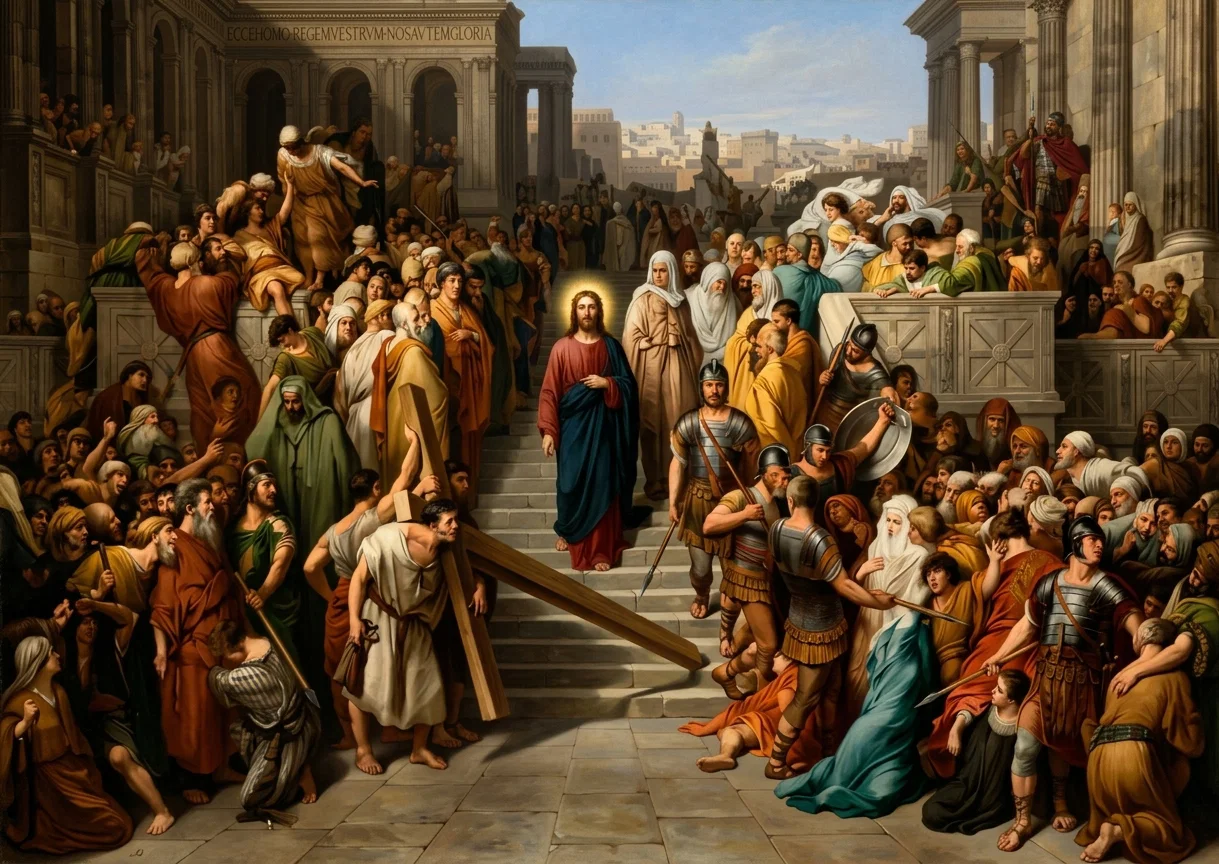
WHERE rough Golgotha's ramparts rise Without the city gateway I stand, beneath the Syrian skies, And lo, there cometh straightway A throng, who lead a virgin's Son. Their hate-tipped tongues deride Him, Cross-burdened, scourged, thorn-crowned, undone, And there they crucified Him.
I shudder at the awful scene, The pregnant passions swaying, The darksome deeds that so demean — Still fouler lust betraying. I see the soldier, stern and cold; The boaster who denied Him; The low-browed ruffian, bad and bold. And there they crucified Him.
I hear them cry, “Away with Him,” And gnash their teeth upon Him, While vicious villains, gaunt and grim, Exude their vileness on Him. They strip and spike Him to the wood — While traitors taunt and chide Him — ’Mid oaths and cursings, tears and blood; And there they crucified Him.
I marvel when I hear Him pray, With wistful gaze above them; For as I listen, He doth say — He does so truly love them — “Forgive them, Father; they forget.” Those murderers beside Him, Unheeding still, refuse Him yet — And there they crucified Him.
The day shrank into night at noon, Appalled at human blindness; The dead sprang free from death's long swoon, Thrilled by His loving-kindness; All heaven shone out, in Him revealed — Nor hate nor hell could hide Him; The veil was rent, and love unsealed, Because they crucified Him.

Question Corner

“IF YE WILL INQUIRE, INQUIRE YE.”

This Inquirers’ Department is conducted for the purpose of helping those who are studying the Bible. The answers are oftentimes only suggestive. They are never to be considered infallible, only as they agree with the infallible Word. The writer who may answer them does not consider that his opinion is infallible. He will simply give the best that he has, and plead with the inquirer to search the Word. Such questions only will be answered as, to the editors, seem to minister to the good of the readers and to the mission of the paper. We can not answer repeatedly in the same volume questions upon the same scripture. The name and address must accompany question, not for publication, but as an evidence of good faith, and that answer may be made by letter if deemed advisable. No letters are answered which do not contain the name of the writer. It is well always to enclose stamp for reply.

4044 — Why Baptize “in the Name of the Father, and of the Son, and of the Holy Ghost?”

The scribe is not a Sabbath-keeper, but I do like those that have the backbone to come out and obey God by keeping the Bible Christian Sabbath. But let me ask, Why do the Sabbath-day church baptize “in the name of the Father, and of the Son, and of the Holy Ghost”? Is not this popery also? A. M.
The Sabbath-keeping church baptize in that formula for the same reason that they observe the Bible Sabbath, because the Lord has told us so to baptize. Jesus said to His disciples before He left, “All authority hath been given unto Me in heaven and on earth. Go ye therefore, and make disciples of all the nations, baptizing them into the name of the Father and of the Son and of the Holy Spirit: teaching them to observe all things whatsoever I commanded you: and lo, I am with you always, even unto the end of the world.” Matt. 28:18-20, A.R.V. We prefer the term “Holy Spirit” to that of “Holy Ghost.” Apostate churches may use this same form; that does not affect the truth of the Bible. There are always many things in the counterfeit that are like that of the true, else there would be no force to the counterfeit; and apostasy has carried with it many things which are in harmony with the Bible. Its apostasy does not pertain to these things, but to the things wherein they differ. Of course where apostasy does carry mere forms, however, these forms amount to nothing, because they have lost their spirit. Baptizing into the name of the Father is into the character of the Father, and of the Son is into the character of the Son, and of the Holy Spirit, into that for which the Holy Spirit stands. The character of the Father stands for righteousness, forgiveness of sins, clothing with the righteousness of God. See Bible Students’ Library, No. 204, “Bible Baptism.” Price, single copy by mail, 2 cents.

4045 — The Bible and Socialists

The principles and statements recorded in Lev. 25:10, 23; Deut. 15:4-11; Ex. 22:25; and Lev. 25:35, 37, are declared by certain Socialistic writers to be Socialistic principles, in the sense that the Israelitish commonwealth, or theocracy, was Socialism in one form established, and that the Socialists of to-day enunciate the same doctrines, more or less. Striving to attain such a worthy object is surely commendable, but not being under the direct leadership of God through prophecy, is it not in one sense a delusion, or a false theocracy? That is, can Socialism be called a false theocracy? Does it not rely too much on self to attain justice? C.
The texts in question have to do with land, with the righteous individual, with usury, with duties toward our fellow men who are poor. Now these are good principles, but the whole history of Israel, directly guided through God, with laws from God, failed to meet the ideal. Why?—Because Israel tried to carry it out according to the letter, without any regard to the spirit. They sought righteousness by their own works, and not by faith. The history of Israel looked at from that standpoint, is an everlasting testimony that no law can make men righteous, or enable them to do righteous things. Of course God’s object in keeping that nation together as He did was for another reason: He must keep the nation together in order to preserve the “seed,” the special family through which Christ was to come. He did everything that He could to induce them to be circumcised in heart, to be separate from the world, to give themselves wholly to Him. At the time of such revival in the nation, when their hearts were in tune with God, all these various principles were carried out, but just as soon as they left God out, and depended on themselves, or on the laws, they failed.
Any society whatsoever that endeavors to reach through law, or to bring about ideal conditions through any human organization whatsoever, will fail. Never, until selfishness is taken out of human hearts, can we have the ideal society, and Christ only can remove that selfishness. The man who assumes to do it, or the set of men that assume to do it, of themselves, are assuming prerogatives and powers that do not belong to them. We may not call it a false theocracy, but it is certainly a kingdom which will sooner or later end by the elements of destruction which it holds within itself. God has set before us the kingdom of man in prophecy. It passed through all phases of human government, from unlimited autocracy and imperialism down through limited monarchies, until at last it is manifest in Socialism, or the clay,—the divided condition of the world. But all these come to nothing. They do not have within them the elements of the divine life. That kingdom only will stand forever the subjects of which get right at heart. Socialists have before them a grand ideal, but they utterly ignore, or reject, the only things which will bring the ideal,—faith in Christ Jesus and the regenerating power of the divine life.

4046 — Hell of Fire

Please explain Matt. 5:22, last clause, “hell fire,” or, as the Revised Version has it, “the hell of fire.” What is it? A. E. C.
The text reads: “And whosoever shall say, Thou fool, shall be in danger of the hell of fire.” The margin is “Gehenna of fire.” There are two words rendered “hell,” with one exception, in the New Testament,—“Hades,” meaning the place of the abode of the dead, whether righteous or wicked, and “Gehenna,” a place of punishment. “Gehenna” comes from two Hebrew words meaning the Valley of Hinnom. The Valley of Hinnom was a place outside of Jerusalem where was cast all the debris and offal of the city. Bodies of malefactors, refuse of all sorts and kinds, were placed here. Upon this mass of rubbish the worms preyed, yet they could not consume it, and to avert the pestilence which might arise from it, constant fires were kept burning; so that the imagery of such texts as Mark 9:43 and on is derived from this literal valley and its use. Here the worm continually devoured, here the fires continually burned. But note this fact, that the worm consumed what it fed upon, and the fire burned up that which was cast into it. So that Gehenna, instead of implying everlasting torment to the wicked, implied absolute and complete destruction, just the same as in Matt. 3:12, “He will gather His wheat into the garner, but the chaff He will burn up with unquenchable fire.” That is, the worm will not die until that which it consumes is gone. The fire will not go out until that which is cast into it turns to ashes. The same finality of punishment is indicated in Isa. 51:8, “For the moth shall eat them up like a garment, and the worm shall eat them like wool; but My righteousness shall be forever.” Matt. 5:22, therefore, simply means the place of punishment. The man that shall call his brother “Thou fool,” or who shall utterly condemn his brother, is in danger of the punishment of destruction.

4047 — Master and Servant

Eph. 6:9; Col. 4:1; 3:22; 1 Tim. 6:1; Titus 2:9; 1 Peter 2:18.—Master and servant. The conditions stated in these texts are to a Socialist unthinkable. They find no brotherliness in such an attitude. They declare Socialism to be Christianity applied. In what way can the above texts be harmonized with the Socialist attitude, or vice versa, if at all? C.
Now it is true, as Socialists contend, that the ideal condition is that men are brothers. So Jesus states, “One is your Master, even Christ, and all ye are brethren.” That is what the Christian church ought to be, and if the Christian church were truly a regenerated body by each soul being regenerated through Christ, that is what it would be. There would be no classes, no servant and master, no lord and servant, in that church. But those are not the conditions in this world, and the Bible is speaking of the conditions in this world just as they are.
It is not the object of the gospel to regenerate the world through reforming politics. As Vice-President Marshall recently said, “Christ was not engaged in repealing bad laws, nor in providing criminal punishments for the violators of good ones. Jesus Christ was more than a reformer. He was a regenerator. The church is to stand as the representative of the kingdom of God on earth, and ‘except a man be born again, he can not see the kingdom.’ He brooded over Jerusalem as a hen broods over her chickens, and yet He never strove to make bad Jerusalem appear to be good Jerusalem.” That is all that laws can do,—make the bad appear to be good by restraining them; and the only excuse there is for civil law, is to compel civility and restrain incivility. It can not change the heart.
The Lord took all this into account. Some of those who accepted Christ were servants. Some of them, in the nature of the case, were masters. His whole aim and object was, whatever position a man was in in this world, that he should have the Spirit of Christ, and live the Spirit of Christ, to demonstrate that men could live Christians whatever their environment. If all the world were a republic to-day, a Socialistic state, it would not continue that way, and could not, one year. Just as long as men’s hearts are unregenerate the old conditions would persist, and there would be master and servant still, those who dominated and those who served. Socialism is endeavoring to bring about through law and system that which can only be brought about through the power of divine grace, and in this Socialism must fail.

4048 — Observing the Wind

Please explain Eccl. 11:4, “He that observeth the wind shall not sow; and he that regardeth the clouds shall not reap.” In its connection in the context I fail to grasp its meaning. C.
Ecclesiastes 11 is a good missionary chapter. It opens with “Cast thy bread upon the waters,” meaning so that we shall find it, just as rice was cast upon the flooded marshes, seemingly lost forever, but later to bring abundant crops. The second verse has also a missionary injunction,—“Give a portion to seven, yea, even unto eight.” That is, do not discriminate; in other words, feed all you can with the truth of God. And then nature does this: “If the clouds be full of rain, they empty themselves upon the earth.” Blessings abundant are poured out from the full clouds. So it ought to be with God’s children, and will be if they are full. The lesson of the tree seems to be a contrary one: “If the tree fall toward the south, or toward the north, in the place where the tree falleth, there it shall be.” That is decay and death; but the live missionary is the one who develops, expands, gives. Do not stop to regard the wind. “He that observeth the wind shall not sow.” There is a time for sowing. Some superstitiously would not sow if the wind were this way, and some if the wind were that way. But when the time is right, and the land is right, then sow the seed, regardless of wind or cloud. And the fifth verse shows that God is able to make it effective in ways which we know not. The same thought is expressed afterward in the sixth verse, “In the morning sow thy seed, and in the evening withhold not thine hand.” We should not be satisfied, like the dead tree, with doing nothing, but regardless of all seeming appearances, work for God, and He who can do in secret things of which we know nothing is able to make our own work effective.

Our Bible Band

Schedule for the Week Ending April 19, 1913

Sunday April 13 1 Samuel 7, 8 Monday " 14 " 9, 10 Tuesday " 15 " 11, 12 Wednesday " 16 " 13, 14 Thursday " 17 " 15, 16 Friday " 18 " 17, 18 Sabbath " 19 Psalms 22, 23
Our readings lie within 1 Samuel, chapters 7-18, inclusive. They give us the choosing of a king, Saul; the death of Samuel; the waning of the house of Saul and the calling of David. Chapter 15 is an awful lesson on the sin of witchcraft, and gives to us the oft-quoted scripture, “Behold, to obey is better than sacrifice, and to hearken than the fat of rams.” The Sabbath reading is Psalms 22 and 23. Psalm 22 is preeminently prophetic of our Lord in His humiliation; and 23 is the shepherd psalm, the most familiar of them all.

The Antitype the Lamb of God

By E. E. Andross
OUR SIN-BEARER ON HIS WAY TO CALVARY

His Offering Once for All

“Antitype, that which corresponds to and is represented by the type; the original of the type.” (“Standard Dictionary.”)
For four thousand years the Saviour of men had been prefigured in the types and shadows of the sacrificial system. In the presence of a vast multitude, on the banks of the river Jordan, the forerunner of Christ, pointing to the Messiah, proclaimed, “Behold the Lamb of God, which taketh [“beareth,” margin] away the sin of the world.” In Jesus, John saw the antitype of all the lambs and other animals slain in sacrifice, from Abel’s offering to Calvary. The lamb is a symbol of sacrifice. Jesus is “the Lamb slain from the foundation of the world.” Isaiah in prophetic vision saw Him “brought as a lamb to the slaughter.” Peter declares, “Ye were not redeemed with corruptible things, as silver and gold, . . . but with the precious blood of Christ, as of a lamb without blemish and without spot.” In describing what he saw in vision, the revelator says, “I beheld, and, lo, in the midst of the throne and of the four beasts, and in the midst of the elders, stood a Lamb as it had been slain.” Rev. 13:8; Isa. 53:7; 1 Peter 1:18, 19; Rev. 5:6.

The Sins of the World upon Christ

If man is saved, sin must be put away. In the divine plan for the accomplishment of this purpose, the sins of the world are laid upon Jesus; hence John speaks of Him as “the Lamb of God, which taketh away the sin of the world.” In speaking of the work of Christ as our great High Priest, the writer of the epistle to the Hebrews (9:26) says, “Once in the end of the world hath He appeared to put away sin by the sacrifice of Himself.” Sin could be put away only by a sacrificial lamb. Not an earthly lamb; for it is written of the offerings which the priests of the earthly sanctuary presented daily, that they “can never take away sin.” And again, “It is not possible that the blood of bulls and of goats should take away sins.” Heb. 10:4. It must be a divine sacrifice—the Lamb of God.
When Adam sinned in the Garden of Eden, he transgressed God’s holy law. “Whosoever committeth sin transgresseth also the law: for sin is the transgression of the law.” “Where no law is, there is no transgression.” And “sin is not imputed when there is no law.” 1 John 3:4; Rom. 4:15; 5:13. The standard erected in Eden must have been a perfect rule of life, else no such penalty as was pronounced against Adam could in justice have been meted out to him for its violation. This truth has been clearly stated by many inspired writers.
“The law of the Lord is perfect, converting the soul: the testimony of the Lord is sure, making wise the simple. The statutes of the Lord are right, rejoicing the heart: the commandment of the Lord is pure, enlightening the eyes. The fear of the Lord is clean, enduring forever: the judgments of the Lord are true and righteous altogether.” Ps. 19:7-9. “All His commandments are sure. They stand fast forever and ever, and are done in truth and uprightness.” Ps.111: 7, 8. “Faultless are all His precepts.” (Isaac Leeser translation.) “Wherefore the law is holy, and the commandment holy, and just, and good.” Rom. 7:12.

The Law Not Changed to Meet the Transgression

When man fell by transgression, the law was not changed in order to save him from its penalty, but a remedial system was established to bring him back to obedience. The law being perfect, it was impossible to alter it in the slightest degree. To do so would make it imperfect, and would justify man in his course of rebellion against God and His government. There was therefore but one of two courses for God to pursue in dealing with man after his fall. He must leave him to reap the full fruitage of his evil course, or He must provide a remedy. God’s love for man would not permit Him to take the former course; but it did provide a complete remedy, which has been revealed in the plan of salvation.
“The soul that sinneth, it shall die,” “for the wages of sin is death.” Such was the unalterable fiat that went forth against disobedience to God’s just and holy law. It is life, then, that the law demands of every transgressor. If, therefore, man is saved from this penalty, a substitute must be provided. The just claims of God’s righteous and holy law could be met only by Christ, who was above law. He, as Creator of all, could meet the demands of His own law in behalf of any or all His own creatures. Such an offering would provide a way of escape for the transgressor, while at the same time it would maintain the integrity of God’s kingdom, preserve the honor of His name, and uphold the majesty of His law. Such a life, unforfeited to the righteous demands of the law—a life equivalent to that of every created being—was all that was called for, and would bring salvation within the reach of every member of the fallen race.

Sacrifices That Were Only a Type

As soon as Adam passed outside the gates of Paradise, the smoke of sacrifice began to ascend to heaven. Not that God took pleasure in the death of His creatures, but that the slain lamb was a very expressive type of the “Lamb slain from the foundation of the world.” The sacrificial offerings served as a means of expressing the faith of the penitent sinner in the perfect offering made on Calvary.
The life of the Son of God being equivalent to the life of all His creatures, since He is their Creator, when He laid down His life as a sacrifice for the sins of the world, a way of escape was provided for every soul who would avail himself of it by sincere repentance and confession, and by steadfast adherence to the right. It was not necessary that Jesus should “offer Himself often,” but “once in the end of the world hath He appeared to put away sin by the sacrifice of Himself.” “But this Man, after He had offered one sacrifice for sins forever, sat down at the right hand of God.” “By one offering He hath perfected forever them that are sanctified.” For those who neglect or refuse to avail themselves of this wonderful salvation through this one offering, “there remaineth no more sacrifice for sins, but a certain fearful looking for of judgment and fiery indignation, which shall devour the adversaries.” Heb. 9:26; 10:12, 14, 26, 27. Surely we can unite with the angelic throng in saying, “Worthy is the Lamb that was slain to receive power, and riches, and wisdom, and strength, and honor, and glory, and blessing.”

Christian Privileges and Duties

By Mrs. E. G. White
It is the privilege of every soul to seek and find peace in Christ. Yet this peace is granted only upon conditions. We must surrender our own ways and wills and plans, and thus put off the grievous yoke which we have bound upon our own necks, and we must take upon us the yoke of Christ, which will bring rest to our souls. “Learn of Me,” says the Divine Teacher; “for I am meek and lowly in heart: and ye shall find rest unto your souls. For My yoke is easy, and My burden is light.”
We each need to learn in the school of Christ; and it is because we are not more humble and diligent students that we are so slow to manifest meekness and lowliness of heart. It is only when we cherish these precious graces that peace and rest can abide in the soul. Only the humble and contrite ones find shelter in the promises of God; only these obtain a saving knowledge of the Scriptures, and a rich experience in trusting God and obeying His precepts. In our own strength we are indeed feeble; but in the strength of our Redeemer we may be strong. In the midst of tumult we may have quietness and peace. We must believe in Him, even though darkness envelop the soul; we must work from principle, rather than from feeling. By this continual, unwavering trust, Satan is baffled and disappointed. Says the psalmist, “Thou through Thy commandments hast made me wiser than mine enemies.” “Thy word is a lamp unto my feet, and a light unto my path.”

Must Rely on His Power

If we would maintain our fidelity to God, in this time of danger and deception, we must constantly rely upon the power of Christ. We must be often before God in prayer, holding every emotion and every passion in calm subjection to reason and conscience, banishing all unholy imaginings, bringing every thought into captivity to the obedience of Christ. By earnest prayer and living faith we can resist the assaults of Satan, and keep our hearts unspotted from pollution.
The strongest temptation is no excuse for sin. However great the pressure brought to bear upon the soul, transgression is our own act. It is not in the power of earth or hell to compel any one to sin. The will must consent, the heart must yield, or passion can not overbear reason, nor iniquity triumph over righteousness.
I appeal to you who profess to be followers of Christ to depart from all iniquity. You must do this if you would represent the truth as it is in Jesus. God wants wholehearted, thoroughgoing men. These only can stand the test of the judgment. If those who have received the light were but true to their trust, what a flood of light would be poured upon the world! But how is it, not only with the members of the church, but with those who stand as ministers of the gospel? Do their habits and experience correctly represent the purity and simplicity of a holy, cross-bearing life?

Must Be Power in the Life

The true toilers in the Lord’s vineyard will be men of prayer, of faith, of self-denial,—men who hold in restraint the natural appetites and passions. These will, in their own lives, give to the world evidence of the power of the truth which they present to others; and their labors will not be without effect. “He that goeth forth and weepeth, bearing precious seed, shall doubtless come again with rejoicing, bringing his sheaves with him.” “And he that reapeth receiveth wages, and gathereth fruit unto life eternal.”
Fellow workers for Christ, time is short; we have no moments to idle away. Are you watching for souls as they that must give an account, or are you yourselves drowsy, ease-loving, and lukewarm? Have you a living faith? Are you every day increasing in the knowledge of Christ? Do you possess practical godliness, Christian meekness, and deep love for the souls for whom Christ died? Search the Scriptures. Do not depend upon the little knowledge which you already have. Pray for clearer light. Dig for the precious gems of truth as for hid treasure. Thus will you be enabled to bring forth from the storehouse of God things new and old.
In this age of conflicting doctrines, when fables abound, and there is so much sensational preaching on the one hand, and so great formality on the other, it is a difficult matter to arouse the people. Our only hope of success is to reach them through God. We must give evidence of earnestness, zeal, and devotion commensurate to the importance and solemnity of our work. There should be no exaltation of self. We are not to call attention to the instrument, but to present Christ and the sacred truths that are to test the people of God. If these truths sanctify our own hearts, if they purify and ennoble our own characters, we shall be living epistles, known and read of all men.
The ambassadors of Christ must learn where their strength lies. They must themselves drink of the living water, before they can guide others to the fountain. We must learn by experience what it is to lean upon the arm of our Beloved. There is no evil more fatal to the prosperity of the church than the influence of the professed teachers and ministers of the gospel who are deficient in Christian experience, in faith, self-denial, self-control, and in the tact and energy essential for skilful warfare.

The Narrow Way

Many retain a form of godliness and a connection with the church, when they bring no strength, help, or blessing to the church. They seek to make the narrow way broad and pleasant for the multitude to walk in. Such are destitute of spiritual eyesight. They have put out their own eyes, and they stumble at every step. The word of God has not widened the narrow way; and if the half-hearted and pleasure-lovingchoose a path where they need not bear the cross or suffer tribulation, they are in a path where the Saviour did not walk.
The Scriptures clearly set before us the high and holy position which we should occupy as sons and daughters of God. If all would seek earnestly to attain this position, and would receive the spiritual benefit which it is their privilege to receive, they would be prepared to do good. If the love of Christ is kindled afresh in their own hearts, if they have drunk anew from the heavenly fountain, their cheerful testimonies and their prayers, sent up in faith, will be as great a help to the church as ministerial labor. The Spirit of God will come into their meetings, and the hearts of believers will say, It is good to be here.
Every church, be it large or small, should be taught not to depend on ministerial labor. Therefore, fellow Christians, there is the greater need that you kindle your tapers at the divine altar, that the light may shine forth to all around. However weak you may be, you can become a help and blessing to others, if you will keep your own souls in the love of God, and search the Scriptures for a clear understanding of the truth. It is not only your privilege but your duty to grow in grace and in the knowledge of the truth. You may rejoice in a living Saviour, and may show to all connected with you that He is the center of your affections and your hopes.
Would that all might view this matter of daily, practical Christianity as it has been presented to me! Would that they could see what we might be in spiritual power, and what we are because we neglect the light which God has given us! Many will have to combat intellectual slothfulness and spiritual stupor, before they can be a blessing to themselves or to their fellow men. We are living under the most solemn message of warning ever given to our world. We are altogether too near the closing scenes of this world’s history to be inattentive, to occupy a neutral position. It behooves us now to be wide-awake, ready for every good work, ready to give a reason for the hope that is in us.
Continue reading: The Sabbath