In the spring of 1891, at the session of the General Conference in Battle Creek, Mich., it was voted that an orphanage and an old people’s home should be established and maintained by our people.
A committee was appointed to inaugurate this work. The outcome was the establishment of an orphanage, known as the Haskell Home, and an old people’s home, known as the James White Memorial Home, both of which institutions are located at Battle Creek, Mich.
A lady, not identified with our cause, but interested in orphanage work, contributed thirty thousand dollars toward the erection of the Haskell Home. A corporation for these enterprises was later created, and operated under various names, according to the desire of those directing its affairs. The last corporate name of the organization was the International Medical Missionary and Benevolent Association, which ultimately became involved financially, and petitioned the court to appoint a receiver.
Prior to the dissolution of this corporation by the court and the appointment of a receiver, its trustees, unbeknown to many of the numerous creditors of the association, deeded the properties known as the Haskell Home and the James White Memorial Home to corporations which had been created by some of those directly connected with the Battle Creek Sanitarium, the Haskell Home, the James White Memorial Home, and the International Medical Missionary and Benevolent Association.
The reader can well imagine the surprise that was felt when it was learned that the Medical Missionary Association had divested itself of these properties which had been carried on its books as an asset.
The records show that the trustees of the defunct Medical Association had, without financial consideration, deeded away both properties, and left the liabilities of the Medical Association unchanged. It has been repeatedly stated by those representing the corporations to which these institutions were deeded that they were undenominational. These institutions were therefore placed beyond the ownership and management of the Seventh-day Adventist denomination.
Notwithstanding the large amount of money which our people were annually contributing for the support and maintenance of these institutions,—amounting, since 1891, to $176,594.34, according to the books of the Medical Association,—the trustees, elected to control and manage the enterprises for the denomination, deeded the properties to these undenominational organizations, in the management of which the denomination has no voice or control.
The question has naturally arisen among our people, Shall our denomination continue the support and maintenance of these institutions?
The Washington General Conference, held in the spring of 1905, recommended “that five general collections be taken,” naming with four others, “an offering for the orphans of the Haskell Home and similar institutions.”
In the spring of 1906 the usual offering for orphanages was taken, amounting to about $4,500. Notwithstanding the knowledge the General Conference Committee had regarding the change in the ownership and management of these institutions, it turned over to the Haskell Home out of this donation for 1906, $3,000. The rest has been set aside and appropriated for other orphanage work carried on among our people.
In the autumn of 1906, the secretary of the General Conference received from the secretary of the Haskell Home and the James White Memorial Home an inquiry concerning the future support of these institutions. The question was laid before the General Conference Committee, together with a large number of presidents of conferences who were assembled in council at Takoma Park, in October, and the following recommendation was adopted:—
“In reply to the inquiry received from the secretary of the Haskell Home and the James White Memorial Home concerning the attitude of the denomination toward the further maintenance of these institutions, we recommend,—
“1. That reply be made to the effect that in view of the present well-known conditions, it is not deemed expedient that any further special appeal be made to the denomination for collections to provide for the maintenance of these institutions.
“2. That the officers of the General Conference be instructed to enter into negotiations with the management of the Haskell Home and of the James White Memorial Home on the basis that the offer be made that the denomination will take charge of and provide for the maintenance of any orphans now in the institution coming from Seventh-day Adventist families; and take charge of and provide for the maintenance of any aged people belonging to the denomination now in the James White Memorial Home who are dependent upon that institution for their support, not having placed in the hands of the management any funds or property providing for the same, and who may desire to go elsewhere.
“3. That each union conference make provision for the care of orphans and aged people within its borders, and that in the future the general call be made for the collection for orphans and aged people as heretofore, and that each union conference be permitted to retain whatever amount is raised within its territory.
“4. That a committee composed of the vice-president of the General Conference and one representative from each union conference be appointed to consider and recommend plans for the establishment and maintenance of the homes for orphans and aged people, or to make other provision for their care as may be deemed advisable.”
The secretary of the Haskell Home and the James White Memorial Home was notified of this action, and acknowledged receipt of the same, but no request has been made of the General Conference Committee to take the supervision and care of any of the inmates of these institutions.
The recommendations of the council concerning the care and maintenance of orphans and aged people in each union conference, should at once be taken up by the union conferences, and a plan worked out whereby persons needing assistance may have the same.
The donation to be taken the first Sabbath in April, 1907, will be used by the union conferences to establish and maintain suitable accommodations for the needy in their respective territories.
We believe that our people will approve of the arrangement to have the aged and orphans among us cared for by our union conferences. These unions will be better able to care for the needy than any central institution. They will more readily find it possible to provide homes among our people. And where it may be deemed necessary to establish an institution, those who share its benefits need not be taken so far away from friends and former associations.
We believe this will bring to us the fulfilment of the prophecy in Isaiah, where the Lord says: “Is not this the fast that I have chosen? to loose the bands of wickedness, to undo the heavy burdens, and to let the oppressed go free, and that ye break every yoke? Is it not to deal thy bread to the hungry, and that thou bring the poor that are cast out to thy house? when thou seest the naked, that thou cover him; and that thou hide not thyself from thine own flesh? Then shall thy light break forth as the morning, and thine health shall spring forth speedily: and thy righteousness shall go before thee; and the glory of the Lord shall be thy rereward. Then shalt thou call, and the Lord shall answer; thou shalt cry, and he shall say, Here I am.”
Let it be remembered that the offering which will be taken the first Sabbath in April will be devoted to the care of orphans and needy aged persons in each union conference. The money contributed will be retained by the union conference treasuries for the work in their respective territories.
Let us take hold of this work with renewed energy, and make a liberal offering in behalf of those who shall need our assistance.
OFFICERS OF THE GENERAL CONFERENCE.
Wales
By W. H. Meredith
Cardiff.—The Lord has blessed us here in Cardiff the past summer, by adding some good souls to our number. A week ago we received nine new ones into the church, and there are several others who will unite soon. Several of these heard the truth first from Brother J. S. Washburn, and one from Brother Keslake. Certainly this is bread that was cast upon the water and seen after many days.
It does our hearts good to hear of so many going out into the mission fields all the time. I hope the good work will go on without a break till the last nation and tribe has had the opportunity of hearing the gospel of the kingdom, and that soon we may hear the sound of the last trump, which will gather us all to17our new home. The sorrow and pain that I see on every hand make me long to see that day come.
W. H. Meredith.
Back in Fiji
By C. H. Parker
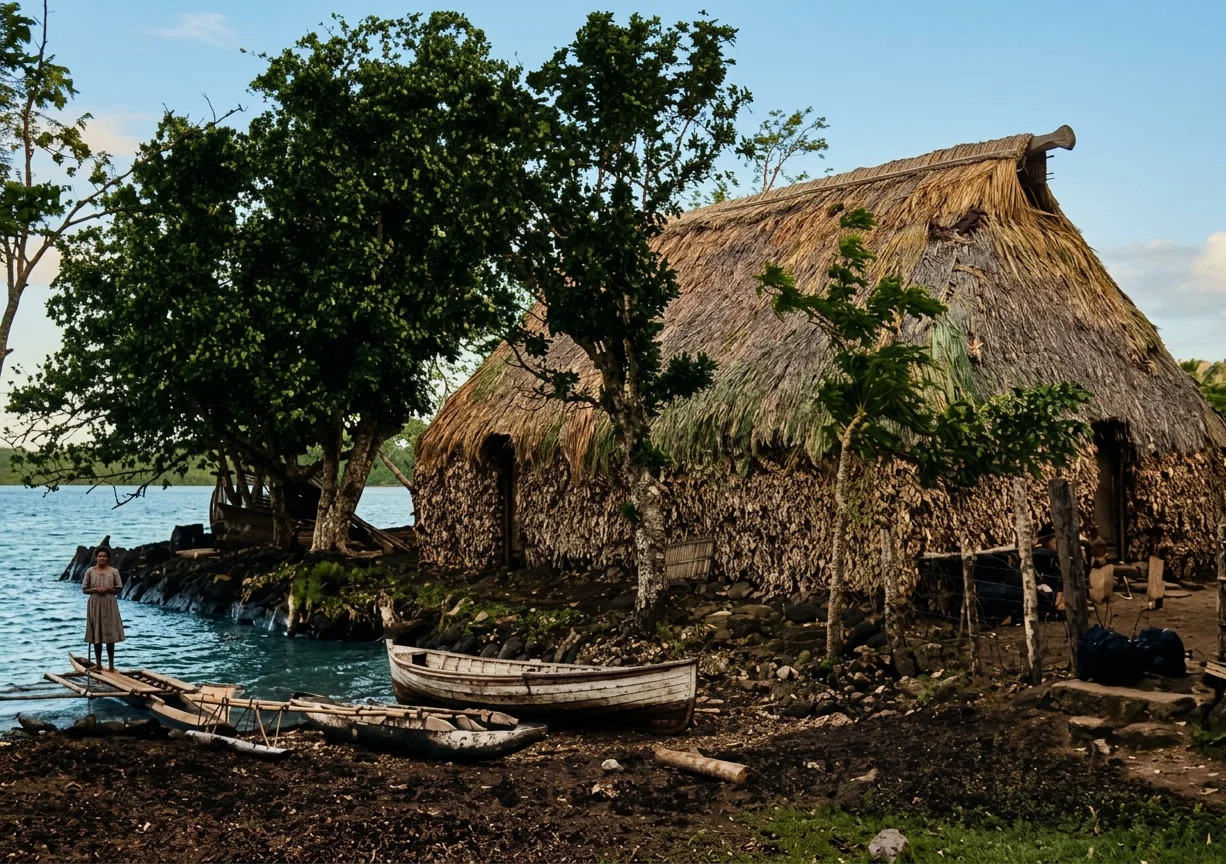
EMORI and I arrived in Suva a week ago to-day, having attended the union conference. We had a very pleasant trip. The sea was as calm as it could be. Four days out from Sydney we reached Noumea, of the New Caledonia group. It was Sunday, but almost every trade was being carried on. A big bicycle race was in progress. In the evening the noise of revelry and the dance filled the air. About every other building in Noumea seems to be a public house. A great deal of liquor is consumed.
FIJIAN’S HOUSE
The people are mostly Catholics. The French Protestant denomination and one other are located here. The cemetery is the most beautiful I have ever seen. There are not many monuments or tombstones, but the graves are decorated with floral work brought from France. The appearance in the sun was like glittering silver. It was a beautiful sight. As the day before was “All Saints’ day,” the graves were especially decorated.
They have a railway running out into the country for fourteen miles. In the market I saw strawberries, lettuce, cabbages, egg plants, radishes, sweet potatoes, yams, and bananas. The market is held in an open square. They have a very productive nickel mine, and boats from all parts of the world load here.
As this has been a French penal station, the French government has been able to make a fine stone wharf, and to lay out beautiful streets. Work is hard to get, as there are so many convicts.
Noumea is said to have a population of six thousand Europeans, including soldiers. There is a population of one hundred and twenty-six thousand in the entire group. These islands must soon be entered. As I have obtained some names of white residents there, I shall send papers from time to time.
Four more days brought us to Suva. The brethren were overjoyed to see me again at Suva Vou. Brother Carr and I celebrated the ordinances with them. It was a good season. All are faithful, and another has begun to keep the Sabbath. We held a few meetings with them. On Monday evening we left for Buresala, and reached there the following day. The students are getting along nicely, and are planting quite large gardens. All the plants are growing well. There are twenty-one students now, and quite a number of applications. As we have funds in hand, we are able to build three more houses for students who are coming. We had a good council meeting with the workers from the Ra coast of Viti Levu. They brought very cheering news of progress. They go back with renewed courage.
I am off now on a trip of four hundred and fifty miles through the Lau province, and am writing this as we are sailing. There is every evidence that this field is ripe for the message. Pray for us.
Brother and Sister Carr are getting along nicely, and are quite well, and of the best of courage. C. H. PARKER.
THE thirty-second annual meeting of the stockholders of the Pacific Press Publishing Company convened at the main office of the company, at Mountain View, Cal., Jan. 30, 1907. The meeting was held in the new factory which is now nearing completion. There was a large attendance of stockholders and friends of the institution, and deep interest was manifested in the work of the publishing house.
The treasurer’s report showed that during the last four months there had been a net gain to the institution as a whole of $991.36. The deficit of $13,421.36, which appeared on the books Sept. 30, 1906, soon after the fire, had been reduced to $1,103.91.
The following is the report from the manager to the stockholders, as presented at this meeting:—
“Dear Brethren and Sisters, Friends, and Fellow Workers:
“We are assembled here this morning in the thirty-second annual session of the stockholders of the Pacific Press Publishing Company.”
Retrospective
“The events of the past year have been too vividly impressed upon our minds to need enlarging upon. We will, however, call your attention to a few of the main points.
“On the morning of April 18, 1906, a terrible earthquake visited this section of California, which wrought havoc in all the cities around the Bay. The walls of our factory were shaken down, but these were soon restored, and the work went on as usual.
“We had hardly recovered from this disaster when a much more serious calamity came upon us. On the evening of July 20, our entire factory with its contents was consumed by fire. The loss was appalling, and at first a cloud of discouragement came upon us. But before the flames were extinguished, a meeting of the board of directors and leading brethren was called to lay plans for continuing the work.
“Telegrams and letters of condolence, expressions of sympathy, and offers of assistance came pouring in from every quarter, and we were urged to rebuild at once. But before doing so it was thought best to call a special meeting of the stockholders and friends of the institution to consider the whole situation.
Special Meeting of the Stockholders
“This meeting convened here at Mountain View, on Monday, Sept. 10, 1906. There was a good representation of our leading brethren from all parts of the field.
“We had taken an inventory of all the property that remained, our books were balanced, and the report of the treasurer showed a net loss on account of the fire of about two hundred thousand dollars, leaving a deficit of over thirteen thousand dollars.
“Notwithstanding this great loss, it was decided to rebuild the factory here at Mountain View at once, the maximum cost not to exceed twenty-five thousand dollars, and to request the General Conference to ask our people to donate fifty thousand dollars to help in the restoration of the plant.
“Our brethren of the General Conference did not see their way clear to call for the full amount we asked for, so cut it down to twenty thousand dollars, and this is included in the one hundred and fifty thousand dollars now being raised.
“We had already received seventy-two thousand five hundred dollars on the insurance, so this gave us something with which to start the work.
“It must be remembered that not only was the factory building destroyed by fire, but all our machinery was put out of commission, and the entire stock of books, printing paper, etc., consumed, amounting in all, as before stated, to about two hundred thousand dollars.
New Factory
“The plans for a new factory had been carefully drawn, and with slight changes were approved by the stockholders.
“The work of clearing away the débris and putting up the new building on the old foundation began at once, and has been pushed forward as rapidly as material could be secured, until now the factory is nearly finished. We expect to begin to move in at once. Indeed, a part of the building is already occupied.
“As you will notice, it is a plain, one-story18structure, 127 by 171 feet, built of iron, and practically fire-proof. The wood floor is laid on concrete, thus giving a firm foundation for machinery, etc., and no chance for a fire to work from underneath.
“The strictest economy has been exercised, and we think the cost will come well under the appropriation. Those who have seen the factory pronounce it a model building. In some respects it will be more convenient than the old factory, and will not cost half so much, notwithstanding the great advance in the price of material.
“Brother A. O. Tait has acted as superintendent of construction, and much credit is due him and his faithful corps of helpers for the progress that has been made and the economy practised.
“And it is only just to state that some of our brethren have worked on this building for much less wages than they might have received elsewhere. It has been a real sacrifice on their part, and we appreciate it fully.
Machinery
“To all appearances, the machinery that passed through the fire was a total loss, and fit only for the junk pile, but in this, too, we have been happily disappointed. With but little cost, comparatively, nearly all the heavy machinery can be restored, and for all practical purposes made just as good as new. But this will take time. Already the large Signs perfecting press has been rebuilt, and is in operation.
Publications Issued
“Since the fire we have been carrying on business in temporary structures, at a great disadvantage, and yet we have turned out a large amount of work. Two cylinder presses and two linotypes, which we fortunately secured immediately after the fire, have been kept running almost continuously night and day.
Commercial Work
“We have strictly adhered to the action of the directors and vote of the stockholders in discarding all commercial work. Not one job of this kind has been done since the action was taken, although we have been urged to do so repeatedly. Our entire office force are now giving their whole time and attention to denominational work, and the Lord has set his seal of approval to this by giving us the sympathy of our people everywhere, and their hearty co-operation in the circulation of our literature. Never before have our canvassers met with the success they have the past season. Girls and boys without previous experience have made remarkable records, and our sales have nearly doubled.
“Our schools and colleges are filled with bright, active young people, and many of them have their minds turned toward the canvassing work. The outlook for the coming year is very encouraging.
Finances
“The great calamity that came to the Pacific Press seems to have touched a tender chord in the hearts of all our people. Many who have had money here on deposit have donated the interest for one or two years, and some have given a part of the principal as well. Others have deposited money with us without interest, and nearly all have signified their willingness to reduce the rate to four per cent or less.
“A few years ago our interest-bearing debt amounted to nearly two hundred thousand dollars. This has been reduced until now it is only about one hundred and nineteen thousand dollars, and, according to the treasurer’s report, we have cash on hand with which to take up notes to the extent of thirty or forty thousand dollars more.
“We have sold our Oakland property for a little over sixty-six thousand dollars cash, and we had hoped that this entire amount might be applied on the interest-bearing debt.
“At the special meeting of the stockholders held last September, our balance sheet showed a deficit of over thirteen thousand dollars. Through the reclamation of machinery, advance in the price of our Oakland real estate, cash discounts, etc., the deficit has been reduced to about one thousand dollars.
“During the last four months the home office shows a net loss of $2,667.45 in operating expenses, but this is not to be wondered at in view of the great disadvantages under which we have labored. Indeed, we are surprised that the loss is not greater.
“Our Kansas City and Portland branches have helped us out so that the balance is on the right side of the ledger. The institution as a whole shows a net gain of $991.36.
“As soon as we get into our new building, the departments can be so arranged and reorganized as to save materially in the operating expenses.
Branch Offices
“Our branch office at Kansas City, under the management of Brother James Cochran, has made the best record in its history, showing a net gain of $3,585.01.
“Our Portland Branch, under the management of Brother W. V. Sample, has also done well, all things considered, the sales amounting to $14,036.71 (an increase of about forty per cent over the previous year), and the net gain to $73.80.
“Taken all together, our subscription book sales have nearly doubled during the past year.
Organization
“The work of securing the transfer of stock from the Pacific Press Publishing Company to the new membership organization has been pushed vigorously, and 2,711 shares are now under the control of the new association, leaving only 1,786 shares outstanding. Nearly all of this outstanding stock represents shares which belonged to persons who are now dead, or whose addresses are unknown to us.
“We would not close this report without expressing our appreciation of the hearty co-operation of our faithful employees under the most adverse circumstances. Huddled together in crowded rooms, without conveniences, many times suffering from cold, yet always cheerful, they have tried to make the best of the situation, and amid all these trials and difficulties we have not heard one word of complaint, but each one has tried to do his duty faithfully. Yet we believe we voice the sentiment of all when we say it will be a day of rejoicing when we get located in our new factory.
“In behalf of the board of directors we desire to express to the stockholders and our people everywhere our appreciation of their words of encouragement and hearty co-operation in the work of re-establishing our plant here at Mountain View, and especially to those who have donated so liberally to the rebuilding of the factory.
“To the directors, I desire to express my appreciation, personally, of the cordial, harmonious relations that have existed between us, and for their help and hearty co-operation during the trying ordeal through which we have passed. And above all do we wish to return praise and thanksgiving to our kind and loving Heavenly Father, who, through all these trying circumstances, has never left nor forsaken us, and who, through his kind providence, is already turning this calamity into a great blessing.
“It is our prayer that God may guide in all the plans that are laid at this meeting, and that the coming year may be one of great prosperity.
“Respectfully submitted,
“C. H. JONES, General Manager.”
The following remarks by Elder George W. Reaser, president of the Southern California Conference, concerning the new building, etc., seemed to voice the sentiments of all:—
“I have been in touch with our offices in Battle Creek, Washington, and other parts of the world to some extent, and I have never seen a building so practical—well lighted and well ventilated—as this, and it is built with a simplicity that certainly will appeal to all our people.
“I speak of this because at some times in the past I have not approved of some of the structures that have been built. I do most heartily approve of this building. It certainly has been built from the standpoint of economy, and is fire-proof. As I came into the building and looked it over, I could not help saying, Surely we can find no just criticism. I trust it has arisen from its ashes to proclaim the third angel’s message, and to this end it will have the hearty support of the people.”
The following-named persons were elected to serve as a board of directors during the ensuing fiscal year: H. W. Cottrell, M. C. Wilcox, C. H. Jones, H. H. Hall, A. O. Tait, E. A. Chapman, H. G. Childs. At a later meeting the board organized as follows: President, H. W. Cottrell; Vice-President and General Manager, C. H. Jones; Secretary and Treasurer, H. G. Childs; Auditor, J. J. Ireland.
Two sessions were held, one in the forenoon and one in the afternoon. During the intermission about one hundred persons partook of the lunch which the sisters of the Mountain View church kindly provided, tables being set in one section of the new factory.
All who were present at this meeting pronounced it one of the best and most encouraging they had ever attended, and they go to their homes with a determination to be more active in scattering the printed page than ever before.
C. H. JONES.
Report from Texas
By W. M. CUBLEY
I CAME to this field two weeks ago, and began meetings in a schoolhouse five miles from Corpus Christi. The first night my congregation consisted of fourteen persons, but soon the house was full, and the interest seems to increase with every meeting.
A minister of some prominence put in his appearance a few nights ago, for the purpose, evidently, of diverting the19minds of the people from the truth; but when he arose to speak, he soon saw that the people were not pleased with the course he was taking.
One thing very noticeable in the meetings is the continual inflow of questions. I never had so many in the same length of time, and nearly all are to the point, showing conclusively that the people are studying for themselves.
I look for good results to follow soon, and shall labor and pray to this end. We have a few of our faith here already, and hope soon to be able to organize a church. This is a fine country and an excellent climate. W. M. CUBLEY.
Progress in Central America
By Hubert Fletcher
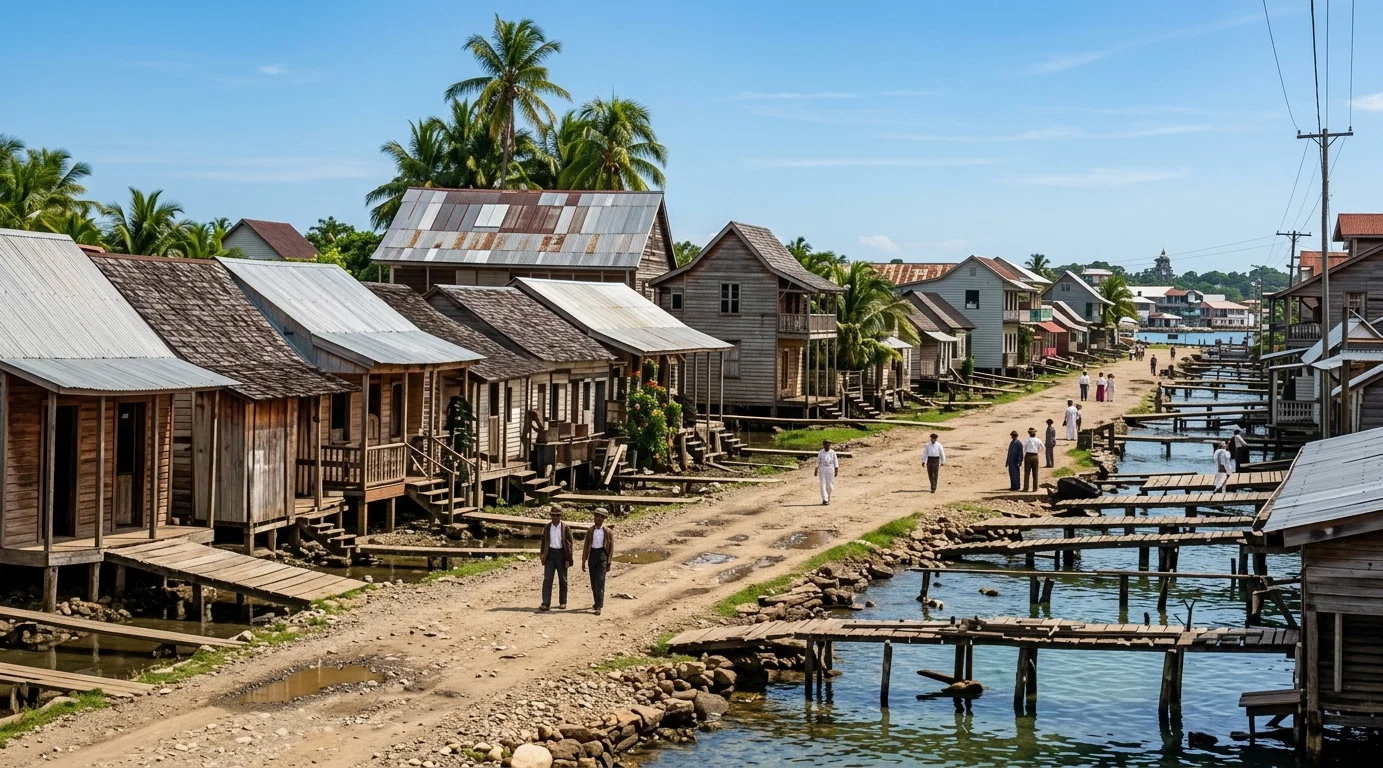
MAIN STREET, BOCAS DEL TORO
The present condition and the prospect for the future of the work in this field are very encouraging. Since the last of November, the writer has been privileged to be connected with the conference work in Bocas. Special services have been held continually, both in our lecture room and in the homes of the brethren; and as a result, sons and daughters have been born into the kingdom. The work has been greatly revived, and the brethren are much encouraged. There have been heart searchings, confessions, and a pressing closer to the Lord and to one another. From the beginning, there was a gentle breathing of the Holy Spirit in the meetings. There has been no excitement, but heartfelt sorrow for sin, and the consecration of self and all to God and his service.
On Sunday, December 16, after due instruction three dear souls were buried with their Lord by baptism. These had some time before received Bible readings, but since our meetings had made a full surrender.
The week of prayer has added much to our feast. It has been, indeed, "a feast of fat things." Before the dawn of day, and after the set of sun, the brethren and sisters could be seen hastening their steps toward our humble place of worship. Their voices were heard chanting the sweet songs of Zion, borne upward by the angelic choir, and sung before the throne with unerring notes. Morning and evening the sacrifices and devotions of God's people are presented by our great High Priest before the throne. Our souls have been refreshed as the soft dews of the Holy Spirit settled down into our hearts.
On the morning of December 20, at the close of the service an invitation was extended to those who desired to surrender their hearts fully to the Lord and to seek him especially for the Holy Spirit, to meet in the lecture room at six o'clock that evening. At the time appointed, nearly the whole church was present, and as never before there was manifested the outpouring of the Spirit. Hearts were united, and the brethren and sisters entered into covenant with the Lord and with one another. Faults were confessed, differences put away, and souls are rejoicing in deliverance from sin.
Sabbath, the twenty-second, was a day long to be remembered. Our little place of worship was so full that it was difficult to find sitting room. After the midday service, a brother, whose wife had been baptized the week before, was baptized. The ordinances of the Lord's house were also administered. I had never before in all my experience seen a more evident outpouring of the latter rain. Even those not of our faith were moved to tears, as the heartfelt testimonies came from the lips of all. Praise the Lord, he has visited his people!
HUBERT FLETCHER.
Why Not Thousands?
By GEO. F. ENOCH
That Earthquake Special that the brethren in the West Indies are getting out will be a most excellent missionary periodical. Last week's REVIEW, in speaking of that paper, on page 7, called it “one of the ablest missionary periodicals printed by our denomination.” Why should not all our people embrace this opportunity of getting acquainted with it?
Then the little publishing house that is responsible for its production month by month is in dire need of just a little assistance. They do not plead for a large plant, or for great facilities, but only for the barest necessities. The manager has just passed us this word, “We are very short financially. I have seen the time here when after paying the help on Friday, we have only about a shilling left, and our pay-roll amounts to only about fifteen dollars a week for all our eight employees. I have been embarrassed many times. Again, our cutter is so small that it has to be set on a table; it is really a hindrance to us in the progress of our work. Imagine, if possible, the cutting of a ream of twenty-five by thirty-eight on a machine eighteen inches wide. We have to fold about five sheets at a time, and then use a long knife to cut them, then go through this again, folding and cutting. Then we have the trimming of the Watchman each month. Imagine our task with the Earthquake Special.”
A large sale of this number of this periodical will give financial help in a time of great need.
Again: the recent calamity in Jamaica gives it additional vantage-ground for a place in our sympathies. As the heaviest end of every publishing house is in the field, the ruin in Jamaica will certainly affect its usual circulation. Some of its patrons are dead, others are penniless.
So we appeal to our brethren and sisters in this prosperous land. Why not make the circulation of this number of the Caribbean Watchman in this country THOUSANDS? We suggest the following plans:—
1. Let every Seventh-day Adventist, as far as possible, invest in at least one copy of this number of one of the important factors in our missionary advance. It is published in the English language, so you will be able to read it all.
2. Here is a rare opportunity for our Young People's Societies to do something practical for the mission field and for the enlightenment of their neighbors as well. Out in the mission field we want young people who can do things. You must learn the secret of it at home. Here is a splendid opportunity for our young people to develop a little of that moral fiber necessary for successful effort in the regions beyond. Can we not count on large orders from our Young People's Societies?
3. We appeal to that devoted band of humble workers who are selling from month to month thousands of pages of our periodicals. This number of the Caribbean Watchman will sell. Many a Christian will buy it just to help along in a mission field. Why not take advantage of the present world-wide movement in the interest of the evangelization of the world to press in some good solid arguments upon the subjects that are receiving special thought? Every successful periodical worker can sell hundreds of this Watchman.
As the paper is to be sold for a nickel, and it is impossible to deliver it to you for less than a nickel, you will have to take up this one effort from a purely missionary standpoint. Price, 5 cents a copy in large or small quantities. Send all orders to I. H. Evans, Takoma Park, Washington, D. C. We are expecting thousands of orders to come in from our people in the States. Why not? GEO. F. ENOCH.
Field Notes
BROTHER W. A. YOUNG recently baptized two persons at Terra Haute, Ind., and received one into the church at Jonesboro, on profession of faith.
BROTHER C. M. GARDNER reports the organization of a church of eighteen members at Mt. Bullion, Cal., with a promise of more later; also at Le Grand a church of nineteen members was organized, and a lot for a church building was promised.
Current Mention
— James Bryce, the newly appointed British ambassador, arrived in Washington, February 21.
— The Senate, on February 20, by a vote of forty-two to twenty-eight, decided that Mr. Smoot, the Mormon senator from Utah, shall keep his seat in the Senate.
— The largest appropriation bill ever passed by any Congress since the foundation of the government is that for the Post-Office, being approximately $209,000,000. This provides for the increase of salaries of 100,000 clerks and carriers, amounting to $9,000,000.
— The “Orianda,” one of two British steamers in collision near Cardiff, Wales, the night of February 17, was sunk, and fourteen persons were lost. On the same day the White Star Line steamer “Republic” collided in the Bay of Naples with the Italian steamer “Centro America.” There were no fatalities, but both ships were considerably damaged. On the 20th the French cruiser “Kleber” rammed and sank a fruit steamer at New Orleans, thereby drowning seven men.
— February 12 President Roosevelt transmitted to the Senate for ratification a new treaty with Santo Domingo. Its main feature is the provision for the collection of the customs revenue of the country by Americans. This is practically a continuation of what has been in operation for nearly two years. By placing fifty-five per cent of the collections in a trust fund, it now amounts to more than $2,300,000. When the treaty is ratified, steps will be taken for floating a $20,000,000 issue of Dominican bonds, and the republic will be placed on a firm financial basis, with a prospect of being free from debt in ten or twelve years.
— A fire broke out in a Russian coal-mine February 12, and forty dead bodies have been brought to the surface.
— Thirty-two residents of Princeton, Mo., have been arrested for playing cards for prizes. This is at the instigation of gamblers who have been prosecuted.
— The Naval Bill appropriating nearly $101,000,000 has passed Congress; and, among other things, provides for two battle-ships of the powerful “Dreadnaught” class.
— The fastest train between New York and Chicago, the Pennsylvania 18-hour special, was derailed on a curve and thrown into the shallow Conemaugh River near Johnstown, Pa., about midnight of Friday, February 21. Of the sixty-four persons aboard, no one was killed, and no one escaped some injury.
— The coast steamer “Larchmont” was struck by the schooner “Harry Knowlton,” off the Rhode Island coast the night of February 11, and sank. Of about 160 persons aboard only nineteen survive. On account of the cold, terrible suffering was experienced by such as were able to get into the boats. Many were frozen.
— The Interstate Commerce Commission’s railroad accident bulletin for the three months ending Sept. 30, 1906, reports 1,891 collisions and 1,781 derailments, causing the death of 267 persons and the injury of 19,563 others, with a damage to rolling stock and roadway of $2,932,760. While this report shows a marked increase of casualties over the three months preceding, the report for the last quarter of 1906 will be appalling, as in three accidents alone more than 100 persons lost their lives.
— After weathering a terrific gale while crossing from England to Holland, the mail steamer “Berlin” was wrecked while entering port at Hook of Holland, February 21. Inspired by the courage and determination of Prince Henry, the life-savers, after continuous effort of thirty hours, succeeded in reaching the wreck, and rescued 11 survivors of the 143 persons aboard. As we go to press, reports come of Lloyd Austrian steamer “Imperatrix” grounded on a rock near the island of Crete. Only 13 of the 320 on board have been rescued, and the position of the rest is extremely dangerous.
— For some time war has threatened between the Central American countries of Nicaragua and Honduras. An arbitration council was arranged at San Salvador for the purpose of settling a dispute and claims coming from an invasion of Nicaraguan territory by Honduran troops, who were pursuing some political refugees; but relations were suddenly broken off February 9. The United States, Mexico, and the other three Central American countries, have been using their good offices to prevent an outbreak, but the proffered help came too late. Hostilities have already broken out, and it seems probable that other Central American republics will be drawn into the trouble — Salvador to join Honduras, and Guatemala siding with Nicaragua. The United States has sent two gunboats for guarding American interests in the respective countries.