Your ShelfYour Projects

Signs of the Times, Vol. 40, No. 31.

Signs of the Times

Signs of the Times

Aug 12, 1913

Pacific Press Publishing Association · Mountain View, California · Aug 12, 1913

Signs of the Times

NECESSITY of ABIDING

AS the branch can not bear fruit of itself, except it abide in the vine; so neither can ye, except ye abide in Me.—Jesus

"IF YE WILL INQUIRE, INQUIRE YE."

This Inquirers' Department is conducted for the purpose of helping those who are studying the Bible. The answers are oftentimes only suggestive. They are never to be considered infallible, only as they agree with the infallible Word. The writer who may answer these questions does not consider that his opinion is infallible. He will simply give the best that he has, and plead with the inquirer to search the Word. Such questions only will be answered as, to the editors, seem to minister to the good of the readers and to the mission of the paper. We can not answer repeatedly in the same volume questions upon the same scripture. The name and address must accompany question, not for publication, but as an evidence of good faith, and that answer may be made by letter if deemed advisable. No letters are answered which do not contain the name of the writer. It is well always to enclose stamp for reply.
Schedule for the Week Ending August 16, 1913
Sunday August 10 Jeremiah 50
Monday " 11 " 51, 52
Tuesday " 12 Lamentations 1, 2
Wednesday " 13 " 3, 4, 5
Thursday " 14 Ezekiel 1, 2, 3
Friday " 15 " 4, 5, 6
Sabbath " 16 " 7, 8, 9
We close the reading of Jeremiah, and the book of Lamentations, written by him, consisting of poetic Hebrew acrostics, and read nine chapters of the book of Ezekiel. Ezekiel was contemporary with Jeremiah. While Jeremiah was God's prophet in Jerusalem, Ezekiel was God's prophet among the captives whom Nebuchadnezzar had carried away with King Jehoiachin in 597 B.C. to Babylonia, where he was settled near the river Chebar. His name means "God strengthens," and he also was of the priesthood. The book consists of two principal parts,—first, earnest discourses to the people of God concerning moral conduct, prophecies regarding Judah and Jerusalem and other kingdoms, and a prophecy of a part of what the Lord would do for His people if they would but yield to Him, in chapters 37 to 48.
In our reading for this week comes the vision of the first chapter, of the four living creatures. These strange beings which are called creatures, said to have the likeness of a man and of a lion and of an ox and of an eagle, represent, it may be, companies of God's angels in these forms, but acting with such harmony that they appear as one creature. The four objects represented in each of these creatures were, according to tradition, the standards under which the house of Israel pitched, the man representing the standard of Reuben, the lion of Judah, the ox of Ephraim, the eagle of Dan. They may also well indicate God's wisdom and strength and patience and glory. From the fact that they moved upon the earth, with their wheels within wheels responsive to the Spirit of God, they would indicate the work which God was carrying on in the world. To the prophet it seemed to be all confusion, but to the infinite God it was working out just the very best that could be worked out for His people.
These living creatures were not, as has been said, the foundation of the throne of God, or the throne, because we are told in the twenty-sixth verse that above these living creatures there was a firmament, and the throne itself was above the firmament, whence God directed. The living creatures were upon the earth. God would show Ezekiel, by this vision, that whatever the powers of earth were seeking to do regarding God's people, the Lord had a care over them.
Very searching are the words of the prophet to his people, and he himself suffers in becoming an example in a temporary way of what is coming to them permanently, as, for instance, in the fourth chapter, where he depicts upon the ground with an iron pan and the figure of a city the awful calamities which shall befall the Jews; where he himself lies upon his left side for the house of Israel 390 days, and upon his right for the house of Judah 40 days, each day representing a year for the captivity of God's people, covering the captivity of Israel and the remainder of the captivity of Judah, to the restoration after the seventy years' captivity. But not all of the sufferings of the prophet were to come in his own person. We shall read of these later on.
The awful idolatry of Israel is pointed out in the eighth chapter, and the worst of all idolatry was the example of the elders of Israel worshiping the sun with their faces toward the east, the most abominable of all idolatrous worship, because the most degrading to humanity. The judgment of it all is shown in the ninth chapter, a prediction also of the last days and the final judgment, when God would send His angels through the midst of His professed people, and set a mark upon the foreheads of "the men that sigh and that cry over all the abominations that are done in the midst thereof."

4149 — Covering for the Head

Ought a woman to have a special cover on her head when she prays? Please explain 1 Cor. 11:4-16. Many Dunkards would like to have this explained, for they wear a cap which they call a spiritual covering.
If we could understand all about the outside customs which existed in the days of the apostle, it would make some of these instructions which he gives us much clearer. There were certain fashions among the idolaters, and the Lord did not want His people to pattern after idolaters. There was not that variety among His children that exists at the present time. Man, He tells us, ought to pray or prophesy with his head uncovered, but the woman ought to have her head covered. But He tells us in the 14th and 15th verses that while it is a shame for a man to have long hair, it is a glory for a woman to have long hair, for that hair is given her for a covering. So it would seem that if a woman had long hair, that of itself would be sufficient.
Bengel says that “man should wear no covering, while the woman should wear a covering, because Christ, to whom the man is subject, is not seen, while the man, for whom the woman has regard, is seen. So the covering of him who is under Christ is not seen, and of her who is under the man is seen.” The thought is that in being uncovered, she acts against the divine ordinance and the “modest propriety that becomes her. Moreover, as the head covering was the emblem of maiden modesty before man (Gen. 24:65) and conjugal chastity (Gen. 20:16), so, to uncover the head indicated withdrawal from the power of the husband, whence a suspected wife had her head uncovered by the priest.” “The Critical and Explanatory Commentary” says: “As woman's hair is given her by nature, as her covering, to cut it off like a man, all admit would be indecorous; therefore, to put away the head covering, too, like a man, would be similarly indecorous. It is natural to her to have long hair for her covering; she ought, therefore, to add the other (the wearing of a head covering) to show that she does of her own will that which nature itself teaches she ought to do, in token of her subjection to man.” It is admitted, however, by the commentators, that the custom of the dress of both men and women was different in Grecian cities from what it was in Judea, for it was the custom in Judea for the men themselves to be covered. The apostle seems clearly to have reference to customs that were proper for that time and place.
Note in this that the apostle does not appeal to any particular law, only just what would be decent and proper, and reverent on such an occasion as that at that time. Note what he says in verse 16: “But if any man seem to be contentious, we have no such custom, neither the churches of God.” He is not laying down hard and fast laws, concerning such things, to proper and decent members in the church of God. It may be manifest in an altogether different way in those days, but in all ages there should be simplicity and modesty and reverence in the house of God.

4147 — The 400 and 430 years

Gen. 15:13 and Acts 7:6 say that the children of Israel were afflicted 400 years. Ex. 12:40 says 430, Gal. 3:17 also. How is this? From Gen. 40:7, 11 I gather that Israel went into Egypt in 1706, and came out in 1491, making 215 years in Egypt. Kindly explain. H. O. T.
The prophecy of Gen. 15:13, referring to the 400 years, included all, evidently, of the sojourn of Abraham and his descendants both in Palestine and in Egypt. There seems to have been something omitted from the Hebrew copy of Ex. 12:40. Boothroyd tells us that the Samaritan and Septuagint read as follows: "Now the time of the sojourn of the children of Israel and of their fathers, which they had dwelt in the land of Canaan and in Egypt, was four hundred and thirty years," and he has this note: "430 years: From the preceding accounts it is clear that the present Hebrew text is defective, and without the addition as preserved in the Samaritan and Septuagint, inconsistent with itself. The Samaritan and Septuagint are supported by Josephus and the best Jewish expositors." The 215 years in Canaan and the 215 years in Egypt make the 430 years. The 430 years date from God's call in Genesis 12, B.C. 1921; the 400 years from about the time of Isaac's weaning, 1891. Gen. 21:8-11.

4148 — Swine's Flesh and the Mouse

Please explain Isa. 66:17. Does that text mean that a class of people eat swine's flesh and the mouse, and also the abomination? or does it mean that the three shall be destroyed together at the coming of the Lord? Does it refer to swine's flesh eaten in general, or does it have special reference to a special class of idol-worshipers?
It would seem to have reference to those who rejected God and His ordinances. The Revised Version reads: "They that sanctify themselves and purify themselves to go unto the gardens [margin, in the gardens], behind one tree [or Asherah, an idolatrous image] in the midst, eating swine's flesh, and the abomination, and the mouse, they shall come to an end together, saith Jehovah." Now it does not mean three different classes, but it means the people who do such things as that shall come to an end together. It would have reference to any system of self-salvation, and ordinances of that sort which led people to reject God and the instruction of His word. Such as that, of course, would naturally indulge in the things which the Lord had prohibited, or designated as unclean and unwholesome. Lowth declares that these were after the rites of the heathen gods, and renders: "They who sanctify themselves, and purify themselves, in the gardens, after the rites of Achad; in the midst of those who eat swine's flesh, and the abomination, and the field-mouse." That is, all these various classes who utterly disregard God's instructions, and walk in their own ways, shall come to an end together. What are called shell-fish, are four times, in Leviticus 11, called an abomination. The text may refer to such things as that. The exact technical meaning is of a great deal less importance than is the class of people there described, those who disregard God.

4150 — The Oil Used

In James 5:14 we are told, "Is any sick among you? let him call for the elders of the church; and let them pray over him, anointing him with oil in the name of the Lord." When we follow the directions given by the apostle, should not a holy oil be used, made according to directions given in Ex. 30:23, 24, 31? Read Ps. 89:20. Those ingredients are all in common use to-day. A shekel is 252 grains, and the hin is 1.6 gallons. B. C. C.
It would seem not. The anointing oil for which the Lord there gives direction seems to have been for that one purpose alone, having to do with the sanctuary and its service. We are told in verses 32, 33: "Upon the flesh of man shall it not be poured, neither shall ye make any like it, according to the composition thereof: it is holy, and shall be holy unto you. Whosoever compoundeth any like it, or whosoever putteth any of it upon a stranger, he shall be cut off from his people." The text in Ps. 89:20 need not have particular reference to the holy oil designed for the sanctuary; in fact, from the instruction given in Exodus it would hardly be that. What is meant in Psalms, evidently, is an oil that was simply used for that one purpose. A common oil in use in Palestine was olive-oil, that is sometimes termed sweet-oil.

4151 — The Treading of the Wine-Press

Please explain what is meant in verse 20 of the 14th chapter of Revelation. M. H. R.
Simply the awful slaughter that will take place in the last destruction of the wicked at the time of the second death, and it may have a partial fulfilment in the great battle of Armageddon, which will be fought at Jerusalem; but it seems probable that it would look forward to the last great destruction at the end of the thousand years. The fearfulness of those days it is impossible for us to comprehend.

Primitive Man

By George McCready Price
THERE is only one science that is in a more confused state than archeology, and that is geology, the science upon which all the most fundamental assumptions of archeology are based. It would be beyond our limits and far from our purpose to attempt, in a short article of this kind, to consider in any detailed or systematic way the fundamentals of either of these sciences. We desire to make simply a few remarks about some of the remains of man that have been discovered in various parts of Southwestern Europe. A prominent daily paper recently gave some of the pictures of the animal drawings that have been found on the cave walls of France, Spain, and Italy, and as is usual in such cases, conveyed the distinct impression to its readers that these pictures were carved and painted by primitive men just emerging from the savage state, and that the time when this work was done was two hundred millennium ago.
These drawings are unquestionably very old; the question is, How old? The pyramids of Egypt are old, and so are the clay tablets of Nippur, and the ruins of Stonehenge. The lower gorge of the Niagara is also very old, and so are the boulders and other “drift” materials that have been scattered over Northeastern America and Northwestern Europe; and the Alps are old, and so are the Rocky Mountains. The geologists, in their own peculiar fashion, have arranged all these natural phenomena in alleged chronological order, and claim to know the exact order of sequence in which all the great physical events took place; and the ambition of the archeologists is to locate their discoveries concerning primitive man with reference to these geological changes, so that their archeology may make a good splice on the end of the geological record.
When we look at the slow rate at which rivers are now eroding their channels or spreading out deltas, and when, taking this modern rate as a measuring unit, we attempt to estimate how long it has taken to dig out the gorge of the Colorado, or spread out the deltas of the Nile or the Mississippi, we soon become dismayed at the length of time involved. IF this extremely slow rate of present-day action is to be projected back into the past as an accurate and reliable measure of the rate at which these phenomena took place. For over half a century it has been quietly assumed that this is the correct method, a really scientific method, of measuring the geological changes of the past; and tho this method involved the manifest positive denial that any great world catastrophe such as the Deluge has ever taken place, it is only recently that it has occurred to geologists that it would be much more scientific in point of method to make this rate of the past geological changes the subject of careful and judicial examination, instead of thus prejudging the matter as Lyell and his followers have always done.
A more calm and candid consideration of the whole matter has led some scientists to see that if a careful and scientific investigation of all the facts all over the globe were carried on along this line, we ought to be able to decide very definitely whether or not the tools of nature have always worked at the same rate and in the same manner as at present, and that it is little short of nonsense to assume this uniformitarian doctrine in the face of the thousands of facts from all over the world now known to testify uniformly to the contrary. I have a profound sympathy for any one who stands dazed at the length of time represented by any single one of these geological events when estimated on the basis of the present action of the elements, and apart from that broad view of the whole subject that can take in at one view the sum total of the general geological facts. But some other word than “sympathy” is needed to describe my feeling for the mind that can, in the face of the facts now known to modern geology, project this theory of uniformitarianism back into the dim abysmal past as an infallible guide, and then claim that the results of such a measurement are truly scientific and accurate.
We really know very little of the races of men represented by these drawings. There is no doubt that, even on the Biblical view of the case, the early races of man were left to work out the discovery of the various handicrafts and trades and the multitudinous properties of earth, air, and water, by their own independent efforts. This was one of the sad conditions of the fall. As Pope has expressed it:
“But He who knew what human hearts would prove, How slow to learn the dictates of His love, That, hard by nature and of stubborn will, A life of ease would make them harder still, In pity to the souls His grace designed To rescue from the ruins of mankind, Called for a cloud to darken all their years, And said, ‘Go, spend them in a vale of tears.’”
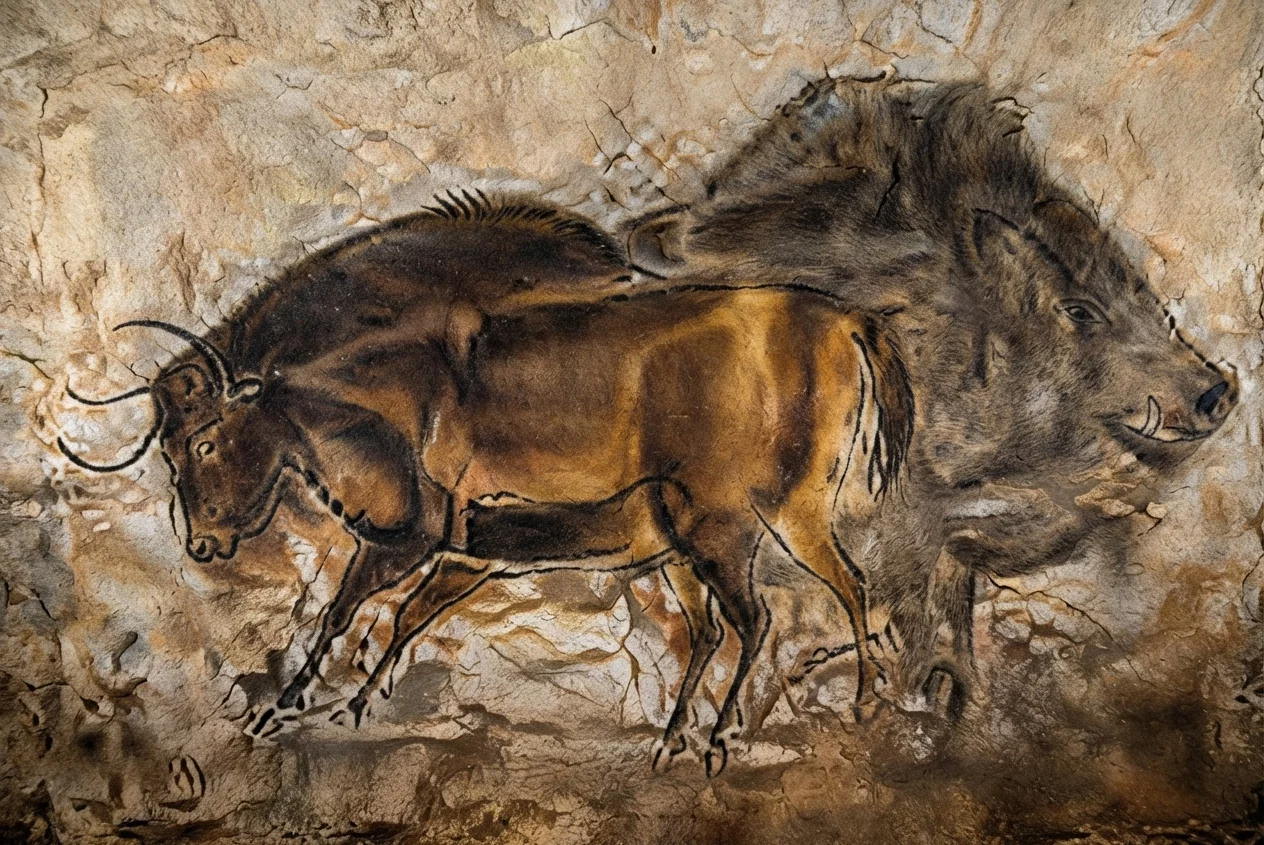
Nearly ten years ago, on the first discovery of these drawings, the present writer published an article in the SIGNS OF THE TIMES calling these drawings “Pictures Older than the Flood.” At present he does not feel so sure that these pictures are really as old as this would indicate; at least it is certain that not all the human remains classed as “palæolithic” are this old, tho some of them may be. As already remarked, the wholesubject is in the greatest confusion, owing to the false and unscientific methods followed in this study at the present time. When every layer in a sand-bank marks off a new “age,” and each peculiarity on a skull or a femur calls for a new Latin name to designate the particular species of the genus homo represented, it would seem that subjective speculations could not well go very much further. Some day we shall probably know more about it. In the meantime, it is impossible to say with certainty whether or not these cave drawings were made before or after other well-known landmarks elsewhere, such as the building of the pyramids in Egypt or the beginnings of civilization in the Euphrates Valley. There is a well-defined boundary line in Europe between the true geological deposits and the “recent,” what Sir Henry Howorth calls the “great dividing line.” But at present it can not be settled which side of this dividing line these men lived. In Biblical language, this dividing line means the Flood; and hence this is equivalent to saying that we can not yet tell whether these men of the caves of France and Spain lived before or after the Flood. And from the present methods of studying the subject, the question never will be settled. But perhaps when clearer facts are discovered, and above all, when more sensible methods are adopted in dealing with the matter, we may hope for better progress.
In the meantime, we need not be alarmed. The Bible is an anvil that has worn out many a hammer. H. L. Hastings used to compare this criticism of the Bible to a rat gnawing a file. It didn’t hurt the file, but it was rather hard on the rat’s teeth.
Loma Linda, California.
Three animals, one on the other,—an ox to the left, a horse over the top of a boar's head at the right

Theosophy—Its Teaching

By Prof. J. A. L. Derby
[Editor's Note.—The following is taken from a chapter in a pamphlet entitled "Modern Mysteries: Their Moral Aspect." In the previous portion of the chapter, Professor Derby quotes as to the meaning of theosophy and its workings from "The Rationale of Mesmerism," by the president of the Simla Theosophical Society, Simla, India. It certainly is not the doctrine of the Christ.]
THE word "theosophy" is derived from two Greek words, one signifying God, the other, wisdom. Its root meaning is, therefore, "wisdom concerning God." Its practical definition nowadays is, "wisdom-religion." The word was coined by Ammonius Saccas, an eclectic philosopher of the third century, who was likewise the originator of the Neoplatonist system of speculation, which was nothing more nor less than the theosophy of those times.

Illumination

The method pursued by teachers of the occult, whether in ancient days or modern, in gaining this sublime wisdom, does not appeal to modern methods of exact science. In fact, it is exactly the reverse. Science of to-day examines a multitude of particulars, and from these, reasons to the general laws involved. For instance, it observes that everywhere objects fall. It thence infers the law of gravitation. It observes a multitude of facts concerning the revolutions of the planets, and deduces from them the laws of Kepler,—that planets move in ellipses, etc. But theosophists from Ammonius down have pretended to a short cut in all these things, which consists in a sort of spiritual illumination, a transcendental intuition, a species of revelation,—not a revelation as from a higher Being, but as of the development and unfolding of an inward faculty higher than reason. They often refer to this faculty as the "sixth sense." The ecstatic laudation of this exalted state of mind is something quite unappreciable by us poor groundlings, who are doomed to drudge along in the ancient quarry of knowledge. Listen:
"Purified and perfected [he, the theosophist], begins to practise supernatural faculties. He finds himself able to pass through material obstacles, walls, ramparts, etc. He is able to throw his phantasmal appearance into many places at once. . . . He can leave this world, and even reach the heaven of Brahma himself. . . . He acquires the power of hearing the sounds of the unseen world as distinctly as those of the phenomenal world—more distinctly in point of fact. . . . He is able to read the most secret thoughts of others, and to tell their characters." ("Esoteric Buddhism," page 47.)
In this condition of mind the adept sees the inner principles and process of the universe at work. Not his to infer by laborious inductions what these are. Indeed, with his godlike acquirement he may, to some extent, be a director of these universal forces, etc., etc. To ordinary mortals this is quite dazing.

Mahatmas

When we begin to search for some person that has experienced this mysterious efflorescence of intellect, we are told that we shall have to betake ourselves to certain rock-hewn caves in the mountain fastnesses of Tibet, in Central Asia. There, hidden away from the eyes of the profane, reside the living representatives of the highest spiritual perfection. They are called Mahatmas, or Arahats, also Arhats. We have been unable to distinguish them from what Gautama (after the Buddha) called the Tathagata.
It will be impossible, in this brief article, to make explanations; we can only sketch an outline of the vast system of speculation which goes by the name "theosophy."
To become a Mahatma often requires long, long years of rigid training, having first entered the sacred order of theosophists through initiation, for in this respect they resemble other secret societies. But the thirty-third degree Mason is but a neophyte, as regards the benefits of his high condition, when compared with a Mahatma.
One of the experiences through which the cheda, or disciple, has to pass, seems to be an extended period of suspended animation. We begin to surmise that we have heard of things like this performed by the common fakirs of India, to say nothing of the "sacred brotherhood."
One of the things which "intuition" reveals to the adept in occultism (a name which theosophy claims exclusive right to) is that the whole universe, especially our own solar system, is advancing, and has been for ages inconceivable, to perfection through evolution. Darwin caught a very limited view of the truth; nevertheless what he did see is true, says theosophy. But instead of being confined to one planet and one life, man has to evolute through seven planets, with at least eight hundred incarnations on each planet. Indeed, it is not impossible that, before the individual monad reaches perfection, it may have to pass through fifty or a hundred million incarnations. If you escape under fifty-six hundred, you may consider yourself very fortunate.

Karma

But why must one be incarnated so many times? — Karma — inevitable Karma. What is Karma? — It is the law of cause and effect in morals. If you do not progress spiritually in one life, you will probably be born a woman or a slave or bow-legged next time. If you never develop any spirituality (which please do not confuse with virtue or goodness), you will, ultimately, go to Avichi, or Avitchi — a place of annihilation — tho even from there you may escape, if I have interpreted the doctrine aright — when in the eons of the remote future, after this system has reached perfection, another manvantara, or evolution of worlds, begins. Fact is, there is not much likelihood that any one will ever go to Avichi.

Devachan

At death? — O, you go to dreamland! Everybody goes there and dreams and dreams and dreams for ages — blissful dreams — no nightmares. This place is called "Devachan." Karma does not work here. It lies dormant till the dreaming soul in Devachan is drawn into a "psychic vortex," and born into life again on earth.

Kama-Loka

No, not everybody at death; for, on second thought, suicides and untimely deaths leave the soul to wander shivering in Kama-loka, for the time natural life would have continued. Kama-loka is where spooks come from. Spirit mediums connect their telepathic telephones with that place, and get the daily news therefrom, by means of table rappings, planchette, trance speaking, and the like.
There is another queer freak in Kama-loka. It is the "astral" body, which demands a word of explication.

The Seven Principles

Man, according to this wisdom-religion, has, or is composed of, seven principles; the body, vitality, the astral body, the animal soul, the human soul, the spiritual soul, and, finally, spirit. Now this astral body is the cocoon of the other principles above it. At death the four higher principles of all persons, except suicides and prematures, escape this shell and go to Devachan, but this astral shell still hovers about the grave of the dead man. It is not alive; it dissolves when the body goes back to the elements. But sometimes it comes in contact with a spirit medium, and this person’s four souls glide into it for a while and galvanize it into life, as an electric battery sometimes galvanizes a dead frog. Some lingering desires reflected from this astral shell manifest themselves through the medium.
There is still another sort of creatures in kama-loka — beings of such suspicious character that even the elect brotherhood of Mahatmas have not dared to vouch for them. These are called "elementals." They also work through mediums. There is a tendency to ascribe to them the more eccentric phenomena of spiritism, especially many of the immoralities and physical manifestations, such as dancing tables. At least there seems to be no good to say of these elementals.

Theosophy and Spiritism

Well, reader, no doubt you have heard enough. This, and much more, is theosophy.
Strip away the fiction of the Mahatmas, divest their boasted "illumination" of its gloss of fine words, cast out the maze of speculation, and what have you left? — Spiritism pure and simple. Not a thing attested of the "enlightened" can not be du-
Continue reading: THE WITNESSING OF GOD