Your ShelfYour Projects

Review and Herald, Vol. 89, No. 19.

WHO WAS TO BLAME?

Review and Herald

May 9, 1912

Review and Herald Publishing Association · Takoma Park, Washington, D. C. · May 9, 1912

WHO WAS TO BLAME?

Lines on the loss of the steamship "Titanic," with sixteen hundred souls on board FRED CLARE BALDWIN, D. D.
Who was to blame? Pray, do not charge this monstrous tragedy to God, He made the icebergs? Well, what then? He also made the human mind; And he hath taught our ever-curious ken How best the ways of safety we may find, And how to shun the paths by danger trod — God will not take the blame!
Who was to blame? His head the captain can not raise To answer us or shield his name From censure or from praise. Beneath two miles of ocean depth he sleeps With that grave throng for whom the whole world weeps. Great names adorn that good bark’s list; Great deeds relieve that sickening mist; Great men were there; when came the time That human nature shows its best or worst, They measured up to all that greatness durst Expect of them: in death all were sublime.
Who was to blame? In part the spirit of this prideful age — Our blind, insatiate lust of luxury; Our false disdain of all simplicity; Our wild and senseless rage for speed; Our maddening haste That will not pause to reckon up the waste; Nor least of all, our gluttonous greed! Where were the life-boats? Answer ye Who can not forfeit for a single hour The warm and genial hospitality Of palace life. What though the treacherous sea Stands ready to reveal its ruthless power — The Public was to blame!
So ancient Rome went down, And other empires of renown! And so, God grant we may not do, And will not if our sodden ears will hear The message these calamities make clear: We must return again to simpler ways, And be content ofttimes to sacrifice Our self-indulgent pleasures and our ease, Or earth will lose what heaven has learned to prize; And we shall surely fall on darker days, Yea, darker days than these!
— Christian Advocate.
Cover Design Printed in Three Colors

EARN YOUR OWN SUBSCRIPTION

By sending us two new subscriptions at $1.00 each, you may earn your own yearly subscription. Send $2.00 for 50 copies; sell 20 to get your money back; then sell or give away the other 30 copies in the interests of true health reform.

PRICES

$1.00 a year, 10 cents a copy; 5 to 40 copies, 5 cents each; 50 or more copies, 4 cents each.

THE MAY NUMBER OF

LIFE & HEALTH

NOW READY!

"California's Big Trees" Cover, in Three Colors

Sixty-Seven Articles

Over 40 Illustrations

An intensely practical as well as a beautiful and instructive number. Its articles are VITAL TO HEALTH!
Questions and Answers.—In this new and popular department the editor replies to questions asked by subscribers. SUBSCRIBE NOW. Send $3.00 for 5 years; $2.00 for 3 years; or $1.00 for one year.

PARTIAL CONTENTS

Frontispiece, Avalon, Santa Catalina Island, California. God's Great Out-of-Doors, by George Wharton James. Bournville, the Garden Village, by G. H. Heald, M. D. How to Escape the "White Plague," by A. B. Olsen, M. D. Keeping Young in Looks, by William J. Cromie. Faulty Foot-Wear, X-ray photographs of normal and of deformed foot. Nuts and Nut Foods, by George E. Cornforth. Typhus and Typhoid. "Prohibition Does Not Prohibit." Questions and Answers.—Sour-Milk Tablets—Yeasts and Ulcers—Exercise for the Voice—Cold-Sores—Water Test—Flies and Typhoid—Tuberculosis, Human and Bovine—Ivy-Poisoning—Pimples—Hookworm Treatment—Greasy, Falling Hair. Current Comment.—"Personal Liberty"—Contaminated Oysters—Overeating Menaces the Race—Smallpox and Vaccination, etc. The Saloon and Insanity. Treatment of Simple Catarrh. Diseases in Public Roller-Towels. Leprosy in New York, and many other articles. Single bound volumes for 1908, 1909, 1910, and 1911, half leather covers only. Each, post-paid . . . . . . . . . . . . . $1.75

Send All Orders Through Your Tract Society
If you don't know your Tract Society address, ask "Life and Health," Washington, D. C.
Cover Design in Two Colors

A GOOD PROPOSITION FOR AGENTS!

PRICES: 25 cents a year, 10 cents a copy; 5 to 40 copies, 5 cents each; 50 or more copies, 4 cents each. Send 10 cents for sample copy. Better still, send $1.00 for 20, or $2.00 for 50. Discount to agents on yearly subscriptions.
A few of the following bound volumes are for sale: Vols. I and II (1909-10), in one, cloth covers only, each, $1.75; Vol. II (1910), paper covers only, each, 50 cents; Vol. III (1911), cloth, 90 cents, paper, 50 cents. All post-paid.

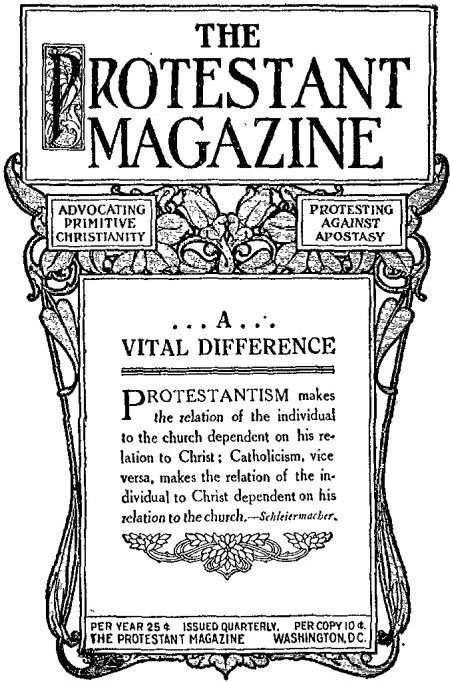
"Rome and Marriage" and "Catholic Prisons" Number

An Arsenal of Information

Recent despatches and interviews published in the leading American dailies, show that Rome's eye is upon the "Protestant Magazine." She fears our fearless yet dignified propaganda.
A letter from Rome to the New York "Sun," July 11, 1892, reveals the plan of the Papacy for America: "What the church has done in the past for others SHE WILL NOW DO FOR THE UNITED STATES."

PARTIAL CONTENTS

Double Frontispiece—Photograph of Holy Cross Church Baptism Certificate (Perth Amboy, N. J.), Showing Rome's Insult to American Marriage Laws. Protestantism and Catholicism (cover). A Girl's Escape From a "House of the Good Shepherd." Rome and Marriage Laws. The Mediation of Christ. Reply to Attack by "Catholic Truth Society" Upon This Magazine. Cardinal O'Connell Above Governor Foss? Chillingworth's Famous Statement. The Privilege of Peter. The Pope's Decree Forbidding Catholics to Sue Criminal Priests. "Another God Upon Earth." Rome Capturing America. Is America to Become Catholic? Protestantism in the Sixteenth Century, and — Other timely articles, news notes, etc.

SPECIAL OFFER ON TEN, ONE YEAR

Ten copies, one year, to one address, or to 10 separate addresses, only $1.50, or 15 cents each. Sender may include his own name as one of the ten. This number should be placed in the hands of every editor, attorney, clergyman, city and county official, and public-school teacher in your county. We can furnish the names and addresses.

Order Through Your Tract Society

If you do not know your Tract Society address, send to "The Protestant," Washington, D. C.

The Glad Exchange

So fitful is life's day We long for glad to-morrow, For joy is wreathed with grief And love is weighed with sorrow.
Our God in mercy bound The thorns among the roses, And through our anxious night His star of hope discloses.
Man's sin in paradise Could never be abiding; It shunned God's majesty, And sought a place for hiding.
The guard with flaming sword, The toil that saps our pleasure, The loss of friends or wealth, Point us to heaven's treasure.
His Son God gave to save, And naught is he withholding To lure us back to him, Safe in his arms enfolding.
O question not his grace, Nor spurn his loving kindness Who purchased all our woe And gives us light for blindness.
Portland, Oregon.

Missionary Nurses

FROM Christ's methods of labor we may learn valuable lessons. He did not follow merely one method; in various ways he sought to gain the attention of the multitude, that he might proclaim to them the truths of the gospel.
Christ's chief work was in ministering to the poor, the needy, and the ignorant. In simplicity he opened before them the blessings they might receive, and thus aroused a soul-hunger for the bread of life. Christ's life is an example to all his followers. It is the duty of all who have learned the way of life to teach others what it means to believe in the Word of God. There are many now in the shadow of death who need to be instructed in the truths of the gospel. Nearly the whole world is lying in wickedness. Yet we have words of hope for those who sit in darkness: "The land of Zabulon, and the land of Nephthalim, by the way of the sea, beyond Jordan, Galilee of the Gentiles; the people which sat in darkness saw great light; and to them which sat in the region and shadow of death light is sprung up."
Earnest, devoted young people are needed to enter the work of God as nurses. As these young men and women use conscientiously the knowledge they gain, they will increase in capability and become better and better qualified to be the Lord's helping hand. They may become successful missionaries, pointing souls to the Lamb of God, who taketh away the sin of the world, and who can save both soul and body.
The Lord wants wise men and women, acting in the capacity of nurses, to comfort and help the sick and suffering. O that all who are afflicted could be ministered to by Christlike physicians and nurses who could help them to place their weary, pain-racked bodies in the care of the great Healer, in faith looking to him for restoration.
Every sincere Christian bows to Jesus as the true physician of souls. When he stands by the bedside of the afflicted, there will be many not only converted, but healed. If through judicious ministration the patient is led to give his soul to Christ, and to bring his thoughts into obedience to the will of God, a great victory is gained.
Soul-saving is the object for which our sanitariums are established. In our daily ministrations we see many care-worn, sorrowful faces. What does the sorrow on these faces show?—The need of the soul for the peace of Christ. Poor, sad human beings go to broken cisterns, which can hold no water, thinking to satisfy their thirst. Let them hear a voice saying, "Ho, every one that thirsteth, come ye to the waters." Poor, weary, oppressed souls, seeking you know not what, come to the water of life. All heaven is yearning over you. Come unto Me, that ye may have life.
There are many lines of work to be carried forward by the missionary nurse. There are openings for well-trained nurses to go among families and seek to awaken an interest in the truth. In almost every community there are large numbers who do not attend any religious service. If they are reached by the gospel, it must be carried to their homes. Often the relief of their physical needs is the only avenue by which they can be approached. As missionary nurses care for the sick and relieve the distress of the poor, they will find many opportunities to pray with them, to read to them from God's Word, to speak of the Saviour. They can pray with and for the helpless ones who have not strength of will to control the appetites that passion has degraded. They can bring a ray of hope into the lives of the defeated and disheartened. Their unselfish love, manifested in acts of disinterested kindness, will make it easier for these suffering ones to believe in the love of Christ.
Many have no faith in God and have lost confidence in man. But they appreciate acts of sympathy and helpfulness. As they see one with no inducement of earthly praise or compensation coming to their homes, ministering to the sick, feeding the hungry, clothing the naked, comforting the sad, and tenderly pointing all to him of whose love and pity the human worker is but the messenger,—as they see this, their hearts are touched. Gratitude springs up, faith is kindled. They see that God cares for them, and as his Word is opened they are prepared to listen.
Whether in foreign missions or in the home field, all missionaries, both men and women, will gain much more ready access to the people and will find their usefulness greatly increased if they are able to minister to the sick. Women who go as missionaries to heathen lands may thus find opportunity for giving the gospel to the women of these lands, when every other door of access is closed. All gospel workers should know how to give the simple treatments that do so much to relieve pain and remove disease.## Teaching Health Principles
Gospel workers should be able also to give instruction in the principles of healthful living. There is sickness everywhere, and most of it might be prevented by attention to the laws of health.
The people need to see the bearing of health principles upon their well-being, both for this life and for the life to come. They need to be awakened to their responsibility in regard to the human habitation which has been designed by their Creator to be his dwelling-place, and over which he desires them to be faithful stewards.
Thousands need and would gladly receive instruction concerning the simple methods of treating the sick,—methods that are taking the place of the use of poisonous drugs. There is great need of instruction in regard to dietetic reform. Wrong habits of eating and the use of unwholesome food are in no small degree responsible for the intemperance and crime and wretchedness that curse the world.
In teaching health principles, keep before the mind the great object of reform,—that its purpose is to secure the highest development of body and mind and soul. Show that the laws of nature, being the laws of God, are designed for our good; that obedience to them promotes happiness in this life, and aids the preparation for the life to come.
Lead the people to study the manifestation of God's love and wisdom in the works of nature. Lead them to study that marvelous organism, the human system, and the laws by which it is governed. Those who perceive the evidences of God's love, who understand something of the wisdom and beneficence of his laws, and the results of obedience, will come to regard their duties and obligations from an altogether different point of view. Instead of looking upon an observance of the laws of health as a matter of sacrifice or self-denial, they will regard it as it really is, as an inestimable blessing.
Every gospel worker should feel that the giving of instruction in the principles of healthful living is a part of his appointed work. Of this work there is great need, and the world is open for it.

Individual Work

Christ commits to his followers an individual work,—a work that can not be done by proxy. Ministry to the sick and the poor, the giving of the gospel to the lost, is not to be left to committees or organized charities. Individual responsibility, individual effort, personal sacrifice, is the requirement of the gospel.
"Go out into the highways and hedges, and compel them to come in," is Christ's demand, "that my house may be filled." He brings men into touch with those whom they seek to benefit. "Bring the poor that are cast out to thy house," he says; "when thou seest the naked, . . . cover him." "Lay hands on the sick, and they shall recover." Through direct contact, through personal ministry, the blessings of the gospel are to be communicated.
Those who take up their appointed work will not only be a blessing to others, but they themselves will be blessed. The consciousness of duty well done will have a reflex influence upon their own souls. The despondent will forget their despondency, the weak will become strong, the ignorant intelligent, and all will find an unfailing helper in Him who has called them to his service.

A Dangerous Pedler

G. B. THOMPSON
THE country is filled with pedlers carrying various wares, advocating many schemes, and disposing of numerous concoctions and healing tonics. Some of these things are valuable, while others are a positive detriment to the purchaser.
There is another class of peddling, however, of which I wish more particularly to speak. It is engaged in by more people, and attended with greater evils, than that of any other business. It is carried forward by all classes of persons, some of whom profess religion and belong to the church. The business to which I refer is that of peddling gossip. Scandal-mongers, backbiters, and tattlers are everywhere. They hear a rumor, more or less unfavorable concerning some one, and they must run and tell it. They drop these morsels of scandal around without going to the individual to find out if it is true. They have heard it; that's enough. Whether true or not doesn't matter; it is something to tell. They will go quicker and run farther to tell some scandal than something good. They prefer to destroy reputation rather than build it up. They peddle a littlehere and a little there.
Others take up the reproach, add a little perhaps, drop words and insinuations, and destroy without a qualm the reputation of some one, perchance at the same time professing to be his friend. Usually after repeating the scandal they add, "Now don't say anything about it, I would not tell anybody except you." Considerable of this evil work is done by professed Christians who claim to follow the Lord, and to be seeking a home where nothing unclean or wicked will ever come.
A large amount of business can be done in this line of peddling without capital. No refinement of character, social polish, modesty of speech, education, nor mental power is necessary to constitute one a successful busybody and a recognized neighborhood gossip. The only thing that will in any way hinder a person's being a decided success in this kind of peddling is pure and undefiled religion. This is an effectual barrier.
Paul mentions those in his day who "learn to be idle, wandering about from house to house; and not only idle, but tattlers also and busybodies, speaking things which they ought not." 1 Tim. 5:13. Not having any business of their own to occupy their attention, they were able to devote most of their time to attending to other people's business, tattling from door to door, making merchandise of other people's reputation. In this way family and neighborhood feuds have been started, reputations blasted, and homes wrecked. Church difficulties have been gendered, alienations and coldness brought in and souls have been driven to perdition as a result. In some instances the church of the Most High God, which should stand as the very example of peace, has been transformed into what has oftentimes resembled the synagogue of Satan.
I know of no more unchristian or ungodly business than this. There is no language too severe with which to condemn it. It originated with the son of perdition and belongs to his kingdom. Those who engage in this work will not long retain the confidence of any one. It would seem that they could have little respect for themselves.
Gossip peddlers are a serious menace to any community. They are more dangerous than a plague. No contagious disease is to be feared and dreaded so much. When they enter the door, a shadow dark and threatening has entered. Beware! You can scarcely speak with safety. With a smile they creep into the home, clothed in the garb of a friend, perchance that of a Christian, and begin the work of backbiting and dissecting some neighbor, friend, or brother. They have heard something and have come in to tell you. But, be on your guard. The burglar comes for your purse; that's trash: the gossip comes to destroy reputation and honor. You can be sure of one thing: that a person who will sit in your home and backbite and tattle concerning somebody else, will sit in somebody's else home and backbite and tattle concerning you.
But one asks, What am I to do when these scandal pedlers come and insist on gossiping and backbiting about other people, and spreading rumors. A writer in a religious journal offers the following:—
"Taking up a reproach against a neighbor is a dangerous business. Persons have been killed recently by handling old shells that had been dropped twenty-five years ago, during the war. If you should happen to plow up one, you would better bury it again. If people bring to you reproaches against their neighbor, carry them no farther. If they lay them down at your door, leave them there till they die. Positively refuse to have anything to do with them. You take them up at your peril. They are an unclean thing, which we are not permitted to touch. Scandal-mongers should find no market for their wares at the house of a Christian. They may offer to give them to you, but you should spurn all such offers as you would an offer to give you the smallpox or the yellow fever."
Takoma Park, D. C.

The Wonderful Name

J. S. WASHBURN
"All hail the power of Jesus' name."
THERE is real, practical saving power in the name of Jesus. "Wherefore God also hath highly exalted him, and given him a name which is above every name: that at the name of Jesus every knee should bow, of things in heaven, and things in earth, and things under the earth; and that every tongue should confess that Jesus Christ is Lord, to the glory of God the Father."
The name of Jesus is "above every name." Why? — Because to man, fallen and lost, all heaven and eternity would be nothing but anguish; to behold the glories of heaven would only intensify the pain of their loss. He can never have eternal life, never gain heaven, without a Saviour. To the repentant sinner the Saviour is first, above all others; and the name which is above every other name expresses the thought of Saviour.
Heaven's first principle is love. God and his angels live not for themselves, but for others. Love to the lost means with God a sacrifice to save. Hence the word Saviour expresses the highest thought of heaven. The name Saviour is above every name not only in earth but in heaven.
Jesus has many names, Michael, Christ, etc., but the name Jesus means more to us than any other name divinely given him. "Thou shalt call his name Jesus, for he shall save his people from their sins." Matt. 1: 21. Note the margin of the word Jesus,—Saviour. When I call the name Jesus, I call him Saviour, my Saviour. Satan is the destroyer, Jesus is the Saviour.
Truly when in faith and trust though it may be in deepest anguish, we call the name Jesus, Satan and all the hosts of hell must flee from our presence. How can they, whom Jesus conquered, hear without fleeing in terror the name which is truly a prayer of faith, even though only the single word Jesus be spoken?
O the power in that name, the name which is above every name, when from the heart, it may be out of the depths of darkness and ruin, it is repeated over and over, with longing faith.
"How sweet the name of Jesus sounds In a believer's ear! It soothes his sorrows, heals his wounds, And drives away his fear. "It makes the wounded spirit whole, And calms the troubled breast; 'Tis manna to the hungry soul, And to the weary, rest. "Dear name! the rock on which I build, My shield and hiding-place! My never-failing treasury, filled With boundless stores of grace!"
Truly his name is the rock on which we build. When Peter walked upon the water and, forgetting Christ for a moment, began to sink, he cried out, "Lord, save me!" These three words are all in the one word Jesus. To the soul in anguish and distress too deep to form a prayer of many words, the Lord has given us one word, than which there is no higher prayer, no stronger appeal,—the one word Jesus, Saviour.
"Never feel that Christ is far away. He is always near, and his loving presence surrounds you. Seek him as One who desires to be found of you. He desires you not only to touch his garments, but to walk with him in constant communion."
"When temptations assail you, when care and perplexity surround you, when, depressed and discouraged, you are ready to yield to despair, look to Jesus, and the darkness that encompasses you will be dispelled by the bright shining light of his presence. When sin struggles for the mastery in your soul, and burdens the conscience, look to the Saviour. His grace is sufficient to subdue sin. Let your grateful heart, trembling with uncertainty, turn to him. Lay hold on the hope set before you. Christ waits to adopt you into his family. His strength will help your weakness; he will lead you step by step. Place your hand in his, and let him guide you.
"The souls that turn to him for refuge, Jesus lifts above the accusing and the strife of tongues. No man nor evil angel can impeach these souls. Christ unites them to his own divine-human nature. They stand before the great Sin-bearer, in the light proceeding from the throne of God."
"No voice can sing, no heart can frame, Nor can the memory find, A sweeter sound than Jesus' name, The Saviour of mankind." Memphis, Tenn.

"Arise, Go to Nineveh"

T. E. BOWEN
JONAH's experience has been made by many the subject of much jesting comment. Others go farther and discredit the whole book as an unbelievable tale, and so throw a slur upon the Bible itself. But Jesus compared his deliverance into the power of evil men, and his experience with death itself, with Jonah's experience in the deep within the great fish. He thus tells us it was a real experience, not fiction, even as his was a real experience with the powers of darkness and the grave. If the former was untrue, we may also discredit the latter.
The book of Jonah presents some intensely practical lessons. Jonah received a definite call. His work was very plain, apparently a simple thing to do. "Now the word of the Lord came unto Jonah the son of Amittai, saying, Arise, go to Nineveh, that great city, and cry against it; for their wickedness is come up before me." This is all: simply go down to Nineveh and proclaim there the message the Lord would give to him to give to the people.
It would seem that Jonah might have gone. To us now it certainly seems that it would have been as easy for him to obey the Lord and go to Nineveh, as it was for him to do the thing he did do. But "somehow some unaccountable desire or inclination, or whatever one may wish to call it, influenced him not to go. So he picked up his belongings, and started for another town,—"any place besides Nineveh," at least so said his actions. He went down to Joppa, and there found a boat going to Tarshish. Jonah, no doubt, said to himself, Here is my chance. Now I can get away from the presence of the Lord.
He embarked and sailed. Presently a terrific storm arose. The men having charge of the ship became greatly alarmed. By and by they began calling upon their gods. Just how it came about, we do not know; but the impression deepened that some one aboard their ship was guilty of some sort of crime which was resulting in this dreadful sea. They finally proposed casting lots to find out the man. It was not mere chance that the lot fell on Jonah. "Then said they unto him, tell us, we pray thee, for whose cause this evil is upon us; What is thine occupation? and whence camest thou? what is thy country? and of what people art thou?" Jonah replied: "I am an Hebrew; and I fear the Lord, the God of heaven, which hath made the sea and the dry land."
This reply added to his companions' trouble. They feared all the more, and asked Jonah this searching question: "Why hast thou done this? For the men knew that he fled from the presence of the Lord, because he had told them."
The men made an honest effort to get their boat to a friendly shore. It was of no avail. God overruled that storm. Jonah had a lesson to learn. At last the men cast Jonah into the raging sea. Of course they understood it to mean certain death for Jonah. That no evil was in their hearts is made plain by their prayer. They cried unto the Lord,—Jonah's God, the one who he had said had made the sea and the dry land,—and said, "O Lord, we beseech thee, let us not perish for this man's life, and lay not upon us innocent blood: for thou, O Lord, hast done as it pleased thee." Then they took Jonah up and cast him into the sea. And what must have been their surprise to see it immediately cease its raging. A wonderful miracle! They saw truly that they were dealing with the great God of heaven who ruled the mighty deep, and that Jonah was being dealt with in earnest for his disobedience.
Did Jonah perish? — Ah! no. Another miracle was performed to help him to see that he, too, was dealing with the great God whose word was not to be trifled with. "Now the Lord had prepared a great fish to swallow up Jonah. And Jonah was in the belly of the fish three days and three nights."
Was this a harder thing for God to do than calming the raging deep? — Not in the least. How did he keep Jonah alive? We know not, nor need we know. One thing is sure,—he did it, and Jonah learned his lesson. For we read, "Then Jonah prayed unto the Lord his God out of the fish's belly."
His is a wonderful prayer when we consider the circumstances surrounding him when he offered it. It was not until Jonah came down into the very jaws of death that his soul cried out unto God. The moment he did so with all his heart, the victory was gained over the devil. God then began to deliver Jonah. "And the Lord spake unto the fish, and it vomited out Jonah upon the dry land. And the word of the Lord came unto Jonah the second time, saying, Arise, go unto Nineveh, that great city, and preach unto it the preaching that I bid thee."
Jonah had the same thing facing him now that he had when he paid his fare to Tarshish. "So Jonah arose, and went unto Nineveh, according to the word of the Lord. Now Nineveh was an exceedingly great city of three days' journey. And Jonah began to enter into the city a day's journey, and he cried, and said, Yet forty days, and Nineveh shall be overthrown."
Not a very eloquent message, but it was that which God wanted given. And it attracted attention. It stirred the city mightily. These people believed what Jonah said. God was behind that message. The people of all ranks, high and low, rich and poor, repented, and God saved their city from the doom he had pronounced upon it. And they knew that it was spared because they had repented and turned from their evil deeds.
What was all this written for? Surely there must be some lesson in it for us. Nineveh contained more than one hundred twenty thousand persons who could not tell their right hand from their left; but when one servant of God proclaimed in it the message that the Lord gave him, it was quickly warned. It was a message against sin. Today there are teeming millions within city limits; and a warning against their terrible sins must be given by some one.
Messages are coming to us as a people, laying the burden upon us to go into these cities with the last warning message. The time of God's great wrath is just before us, and that will surely be a day of "fierce anger." May God help us to be as faithful to duty as was Jonah after he came up from his watery grave, a subdued and obedient man, that the Lord may use us in the finishing of his work, as he used Jonah in days of old.
Takoma Park, D. C.

Worship

W. R. UCHTMANN
No greater tribute can be rendered to God than that of true worship. Jesus said to the woman of Samaria: "But the hour cometh, and now is, when the true worshipers shall worship the Father in spirit and in truth: for the Father seeketh such to worship him." John 4:23.
Is it not wonderful that the great Father, the source of all light, the greatest and most majestic being in all the universe, is looking from above, seeking for true worshipers? The question may be raised, What is true worship? According to Webster, it is defined as "acts of adoration to God."
"The preaching at our Sabbath meetings should generally be short. Opportunity should be given for those who love God to express their gratitude and adoration."—"Testimonies for the Church," Vol. VI, page 361. And again, page 366 of the same volume: "In the inner court of heaven they [the heavenly intelligences] listen to the testimony of the witnesses for Christ in the outer court on earth, and the praise and thanksgiving from the worshipers below is taken up in the heavenly anthem, and praise and rejoicing sound through the heavenly courts because Christ has not died in vain for the fallen sons of Adam."
It seems to me that if our preaching or teaching fails to bring about a condition among our people as described above, we have not accomplished God's purpose, and the Father is compelled to continue to seek for true worship and worshipers. We all realize the importance of preaching, but as this is merely a means to an end, it can never take the place of true worship on the part of the people. See Volume VI, page 367.
Let us bear in mind that in every assembly of the saints below are angels of God, listening to the songs, testimonies, and prayers. Let us remember that our praises are supplemented by the choir of the angelic host above. While the sermon fills its place in divine worship, the angels listen as well to the testimonies and praises and prayers of the saints.
South Lancaster, Mass.

The Bible the Cure for Evils

ARTHUR V. FOX
The Bible is admirably adapted for the removal of all the evils of mortal life. Among these stands poverty. By this we mean that lack of spiritual food as well as physical food which God is able to supply. If we live not for others, how can we expect the Lord to supply us with that upon which life depends? "Let us not be weary in well-doing: for in due season we shall reap, if we faint not." Idleness and improvidence are both forbidden in the Word of God.
That law which was given on Sinai, while the mount trembled, and smoked, and grew terrific with the symbols of divine majesty,—that law graven on stone, to denote its perpetuity, and by the finger of God, to signify its authority,—requires industry. The gospel is not less exacting than the law. "This we commanded you, that if any would not work, neither should he eat." "He that observeth the wind shall not sow; and he that regardeth the clouds shall not reap." "In the morning sow thy seed, and in the evening withhold not thine hand: for thou knowest not whether shall prosper, either this or that, or whether they both shall be alike good."
The Saviour went about doing good against many odds; and his great ambassador to the Gentiles, with the care of all the churches upon his heart, often made his own hands minister to his necessities. One writer has said, "Did you ever see a lazy Christian? As well look for a holy devil." You have seen the poor, contemptible, profane idler converted by the power of the gospel into the contented, faithful laborer, the pest of society turned into its benefactor.
In a small village on the western reserve, there lived an influential, strong-minded infidel. He was a tiller of the earth and an officer of the State; he was moral and thrifty, sober and diligent, his habits having been acquired in a Christian family before his change of views on religious subjects. His excellences seemed to give him great power, and it was not surprising that they should secure for him an extensive influence among the youth. In a short time he had the satisfaction of finding himself surrounded by fellow infidels. As his hope of salvation rested upon his moral conduct, he was very kind and benevolent to the poor. Finding, however, that the drafts upon his resources were becoming more and more numerous, he began to inquire how it happened that while all around was prosperity, his neighborhood should be getting more and more thriftless. In prosecuting this investigation, he visited all his neighbors, and was startled to learn that in every home where the Bible was found, there was plenty; and in every abode where the Bible was absent, poverty was present, or was approaching.
Not long after, there came into the village an itinerant preacher, who proposed to hold a protracted meeting. His place of preaching was an old schoolhouse. Here he addressed the people who assembled night after night. The truth was presented with such power that it reached the hearts and troubled the consciences of the hearers. Those who were skeptical became demon-like, and began to produce disturbances, and to offer insults to the speaker, who, having appealed in vain to their sense of justice, character, and propriety, at length dismissed them by saying that he felt that he had done his duty to them; and seeing that they put the gospel from them, he would turn to those who would receive it with more respect. The next morning, while preparing to start away, he was visited by the infidel, and urged in the most cordial manner to remain and continue his meeting. To this solicitation he yielded. In the evening he went to his accustomed place of worship, and found his usual congregation, whom he addressed as faithfully as before; but when he had concluded his discourse, and the disturbance was about to be renewed, his infidel friend, who this evening had been seated just below him, arose and addressed the assembly, saying, in substance:
"This man must be treated with respect; the law can, and I will, protect him. Infidel as I am, I believe he is doing a good work. I have been around among you, and I find that you who revere the Bible live in prosperity; you who despise it are approaching pauperism, if not actually in distress. I am alarmed at what I have done. I have made you infidels, but in doing so, have I not ruined you? Many of you are young men of good minds. I have a family of daughters, but I would rather follow them all to the grave than see them united in marriage with you. Henceforth I will be the friend of the Bible; it is the instrument of good."
Pomeroy, Wash.

Accuracy and Spiritual Life

"The gain of rigid, habitual accuracy enters richly into our whole life, and nowhere more vitally than in our spiritual life; for accuracy is applied truthfulness."
Continue reading: Editorial