Your ShelfYour Projects

Signs of the Times, Vol. 40, No. 2.

Power with God

Signs of the Times

Jan 14, 1913

Pacific Press Publishing Association · Mountain View, California · Jan 14, 1913

Power with God

By Delwin Rees Buckner
Beyond Brook Jabbok, Jacob looks upon His family's clustered forms, lit by the spark The camp-fire spits. Alone he stands—no; hark! What treads amongst the trees? A fallow fawn, Perhaps, which crops the dew-wet thicket lawn, Or strays in search of savory sapling bark, Or—arms of iron, thrust through the shade-blurred dark, Encircle him; but brawn is met by brawn.
The Orient sky is flowering like a rose, With neither, victor; when, through touch divine, Within the sweat-bathed Hebrew's throbbing thigh A tense, strained sinew shrinks, wherewith he knows His Foe, meanwhile bright angel garments shine, And craves the blessing He will not deny.

"IF YE WILL INQUIRE, INQUIRE YE."

This Inquirers' Department is conducted for the purpose of helping those who are studying the Bible. The answers are oftentimes only suggestive. They are never to be considered infallible, only as they agree with the infallible Word. The writer who may answer them does not consider that his opinion is infallible. He will simply give the best that he has, and plead with the inquirer to search the Word. Such questions only will be answered as, to the editors, seem to minister to the good of the readers and to the mission of the paper. We can not answer repeatedly in the same volume questions upon the same scripture. The name and address must accompany question, not for publication, but as an evidence of good faith, and that answer may be made by letter if deemed advisable. No letters are answered which do not contain the name of the writer. It is well always to enclose stamp for reply.

3958 — No Man Hath Ascended Up to Heaven

A Baptist minister has asked for an explanation of the verse, “And no man hath ascended up to heaven, but He that came down from heaven, even the Son of Man which is in heaven.” We know that Enoch and Elijah had already ascended. Please explain. G. H. G.
The passage is found in John 3:13. The Revised Version reads, “And no one hath ascended into heaven, but He that descended out of heaven, even the Son of Man, who is in heaven.” The thought is not that no one has ascended into heaven, but that no one has gone up to heaven, to receive God's message and bring it down, but Jesus. He is the One through whom God has revealed all His truth. Nicodemus was wondering and querying as to what was truth. He, the teacher in Israel, did not know that man's heart must be changed, or born from above. Jesus wanted him to learn that the things that He spoke to him were things which He had seen. He told him of earthly things, and he did not believe them, then how would he believe if He told him of heavenly things; and then follows the text in question, that He was the very one who had descended out of heaven to bring these glad tidings and important truths to the world. He was the Immanuel—God with His people. Elijah ascended into heaven, but he did not come back with a message. Moses was raised from the dead, but he has not come back to this world; and this also is true of Enoch. But our Lord came down from heaven to give life to the world, by word and example.

3959 — Sanitariums

It is said that a people who are vegetarians and that have so many sanitariums to keep them well, have more surgical operations than do people who pay no attention to their diet, or who make no pretensions to their diet. Christ nor His followers had any sanitariums, nor used medicines, etc., etc. T. E. W.
It might be well to say to our inquirer that if he knew our sanitariums and the people that come there for treatment, he would find that the real health reformers are comparatively few. There are many who accept health reform after every other means has failed. Then they adopt a vegetarian diet, but sometimes disease is so far advanced that a mere change of diet does not cure, and such as these go to sanitariums. They go there for the twofold purpose, not simply in order to get well, but to know how to keep well; and there are thousands of testimonies that have been given over and over again, of those who have thus learned and who have been able to care for their own families for years after, without ever calling a physician, or suffering from sickness. Our Lord did heal without sanitariums. His apostles and His disciples healed, but at the same time, they used remedies, and we find very much instruction, indeed, in the Word of God in regard to the use of proper remedies,—air and water and sunshine, God's own remedies. Paul tells Timothy to “use a little wine for thy stomach's sake and thine often infirmities,” and he who healed people with a touch and a word, also wrote of a beloved disciple, “Trophimus have I left at Miletus sick.” Our Lord's great miracles were wrought in order that we might believe on Him who had life, and life to save from sin. We are not by this belittling the healing by faith. We believe in it most thoroly, but we can not force faith. The Christian must take people just where they are. In our own sanitariums, there has been much healing by faith, and many who have gone to sanitariums to obtain relief in a physical way have found Christ Jesus, and have found Him not only a Healer of the soul, but a Healer of the body as well. It would rather seem as if the ones who bring these objections are priding themselves over certain things, and are making of their own particular narrow views an idol which those they criticize are not. We believe that it is true that few of God's children, indeed, upon the earth have the simple, childlike faith in Him that they ought to have, but that does not debar any one from doing all that he can in stretching out a helping hand to aid the poor and the needy. We would like to remark further, that the chief medicines used in our sanitariums are nature's remedies, most abundant,—water, air, diet, and electricity.

3960 — What Will the Holy Spirit Do?

Please explain John 16:13, in connection with Isa. 30:21. J. D. P.
John 16:13 is the promise of our Lord that the Spirit would guide His disciples after He had gone away. “Howbeit when He, the Spirit of truth, is come, He will guide you into all truth: for He shall not speak of Himself; but whatsoever He shall hear, that shall He speak: and He will show you things to come.” That is, through God's own revelation by His disciples and through the spirit of prophecy, God's Spirit would speak. It would also recall to mind the truth which men have learned from God's Holy Word. It is the great agency in the hands of God, of developing and perfecting His people through the Spirit-filled Word. It will also call to the sinner. Isa. 30:21 refers to the man who is going astray, not to the one who is pressing on in the upward way. But it does tell us this, that if people are devoted and earnest, when they do go astray they will hear a voice behind them saying, “This is the way, walk ye in it.” That shows that they are turning away from the Master, for the great Shepherd always goes before, and His sheep follow Him; and the man who is pressing on in the heavenly way listens to the voice from before, and not from behind. It is only when he turns to the right hand or to the left that the voice of God is heard behind him. Let us so follow Him that His voice shall always be before us, calling us on.

3961 — A Generation

What time is allotted to a generation? M. W.
We know of no definite time that is allotted to a generation. It would probably be considered longer in the days of the antediluvian patriarchs than at the present time. Some have rather gathered from Gen. 15:13, 16 that it was a hundred years—four generations, four hundred years—and others have tried to figure out from the forty-two generations, mentioned in Matthew 1, that it was somewhere in the vicinity of forty years. But God has given us no definition of a generation, nor has He designed in the last generation to fix that time for us. Sometimes generation means race, people, nation. Sometimes it means the people living upon the earth at one time.

3962 — Children of Mary

Did Mary have any other children than Jesus? If so, what were their names? M. W.
We do not think that she did. Brothers and sisters of our Lord are mentioned, as in Mark 6:3: “Is not this the carpenter, the son of Mary, and brother of James, and Joses, and Judas, and Simon? and are not His sisters here with us?” See also Matt. 12:47. But these brothers and sisters were doubtless the sons of Joseph by a former wife, and yet who, according to law, were reckoned brothers and sisters of Jesus.

3963 — Armageddon

When will the war of Armageddon take place, before or after the resurrection of the just? A. M. B.
It will take place before the resurrection of the just, under the sixth plague. See Revelation 16. The plagues precede the first advent in glory of our Lord; when Christ comes the second time in glory, then the dead will be raised. 1 Thess. 4:16; 1 Cor. 15:51-54. This makes it very clear indeed that the war of Armageddon precedes the resurrection of the just. All not slain in that war will be slain by the glory of Christ's presence.
3964 — L. J. R. writes us under date of November 17 regarding the article on “The Tabernacle and the Ark” in the “Signs” of November 12, and says, “Please see Ex. 16:34; 25:16; 40:20; Num. 17:10, 11; 1 Kings 8:9; Heb. 9:4.” We do not know why our correspondent has referred us to these scriptures. They are all well known to the writer of the article, only the scope of the article did not necessitate their use.

3965 — Titles of Books

Sometimes I find, in the references to my Bible, one indicated by “Cant.” What does it mean? C. M.
“Cant.” is an abbreviation of “Canticles,” simply another name for the Song of Solomon. Sometimes we find the Revelation indicated by “Apoc.”—“Apocalypse.” We also find in the margin of our Bibles frequently “cf.,” and this is a puzzle to some. It stands for “confer,” meaning, in our Common Version, to compare some other scripture with the one to which it is appended.

3966 — Death of Martin Luther

How did Martin Luther die? Catholics claim he committed suicide? A. M. B.
“The Life of Martin Luther,” by Mrs. Emma H. Adams, a work on which a great deal of time and research was placed, refers to his sickness and death on pages 157, 158. The winter of 1546 Luther's health was very frail, and yet he set out on the 23d of January, attended by two of his sons, to Eisleben, in the hope of adjusting a serious disagreement between the two counts of Mansfeld, whose subject he was. Reaching Halle, Dr. Jonas, his friend, accompanied him the remainder of the journey. At Eisleben, his symptoms became more alarming, yet there he preached four times, administering the Lord's Supper twice, and ordained two ministers. On the 17th of February, he was so ill that the dukes prayed him to remain in the house. At supper he spoke much about his death. He retired to his room, and remained a long time in prayer. He then slept for an hour and a half, and on waking prayed with great fervor in Latin, and said, “O God of truth, into Thy hands I commend my spirit.” He slept again, and woke feeling still worse. Soon came two physicians with Count Albert and wife, and Luther said to them, “I am dying. I shall remain at Eisleben,” and then prayed audibly this prayer: “O my God, Father of our Lord Jesus Christ, Thou God of all consolation, I thank Thee for revealing to me Thy well-beloved Son, in whom I believe. I commend my soul to Thee, O my Saviour, Jesus Christ, I know I shall rest with Thee eternally.” Suddenly then his eyes closed; he fainted. After much effort he was restored. Dr. Jonas then said to him, “Reverend father, do you die firm in the faith you have taught?” He answered distinctly, “Yes,” and soon passed away. Another Catholic writer declares that Luther died blaspheming, that is he did not believe in Roman Catholicism.

OUR BIBLE BAND

Schedule for the Week Ending January 18, 1913

Sunday | January 12 | Genesis 22, 23 Monday | January 13 | Genesis 24 Tuesday | January 14 | Genesis 25, 26 Wednesday | January 15 | Genesis 27 Thursday | January 16 | Genesis 28; 29:1-30 Friday | January 17 | Genesis 30:25-36; 31 Sabbath | January 18 | Psalms 4, 5, 6
We continue with Genesis, following the family through which the Seed was to come. The promises from Abraham extend to Isaac, from Isaac to Jacob. We omit Genesis 20 and 21 and a portion of 29 and 30. They may be easily read by those who desire. There are lessons in them all. We close the week's reading, in Jacob's unsatisfactory experience. If he had had better earlier experience, he would have saved himself much of the later. The overweening affection of the overfond, aged father for Esau, was no particular help to either Esau or Jacob. This naturally demanded stronger sympathy on the part of the mother for her neglected child, whom she favored, which brought division to the family. Evidently she knew of the promise of God, and that it would be manifest through Jacob, and she ever kept before him the importance of the Seed in a material way, without the fullest appreciation of the spiritual blessings. It was the material overreaching all the way through which demonstrated the fitness of the name of her son Jacob,—supplanter. Yet God in His mercy brings a change, as we learn in our next lesson.
Psalms 4, 5, and 6 are worshipful and inspiring. Psalm 5 is the basis of the hymn beginning, “Lord, in the morning Thou shalt hear.”

The Healing of the Leper

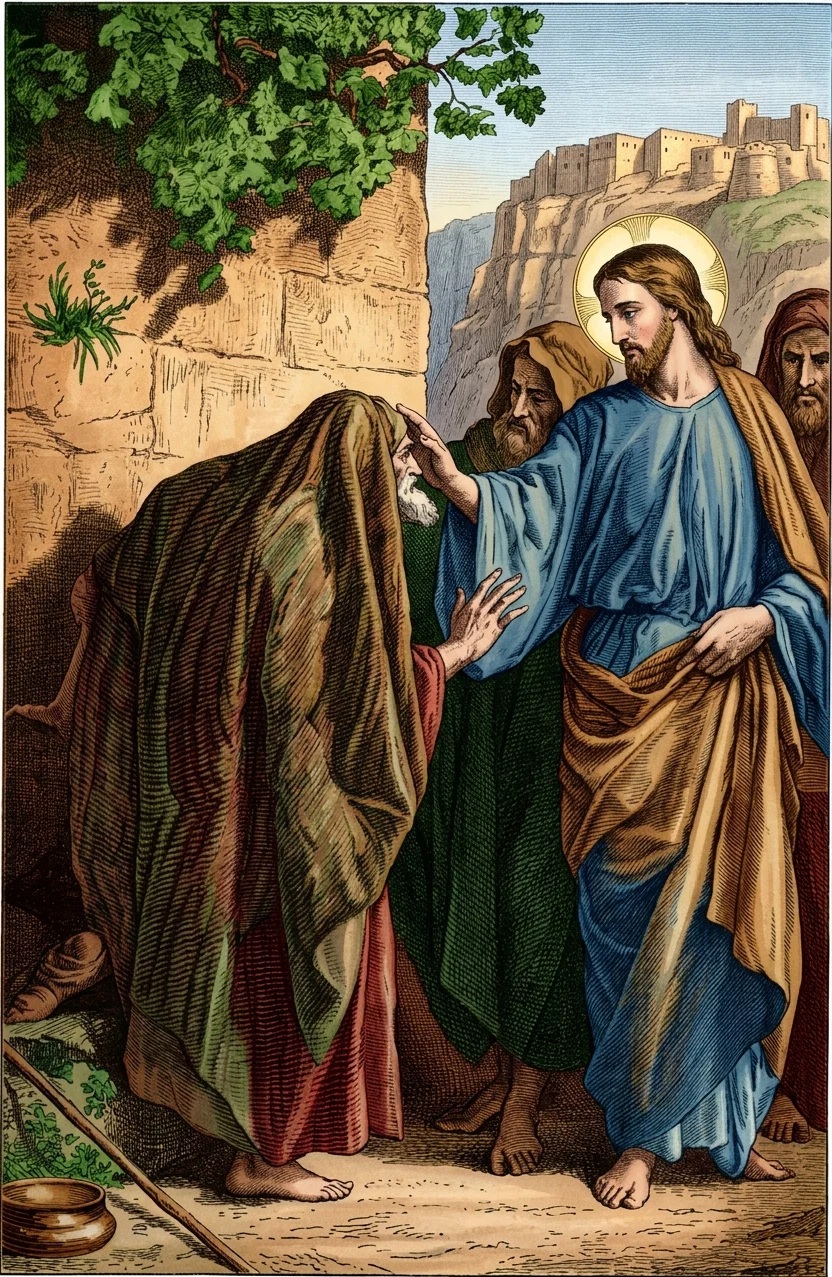
JESUS HEALING THE LEPER
THE dread disease leprosy abounded in Eastern lands, and still abounds. It is one of the most fearful diseases, and in its worst forms is incurable, so far as the skill or power of man can go. It comes from a Hebrew word which means “a smiting,” referring more to its fearful and hopeless result than to its beginning, for it begins slowly and insidiously. It does not after its appearance at first seem to affect the general health, and the only inconvenience is a slight itching when the skin is heated. It is common to both sexes, and to all ages, and to all ranks of society.
There are three kinds mentioned in the Scriptures, the first of which did not render one unclean. The other two did. If on examination by the priest the person was found to be affected by the “smiting,” he was immediately declared unclean, separated from the cities and people; the hair of his head was to go loose, and he was to cover his upper lip; and when he saw people approaching him, he was to cry, “Unclean! Unclean!” Most mournful and despairing it must have sounded to victim and beholders.
Our description of the disease comes from its later developments and phases, and is called scientifically, elephantiasis, from the thickening of the skin, making it to appear like the skin of the elephant: the face becomes frightfully deformed, the forehead is traversed by deep lines, and covered with numerous tubercles; the eyebrows become bald, swelled, furrowed by oblique lines; the eyelashes fall out; the eyes assume a fixed and staring look; the lips are enormously thickened and shining; the beard falls out; the chin and ears are enlarged and beset with tubercles; the nose frightfully enlarged and deformed; the voice hoarse and nasal; and the breath intolerably fetid. Sometimes it is years before these tubercles ulcerate. The extremities are affected in the same way as the face. The sensibility of the skin is greatly impaired, and often entirely lost. Joints of toes and fingers ulcerate and fall off, one after the other, and insupportable fetor exhales from the whole body. And these conditions continue for years, but the sufferings are rarely equal to the external deformity and appearance. Sometimes the patient becomes morose and melancholy, and shuns the sight of the healthy, knowing what an object of disgust he must be, and life becomes a loathsome burden. Sometimes he falls into a state of apathy, and cares for nothing going on around him save to secure the food that he needs.
What a picture this is of sin, which destroys its victim and at the same time destroys his sensibility, which literally eats him up; yet at the same time he does not recognize that he is being devoured by it. Utterly incurable by men; so also is sin, and he who becomes affected by its dreadful germs, must go on in the living death to the end. Even so “sin when it is finished,” however fair it may be in the beginning, “bringeth forth death.”
Similar to this description must have been the spectacle which greeted our Lord on one of His tours through Galilee. Nay, He may have been greeted by many more. The instances given are typical. We can easily picture to ourselves the eagerness of the poor victim, to whose ears had come the news of the wonderful Healer, who had, as he drew nigh to the great Physician, forgotten his cry of “Unclean.” We can see the crowd surrounding our Lord press back in horror from the revolting object as he approached. They wonder why the great Prophet does not wave him back, why He Himself does not flee with the crowd, lest He be contaminated. But He does not, He can not thus deny His mission—He came to seek and to save the lost.
The leper presses closer, yet doubting—not the Master’s power, but—His willingness. He kneels before our Lord, and from the agony of his longing soul, cries, “Lord, if Thou wilt, Thou canst make me clean.” He had met slightings and rebuffs and repulsings, and even cursing, as one smitten of God, until it seemed that all humanity were against him; and doubts arise in his mind as to whether this mighty, compassionateHealer does not stand with them. Jesus, he believes, could heal him,—would He?
Jesus knew the heart of the poor leper, knew that under the treatment he had received the heart would harden and grow doubtful. But not the appearance, not the standing, not the worth of the leper appealed to the heart of the Master, but the pitiful need of the poor victim. He wished to assure the poor man that God did not forget him, that He is very pitiful and of tender mercy; and therefore when Jesus spoke He touched him. It was no casual touch; the words were no ordinary words. “I will, be thou clean,” were wonderful words of life, pregnant with creative power. The touch was filled with healing, as well as sympathy. Creative power coursed through arteries and organs. Bone and skin responded to it, and the man who was literally rotting away became whole again, and his flesh like that of a little child.
This is the lesson to us. As children of earth, we are all smitten with the leprosy of sin. The fearful disease, leprosy, they say, is not contagious, but it is hereditary; and so it is with sin. We have inherited it. We need not take it from our fellow beings around us, but we are born sinners. The fearful disease is upon us, whether we will or not. It may not be seen to-day, there may be the mildest symptoms of it to-morrow. We may almost deny that we have it, nevertheless it is there; and as we yield to its spirit, it becomes more and more manifest how potent of evil is its power. It affects heart and mind and disposition, and to the soul that yields to the longing for righteousness which God’s Spirit would implant in every soul, it brings despair. Yet there is healing, and there is just as complete healing to the poor sinner as there was to the leper that met Jesus in the way. The Master has come down to earth, and does come down, to show His sympathy with the poor sinner. He does not separate Himself from that sinner by a cordon of saints, or angels, or priests. He pleads with the poor, leprous sinner, “Come unto Me;” approach Him just as the leper did. Forget all other souls, all their regard for us for ill or good—forget all things else but the sinner and the Cleanser from sin, and go to Jesus. Say to Him, as did the leper, nay, with more confidence than did the leper, “Lord, make me clean.” He has willed to do this,—“This is the will of God, even your sanctification,” and He pleads with you to come. “Let the wicked forsake his way, and the unrighteous man his thoughts: and let him return unto the Lord, and He will have mercy upon him; and to our God, for He will abundantly pardon.” He declares: “Tho your sins be as scarlet, they shall be as white as snow; tho they be red like crimson, they shall be as wool.” “Himself took our infirmities, and bare our sicknesses.” He knows the sufferings of poor, sinful humanity. He has the potent remedy for them all. And all these miracles are written that in Him we may have hope, and by simple, childlike faith grasp the great life to heal. He is not only able, He is willing, and not only willing, but anxious, to cleanse and heal all the sins of humanity, and to save to His eternal kingdom. Let us carry with us the lesson of hope in our hearts always.

Studies in Ephesians

Chapter 1, Verses 3, 4, A.R.V.

1. To whom does the apostle ascribe blessing?
“Blessed be the God and Father of our Lord Jesus Christ.” Verse 3, first part. Note 1.
2. Why is He worthy of blessing?
“Who hath blessed us with every spiritual blessing in the heavenly places in Christ.” Verse 3, last part. Note 2.
3. What was precedent to the blessing?
“Even as He chose us in Him before the foundation of the world.” Verse 4, first part. Note 3.
4. What was His purpose in choosing us?
“That we should be holy and without blemish before Him.” Verse 4, last part. Note 4.
1. “Blessed be the God.” The margin reads, “Blessed be God and the Father of our Lord Jesus Christ.” The text seems to be clearer,—“Blessed be the God and Father of our Lord Jesus Christ.” The word “blessed” is used in the sense of praise. All praise to Him. He is the Giver of all good, the Creator of all things, the Upholder of the universe, a marvelous, everlasting Provider. Surely every child of His ought to join with the apostle in ascribing to Him blessing. This expression is one of the seven which John uses in Rev. 5:12, ascribing them to the Lamb.
2. “Who hath blessed us.”—The expression is comprehensive. It would have us understand that God’s blessing includes all. It is not limited to one thing; it includes every blessing,—not only the blessings of the earthly, but the blessings of the heavenly. Earth of itself furnishes no blessings. In its perverted, sin-cursed state, it brings curses. “Cursed is the ground for thy sake,” was the word to our first father; but out of the heavenly places in Christ, God has brought down all the blessings and bestowed them upon His children. To this he refers again, as we will find in our study of the book; but take note of this, and do not put the spiritual blessings far off in the uncertain future: “He hath blessed us.” The blessings are ours now, even as Christ is given now. “For in Him dwelleth all the fulness of the Godhead bodily, and in Him ye are made full.” Col. 2:9, 10. He would have our faith grasp these now. He has exalted us by the gift of His Son, who died in our behalf, and who Himself was made one of the human family, to a seat in the heavenly places. He would have us occupy it. He would not have us insult the royal Giver by refusing to take it because we are unworthy. He would have us believe the royal promise, and in the worthiness of our Lord sit with Him together in the heavenly places. Eph. 2:6. How such a conception would take away all of our timidity in the world! How it would give us boldness to meet all the world’s scoffs and jeers and sneers! How it would enable us to meet all the trials and conflicts and seeming darkness of life, to know that in it all we were with Christ, we were with Him also in the heavenly places! It is one of the divine and blessed paradoxes of Scripture that while we are here, He the Heavenly One is with us, and while He, our Brother beloved in the flesh, is there, we are there with Him.
3. “Even as He chose us.” It is not a separating out of individual cases, choosing some “to heaven and some to hell, all for His glory.” That is not a part of God’s choosing. God chose character in the very beginning, a certain number of a certain character, to completely fill the home of this earth which He had provided for them. See Gen. 1:26; Ps. 115:16; Isa. 45:17, 18. The names of these characters were written in the Lamb’s Book of Life from before the foundation of the world (Rev. 17:8); and when God calls us, He calls us to one of the chosen names, and counts that ours when we begin the Christian life (Phil. 4:3). The name of that character shall never be blotted out. That crown of life, crown of righteousness, crown of glory, that awaits the conqueror, will never fade or wither. That inheritance to which the soul is called, shall never pass away; and when God calls one of the children of earth, as He calls every one to one of those characters, His calling is “without repentance.” The failure will always be on our part, not His; and every spiritual blessing in heavenly places in Christ will be bestowed upon that soul, that he may reach that character. And so by choosing us to one of those eternal characters, which were in God’s plan before the foundation of the world, God has chosen us before the foundation of the world in that character to which He calls. And the trials and conflicts and perplexities and struggles and triumphs of this life are the putting away of the wrong education which the world has given us, are the development of a right character in His sight, are the spelling out, letter by letter, of the new name which shall be wholly ours when the overcoming is complete. James 1:12; 2 Tim. 4:8; 1 Peter 5:4; Rev. 3:5, 11.
4. “Holy and without blemish.”—The one thing of worth in the entire universe of God is character. The only thing which will endure throughout all eternity is character, and that connected with it. The only thing that makes our God the worthy Being that He is, is character. Men may be worth their millions, may own and rule the world, may pile their wealth mountain-high, and their fame may be world-wide, but it is all of no worth without character. When they die all is left, and all things that men may gather in this life will not tunnel the grave; but character does, and it is to character that God chooses His children; and those who in Him (for it is in Christ that we are chosen before the foundation of the world) gain that glorious character, shall have all the riches of God’s universe throughout all eternity. “Holy and without blemish before Him,” in His presence they shall verify in their own lives the song of the Psalmist, “In Thy presence is fulness of joy; at Thy right hand there are pleasures forevermore.” Let us take home to our hearts the blessed lessons, and make them ours.

The Value of Today

“ONE to-day is worth two to-morrows.”

The Ensign of the Holy One

THE distinguishing characteristic of the true God is creative power. The ensign of His power is the Sabbath, around which cluster the great facts of a completed creation. It is the only commandment in God’s holy law which reveals Him for what He is, Creator and Redeemer, mighty to save, the Holy One of Israel.
And yet when the badge of God’s authority is lifted before the people, many ridicule, despise, and reject it. This the Lord Himself foretold in Isa. 30: 8-11: “Now go, write it before them in a table, and note it in a book, that it may be for the time to come forever and ever [marginal, Hebrew, ‘the latter day’]: that this is a rebellious people, lying children, children that will not hear the law of the Lord: which say to the seers, See not; and to the prophets, Prophesy not unto us right things, speak unto us smooth things, prophesy deceits: get you out of the way, turn aside out of the path, cause the Holy One of Israel to cease from before us.”
Men may hide God now, and may hide His truth from their eyes, but they will sometime meet it all in the judgment. They will then also meet their own delusions, which they have chosen, ripened to their own destruction. See verses 11-13. He would have us choose life now—“turn and live.”

Affliction as Evidence of God’s Love

ONE of the greatest evidences of God's love to those that love Him is to send them afflictions, with grace to bear them.—Wesley.
Continue reading: The Coming of Our Lord