Your ShelfYour Projects

Review and Herald, Vol. 90, No. 19.

The Last Call for

Review and Herald

May 8, 1913

Review and Herald Publishing Association · Takoma Park Station, Washington, D. C. · May 8, 1913

The Last Call for

THE GENERAL CONFERENCE

DAILY BULLETIN

to be issued daily, except Sabbaths, from May 15 to June 9, giving full reports of the Conference. The first number to be mailed May 16.
All who can not attend this, the greatest and most important assembly of workers in the history of the denomination, should have the Bulletin. This is the last call to be made before the Conference begins. No delay can be made now in ordering if the Bulletin is to be received promptly.
PRICE, 50 CENTS FOR THE SESSION
All the Details of the Conference for Only 2½ Cents a Day

What a Successful Lady Agent Says

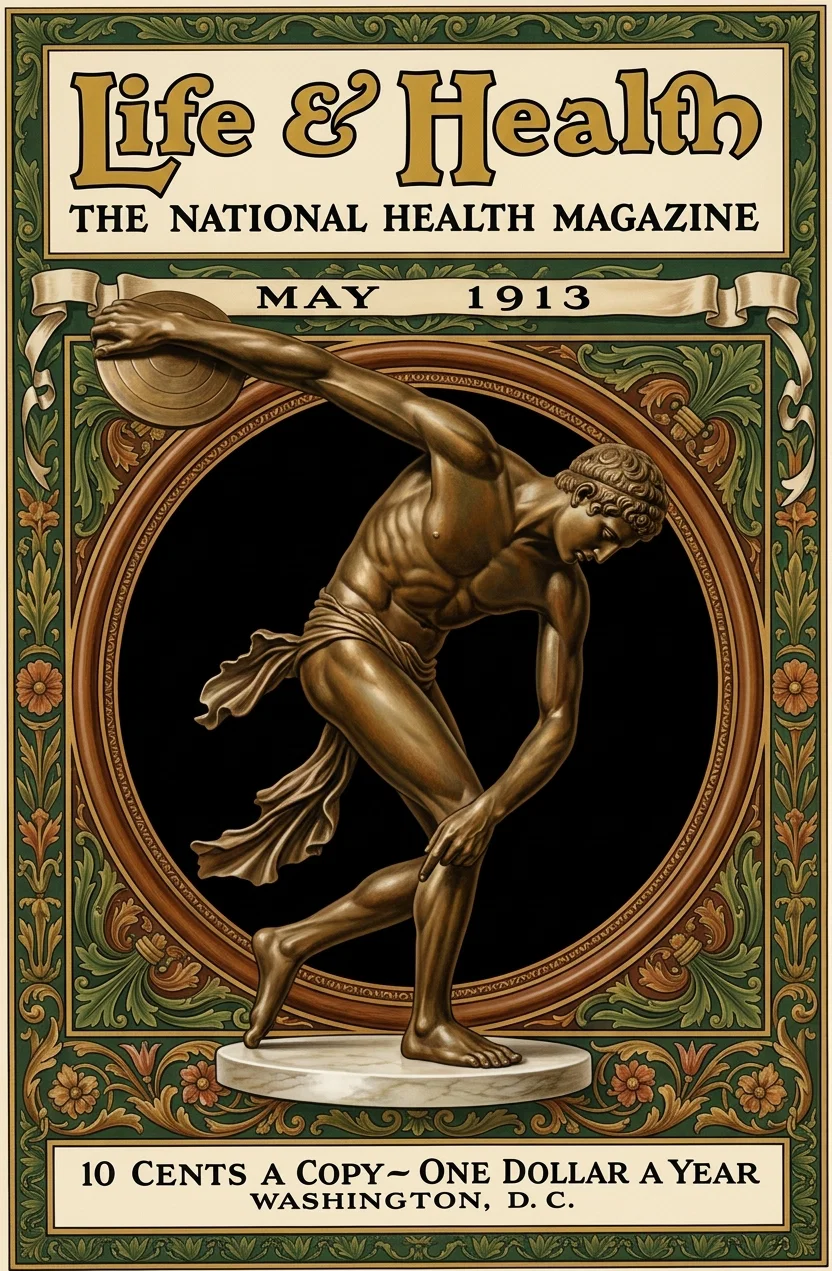
This is the magazine that tells you WHAT TO DO, as well as WHAT TO AVOID, for the sake of your health. It also tells you HOW TO PREVENT, as well as HOW TO CURE, disease.

What a Successful Lady Agent Says

Who Is Selling This Number in Hawaii:

“I like the front cover of the May number. Think it will sell better than the March or April number. Enclosed find payment for the 50 copies ordered.”—Mrs. Bertha A. Bartholomew, Honolulu, April 15.
Contains at Least 20 Articles, Each Easily Worth a Dime!

Note These Few

Professor Metchnikoff on “The Cause of Old Age”
The Sun and My Lady’s Face
Startling Revelations Concerning Diseased Meat
How to Prepare Six Vegetarian Salads
Does Alcohol Warm the Body?—What Arctic Explorers Say
Is Castoria Injurious?
Friedmann Tuberculosis Treatment
Cure for Tapeworm
Substitutes for Coffee
“Sex Hygiene” Commercialism
A Doctor or a Good Nurse—Which?
Questions Answered by the Editor
If you want to be as strong and healthy as the stalwart Greek “Discus Thrower” (in modern athletics he would be the “Hammer Thrower”), pictured on this cover, follow the principles taught by “Life and Health.” And don’t forget to pass them on to others.
10 Cents in Stamps Will Bring You a Sample Copy
Send $1.00 for 20 copies; $2.00 for 50; $4.00 for 100; or $8.00 for 200. Fifty or more, 4 cents each, post-paid.

ORDER THROUGH OUR NEAREST AGENCY

(If you do not know the address of our Agency, ask “Life and Health,” Washington, D. C.)

That Glad Day

WORTHIE HARRIS HOLDEN
AMIDST the mottled shadows of the sorrow Athwart thy path to goad thee to dismay, List to the whispered hope thy soul may borrow From that glad day.
O glorious day, devoid of tears and sighing, Effulgent with the heaven wonder-light, There dwelling mid no grief nor fear of dying, Farewell to night!
We long for thee, fair morn of day supernal, And strain out eyes to catch the dawn's first gleam, Assured thy joys which span that life eternal Exceed our dream.

A Short Sermon

H. A. ST. JOHN
“Sir, we would see Jesus.” John 12: 21.
How refreshing it was to the early disciples, who were made so sorrowful by the death of Christ, to behold the risen Saviour. Has not the Holy Spirit power to take of the things of Christ and show them unto us? Yea, more, can not the Holy Spirit show Jesus himself unto us, and thus fulfil the Saviour’s promise that he would come and manifest himself to those who love him, and keep his commandments? Reader, would it not be refreshing to you, for Jesus to manifest himself to you in some way, as the chiefest among ten thousand, and the one altogether lovely? Would it not be a shower of blessing indeed? You will be interested to consider the grounds for faith in this respect. Hear the spirit of prophecy:—
Enoch “lived in the atmosphere of heaven.” “He had looked upon the celestial city. He had seen the King in his glory in the midst of Zion.” “To him prayer was the breath of the soul.” “His face was radiant with a holy light, even the light that shineth in the face of Jesus.” “To such communion God is calling us.”
“John the Baptist in his desert life was taught of God. . . . Under the guiding of the divine Spirit, he studied the scrolls of the prophets. . . . He looked upon the King in his beauty, and self was lost sight of. He beheld the Majesty of holiness, and knew himself to be inefficient and unworthy. . . . In this age, just prior to the second coming of Christ in the clouds of heaven, such a work as that of John is to be done. . . . In order to give such a message as John gave, we must have a spiritual experience like his. . . . We must behold God, and in beholding him, lose sight of self.”
“There are many who in dwelling too largely upon theory have lost sight of the living power of the Saviour’s example.” “What they need is to behold Jesus. Daily we need the fresh revealing of his presence.” See “Testimonies for the Church,” Vol. VIII, pages 317-333.
What a rich experience is here indicated as within the reach of every one! It will be such a manifestation of Christ to the individual as will be a shower of blessing indeed. Let all begin at once to seek for such showers, for we are in the time of the latter rain. Who knows but the time for the great and general refreshing, even greater than Pentecost, has already come? It surely is not far off. When it does come, all who receive it will be of one accord in one place, not geographically, but spiritually. For this let us all begin at once to pray, for ourselves and for our brethren. When that refreshing shall come, all other blessings will follow quickly in its train. The last message will go with a loud cry, the earth will be lightened with its glory, and a short work will the Lord make on the earth. Then will appear the Lord Jesus in great glory, and every eye will see him. The wicked, in great distress, will seek to hide from the brightness, but the redeemed will rejoice in that brightness. They have had such views of Jesus by faith, in their closing work, that they are all light in the Lord.
“With his radiance splendid Shall your light be blended When his glory shall appear.”

Saving Faith

MRS. E. G. WHITE
The faith essential for salvation is not mere nominal faith, but an abiding principle, deriving vital power from Christ. It will lead the soul to feel the love of Christ to such a degree that the character will be refined, purified, ennobled. This faith in Christ is not merely an impulse, but a power that works by love and purifies the soul. It accomplishes something, bringing the soul under discipline, elevating it from defilement, and bringing it into connection with Christ, till it appropriates his virtue to the soul’s need. This is saving faith.
There are many who claim to have faith, but how shall we know that it is genuine? The Lord has given us a test by which we may prove our profession and the profession of others. The prophet says, “To the law and to the testimony: if they speak not according to this word, it is because there is no light in them.” John declares, “He that saith, I know him, and keepeth not his commandments, is a liar, and the truth is not in him.” This test applies to those who have been enlightened in regard to the claims of God’s law. The principles of the Bible must be brought into every-day life, to enlighten conscience and regulate the conduct.
If heavenly light is welcomed by the soul, grace will be given to adorn the character, to dignify the nature, and to fit man for the society of the angels of heaven. Every temptation may be conquered through the strength of Christ. God desires us to have pure characters; purity is power, but sin is weakness and ruin.
Christ has said, “If ye keep my commandments, ye shall abide in my love; even as I have kept my Father’s commandments, and abide in his love.” Christ came to our world, and for our sake he became a man of sorrows and acquainted with grief. He suffered reproach,he was despised and rejected of men. He died a shameful death upon the cross, that we might have eternal life; and shall we dare to flatter ourselves that we may follow a course of sin, choosing our own way, shunning the cross, avoiding reproach and self-denial, and yet have a home in the kingdom of heaven?—No; through faith in Christ we must render obedience to all the requirements of God; through his merits we may be elevated to keep God’s commandments.
Exceeding great and precious promises have been given unto us, whereby it is we may become partakers of the divine nature, having escaped the corruptions that are in the world through lust. We must appropriate these promises to ourselves that we may overcome unbelief and get the victory over every besetment, perfecting a character that will meet the approval of heaven. We are very anxious to appear well in the sight of men, but of how much greater importance is it that we stand approved in the presence of God!
Day by day we are to fight the good fight of faith. Day by day God will give us our work; and though we can not see the end from the beginning, we are to examine ourselves daily to see if we are in the path of righteousness. We must strive to overcome, looking unto Jesus; for in every temptation he will be at our side to give us the victory. Every day should come to us as the last day in which we may be privileged to work for God, and much of it must be given to prayer that we may work in the strength of Christ. This is the way in which Enoch walked with God, warning and condemning the world by manifesting before them a righteous character.
We profess to believe that Christ is soon coming to the earth, and a solemn responsibility rests upon us; for a lost world is to be warned of the hastening judgment. We must not lay off our responsibility; we must carry the burden of the work. Self must be out of sight, and Christ must appear; as faithful, obedient children we must follow the light, and reflect its precious rays to others. We must be living epistles, known and read of all men. If we are to be cleansed, both soul and body, we can not afford to be slothful and negligent. Christ is coming, the third angel’s message must be proclaimed to the world; for it brings light upon the commandments of God and the faith of Jesus. O, could we realize how all heaven is interested in the salvation of the world, we should rouse up with holy zeal to be followers of Jesus!

Sabbath Observance

ISAAC SANBORN
“Remember the Sabbath day, to keep it holy. Six days shalt thou labor, and do all thy work: but the seventh day is the Sabbath of the Lord thy God: in it thou shalt not do any work, thou, nor thy son, nor thy daughter, thy man servant, nor thy maid servant, nor thy cattle, nor thy stranger that is within thy gates: for in six days the Lord made heaven and earth, the sea, and all that in them is, and rested the seventh day: wherefore the Lord blessed the Sabbath day, and hallowed it.” Ex. 20: 8-12.
From the pillar of cloud Christ declared concerning the Sabbath: “Verily my Sabbaths ye shall keep: for it is a sign between me and you throughout your generations; that ye may know that I am the Lord that doth sanctify you. Ye shall keep the Sabbath therefore; for it is holy unto you: every one that defileth it shall surely be put to death: for whosoever doeth any work therein, that soul shall be cut off from among his people. Six days may work be done; but in the seventh is the Sabbath of rest, holy to the Lord: whosoever doeth any work in the Sabbath day, he shall surely be put to death. Wherefore the children of Israel shall keep the Sabbath, to observe the Sabbath throughout their generations, for a perpetual covenant. It is a sign between me and the children of Israel forever.” Ex. 31: 13-17.
How can we consider that we are keeping the Sabbath if we do any of our work on the seventh day? It means eternal salvation to keep the Sabbath holy unto the Lord. God says, “Them that honor me I will honor.” 1 Sam. 2:30.
“O, how many I saw in the time of trouble without a shelter! . . . Those who refuse to be hewed by the prophets, and fail to purify their souls in obeying the whole truth, . . . will come up to the time of the falling of the plagues, and then see that they needed to be hewed and squared for the building.”—“Early Writings.”
In Volume VI of “Testimonies for the Church” there are twenty pages devoted to the proper observance of the Sabbath. I earnestly recommend all our brethren and sisters to read this instruction, for I am sure it will cause a great reform in our Sabbath-keeping.

Communion of the Spirit

The Holy Spirit—No. 17

Communion of the Spirit

G. B. THOMPSON
AMONG the most solemn and impressive statements made by inspired writers concerning the Spirit of God, is that of the apostle Paul in his benediction to the Corinthian church, “The grace of the Lord Jesus Christ, and the love of God, and the communion of the Holy Ghost, be with you all. Amen.” 2 Cor. 13: 14. What are we to understand by the communion of the Spirit? In Phil. 2: 1 we have the expression “fellowship of the Spirit.” This conveys the idea of partnership, not especially in business, but in spiritual things. We speak of the communion service, or Lord’s Supper. It is at this service that the members of the church meet together, and with the great Head of the church, commune as a loving family or as the dearest and most loving friends. This expresses to some extent the idea of communion.
The word communion expresses friendship. Jesus “communed” with two of his disciples on the way to Emmaus the day of his resurrection. He talked with them as the most loving friend, and partook of their hospitality.
This helps us to understand what is meant by the communion of the Holy Spirit. It is to talk together as friends; to hold close and confidential relations together; to exchange bosom secrets; to sympathize in the trials and burdens of life; to have, in a sense, common interests; to be one in spirit. This is a most blessed thought for every child of God, yet almost overwhelming when we stop to consider all that it means to us.
Communion with the Spirit means that there is complete agreement between the Spirit and the individual. “Can two walk together, except they be agreed?” Amos 3: 3. Hardly. “What agreement hath the temple of God with idols?” There is no basis of agreement. “What communion hath light with darkness?” There is no communion between them. They are at war with each other, and those who are enemies do not commune together. Let intimate friends once become involved in a heated discussion, and their friendly communion ceases at once. Belligerancy interrupts communion.
It is the same with the Spirit of God. It is dove-like. Discord and strife, or anything which it condemns, if unsurrendered, breaks its communion with the soul. It is no use to argue and debate, seeking some compromise; the Spirit is sovereign. He will make no compromise with sin. No idol can sit on the throne with him. His will, not ours, must prevail. When he points out defects in our lives they must be given up. It is sin only that interrupts our communing with the Holy Spirit. When we compromise, excuse, or tamper with it, contrary to the instruction and warning of the Holy Spirit, we break the connection between the soul and the Spirit and destroy the communion which should exist. So when Paul prayed for the “communion of the Holy Ghost,” he was praying for a oneness, a perfect harmony between the Spirit and the church.
But the thought that we have as a companion, as a sympathizing friend, a constant counselor, and burden-bearer, as a bosom friend, one sent into the world as the personal representative of Christ, is very searching. What does the Spirit think of my words, my actions, my thoughts, my motives? How is he pleased with my missionary endeavors? What is there in my life which grieves one so holy? Do I shock his tender sensibilities by rude, boisterous ways, by unkindness in the home, by my impatience, irritability, and fretfulness? Do I grieve him by reading trashy literature, by joking and jesting, by living a cheap, aimless life; by my selfishness and pride; by a covetous, stingy disposition? A realization of the real presence of thisdivine Representative will cause us much sober, serious reflection over these questions.
A representative of heaven! Were we to entertain a representative of an earthly throne we should feel highly honored. We should make the most careful preparation possible. We should arrange everything in our home and in our personal appearance the best we could, that he would feel welcome and at home while with us, and not be in any way offended, and the sovereign whom he represented be displeased or dishonored. Surely when we are to have continual fellowship with Christ’s Vicar on earth we should be as careful in our preparation and deportment, and most earnestly pray that he will see no unclean thing in the life and be grieved away from us.
In the upper room with the disciples the Saviour prayed “that they all may be one; as thou, Father, art in me, and I in thee, that they also may be one in us: that the world may believe that thou hast sent me.” John 17: 21. In this verse is expressed a personal union to Christ, a union of all believers in Christ, and a union through Christ of the Father, the Son, and all believers.
Let us notice further this statement. “Thou, Father, art in me.” The Father dwelling in Christ was revealed in Christ’s character. He and his Father both had the same character, so that those who saw Christ saw the Father also. In Verse 23 he says, “I in them, and thou in me.” If the dwelling of the Father in Christ was seen in the revelation of the Father’s character, Christ in his people is seen through the revelation of Christ’s character. The Father in the Son, the Son in the Father, and the believers in the Son, and the Son in his people through the Spirit. This is indeed a blessed trinity!
But think what such a communion implies. It means a common character. This is not written without some realization of the broad meaning the words imply. Christ reflected the character of his Father, and the people of God are Christ’s representatives in the world, and are to reflect his character in a world where they shine as lights. “There is nothing that Christ desires so much as agents who will represent to the world his Spirit and character.”—“Christ’s Object Lessons,” page 310.
We can not reflect his character unless we have his character. And this high and holy attainment can be realized only through the Spirit of God dwelling in our hearts. The work of the Spirit is to implant the love of God and write his perfect law in the heart. The solemn truth uttered in these words of Christ makes one feel like walking very softly and humbly before the Lord.
When Jesus comes, a people here in this world of sin and sorrow “shall be like him; for we shall see him as he is.” 1 John 3: 2. We are to “bear the image of the earthly” as truly as we have “borne the image of the earthly.” How this amazing transformation of character is accomplished we are told by the inspired apostle. “But we all, with open face beholding as in a glass the glory of the Lord, are changed into the same image from glory to glory, even as by the Spirit of the Lord.” 2 Cor. 3: 18. This is indeed a great change.
“It is only the Spirit of the Lord dwelling within us that can fashion us to the image of the Lord set before us. Who is sufficient by external imitation of Christ to become conformed to the likeness of Christ? Imagine one without genius and devoid of the artist’s training, sitting down before Raphael’s famous picture ‘The Transfiguration’ and attempting to reproduce it. How crude and mechanical and lifeless his work would be! But if such a thing were possible that the spirit of Raphael should enter into the man and obtain the mastery of his mind and eye and hand, it would be entirely possible that he should paint this masterpiece; for it would simply be Raphael reproducing Raphael. And this in a mystery is what is true of the disciple filled with the Holy Ghost. Christ, who is ‘the image of the invisible God,’ is set before him as his divine pattern, and Christ by the Spirit dwells within him as a divine life, and Christ is able to image forth Christ from the interior life to the outward example.”—“The Ministry of the Spirit,” page 119.
This means a new man, born of the Spirit. It is indeed “the Spirit that quickeneth; the flesh profiteth nothing.” There is an impassable gulf between the divine nature and the Adamic nature. The likeness of Adam can never be reshaped into the image of God. The old Adam must die, and there must be a new, spiritual birth, becoming indeed new creatures.
A crooked tree may possibly be made straight if one begins in time, but no manifestation of power known to man can change the nature of a tree, so that grapes can be gathered from a thorn bush or figs from thistles. Before this change of nature can be effected a new life must be grafted in by the cutting away of the old and the putting in of a new scion of life. This is a new creation just as truly as man was created in the beginning and given life by the breath of the Almighty. O, that the Spirit of God will hover over us, and bring order out of spiritual chaos, light out of the darkness, and impart unto us a new life and power!

Two Great Assets

G. F. WATSON
IN looking over the field far and near, we see a change rapidly taking place, a change (were it not for our schools and young people) that would stop the giving of the last message of mercy to this fallen world so far as present workers are concerned; but our training-schools, and our twenty thousand young people in our schools, are the two greatest assets that this denomination has. Look out on all the fields; they are white, ready to harvest. The old reapers are few, and every year cuts the number down, and younger men and women have to take their places. Thus the field is being manned with young men, a change that a few years ago would have been looked upon as detrimental.
In view of these facts, should not our schools have the best equipment possible for the training of the youth? But I hear some one say, “Our school is in debt, and we must not add any more to our equipment until our debts are paid.” Thank the Lord for the plan now being set before all the people whereby our school debts can be paid. Let us all read and reread what Elder A. G. Daniells and others have written in the REVIEW about this plan, and make it our very own to be carried out just as we carry out any good plan in our homes. If we as a people will give this plan a little careful thought, I am sure it will appear beautiful to us; and as we take hold of it, we shall learn to love our schools more than we ever have, for we shall see them in a way we have not seen them before. Too many of us have looked on our schools as a great clog to the wheels of the gospel car, but without them the gospel car would stop. Let us thank God for every good training-school among us, and view the schools as they really are, a part of God’s great missionary plan. Yes, our training-schools are a part of the great missionary plan just as truly as the man who goes to a foreign field to preach and teach the saving gospel is a part of the missionary plan.
We are sure that if as much thought had been given to our institutional work as has been given to our missionary operations, our institutions would be on a much better financial basis. Let us see to it that we do our part.

A. G. DANIELLS

Does the History of Turkey and Egypt Since 1798 Fulfil the Prophecy of Dan. 11:40-44? — No. 16

A. G. DANIELLS

“He shall enter also into the glorious land, and many countries shall be overthrown: but these shall escape out of his hand, even Edom, and Moab, and the chief of the children of Ammon. He shall stretch forth his hand also upon the countries: and the land of Egypt shall not escape. But he shall have power over the treasures of gold and of silver, and over all the precious things of Egypt: and the Libyans and the Ethiopians shall be at his steps.” Dan. 11:41-43.

The Conquest of Arabia

AT the conclusion of the war between France, Egypt, and Turkey, Arabia, with its holy cities of Mecca and Medina, was entirely independent of Turkey. Abdel-Wahab and his followers, called Wa-ha'-bys or Wahabites, began the conquest of Arabia about the year 1746, and succeeded in gaining control “of the vast country stretching from the Red Seato the Persian Gulf, and from the Indian Ocean to the desert of Syria.” Mohammed Ali was directed by the Porte to invade Arabia, overthrow the Wahabites, and restore Medina and Mecca to the sultan. He therefore sent an army of Turkish troops under command of his son Toussoun, into Arabia.
“Reenforced from Kosseir, Toussoun again advanced on Medina, which he took after a short blockade. . . . From Medina, Toussoun marched on Jedda, where Ghalib opened the gates with effusive professions of loyalty. Mecca also surrendered, and at last Mehemet Ali was able to send the keys to the sultan, as a proof that he had restored the prestige of the Turk.
“Step by step the invaders went their way through the suburbs, storming the walls, and hemming in the last garrison without hope of relief, till, in September, 1818, Abdullah surrendered to the conqueror. Taken to Cairo for the inspection of the pasha, he was sent on to Stamboul, where he was beheaded. As for Deraya [the capital], not one stone was left upon another, the palm-trees were burned, and the inhabitants driven away. . . .
“Thus ended Wahabiism as a definite attempt to restore an Arab califate and to wrench the custody of the holy cities from the sultan of Turkey.”—“Egypt in the Nineteenth Century,” pages 103, 110, by Cameron.

“The Libyans and the Ethiopians Shall Be at His Steps”

Libya and Ethiopia were divisions of Africa lying west and south of Egypt.
“The name Ethiopia was more usually and definitely applied to the country south of Libya and Egypt, between the Red Sea on the east and the Sahara on the west, and embracing the modern regions of Nubia, Sennar, Kordofan, and Abyssinia. In a still narrower sense, the designation was restricted to the province of Meroe, which was also called the civilized Ethiopia. African Ethiopia, which is called in the Bible the land of Cush, embraced, according to Pliny, forty-five distinct kingdoms.”—The Encyclopedia Americana, article on “Ethiopia.”
The modern name of this great stretch of territory is “the Sudan,” and it embraces divisions known as Nubia, Sennar, Kordofan, Dongola, etc. As soon as Mohammed Ali had conquered Arabia, he began preparing an expedition for the conquest of Ethiopia.
“This expedition started in February, 1820, and, after a desperate battle, completely succeeded in its object. Siwa was permanently annexed to Egypt, while certain Europeans surveyed the district, and furnished the accurate information published by Jomard in 1823.
“The main expedition for the Sudan left Cairo in July, 1820, and consisted of 3,400 infantry, 1,500 cavalry, some artillery, and a contingent of 500 friendly Ababdeh Arabs. As it passed Wadi Halfa, the remnants of the Mamelukes, who had been driven south by Ibrahim, the pasha’s eldest son, and who had formed their ordeh, or camp, at the place now known as Dongola, broke into two parties, the one surrendering to the Egyptians, while the other retired into Kordofan. Old Ibrahim Bey had recently died, and with him the famous order, which had ruled Egypt for six centuries, definitely ceased to exist.
“Leaving the White Nile, he proceeded up what was then held to be the main stream, and arrived at Sennar, where the Sultan Bady paid him homage, and was appointed the viceroy’s agent. The short campaign had been entirely successful, and Ismail sent down thousands of slaves to Assouan, where a military camp was being formed for a drilling of the new army. . . .
“Meanwhile, the viceroy had sent a third expedition under his son-in-law, Mohammed Bey Defterdor, into Kordofan, which province was annexed in 1822.”—“Egypt in the Nineteenth Century,” page 114, by Cameron.

“He Shall Have Power Over the Treasures of Gold and of Silver, and Over All the Precious Things of Egypt”

These conquests of Mohammed Ali, the Turkish governor of Egypt, required immense sums of money. Instead of the Turkish government supplying the needed funds from the national treasury, it required the governor of Egypt to finance his provinces and conquests, and in addition to send to Constantinople a large annual tribute.
“Having drained the treasury by these expenses, he levied a benevolence of 40,000 pounds [$200,000] on the Copts, and raised 250,000 pounds [more than a million dollars] by an extra tax on the fellaheen.”—Id., page 90.
But securing possession of Egypt’s treasuries was carried far beyond the levying of taxes. Paton says:—
“It was in the years 1808-10 that Mohammed Ali effected a revolutionary transfer of landed property in Egypt. Not content with greatly increasing the taxes on the soil, he ordered an inspection to be made of all title-deeds; and, on one pretext or another, his agents objected to their validity,—contesting the legitimacy of the successions, imposing additions to the land tax, and in a great multitude of instances retaining the title-deeds, which were burned. A few influential sheiks were spared; but, wherever the government chose, the land, for want of titles, gradually lapsed to the Miri; so that in a few years the pasha became landlord of nearly the whole of the soil of Egypt, some insignificant annuities being granted in compensation. Mohammed Ali’s elevation to power was, as already said, founded on public opinion; but his first acts, after the consolidation of his rule, were the most flagrant defiance of public opinion, and of the sacred rights of private property in the modern annals of Egypt.”—“History of the Egyptian Revolution, Vol. II, pages 26, 27.
“Meanwhile, too, the Wahabi fanatics of Arabia had seized the holy cities and stopped the annual pilgrimage. The Porte, therefore, ordered Mehemet Ali to fit out an expedition against them, leading him to understand that his tenure of office in Egypt depended on this act of devotion to his suzerain.
“Now the pasha was practically bankrupt, and if he must obey, then he must obtain a steady annual revenue; and, as the only important source of revenue was the cultivated soil, therefore he must bring the surface of the country under his direct control, and no voice must be raised against the execution of his will in taxation. . . . The next point was how to cultivate these lands for the crown. The middleman having been ousted, the pasha must deal direct with the peasants.
“Mehemet Ali appointed moudirs, or directors, of his reforms in the provinces, some fourteen in number.” These officers were required “to render account to Mehemet Ali, the sole proprietor of Egypt. . . . Not a clod of earth, not an ear of corn, not a piaster profit from sale of grain, belonged to any one but himself.”—“Egypt in the Nineteenth Century,” pages 83-87.

The Prophecy Fulfilled

Thus all the evidence goes to show that a remarkable change was effected by Turkey in Syria, Palestine, Egypt, Arabia, and Ethiopia following the defeat of the French at Acre. This change was entirely to the advantage of Turkey, and it was in harmony with the outlines of the prophecy:—
1. The whole Syrian province, which included Palestine, the “glorious land,” was brought under better and more complete control of the Porte.
2. Egypt was more than regained from the French. Turkey’s control of that country was made stronger than it had ever been. The French were expelled. The Mamelukes were exterminated. The land itself was wrested from the people and appropriated by the Turkish governor, thus literally turning the treasures of Egypt into the treasury of Turkey.
3. Ethiopia and Libya, with their various divisions, were conquered and annexed to Turkey’s Egyptian province.
4. Arabia was wrested from the Wahabites, and the holy cities Mecca and Medina were restored to the sultan.
Thus for a time Turkey seemed triumphant everywhere in the south. “But tidings out of the east and out of the north” brought trouble to him.
The presentation of the history that fulfilled this part of the prophecy will be considered sometime later.

The Work Providence Assigns

CHEERED by the presence of God, I will do at each moment, without anxiety, according to the strength which he shall give me, the work that his providence assigns me. I will leave the rest without concern; it is not my affair.—Fenelon.
Continue reading: The Journal of Confederacy