While I am deeply sensible of the magnitude, the importance, and the urgency of the work to be done in this great field, yet I confess to a feeling of peculiar pleasure in being permitted to lay before this conference the needs and claims of China as they have appealed to me during my comparatively brief stay there.
Standing, as she does to-day, an object of absorbing interest, and even grave concern, to the whole world politically, industrially, and commercially, China might well engage our attention from any of these considerations. But viewed from the standpoint of the message we bear our chief concern can only be the problem of her evangelization.
The first Protestant missionary to set foot in China was Robert Morrison. He entered the empire in the face of tremendous and most forbidding obstacles. The feeling against all foreigners was decidedly hostile, and it is marvelous how this man, almost single-handed, performed the gigantic task of translating the entire Bible and preparing a dictionary of the Chinese language; and all this time he was confined within the limits of the “foreign factory,” living in a godown, aided by a single Chinaman, whose secret but determined efforts in behalf of Morrison were a capital crime.
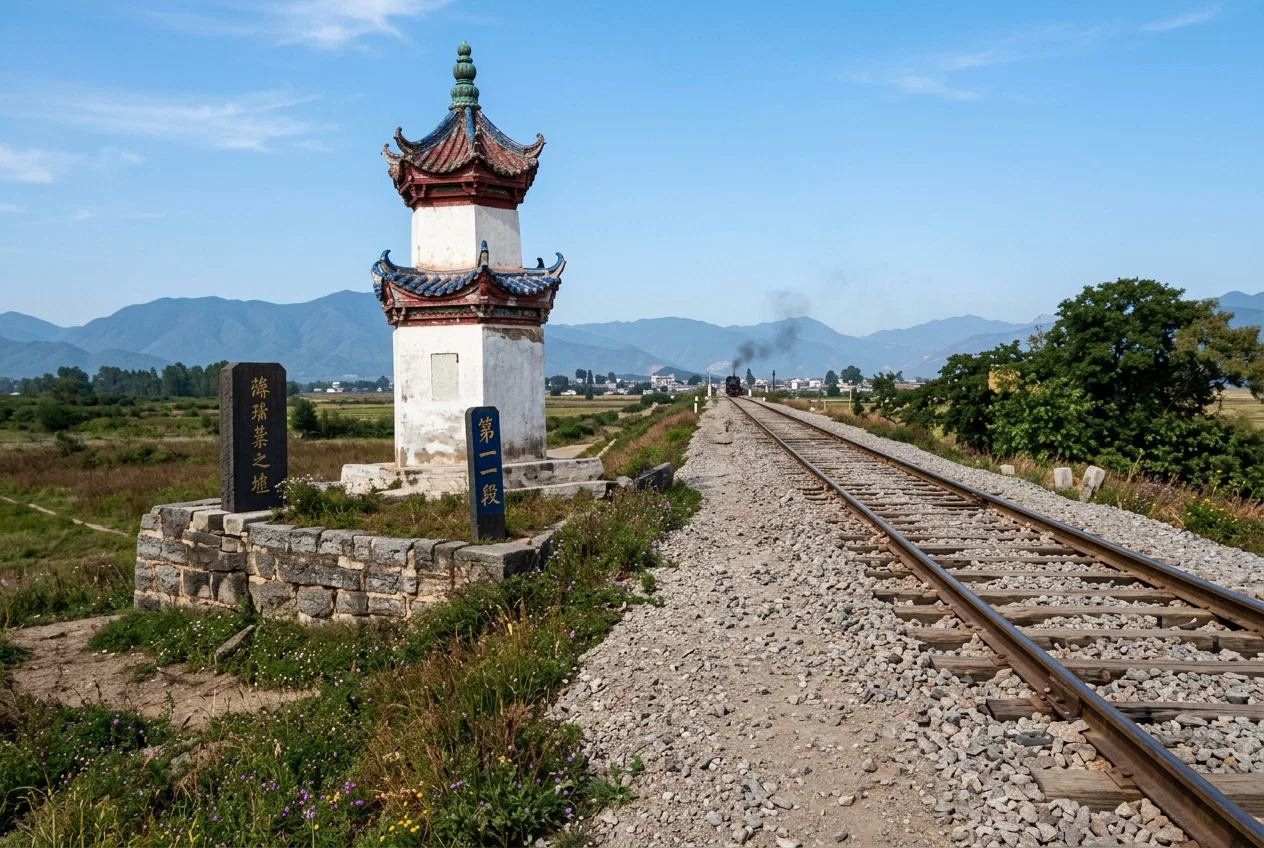
THE FIRST RAILROAD IN CENTRAL CHINA
Thus the Protestant missions in China began with the Bible as a foundation. And to this fact must be ascribed whatever success has been attained. In the year 1900 the total foreign force was 2,727 workers, assisted by a native force of 5,112, and representing fifty different missionary societies. The total number of communicants is estimated at one hundred thousand, while the baptized number about doubles that figure, being distributed in all the eighteen provinces. Since the uprising of 1900, all the preceding figures have been largely augmented, and the auxiliary agencies, such as schools, Bible societies, hospitals, etc., have come to be mighty forces in the work. Last year two million copies of the Scriptures entire, or in portions, were distributed by the agents of the three Bible societies. All things considered, these evangelical forces are quite evenly distributed throughout the eighteen provinces. The Word of God in a written form is winning its way into the homes of this people, rich and poor, in a most remarkable way now, in these busy days of the Lord’s active preparation.
The Inauguration and Present Status of Our Work
As we enter upon a brief review of our work in China, we must all feel that we entered this field at the eleventh hour; for not until the year 1901 did Seventh-day Adventists address themselves with any definite active purpose to the giving of the third angel’s message to the masses of this empire. At the General Conference held in the spring of that year, it was voted, upon our own request, to send Mrs. Anderson and myself to that field. In the following November, Miss Ida Thompson was recommended by the Mission Board to accompany us. By advice of the Board, we went to Hongkong, since Brother La Rue was there, and for the additional reason that we needed a temporary stopping place, which would afford us an opportunity to study the situation, preparatory to entering actively upon our work for the Chinese.
It is scarcely necessary to say that Hongkong is not China, nor even a part of China, but a distinctively English colony. Here Brother La Rue, by his own choice and the sanction of the Mission Board, had been carrying on ship mission and colporteur work since 1888. Almost alone, this veteran of the message wrought a splendid work among the sailors and soldiers and other seafaring people. Not only in Hongkong, but in Shanghai, Japan, Singapore, Borneo, and at the ports of call between Hongkong and Palestine, this faithful brother sold hundreds and even thousands, of our standard books, supplemented by the distribution of a vast amount of our other literature. This was his work. But in addition to this, he saw an opportunity in his acquaintance with Mok Man Cheung, a colonial court translator, to do something for the large Chinese population of the island of Hongkong. The result of his effort was the translation of two tracts, which were scattered by the thousands, but without any apparent fruits.
On our arrival, we found Brother La Rue an old man of four-score years. And, while still young in spirit, and well-preserved, he was taken, just after our arrival, with a severe attack of pneumonia leaving him in a condition which clearly made it our duty to stay with him and share the burdens he had so bravely assumed. That whole year yielded us little or nothing in the way of preparation for work among the Chinese, but we were permitted to see eight persons, with one exception members of the British navy, baptized, largely as the result of this brother’s work. Others heard the message, one at least of whom was baptized later.
The last of October, 1902, our force was increased by the coming of Brother E. H. Wilbur and his wife, who a month later entered the city of Canton, the metropolis of all China, and thus were the first missionaries under the direction of a Seventh-day Adventist Board to actually enter the Chinese empire. A month later—Jan. 1, 1903—Elder Erik Pilquist and his wife, being released by the British and Foreign Bible Society, connected with our mission, and at once began work in the province of Honan in central China. In November of that same year, they were re-enforced by six new workers,—the Drs. Selmon, Drs. Miller, and the two nurses, Miss Simpson and Miss Erickson.
To speak briefly, our work in China has now entered three provinces; namely, Honan, Quangtung, Fukien. In the province of Quangtung we have, in the city of Canton, one station, manned by Brother E. H. Wilbur and his wife, Mrs. Anderson and myself, and Miss Ida Thompson, together with Brother A. C. Tidbury, a young Englishman lately out of the British navy, who teaches in our Anglo-Chinese school. With the assistance of four native helpers, we are carrying on a girls’ school, two boys’ schools,—one English and one Chinese,—and regular public meetings in one chapel. Bible work is also carried on among the women. So far, none have been baptized, though several are waiting baptism upon my return. We are all able to do some work in the Chinese language, yet each one of us devotes about three hours daily to the study of the language.
The work at Amoy, in Fukien Province, is at present carried on as an outstation of the Canton Mission, though it is probable that Brother and Sister Hankins are by this time on the ground, preparing to look after that mission which gives us entrance to millions. At the time of my last visit there, three had taken a stand for the truth, with Brother Keh, who has already preached the truth extensively in those parts.
In the province of Honan, distant from Canton in a straight line about nine hundred miles, we have four stations, with two foreigners at each station, except at Dr. Miller’s, where, since the death of his companion, he now remains alone. Brother Pilquist, being already familiar with the language, was able to enter at once upon active work. He reports forty-one baptisms for last year, with a church organized at Losan. Sister Pilquist has a girls’ school, and22works for the women. Extensive work is also carried on in the surrounding villages, in the way of preaching and distributing Bibles and other literature.
At the other three stations, active work is being carried on in waiting on the sick, teaching the word, both by the missionaries and by their native helpers. As with us in the south, all the workers devote regular hours to the study of the language, and encouraging progress is being made, which fact in itself is of great value, since it is by no means infrequent that missionaries to China meet with sad failure on this very point. Our working force consists of twelve foreigners, all laboring in the Chinese, and for the Chinamen. These are assisted by nine native helpers.
A beginning has been made in the preparation of literature. In addition to the two tracts put out by Brother La Rue, we have now ready for distribution a tract on the Sabbath, a second one setting forth God as the true and only God, based on the first chapter of Genesis, while a third tract, intended primarily for school work, deals with the first seven chapters of Genesis on the catechetical plan. Other tracts are ready for publication, and still others are in preparation. We wait only for means. The small hand-press donated to the mission is now being set up by Drs. Miller and Selmon, on which we hope to print a large quantity of small tracts and leaflets. The Chinese have profound respect for letters, and our literature must necessarily act a most important part in that field, though it is important for us to remember that beyond a peradventure, it will have to be put out at a financial loss. In general, Christian literature in China is sold at about half the cost of production.
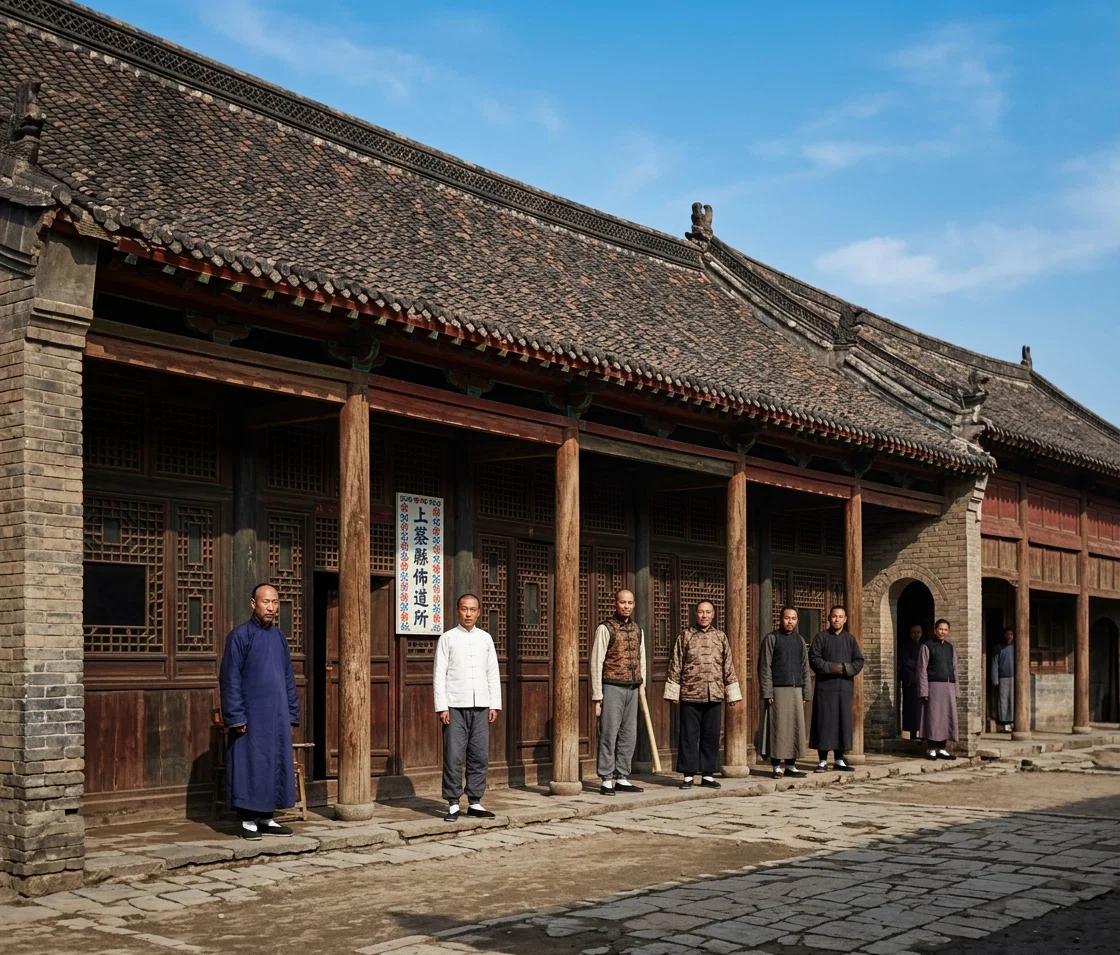
THE SHANG-TSAI HSIEN MISSION
Prospective
While our work in China is small, and only in its beginning, yet it is a beginning. We have entered three provinces, with an aggregate population of seventy million. Do you ask what remains?—Beyond are fifteen additional provinces, with an aggregate population of 325,000,000. Besides these, on her northern and western borders lie China’s great dependencies, in point of area even larger than the eighteen provinces of China proper. These are known as Manchuria, Mongolia, Turkestan, and Tibet. We must strengthen the work which is as yet but slenderly manned, and as fast as God gives us means and consecrated leaders, press on into the unoccupied provinces. I say leaders, because, while native workers can and must be trained to do a vast proportion of this work, the responsibility of directing and molding must fall to the foreign missionary. The conditions in China call for a very careful selection of workers. The mastery of the language, especially of the characters, is in itself a life’s task; and if by close, persevering work, a person acquires a good working knowledge of it in from three to five years, he has made a good showing. All the languages of China are not equally difficult. The Mandarin, which, to speak broadly, is used by fifteen out of the eighteen provinces, is perhaps the least formidable. But in any case it requires an active memory and a mind trained to habits of close application. After that comes the study of the people and of their customs and habits, more difficult than the language itself. To stand alone as leaders against a surging tide of heathenism, craven superstition, and insidious philosophy, requires character that rests on the rock of eternal truth. It is quite impossible to understand the full meaning of this until one has stood alone with his God, thousands of miles away from friends and home, and felt the ceaseless waves of spiritual darkness beating up against him. But God has swung wide open the door of entrance and opportunity to every province of this great empire, and years of careful preparation urge us to enter without delay.
In behalf of the members of the China Mission, I wish to express appreciation and gratitude to you for the loyal way in which you have extended sympathy and support to the work in that field. And I will further say that our confidence in you, and our faith in the message, remain unshaken. As the horizon of our vision is extended, the work grows larger with the passing of each day; yet we know that the mighty promise of our God concerning the land of Sinim abides unchangeable, and while we have made but a mere beginning, our hearts swell with grateful emotions, as we reflect on the measure of success our Father has thus far vouchsafed to us. The work, the means, the agencies, are all the Lord’s, and we have every reason to believe that he has in preparation a host of workers, who have heard or will hear the call and the command of our ascended Jesus, and, like the apostle Paul, respond, “I was not disobedient unto the heavenly vision.”
Since the beginning of our work three years ago, we have been called upon to lay to rest two of our laborers,— Brother Abram La Rue, at the ripe age of eighty-one, and Mrs. Miller, who passed away March 14 of this year, after spending less than eighteen months in the field where she had elected to give her life’s work. We can but bow in sorrow at our great loss in this sister who was just entering upon her labors. While, in our short-sightedness and human limitations, we may fail to read aright the purpose of our Father in this loss, yet we know that his love and his wisdom embrace in all, that all is well, and that in the great spiritual economy of God there are no mistakes, and there is no waste. Life begets life, and every kernel of grain that falls into the earth will surely spring forth and yield fruit.
J. N. ANDERSON, Supt.
Thirteenth Meeting
By H. W. Cottrell; W. A. Spicer
THE thirteenth meeting was called at 9:30 A. M., May 18. H. W. Cottrell was in the chair.
Prayer was offered by E. T. Russell, and the minutes of the previous meeting were read.
On motion, consideration of the report pending at last adjournment was deferred, in order to listen to the report of the Southern Union Conference, which was presented by G. I. Butler. The following is a very brief summary:—
Southern Union Conference
This union conference has nine States in its territory. Population, white, 9,084,496; colored, 5,823,023. This territory was once the great heart of the Southern Confederacy, and is compact. Because of this solidity, and the strong social and other ties binding all portions together, this union conference of the sunny South must be most influential among the union conferences of this country. For nearly forty years our message has been penetrating this territory, but the general progress was slow. Believers in this truth were raised up here and there. The Tennessee River Conference, the first conference, was organized in 1879.
In the South, generally, people are strongly attached to old church associations. They have a respect for religion, and an unusual regard for their ministry, so that they are less inclined to break away from their own churches, and the influence of the minister is generally greater than in the North. These things make it more difficult to secure attention to the message for this time. After sixteen years in the South, we have learned to love the people, and to know that there are thousands and thousands of noble souls who would be glad to receive this truth, if they understood it as we do. It is a pleasure to live among them, and become acquainted with their kindness, hospitality, and goodness of heart.
Our work is gaining in strength. Nineteen churches have been added during the two years. Churches now, 99. Members added, 529. Present membership, 2,353. The tithe last year was $22,035.97, an increase of $1,464.67 over that of two years ago. The average tithe is about eight dollars which compares most favorably with the average in the North.
With special difficulties in the general field, it is in the effort for the vast colored population that the greatest difficulties23exist. One third of the population is colored. More or less had been done among these for years, yet but little was accomplished until Brother J. E. White and his associates began work in Mississippi, with the "Morning Star" steamer as the basis of operation. This work has steadily grown, amid difficulties known only to those in the field.
The leading institutional interest is the Southern Publishing Association. It has turned out a large amount of work, and has a good equipment. Sometimes it has had to work night and day. It needs assistance, however, and counsel is asked of this conference as to its work. The Graysville Training-school is the most important educational institution in this union conference. The attendance last year was the largest in its history. The large majority of students have left it as Christians. This school needs further improvement in facilities, however. The colored school at Huntsville, Ala., has struggled heroically with a difficult problem, and is becoming stronger and stronger. A great work is before it. Last of all, a school to train teachers (white) for some of the Southern districts has been started near Nashville by Brethren Sutherland, Magan, and others.
The Southern Watchman has been prospered, but needs a still larger circulation to become self-supporting.
The time for the ministerial institute having come, it was agreed that the Southern Union report should be completed at another hour.
Meeting adjourned.
H. W. COTTRELL, Chairman,
W. A. SPICER, Secretary.
Fourteenth Meeting
By H. W. Cottrell; W. A. Spicer
The fourteenth meeting was called at 2:30 P. M., May 18; H. W. Cottrell in the chair.
Prayer was offered by M. C. Wilcox. A few moments were granted to the International Publishing Association, of College View, Neb., which held a legal meeting, for the appointment of committees.
The minutes of the previous meeting of the conference were then read.
On call for delegates newly arrived, the following brethren responded:— E. E. Miles, W. B. White, L. H. Crisler, G. W. Wells.
The unfinished report of the committee on resolutions was taken up, as follows:—
Sabbath-School
9. Whereas, Sabbath-school conventions, wherever properly conducted, have proved very helpful, not only in an increased interest in the work of the Sabbath-school, but in the deepening of personal piety and in the salvation of souls as well; therefore,—
Resolved, That the holding of conventions in the various conferences be encouraged, embodying the various lines of missionary work, and that conference officers and laborers assist in these important gatherings, not only in counsel, but in providing talented help, that they may be made a strong educational factor in the important work of the Sabbath-school, and assist materially in building up the work of the gospel.
W. C. White remarked on the good work these conventions did years ago, and rejoiced that they were being revived again.
A recommendation regarding missionary exercises in the Sabbath-school was referred to the finance committee.
Religious Liberty
10. We recommend, That Religious Liberty departments be organized, and secretaries appointed in each union and State conference in North America, in counsel with the general Religious Liberty Departments.
Remarks on resolution:—
A. G. Daniells believed the religious liberty work ought to be carried on by all the people. There is a general tendency toward religious legislation in all parts—often of sincere desire to stem the tide of evil. We know this is not the remedy, and we must tell the people so. Our ranks everywhere must be drilled, and must be watchful to meet the issue, and not leave a central committee to do the work alone.
K. C. Russell had met, only yesterday in Washington, Senator Blair, of the “Blair Sunday-rest bill” of years ago, who said that he admired the earnestness and persistency and force with which Seventh-day Adventists had agitated on these issues, and that it showed discernment to establish our headquarters in Washington, where the problem would be worked out, and he hoped the best side would win.
In reply to a question as to why the resolution did not urge the same action outside of America,—
L. R. Conradi stated that in some of the European fields it was best to work quietly. If we began the religious liberty agitation, as such, workers might be speedily expelled from various countries. In some parts it is best to suffer silently, and let God work the matter out—and he has worked deliverance repeatedly. The authorities in Germany had declared no one should have the Sabbath off in the required military service, but God has stood by young men who were steadfast and true, and the freedom has been granted. The emperor has pardoned several. One young man told the authorities that years ago his father had repeatedly suffered imprisonment for refusing duties on the Sabbath. The record was looked up, and the young man’s colonel told the whole regiment that he was to have the Sabbath free, and none were to cast reproach.
Allen Moon said that the “God in the Constitution” party, while for some years quiet, are now working, and mean to win. Should they amend the Constitution, the States would be appealed to to ratify it. In all the States educative work must be done to inform and warn the people.
11. We recommend, That religious liberty institutes be held in the conferences as may be arranged.
12. We recommend, That the petition and remonstrance work be diligently followed as occasion and circumstance may require.
13. We recommend, That suitable religious liberty literature be prepared, and that it be diligently and extensively circulated.
R. A. Underwood suggested, on the latter recommendation, that some of the declarations of protest, from Baptists, Seventh-day Adventists, and others, which appeared in Washington papers during the religious education agitation, be placed before the public.
J. O. Corliss felt that in all our religious liberty literature now, the message should be so interwoven that people would see why we take the position we do.
S. H. Lane desired published a fresh statement of the general principles of religion and civil government.
14. We recommend, That “American State Papers” be republished, with appropriate corrections and additions, thus bringing it up to date.
Question was called on the entire report, as amended, and it was unanimously adopted.
Partial Report on Nominations
The Chair called for the report of the committee on nominations. A partial report was submitted by F. Griggs, the secretary, as follows:—
For officers of General Conference:—
President, A. G. Daniells.
Vice-Presidents, L. R. Conradi and G. A. Irwin.
Secretary, W. A. Spicer.
Treasurer, I. H. Evans.
Executive Committee: A. G. Daniells, L. R. Conradi, G. A. Irwin, the presidents of union conferences and union mission fields at present acting, as follows: H. W. Cottrell, G. I. Butler, Allen Moon, R. A. Underwood, E. T. Russell, N. P. Nelson, W. B. White, W. H. Thurston, O. A. Olsen, P. A. Hansen, W. S. Hyatt, J. W. Westphal, W. H. Wakeham, and the president of the Australasian Union Conference; additional members nominated to be elected by this conference, W. A. Spicer, I. H. Evans, W. W. Prescott, W. C. White, W. C. Sisley, S. N. Haskell. [Report of members incomplete.]
It was moved to adopt by considering each name separately. On the name of G. A. Irwin, E. W. Farnsworth inquired if that would mean taking Brother Irwin away from Australia. O. A. Olsen, in behalf of the nominating committee, stated that it was with very serious consideration of the effect of this action on Australasia that the committee had united in this nomination. After praying and studying separately over the matter of a selection, members had come together, each with the same deep conviction. The necessity of giving the president of the General Conference a helper, strong to share the burdens in this growing work and in these critical times, had pressed with weight upon the committee. It had come most unexpectedly upon Brother Irwin, and he had felt deeply over the matter; but on the promise that the best possible would be done to help Australasia, he had yielded to the unanimous conviction of the brethren that it was the right move. All were grieved to take him away from Australasia, but it was felt that the whole general situation made this vice-presidency of first importance.
E. W. Farnsworth feared that interests in Australasia would suffer. The return of workers to America had brought discouragement already, and he feared this move would make people feel that there was some plan to draw workers to America.
A. G. Daniells stated that he could assure the brethren that certainly there was no plan to bring workers to America. In this case the decision had come solely from the committee, and the conviction had come to them, as we had heard, unexpectedly.
Brethren Sharp and Olsen spoke further, and by the responses from the congregation it was evident that hearts were touched by the suggestion of the possibility of our brethren in Australasia feeling that their interests had not been properly considered.
W. D. Salisbury, of Australia, believed24he could say in behalf of the brethren in Australasia that they would meet the situation with confidence in the good will of the conference toward that field. They would deeply feel the loss, but he felt that the needs of that field would surely have most earnest consideration.
G. A. Irwin had never in this message had a matter more difficult to decide. It had come as a great surprise to him. Heart and soul were in Australasia, without a thought of leaving the field. After struggling all day with the matter, he had been led last evening to say to the brethren that he must accept on promise that the best would be done for Australasia. If it is God’s will for him to return to America, he could say, Amen; if to go back, assuredly, Amen. He loved the people and the field—a grand territory and a growing work. It needs help, having truly been much drawn upon. It was in accord with his desire always to stay by a field or a work until the body sending recalls. The work is to be done by sticking to it.
Question was called on the partial report as submitted, and it was adopted.
Five minutes was taken for recess.
On resuming, the conference listened to the completion of J. N. Anderson’s report for China. The Spirit of God touched hearts with China’s need as the field was presented. (The report appears elsewhere in this paper.) The Chairman remarked that the population of the United States was but three fourths of one fourth of China’s population. America has many laborers, and sixty thousand believers, while China has fourteen workers.
J. O. Miller was especially interested in China, having given a son to that field [Dr. H. W. Miller]. He could not say No, when the call came, and now had come the word of the death of his son’s companion. Her mother, Sister Thompson, had written that she could not be sorry that she had given permission for her daughter to go. The loved one was buried at the dead of night to avoid the mob, but he was consoled with the thought that Elder Hyatt had suggested of fallen African workers, and prayed that as those Chinese see this new grave in Honan, and wonder why she came to give her life, it may teach them of the love that led Jesus to leave the courts of glory for our sakes. In a little time will come the gathering; now it is first the scattering, the word is Go, either to go to the fields or to go down into the pocket to send. He thanked God for the missionary agitation in fulfilment of Matt. 24:14.
J. N. Loughborough spoke of Brother A. LaRue, who died in Hongkong in a good old age. He had known him for many years, and he was always giving. People told him, “You will give away all you have.” His reply was, “When the Lord comes, I want to have only twenty-five cents.” He awaits the resurrection.
E. W. Farnsworth, of England, said that in Portsmouth he met a sailor who said he used to climb the stairs to Brother LaRue’s lodging in Hongkong “to see the best man on the earth.” This man had nearly all our books, and declared that “if he were not saved in the kingdom, it would not be because Father LaRue had not done his duty.” Six men on one British battle-ship, the “Terrible,” had embraced the truth through Brother LaRue’s faithful efforts.
Brother C. Haynes sang the following hymn, adopted by Mrs. Dr. Selmon, of our Honan Mission, the conference joining in the chorus:—
CHINA’S CALL
Nearer fields, the reapers toiling,
Gather in the golden grain;
Still the distant eastern borders
To the workers’ skill remain.
CHORUS
Lord of harvest, send forth reapers,
Hear us, Lord, to thee we cry,
Send them China’s sheaves to gather
Ere the harvest-time pass by.
Long the shadows there have tarried;
Late the precious seeds were sown;
Now the world’s great Light is shining
On a harvest fully grown.
China, with its teeming millions,
Souls for whom our Saviour died,
Knowing heaven, but not the pathway,
Lost, is waiting for a guide.
Now the Word from home has reached them,
Are there none to lead the way?
Ere the harvest-time is over,
Will you help as well as pray?
The meeting adjourned, it being announced that P. W. Field would report for Japan at the evening hour.
H. W. COTTRELL, Chairman,
W. A. SPICER, Secretary.
Review and Herald Publishing Association
By W. W. Prescott; W. B. Walters
The adjourned meeting of the Review and Herald Publishing Association was held on Tuesday, May 16, at 9:30 A. M. Prayer was offered by Elder D. T. Bourdeau. The secretary's report of the former meeting was read and approved.
The president of the association then gave quite a complete history of the steps leading to the dissolution of the Seventh-day Adventist Publishing Association of Battle Creek, Mich., and a full statement of the process by which the property and interests formerly belonging to this association had been transferred to the Review and Herald Publishing Association of Washington, D. C., in pursuance of recommendations made at the General Conference in March, 1903, and the action taken by the stockholders of the old association at their meeting in Battle Creek, in April, 1903. He stated that the final result was that the new association of Washington had come into possession of all the property and accounts of the old association. This statement was made in detail, and full opportunity was given for asking questions. Several members of the association availed themselves of this privilege, and their questions were answered by the president.
The report of the manager was then read, which was printed in the last issue of this paper. The treasurer, S. N. Curtiss, submitted his report, printed copies of which were distributed to the members of the association. From this report it appeared that after making proper allowances for loss and depreciation, the business still showed a small gain.
The auditor, R. H. Cadwalader, then read his report in which he stated that the books had been found in a satisfactory condition, and that the bank balances and cash on hand were found to be in accordance with the statement. He declared to the members of the association that he was justified in saying that the report of the treasurer presented the actual standing of the association. On motion, the reports of the treasurer and auditor were accepted.
The committee on nominations then made a report through its secretary, W. H. Thurston, recommending that G. B. Thompson, W. A. Colcord, D. W. Reavis, and I. H. Evans be elected as trustees for the two years next ensuing, to fill the places of the four trustees whose terms expired at this time. The recommendation was accepted, and these persons were duly elected.
The meeting then adjourned to Tuesday, May 23, 1905, at 2:30 P. M.
W. W. PRESCOTT, Chairman,
W. B. WALTERS, Secretary.
Department Meetings
The hour from eight to nine o'clock each morning is set apart for simultaneous meetings of the various departments of the General Conference. The secretaries of the several departments have kindly furnished the following brief reports of these meetings:—
Educational Department
All phases of the educational problems, involving the organization, management, and support of all grades of schools are being considered in the meetings of the departments. A spirit of unification and harmony seems to be present in a very marked manner. This has been particularly manifested in the consideration of the text-book question, which has so far received more consideration than any other question. It seems to be felt that all should unite in the use of the very best books which can be produced. The educational workers look for decided advancement as the result of the consideration which this conference is giving to this department of our work.
F. GRIGGS, Secretary.
Medical Department
Representatives from sanitariums and various medical mission fields, together with Elders A. G. Daniells and W. C. White, have met in regular morning sessions, organizing the medical missionary council as a department of the General Conference. This will unify all departments of the work and the message-bearers will present an unbroken front in giving the third angel's message. Committees have been appointed to consider the questions of nurses' training-schools in relation to the advanced requirements by various States. The opinion prevails that a three-years' course should be given; also a committee to consider the work and unification of graduate nurses with their various conferences, looking forward to the establishing of exchanges and organized aggressive work.
C. P. FARNSWORTH, M. D.
Secretary.
Religious Liberty Department
Meetings are being held every morning from eight to nine o'clock. The attendance is good, and interest is being aroused in the revival of religious liberty work along the lines of educating more thoroughly the people on this important phase of the message. Papers on the subject of literature and its distribution, the most effective way to labor25for legislators, have been read, and much interest is being awakened.
S. B. HORTON, Secretary.
Sabbath-School Department
At the eight-o'clock hour interesting departmental meetings are held to consider the various phases of the Sabbath-school work. Topics have been assigned to various persons, such as Uniform Lessons, Conventions, The Home Department, Work at Our Camp-meetings, etc., and the discussion is very helpful. Special meetings are also held to consider the problem of how best to help our young people. We all are thankful for the privileges of this meeting.
NELLIE B. UNDERWOOD, Secretary.
Publication Department
The General Conference Publication Committee is holding meetings each day. The meetings thus far partake of the nature of a publishers' convention. The gatherings are not confined to the members of the committee, but are well attended by those more or less interested in the make-up and sale of our literature. The time spent thus far has been largely consumed in the discussion of methods and plans leading to a wider circulation of the different periodicals. Many valuable suggestions have been offered by Elder L. R. Conradi, representing the Hamburg publishing house, W. C. Sisley, of the London publishing house, and W. D. Salisbury, of the Echo Publishing Company, Australia. The fields in which these brethren are located are doing an excellent work with our papers. The results of the publishers' convention will be crystallized into form which we trust will be beneficial in the future.