Your ShelfYour Projects

Signs of the Times, Vol. 32, No. 9.

FUNDAMENTAL PRINCIPLES. No 3

Signs of the Times

Feb 28, 1906

Pacific Press Publishing Company · Mountain View, California · Feb 28, 1906

FUNDAMENTAL PRINCIPLES. No 3.

"God is no respecter of persons." Acts 10:34.
"If any man hear My sayings, and keep them not, I judge him not; for I came not to judge the world, but to save the world." John 12 : 47.
"We are ambassadors therefore on behalf of Christ, as tho God were entreating by us; we BESEECH you on behalf of Christ, be ye reconciled to God." 2 Cor. 5 : 20.
"Not that we have lordship over your faith, but are helpers of your joy; for in faith ye stand fast." 2 Cor. 1 : 24.
"Neither as lording it over the charge allotted to you, but making yourselves ensamples to the flock." 1 Peter 5 : 3.
"Knowing therefore the fear of the Lord, we PERSUADE men." 2 Cor. 5:11.
The lily pond and the reflection of the summer house.

OUR PUBLICATIONS

THAT our friends may become more familiar with our general line of books, tracts, etc., we are giving each week in this column a review of the items as they appear in our catalog. You will be instructed as well as interested by perusing this page carefully each week.

The Conflict between Capital and Labor

By E. T. Russell. One of the most puzzling and perplexing problems to be solved to-day is that of capital and labor. The various organizations and combines are rapidly reaching out and embracing all classes of trades and professions. With these conditions, the strife can only grow more bitter, the struggle more fierce and gigantic. What will be the outcome? How shall we meet the great issue?
Many books have been written on the subject, but we believe none from a non-partisan, Christian, and Bible standpoint as this one. While the author gives many interesting facts and figures, and draws many valuable lessons from the past, we are sure that our readers will be equally interested in the Bible facts produced, showing the outcome of the struggle, and giving instruction that will help all to meet the question intelligently and in the best way. 167 pages, board covers - $0 50

The Desire of Ages

By Mrs. E. G. White. The life of Christ presented in a new and beautiful form. Its whole object is to show that in Christ the love of the Father is revealed, and that we may live the life that He lived if we rightly connect with the same Source of power.
In every phase and circumstance His experiences were similar to our own. The wonderful manner in which Divinity and humanity were combined; the way in which Christ, while dwelling in human body, with only human strength, took hold of divine strength, and thus overcame sin; these things are made wonderfully clear and helpful on every page and in every sentence. Step by step the life of our Saviour is traced, and is made to touch our life, so that He becomes, in very truth, "our Elder Brother."
The illustrations number about 300 and are largely original. It contains nearly 900 royal octavo pages, printed on enamel finish paper, with wide margins. The bindings are handsome, as well as substantial.
Cloth, plain edges, narrow margins, thin paper - $2 50
Cloth, marbled edges - 3 50
Cloth, gilt edges - 4 25
Library, marbled edges - 5 00
Full morocco, gilt edges - 7 00
Trade edition, no illustrations, thin paper, smaller type.
Cloth bound - 1 50
Leather bound - 2 00

Daniel and the Revelation

Revised edition. By U. Smith. A history of the rise and fall of nations, being an exposition, verse by verse, of the important prophecies of Daniel and John, comparing Scripture predictions with historical facts. It follows in the track of no other commentary; but, guided by the obvious rule that the Bible should be its own interpreter; it aims to arrive at the exact meaning of the sacred writers in harmony with the great plan of redemption, as presented throughout the Scriptures. The author has devoted over thirty years to the study of the Bible, and believes that the prophecies of Daniel and John were written for our admonition, and that the subjects they unfold are the coming themes for the religious world, destined to engage the attention of all thoughtful minds. 854 pages, with illustrations, beautifully bound.
Plain cloth - $1 00
Cloth, marbled edges - 2 50
Cloth, gilt edges - 2 75
Library, marbled edges - 3 50
Full morocco, gilt edges - 4 50
Paper-covered edition, in two volumes - 50

TO OUR PATRONS.

Please be careful to write all names of persons and places plainly.
Send money by Post-office Money Order, Express Order, or Bank Draft on New York, Chicago, or San Francisco.
Orders and Drafts should be made payable to the Pacific Press Publishing Co.
Paper money or silver should be sent in a registered letter.
Registered mail is safe. Unregistered mail is at the risk of the sender.
Postage-stamps in five or ten cent denominations will be accepted for small amounts.
The address label on your paper will indicate the time to which your subscription is paid. In case of non-receipt of papers, or any other irregularity, please notify us immediately.
When subscriptions expire, no more papers are sent to the party except by special arrangement.
You are requested to watch the date on your label, and renew early, and save the loss of papers. We can not always furnish missing numbers.
When requesting change of address, be sure to give both old and new addresses.
Important.—If you order SIGNS, Our Little Friend, books, etc., at the same time, use a separate sheet of paper for each. If this request is complied with, it will materially assist in the prompt and accurate despatch of the business.
When writing to the editor, be sure to use a separate sheet of paper.

Renewing the Signs Subscription

"Please send fifteen copies of the SIGNS OF THE TIMES for another three months. Enclosed find $3.38 for same. I am very much pleased with the papers as they contain just the truth for these times.
"Yours very truly, "J. E. HUBBARTT."

Working Up Signs Circulation

"I am trying my best to work up the circulation of the Signs here and throughout the state, and I hope that the efforts will not be fruitless, because the paper is certainly good and contains valuable reading matter which ought to be in the hands of the people at the present time. "JOHN H. NIEHAUS. "Indiana Tract Society."

ARTHUR A. CURTIS

"I appreciate the SIGNS more and more, as I do 'the Book,' because they are so much alike."

ARTHUR A. CURTIS

Delighted With the Signs

"Have just received my SIGNS with a description of New York City, and I am more than delighted with it. God speed the SIGNS OF THE TIMES."

PACIFIC PRESS PUBLISHING CO.

MOUNTAIN VIEW, CAL.

1109 E. 12th St., Kansas City, Mo.
285 Salmon St., Portland, Ore.

"IT IS WRITTEN."

Divine Life Triumphant Over Physical Life.
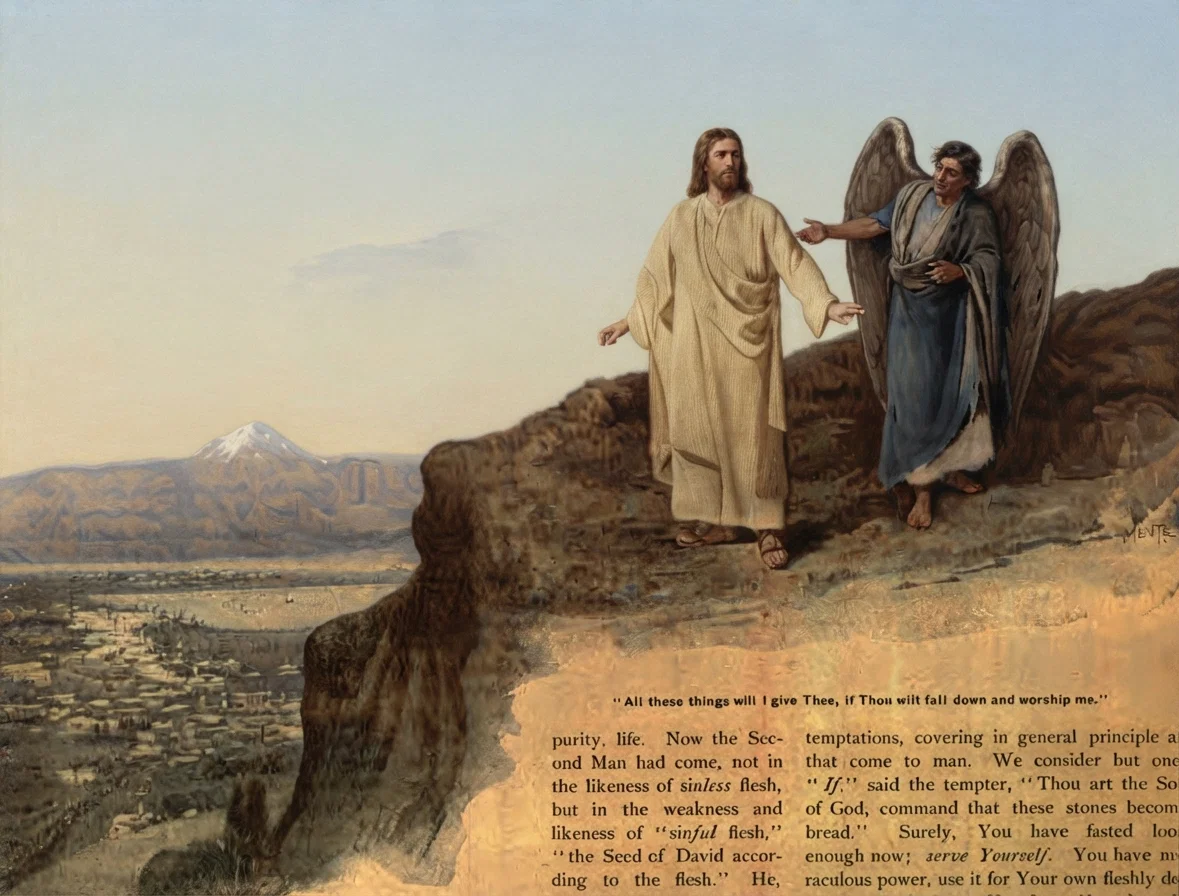
THUS Matthew speaks of the temptation of Jesus: "Then was Jesus led up of the Spirit into the wilderness to be tempted of the devil." Mark: "And straightway the Spirit driveth Him forth into the wilderness. And He was in the wilderness forty days tempted of Satan; and He was with the wild beasts." And thus Luke: "And Jesus, full of the Holy Spirit, returned from the Jordan, and was led in the Spirit in the wilderness during forty days, being tempted of the devil."
So OPENS another chapter in the life of Christ Jesus, in which it "became Him" to meet what man had met, and before which man had fallen, but which must be met successfully in order that man might have a part in the kingdom of God. Not all the temptations which Satan brought are recorded. We may well believe that every hellish art of which the adversary had been capable, which had been successful in the destruction of the souls of men in past ages, was plied as never before. For this time Satan had waited. Since the hour when God had pledged that the Seed of the woman should bruise the serpent's head, Satan had waited for that Seed. The first head of the human family had met the subtle devices of devilish art, and yielded—yielded liberty, dominion, righteousness, innocence, purity, life.
Now the Second Man had come, not in the likeness of sinless flesh, but in the weakness and likeness of "sinful flesh," "the Seed of David according to the flesh." He, too, in Satan's purpose, must fall, that all the hopes of the human might die with His fall, and the very throne of the universe might be disgraced.
“All these things will I give Thee, if Thou wilt fall down and worship me.”
AND therefore Jesus was driven to the conflict. Filled with the Spirit, with God's voice, "Thou art My beloved Son," sounding in His ears, He went forth to meet for man the inevitable conflict with the world, the flesh, the devil. What subtle, hypnotic influence the enemy used, what discouragements of a thankless, sinful race were placed before the Son of God, how the very temptations which he brought were made to seem the very cherished thoughts of the Tempted One Himself, we do not know, we can not fathom. But we do know that every means was employed which Satan could use to overthrow the Second Adam, and in Him all the human family, and that, too, when He was weakened, wasted, worn, harassed, by all the doubts and fears and weaknesses of the ancestry of "the seed of David."
THE three temptations given are typical temptations, covering in general principle all that come to man. We consider but one. "If," said the tempter, "Thou art the Son of God, command that these stones become bread." Surely, You have fasted long enough now; serve Yourself. You have miraculous power, use it for Your own fleshly desires. Feed Yourself. In self-service, in self-indulgence, lies destruction. To this our first mother yielded. For this Esau sold his blessed birthright. On this account thousands of Israel died in the wilderness when God gave them up to their own lust, but "sent leanness of soul" and all the consequences of their sin. To this lust Alexander yielded the will that had conquered the world, and died in a drunken debauch. We can not name theuntold millions who have in the past sold their birthright in God to appetite, nor the myriads, now who are selling it daily at the shrine of fleshly lusts, that the palate may be tickled, for instance, by the wine which "goeth down smoothly," but which at the last "biteth like a serpent, and stingeth like an adder." And then the myriads who are victims of appetite in some other way, who "dig their graves with their teeth," and by gluttonous and unwise eating and drinking have laid the foundation of incurable diseases and opened premature graves.
TO BREAK this power of appetite Christ came and was tempted. He did not enter upon His mission to serve self. The human soul could be saved, but the power of salvation was the Word of God. Therefore Jesus sought for that power, and however great His own flesh clamorings, He must not indulge them when greater considerations were at stake. Let the body become emaciated, the appetite clamor, He must know the greater power over life from the Word of God. And, therefore, He answered the enemy, "It is written, Man shall not live by bread alone, but by every word that proceedeth out of the mouth of God." Fifteen hundred years before, the Son of God had spoken the same words through Moses to Israel in the wilderness, to teach them that the life of God in His Word must be dominant over the perverted, fleshly life. Deut. 8:3. To teach this, God had given the daily manna. To teach it again, the Bread of Life came to the world and lived what before had been taught. The Word of God was potent to meet the enemy. "It is written" was mightier than a thousand temptations of the enemy. Jesus Christ taught it in this object-lesson as a continual, ever-present, living principle of life.
MAN in a large circle of the professed followers of Christ has thrown the sop of forty days of Lent to a remorseful conscience, and given the rest of the year to the indulgence of the flesh. Like all unbiblical things it takes the form of a fetish, the worship or adoration of which in observance is counted as so much good works to the credit of the soul, endeavoring to make it a partial offset, at least, to the year of indulgence. It started as a forty-hour fast, covering the period that Jesus was supposed to have been in the grave. Then the fasts of Moses and Elijah and Jesus were appealed to as precedents, and the forty-hour fast became a forty-day observance, beginning with Ash-Wednesday, this year February 28, excluding the Sundays, which still bear their original pagan stamp of being days of feasting, hence are called not "Sundays of Lent," but "Sundays in Lent."
BUT this device of man misses the great lesson. Jesus declared as the very foundation of discipleship, "If any man would come after Me, let him deny himself, and take up his cross daily, and follow Me." Luke 9:23. "I die daily," wrote Paul. Daily by faith the carnal man was placed upon the cross of Christ. Daily by faith the divine, eternal life of Christ came in to dominate and rule. And, therefore, the true Christian can say: "I am crucified with Christ; nevertheless I live; yet not I, but Christ liveth in me; and the life which I now live in the flesh I live by the faith of the Son of God, who loved me, and gave Himself for me." Gal. 2:20. "Therefore, brethren, we are debtors, not to the flesh, to live after the flesh. For if ye live after the flesh, ye shall die; but if ye through the Spirit [the life of God] do mortify [put to death] the deeds of the body, ye shall live." It is a daily, constant work, but the power of life in the Word of God will be found all-sufficient without any human devices. "It is written," day by day, is worth a forty years of Lent. Not by human device, but by the Word of God are we saved. "Concerning the works of men," says the psalmist, "by the word of Thy lips I have kept me from the paths of the destroyer." Ps. 17:4. "Thy Word have I hid in mine heart, that I might not sin against Thee." Ps. 119:11. If we would know Christ's triumph, we must take Christ's way.

THE KEY THAT UNLOCKS HEAVEN.

WE have the warnings of the Word of God that faith will be scarce upon the earth in the last days of this dispensation. Looking down to our own time, through all the experiences of His people, our Lord exclaimed, “When the Son of Man cometh, shall He find faith on the earth?” Every scheme which Satan can invent is now being used to destroy faith in the hearts of men.
Nevertheless, living, working faith in the hearts of loyal children of God will be a reality right up to the time of our Lord’s appearance in the clouds of heaven. Of the company which stands triumphant at that time the prophet says: “Here is the patience of the saints, they that keep the commandments of God, and the faith of Jesus.”
We may know definitely that if we are engaged in the work of weakening faith in the Word of God, in the plan of salvation, in God’s justice and goodness, we shall not stand with that company which triumphs with the triumph of Christ. The Word of our God is sure and steadfast, and the triumph of His purpose is sure. There is no necessity for doubtings; there is no restfulness therein.
On the other hand, there is a blessed stability about the experience of the true Christian. It is because there is a solid foundation to the Christian life. It is built upon the Rock Christ Jesus, which no storms of doubt or fear, no waves of opposition, can hope to overthrow. Having that, we have the blessed peace which comes of settled conviction, assurance, faith.
It was never God’s design for man that he should be continually harassed by doubt—or ever so harassed. The admonition of our Saviour is, “Neither be ye of doubtful mind.” The assurance which the Father desires we should have is beautifully expressed in that wonderful twenty-third psalm: “The Lord is my shepherd; I shall not want. He maketh me to lie down in green pastures; He leadeth me beside the still waters. . . . . Yea, tho I walk through the valley of the shadow of death, I will fear no evil; for Thou art with me.”
It is also well expressed by the prophet Isaiah: “Thou wilt keep him in perfect peace, whose mind is stayed on Thee; because he trusteth in Thee.” Isa. 26:3. But with the ungodly it is not so. Doubt and perplexity are their continued portion, and perfect trust and confidence they never know.
The reward of belief is a bulwark of eternal strength. It is a divine shield which the arrows of the enemy can never pierce. “The name of the Lord is a strong tower; the righteous runneth into it, and is safe.” Prov. 18:10. “Whoso putteth his trust in the Lord shall be safe.” Prov. 29:25.
There is no occasion for doubt here. He who holds the universe in His hand, who made it and all that in it is, has made Himself surety for every promise that His Word contains. It is more substantial than the mighty hills; for they are but the creation of His hands. At His word they come into being; at His word they consume; but His promise is established upon His very character, and so can not fail. He who has faith in that fact has in his possession the key that will unlock heaven. He who trusts in that stability can never be moved; he who is surrounded by that bulwark can never be overthrown; he who carries that shield can never be pierced by the fiery darts of the wicked one; and he who has this hope in Him “purifieth himself even as He is pure.”
How much better, more satisfying, is the condition of such a one than that of the doubting, vacillating soul who refuses to be in harmony with God and His ways and works. “The wicked are like the troubled sea, when it can not rest, whose waters cast up mire and dirt. There is no peace, saith my God; to the wicked.” Isa. 57:20, 21.
Nowhere in the Word of God is there any promise to the doubter; therefore we can not afford to be of a “doubtful mind.” The purchase price of peace, assurance, hope, and trust is perfect faith in Christ. That is the key which unlocks heaven and makes its treasures ours.

“NEW LIGHT.”

THE claim to new light on religious questions is quite common in our day, and it is a blessing that we have reason to expect; for “the path of the just is as the shining light, that shineth more and more unto the perfect day.” Prov. 4:18. But everything that is new is not necessarily light. Even tho it be brilliant, it may dazzle, rather than strengthen, the sight. So Satan, knowing that increase of light upon the Word of God is due to them who walk in the light, and knowing the delusive effect of false light, takes advantage of those who are susceptible to deception. He is able to assume the rôle of “an angel of light;” therefore we are told that his ministers also may be so transformed. 2 Cor. 11:14, 15.
But while the people of God are assured of advancing light on His truth, we are not to understand that it is to be gained by throwing away truth that has led His people in the past, and looking for that which is altogether antagonistic to former teaching of the Spirit. As to such as would advocate such a course we have only to say, “To the law and to the testimony; if they speak not according to this Word, it is because there is no light in them.” Isa. 8:20. The law and the testimony will always be in harmony, and those through whom Godwould give increased light will always harmonize with His recognized instruments and teaching of former days.
To those who walk in the light, new light from the same Source will be an addition to former light, and not a substitute for it; while those who feel that they must put out the light they formerly had from “the law and the testimony” in order to receive new light, merely exchange light for darkness and delusion. “If therefore the light that is in thee be darkness, how great is that darkness.” Matt. 6:23. “Take heed therefore that the light which is in thee be not darkness.” Luke 11:35.

An Object-lesson.

Some imaginary new light came to certain ambitious princes in Israel during the sojourn in the wilderness. They had all along acknowledged Moses and Aaron as their leaders and as the mouthpieces of God; that is, they had nominally so acknowledged. But their envy and covetousness of position led them to murmur against Moses and Aaron. To these men they said, “Ye take too much upon you, seeing all the congregation are holy, every one of them, and the Lord is among them; wherefore then lift ye up yourselves above the congregation of the Lord?” Num. 16:3.
Now the Lord had selected Moses and Aaron for the positions they occupied, and this fact had been emphasized on various occasions, and acknowledged by the people in general. But by some means these dissatisfied “princes” had received new light, to the effect that all the people were holy, and therefore Moses and Aaron were no longer to be recognized as the special instruments of the Lord. That light had become darkness to them, and the new light was so dazzling and so alluring that it drew quite a following.
Korah, Dathan, and Abiram, the leaders in this insurrection, were soon surrounded by two hundred fifty leading men, and, of course, a much larger number of less influential adherents. In fact, the dissension was so widespread that Moses and Aaron were greatly perplexed. But they took it to the Lord in prayer, and allowed His counsel to settle the matter. The record tells us how suddenly and effectually the new candle was snuffed out, and how the Lord vindicated not only His own choice of leaders, but also His testimony to the people through them.

Where Satan Finds Advocates.

It ever has been true that the adversary’s most obstructive work has been through a pretense of new light for the church; but invariably he has found his instruments among “princes” who have become skeptical regarding formerly accepted testimony, and envious of some who have been called to leading positions in the Lord’s cause. Ever since the days of the apostles there have been those who would arise in the church with an ambition to draw away disciples after themselves (Acts 20: 28-30); and their success has ever been through departure in some way from “the law and the testimony,” and the consequent following of some imaginary new light.
It is also true that in every crisis through which the church has passed, the Lord has vindicated the “old paths” marked out by His Spirit. The perversions thereof never have been able to stand the rays of the true light. So the people of God may rest assured that in every test, those who stand firmly on the true landmarks of “the commandments of God, and the faith of Jesus” will never fail of seeing the Lord’s side so emphatically marked that none need fail to discern it. The line will be drawn by the unerring hand of God, and not in the wisdom of men. G.

IN HARMONY WITH GOD'S PURPOSE.

FEW of us realize what God's fixity of purpose means to us or to this old world on which we live. He declares of Himself that He is "the same yesterday, and to-day, and forever." If His purpose were a vacillating one, the history of this world would be far different from what it is.
"I am the Lord, I change not; therefore ye sons of Jacob are not consumed." That was said many hundred years ago, and still they are not consumed, tho they are mingled with every nation under heaven. God had promised a Redeemer to come through that people; and until that was accomplished, God kept them a homogeneous people in the land where they had been an independent nation—and all this in spite of their overthrows and uprootings. Other nations had been overthrown and disappeared; but God had spoken a purpose concerning Israel, and that people could not be lost. In every nation the scattered fragments of that people are found to-day, and still the people are not lost as a distinct people.
The scattered condition of the Jewish people to-day is in direct fulfilment of the word of Jehovah concerning them. "They shall know that I am Jehovah, when I shall disperse them among the nations, and scatter them through the countries." Eze. 12:15.
God's preservation of Israel was in harmony with His purpose concerning them and the world. He shows that same unchangeableness now in bearing with a sinful world until every honest soul has been won from the clutches of the enemy, whether that soul be Jew or Gentile, "barbarian, Scythian, bond or free." Were He changeable, we might expect Him to alter His purpose and wipe the wicked world out of His sight. But He does not do it. We learn from Eph. 3:11 that God has an "eternal purpose which He purposed in Christ Jesus." An eternal purpose is not a changeable one. "Every purpose of the Lord shall be performed." Jer. 51:29. "I have purposed it, I will also do it." Isa. 46:11.
True, the Lord has not carried into execution all the punishments pronounced upon individuals. When they have repented, He has turned away the punishment. But that did not affect His great purpose concerning man. Rather it was in direct line with that purpose and with His character as "the Lord God merciful and gracious."

The Eternal Foundation.

Because the Lord is unchanging and His purpose an eternal one, this earthly home will again be man's possession, in spite of man's forfeiture of his right, and righteousness will yet replace the rule of sin. To fulfil that mighty purpose, God found it necessary to "lay in Zion for a foundation a stone, a tried stone, a precious corner-stone, a sure foundation." Isa. 28:16. We learn from Eph. 2:20 that our Lord Jesus Christ Himself is that foundation-stone, upon which was established, and is now being completed, that wonderful building of God's purpose concerning man.
It was necessary that such a foundation stone as God required for that work should be a tried and proved one. God's purpose must not fail. That Stone was first tested when rebellion raged in heaven. It was tested again when the author of that rebellion in heaven attempted Christ's overthrow in the wilderness of this world. The test came again in the Garden of Gethsemane and upon the cross. It was indeed a tried one; its worth was demonstrated; and now it has become the foundation Stone of God's glorious building.
Ritual-ridden religion refused to honor or accept that Corner-Stone. As a result of that attitude, that system withered and shriveled and wasted into the bleakest kind of dead ceremonies, its house left desolate, its holy of holies flung open to the gaze of the multitude. To that system and to those who held it that Stone became "a stone of stumbling and a rock of offense." But those who belived on and accepted Him became "lively stones," and are built into that "spiritual house," offering up "spiritual sacrifices, acceptable to God."

The Only True Way.

Thus has God shown us by a wondrous object-lesson the wisdom of harmony with His eternal purpose. It is never safe or wise to battle against the purpose of the Almighty. The better way, the only sure and true way, is the way of His choosing, harmony with His unchanging purpose. Then will we share in His everlasting triumph. It is better to do right than to do the way our wills may choose; better to think right than to think the way we may choose to think. Our doing can not make wrong right; our thinking can not alter fact.
God's way is right and will triumph; if we are in harmony with that way, we will triumph with it. The question for each one is: "Would I rather have my own way? or would I rather share in the eternal triumph of God?" We can not have both unless we have chosen God's way for our way. It is the part of wisdom to say, "I will be in harmony with God's way and triumph in His victory."

Question Corner

1780.—Use of the Tithe. Deut. 14:22-29.
Will you kindly explain the meaning of Deut. 14:22-29? It would seem from this scripture that we could appropriate the tithe as we please.
The regular tithe belonged to the Levites, the tithe of the Levites belonged to the priests, as is very clearly stated. There was another tithe, and some argue a third tithe, which was used for the entertainment of God's people at the place where they met together; but the regular tithe itself was used for the house of the Lord and the support of those who ministered there. You will see by Deut. 12:5-7 that to these gatherings of God's children was to be taken all their sacrifices and all their offerings, together with the tithe; and that was also intimated in the 14th chapter by the "firstlings of thy herds and of thy flocks." See Neh. 10:37, 38. That the tithe should be brought to the Levites and the Levites should bring their tithes up to the house of God to the priests. Look up the related passages by the marginal references and you will see how clearly it is stated.

THE PATENT MEDICINE CURSE.

[From "The Stimulant Habit," a booklet by Dr. E. C. Loomis, health officer of Vermillion County, Ind.]
THE plea is made by the Prohibition party that the government fosters the alcoholic drink habit. They rail at the army canteen, as a drunkard-maker, and yet patent medicine syndicates make a thousand times as many. Blinded to this fact, temperance people pay but little attention. Worse, these syndicates are actually lauded. We quote: "Peruna has among its friends many of the leading temperance workers in the country, who give it unstinted praise and do not hesitate to indorse it by the use of the most extravagant language. Peruna contains 23.16 per cent. of alcohol by weight. Lydia Pinkham's Vegetable Compound, 16.67 per cent.; Green's Nervura, 17.20 per cent.; Hood's Sarsaparilla, 18.80 per cent.; Paine's Celery Compound, 21 per cent.; Ayer's Sarsaparilla, 26.10 per cent.; Warner's Safe Tonic Bitters, 35.70 per cent.; Parker's Tonic, 41.60 per cent.; Hostetter's Stomach Bitters, 44.30 per cent.;" etc. Millions of dollars' worth are sold each year. Beer contains from two to three per cent. of alcohol, and yet these worthy reformers hurl the most scathing denunciations against the brewer and saloon-keeper. By drinking compounds ten times as strong, for some real or fancied ailment, or to revive drooping spirits, prohibitionists are inspired to prodigious labors.
The author is glad to admit that thousands of the people who daily use patent bitters would not do so if they knew the nature of the deadly mixture. The Prohibition party would do well to educate the masses along this line. It is no exaggeration to say the amount of alcohol consumed this way by Christians, prohibitionists, reformers, and ordinary people is equal to, if not greater, than that drunk in the saloon.
The method of advancing these bitters in the newspapers is apparently as infamous as that of beer and tobacco. Modesty, too, is evidently a lost virtue, else why should a woman having a "trouble" wish to parade herself by a Peruna-Pinkham "testimonial" and a companion picture, the whole being little less than a "state of nature" display held up to the gaze of suffering men.
The Terre Haute Brewing Co., freighted one week to the Peruna Company, as sample shipment only, four carloads of high wines, eighty barrels to the car, each barrel containing ninety gallons, making a total of 28,800 gallons to make an authorized temperance drink or medicine.
Continue reading: THE BEER DELUSION