Your ShelfYour Projects

Signs of the Times, Vol. 20, No. 6.

Christ’s Personal Second Coming
Earlier text: GOD'S CHARACTER

THE CALIFORNIA MIDWINTER FAIR.

THE California Midwinter International Exposition will go down into history as an illustration of the most rapid development of a great enterprise that the world has ever seen. It was not until the last day of June, in 1893, that the proposition to hold an International Fair in San Francisco, in midwinter, was even so much as thought of. On the evening of that day several of the foreign commissioners to the Columbian Exposition were together in Chicago, when someone incidentally remarked that part of the foreign exhibits would probably go from Chicago to Chile before being returned home. The thought immediately came to the mind of Hon. M. H. De Young, the California member of the United States Columbian Commission, that if these exhibits were to be available for display elsewhere, why not secure them for California, and why not, at the same time, advertise California's climatic advantages by holding a great international exposition by the side of the Golden Gate, at the season when the greater part of the rest of the world sits huddled around its fires, or wrapped in a mantle of snow.
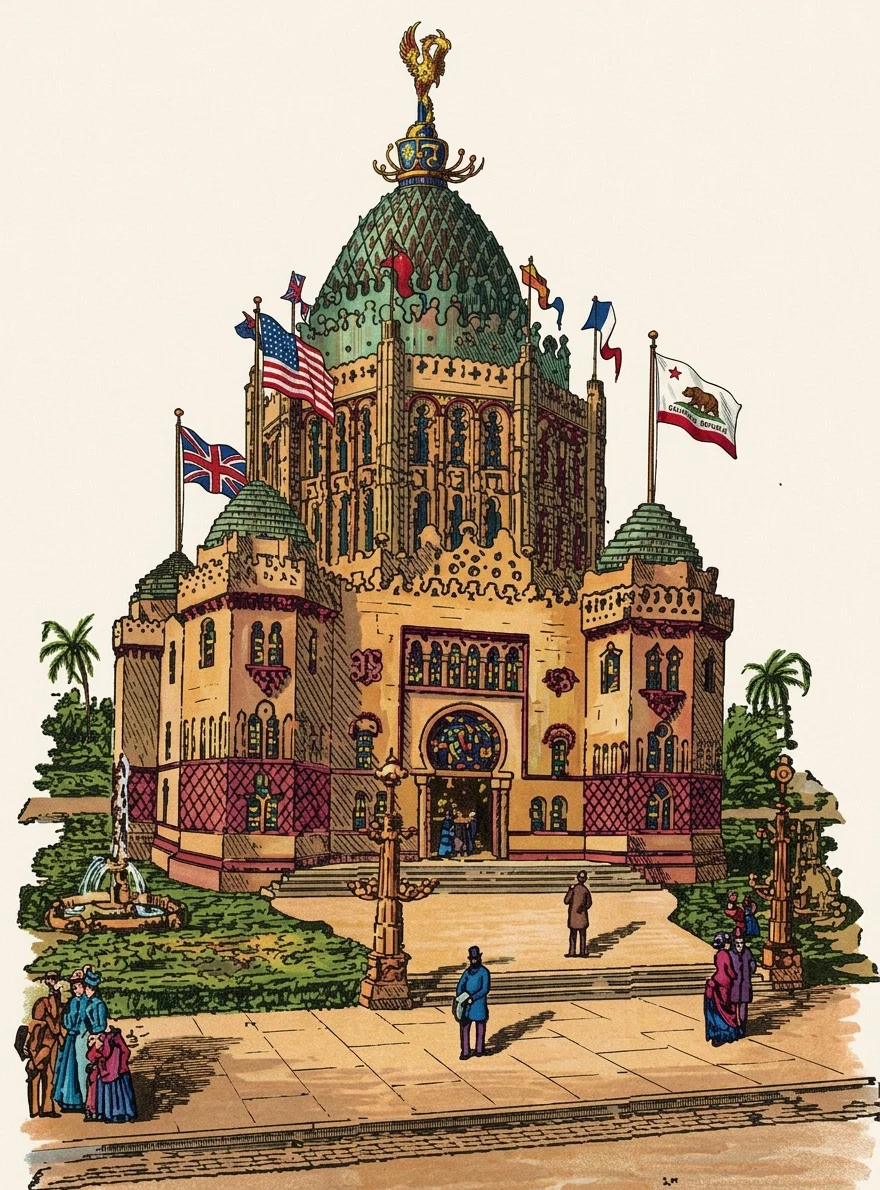
ADMINISTRATION BUILDING.
On the following day Mr. de Young communicated this thought to several other prominent Californians who happened to be in Chicago at the time, and through their combined efforts the Midwinter International Exposition began at once to assume shape. When the idea was first broached, it met with decided opposition in some quarters, and ridicule in others, while the good people of San Francisco themselves, though never underestimating their ability, were almost inclined to ridicule the project from the start.
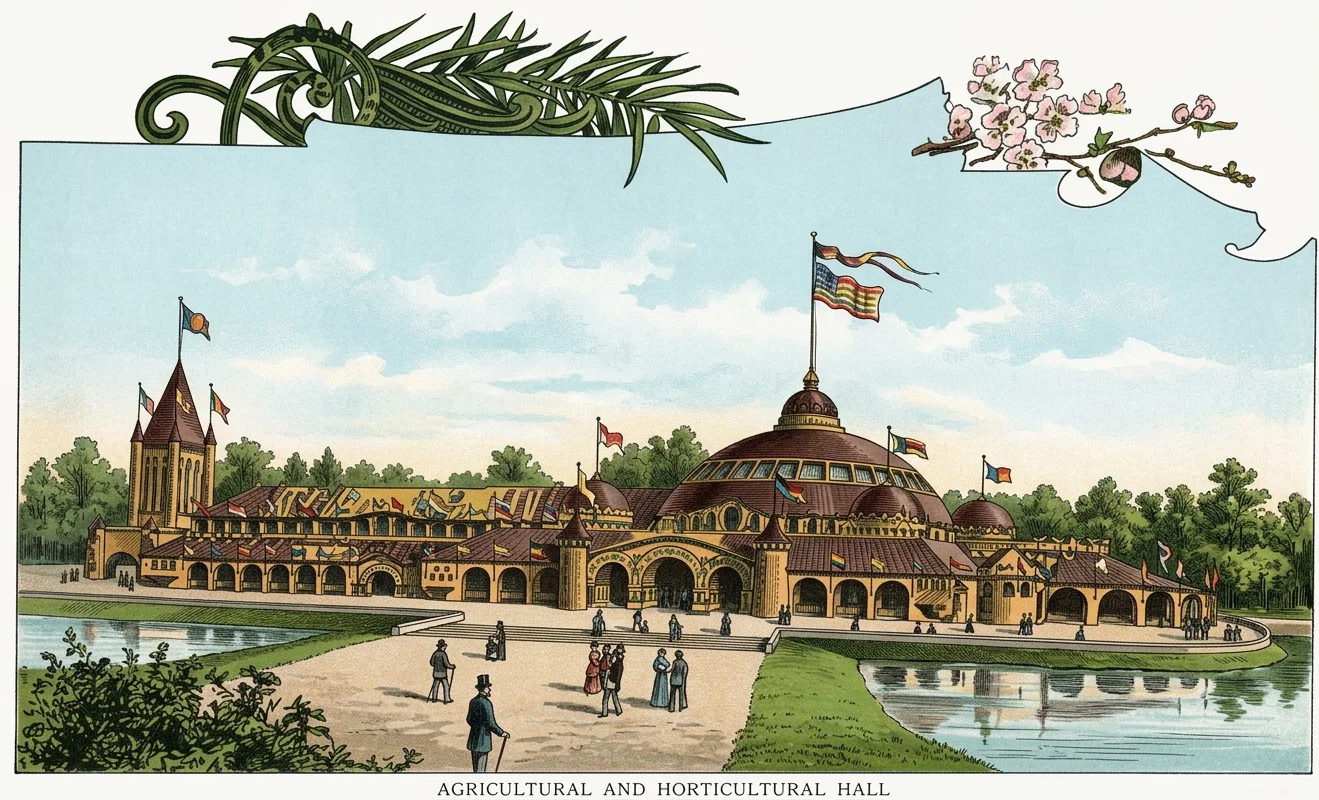
AGRICULTURAL AND HORTICULTURAL HALL.
A few, however, arose to the necessities of the case, and the result was the formulation of a plan for an Exposition which should include many of the choicest exhibits from Chicago, and as many new ones from abroad as might be obtainable, and a considerable list of local California exhibits and other practical features of Pacific Coast production—an Exposition, in fact, which should embody every element of interest and attractiveness, and which should draw to California thousands upon thousands of people who had for years been waiting for a better excuse to make a winter journey to the "land of sunshine, fruit, and flowers."
Ground was first broken for this Exposition on the 24th day of August, and within a fortnight after contracts had been let for the erection of five main buildings, to cost about four hundred thousand dollars, though where the money was to come from was yet uncertain. A popular subscription list had been started in San Francisco, and something like a quarter of a million of dollars was quickly raised; the rest came little by little, and when work on these five great buildings began, new subscriptions began to pour in, until now the four hundred thousand dollars has nearly been subscribed, and there is enough more money in sight from the sale of concessions and from the rental of space in the Exposition buildings to warrant the assertion that the California Midwinter Fair will be open on the first day of January, six months after its inception, and that when its gates swing ajar, it will not have a dollar of indebtedness, but that the receipts for admissions will not need to be diverted from the direct payment of the running expenses of the Fair during the six months of its duration.
The five buildings grew apace; a penalty of four hundred dollars a day was a part of the Exposition contract with the builders, if they failed to finish the buildings within ninety days from starting. The result was that no five such buildings have ever, in the history of the world, been pushed forward so rapidly as these, yet they have been constructed under the personal supervision of competent engineers, so that there can be no doubt of their stability and adaptability to the purpose for which they were planned.
We give in this issue cuts of two of these great buildings. Others will be given later. The first of these which we present is that of the Administration building, where the offices of the Exposition management will be located. It is by far the smallest of the five main buildings, being but 60 feet long by 40 feet wide. Its interior is especially adapted for the purpose for which it is designed, while architecturally it is highly ornamental. Our second cut is that of Agricultural and Horticultural Hall, 300 feet long by 125 feet wide, having a gallery 25 feet wide. The roof is partially covered with skylights. Manufactures and Liberal Arts, Mechanical Arts, and the Fine
Arts and Decorative Arts buildings will be briefly described in the future.
All these buildings have now progressed so far that the roofs are in place and the interiors perfectly protected from winter rains. The outside of the buildings is being covered with staff, and they present as solid an appearance as if made of granite or marble. These five main buildings are located around a grand central court, 900 feet in length and 500 feet in width, in the center of which a grand electric tower, 270 feet high, already begins to lift its head. In this court there will also be an allegorical fountain, emblematic of the history and achievements of the State of California, and also the magnificent electric fountains, which created such a sensation in Chicago, and which are to be transported to San Francisco at a great expense.
In addition to these main buildings and the features of the grand central court, concessions have been let for a great many other interesting exhibits and displays. The great cyclorama of the burning mountain will find a place in the Hawaiian concession. Heidelberg Castle will stand on an elevation, with the German village clustering around its base.
There will be an ostrich farm in full feather, an Arizona Indian village, a Spanish ranchero, an electric theater, a copy of the Ferris wheel 100 feet in diameter, a grand exhibit of sea lions from the Santa Barbara Channel, and an interesting exhibit of lions of another sort equal to the famous Hagenbeck Wild Animal exhibit in Chicago.
Besides all these, work on all of which is being pushed rapidly forward, there are also being constructed half a dozen special buildings, in which the exhibits from different counties of the State of California are to be combined, and in two of these buildings, the two great citrus belts of the different sections of the State, northern and southern, will be entered in friendly competition, so that visitors to the Fair will have a chance to see the greatest display of oranges that has ever been made.
These are but a few of the thousands of things that might be said in explanation of the development of this great Midwinter Exposition undertaking. It is said that it will open on the first day of January without fail, and everything is to be in readiness at thattime. The great advantage of such an Exposition, at such a time, is no longer a question in the minds of the people of California, and the dwellers in neighboring States are fast awakening to the opportunity offered in this connection to display their own products at great advantage. Nevada has already secured 2,000 feet of space, Oregon, Washington, Utah, and New Mexico are all falling in line, and other States west of the Rocky Mountains will also be represented there, to say nothing of the vast number of exhibits that have arranged to take up at San Francisco the work of advertising themselves which they began so successfully by the side of the inland sea at Chicago.

"THIS NIGHT."

O COVETOUS soul, who carest for naught Save heaping up wealth, a golden store, Filled are the storehouses, filled are the barns; Plenty thou hast, thou needest no more. Lo! suddenly comes the summons so dire, "Thou fool, this night I thy soul require."
Thou lover of pleasure more than of God, Sailing so gayly down the broad stream Leading thee straight to the bottomless pit, Wake! oh, awake from thy frivolous dream! What if to thee comes the summons so dire, "Thou fool, this night I thy soul require"?
Ah, foolish and fair one, giddy and frail, Tempting and tempted, hope hast thou none, Steeped in sin's depths, without Christ, without God, Think thee in time, while heaven may be won; Pause ere to thee comes the summons so dire, "Thou fool, this night I thy soul require."
And thou who hast heard the gospel so oft, Careless, indifferent, trifling with grace, Hardening thy heart against measureless love, Heed, lest destruction becometh thy place; Heed, lest to thee comes the summons so dire, "Thou fool, this night I thy soul require." —Selected.

JUDGE NOT—LOVE ONE ANOTHER.

BY MRS. PHENA MOREY.

Mrs. Brown and Mrs. White were not only neighbors, but members of the same church, to which they had been connected for about two years. Mrs. White had been away on a visit, and after returning Mrs. Brown was the first caller. After talking over a revival which had been in progress in the church during Mrs. White’s absence, the latter anxiously inquired as to who had given their hearts to God. Mrs. Brown gave a sigh and looked out of the window. Just then Lula Jones passed.
"There," said Mrs. Brown, "goes one of the converts with the same ruffled dress on as before."
"Do you know the reason of her wearing it now?" spoke Mrs. White. "You know her father is poor and not able to furnish Lula with all new dresses, and she has had that dress a long time and she probably thinks it not worth making over. I should not, at least."
"Mrs. Simple," said Mrs. Brown, "is another convert. You know how she runs her husband in debt; just two weeks before the meeting she bought a silk dress, which cost thirty dollars. Her husband has all he can do to keep out of debt. I saw her come from town last week again with a big armful, and I expect there is another big debt for Mr. Simple to pay."
"Mrs. Brown, are you not too quick to notice these things? Did you know that Mr. Simple goes away early in the morning and does not get home till late at night, and Mrs. Simple has all the shopping to do, and likely she had been doing that this time. Mr. White works with Mr. Simple, and he says there is a great change in his wife, and that she sold her silk dress for twenty-five dollars, to help pay up his debts. That must have been quite a sacrifice for her; but we all receive blessings by sacrificing."
"Why, I had never heard of that before," said Mrs. Brown. "There is Mr. Dipple, the drunkard," she continued, "he claims to have been converted but I saw him go in the saloon about a week ago. I don’t give much for such conversions."
Mrs. White looked up and said: "I know a few weeks ago Mr. Dipple owed thirty dollars at the saloon; I hear he has work now, and gets forty dollars a month; it would show honesty in him to go and pay his debts everywhere. It may be that that was what he was doing last week."
"Mrs. Gem joined the church, too, but she scolds her children as bad as ever. I guess the conversion was not very deep."
"Poor woman!" said Mrs. White. "I feel sorry for her, she has so many trials, and she is only a babe in Christ. I expect a Christian visit from someone would help her. Suppose we try it. We will realize a blessing by helping her."
Mrs. Brown now spoke her mind freely: "Mrs. White, you always look at the best side. Why is it?"
"Mrs. Brown, did you ever read Matt. 7: 1; 1 John 4: 11? These two texts make the change."
"Why cannot I do so too?" replied Mrs. Brown.
"You may. Just let the Lord do the work in you. Think of the love of Jesus to you, and then it will be easy to be charitable toward other people. When you get home, read carefully Mark 10: 27 and Heb. 13: 8. Then study 1 John 3: 22."
This ended the conversation of the two friends. Dear reader, which one are we like?

INDIA OF TO-DAY.

[Condensed from an article by the Rev. James Johnston, Bolton, England, in the Missionary Review.]
The march of empire over the "Eye of Asia," the name by which India is occasionally designated, presents features of deepening interest, and prophetic of more remarkable changes. Advances in her moral and material condition and in civil and religious development plainly indicate that India is assuredly taking a right place among the progressive nations east and west. The pacific revolutions of the last generation or so in her social and national life have amazing significance. Those degrading heathen customs, the self-immolation of widows on the funeral piles of their husbands, the dedication of favorite daughters at idolatrous temple services, the trampling to death of imbeciles, the drowning of aged persons, the universal practice of female infanticide, and the cruelties of child marriage and widowhood, have been wholly or partially swept away, and at the present day fresh campaigns initiated against the abominations which still linger on the horizon of India's humanity.
In point of population the Indian census offers an array of figures not easily grasped. The British possessions contain 221,172,950 souls, and the feudatory States 66,050,480, making a grand total, for these two divisions, with the territories of Upper Burmah, North Lushai, and Kashmir, now included for the first time, of 288,000,000 human beings. Natives in British provinces occupy an area of 962,070 square miles, and those of the feudatory States 595,310 square miles. The pressure of population on the land during the last decade has risen from 227 to 249 per square mile in British territories, and from 107 to 123 in the native States, or if the whole of India, inclusive of the new tracts, is tabulated, the British divisions give 230 persons and the feudatory States 111, or an average of 184 to every square mile of greater India.
Pressure of population on the soil has its highest provincial density in Oudh, returned at 522 persons to the square mile; in Bengal, 471; in the Northwest Provinces, 411; in the Madras native States, embracing the crowded shores of Travancore and Cochin, 385; in Baroda, 294; in the Madras Presidency, 252; in Bombay, 207; Ajmir, 207, the last two being the remaining provinces or States, which have an aggregate density of 200 to the square mile. Upper Burmah, with an area of 83,500 square miles, has a population of 35 to the square mile, and Kashmir, 31. Comparing these figures with countries having dense city populations, a condition of existence uncommon in India, there are 498 people to the square mile in England and Wales, 21 in the United States of America, and 5 in the habitable parts of Canada. The returns of the current census denote an influx of people from congested Indian centers to regions of virgin soil, an increase more noticeable in the feudatory than the British States. Just in proportion as the feudatory States are safeguarded by laws does the Indian peasant feel himself tempted to migrate into new pastures. The first advance across a British feudatory frontier is effected by marriage relations, by daughters being given as wives to villagers on the other side of the border line. In many cases the rural emigration has not passed the initial stage, which shows a marked percentage of females over males. Save in certain localities an extensive migratory movement from British to feudatory States is unreported.
From the aggregate returns of population there is not, it appears, a uniform increase of both sexes. Throughout India the average proportion of women to men is given at 958 of the former to 1,000 of the latter in 1891, while in the towns it does not exceed, as a whole, 886 females. Some of the city populations of India are making rapid strides. Bombay has 821,760 people, and Calcutta, with its two adjoining suburbs, a population of 741,140, or, counting the dwellers in the environs, where the growth is specially noticeable, Calcutta has a return of 978,370. The population of Madras is 452,520; of Hyderabad, 415,000; of Lucknow, 273,030; and of Benares, 219,470. In 22 other cities there are populations of 100,000 or upward, and in 48 towns the populations average from 50,000 to 100,000 inhabitants. The natives of India, occupying a country equal in size to the continent of Europe, excluding Russia, speak 106 different languages, as distinguished from dialects, and of these 18 are used by more than a million persons. Racial differences are further accentuated by social and religious prejudices and conflicting material interests. Every type of humanity has its representatives on the arena of India. Ghonds, Pathans, Rohillas, Belochees, and numerous fierce tribes, half clad, bloodthirsty, head hunters, wielding stone weapons and indulging in degrading superstitions, dwelling in caves, on the hills, and in forest deeps, are the survivors of prehistoric times, in contrast to whom stand the Parsee and Brahman, the embodiments of polished manners, scholarship, philosophy, commerce, and Western ideas. Beyond its own vast possessions British rule exercises no little supervision over 117 native States, the theaters of loose tribal communities, warlike chiefs, and princely rulers.
Very curious facts are furnished bearing on the religions of the myriads of people in India. The difficulty to register these is increased, because of the indistinct lines which separate Hinduism, Sikhism, and kindred systems. When the lower superstitions, such as ghost worship, tree and animal worship, or demon worship, are taken into account, the perplexities are intensified. Amid these peculiarities it is evident, from recent enumerations, that Hinduism is absorbing steadily the hill and forest tribes accustomed to practice strange primitive rights. If these animistic tribes, together with the 3,050 Brahmos and 39,950 Aryas, be added to Hinduism, the combined groups of Hinduism, semi-Hinduism, and reformed Hinduism, number 75 1/4 per cent of the total; Mussulmans, 19.96 per cent; Buddhists, 2.48; Christians, 0.80; Sikhs, 0.66; Jains, 0.49; Parsees, 0.03; and of miscellaneous beliefs 0.02 per cent.
Putting the religious census in another form, Hinduism claims 207,500,000—the term, it may be remarked, signifying "any religion which is not Mohammedan;" Islam, 57,000,000; Buddhism, 7,000,000, and Christianity, 2,225,000. The Jews count 17,180, and the Parsees in all 89,887 persons. Of theists, agnostics, and atheists 289 are enumerated. Taking the "animistic group" alone, they represent 3.23 per cent of the whole population, which allows them to stand next to the Mussulmans in numerical strength. Hindus and Mussulmans have increased 10.74 and 10.70 respectively, in proportion to the growth of population; Buddhism has increased 24 1/2 per cent at a pace with the growth of the general population in Lower Burmah; while the Christians have multiplied at the rate of 22.16, including large conversions from the forest tribes, particularly in the Chutia Nagpur territories. Gratifying results of the triumphs of Christianity come from the Punjab, the Northwest Provinces, the Karen districts in Lower Burmah, Madras, and the west coast seaboard, where the native Christian population is growing at an astonishing rate.
Of "Young India," considering the population as a whole to the age of fifteen, the Indian return shows that 63.90 per cent of the boys and 82.47 of the girls are unmarried; and of the married under fifteen years of age, 5.09 boys, 17.02 girls. In every 10,000 of the population there are left as "widowed" 20 boys and 51 girls under the age of fifteen years, and of this "widowed" category 20 per cent of the boys and 35 per cent of the girls are under five years old. The state of education presents terrible backward features in the adult sections of the population, where, again, there is disparity between the two sexes respecting capacity to read and write. From returns affecting 262,000,000 people, it is tabulated that 89.1 per cent of the males and 99.4 per cent of the females are unable to read or write. In the male section, consisting of 133,500,000, only one in nine can pass this double test, and in the female division, comprising 128,500,000, barely one in 173 women. Of the total population in India having a knowledge of reading and writing in English, the census makes a return of 360,000 natives. For the training of the young, public and private institutions number 138,054, and pupils 3,682,707. Allowing, therefore, that 18,000,000—a liberal estimate—of India's people have the advantage of an elementary education, it leaves the enormous number of 270,000,000 of Hindus buried in calamitous ignorance. Out of the few millions able to read and write a very small proportion have any acquaintance of English.

HURRIED DINNERS.

It is a mistake to eat quickly. Mastication performed in haste must be imperfect even with the best of teeth, and due admixture of the salivary secretion with the food cannot take place. When a crude mass of inadequately crushed muscular fiber, or undivided, solid material of any description, is thrown into the stomach, it acts as a mechanical irritant, and sets up a condition in the mucous membrane lining that organ which greatly impedes, if it does not altogether prevent, the process of digestion. When the practice of eating quickly and filling the stomach with unprepared food is habitual, the digestive organ is rendered incapable of performing its proper functions. Either a much larger quantity of food than would be necessary under natural conditions is required, or the system suffers from lack of nourishment. The matter may seem a small one, but it is not so. Just as a man may go on for years with defective teeth, imperfectly masticating his food, and wondering why he suffers from indigestion, so a man may habitually live under an infliction of hurried dinners, and endure the consequent loss of health, without knowing why he is not well, or how easily the cause of his illness might be remedied.—Family Doctor.

A CHILD'S PHILOSOPHY.

"SPELL toes," said the mother, who was teaching her little daughter, several years old, to spell.
"T-o-z-e," answered the child.
"No, dear, that's not right. T-o-e-s spells toes."
"But it sounds like t-o-z-e."
"I know it, but you cannot go by the sound."
Then, in order to enforce this proposition, the mother called on her daughter to spell froze.
"F-r-o-e-s," said the child.
"No, you're wrong again. This time we do use the z, and spell the word f-r-o-z-e."
"Huh!" grunted the child.
"Now spell rose," said the mother.
The child hesitated. Finally she said, "I don't know whether to say r-o-z-e or r-o-e-s, and, really, I don't know that either way would be right."
"Spell it r-o-s-e," said the mother, "though there is another word pronounced just like it that's spelled r-o-e-s. That word is the name of the spawn of fishes."
The poor little child looked quite miserable.
"Just one more word," said the mother. "Tell me how you spell blows."
"Well," said the child, who had quite enough nonsense, as she viewed it, from her mother, and had suddenly made up her mind to pay back in kind, "I spell it three ways: I spell it b-l-o-s-e for breakfast, b-l-o-e-s for dinner, and b-l-o-z-e for supper."
"I spell it b-l-o-w-s all the time," said the mother.
The child said nothing for a minute or two, then, looking up, she solemnly remarked:
"I think, mamma, that the English language was made for persons very, very well educated."—New York Times.

GOD O'ERRULETH ALL THINGS RIGHT.

WHEN our narrow-sighted vision Cannot trace th' Eternal aim, Let us wait his wise decision, Let us trust him still the same. Past our feeble comprehension Is God's comprehensive care, Yet we know that all who seek him Need not perish in despair.
Never can consistent goodness Heed the fledgling raven's cry And neglect his suffering children, Or his promised aid deny. The beneficent Creator Kindly watches over all, And without his gracious notice E'en a sparrow cannot fall.
"Bruised reeds shall not be broken, Smoking flax shall not be quenched," E'en though many a pain and sorrow Must be borne and keenly sens'd. Griefs that seem to tear asunder Tender'st fibers of the heart Are but cords to draw us to Him Who alone can heal the smart.
Crush'd and bruis'd are sweetest blossoms All their fragrance to distill; Precious souls are tried and proven Love's own purpose to fulfill. Humbly let us bow before Him Who from gloom evolveth light, And with trusting hearts acknowledge God o'erruleth all things right. —Emily H. Woodmansee.

THE RELIGION OF THE JAPANESE AINU.

THE religion of the Ainu has traces of that widespread sun worship which was known in Egypt, Babylon, India, Persia, Mexico, Peru, and many other nations. The Shintoo faith of Japan is of the same general character, the sun goddess having been regarded as the ancestor of the Mikados; but the Ainu treat this goddess as only one of the deputies, though she is preëminent among them. She has a variety of functions, and is a sort of general care taker and friend, like the Vishnu of the Hindus and the Apollo of the Greeks.
The Ainu have no priesthood, no altars for sacrifices or offerings, no temples, no stated days for worship. The nearest approach to altars and temples are the inao, mere pieces of wood whittled into shavings, which are left still attached at one end. These are set up as tufted stakes near the house or the fishing place, or wherever they wish the favor of the respective gods to be shown. They are merely tokens or reminders; they are scarcely fetishes.
According to Mr. Bachelor, if an Ainu were to formulate his creed of religious beliefs and superstitions, it would be something like this. At any rate, almost every Ainu would assent to the following items as a concise summary of his belief:—
  1. I believe in one supreme God, the Creator of all worlds and places, made by “God, the maker of places and worlds and possessor of heaven.”
  2. I believe in the existence of a multitude of lesser deities, all subject to this one Creator. They receive their life and power from him, and they govern the world under him.
  3. I believe there are also many evil gods, who are ever ready to inflict punishment for wicked deeds.
  4. I believe in Aioina Kamui as our ancestor, a man become divine, and who has now the superintendence of the Ainu race; in a goddess of the sun; in a goddess of fire; in goddesses of rivers; in gods of mountains and forests; in the gods of animals; in the gods of the sea and of the skies and all things contained therein.
  5. I believe in demons, of whom the devil is chief, and also that there are demons who preside over accidents and all evil influences.
  6. I believe that the souls both of human beings and animals are immortal; that separated husbands and wives will be rejoined hereafter; that all people will be judged, and the good rewarded and the evil punished.
  7. I believe that the souls of departed animals act as guardians to human beings.
  8. I believe in ghosts; that the departed spirits of old women have a mighty power for harm, and that they appear as very demons in nature.
  9. I believe that there are three heavens, called respectively “the high vaulty skies,” the “star-bearing skies,” and “the foggy heavens.” I also believe that there are six worlds below us.
The religion of the Ainu differs from most other systems of the East in these particulars:—
  1. It is free from pantheism.
  2. It holds to a real creation instead of any form of evolution.
  3. There is no trace of asceticism.
  4. There is no jugglery, hypocrisy, or priestly imposture.
  5. There is no organic form of religion in the tribe or even in the family, and there are no records.
  6. The system is greatly lacking in moral earnestness. The idea of future rewards is vague, and heaven has little attraction.
A gospel of light and hope ought to be readily received.—Rev. F. F. Ellinwood, D.D.

BIBLES

A Large and Varied Stock.
Send for Catalogue to
Pacific Press Pub. Co., Oakland, Cal.

Steps to Christ

STEPS TO CHRIST. The Pacific Press Publishing Co., Oakland, Cal., have received an entirely new stock of the latest edition of that excellent book entitled "Steps to Christ," by Mrs. E. G. White. The price, postpaid, is only 75 cents. Address as above

WEARINESS IN WORK.

In this age of pronounced opposition to the simple gospel it is not unusual for the children of God to be sorely tempted to abandon their work because of the weakness of the flesh. A mere glance at the issues involved in the mighty struggle between good and evil now going on in the world, ought to convince everyone of the importance of resisting all such temptations.
Nothing would gratify the adversary of souls more than to reduce the ranks of Christian workers in this way. Such desertion would strengthen the kingdom of darkness, would weaken, in a corresponding degree, the kingdom of light, and would certainly tend to impoverish the spiritual natures of these unfaithful servants. Professor Austin Phelps once wrote to a friend as follows: "It is a sad thing to put one's self out of the line of God's work prematurely. I earnestly wish to avoid that if I may."
We are not in this world merely to absorb truth and consume our time in pious contemplation. We are here to "show ourselves men" in obeying the divine command. In this cause it is very encouraging to remember that the final awards will be administered on the ground of improved talents, and not on the ground of their real or supposed possession; the "well done" is given to those who have been, in a scriptural sense, "good and faithful." They are not given to those concerning whom it is only said, "They are talented or influential."
When tempted to forsake the post of duty, we do well to recall the unselfish devotion of those who are toiling in foreign lands or in the newly settled portions of our country. Amid persecutions and discouragements they toil on, joyful for the privilege. In distant lands native converts are giving us examples of true-hearted service for Jesus and of liberal giving out of their poverty, which often put our easy-going charity and benevolence to shame. "Let us not be weary in well doing; for in due season we shall reap if we faint not."—Christian Advocate.

FIELD NOTES.

ELDER M. G. HUFFMAN reports good progress in raising funds for the new repository building at Deering, Maine.
ELDER E. J. HIBBARD recently baptized sixteen persons at Eldred, Pa., and some half dozen more are awaiting baptism.
ON the 23d ult. Brother C. H. Richards and wife sailed from New York for Nassau, Bahama Islands, where they go to engage in the canvassing work.
A NOTE from Brother D. E. Scoles, dated Pendleton, Oregon, November 24, says, "The work here is progressing; there are now forty-one names on the covenant."
NOVEMBER 12 a church of eleven members was organized at Carbon, Iowa. At Corning, seven miles distant, the day previous, Elder C. M. Gardner baptized eight persons.
NOVEMBER 22 Elder W. A. Spicer and family sailed from New York for London, where Brother Spicer will enter upon editorial duties connected with the Present Truth, as heretofore announced.
IN Jersey City, N. J., regular Sabbath meetings are held at the corner of Jackson Avenue and Union Street. The membership at last report was forty-seven, with a Sabbath school membership of double that number.
A DETROIT paper states that three Seventh-day Adventists, Robert Sweeton and son, and Wallace Sweeton, residents of Merser, Ontario, have been arrested on a charge of working on Sunday, the specific act being the painting of a wagon tongue.
AS a result of meetings held in Urbana, Iowa, by Brethren L. F. Starr, D. H. Tanner, and C. M. Gardner, sixteen are now keeping the Sabbath and others are deeply interested. Preparations are under way for the erection of a house of worship.
ELDER W. S. HYATT reports to the Review a good work at Goldsberry, Mo., during the early part of November. He was there one week, and twenty united with the church, seventeen of whom were baptized. Amongst other services a new house of worship was dedicated.
ELDER G. T. WILSON writes from Gisborne, N. Z., November 3: "We have been here nearly three months, holding meetings with the church and for the outside. We have had two open-air meetings, at which Sister White spoke on temperance. Several hundred persons listened each time. Last Sunday we had the theater, and had an audience of 250 or more."
THE Southern Echo, a newspaper published in Southampton, England, notices at considerable length the meetings being held in that city by Elders J. S. Washburn and Francis Hope. They were delivering a course of lectures on "Christ and Antichrist: The Two Mysteries." Brother Washburn had come from Bath, and Brother Hope from Belfast, Ireland.
OF the work in Spartanburg, S. C., Elder E. W. Webster writes: "God is still blessing the work here. The dragon is getting stirred up a little, but people still inquire after the truth, and the interest is deepening with those who have taken a stand with us. One of these, a colored man, is the best educated man in the Colored Baptist Church, the minister not excepted."
AT Shady Side, Md., the opposition has shown itself in repeated attempts to destroy the tent property of our laborers. One night persons concealed near by suddenly rushed out and cut six ropes, expecting to see the tent fall. Twenty-one ropes have been cut at different times, and people going to and from the tent have been assaulted with missiles thrown from ambush. This style of controversy is instigated principally by men claiming to be leaders in the Methodist Church.
A NOTE from Elder W. A. McCutcheon states that he and Prof. C. E. Keck were arrested on Sunday, November 19, at Gainesville, Ga., on a charge of "disorderly conduct," their specific offense being the arranging of seats in a building where they designed to commence a school the next day. They were each fined $50 and costs, with the alternative of ninety days' work in the chain gang. They appealed to a higher court, which sits in January, and bail was secured for them. They were then bound over to the County Court on a charge of "sabbath breaking," which is a State offense. Following is the closing paragraph of an account of the matter published in the Atlanta Journal:—
"There is considerable excitement in Gainesville as the result of this imprisonment and fining of these people, and many who were opposed to them before are now their friends. Some say it is a clear case of religious persecution, and reminds them of the time of Roger Williams and the persecution of the Quakers and Baptists."
Continue reading: A GLEAM ACROSS THE WAVE