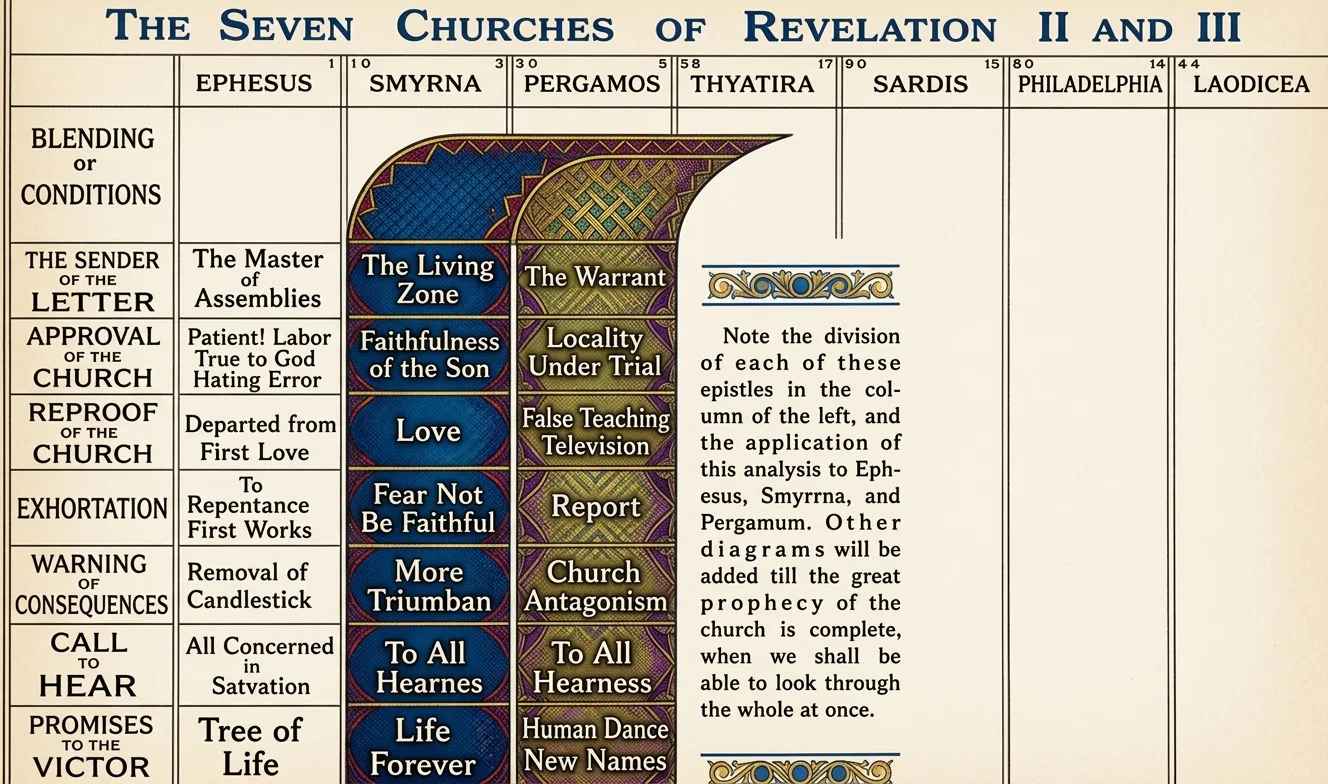
We study two of the typical churches in this number, Smyrna and Pergamum. It might be well to consider briefly the types, the actual churches and towns of Asia Minor. Ephesus, of our last lesson, is no more. The magnificent ruins of the great temple of Diana and the famous theater of the mighty throbbing, pleasure-loving city are about all that there is of her former power and grandeur. Both city and church are no more.
Smyrna was a celebrated commercial city of ancient times. It was less than fifty miles north of Ephesus, on the Smyrnian Gulf, an arm of the Ægean Sea, at the mouth of the little river Meles. Its origin runs far back into antiquity. It was finally destroyed by the Lydians, after which it lay waste for four centuries to the time of Alexander the Great, who began its rebuilding a little distance from the old site. This work was continued under Antigonus, and it soon grew to a flourishing city. The city was destroyed by an earthquake in A.D. 177, but was rebuilt with more than its former splendor by the Emperor Aurelius. While it declined from its former glory, it is today no inconsiderable city with a population of 130,000, and a great central trade emporium. The Turks call it Imzir, even Infidel Imzir, because of its large population of non-Moslems. Most of the Christians are the formal members of the Greek and Armenian churches. The early church, used as a type, has not its antitype in Smyrna.
Pergamos, or better, Pergamum, lies about sixty miles north of Smyrna, in a wonderfully fertile valley in the province of Mysia, of which it was the capital. Through it ran the River Ciacus. Two centuries before the Christian era it was a noted seat of literature and the fine arts, and the residence of the celebrated Attalian kings. Under King Eumenes the library was increased to 200,000 volumes. The art of preparing skins for manuscripts reached here its perfection, and from the place came the term parchment. Mark Antony transported the library to Egypt as a present to Cleopatra. Under Rome its preeminence was maintained. Remains of noted buildings are still in evidence. In this city Æsculapius was worshiped in the form of a living serpent, the god of Pergamos. As the serpent is a type of Satan, so it could be said that Satan had a seat or throne in Pergamos, a type of later manifestations. The town now is poor and mean; there are a few Christians, and remains of a church of a few centuries ago. The early Christians did not have the trials in Pergamos which they had in Smyrna.
The Answer of the Text
[The answers to the questions are from the American Revised Version. Omitting questions, and disregarding sometimes the capitals at the beginning and the period at the close of an answer, the text may be read continuously. In notes and comments both versions are used without designation.]
1. How does the Master address Himself to Smyrna?
“And to the angel of the church of Smyrna write: These things saith the First and the Last, who was dead, and lived again.”¹
2. What had He recognized in Smyrna?
“I know thy tribulation, and thy poverty (but thou art rich), and the blasphemy of them that say they are Jews, and they are not, but are a synagogue of Satan.”²
3. What exhortation does the Master offer in view of suffering to come?
“Fear not the things which thou art about to suffer: behold, the devil is about to cast some of you into prison, that ye may be tried; and ye shall have tribulation ten days.”³
4. What assurance is given the faithful?
“Be thou faithful unto death, and I will give thee the crown of life.”⁴
5. What earnest call is made to every anxious soul?
“He that hath an ear, let HIM hear what the Spirit saith to the churches.”
6. What is the promise to the overcomer?
“He that overcometh shall not be hurt of the second death.”
The Letter to Pergamum
7. How does our Lord represent Himself to Pergamum?
“These things saith He that hath the sharp two-edged sword.”⁵
8. What did He recognize?
“I know where thou dwellest, even where Satan’s throne is.”⁶
9. For what did He commend them?
“And thou holdest fast My name, and didst not deny My faith, even in the days of Antipas My witness, My faithful one, who was killed among you, where Satan dwelleth.”⁷
10. What reproof does the Master give?
“But I have a few things against thee, because thou hast there some that hold the teaching of Balaam, who taught Balak to cast a stumbling-block before the children of Israel, to eat things sacrificed to idols, and to commit fornication. So hast thou also some that hold the teaching of the Nicolaitans in like manner.”⁸
11. What charge and warning are given?
“Repent therefore; or else I come to thee quickly, and I will make war against them with the sword of My mouth.”⁹
12. What earnest admonition is repeated to all?
“He that hath an ear, let HIM HEAR what the SPIRIT saith to the churches.”
13. What is the promise to the overcomer?
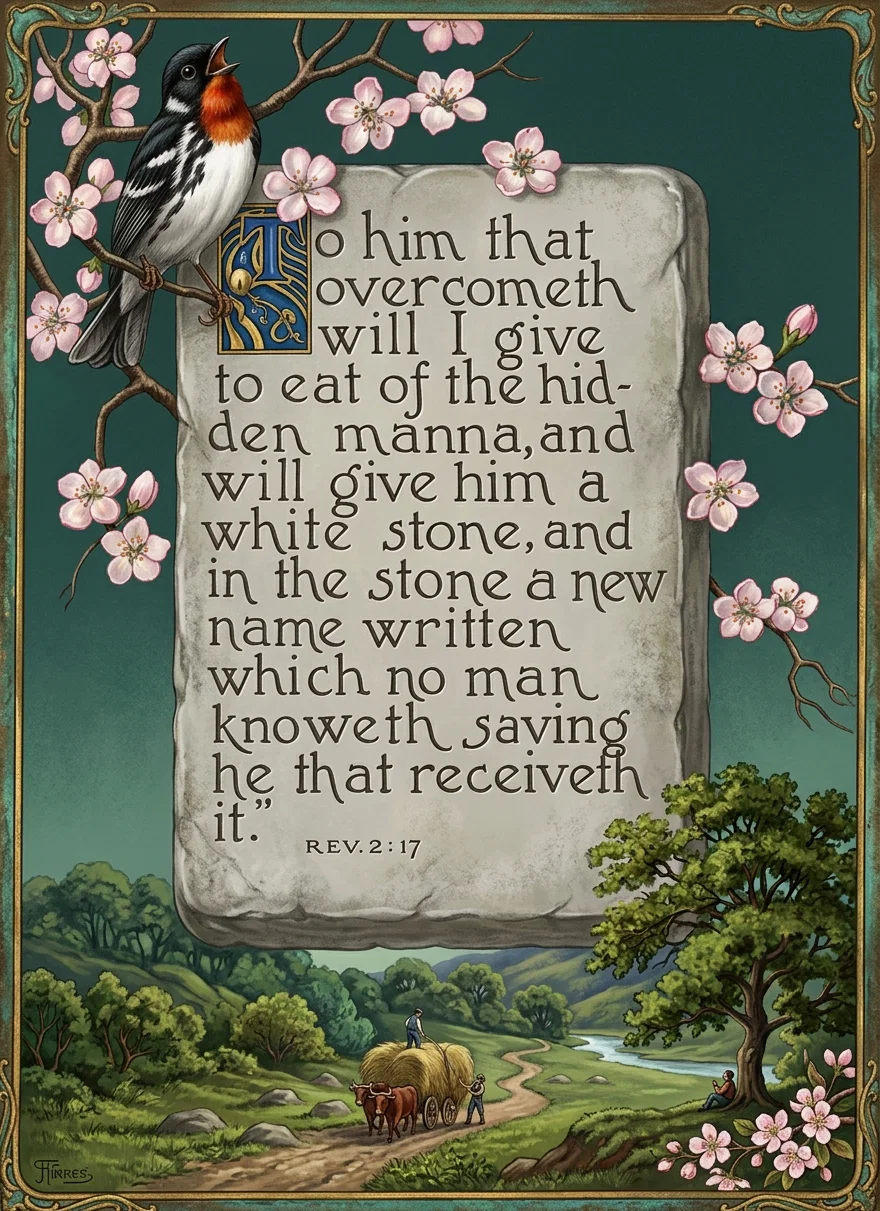
“To him that overcometh, to him will I give of the hidden manna, and I will give him a white stone, and upon the stone a new name written, which no one knoweth but he that receiveth it.”¹⁰
Notes of Explanation
1. “Smyrna.”—From myrrh, more odorous by being crushed, typical of that condition of the church during the pagan persecutions about 100 to 300. “The First and the Last.”—The One who creates, who places the feet of the cleansed sinner in the heavenly way, the One able to save to the uttermost, to carry to eternal victory all who trust Him. Again is emphasized the awful fact of chapter 1:18, He “was dead,”—Christ the Son of God. But He lives again, and because He lives we shall live also. How fitting that He should reveal Himself as death’s Victor to that church of Smyrna which should pass through such fierce persecution even unto death.
2. “I know.”—The Master knows it all, knows the tribulation, the thrashing, the pressing, the crushing, knows the grinding poverty caused by7persecution, banishment, confiscation of goods; but more precious than earthly treasure are the riches of faith. “Harken, my beloved brethren; did not God choose them that are poor as to the world to be rich in faith, and heirs of the kingdom which He promised to them that love Him?”James 2:5. “Blessed are ye poor: for yours is the kingdom of God.”Luke 6:20. What are all the baubles of earth compared with one hour of God’s eternal riches! “Jews.”—Jews who were not Jews. They had the human blood, and bore the name, but were not Jews in God’s measure of the meaning. “They are not all Israel, that are of Israel.”Rom. 9:6. “He is not a Jew who is one outwardly; . . . but he is a Jew who is one inwardly.”Rom. 2:28, 29. “Jew” is from “Judah,” the center of which tribe is Shiloh, the Saviour, who declares that “salvation is of the Jews.”Gen. 49:10; John 4:22. “Synagog.”—A meeting-place. “Church” is never used of those apostate. “Satan” means adversary. All those who oppose Christ or His cause belong to the company of the adversary, the synagog of Satan.
THE SEVEN CHURCHES OF REVELATION II AND III
3. “About to suffer.”—The Revelation was written about A.D. 95 or 96. Pagan persecution had already begun. John was on Patmos for his faith. That persecution would become more wide-spread. God’s people would suffer more than in apostolic times. That time was upon them, they were entering upon it; let them. The devil was planning their destruction. If he could not beguile them away, he would force them, coerce them, put them to death. All the persecution of all ages has had for its instigator the devil. It came the worst to this early church under the “ten days,” symbolical of ten years’ persecution under the Emperor Diocletian, 302 to 312, when thousands upon thousands were put to death, often with cruelties indescribable.
4. “Crown of life.”—The crown implies victory now; not the kingly crown, or diadem, but the victor’s garland, the stephanos, placed upon the brow of him who strives lawfully. 2 Tim. 2:5. It is the “crown of righteousness,” imparted in the faith of Christ (2 Tim. 4:8); it is “the crown of life,” life everlasting, which the approved of God will receive (James 1:12), the unfading, incorruptible “crown of glory” (1 Peter 5:4). Let the devil and death do their worst, He who has tunneled the grave in victory holds for the resurrection morning the crown of life for every overcomer. Those who sought to purchase ease by yielding to the devil, will, tho they rise from the dead, go down to eternal death; but the overcomer in Christ shall not be hurt of the second death. Rev. 20:14.
5. Pergamum.—The name is said to mean height, elevation, which well fitted that splendid city, and also the symbolized condition of the church from the council of Nice to near the middle of the sixth century. The “sharp two-edged sword,” the Word of God, not simply the Word in general, but the Word in judgment, that cuts out sin or the sinner who identifies himself with the sin. In the age of the Pergamum condition the church of God was departing from the Word of God to human doctrines, human philosophy, human tradition. Christ would emphasize as the one standard the Word.
6. “Satan’s throne.”—As the local church in Pergamum dwelt in a city where the worship of a living serpent, the emblem of the devil (Rev. 12:9) was in vogue, so the church living in that period of time when Rome, the seat of world empire and corruption, became the head of the rapidly apostatizing church. It was during this period that the foundation of the Papacy was laid in the growing assumption of the Roman bishop, mightily helped by the civil power under such rulers as Constantine, Clovis, and Justinian. However sincere those were who were working to that end, the devil was at the bottom of all the perversions.
7. “Antipas” was perhaps an unknown martyr, or represented a class opposed to the growing assumptions of the Papacy,—“anti,” against, “pas,” father or pope.
8. “Against thee.”—It was “one thing” against the Ephesus condition; it is a “few things” against the Pergamum. The doctrines of the Nicolaitans which were hated by Ephesus were tolerated by Pergamum, as were also those who taught as did Balaam, fornication, union with the world, union with the state, consummated in this period, an eternal curse to both church and state. Yet the best of God’s children now tolerate it.
9. “Repent,” turn, or the Master has become the adversary, as He of old withstood Balaam. One’s case is indeed hopeless when he makes Infinite Power his enemy.
10. “Hidden Manna.”—The manna, “corn of heaven,” given by miraculous power, typified Christ Jesus, the Bread of Life. John 6:33, 48-51. Not hidden in the sense of purpose to put from the grasp of men, but hidden to unbelief. The mystery of God is disclosed to the child of faith. 1 Tim. 3:16; Col. 1:26, 27. “If our Gospel be hid, it is hid to them that are lost; in whom the god of this world hath blinded the minds of them which believe not.” The hidden mystery is the hidden manna, the Bread of Life, Christ Jesus. The overcomer shall partake of Him to the full. A white stone represents God’s choice for us. It is the pebble used in voting, black if against, white if favorable. Christ casts His vote for us by the white stone or pebble upon which is engraved a new name, representative of character. A man of old gained the victory, and his name was changed from Jacob the supplanter to Israel the prevailer. Gen. 32:28. Our new name will be the sum of all our experience, the name we are spelling out day by day, by the hardest of labor at times, under severest trial, often making great blunders, yet under the Master making progress. We do not know it now, but God sees it. Like the tapestry weavers, we see the wrong side, it seems rough and ugly; God sees the finished name. He knows it, of course, for He bestows it, and has spelled it all out with us; but no one else knows it, because no one else can have our experience. It is an eternally open secret (but partially read by others) to all eternity, between each soul and its Lord. Pergamum represents an age of charms, amulets, hoodoos, mascots, relics, superstitions of things and relics once touched by some good soul; how fitting it was to present the true in the same form of mystery, yet eternally effective. God grant that the reader may eat of the hidden manna, and spell out by His grace the perfect and eternal new name.
8. And unto the angel of the church in Smyrna write; These things saith the First and the Last, which was dead, and is alive;
9. I know thy works, and tribulation, and poverty, (but thou art rich) and I know the blasphemy of them which say they are Jews, and are not, but are the synagog of Satan.
10. Fear none of those things which thou shalt suffer: behold, the devil shall cast some of you into prison, that ye may be tried; and ye shall have tribulation ten days: be thou faithful unto death, and I will give thee a crown of life.
11. He that hath an ear, let him hear what the Spirit saith unto the churches; He that overcometh shall not be hurt of the second death.
12. And to the angel of the church in Pergamos write; These things saith He which hath the sharp sword with two edges;
13. I know thy works, and where thou dwellest, even where Satan's seat is: and thou holdest fast My name, and hast not denied My faith, even in those days wherein Antipas was My faithful martyr, who was slain among you, where Satan dwelleth.
14. But I have a few things against thee, because thou hast there them that hold the doctrine of Balaam, who taught Balak to cast a stumbling-block before the children of Israel, to eat things sacrificed unto idols, and to commit fornication.
15. So hast thou also them that hold the doctrine of the Nicolaitans, which thing I hate.
16. Repent; or else I will come unto thee quickly, and will fight against them with the sword of My mouth.
17. He that hath an ear, let him hear what the Spirit saith unto the churches; To him that overcometh will I give to eat of the hidden manna, and will give him a white stone, and in the stone a new name written, which no man knoweth saving he that receiveth it.
Taste and See that the Lord Is Good
By T. E. Bowen
By T. E. Bowen
“The Lord is righteous in all His ways, and holy in all His works. The Lord is nigh unto all them that call upon Him, to all that call upon Him in truth. He will fulfil the desire of them that fear Him: he also will hear their cry, and will save them. The Lord preserveth all them that love Him: but all the wicked will He destroy.”Ps. 145: 17-20.
HIS is a precious portion of Scripture. God works. He actually does great things; yet all His ways are righteous, all His works holy. Whether or not we understand this, depends upon whether or not our hearts are right in His sight. Whether we are righteous or wicked, changes not the fact that God is righteous and holy in all His ways and works.
The next sentence holds out to every man, every child of His, great or small, rich or poor, high or low, the opportunity to prove the Lord to his own satisfaction. The promise is made that His presence shall be made known, made manifest, to “all them that8call upon Him,” provided they call upon Him in truth. But this proviso means much. Let not that one who, in the innermost temple of the soul, knows that he is trampling upon some revealed truth, suppose that God is bound by this promise to come nigh unto him. Christ reads every motive of the heart. No one can deceive Him. Has the Spirit of truth convicted you of some duty? Has some unpopular truth been brought home to your heart as being the truth of God’s Word somewhere in your experience? Have you stifled that voice that urged you to obey the Word of God, pointing some duty, as baptism, keeping the Sabbath of the Bible,—the seventh day,—or some other unfulfilled duty? Until these things are adjusted with your God, He must wait until you yield to His requirements. He can come to such a one as a reprover only. God can not lie. He deals faithfully with every soul. He can not come nigh to such a soul with His blessing as He otherwise would be glad to do.
But to those who do yield, the promise comes a little nearer. God says to such, whose hearts are perfect toward Him, to walk in all His commandments, that “He will fulfil the desire of them that fear Him: He also will hear their cry, and will save them.” This can be counted upon as literal. God will actually do this. In a thousand ways the promise may take new shape and form; but just as truly as God lives, and is a God of truth, just so truly will He hear the varied cries of those who actually call upon Him in truth. He will save them. He will deliver them now from the awful crushing fear and anxiety that are forced down upon the child of God by the enemy; He will save them in the hour of special danger; He will answer their cry in sickness, restoring to health when this can glorify His name; He will come near with answers of peace in times of affliction and sorrow; He will save in the hour of death, writing the name of His dying saint in the Lamb’s Book of Life as a candidate for the first resurrection; all this and “much more” will He do for you when the heart is perfect in doing His will.
All this comes to “all them that love Him.” But one more stroke of the divine pen shatters the hopes of the wicked; for the sentence is, “All the wicked will He destroy.” It is the same God of love and righteousness and holiness that destroys the sinner, who delivers the righteous,—those who fear and love Him. Have not all had the same opportunity? Has not God proved Himself willing to save every one who should call upon Him in truth? How possibly can He be at fault, when all were invited, all were sought after, to all was given opportunity to accept of some ray of truth, that, if followed, would have led to Christ Jesus the Lord? God is not so unrighteous as to save unto eternal life that individual who in his heart has despised God’s Word, His law, and His righteousness. He could not maintain His holiness and do that. But He does for him all that a loving and just God can, by bringing his life of sin, after just punishment, to an everlasting end.
Reader, why not give to God your heart now, fully, freely, making no reserve, proving Him to your own satisfaction that He is all that He has promised,—a God of love, of truth, of holiness, One “able to save”? You will experience this mighty power sooner or later, either in the power to save from sin, or to destroy the sin with the sinner. See Luke 12:4, 5. Why wait for the latter, and be lost, eternally lost, when you might experience His power of redeeming love now during the day of salvation, and enjoy eternal life with all His saints throughout all eternity in His kingdom?
A Contrast in Temporal Affairs
By James D. Montgomery
By James D. Montgomery
“As for me, my feet were almost gone, my steps had well-nigh slipped. For I was envious at the foolish, when I saw the prosperity of the wicked.” Ps. 73: 2, 3.
THE prosperity of the wicked was and is and will ever be a great temptation, or rather stumbling-block, to the Christian. The world has so long attributed the possession of wealth to the direct blessing of God that when we see the worldly man prospering and the godly man suffering more or less from adversity, we are prone to overlook the fact that the one is merely an unfaithful steward of God’s means while the other one may be his victim.
Again, it may be that the man in adverse circumstances is merely undergoing his fiery trials that are to try all who dwell upon the earth. Money may be his besetting sin. The possession thereof might be his eternal ruin, even as it has dwarfed the soul of his prosperous fellow. So in love and tender compassion God has removed from him this snare — the “deceitfulness of riches.”
The man under trial, however, may like David permit his steps well-nigh to slip and his feet almost to go astray when he sees the prosperity of the worldling and allows himself to become envious at the foolishness of the wicked. For, says he, “They are not in trouble as other men; neither are they plagued like other men. Therefore pride compasseth them about as a chain; violence covereth them as a garment.” Verses 5, 6.
(FOR ARTICLE SEE PAGE 6)
He can not understand their immunity from sickness, their freedom from all trouble. He sees that “they are corrupt, and speak wickedly concerning oppression: they speak loftily. They set their mouth against the heavens, and their tongue walketh through the earth.” He is amazed when he sees their Heaven-defying pride, and hears them say, “How doth God know? and is there knowledge in the Most High?” So in his discouragement he says: “Behold, these are the ungodly, who prosper in the world; they increase in riches. Verily I have cleansed my heart in vain, and washed my hands in innocency. For all the day long have I been plagued, and chastened every morning.” For a time he forgets that “whom the Lord loveth He chasteneth, and scourgeth every son whom He receiveth.” Heb. 12: 6.
Thus are we tempted and tried, thus we murmur and fret until we consider the end of those who misuse their means in this life. As the psalmist puts it: “When I thought to know this, it was too painful for me; until I went into the sanctuary of God; then understood I their end. Surely Thou didst set them in slippery places: Thou castedst them down to destruction.” And in conclusion he exclaims: “Thus my heart was grieved, and I was pricked in my reins. So foolish was I, and ignorant: I was as a beast before Thee. Nevertheless . . . Thou shalt guide me with Thy counsel, and afterward receive me to glory.”
So let us not for one moment envy the prosperous man his prosperity, nor the care-free their fancied security; for with it all they are liable at any time to be “brought into desolation as in a moment,” and to be “utterly consumed with terrors.” Amid all their gaiety there creeps in the dread knowledge of this suspended sentence: “Thou fool, this night thy soul shall be required of thee: then whose shall these things be, which thou hast provided?”
All such people have is what they get from this short life. They sell their prospects of a future existence for the uncertain and deceitful riches of this life. There can be no call for the heirs of the kingdom to envy them their poor possessions. In fact God has chosen the “poor of this world” to be rich in faith and heirs of His eternal kingdom; and we must not forget that He who has given to us the Lord Jesus, will with Him give us freely also of all things. See Rom. 8: 32. And tho we may meet some hardships here, and be “plagued every morning,” yet “I reckon that the sufferings of this present time are not worthy to be compared to the glory which shall be revealed in us.” “For which cause we faint not; but tho our outward man perish, yet the inward man is renewed day by day. For our light affliction, which is but for a moment, worketh for us a far more exceeding and eternal weight of glory; while we look not at the things which are seen, but at the things that are not seen: for the things which are seen are temporal; but the things which are not seen are eternal.” 2 Cor. 4:16-18.
Newark, Ohio.
Some One Hears
By Leola Bailey
By Leola Bailey
EV'RY tiny word that's spoken,
Just a thought from out the heart,
It may prove a ray of sunshine,
Or may be a poisoned dart,
Grieving sore the heart of Jesus,
Bringing forth sad, solemn tears.
But the least, least little whisper
Some One hears.
Have you wronged been by a brother?
Are you longing for the just?
Have you wandered into trouble?
Then in Jesus put your trust.
You are, O, so sorely stricken!
You have many doubts and fears!
You are tempted,—but be careful,
Some One hears.
Do not tarry to forgive him.
You have been forgiven too.
If you feel that you are tempted,
Jesus still is watching you.
Fill your heart with love and kindness,
Do not grieve thy Lord to tears.
For the least, least little whisper,
Some One hears.
The Day OF Rest and the Man AT Rest
By G. W. Reycroft
By G. W. Reycroft
“The seventh day is the Sabbath of the Lord thy God,” specifies Jehovah.
“He that hath ears to hear, let him hear,” says Jesus.
“Anoint thine eyes with eyesalve, that thou mayest see.”
Do not be afraid to ask, “How many are mine iniquities and sins? Make me to know my transgression and my sin.”
“Hear, O earth, the words of My mouth,” says the everlasting Father.
“The seventh day is the Sabbath of the Lord thy God.”
“How forcible are right words!”
But there is more to this vital truth than the correct time.
Let us not be a wrong man in a right day.
Staying in a barn does not make a man a horse. Nor does stopping in an apothecary shop make one a druggist. Neither does sliding my scale of observance twenty-four hours to the left or right, make a SABBATH-KEEPER of me.
When I COME to BEING right, I can GO to DOING right; not before.
“Come unto Me,” says Jesus, “and I will give you rest.”
“The wicked are like the troubled sea, when it can not rest.” Isa. 57: 20.
“Learn of Me,” again says Jesus, “and ye shall find rest unto your souls.”
“He that is entered into HIS rest, he also hath ceased from his own works.” Heb. 4: 10. “Let us LABOR therefore to enter into THAT REST.” Verse 11.
July 4 is set apart, commemorative of the signing of the Declaration of Independence. But to repudiate the righteous principles for which that day and that signatured document stand, and merely to waste time and money in celebration on the correct day, is but hollow mockery, and dire folly.
“The seventh day is the Sabbath of the Lord thy God.”
It is no effort to determine the correct day. All Bibles say the seventh day is the Sabbath.
All calendars, encyclopedias, dictionaries, and standard books of authority, determine that from sunset Friday to sunset Saturday is the seventh day.
But the correct proportionate portion of time is one thing; and the acceptable observation of it, another.
The day is divinely set apart as a monument to eternal power and vital principle.
To neglect to assimilate into one’s daily breath and character, the blessed tranquility crowning the beautiful fellowship of a perfect relation with God and man, and yet seek to please God, or benefit men, by formal attitudes and lifeless ceremonies on a specified day, is shallow theft, and compassless worship.
There is a “blessed quietness” to one’s soul in godly labor, even on the rest-day.
“My Father worketh hitherto, and I work,” said Jesus.
“It is lawful to do well,” says He, even “on the Sabbath days.”
There is royal rest in reactive righteousness, at all times; but no man can rest right, in any moment, while working wrong.
Keep things working right, through the days; and you can rest all—and doubly in ONE—of them: but work wrong—by your ways—and you can not rest at all, in any of them.
What one of us,—composite of desires, purposes, and plans, to defraud, smirch, betray, or damage our fellow men,—can, by changing locality, building, or outward attitudes—without alteration of character-consistency—find peace and rest in himself or herself? No one, surely!
Again, let me emphasize the words of Christ, “My Father WORKETH hitherto, and I WORK.” John 5: 17. Study of the context will reveal that this utterance was in reference to His usage of the Sabbath day, too. I would not be misunderstood; so I quickly determine that His work was not manual effort, prompted by selfishly ambitious grasp after temporal gain. But Himself was as strenuously exercised in dutiful, blessed, helpful effort to heal, comfort, and aid others, as any man could be in energy expended otherwise.
The observation of the Sabbath, therefore, does not consist in not working; but in not doing “thy work” (Ex. 20: 9); “for he that is entered into his rest, he also hath ceased from HIS OWN WORKS.”
Yet, “this is a faithful saying, and these things I will that thou affirm constantly, that they which have believed in God might be careful to maintain good works. These things are good and profitable unto men.” Titus 3: 8.
And “the Sabbath was made for man;” wherefore it is lawful to do well on the Sabbath days.”
That being who on the Sabbath, works most according to God’s law, rests most.
And such a one as seeks to rest from working righteousness, rests least.
For only the soul AT rest, truly observes the day OF rest.
Ten precepts, called in the literal original Hebrew, ten words; commonly known as the Ten Commandments, or the Decalogue.
3. What is the fourth precept of that law?
“Remember the Sabbath day, to keep it holy. Six days shalt thou labor, and do all thy work: but the seventh day is the Sabbath of the Lord thy God: in it thou shalt not do any work, thou, nor thy son, nor thy daughter, thy man servant, nor thy maid servant, nor thy cattle, nor thy stranger that is within thy gates: for in six days the Lord made heaven and earth, the sea, and all that in them is, and rested the seventh day: wherefore the Lord blessed the Sabbath day, and hallowed it.” Ex. 20: 8-11.
4. Where in the law is that precept placed?
Right in the very heart of it. God anticipated a time that men would say the Sabbath was no part of His moral law, consequently He hedged it in so that disobedient mortals must pass over three immutable commandments on the one side before they can touch the commandment guarding the Sabbath, and six commandments on the other side. These nine immutable precepts like invulnerable walls enclose it about in order that men may forever know that the Sabbath is a part of that irrefragable, immutable, eternal law.
5. To what great event does that Sabbath law refer?
To the creation. “For in six days the Lord made heaven and earth, the sea, and all that in them is.”
6. What day does it definitely point out?
His blessed rest-day. “Remember the SABBATH day.” On the SEVENTH day He rested. “Wherefore the Lord blessed the SABBATH day, and hallowed it.”
7. How are His people to keep that day?
“Remember the Sabbath day, to keep it holy.”
NOTE.— It will be observed that the commandment uses the definite article “the” and points out a specific day. The manner of keeping the day is equally specific. It does not say that we are to make the day holy; it does not even imply, as some declare, that we can keep holy any day. The Lord demands that we shall keep a certain day holy. He has already hallowed it before. Man can only keep holy what God has made holy, and holy men only can keep holy what God has made holy. Every effort therefore on the part of civil government or combinations of any kind to seek to compel men to keep the Sabbath, is contrary to the simple truth of Scripture, because no day can be kept holy by compulsion. It must be a full heart task to keep God’s Sabbath as He Himself has given it; and He only can make men holy so that they can consistently observe a holy day.
The Power of Love
By Henry D. Thoreau
LOVE is the wind, the tide, the wave, the sunshine. Its power is incalculable; it is many horse-power. It never ceases, it never slacks; it can move with the globe without a resting-place; it can warm without fire; it can feed without meat; it can clothe with-out garments; it can shelter without roof; it can make a paradise within, which will dispense with a paradise without. But, the wisest men in all ages have labored to publish this force, and every human heart is, sooner or later, more or less made to feel it, yet how little is actually applied to social ends! True, it is the power of all successful social machinery; but as in physics we have made the elements do only a little drudgery for us, steam to take the place of a few horses, wind of a few oars, water of a few cranks and hand-mills,—as the mechanical forces have not yet been generally applied to make the physical world answer to the ideal,—so the power of love has been but meanly and sparingly applied, as yet.—Henry D. Thoreau.