Your ShelfYour Projects

Signs of the Times, Vol. 23, No. 35.

Editorial

Signs of the Times

Sep 9, 1897

Pacific Press Publishing Company · Oakland, California · Sep 9, 1897

Editorial

THE LIGHT OF THE WORLD.

"And as Jesus passed by, he saw a man which was blind from his birth." And Jesus said, "As long as I am in the world, I am the light of the world. When he had thus spoken, he spat on the ground, and made clay of the spittle, and he anointed the eyes of the blind man with the clay, and said unto him, Go, wash in the pool of Siloam (which is by interpretation Sent). He went his way, therefore, and washed, and came seeing." John 9:1-7.
In this simple story we learn how literally true are the words of Jesus, "I am the light of the world." Here was a poor man who in the midst of light was walking in darkness. Jesus said, "I am the light of the world," and immediately gave the man sight. It is very evident that the poor man was wholly dependent on Jesus and his word for his sight. Jesus was literally to him the light of day.
But that case is only illustrative. What Jesus was to that man, he is to all. He is literally the light of the world. "All things were made by him" (John 1:3), and "by him all things consist" (Col. 1:17). God has set his glory upon the heavens. Ps. 8:1, R. V. The light of which the sun was made bearer, is nothing less than "the light of the glory of God." All the light of this world came from the word of God, who said, "Let there be light," and there was light.
It was this same word that gave light to the poor, blind man. There was no healing virtue in the clay, nor in the water; but the man obeyed the command, "Go and wash," and in those words of Jesus he found the light. Thus he found that the words, "Thy word is a lamp unto my feet, and a light unto my path," are most strictly and literally true. He who follows Christ can not walk in darkness, because he has the light of life. John 8:12.
The man upon whom this miracle was wrought was only a poor beggar, who until that day had never seen the light, yet as soon as the miracle was performed, he had more true knowledge of the light than all the learned Pharisees and doctors of the law had. Note his clear and decisive answers under cross-questioning. When there was a doubt expressed as to his being the same blind man who begged by the wayside, he settled that question by saying, "I am he." He was not ashamed to acknowledge his low degree.
NEITHER was he ashamed to acknowledge his dependence upon Jesus for his sight. On being asked how his eyes were opened, he said, "A man that is called Jesus made clay, and anointed mine eyes, and said unto me, Go to the pool of Siloam, and wash; and I went and washed, and I received sight." It was a simple testimony to the truth, and therein lay its convincing power. The most learned man in the city could not have told it any better.
THEN there was a dispute as to the character of Jesus. First he bluntly declared, "He is a prophet." Note that he did not give it as his opinion or belief, but as a fact that admitted of no dispute. In his simplicity he did not presume to advance theories, but stuck to what he knew, and that was far better than theories. If professed Christians, and Christian teachers, were better acquainted with the practical facts of the Gospel, there would be far less groping among systems and theories.
FURTHER than these simple facts, the young man would not allow himself to be enticed. To the Pharisees' declaration that Christ was a sinner, he replied, "Whether he be a sinner or no, I know not; one thing I know, that, whereas I was blind, now I see." That was a fact which the Pharisees would gladly forget, but the young man held them to it; and it really settled the whole question. For to give sight to a man born blind, was a creative act, and showed divine power. That being admitted, there could be no further question as to the character of Jesus.
THE result was characteristic. The Pharisees could not gainsay the facts so simply yet graphically told by the man, but they were loath to accept the light that had so brightly dawned upon him, and so they said, "Thou wast altogether born in sins, and dost thou teach us?" and they cast him out of the synagogue. When men meet facts which they can not overthrow and will not accept, they betray their confusion by appealing to their age, or their position, or their learning.
BUT the great lesson for us to learn is the reality of the light which God gives by his Word, and the positive assurance with which those must speak who have received that light. If all the philosophers inthe world should unite to demonstrate that the sun is an opaque body, and that we actually receive no light from it, the most ignorant man in the street could say, "I don't know anything about your science, but I know I see;" and with that fact he could overturn all their theories. So the simple man whose eyes are opened to see "the light of the glorious Gospel of Christ," can silence every learned objection with the simple declaration, "I was blind; now I see." Doubtless few will accept the truth through his simple testimony; but he may be sure that those who will not accept it on such evidence, would not accept it under any circumstances. One thing that an unlearned man knows is worth more than ten million things that wise men do not know. Ellet Joseph Waggoner

A SHOT AND ITS RECOIL.

A ROMAN CATHOLIC priest, M. O'Keefe, in a sermon published in the Catholic Mirror of August 14, replies to a Methodist Protestant clergyman who attempts to defend Sunday, and his (the clergyman's) observance of it, by declaring that if he had the Holy Spirit to teach him, he was "abundantly privileged." Thus it is that Mr. O'Keefe replies:—
Before I proceed to analyze his interpretation of these words, I would ask him, Did he have the Holy Spirit to teach him, 1st, That it was the practice of Christ and the apostles to keep Sunday? 2d, Did the Holy Spirit inspire him to keep Sunday, whilst he inspired the apostles and evangelists to keep Saturday to the last hour of their lives? And, 3d, Did the Holy Spirit instruct him to contradict the plain Word of God by keeping Sunday, whilst every page of the apostolic writings says Saturday? The spirit that inspired Rev. Bryan is evidently in direct conflict with the Holy Spirit, and is necessarily not the spirit of truth, but the spirit of error, of darkness, of uncompromising falsehood, who inspires him to contend against "the known truth."
Now this is a logical argument, and a fatal shot to the Sunday cause. But the recoil is just as heavy against the teaching of the Catholic Church; for if she has a spirit which teaches her to teach contrary to the Word of God and the example of Christ and his apostles, what spirit is it? On the Bible ramparts such shots are harmless.

PEACE.

"Acquaint now thyself with him [margin, "with God"], and be at peace; thereby good shall come unto thee." Job 22:21.
Various are the human devices for bringing about "conditions of peace." The governments of earth depend upon alliances one with another, upon treaties, upon the arts of diplomacy, and most of all upon preparations for war. The greater nations, in their dealings with acknowledged weaker ones, depend upon enforcing peace by means of their own strength, and the weaker governments are obliged to resort to a degree of subserviency in order to secure a modicum of peace. With individuals, the idea of peace with one another is that each may pursue his own way without interference from others. Where one's pursuit of happiness infringes upon the rights of others, he will seek his desire of peace by intimidation or deception.
But the idea of peace with God has been the subject of more deception and unhappiness than any other theme that ever has confronted the human race. The reason for this is that man, through the fall of Adam, became at enmity with God, and, with individual exceptions, has refused the conditions of peace offered by Him through whom alone peace can be effected. By the delusions of the great adversary of souls, men have been led to seek peace through all manner of idol worship, ancestor worship, creature worship, demon worship, self-torture, human legislation, etc., etc. All these ideas are based upon the delusion that the supreme deity, whatever he be, is offended with men, and they must, by some effort of their own, appease his anger.
Now while it is true that there can be no reconciliation between God and sin, he has presented a plan by which the sinner may be reconciled to him and be at peace. While it is true that "the wages of sin is death" (Rom. 6:23), it is also true that "God so loved the world, that he gave his only-begotten Son, that whosoever believeth in him should not perish, but have everlasting life" (John 3:16). And this is the fact with which man is to "acquaint" himself in order to be acquainted with God and be at peace. No man can become acquainted with God excepting through Christ, the only mediator whom God has provided; he will recognize no other. "Therefore being justified by faith, we have peace with God through our Lord Jesus Christ." Rom. 5:1.
God has not only offered favorable terms of peace with his rebellious creatures, but he tells us how we may be kept in that happy condition. "Thou wilt keep him in perfect peace, whose mind is stayed on thee; because he trusteth in thee." Isa. 26:3. We are not only told that the sinner is justified, or is made just, by faith in Jesus Christ, but that "the just shall live by his faith." Hab. 2:4. Now the Word of God is harmonious all the way through. Then to live by faith in the Lord Jesus Christ is to follow his example, and this can be done only by abiding in him. See John 15:4-10. Again it is written, "He that saith he abideth in him ought himself also so to walk, even as he walked." 1 John 2:6. How did Christ walk?
Let him answer: "I have kept my father's commandments, and abide in his love." John 15:10. This very thing had been said of him through the prophet David: "Lo, I come; in the volume of the Book it is written of me, I delight to do thy will, O my God; yea, thy law is within my heart." Ps. 40:7, 8. But what has the law to do with peace?—Why, "great peace have they which love thy law; and nothing shall offend them." Ps. 119:165.
It was by transgressing the law of God that the peace between God and man was broken, for "sin is the transgression of the law." 1 John 3:4. And Christ, who came to earth and died in order to bring about a reconciliation, and who had the law in his heart, is called the "Prince of Peace." When John the Baptist was born, his father prophesied of him: "And thou, child, shalt be called the prophet of the Highest; for thou shalt go before the face of the Lord to prepare his ways; to give knowledge of salvation unto his people by the remission of their sins, through the tender mercy of our God; whereby the dayspring from on high hath visited us, to give light to them that sit in darkness and in the shadow of death, to guide our feet into the way of peace." Luke 1:76-79.
The birth of Christ was heralded by a multitude of angels singing, "Glory to God in the highest, and on earth peace, good-will toward men." Chapter 2:14. On his triumphal ride into Jerusalem, his disciples sang, "Blessed be the King that cometh in the name of the Lord; peace in heaven, and glory in the highest!" Chapter 19:38. Thus is indicated the harmony between Heaven and earth brought about by the mediation of Christ,—the angels sing, "Peace on earth;" the disciples sing, "Peace in heaven."
While the opportunity for making peace is present, there is danger of its going by. This was the experience of ancient Jerusalem, the highly favored city of God, where he had planted his temple and established his name. "And when he [Jesus] was come near, he beheld the city, and wept over it, saying, If thou hadst known, even thou, at least in this thy day, the things which belong unto thy peace! but now they are hid from thine eyes." Jerusalem was an example to the world, and especially to those who profess to be the people of God.
The rulers of the Jews thought to secure peace by putting to death the Prince of Peace. After the resurrection of Lazarus, they met in council and consulted in regard to what should be done, saying, "If we let him thus alone, all men will believe on him; and the Romans shall come and take away both our place and nation." But that is just the way with all who refuse to believe in Christ, as well as with all professed believers who would set aside the law of God, the violation of which has broken the peace between God and the human race. Instead of desiring or seeking "conditions of peace" (Luke 14:32) from Him who alone has the power to make such conditions, they set about devising ways of their own. Of such the prophet Jeremiah says: "They have healed the hurt of the daughter of my people slightly, saying, Peace, peace; when there is no peace. . . . In the time of their visitation they shall be cast down, saith the Lord." Jer. 8:11, 12.
How then shall we find peace with God?—As before stated, "being justified by faith, we have peace with God through our Lord Jesus Christ." Rom. 5:1. "The kingdom of God is not meat and drink; but righteousness, and peace, and joy in the Holy Ghost." Chapter 14:17. "Let us therefore follow after the things which make for peace" (verse 19) and "seek ye first the kingdom of God, and his righteousness" (Matt. 6:33); for "the fruit of righteousness is sown in peace of them that make peace" (James 3:18). On such the Lord has pronounced this special benediction: "Blessed are the peace-makers; for they shall be called the children of God." Matt. 5:9.

Christian Citizenship and Sunday Laws

Noble Words—Good Counsel.—No better counsel could be given the Christian Endeavorers than that given by the secretary, John Willis Baer, in the Golden Rule of July 8. He said, among other things:—
“My heart’s desire for every Christian Endeavorer is deliverance from all that handicaps our life of usefulness and loyal allegiance to all that shall build us up in the joy of the Lord. 'Woe to the rebellious children, saith the Lord, that take counsel, but not of me; and that make a league, but not of my Spirit.' [Italics his.] . . . Please God, grateful for all his leadership and what he hath wrought so far, we have a right to expect even greater things of him, if we will constantly seek his counsel and keep from making a league with any one or anything out of his Spirit. [Italics ours.]”
And this is our heart’s desire for every soul among them; and it is because of this that we endeavor to show them the intrinsic evil of the whole “Christian Citizenship” and Sunday-closing movement. To espouse these causes (which are really one) is to make a league with the world, and the spirit of evil behind it. Religious legislation or union of Church and State in any form is not Christian or of the Spirit. John 18:36; 2 Cor. 5:11.

Shutting in the Light.

The sun has risen, and is beginning to flood our room with light. Brighter and brighter the light shines, as the sun ascends in the heavens. "Ah, now we have light enough; that is quite sufficient; we shall not need any more! We will therefore now close the shutters tightly, so that we may prevent any more light from coming in, and keep only that which we now have." This we forthwith do, but, behold, it is perfectly dark! The light that we had went out as soon as we shut out the light that was streaming in. So we find that it is impossible to retain the light that we now have, unless we allow the light to continue to come in freely. How many are forgetting the obvious fact, content to have no more light, and even strenuously resisting its entrance! Let such remember that they are in the way of making the light that is in them become darkness. E. J. W.

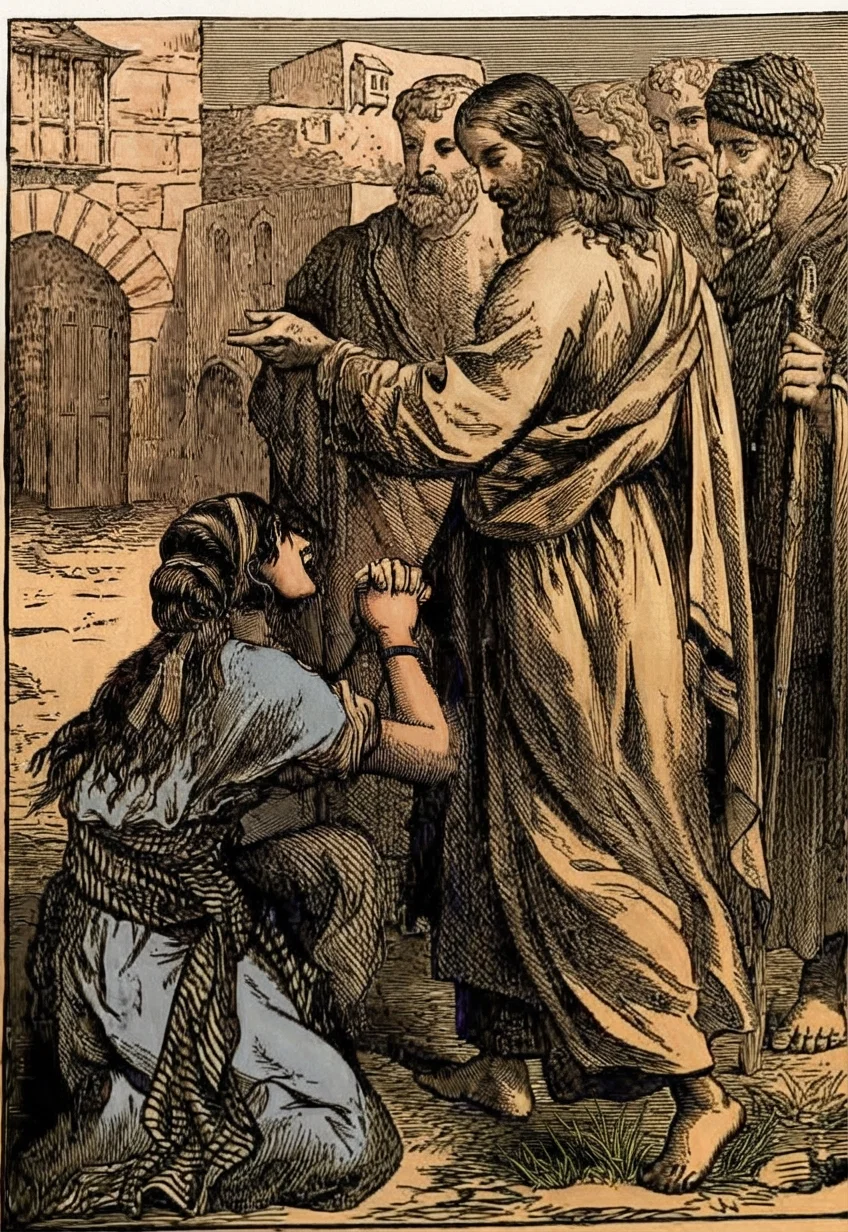
THE WOMAN OF CANAAN.

“THEN Jesus went thence, and departed into the coasts of Tyre and Sidon.” Here Jesus hoped to find the rest and quiet that his human nature needed. Tyre and Sidon were not like Jerusalem, where every one knew of Christ’s wonderful works; nor like Galilee, where multitudes followed him daily. He hoped that where his work was not so widely known he might find retirement. But this was not his only purpose in taking this journey.
“Behold, a woman of Canaan came out of the same coasts, and cried unto him, saying, Have mercy on me, O Lord, thou Son of David; my daughter is grievously vexed with a devil.” The people of this district were of the old Canaanite race. They were idolaters, and were despised and hated by the Jews. To this class belonged the woman who now came to Jesus. She was a heathen, and was therefore excluded from the advantages which the Jews daily enjoyed.
This woman had heard of a wonderful prophet, who, it was reported, healed all manner of diseases. As she heard of his power, hope sprang up in her heart. Inspired by a mother’s love, she determined to present her daughter’s case to him. It was her resolute purpose to bring her affliction to Jesus. He must heal her child. She had sought help from the heathen gods, but had obtained no relief. And at times she was tempted to think, What can this Jewish Teacher do for me? But the word had come, He heals all manner of diseases, whether those who come to him for help are rich or poor, and she determined not to lose her only hope.
Christ knew this woman’s situation. He knew that she was longing to see him, and he placed himself in her path. By ministering to her sorrow, he could give a living representation of the lesson he designed to teach. For this he had brought his disciples into this region. He desired them to see the ignorance existing in cities and villages close to Judea. Those who had been given every opportunity to understand the truth, were without a knowledge of the needs of those around them. No effort was made to help those in darkness.
The Jews thought themselves superior to any other people because they were the descendants of Abraham. No others, they thought, had a right to the promises or the love of God. They had been specially blessed by the Lord, but it was that they might in their turn be a blessing to others. But this they had lost sight of. In their pride and self-sufficiency they built a wall between themselves and the surrounding nations. But with all their advantages, the Jewish priests and rulers were ignorant of the Scriptures. They failed to see their true import. They stood in important and responsible positions, as the leading men of the nation, but they were in need of understanding the first principles of pure and undefiled religion. They should have been willing to minister to those around them, but they passed by on the other side, unheeding their wants.
Christ did not immediately reply to the woman’s request. He received the importunities of this representative of a despised race in the same manner as the Jews would have done. In this he designed that his disciples should be impressed with the cold and heartless manner in which the Jews would treat such a case, as evinced by his reception of the woman, and the compassionate manner in which he would have them deal with such distress, as manifested by his subsequent granting of her petition.
But, altho Jesus did not reply, the woman did not lose faith. As he passed on, as if not hearing her, she followed him, continuing her supplications. Annoyed by her importunities, the disciples asked Jesus to send her away. They saw that their Master treated her with indifference, and they therefore supposed that the prejudice of the Jews against the Canaanites was pleasing to him. But it was a pitying Saviour to whom the woman made her plea, and in answer to the request of the disciples, Jesus said, “I am not sent but unto the lost sheep of the house of Israel.” Altho this answer was in accordance with the prejudice of the Jews, it was an implied rebuke to the disciples, which they afterwards understood as reminding them of what he had often told them,—that he came to the world to save all who would accept him.
The woman urged her case with increased earnestness, bowing at Christ’s feet, and crying, “Lord, help me.” Jesus, still apparently rejecting her entreaties, according to the unfeeling prejudice of the Jews, answered, “It is not meet to take the children’s bread, and to cast it to dogs.” This was virtually asserting that it was not just to lavish the blessings brought to the favored people of God upon strangers and aliens from Israel. This answer would have utterly discouraged a less earnest seeker; but the woman saw that her opportunity had come. Beneath the apparent refusal of Jesus, she saw a compassion that he could not hide. “Truth, Lord,” she answered; “yet the dogs eat of the crumbs which fall from their masters’ table.”
Jesus had just departed from his field of labor because the scribes and Pharisees were seeking to take his life. They murmured and complained, they manifested unbelief and bitterness, and refused the salvation so freely offered them. Here Christ meets one of an unfortunate and despised race, that has not been favored with the light of God’s Word; yet she yields at once to the divine influence of Christ, and has implicit faith in his ability to grant the favor she asks. She begs for the crumbs that fall from the Master’s table. If she may have the privileges of a dog, she is willing to be regarded as a dog. She has no national or religious prejudice or pride to influence her course, and she immediately acknowledges Jesus as the Redeemer, and as being able to do all that she asks of him.
The Saviour is satisfied. He has tested her confidence in him, and he now grants her request, and finishes the lesson to the disciples. Turning to her with a look of pity, he said, “O woman, great is thy faith; be it unto thee even as thou wilt.” From that hour her daughter became whole. The demon troubled her no more. The woman departed, acknowledging her Saviour, and happy in the granting of her prayer.
This was the only miracle that Jesus wrought while on this journey. It was for the performance of this act that he went unto the borders of Tyre and Sidon. He wished to relieve the afflicted woman, and at the same time to leave an example in his work of mercy toward one of a despised people, for the benefit of his disciples when he should no longer be with them. He wished to lead them from their Jewish exclusiveness to be interested in working for others besides their own people.
This act opened the minds of the disciples more fully to the labor that lay before them among the Gentiles. They saw a wide field of usefulness outside of Judea. They saw souls bearing sorrows unknown to those more highly favored. Among those whom they had been taught to despise were souls longing for help from the mighty Healer, hungering for the light of truth, which had been so abundantly given to the Jews.
Afterward, when the Jews turned still more persistently from the disciples because they declared Jesus to be the Saviour of the world, and when the partition wall between Jew and Gentile was broken down by the death of Christ, this lesson, and similar ones which pointed to a Gospel work unrestricted by custom or nationality, had a powerful influence upon the representatives of Christ in directing their labors. MRS. E. G. WHITE.

GO YE; PREACH. NO. 2.

TO PREACH, first of all get a hearing. It would be a farce to begin without an audience of at least one. To get this hearing, the first requisite is to arrest the attention by something exhibited in some way, which shall answer to the cry of human need. This involves a life, a testimony, an example, helpfulness of just the sort that is required to meet the need,—such helpfulness as shall compel confidence, where there is none, restore confidence which has been lost, and keep it when once found. This demands Christ in us, and Christ in us must have at least as good a chance as he did in himself, to express the life and truth.
It took Christ the largest part of his life to get ready to speak, and to find ears to hear. We are not quite sure that we know what he was doing all those years which are covered with silence, but we can at least believe that he was doing just what experience has made so clear that we must do, before we can follow him in practical work for the lost, that is, getting acquainted with the world, which he had come to save, the enemies he must meet, and the resources upon which he must depend. Our resources are those that he garnered for us during those days, and stored up in the Holy Spirit and the Word. The enemies which we must meet are the same that he overcame for us; the field is the same field of the world, with precisely the same needs; and we must take the Gospel to it, go into it, preach by life and love and self-sacrifice, as he did. We must live before we talk; he did. Any child must do that, and the words must be the expression of the life, or they will amount to nothing. Some preachers are all talk and no life; some are all life and no talk. The last are the first, but are not all that is required. The effective preacher both lives and talks. We must not ourselves choose our rostrum, forum, or sanctuary, and stand and ring, or sing, or call, to collect an audience; but the command is, “Go ye.” Perhaps, very probably, we must go first simply to observe and “take our bearings,” to walk quietly about into places of business, maybe into junk shops, saloons, disreputable haunts of all sorts; because they are part of the field.
If there are any clean, respectable places which have maintained such a character until we came and found them, they can get along without us better than we can without them. Any such will be invaluable as a base of some sort of supplies. Some preachers shrink from the very needy, the disreputable, the outcast; but no fields are so productive as these. It is still true that publicans and sinners press into the kingdom before the scribes and Pharisees. There are timid preachers who are afraid of losing reputation, of offending public sentiment, and violating good taste; but the man or woman who is really charged with a message from God does not need to stop to consider these things, but can well afford to go straight on, for these are among the things which, if “committed unto him,” he is perfectly able to take care of for us. 2 Tim. 1:12.
We can not go anywhere without leaving something which we may have valued, and which we must so absolutely trust some one to take care of for us, that it shall not be a burden to us as we remember it. It may be only a grave, but if we can not trust it to some caretaker, even if it be “only God,” and so really leave it, we can not go; or, if we must go, it will be with weakness and not strength. It is therefore necessary that we should know that God will take care of all things for us, before we go and preach to any one. Otherwise, we shall not be strong enough to stand, and to withstand the efforts which will be made to silence us, or drive us from the field.
We must also be able to trust God to overcome all opposition for us, or we shall faint away spiritually, and be a dead weight on the hands of any good work. But with faith in his keeping, we can go on regardless of opposition, until he shall be able to manifest himself through us in such a manner as to make even our enemies to be at peace with us; as they must be when they find out that they really need what we have.
The secret of a successful preacher, either by life or word, is to allow God to make him indispensable to those to whom he is sent. Men will not quarrel with, or bitterly oppose, anything which they recognize as necessary; and in so far as the needy world finds that we, as the servants of God, are truly ministers of those things which do relieve its sorrows, it will be kind to us, at least as long as it can use us.
There is much in human nature which rebels against being used; but, as dispensers of the Gospel, we must be glad of the opportunities which such a disposition of us will afford. In making a channel for water from a great reservoir to the homes of a city, much that would seem but superfluous conduit must be used to maintain the connection. The pipes must sometimes pass under very unclean places, and long distances without being broken in upon by a single tap, and must also often find them self-drawn upon for no good purpose. The precious tides with which they are filled may be left to run out into gutters, to make foulness all the more foul. They will be drawn upon by the mercenary, the ungrateful, the vicious; but for the sake of the homes that could not exist without the water which they carry, they must submit to all the waste and misuse. So we must be ready and glad to be used by man, as well as God, as conductors of truth and helpfulness.
Some are afraid that they will not be able to accomplish anything if they do go, and so hold back and remain shut in with themselves to perish spiritually. Such fearfulness is from unbelief, for when God has said, “Go ye,” to any servant of his, he has also said, that his Word shall not return unto him void, but shall accomplish that whereunto he has sent it. Isa. 55:11. Beside all these assurances of faith, we are taught that “our God shall fight for us,” so that we may be left at peace to go on.
I know of a W. C. T. U. woman who had a remarkable illustration in her own experience of all these principles to which I have called attention. The command, “Go ye,” had come to her, and she had gone, leaving much behind her for God to care for, while she found daily much more which would have taxed the “strong man, armed.” She was pursued by a vile and relentless enemy, so that even her life was in danger, altho she did not know it until months afterward; for she had learned to go on and ask no questions. Her home was moved at three different times to get her into a place of safety. For more than six months she had a self-constituted body-guard of men, who had been converted in her work. This patrol never lost sight of her while she was out on the street. They kept themselves at a respectful distance, but maintained a constant watch over the house where she lived. But at last God himself undertook for her, and worked out the problem of how to make a powerful and malignant enemy into a friend, and so render especial visible protection anywhere unnecessary. To accomplish this he simply led her out one morning, on a certain errand, so that she was on the scene of a terrible disaster, in which ten men lost their lives—eight at once, instantly, the other two being brought into the hotel, on the steps of which she was standing. One of the surgeons, in passing, recognized her, and she was called in, and accosted with:—
“I thought I could depend on you.”
“You can,” she replied, “for anything that I can do.”
“Then take that head, and find the face of it, if you can,” was the order.
She ripped the sleeve from the right arm back to the elbow, plunged her hand into a pail of hot water which had been brought, with cloths and sponges, and went to work on the unconscious form on the bed. The other man was groaning across the hall, and all night, until he died. She went between the two; then she devoted herself to the survivor for the next five days and nights.
This disaster had cast a shadow over the entire city, and thousands of both high and low, good and bad, waited with intense anxiety for the result of the efforts to save this tenth man; and, of course, the woman who had taken up the work, just as his own mother might have done, was in every thought.
A surgical operation was to be performed for him, whereat he laid his hand on her, and said:—
“Will you stay with me?”
“I will,” she said.
“All through?”
“I will, all through.”
“Honor bright?”
“Honor bright.”
So she stood at his bed-head, with her hand where he himself placed it, on his head. When he had gone into the ether sleep, the surgeon said to her:—
“Now you can be excused.”
“But I can not be excused,” she replied.
“But you ought to. You had better go.”
“Did you hear what he asked, and I promised?”
“Yes, but he will never know.”
“But I should; and I should expect to be forsaken in my extremity if I did not keep that promise. Do not notice me. If I faint, let me lie; but I shall not faint.”
She had only one thought, which was to honestly meet the need of that poor boy who had trusted her; but God made of it an engine for the slaughter of the hatred which had pursued her with such malignity, as well as of winning some of those hostile souls to the love of that Christ whom she had preached.
MRS. S. M. I. HENRY.
Sanitarium, Battle Creek, Mich.

SPIRITUAL MANNA.

How MANY Christian pilgrims would never have seen anything of the spiritual manna and the spiritual stream from the rock, had God listened to him when, with fear and trembling, he besought God not to lead him into the desert!—Thrummacher.

Faith and Obedience

"Not to trust Christ is as presumptuous as to disobey him." It is to disobey; for faith is one of the "weightier matters of the law."

God’s Grace and Gifts

"THINK not to deserve His grace or buy His gifts; let His nature, which is love, be His reason for blessing you."

Christ’s Easy Yoke

“CHRIST’s yoke is so easy that there is no rest without it.”

Work for a Living

"THOSE who work for a living, get nothing else."
Continue reading: THE APOSTLES AND THE LAW OF GOD