Your ShelfYour Projects

Signs of the Times, Vol. 23, No. 35.

Editorial
Earlier text: THE APOSTLES AND THE LAW OF GOD

CHRIST'S SECOND COMING.

Acts 3: 19-21: All the prophets have spoken of Christ's coming.
Acts 1: 9-11: The angels said he would come again.
John 14: 1-3: Christ himself said, "I go to prepare a place for you" and "I will come again, and receive you unto myself."
Matt. 24: 30; 26: 64: Sitting on the right hand of power, he will come in the clouds of heaven, and all the holy angels with him.
Rev. 1: 7: "Every eye shall see him."
1 Cor. 15: 51, 52; 1 Thess. 4: 16, 17: When he comes, those who sleep in Jesus arise, the living righteous are changed, and together they meet the Lord in the air.
2 Peter 3: 14: "Wherefore, beloved, . . . be diligent that ye may be found of him in peace."
1 John 3: 3: "And every man that hath this hope in him purifieth himself, even as he is pure." LENA E. HOWE.

Question Corner

"Enquire, and make search, and ask diligently."
NOTE.—We wish those who ask questions to take particular notice: (1) Only such questions will be answered here as we believe to be of general interest and information. (2) We can not undertake to explain from four to a dozen scriptures, as in one sentence we are often requested to do. (3) Do not ask to "explain" a certain text or passage. State clearly the point in question. (4) Give full name and address, not for publication unless desired, but as evidence of good faith, and to give us the privilege of replying by letter if deemed best. (5) Unsigned communications of any kind find the quickest way to the waste-basket. (6) It is always well to inclose stamp. (7) "Foolish and unlearned questions avoid," also those that minister to mere curiosity. (8) Study the Scriptures yourselves.

No. 627. A Question of Genealogy.

WHY is it that the genealogy, running from David to Christ, as given in the first chapter of Matthew, does not agree with that given in the third chapter of Luke? C. C. B.
For the reason that Matthew traces Christ's lineage from David through Solomon to Joseph, the legal father of Jesus, while Luke traces his lineage from David through Nathan on Mary's side to Mary. Joseph is named because he is the husband. The one line is that of Joseph, the other that of Mary. By study it will be seen that they meet and touch on the stream of time.

No. 628. First-born from the Dead.

WHY is Christ called the "first-begotten from the dead" when many were raised before him? G. J. H.
"First-begotten of the dead" occurs in Rev. 1:5. Better as in the Revised Version, "first-born of the dead." The term "first" is used to indicate pre-eminence rather than priority, because Christ was the First-born, the One by virtue of whose death and resurrection all will be raised. So the Lord calls Israel his first-born (Ex. 4:22), tho in point of time Esau was born first. Ephraim is also so called (Jer. 31:9), tho Manasseh was first in point of time. On account of Christ's character the Lord says, "I will make him my first-born." Ps. 89:27. See Col. 1:18.

No. 629. The Ten Commandments—Sabbath-keeping.

WILL you please inform me in the Question Corner (1) if 1 Cor. 1:9 refers to the Ten Commandments; and (2) would I be breaking the law if I should take my gun and shoot a hawk that is carrying my chickens off? P. B.
1. There is nothing in 1 Cor. 1:9 which particularly refers to the Ten Commandments, other than this, that God called us to obedience, to be in harmony with him, or to the fellowship of his Son. The expression of God's will in letter is the Ten Commandments and in life is Jesus Christ. There may be a mistake in the reference of our querist.
2. If it were the province of men to give a dogmatic answer to the second question, many might answer yes, many no. We should say yes. The Lord says, "Remember the Sabbath day to keep it holy." This is explained in Isa. 58:13. A good question to ask would be, What would Jesus do? One example in shooting on the Sabbath might lose a soul, worth more than all the chickens in the world. Seek God's Word, pray for his Spirit, and act for his glory. The Lord will guide aright in all details if we are willing to be guided. But let us be sure of this, and not interpret his law to our advantage.

No. 630. Image of Daniel 2.

WHAT nations represent the metallic image of Daniel 2, especially what nations represent the ten toes from their first until now, more especially now? T. L. S.
The head of gold represents Babylon down to B.C. 538; the breast and arms of silver, Medo-Persia to the year B.C. 331; the belly and thighs of brass to the knees represent Grecia to the year B.C. 161; the legs of iron represent Imperial Rome to the time of her breaking up in the fourth century; and the mixture of iron and clay represent the divisions of the Roman Empire ever since. The prophecy does not say that the toes represent any nations; if they do, it is probably the ten horns, not yet fully developed, indicated in Rev. 17:12.

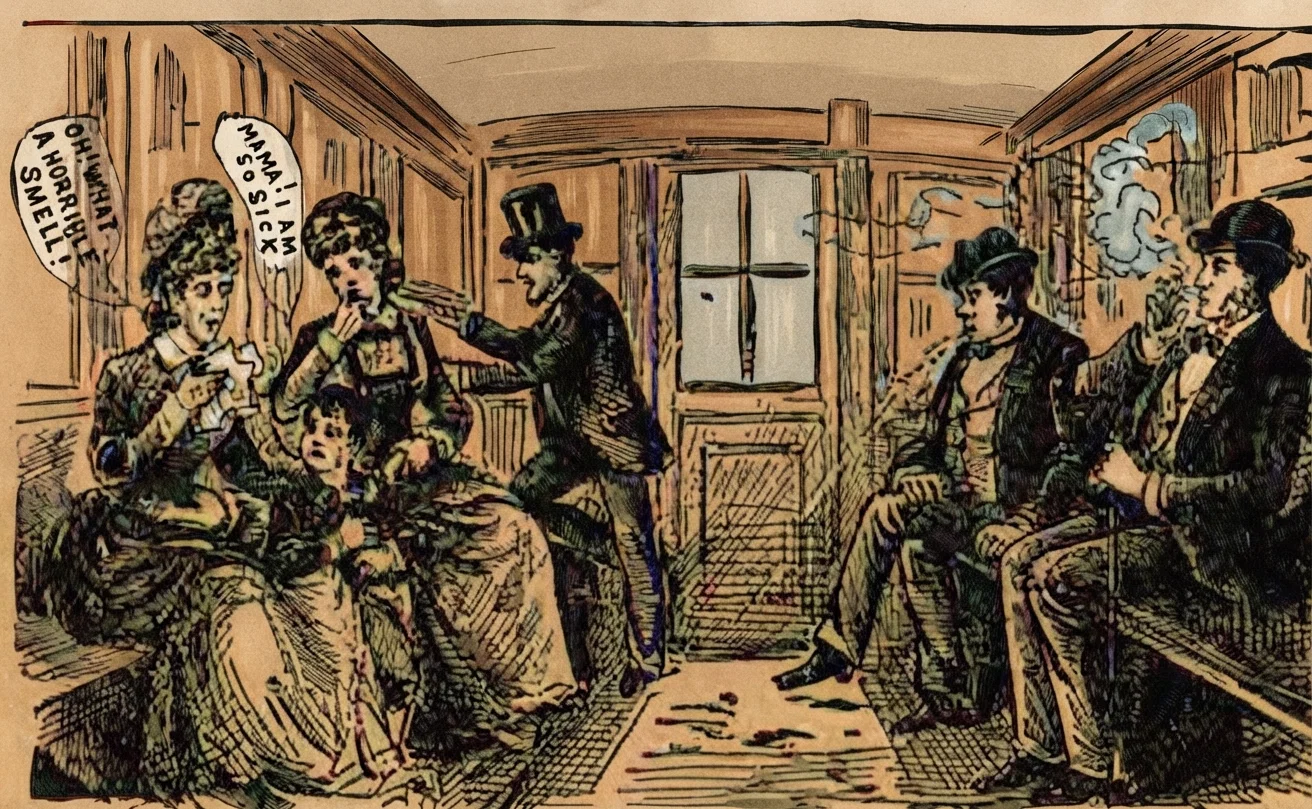
Tobacco Smoke in Streetcars

THE SMOKE NUISANCE.
THE SMOKE NUISANCE.
OUR artist has given us in the above picture an illustration of what exists somewhat less frequently than in former times, but still exists, and may be encountered in almost any large city where civilization has carried those relics of barbarism—the pipe, the cigar, and the quid. The engraving is supposed to represent the inside of a street-car or omnibus, in which two of the male occupants are paying their respects to the smoky god, Nicotiana, regardless of the feelings of their fellow-passengers. One complacently puffs his "long nine," making the air blue with its poisonous fumes, while the other as deliberately defiles himself and his surroundings by rolling the noxious weed beneath his tongue, and expectorating its stinking juice upon the floor. The hardened devotees of the weed take no notice of the nauseating effects of the poison upon the ladies who have the misfortune to be their fellow-passengers, or the little boy who protests against the vile smell.
According to the Cincinnati Times, a citizen of that place fell dead in a street-car, poisoned by the dense fumes of tobacco smoke with which the car was filled. "He was an occasional sufferer from heart disease, and the trouble was so aggravated by the suffocating smoke of the car that he died after breathing it a few minutes. The car in which he rode had only one compartment for men, women, and children, and the smokers were allowed full sway in it. Two other passengers were overcome by the tobacco fumes."
If human beings possess one inalienable right more sacred than any other, it is the right to breathe the atmosphere of heaven, pure, free, and unadulterated. No man has any better right to puff tobacco smoke into the air I am about to breathe than to defile the water I am about to drink, or to sit down beside me at the dinner table and sprinkle upon the food I eat, vile and loathsome substances, obnoxious to the senses and deleterious to the health.
Did any of you smokers ever attempt to imagine the felicity(?) of a lady or gentleman to whom the odor of tobacco is sickening and most repulsive, following in your wake on a still summer evening, while you puffed with self-complacency and intense satisfaction the, to you, fragrant Havana? Or did you ever endeavor to picture in your imagination the delightful(?) sensations which must be experienced by a sensitive man or woman, who has never offered incense to the smoky god, when compelled to ride in a close cab, on a seat opposite or beside you, while you rolled between your lips the stump of a "cold cigar"? Please put yourself in that man or woman's place; and see if you will not decide with unhesitating promptness that the tobacco-user is a nuisance which should be abated.
Tobacco smoke is excellent in its place. The writer set an old smoker going in a greenhouse one day with good effect. Every living thing that was able to travel left for parts unknown, and the few that were not able to get away, died of nicotine poisoning,—all except the smoker himself, who was tough and nicotine proof. Tobacco is to be recommended to kill vermin of all sorts. Christopher Columbus thus described the original smokers: "We saw the naked savages twist huge leaves together and smoke like devils"—not a very interesting experiment it would seem, but one which possesses such a strange fascination that since the description by Columbus nearly one-half of the civilized world have been following the example of these naked savages.
King James, in his "Counterblaste to Tobacco," very well says:—
"And now good Countreymen let us consider what honour or policie can mooue vs to imitate the barbarous and beastly manners of the wilde, godless, and slauish Indians, especially in so vile and stinking a custom. Why doe wee not as well imitate them in walking naked as they doe? In preferring glasses, feathers, and such toyes, to golde and precious stones, as they doe? Yea, why doe wee not denie God and adore the Deuill, as they doe?"
This royal anti-tobacco agitator stigmatizes the use of the weed in a most vigorous manner, pronouncing it "a custome lothsome to the eye, hatefull to the nose, harme-full to the braine, dangerous to the lungs, and in the black stinking fume thereof, neerest resembling the horrible Stigian smoake of the pit that is bottomlesse."
Passing a London cigar store one day, the writer noticed a flaming placard announcing, "The Devil's Own," as the name of a new brand of cigars just produced by the manufacturers. The name impressed him as exceedingly suggestive, and he wondered that so appropriate a cognomen had not before been utilized. The cigar is undoubtedly one of the devil's favorite instruments for converting boys who might become respectable citizens and useful men, into loafers, vagabonds, drunkards, and criminals of every description.
Notwithstanding the repeated exposures which have been made of the dangers to life and health incurred by the use of the filthy weed, the number of its devotees seems to be constantly upon the increase. The tobacco habit must be regarded and treated as a moral disease which has fastened itself upon society,—one of "the devil's own" means for degrading and depraving humanity. How perverted, indeed, are the instincts of the human being who deliberately defiles the image of his Maker till nearly every trace of the divine workmanship is obliterated by the scourge of the stinking weed, and he becomes fit only to be labeled "the devil's own"!
If smokers will persist in defiling themselves, and in spoiling the pure air, adulterating its life-giving oxygen with a deadly vapor, offensive to the natural instincts of man and beast, let them be compelled to indulge the preciouspoison by themselves, apart from the rest of humankind. Let them together enjoy the pleasures of the pipe, cigar, and cigaret.

WHERE'S MOTHER?

BURSTING in from school or play, This is what the children say; Trooping, crowding, big and small, On the threshold in the hall— Joining in the constant cry, Ever as the days go by, "Where's mother?"
From the weary bed of pain This same question comes again; From the boy with sparkling eyes, Bearing home his earliest prize; From the bronzed and bearded son, Perils past and honors won— "Where's mother?"
Burdened with a lonely task, One day we may vainly ask For the comfort of her face, For the rest of her embrace; Let us love her while we may, Well for us that we can say, "Where's mother?"
Mother with untiring hands At the post of duty stands, Patient, seeking not her own, Anxious for the good alone Of the children as they cry, Ever as the days go by, "Where's mother?"
—Good Housekeeping.

THE SURE REWARD OF HONOR.

THE boys attending the school at Austin used to see Arthur Watson driving a cow to pasture. In the evening he drove her back again, they did not know where, and this was continued for several weeks.
The boys at the school were nearly all the sons of wealthy parents, and some of them were mean enough to look with disdain on a classmate who had to drive a cow. With admirable good-nature Watson stood all their attempts to annoy him.
'I suppose, Watson,' said Jackson, one day, 'I suppose your father intends to make a milkman of you.'
'Why not?' asked Watson.
'O, nothing! Only don't leave much water in the cans after you rinse them—that's all.'
The boys laughed, and Watson, not in the least mortified, replied:—
'Never fear. If ever I am a milkman, I'll give you good measure and good milk.'
The day after this conversation there was a public examination, at which many of the people from the neighboring towns were present, and prizes were awarded by the principal.
Both Watson and Jackson received a creditable number, for in respect to scholarship they were about equal.
After the ceremony of distribution the principal remarked that there was one prize, consisting of a gold medal, which was rarely awarded, not so much on account of its great cost as because the instances were rare which rendered its bestowal proper. It was the prize of heroism. The last medal was awarded about three years before to a boy in the first class who rescued a poor girl from drowning. The principal then said that, with the permission of the company, he would relate a short anecdote.
'Not long since, some boys were flying a kite in the street, just as a poor lad on horseback rode by on his way to the mill. The horse took fright and threw the boy, injuring him so badly that he was carried home and confined some weeks to his bed. Of the boys who unintentionally caused the disaster, none followed to learn the fate of the wounded lad. There was one boy, however, who witnessed the accident from a distance, who not only went to make inquiries, but stayed to render service. This boy soon learned that the wounded boy was the grandson of a poor widow, whose sole support consisted in selling the milk of a cow, of which she was the owner. She was old and lame, and her grandson, on whom she depended to drive her cow to the pasture, was now helpless with his bruises.
'Never mind, good woman,' said the boy; 'I will drive the cow.'
'But his kindness did not stop there. Money was wanted to get articles from the apothecary.
'I have money that my mother sent me to buy a pair of boots with,' said he, 'but I can do without them for a while.'
'O, no!' said the woman, 'I can't consent to that; but here is a pair of heavy boots that I bought for Thomas, who can't wear them. If you would only buy these we should get on nicely.'
'The boy bought the boots, clumsy as they were, and has worn them up to this time.
'When it was discovered by the other boys at school that our student was in the habit of driving a cow, he was assailed every day with laughter and ridicule. His cowhide boots in particular were made a matter of mirth. But he kept on cheerfully and bravely, day after day, never shunning observation, driving the widow's cow and wearing the thick boots. He never explained why he drove the cow, for he was not inclined to make a boast of his charitable motives. It was by mere accident that his kindness and self-denial were discovered by his teachers.
'And now, ladies and gentlemen, I ask you, Was there not true heroism in this boy's conduct?
'Nay, Master Watson, do not get out of sight behind the blackboard. You are not afraid of ridicule, you must not be afraid of praise.'
As Watson, with blushing cheeks, came forward, a round of applause spoke the general approbation, and the medal was presented to him amid the cheers of the audience.—Selected.

KILLING BUTTERFLIES.

BY GEO. T. ANGELL
STOPPING at the seashore a few days since we saw a number of interesting little children gathering butterflies, grasshoppers, and other varieties of insects, and fastening them with pins to the side of the hotel, where the poor creatures were writhing and struggling to escape. It was not the fault of the children. They were very young, and knew no better. They did not once dream of the agony endured by these insects, and on being told of it all assented to their being at once killed, and cheerfully stopped further pursuit of them. But it was your fault, fathers and mothers of those children, and one for which God holds you accountable. If you neglect your duties to your children in that period of life when the molding of their characters is in your hands, and they grow up more and more merciless, until in your old age you reap the harvest you have sown, you have no one to blame but yourselves.—Our Dumb Animals.

CRETE.

NO ISLAND of the Mediterranean has of late received so much attention as Crete, on account of the revolution that has for some time been in progress. While daily reading of the troubles that the island is now undergoing, let us briefly glance at its history, to become more familiar with it.
About seventy-five miles southwest of Rhodes, Crete lies, in the same latitude as the island of Cyprus, and is the southernmost portion of Europe. One hundred and sixty miles long, and varying in width from ten to thirty-five miles, it forms the southern boundary of the Grecian Archipelago. It is mountainous throughout its entire length, the highest peak being Mount Ida, which exceeds 8,000 feet, and is covered with snow nearly the whole year. It is not clear who first peopled Crete, but it is known that the Greeks settled here as early as 1300 B.C., or before the Trojan War, and soon after the exodus. Mount Ida figures very largely in Grecian mythology, as being the abode of Saturn, Jupiter, etc.
The climate of Crete is agreeable, and its soil productive of nearly all kinds of grains and fruits; its oranges and lemons are of excellent quality, and so abundant as to furnish almost the whole supply of Greece and Constantinople. The present population is a little larger than that of Cyprus, being about 200,000; nearly all are Greeks, one-fourth of whom are Mohammedans, having accepted Islam for the sake of political advantages at the time of the Turkish conquest. The present population is evidently much smaller than it was anciently. Herodotus states that the island had ninety cities; but now it has four or five, the largest having only fifteen to eighteen thousand population.
Touching the character of the people and the government, Polybius, a Greek historian, born in the third century B.C., states that the history of Crete was almost a continuous account of civil wars and strife; and the subsequent history up to the living present is of the same nature. The apostle Paul in writing to Titus says of them: "One of themselves, even a prophet of their own, said, the Cretians are always liars, evil beasts, slow bellies. This witness is true." Titus 1:12, 13.
Altho torn by internal dissensions, Crete maintained its independence till B.C. 67, when it fell under the growing power of the Romans. In the ninth century it was taken by the Saracens, then by the Venetians, who held it till 1645, when the Turks landed an army of 50,000. The Turks quickly overran the wholeisland, and then laid siege to Candia, which held out for more than twenty years, thus sustaining the longest siege on record. The Turks have found the Cretans hard to manage, and have had many insurrections to quell. As well understood, the present revolution is for the purpose of annexation with Greece, the mother country. When the powers offered the Cretians autonomy, or home rule, they objected, saying they wanted union with Greece or death. But, like Greece, they are helpless, and will have to accept what the powers conclude to give them, if the powers can ultimately agree. At present, they seem to have practically reached an agreement in favor of autonomy, but this can not be considered final till actually in operation. The present prospects are that Mr. Droz, an ex-member of the Swiss National Council, may be nominated for governor of Crete.
In the days of Paul, Christianity found its way to Crete, and several churches were established there, for in writing to Titus, the apostle says: "For this cause left I thee in Crete, that thou shouldest set in order the things that are left undone [margin], and ordain elders in every city, as I had appointed thee." Chap. 1:5. Titus was in the island when Paul wrote his epistle to him from Macedonia. In the account of Paul's last voyage to Rome, the island of Crete is mentioned several times. It was while trying to secure a good wintering place in Crete, that the ship was caught in the storm called euroclydon (united winds), and driven about fourteen days, till wrecked off the island of Melita, or Malta, as it is now called.
The same Christianity that was able to convert people of the character of the Cretians in Paul's day is able to convert them to-day. The pure Gospel that Paul preached had been lost when the Turks conquered the island, and the Greeks saw little choice between what was then called Christianity and Mohammedanism. When the Gospel in its purity is once more preached in Crete, we shall see some of the worst rescued. When speaking of the closing message of the Gospel, the prophet says, "Surely the isles shall wait for me." Isa. 60:9. In the same chapter we are commanded to "arise and shine," and then follows the promise, "And the Gentiles shall come to thy light." Who will heed the command? While many can not go in person, it is the blessed privilege of all to have a part in the work in this field by furnishing means to send some that can go. The Lord takes notice of the smallest thing done in his name. Let us send the Gospel to the Cretians, and in this way we shall do more for their welfare and peace than all the powers of Europe. H. P. H.

A GOOD WATCHMAN.

A CITIZEN of Kalamazoo, Michigan, says Our Dumb Animals, has a valuable parrot. On three different occasions he has saved the house from being burglarized. The last time was on a recent night. The burglar got the door unfastened, but when he opened it, the parrot asked, in a stern voice: "Hello there! What's the matter?" The burglar didn't stop to answer.

THE HOLY TEACHER.

Nor doth it lessen what He taught, Or make the Gospel Jesus brought Less precious, that His lips retold Some portion of that truth of old; Denying not the proven seers, The tested wisdom of the years; Confirming with his own impress The common law of righteousness. We search the world for truth; we call The good, the pure, the beautiful, From graven stone and written scroll, From all old flower fields of the soul; And, weary seekers of the best, We come back laden from the quest, To find that all the sages said Is in the Book our mothers read, And all our treasures of old thought In His harmonious fulness wrought Who gathers in one sheaf complete The scattered blades of God's sown wheat, The common growth that maketh good, His all-embracing Fatherhood. —J. G. Whittier.

Temptations and Self-Confidence

TEMPTATIONS are a file which rub off the rust of self-confidence.—Fénelon.

TRIUMPHING OVER DIFFICULTIES.

THERE lives in Brooklyn a remarkable blind woman, who, tho totally deprived of sight, conducts successfully a large business. She became blind when a little girl, through disobeying her mother, who told her not to wear a certain dress. She put it on, nevertheless, and, finding that it needed a slight alteration, was using a pair of scissors upon it when a point entered an eye. The unfortunate girl became the friend of Laura Bridgman, and evidently received a share of her fine spirit. She became skilled in music and pushed her own way, until now she has a profitable establishment for the sale of musical instruments, which she manages without assistance. She finds her way alone with no trouble, and even visited alone the World's Fair at Chicago, and made, unaccompanied, a trip through Europe. She devotes her life and her wealth to the training of the blind. How such a history of one who lacks the priceless advantage of sight should put to the blush us sluggish mortals who can see!

SOME FACTS ABOUT THE CHINESE.

THERE is no caste in China such as exists in India. The people, as a whole, are homogeneous, not merely in the sense of being one race, but as to their rights and privileges. The highest positions are open to aspirants from all classes, and instances are given of men rising from the lowest walks of life to fill the highest offices in the land. Their life is somewhat on the plan of the old patriarchal system. They live in clans, and the family lines are very distinctly drawn. Each family has an organization that centers in the ancestral hall, where the tablets of the deceased fathers are placed. A reunion is held at least once a year, about Easter, which is the time for worshiping in the tombs, when, among other things, roast pork is divided among the members as a recognition of their standing. The threat to deprive a man of his piece of pork means that he will be expelled from the clan. At this time arrangements are made for repairing the grave and offering annual sacrifices at the tombs.
The management of the village affairs is usually intrusted to a few men, who, by wealth or literary distinction, have obtained prominence. They are known as the gentry, and it is only through their mediation that obscure members of the clan can bring their suits before the officials or receive redress of injuries. It is also a principle of Chinese law to hold relatives of a criminal in some degree responsible for his crime, so that the whole family is concerned in the conduct of its individual members. A case recently occurred revealing this, among other remarkable facts. A man in a fit of insanity killed his mother. He imagined he saw a mad dog rush into the house, and, snatching up a hatchet, struck it dead. It was his mother. He was arrested; all his property was confiscated, and his family reduced to beggary. After his trial he was executed. Not only was his own immediate family involved in the disaster, but the teacher who first instructed him was so keenly affected by the blight it brought upon him that he committed suicide by taking opium, the theory being that he must have given an evil bent to the young mind intrusted to his care.
Chinese family life is not such as to promote domestic comfort or improve the social side of men. Its one redeeming feature is the respect shown to the aged, but this is carried to such an absurd extreme, and magnified to such a degree, that all other duties are overshadowed. It is of equal importance that the elder should watch over and guard the younger, especially in the time of helpless infancy.
The separation of men and women is a permanent barrier to all true social intercourse. Where circumstances permit, the women are secluded. In the houses of the wealthier people they have their own apartments, into which the men may not enter. Here they spend their time, often in listless idleness, or, if inclined to exertion, in superintending the details of household work, in sewing or embroidering, in dressing their hair and beautifying their countenances, or in cultivating long finger-nails, which they are careful to protect with silver sheathes at night. The eating of water-melon seeds while they gossip is one of the great pastimes of Chinese ladies. What hours have been consumed in this way it would be difficult to compute, but the wearing away and premature decay of two particular teeth on the right side of the mouth so frequently observed, shows how constantly they have been employed for this purpose. Few of them can read, so that their ideas are almost as narrow as the confines of their own apartments.
When a man receives calls from his most intimate friends, his wife and daughters never appear; they may be behind the curtains listening, but remain invisible. When a gentleman invites his friends to dine with him, he hires a room in some eating-house, or engages a boat on the river, where the feast is spread; but such a thing as a party where ladies and gentlemen sit down together would shock their sense of propriety beyond recovery. Their absurd, strict, and stilted ideas of propriety breed an artificial prudery, deprive the men of what they most need,—the refining influence of good female society. The whole system is based upon a low and utterly unworthy estimate of woman. She is regarded as weak and erring, and must be hedged in by these restrictions lest she bring dishonor upon the family. The crucial test of any civilization is found in its estimate and treatment of women; and, judged by the high standard with which we are familiar, China falls wofolly short of the mark.—Congregationalist.

OUR WORK AND WORKERS.

Four converts at Chama, N. M., are reported by Elder G. W. Anglebarger.
The Ohio Tract Society office has been removed from Cleveland to Marion.
At the close of the recent camp-meeting at Hildebrand, N. C., thirteen candidates were baptized by Elder N. W. Allee.
The Santa Cruz, Cal., dailies give quite copious reports of discourses delivered by Elder H. F. Courter in Temperance Hall.
Elder W. C. White arrived in this city from the east on the 26th ult., and on the evening of the 4th inst. left for Vancouver, B. C., to take the steamer for Australia on the 8th.
Brother J. P. Lorenz, formerly a licentiate of New York, was ordained to the Gospel ministry by the Texas Conference, at the recent session at Fort Worth. Bro. Lorenz had also labored in some of the western States.
As visible fruit of labor at Lake Benton, Minn., ten have taken their stand to keep the commandments of God. A Sabbath-school of sixteen members was organized. Brethren C. H. Parker and O. O. Bernstein were the laborers.
The recent camp-meeting at Springfield, Ohio, was attended by about 600 of our people, and twenty-five persons were baptized. Elder R. C. Porter was elected president of the conference and tract society; R. R. Kennedy, vice-president; E. A. Merriam, secretary; D. K. Mitchell, treasurer; and Estella Housler, corresponding secretary.
The case of Brother Henry Bell, of Tupperville, Ont., who was tried for working on Sunday, was dismissed without costs. The justice at first thought to be lenient and fine him only $5.00 and costs, but when he learned that an appeal would be taken he dismissed the case. He was evidently afraid that the trial would not stand the inspection of a higher court.
At the close of the southern California camp-meeting, Elder A. J. Breed was called by telegraph to Neillsville, Wis., on account of the illness of his wife, who, it was stated, could not long survive. Sister Breed had gone there on account of the sickness of her mother, who died soon after her arrival. Brother Breed and son left for Wisconsin on the evening of the 31st ult.
A letter from headquarters of the International Religious Liberty Association, 39 Bond Street, New York City, says: "Ten cases of prosecution for violation of Sunday laws have been reported to us within the past three or four months. These mostly resulted favorably for the defendants, but in a few instances the cases have resulted in imprisonment or labor on the public roads. The case last reported is that of Brother McKelvy, of Manitoba, who is now in jail for Sunday work."
Elder H. M. J. Richards sends these notes of his work in Iowa: "As a result of my meetings at Hanley and Brittian, near Winterset, fourteen accepted the third angel's message, and others were interested in the truth. Brother C. A. Hansen assisted me at these places, and two Sabbath-schools were organized. I have just closed a seven weeks' course of tent-meetings at Winterset, and as a result ten new ones have taken their stand to keep the commandments of God, and to prepare for the coming of his Son from heaven. Brother W. E. Frederick, who was with me, has gone to Colorado. I now have the tent pitched at Macksburg, and have it filled to overflowing with attentive hearers."
Sister Stella E. Colvin writes to the Minnesota Worker concerning the work in the island of Trinidad, and we cull these items referring to the medical missionary work:—
"The medical missionary work has had a hard struggle, but is beginning to look brighter. I have always had plenty to do, but had to work so carefully lest I antagonize the doctors. But the Lord has guided it so that they are beginning to be friendly, and the leading one here, an American, who has been here more than thirty-five years, is becoming much interested. This is through patients of his I have treated. Our plan is to open a 'medical home' for ladies. This is in demand here, as there are but few doctors and no nurses outside of Port-of-Spain, and the families of the estate, owners, managers, etc., when ill are obliged to come to the hotels or the hospitals, which is not pleasant, and few besides the poor will go there. There are now three cases who would be very glad to come to us, but it requires a little outlay of means to start, as rent is very high, and also furniture. Who would like to have an interest in such a work? I would have the support and help of at least one physician, and he the very best in the island. This work is highly appreciated here so far as it has gone. One gentleman whose sister was rescued from an untimely death by these God-given principles of healing, said to her, 'Surely the Lord sent that nurse here; I never saw anything more clearly from the hand of the Lord.'"

PERIODICALS WANTED.

M. C. GUILD, 75 Ossington Avenue, Toronto, Ont., desires clean late copies of the SIGNS and Instructor for missionary work. Send post-paid.
THE Florida Tract Society is in need of late copies of the SIGNS, Instructor, and Our Little Friend, to be used in missionary work. Address, post-paid, Josephine Grannis, box 508, Orlando, Fla.

The Sabbath School

International Series.

LESSON XIII.—SABBATH, SEPTEMBER 25, 1897.

REVIEW.

Lesson Scripture, Acts 1:1 to 8:4, R. V.

QUESTIONS.

1. WHAT two promises are recorded in chapter 1?
2. To what is the whole of the second chapter devoted?
3. Into what two sections is the third chapter naturally divided?
4. Of what is the fourth chapter chiefly a narration?
5. Name the two leading features of the fifth chapter.
6. What is the main subject of the sixth chapter?
7. What do we have in the seventh chapter?
8. Where do we find the promise of the Holy Spirit?
9. Where is the direct promise of Christ's second coming?
10. Repeat the words of this promise, and tell what special features of Christ's coming it presents.
11. Give an account of the events of the day of Pentecost, and present in their order the points in Peter's discourse.
12. Where do we find the statement that "whosoever shall call upon the name of the Lord shall be saved"?
13. In the chapters that we have studied, how many quotations are there from the Psalms? Name them, tell where they originally occur, and state the purpose for which they are quoted.
14. What two texts show that the writings of the prophets are the Word of God?
15. What are the words which show the covenant that God made with the fathers? How many does that covenant with Abraham concern?
16. For what purpose does God bless them?
17. What striking instance is given of the power of the name of Jesus? Through what is its power manifested?
18. Where and in what connection does the statement occur that there is no salvation except in the name of Jesus?
19. State the practical use to us of the record of the healing of the man who was lame from his birth.
20. By what power was the early church kept clear of hypocrites?
21. Where do we find the statement that repentance, as well as forgiveness of sins, is a gift from God?
22. How did the apostles feel when they were persecuted?
23. Give the proof that the hope of the people of God has always centered in the resurrection.
24. Give an outline of Stephen's discourse, and state the thought that runs through it all.
25. What was the result of the attempt to crush out the truth by persecution?

NOTE.

These review questions, it will be seen, are only representative, and can be added to indefinitely. The faithful student will not rest satisfied until he can at will call up any portion of Scripture that has been passed over, or can think, without interruption, through the whole from the beginning.
Continue reading: The Sunday School