FARMER BELL ate with a keen relish his supper of feathery griddle cakes, well sweetened with maple syrup. He didn't notice that the tablecloth was snowy white, and the glasses and china were polished and lintless. He didn't stop to tell poor, tired-looking Mrs. Bell that she was the best cook in York County. He knew it, and boasted of it away from home; but then it wasn't his way "ter speak out a-praisin' his own family." Besides, the griddle cakes and Mrs. Bell belonged to him; and he declared it as his policy "ter keep only the very best uv every kind of stuff, from the woman folks in the house down to the primest pertater patch on the country roads."
Farmer Bell took his hat from its peg in the entry-way and sauntered down the shady walk. At the foot of the garden he found his good neighbor, Deacon Bonus, attending to the weeds and potato bugs just across the garden fence.
Altho the neighbors hadn't met before for several days there was no conventional greeting, not even a "howdy," for Farmer Bell wasn't in any way a conventional man. He claimed to be simply "square," and took pride in the sharp corners that stuck out on every side of his nature. He had no sympathy for any sensitive person who "couldn't stand the hard knocks they got round in his neighborhood." Yet underneath all this rough masonry, inside which he incased himself, there was a soul that scorned every form of double dealing with God or man. He was just as "square" with one as with the other.
"Keeps yer purty lively, deacon, a-huntin' them calikerbacks, eh?"
"Yes, rather," replied the deacon as he snipped at a vine where a strong army of the destructive beauties were huddled.
"There ain't no calkerlatin' on them chaps. They're a nuisance, created for what purpose I never could make out," added the farmer, who went on to explain what he considered to be the best methods of "squelchin' the things."
The neighbors chatted about crops, the weather, and politics, and finally fell to discussing religion.
"They say neighbor Green has got most thru, deacon, an' they've sent for Corliss ter come home from college."
"Indeed! Is it true then that we must spare him? A good, Christian man. Ah, yes, neighbor Bell, there are few like him. 'Twill be pretty sad for the family to lose such a kind, indulgent husband and father. Well, well, this neighborhood can't afford to lose its best men. We haven't many like Brother Green; no, not many," and the deacon's face spoke the sincere sorrow of his heart.
Farmer Bell drummed a bit on the top rail, looked up and down the valley, and said nothing. He was thinking what the deacon would probably have said had he, Josiah Bell, been lying near to death, like neighbor Green. The thought wasn't very pleasant. He knew very well that no one would think of calling him "a good, Christian man," nor "a kind, indulgent husband and father." For the first time in his life the truth forced itself upon him that there would not be much about him that people could praise, except, perhaps, that he was "square," and owed no man a cent. Then a vision of a darkened room, and people moving about softly, with drawn faces, such as are seen always in the house of death, came to him. There in the front room, he, Josiah Bell, was lying, and the neighbors had come in to help at the funeral. Mary and John were there. But somehow there were few tears, if any. He could see the parson, too; but there was no ring of sorrow in his voice. And the singers, why, they sang "Old China" as tho it were a sort of Christmas tune, so gladsome-like and cheery. And, stranger still, he could hear the boys shouting in the playground just beyond his house, not thinking it worth while to stop their sport "because such a disagreeable old codger was out of the way," even long enough to let the funeral go on. Of course this was only a vision, but it meant a great deal to Farmer Bell. It illumined his darkened understanding as no human voice or argument could do. He had spent many an hour with the deacon; when going the round of discussion time after time, the farmer would swing the outer circle with what he believed was this "clincher" that the deacon never tried to combat: "I never could stan' the idee of this livin' in the go-as-you-please style all your lifetime, then buying up a lot of religious stock jest in time for the rise. Ef I'm goin' to ask the Lord ter make a good Christian outer me, I've got to make a bargain with Him as will hold me clus an' fast ter doin' 'bout right ev'ry day. I don't calkerlate thet ef I should git down onto my knees an' tell the Lord what a lot I think on Him, an' how much I'm willin' ter do for Him, an' then go out inter the barn an' trade horses crooked, that He'd be fooled inter believin' thet I'd got religion. An' it's my opinion, deacon, the Lord ain't a-goin' ter trust any man ter go inter heaven, an' send him ter walk thru the golden streets when He knows thet before he'd been there an hour, ner even a half an hour, he'd be down onto his knees a tearin' up the pavements an' tryin' to stuff 'em inter his breeches' pockets."
Still the farmer stood by the fence, and his silence and the frozen-up look on his face forbade the deacon to address him further. The vision of that darkened room would not depart. It stood like an accusing angel, and burned letters of fire into the soul of its victim. His head dropped lower and at last rested upon his arms, crossed above the top rail of the garden fence. A strange tremor shook his frame, like the chill that forebodes sudden sickness.
The deacon questioned, "Are you ill, neighbor Bell?"
No answer; only a movement as of raising his bowed head; then it sunk again upon his arms.
"Do you feel chill, neighbor? The air is damp. Will you throw my coat across your shoulders?" urged the deacon very gently, at the same time taking the garment from a post near at hand and spreading it protectingly upon him.
At last Farmer Bell, as if arousing from deep sleep, raised his head slowly and turned toward the west. Was it the light of the sunset that made his face luminous, and smoothed from his countenance all the hard, bitter lines that the deacon had been wont to see there?
"I'm a rough old feller, deacon," said he, speaking in a strange, hoarse voice, "an' I don't suppose I ken make yer understan' jest how I happened to be fixed. Ye and I have had a great many talks together 'bout the way things ought ter be, and I allus got the best on ye in the argument; but sumthin' ye've said to-night has struck hum, deacon—it's struck hum.
"Did ye ever have the nightmare, deacon, when sumthin' clutched ye an' it wouldn't let go till it hed crushed yer life and yer breath and yer strength? I've hed such a one sence I've stood here. Ye see, deacon, I've allus been a 'square' man; I hain't cheated nobody—no, never one cent. But, deacon, I ken see it now, I've cheated Mary an' John, an' most of all, I've cheated myself all along. I've cheated myself out uv the lovin' thet belongs to a man in his family; and, deacon, the nightmare thet's been upon me—mebby it's God thet's sent it—He's showed me thet ef I should die ter-day there ain't a man er woman er child es would remember anything good uv me.
"Ye've asked me a great many times ter try ter be a Christian, deacon, an' I've told ye thet the kind o' religion that folks was a-gittin' generally wouldn't suit my case. But now I've come to thinkin' ef we can make out some kind of a contract—some sort of an insurance—not thet kind es is lookin' fer a good chance in the next world, but one as will make me be lovin' an' tender an' honest by Mary an' John an' all the rest, now, before I die, I want it. An' I'd be willin' ter give a medder farm fer it, deacon—a medder farm, an' more, yes—more, a deal more. Fer I hain't done right by Mary. I've let her work just es hard es if she's a poor man's wife. An', deacon, I'm ashamed ter remember how I've let thet dear woman do my prayin' fer me all the years sence we've been husband and wife. Many is the time I've waked up in the dead of the night ter find Mary down onto her knees a-prayin' soft like an' still. An' I've11heard her askin' God ter bless her husband an' lead him inter the light. An' deacon, I've laid there jest like a great, lazy hulk, when I knowed I orter git down on my knees beside her an' do my share uv the askin', because I needed it a powerful sight mor'n she did.
"An' so, deacon, when ye fix up the dokiment, I want ye to make sure that I be bound fast an' strong ter try ter make up ter Mary, jest the best that I ken, all that I've starved out uv her life."
"An' now there's one thing more—an' I want this ter be the most bindin' of all, because ye know it's Mary's dearest hope—an' thet is, thet I shan't stan' in the way of John an' his hankerin' after bein' a minister. An' I want the Lord ter git a strong grip onto my purse-strings an' not let 'em git shet up tight an' kinked inter hard knots when the call comes ter help along His work."
"Now, Deacon Bonus, do ye think ye ken make out the dokiment in the right kind er fashion, an' make it strong, deacon, make it strong and bindin'?"
"Thanks be to God, my brother! The compact shall be written in letters of living light. Let us kneel that God may place upon it His sacred seal."
The farmer's knees, so unaccustomed to bending, almost refused to do him that service; but his soul knelt in the depths of that divine humility which asks no outward sign.
Upon the soft sward, on either side of the garden fence, the two neighbors prostrated themselves. The evening breeze lifted gently the gray locks of their silvered heads, and, while the deacon prayed aloud, across the hills came the sound of the village bell. With slow and solemn strokes the years of neighbor Green's life were being measured off. The sound disturbed not the kneeling supplicants. When the prayer was ended, and the bell ceased tolling, Farmer Bell said:
"For life and death is it, deacon?"
"For life and death, neighbor Bell."
When Farmer Bell arose upon his feet, the twilight had shaded almost into darkness. His ear caught the sound of something moving softly just beyond the russet apple-tree by which he had been kneeling. He thought at first it must be Rover; but he remembered that he left the dog chained in his kennel. It was some one weeping; but it sounded more like gladness than tears. It roused the old man, for he knew it must be Mary. It was Mary.
After supper had been cleared away, and the last shining pail and pan for the dairy set to dry—these tasks had been hurried lest the oncoming darkness might force the wasting of a tallow dip, an extravagance that Farmer Bell was wont to disapprove—weary in body and sick of heart, Mrs. Bell sat down by the window to rest. Bitter thoughts would come in spite of her longing to be content. Bitter tears would start as she remembered the long, thankless, drudging years thru which she had "toiled without recompense" to make Josiah Bell a rich man. She looked out upon the hills, watching the darkening shadows creep slowly toward their summits, and thought of her young life, and of the bright, happy youth that had been hers. She couldn't help thinking how its light had been extinguished just as relentlessly as the darkness was quenching the last bit of the day's sunshine.
She thought, too, of John, her precious boy; and how his young, sensitive soul was going to be forced to grapple with work for which he had no heart, just because Josiah Bell—his father, her husband—was a great tyrant and would have his own way; just because money was his god, and he demanded that his god should be worshiped.
The thought would come—it was a wicked one—"What if Josiah Bell should die? Then these broad acres would be John's and her's to do with as they pleased. How different everything could be! They could have their way then, and there'd be no more drudgery for her and John. Ah! John, her John, the dear, beautiful soul!"
Just then the first stroke of the tolling bell fell upon her ear. It roused her to life—to herself.
"What is it? Who is dead? Who is the bell tolling for? Can it be that Josiah—I've just been wishing it—O, my God, can it be that Josiah is dead?"
She didn't think of neighbor Green. She remembered that she last saw her husband, more than an hour ago, going down the garden path. Had he come in? If so, where was he?
She flew to his room. Perhaps he had gone to bed. He often did so earlier than this. He was not there. She ran to the porch, then to the stable, then up-stairs and down, calling all the while, yet hearing no response, only the echo of her own frightened voice.
Then down the garden path she fled, nor stopped a moment, until, nearing the russet apple-tree, she heard a voice—a voice in prayer; and there upon his knees—could she believe her eyes?—she saw Josiah, her husband. Could it be possible? Josiah Bell, whose will had never yielded either to the love of wife or children, giving up to God?
She knelt upon the grass; but Josiah heard not the rustle of her garments, for his soul was uplifted in the first rapture of divine love. The bell tolled on, stroke after stroke, with solemn, measured sound, but each stroke for her was like the music of the heavenly hosts when the plains of Bethlehem resounded with the news of the Saviour's birth.
"Are ye there, Mary?"
A voice—not Josiah's of this morning, yesterday, or of the long, hard, weary, grasping, grudging years of her married life—but the voice of the lover who had wooed and won her young heart and life.
"Yes, Josiah," she answered softly. "The tolling of the bell frightened me. You were gone so long, I was afraid—it—might be—be tolling—for—for—you," she answered, half apologetically and quite timidly, as had been her wont to address him.
"It was, Mary; it was tolling for old Josiah Bell, a wretched, miserable, old tyrant, as hasn't been worth your worryin' fer, an' yer lovin'. Mebby ye haven't any objection to havin' a new husband—one thet's goin' ter live fer ye an' John, an' the rest on 'em, accordin' to the contract I've made with the Lord. If ye hain't sorry fer it, we'll have a new weddin' an' the deacon here shall tie the knot."
"Here, Mary, give me yer right han', and may the Lord hold me clus ter my bargain!"
With bowed heads, and hands tenderly clasped, the old couple stood while the deacon leaned across the top rail of the garden fence, the tears streaming down his cheeks; he invoked the blessing of the Father upon the waiting pair and the new life upon which they were about to enter. The bridegroom's lips touched reverently the fair, tho wrinkled forehead of the bride, and, as they walked hand in hand up the garden path, the holy stars looked down upon the new and the true wedding.
Overland Limited
Chicago 68 Hours
Electric Lighted Equipment
World's Events Telegraphed, Train Daily
Unexcelled Dining Service
Observation---Parlor---Cafe Cars
Drawing-room---Stateroom Sleepers
Through without Change
Across Great Salt Lake and High Sierra by Daylight
Fastest Time---Most Direct Route
VIA
Southern Pacific
Bank of Mountain View
By Editor
If you haven't already done so, why don't you drop us a postal asking us to send you a copy of our monthly paper, "The Bank of Mountain View Journal." It is very interesting. It is full of good ideas, and it is free to you for the asking. If you live in the East, send for a copy and see how we do it in California. We still hold ourselves ready to furnish you with information about Mountain View. Write us.
Address
Bank of Mountain View
Mountain View, Santa Clara County, California
VIEW NEW YORK HARBOR
from the convenient New York terminals of the Grand Trunk-Lehigh Valley Route. Double track. For time tables, descriptive literature, etc., write Geo. W. Vaux, A. G. P. & T. A., Grand Trunk Railway System, 135 Adams Street, Chicago.
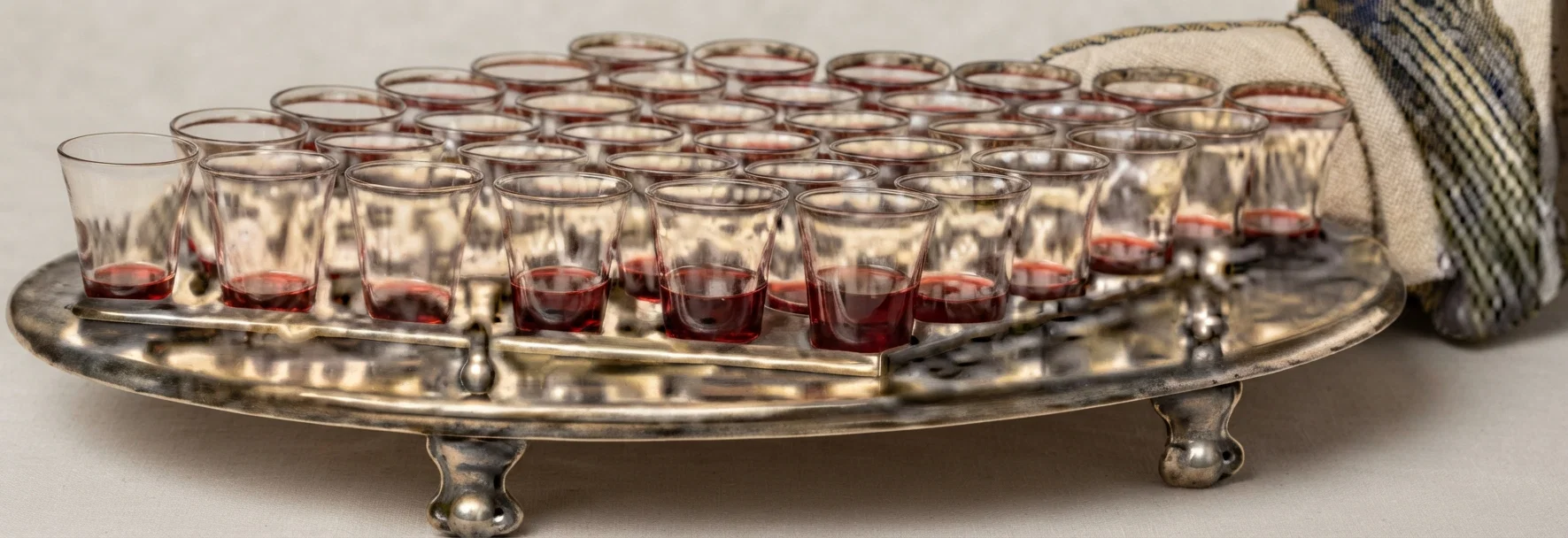
Individual Communion Cups
SENT FOR TRIAL
More convenient, sanitary; add impressiveness to ceremony. We introduced individual service, make the best and supply over 4,000 satisfied congregations. They never go back to the old way. List of users on request. Send for free catalogue. Return outfit (our expense) if not satisfied after trial
SENT FOR TRIAL
Sanitary Communion Outfit Co. 64th St. Rochester, N.Y.
MY ALL.
By Ella Cornish
WHAT tho my sins are multiplied
As sands beside the sea?
It was for these my Saviour died,
And He has set me free;
Yes, cleansed me from each guilty stain,
And made me His own child again.
And tho my friends should faithless prove,
And foes around increase,
Eternal friendship's in His love.
He giveth joy and peace,—
A peace the world can never give,—
And joy, 'tis joy in Him to live.
No treasure mine, nor house nor land,
Nor raiment fair to see;
Yet by the bounty of His hand
He daily cares for me,
And stoopeth down my soul to bless,
And clothes me with His righteousness.
My portion here is want and pain;
For I am sore bereft;
I count earth's loss as heavenly gain
While I have Jesus left;
For He is all in all to me,
And will be thru eternity.
ELLA CORNISH.
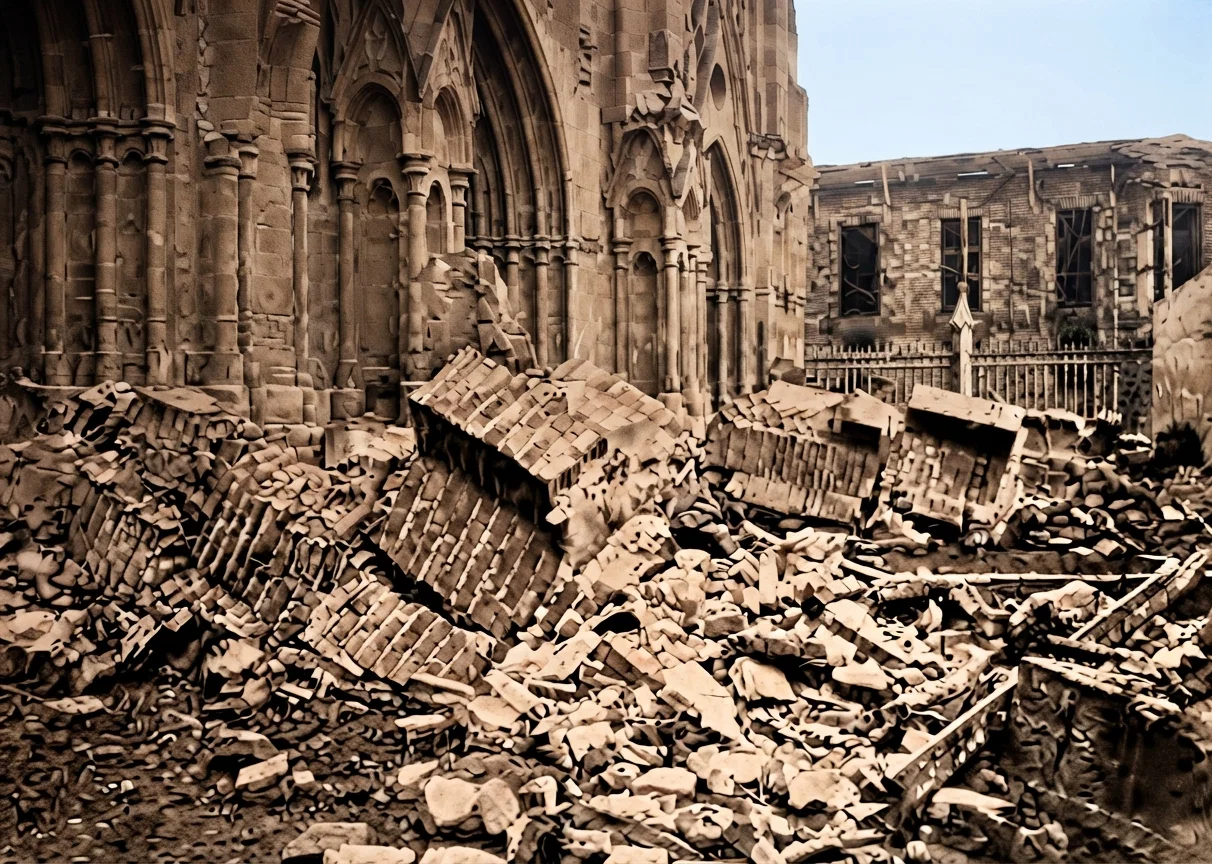
Cathedral Street, Santiago, Chile, after the Earthquake of Aug. 16, 1906.
PERSONAL EXPERIENCES.
By Wm. Steele
MORE than two years have passed since our arrival in Chile,—years of blessed privileges of announcing the Gospel of Christ to a people who are in great darkness; years of varied experiences, which no doubt will be a help to us in our future work. Altho we have been called to pass thru some severe trials, we count them but joy, for we know our heavenly Father overruleth all things, and that He careth for those who put their trust in Him.
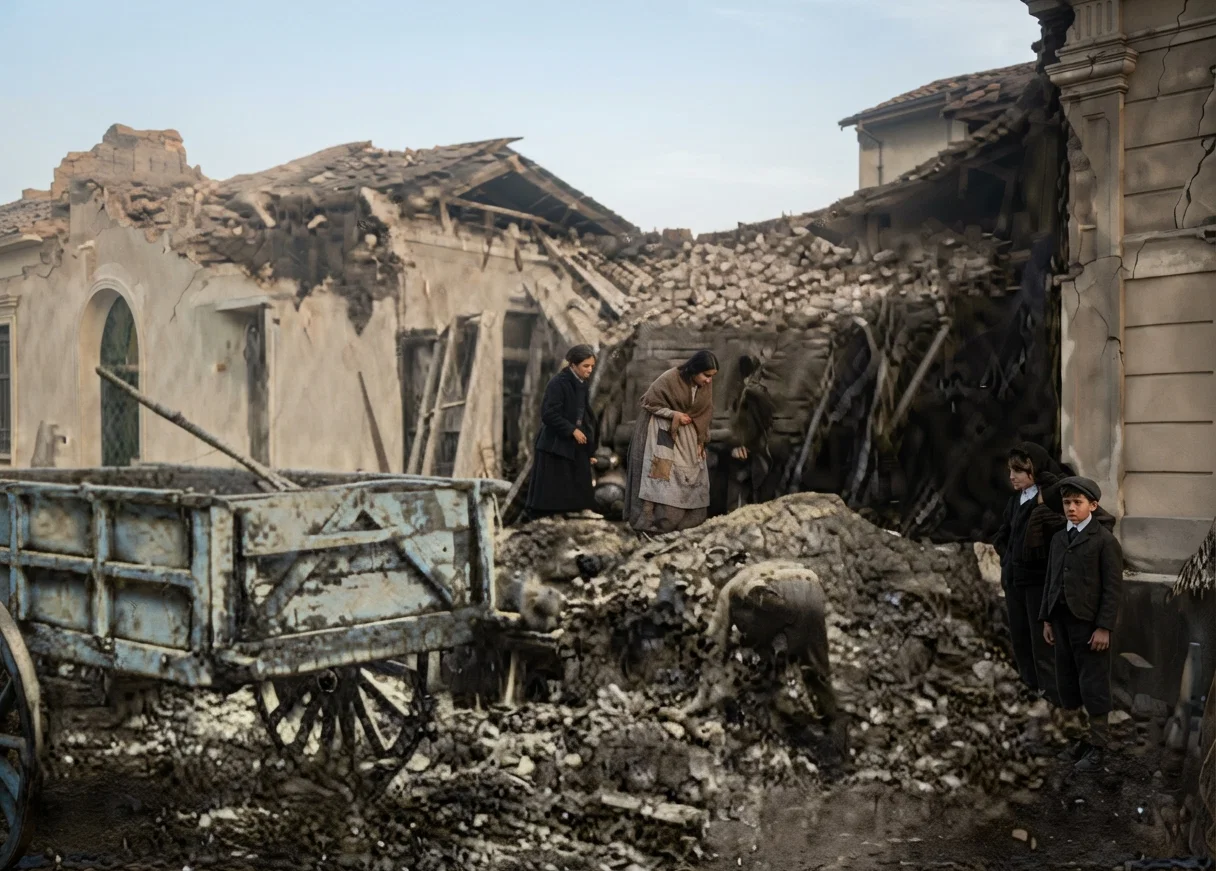
Why the mission was permitted to burn last year was beyond our comprehension, but after the earthquake and fire, we believed we could see why it was permitted, for if we had been living there at this time escape would have been very difficult, as that part of the city was shaken down and immediately burned. Not only would we have lost all, but we would not have been able to collect the insurance, so our financial loss would have been many times greater.
After the destruction of the mission last year, we found rooms in a three-story brick house, which we decided to take, altho they were not just what we wanted, as even at this time suitable rooms for our work were hard to find. We offered to pay part of the rent in advance to bind the bargain; the landlord agreed, but as we were handing him the money, he changed his mind and said:
"If you want the house and move in in three days you may have it, if not I will rent it to some one else. I will not take your money now." Before the end of the three days we found a house more suitable to our needs. A few days after the earthquake, as I had occasion to pass near the street in which this house was located, I thought I would see how it had fared, and as I looked at the once beautiful house, I saw now only a mass of broken bricks and timbers. We believe the Lord had a hand in changing this man's mind, for otherwise we would have been buried in the ruins.
After the earthquake some English friends of ours decided to spend a year in England, and gave us their house to live in while they were gone. Thus, without effort on our part, the Lord provided us with a house in every way suited to the needs of the work. This means much, for now there are few houses in which a person can live. Many thousands of people are living in little shanties made of old zinc.
The house in which we were living suffered little from the quake, altho it subsequently burned, but not until we had an opportunity to carry many things to a place of safety. In the first fire all the books burned were in other languages, and had little or no sale here, and were insured for their cost price. It was hard to understand why the Lord permitted our depository to burn the second time, as we had about 85,000 pages of Spanish literature that the people needed. But since the earthquake the mission has published, and the brethren with the Lord's help have sold, about 560,000 pages of our missionary paper Las Señales de los Tiempos, and all the books that we had sent out before. Under ordinary circumstances they would have sold only 124,000 pages of Señales; and had they sold all the books in stock in this length of time, it would have made only 209,000 pages; thus there was a gain of 351,000 pages of printed matter that contain the truth for this time as a result of the earthquake. There is even a greater gain than this, for the colporteurs would not have sold one-fourth of the books. Surely the Lord works in mysterious ways. We are led to praise His name more and more every day as we see His wondrous leadings.
Church of Salvador, Santiago, Chile, after the Earthquake of Aug. 16, 1906.
As a result of the earthquake, we have been enabled to buy a fine printing outfit, consisting of a large cylinder press, one job press, a large paper-cutter worth two-fifths of what we paid for all, and ninety-six boxes of type. All the machinery and most of the type is as good as new. We now have a first-class outfit for printing literature to warn the people in our field. What we need now is a fund for the publication of tracts and small books.
After the work is well started, I think it will be self-supporting. Once that we have a supply of the right kind of literature, we believe that the Lord will raise up native workers to carry the message quickly to all parts of the field. As an illustration of how the Lord will work, I will give the experiences of one young native brother. About eighteen months ago he came to Valparaiso to take charge of a herbaria belonging to one of the brethren. Recognizing his talents, I gave him every opportunity to improve, and he soon developed into a successful Sabbath-school worker, and desired to enter the work as colporteur, but could not because of his contract to remain with the brother as13long as he should be needed. Last New Year's night, in company with several brethren, he went out to sell Las Señales for the first time, and had good success. This animated him to the extent that he desired more than ever to enter the work. The brother allowed him a few hours each Sunday in which to sell papers. He soon became a successful agent.
Since the earthquake, being released from his obligations, he has dedicated his entire time to the work. Last quarter he worked 36 days and sold papers and took subscriptions to the value of more than 700 Chilean dollars. During a part of October and November, he has been in Caldera and Copiapo, working in all 30 days, and has taken 430 subscriptions, sold 2,000 single copies, besides many Bibles, Testaments, etc., preached many sermons, given Bible readings, and baptized two persons, as he was ordained elder of a small company of believers at the latter place.
With a few such workers, and suitable literature, the whole field could be speedily warned. And I fully believe that when we get the literature the workers will not be wanting. The Spanish fields, altho at the very doors of the United States, have been greatly neglected.
The Mission Board has appropriated $2,000 of the $150,000 fund for our school and publishing work. We pray that the Lord may move the hearts of the brethren to raise this whole amount at once. Work has already begun on one building for our school, and we hope by the first of May to have it completed so as to begin on that date a school for the workers and those who desire to enter the work. The raising of this fund will be a great help to needy enterprises in this, a most needy field.
Perhaps it would be of interest to the brethren to know how we sell Las Señales de los Tiempos. The workers in the Mission are able to devote part of one day each week to this work, usually Sunday or a holiday, as the people spend these days seeking pleasure. We take a bundle of papers on one arm, one in the hand to show the people, and go to some place where crowds are continually passing, and cry as loud as we can the name of the paper and the titles of the principal articles in the number that we are selling, thus even if they do not buy they receive a testimony. Sometimes boys and unprincipled persons mock us, but as we only cry the louder, they soon stop.
Last Sunday I sold 100 papers in about two and a half hours, and yesterday 101 in three and one-half hours in the same street. One man tried to get me into an argument by saying that all the paper contained was lies. I told him we had studied the subjects presented, and that they were true according to God's word. Then he got very angry and began to talk in a very loud voice, saying: "You lie; every number of your paper is filled with lies." I paid no more attention to him and continued to sell papers. When he saw that the people still bought the paper, he soon left; then nearly all who had heard him talk bought a paper, probably to see what the lies were; so he only helped the sale.
In four months we have printed 72,000 copies of the Señales, and they have nearly all been placed in the hands of the people. May the Lord impress His people who have means to use it freely for the advancement of the work in the most needy fields.
WM. STEELE.
A HEATHEN FETISH.
A FEW weeks ago, in a certain town which I was visiting for the first time, an old man came and laid at my feet his most sacred fetish. It was in a small cylindrical box of bark, made for the purpose of holding this kind of fetish. The women, when they saw the box, turned and fled for their lives, first putting their hands over their ears lest they hear the old man's words and die. They are not supposed to know the contents of the box, and tho they do know, they are ready at any moment to take a solemn oath that they do not.
This box contained, first and chiefly, the brains of the old man's father, who had gained eminence and success according to Fang ideals. Immediately after this man's death, his son had split his head open with an ax, had scooped out his brains, and then mixed them with dry, white clay. To this he had added one of the old man's teeth, and a bit of his hair and finger nails; also a strip of flesh cut from the dead man's arm and dried over the fire.
When the owner of such a fetish is about to engage in any considerable enterprise he rubs a portion of these brains upon his forehead, and thereby possesses himself of all the serviceable qualities of the original—his adroitness in lying, his skill in cheating, his cleverness in stealing goods, capturing other men's wives, and killing his enemies. If he is going to talk a big "palaver" he places the strip of dried flesh in his mouth, between his teeth and his cheek, and keeps it there all the time he is talking, that he may be eloquent and successful.—R. H. Mulligan, Libreville, Gaboon, W. Africa.
ENROUTE TO AFRICA.
With a subscription to the SIGNS to be sent to a friend in America, the following letter comes from Mrs. Joel C. Rogers, who, with her husband, is now in Nyassaland, Africa, missionaries to the natives. The letter is dated, "South Atlantic Ocean, Dec. 18, 1906."
"Dear Brother Wilcox:
"The Lord has been very good to us, and given us a beautiful voyage on the North Atlantic, and thus far on the South Atlantic, also. To-morrow morning at daybreak we reach Madeira, and are promised seven hours ashore. Are scheduled to reach Cape Town January 1. The Conference meeting begins January 4, so we shall be just in time. We are of good courage concerning our work in Nyassaland. Our people in Washington, D.C., and in South Lancaster, voluntarily raised nearly $100 for the purchase of an excellent sewing-machine and good hand grist mill for our mission, for which helpful kindness we are very grateful. The machine is on board our ship to-night, coming with us from New York City.
"I called upon the head officer of the Singer Company at New York and told him of our mission and the need of a good, standard machine. He immediately offered his highest grade machine at precisely one-third retail price. It is aboard our vessel and will reach Cape Town with us. For this concession we are truly grateful. This leaves enough of the fund to purchase a good hand grist mill, with which to grind the Kaffir corn, which will form the chief article of food for the natives and for us.
"We used the SIGNS on board the S. S. Amerika to excellent advantage. The paper is of inestimable value to workers, and we surely appreciate it."
OUR WORK AND WORKERS.
By Editor
A church of nineteen members has been organized at WaKeeney, Kan., by Brother N. T. Sutton.
The retail value of subscription books sold in Texas during 1906 is reported to be in round numbers $14,500.
Two new Sabbath-keepers are reported at San Bernardino, Cal. Two have also been added to the church at Long Beach, Cal.
A church of thirteen and a Sabbath-school of thirty-three are the results of the labors of Brother Emil R. Lauda in Sandusky, Mich.
Brother Sydney Scott has been instrumental in bringing the truth to nine colored brethren at Junietta, Ala., and two at Montgomery, Ala., all of whom have joined the churches at these places.
During the year just closed, seventy-six workers have been sent into foreign fields from America and Australia. These faithful brethren and sisters go as preachers, Bible workers, teachers, nurses, printers, and canvassers—all as ministers in the cause of truth to those who know it not.
WANTED FOR MISSIONARY WORK.
By Editor
SPANISH Seventh-day Adventist papers and tracts will be very profitably used by Thos. H. Davis, Guayaquil, Ecuador, South America. A box of papers would be admitted by the Ecuador custom houses duty free. The postage rate on papers is one cent for each four ounces, the same as in the United States.
Continuous supply of late copies of SIGNS, Instructor, Life and Health, Liberty, Life Boat, and tracts. Address, Cora C. Lyle, Ridgefield, Wash.
THE LORD'S APPOINTMENT.
By The Watchman
I SAY it over and over, and yet again to-day,
It rests my heart as surely as it did yesterday:
"It is the Lord's appointment;"
Whatever my work may be,
I am sure in my heart of hearts
He has offered it for me.
I must say it over and over, and yet again to-day,
For my work is somewhat different than it was yesterday:
"It is the Lord's appointment;"
It quiets my restless will
Like voice of tender mother,
And my heart and will are still,
I will say it over and over, this and every day,
Whatsoe'er the Master orders, let Him bid me what He may:
"It is the Lord's appointment;"
For only His love can see
What is the wisest, best, and right,
What is truly good for me.
—The Watchman.