Your ShelfYour Projects

Review and Herald, Vol. 91, No. 23.

THE WORK AND THE WORKERS

Review and Herald

Jun 4, 1914

Review and Herald Publishing Association · Takoma Park Station, Washington, D. C. · Jun 4, 1914

THE WORK AND THE WORKERS
THE beautiful July or "Care of the Children," "Hot Weather Dangers," "Obesity," and "What to Do First" number of Life and Health is now ready. Speaks for itself. Order early!
WHY not devote three weeks, a month, or even two months, to earning a college scholarship for next year through the sale of Life and Health, Liberty, the Protestant Magazine, or the Temperance Instructor? Send 25 cents to your tract society for sample copy of each.
THE following telegram, just received from a gentleman putting up at Statler's Hotel, Buffalo, N. Y., is of interest: "Send as many copies as possible of the Protestant Magazine for $5.00. Money order telegraphed. Rush for big meeting Wednesday night." Sent him 125 copies of the June number.
SPEAKING of the June Protestant Magazine, Pastor E. E. Andross, president of the Pacific Union Conference, says: "We will do all we can to give this number a large circulation in our field. I can assure you I am greatly pleased with the work the Protestant Magazine is doing. I am sure it is destined to be a very potent factor in the closing of this work."
A FEW of the interesting articles in the July Life and Health, now ready: "The Annual Assassination of Infants," by Leonard K. Hirshberg, A. B., M. D., Johns Hopkins University; "Hot Weather Care of the Children," by Edythe Stoddard Seymour; "More About Bob;" "Care of Milk in the Home;" "The Rights of Children;" "Background of Our Children's Lives;" "Obesity, Its Cause and Cure;" "Heat and Infant Mortality;" "Why Children Go Wrong;" "Babies Are Cheap;" "Community Dangers;" "What to Do First" (for freckles, nosebleed, chigoes, mineral poisoning, seasickness, mushroom poisoning); "Questions and Answers." You can easily sell 100 to 1,000 copies in a few hours. The summer months are the most dangerous for the babies. Every mother and father will thank you for bringing this number to the house. Order 50 today — only $2.00 — and then sell for $5.00.
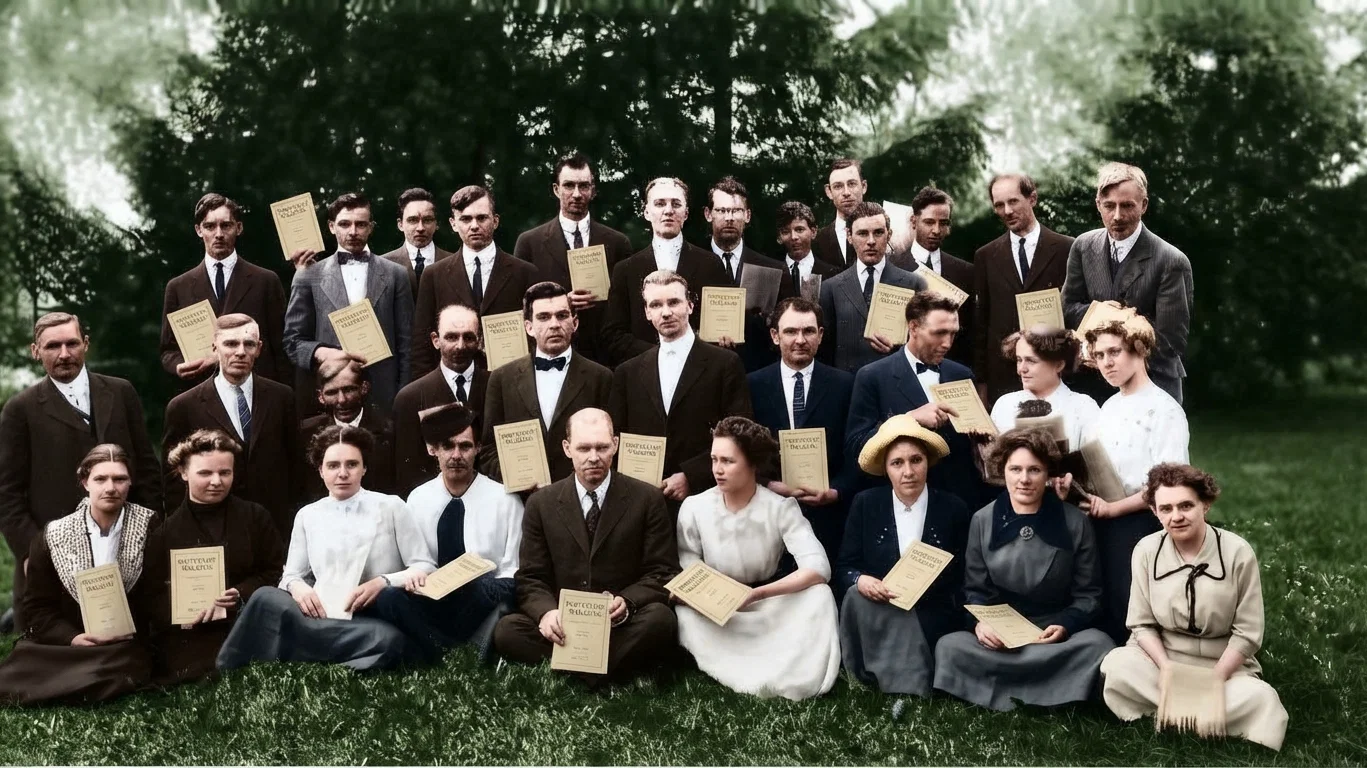
The “ Protestant Flying Brigade ” Composed of Student Volunteers From Emmanuel Missionary College, Berrien Springs, Mich.
THE two-page cartoon in the center of the current number of Liberty, entitled "Gallio's Wise Decision — Religious Matters No Business of the State" (see Acts 18:12-16), is well worth the price of this "Pilgrim Fathers," "Church Monopolies," "Sunday Law Court Decisions," and "True Patriotism" number. Full-page front cover illustration of the "Mayflower," also last-cover-page picture of the "Landing of the Pilgrims." Send $1.00 for 20 or $2.00 for 50 copies today.
AsK your tract society secretary how many copies of Life and Health you must sell to obtain a year or a half-year scholarship in the college or academy nearest you.
A FULL set of cloth-bound volumes of the Protestant Magazine for the years 1909-13, inclusive, gilt stamp on back, for $5.25. Includes every number from the first. First come, first served. Back numbers very rare.
ACCOMPANYING their order for $1.00 worth of the May and June Protestant, the Temperance House and Protestant Book Room, 1119 Washington St., Boston, Mass., write: "Your magazine is much needed in Boston. Have had our plate glass window bricked six times. Have had detectives working for about four weeks. Kept a night watchman at the place nights for seven weeks, being refused police protection. Plate glass costs $50 each time it is smashed, so you see what it is to run a Protestant Book Room in Boston." These brave people handle a club of the Protestant every month.
A TELEGRAM from the California Bible House, Oakland, Cal., reads thus: "Send 1,000 Temperance Instructor and 300 more June Life and Health. Enter our order for 1,200 July Life and Health and 200 July Protestant." A total of 2,700 magazines!

Not Understood

Not understood! We move along asunder, Our paths grow wider as the seasons creep Along the years. We marvel and we wonder Why life is life, and then we fall asleep Not understood.
Not understood! We gather false impressions And hug them closer as the years go by, Till virtues often seem to us transgressions, And thus men rise and fall, and live and die, Not understood.
Not understood! Poor souls with stunted vision Oft measure giants by their narrow gage; The poisoned shafts of falsehood and derision Are oft impelled 'gainst those who mold the age, Not understood.
Not understood! The secret springs of action, Which lie beneath the surface and the show, Are disregarded. With self-satisfaction We judge our neighbors, and they often go Not understood.
Not understood! How trifles often change us! The thoughtless sentence and the fancied slight Destroy long years of friendship and estrange us, And on our souls there falls a freezing blight, Not understood.
Not understood! How many hearts are aching For lack of sympathy! Ah, day by day, How many cheerless, lonely hearts are breaking! How many noble spirits pass away Not understood!
O God, that men would see a little clearer, Or judge less harshly when they cannot see! O God, that men would draw a little nearer To one another! They'd be nearer thee, And understood. — Selected.

FRANCIS MONROE BURG

Moses and Christ — No. 1

FRANCIS MONROE BURG

"And they sing the song of Moses the servant of God, and the song of the Lamb, saying, Great and marvelous are thy works, Lord God Almighty; just and true are thy ways, thou King of saints." Rev. 15:3.
The reader's attention is especially invited in this short series of papers to the fact, as shown by the scripture quoted above, that in the great anthem which the redeemed will sing in the eternal years, the name of Moses appears along with the mention of Christ as the Lamb of God. There seems to the writer a deeper meaning to this than may be apparent from a casual reading of the text quoted. This key opens the door to an interesting and profitable field of thought.
In much of the theology of our times the effort is made to place Christ and Moses at antagonistic relationship with each other. This is fundamentally wrong and in direct opposition with the teaching of the Holy Scriptures. There is also involved in the question of the relationship between Moses and Christ some very vital matters pertaining to the subject of man's redemption. This is worth the careful thought and study of every reader.
That there is a most intimate relationship between Christ and Moses is very clear from the following scriptures:
"And Moses verily was faithful in all his house, as a servant, for a testimony of those things which were to be spoken after; but Christ as a Son over his own house, whose house are we." Heb. 3:5, 6.
The reader's attention is incidentally called to the mention that is made here of Moses as the "servant" of God, and of Christ as a "Son." This comparison between them becomes a key to another beautiful and interesting thought, though not in direct line with the trend of this discussion. However, in passing from this mere mention, it may be noted with interest that in the song to be sung over there Moses is called the "servant" of God. This is a very familiar appellation applied to him in the Scriptures, and has a meaning.
We shall notice another text of Scripture showing the relationship recognized in the Bible between Christ the Son of God and Moses the servant of God. In speaking to the Jews concerning Moses, Jesus said, "Had ye believed Moses, ye would have believed me; for he wrote of me. But if ye believe not his writings, how shall ye believe my words?" John 5:46, 47. This language bears directly on the statement under consideration: "He wrote of me." Moses wrote of Christ. This means that the theme of his writings was Christ and his work. Not that he incidentally and occasionally made mention of Christ in his writings, but Christ was the subject about which he wrote. As an author writing on the religion of the Crescent has Mohammed and his teaching as the theme, or subject, which pervades his book, his aim being to set forth the essence, the philosophy, the real object and aim of this religious system of the Orient; so Moses in writing of Christ, the Saviour of men, wrote of his great plan and his ministry, —of his sacrifice for the salvation of the world. This was his theme; this was his subject.
If theologians today would read Moses' writings from this angle, the doctrine of antinomianism, out of which grows the teaching relative to Christ and Moses as opposed to each other, would vanish immediately.
Notice, as already quoted, Jesus asked the people, "If ye believe not his writings, how shall ye believe my words?" From this language it is safe to conclude that one cannot have an adequate understanding of the work and mission ofChrist while looking upon Moses as one who maintains an antagonistic attitude toward Christ. There are teachings in the books of Moses relative to the work of Christ as man's Redeemer and Intercessor that make this view unavoidable. Following articles will present the office and work of Christ, the Saviour of the world, as set forth in the books of Moses.
Los Angeles, Cal.

God Is Love

WM. COVERT
THIS short sentence of only three words, "God is love," comprises in its enfolding a thousand volumes of richest lore. These volumes with opened pages are spread before us in the sun, the moon, and the stars; and their contents are printed legibly over all the highlands, meadows, and plains where the children of men dwell. But only a small per cent of our entire race have ever learned to read these open books. The reason so few out of earth's teeming millions have learned to read the books in God's great library of nature is because sin has blurred the perceptive faculties of men.
When God planned to make those things which the eyes of men behold, he also planned that man should know him, love him, and enjoy his works. It is because God is love that his works abound; and it was because of his love for us that we were given being. His purpose was that we should have mind sufficient to give him pleasure in our ability to know him and his works. Paul speaks of "the hidden wisdom, which God ordained before the world unto our glory." This primal wisdom cannot be given to the princes of this world, because of their separation from God. And in the absence of this wisdom the princes of this world went so far astray as to crucify the Lord of glory, who was the sum of all wisdom and the incarnation of love.
The wisdom God's love intended was enjoyed by Adam the day he was made. Then he knew the thoughts of God in what he saw, so that when the newly created animals were made to pass before him he gave a name to each one according to its true character.
When God spoke to Job concerning the glad time of creation, he said, "The morning stars sang together, and all the sons of God shouted for joy." Job 38:7. Everything everywhere was in perfect accord. Then every heart vibrated in union with the thoughts of God, and every faculty in all nature expressed itself in shouts of joy. God was speaking through his works, and his thoughts were made audible. Every flower that opened its beauty to the eye, and every tree that was breathing through its foliage of green, was saying, "God is love." All sounds blended into music, and all creatures filled their places well. The love of God and his handiwork on that glad day were read in the glowing heavens, the lofty trees, the singing birds, the clinging vines, and in the joy that made every heart glad. Joy like the joy of that day would have been perpetuated forever if sin had not come.
Sin entered this world, and discord followed. The fall brought confusion, and marred the beauty of what God had written. Transgressions made scars, and blight brought decay. Tears furrowed human faces, and sorrows caused bitterness of soul. Unkind words separated friends, and animosities grew into sore trials.
However, God's plan is to destroy sin and restore the perfection of beauty. Then the eyes of the blind are to be opened, and the ears of the deaf are to be unstopped. The tongue of the dumb is to sing, and the limbs of the lame are to be made supple. Then the light of God's glory will drive darkness away, and the life of God will conquer death and bring the righteous dead from their graves.
But God designs that his love shall now be manifested in the lives of men. The Spirit of the Lord longs to rule in all hearts, and to place the scepter of righteousness there. When the love of God is enthroned in the soul, no jealousies will be there, no harshness of spirit will ruffle a sensitive mind nor cause the timid a pain.
It is now that God is love. This is the world where that love is to do its work. In this world where sinners live is the place where sinners are to be converted. It is God's love that is to lead them to repentance now. In glory our service of love may be appreciated, but in the land of sorrow is the place where it is needed. It is now that God would have it manifested through us.

MRS. E. G. WHITE

Early Counsels on Medical Work—No. 10

MRS. E. G. WHITE

A Revival in Health Reform

Since the laws of nature are the laws of God, it is plainly our duty to give these laws careful study. We should study their requirements in regard to our own bodies, and conform to them. Ignorance in these things is sin.
"Know ye not that your bodies are the members of Christ? . . . What? know ye not that your body is the temple of the Holy Ghost which is in you, which ye have of God, and ye are not your own? for ye are bought with a price: therefore glorify God in your body, and in your spirit, which are God's." 1 Cor. 6:15-20. Our bodies are Christ's purchased property, and we are not at liberty to do with them as we please. Man has done this. He has treated his body as if its laws had no penalty. Through perverted appetite its organs and powers have become enfeebled, diseased, and crippled. And these results which Satan has brought about by his own specious temptations, he uses to taunt God with. He presents before God the human body that Christ has purchased as his property; and what an unsightly representation of his Maker man is! Because man has sinned against his body, and has corrupted his ways, God is dishonored.
When men and women are truly converted, they will conscientiously regard the laws of life that God has established in their being, thus seeking to avoid physical, mental, and moral feebleness. Obedience to these laws must be made a matter of personal duty. We ourselves must suffer the ills of violated law. We must answer to God for our habits and practices. Therefore the question for us is not, "What will the world say?" but, "How shall I, claiming to be a Christian, treat the habitation God has given me? Shall I work for my highest temporal and spiritual good by keeping my body as a temple for the indwelling of the Holy Spirit, or shall I sacrifice myself to the world's ideas and practices?"
Healthful living must be made a family matter. Parents should awake totheir God-given responsibilities. Let them study the principles of health reform, and teach their children that the path of self-denial is the only path of safety. The mass of the inhabitants of the world by their disregard of physical law are destroying their power of self-control, and unfitting themselves to appreciate eternal realities. Willingly ignorant of their own structure, they lead their children in the path of self-indulgence, thus preparing the way for them to suffer the penalty of the transgression of nature's laws. This is not taking a wise interest in the welfare of their families.

The Church and Health Reform

There is a message regarding health reform to be borne in every church. There is a work to be done in every school. Neither principal nor teachers should be intrusted with the education of the youth until they have a practical knowledge of this subject. Some have felt at liberty to criticize and question and find fault with health reform principles of which they knew little by experience. They should stand shoulder to shoulder, heart to heart, with those who are working in right lines.
The subject of health reform has been presented in the churches; but the light has not been heartily received. The selfish, health-destroying indulgences of men and women have counteracted the influence of the message that is to prepare a people for the great day of God. If the churches expect strength, they must live the truth which God has given them. If the members of our churches disregard the light on this subject, they will reap the sure result in both spiritual and physical degeneracy. And the influence of these older church members will leaven those newly come to the faith. The Lord does not now work to bring many souls into the truth, because of the church members who have never been converted, and those who were once converted but who have backslidden. What influence would these unconsecrated members have on new converts? Would they not make of no effect the God-given message which his people are to hear?
Let all examine their own practices to see if they are not indulging in that which is a positive injury to them. Let them dispense with every unhealthful gratification in eating and drinking. Some go to distant countries to seek a better climate; but wherever they may be, the stomach creates for them a malarious atmosphere. They bring upon themselves suffering that no one can alleviate. Let them bring their daily practice into harmony with nature's laws; and by doing as well as believing, an atmosphere may be created about both soul and body that will be a savor of life unto life.
Brethren, we are far behind. Many of the things which the church should do in order to be a living church are not done. Through the indulgence of perverted appetite, many place themselves in such a condition of health that there is a constant warring against the soul's highest interests. The truth, though presented in clear lines, is not accepted. I wish to set this matter before every member of our churches. Our habits must be brought into conformity to the will of God. We are assured, "It is God which worketh in you," but man must do his part in controlling appetite and passion. The religious life requires the action of mind and heart in harmony with the divine forces. No man can of himself work out his own salvation, and God cannot do this work for him without his cooperation. But when man works earnestly, God works with him, giving him power to become a son of God.
When persons are spoken to on the subject of health, they often say, "We know a great deal better than we do." They do not realize that they are accountable for every ray of light in regard to their physical well-being, and that their every habit is open to the inspection of God. Physical life is not to be treated in a haphazard manner. Every organ, every fiber of the being, is to be sacredly guarded from harmful practices.

He Understands

We do not know why Marah's waters flow Before the place where Elim's palm trees grow, To cool the desert sands, Nor why when Canaan looks so sweet and fair, Strong, deadly foes are waiting everywhere, But then God understands.
We cannot see why Jacob, all night long, Must hold his feeble arm against the Strong To get his high demands, Nor why e'en now some souls in anguish plead When God is waiting to supply each need; But then he understands.
We can but wonder why some lives are bound With chains of steel, nor hear a sweeter sound Than toil's severe commands, While time makes melody for other ears, As perfect as music of the spheres; But then he understands.
There must be purpose in our pain and strife, And when rue mingles with the wine of life, If we are in his hands; So when we cannot conquer with the strong, We need not with the vanquished suffer wrong, Because he understands.
Sometimes I look upon the glowing west, And think I see some shining mountain crest In distant Eden lands, And grateful for the way my feet have trod, I care not which the path if close to God, Because he understands.
— Myra Goodwin Plantz.

“ He Loved Them Unto the End ”

T. E. BOWEN
THERE are no needless expressions in the Scriptures. Here is one full of comfort and encouragement to the struggling remnant who have entered upon the trials of the end: “When Jesus knew that his hour was come that he should depart out of this world unto the Father, having loved his own which were in the world, he loved them unto the end.” John 13: 1.
Why this last expression, “Having loved his own which were in the world, he loved them unto the end”? In fact, there were at this time many things about the little company of disciples, those who for three years had followed Jesus the most ardently and faithfully, that were not at all lovable. There was almost continual strife among them as to who should be accounted the greatest. Judas had at this time contracted to betray his Lord. John and James, through their mother, had asked for the highest seats in his kingdom. Doubts pressed upon Thomas. And all were quite unprepared for the trial Jesus knew was right upon them. Peter that very night was to be so wholly surprised by the fallen foe as to deny his Lord. Therefore this expression dropped in just at this time means much. Jesus was about to enter into the final test Heaven had appointed for him. Would he drink the cup for such unworthy persons? His noble decision is made, and John's inspired pen records it, “Having loved his own which were in the world, he loved them unto the end.” Whatever they might do, he would make manifest for all coming time that he had not proved untrue to them in the crisis. He would love his own disciples, his own nation, yea, a lost world, unto the end, despite their unworthiness.
There were two very sharp stings to Satan's temptations, so carefully prepared and presented to the Son of God. The first, when he began his ministry, was the subtle insinuation, “If thou be the Son of God, command that these stones be made bread.” The last was not, “If thou be the Son of God,” but, “Why throw yourself away in an ignominious death for such a lot of rebels? Your own nation is seeking your life. One of your closest disciples will deny you, another betray you, and all will forsake you. The sacrifice of such a life as yours is too great. Such a lot of ungrateful sinners ought to be left to perish.” This was the terrible temptation that caused the cup to tremble in the hands of the world's Redeemer in Gethsemane.
And who dare say which of the two stinging temptations cut deeper into the loving heart of the Saviour? There is this about it: Jesus knew that Satan's last insinuation concerning the unfaithfulness of those for whom he had given his life was only too true. But he knew more; he knew who was responsible for inspiring all this strife and contention and selfishness among his little band of followers; it was the archaccuser of the brethren himself. And the Saviour's purpose did not waver. “Having loved his own which were in the world, he loved them unto the end.”
Of this masterful temptation in the garden we read:—
“As Christ felt his unity with the Father broken up, he feared that in his human nature he would be unable to endure the coming conflict with the powers of darkness. In the wilderness of temptation the destiny of the human race had been at stake. Christ was then conqueror. Now the tempter had come for the last fearful struggle. For this he had been preparing during the three years of Christ's ministry. Everything was at stake with him. . . . With the issues of the conflict before him, Christ's soul was filled with dread of separation from God. Satan told him that if he became the surety for a sinful world, the separation would be eternal. He would be identified with Satan's kingdom, and would nevermore be one with God.
“And what was to be gained by this sacrifice? How hopeless appeared the guilt and ingratitude of men! In its hardest features Satan pressed the situation upon the Redeemer: 'The people who claim to be above all others in temporal and spiritual advantages have rejected you. They are seeking to destroy you, the foundation, the center and seal of the promises made to them as a peculiar people. One of your own disciples, who has listened to your instruction, and has been among the foremost in church activities, will betray you. One of your most zealous followers will deny you. All will forsake you.' Christ's whole being abhorred the thought. That those whom he had undertaken to save, those whom he loved so much, should unite in the plots of Satan, this pierced his soul.The conflict was terrible. Its measure was the guilt of his nation, of his accusers and betrayer, the guilt of a world lying in wickedness.”—“The Desire of Ages” (trade edition), pages 821, 822.
Doubtless one of the ways by which Satan prepared for this last terrible attack was by leading the Jewish nation and Christ's intimate followers to be unworthy of Christ's sacrifice and love. It was upon this unworthiness, held up without love or mercy mixed with it, that Satan, in his last desperate struggle for the supremacy, based his highest hopes of conquering the Son of God through his humanity. But Jesus, setting himself aside, remained true to his own decision: “Having loved his own which were in the world, he loved them unto the end.” O, for such matchless love let us continually praise God!
The “remnant” are still in the world. This same foe is still walking up and down, to and fro, throughout the earth. And the children of God are not yet all perfect. Sometimes evidences appear that envy and strife for place, or to be “accounted the greatest,” or selfishness in some other form still lingers in the hearts of the disciples. With such a display of infinite love as Jesus made, what about our loving our brethren and sisters, despite some imperfections, and that, too, to the end? That new commandment puts the obligation, in actual newness, squarely upon us, for it reads, “A new commandment I give unto you, That ye love one another; as I have loved you, that ye also love one another.” It is as true of us as of the twelve, centuries ago, “Having loved his own which were in the world, he loved them unto the end;” for the promise is, “Lo, I am with you alway, even unto the end of the world.”

Delaying the Lord's Coming

H. B. MOORE

We are rapidly nearing the close of time. Soon the edict will go forth, "He that is unjust, let him be unjust still: . . . and he that is holy, let him be holy still." We are doing our final work, such as it may be, and each moment counts now. The perils of the last days will soon be upon us, and it is safe to say that if present times and conditions do not cause us to bestir ourselves, nothing will. Signs of the end are thickening on all sides, and all omens point to that quick work in righteousness which God will make in the earth.
There is much occasion for concern now because of the fact that many of our brethren are clinging to their extra property. This is especially evident in America. "If thou wilt be perfect, go and sell that thou hast, and give to the poor, and thou shalt have treasure in heaven: and come and follow me." The world is famishing for the Word of God, and we are largely responsible for this condition. It is dangerous to hold on to anything that should be sold and placed in the treasury of the Lord. Much of this property will be lost entirely to the Lord's service if not very soon placed there. Soon it will be too late to do anything whatever with it. Our actions in this matter, which speak louder than our words, say, "My Lord delayeth his coming;" and by these acts we certainly are delaying his coming. If those who have extra property of any kind would place it upon God's altar as they should, they would lose no time in its disposal and in placing its value in this blessed cause. If every one in the denomination would dispose of all property that it would be consistent to dispose of, and place the means in the cause, missionaries could be sent by the score to every benighted land, the work would soon end, and the great reign of sin forever cease. Such a course would be merely exchanging property in this perishing world for property in the eternal world.
It is no crime to be rich, but those who have means will certainly have to unload before they ever enter the portals of heaven. Beyond mistake God requires this, as is taught by the lesson that "a rich man shall hardly enter into the kingdom of heaven." Such an investment as this is meant for no other purpose than to give each of us the privilege of proving his faith by his works. Because faith works, it does not shrink from duty. "Faith, if it hath not works, is dead." We are blessed only according to our faith expressed. If we have not the faith to make such an investment, we certainly need not look for great blessings; but upon those who sacrifice everything, laying all upon God's altar, will surely come the outpouring of the latter rain, which is worth more than all the treasures of earth. Why need we pray for or look for the latter rain in any more marked manner than that in which we express our faith by our works? For if our works are dead, then our faith is dead, and the latter rain is dead to us. But some one is to receive it, and many are receiving it.
Are we each receiving this blessing? If not, let us examine our own hearts to see if we are in the faith. We are either hastening or delaying the Lord's coming.
San Diego, Cal.

Confession

F. A. ZAPPE
"He that covereth his sins shall not prosper; but whoso confesseth and forsaketh them shall have mercy." Prov. 28 : 13.
The preceding scripture brings to view the fact that it is impossible to prosper spiritually, to maintain a living experience in the things of God, while cherishing or attempting to cover sin, which separates man from the source of life and power. It is evident from the text that in complying with the simple and just and reasonable conditions of obtaining mercy and the forgiveness of sin, we must confess and forsake the very sins of which we are guilty.
"Confess your faults one to another, and pray one for another, that ye may be healed," says the apostle. Those who would develop a Christlike character in sinful flesh, a character that will stand for eternity, must faithfully follow this instruction. If we have given offense to our neighbor, it is our Christian duty to acknowledge our wrong, and it is his duty freely to forgive. We know not what the morrow has in store for us. We cannot afford to continue putting off confessing known faults one to another. It is impossible for God to forgive our sins while we cherish an unforgiving spirit toward one another. To know that all is right between us and God and our fellow men is the most satisfying and most peace-giving knowledge that it is possible for the mind of finite man to possess.
One of the first symptoms of the dying of the old man of sin, and of the new birth, is genuine confession, which is always of a specific character and acknowledges particular sins. Our sins may be of such a nature as to be brought before God only; they may be such as should be confessed to individuals who have suffered injury through them; or they may be of a public character, and should then be as publicly confessed. But all confession should be very definite and to the point, and without adding an apology in excuse of the course taken.
"Those who have not humbled their souls before God in acknowledging their guilt, have not yet fulfilled the first condition of acceptance. If we have not experienced that repentance which is not to be repented of, and have not with true humiliation of soul and brokenness of spirit confessed our sins, abhorring our iniquity, we have never truly sought for the forgiveness of sin; and if we have never sought, we have never found the peace of God. The only reason why we do not have remission of sins that are past is that we are not willing to humble our hearts and comply with the conditions of the Word of Truth. Explicit instruction is given concerning this matter. Confession of sin, whether public or private, should be heartfelt and freely expressed. It is not to be urged from the sinner. It is not to be made in a flippant and careless way, or forced from those who have no realizing sense of the abhorrent character of sin. The confession that is the outpouring of the inmost soul finds its way to the God of infinite pity."
Our confessions cannot be acceptable to the Father above without sincere repentance and reformation on our part. There must be decided changes in our lives, and a complete forsaking of everything that is offensive to God. "Wash you, make you clean; put away the evil of your doings from before mine eyes; cease to do evil; learn to do well; seek judgment, relieve the oppressed, judge the fatherless, plead for the widow." This is the work that accompanies genuine sorrow for sin, and confessions that are inspired by the divine Spirit, which will be acceptable to God.
Philbrook, Minn.

Avoid Anything Suggesting Impurity

"Avoid seeing, hearing, or reading anything that will suggest impurity."

EDITORIAL

God's Estimate of Man

"COMFORT ye, comfort ye my people, saith your God. Speak ye comfortably to Jerusalem, and cry unto her, that her warfare is accomplished, that her iniquity is pardoned: for she hath received of the Lord's hand double for all her sins. The voice of him that crieth in the wilderness, Prepare ye the way of the Lord, make straight in the desert a highway for our God. Every valley shall be exalted, and every mountain and hill shall be made low: and the crooked shall be made straight, and the rough places plain: and the glory of the Lord shall be revealed, and all flesh shall see it together: for the mouth of the Lord hath spoken it.
"The voice said, Cry. And he said, What shall I cry? All flesh is grass, and all the goodliness thereof is as the flower of the field: the grass withereth, the flower fadeth: because the spirit of the Lord bloweth upon it: surely the people is grass. The grass withereth, the flower fadeth: but the word of our God shall stand forever.
"O Zion, that bringest good tidings, get thee up into the high mountain; O Jerusalem, that bringest good tidings, lift up thy voice with strength; lift it up, be not afraid; say unto the cities of Judah, Behold your God! Behold, the Lord God will come with strong hand, and his arm shall rule for him: behold, his reward is with him, and his work before him. He shall feed his flock like a shepherd: he shall gather the lambs with his arm, and carry them in his bosom, and shall gently lead those that are with young."
Continue reading: Honoring Men Instead of God