SINGAPORE is a good-sized modern city, with electric lights and cars, excellent roads and beautiful drives, many good schools, and a fine library and museum; and last but not least of those things necessary for the welfare of its many inhabitants, it is a clean city, which is more than can be said for most Eastern towns. It is here that the East and the West mingle together under a flag that insures equal justice to all — to the Asiatic and to the European. Here also one sees the ways of the East and the West side by side,— the Indian shop, with its proprietor sitting among his goods, within a stone's throw of the up-to-date department stores of the European; the humble ricksha, drawn by a half-naked Chinese coolie, running alongside the latest motor car; the steam road roller at work, while within sight of it, perhaps, will be a dozen or so Indian coolies doing the same kind of work with an iron maul, all slowly keeping time. The climate is warm, the thermometer always indicating between 80° and 90°; occasionally it may reach 92°.
The population is chiefly composed of Chinese and Malay, there being over 200,000 of the former and about 30,000 of the latter. There are also 5,000 Europeans, and about as many Eurasians, as well as 25,000 Indians from various parts of British India. Besides these, there are people living here from almost every nation, large or small, and these, added to a floating population of nearly 6,000, make another 10,000. The entire population of the island is approximately 300,000, about 44,000 of whom live outside the city. There is, therefore, a great deal of work to be done in this island; hence the need of more workers willing to consecrate themselves to this work of giving the last gospel message to the many people of the Malaysian field.
Here is located the headquarters of the Malaysian Mission, which comprises the Straits Settlements and Federated Malay States, Borneo, and the islands of the Dutch East Indies, with the exception of New Guinea.
In Singapore our work is making progress, and we see no cause for discouragement. The prospects are bright for future conquests, especially among the Chinese and Tamils, who are at the present time most susceptible to the truth. The battle often goes hard, it is true, but this brings greater rejoicing in victory, and greater faith in our great Commander.
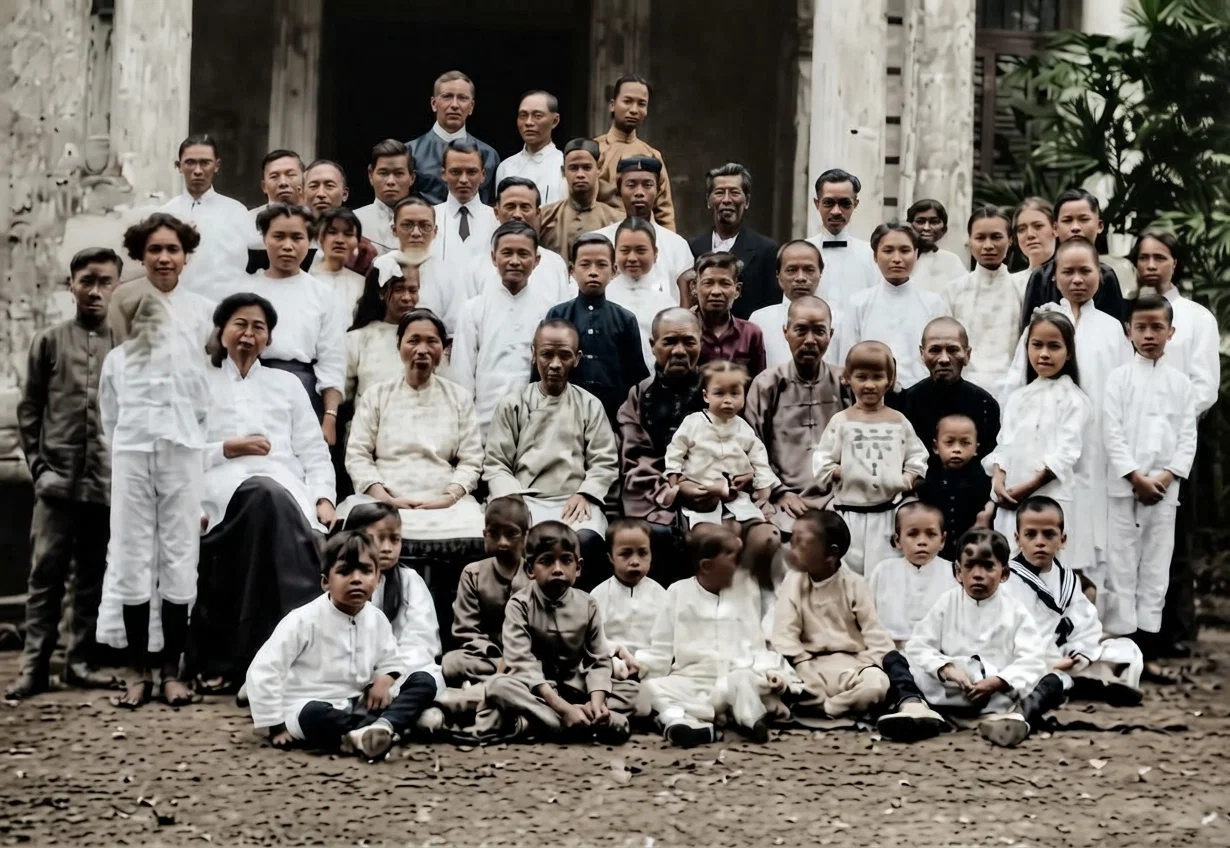
PORTION OF SINGAPORE SABBATH SCHOOL. SEVERAL NATIONALITIES REPRESENTED
Our church is centrally located, and at present has a membership of eighty, about twenty having been added during the past year. Several have expressed their desire to unite with the church, and are awaiting baptism.
The Sabbath school membership is about one hundred and fifteen, and we have classes in English, two or three dialects of Chinese, and Tamil (a language of South India). The picture shows a group of some of our Sabbath school members, most of whom are Chinese.
Recently our church has begun to take a fresh interest in missionary work. Literature is distributed in the English and Chinese languages, the sick are visited, and sewing for the poor is done.
A thousand copies of the Harvest Ingathering REVIEW have come to us. About three hundred and fifty of these were sent to Borneo, Java, and Sumatra, the remainder being disposed of by the Singapore church and workers. Many good experiences are gained in this work, and we were greatly encouraged to find so many friends of the cause who gladly gave to our work, so that in Singapore and Kuala Lumpur (the capital of the Federated Malay States), nearly $300, gold, was collected. In Batavia, Java, about $100 was collected.
Our field is large, and greatly scattered, but the good news of salvation and a soon-coming Saviour must go to the people of these islands.
Mission Notes
About a year ago, Mr. H. Z. Duke, a Baptist, of Texas, began to give for religious purposes the proceeds of his twenty-one nickel stores. He and his wife had agreed that when their earnings should amount to $100,000, they would then give their earnings of these stores to the cause of Christianity. Over a year ago the sum named was completed, and on the first of last year he entered upon
his covenant. Every penny earned from the sale of candies, toys, and the thousand and one things found in a five-cent store, will be used in Christian work. It is said that Mr. Duke, from his youth, has given one tenth of his earnings to Christian work, and now he has dedicated his entire earnings to the cause he loves.
Alden B. Case, a missionary stationed at Sonora, Mexico, found his church and school work broken up. He decided to turn his attention to the revolutionist section of the field, circulating the Scriptures. He gives briefly this experience: "This is my third day out at the Constitutionalist camp of some three thousand soldiers. Among them are hundreds of Indians, and the population of the camp is about six thousand. The greater number live in picturesque structures of poles and brush. I brought what seemed to be an abundant supply of Scriptures and other literature for the three days of my visit, but by noon yesterday everything was gone. The general in command, to whom I explained my mission on arrival, very cordially gave me the freedom of the camp. Another officer, a Christian, took me to his quarters. Of the one hundred and fifty copies of New Testaments and Gospels sold, the larger part was taken by the Indians. I had never13seen so great an opportunity for sowing the seed of the kingdom."
A new day has come to Brazil, Argentina, and Chile, the three foremost countries of South America, and it is a day of new life for mission enterprises. The millions already in these rich and productive lands are every month supplemented by thousands of immigrants from Europe and Asia. Large cities and towns are fast building up. Buenos Aires today has 1,400,000 inhabitants, and Rio de Janeiro 1,000,000, while Montevideo has 300,000, Sao Paulo 400,000, and Bahia 300,000. Education is becoming more widespread, large government institutions are being built up and fostered for general as well as technical and professional instruction. The evangelistic denominations at work in South America are beginning to build up first-class schools and colleges in the countries occupied, and these schools are patronized by the best classes of Brazilians, Argentines, and Chileans. This means a change in this territory that has been so long under the blighting domination of papal Rome.
The National Congress of Mothers
By Mrs. C. C. Lewis
MRS. C. C. LEWIS
THE Mothers' Congress held its third international session on the welfare of the child, April 22-28, in Washington, D. C. Delegates from many States, representing organized motherhood and Parent-Teacher Associations, were in attendance; also delegates from other countries, including China, Japan, and Bulgaria.
I wish the mothers and fathers who read the REVIEW could have been with me the past few days, and listened to the earnest words of some of the noblest mothers in America.
The president, Mrs. Frederick Schoff, gave a powerful address on the subject "Laying the Foundation for Race Betterment." One lady who has wide experience in Christian work said the address was one of the best she ever heard.
"The Home and Child Welfare" was the main theme for two days. Thousands of babies die every year from lack of proper food and care. "Baby-Saving Work the World Around," was a round table topic. Mrs. Richardson, of New York, chairman of the Child Hygiene Department, gave a most excellent address on "The Press and Baby Saving." "Twentieth Century Motherhood" was another subject presented in a very helpful manner. Friday, April 24, "The School and Child Welfare" was taken up.
Reports were given by national chairmen of the National Congress of Mothers' and Parent-Teacher Associations; such as, "Department of Child Labor," "Children's Book List," "Opportunities for Child Study by Parents," "Methods of Organizations of Parents," "Parent-Teacher Associations Solve National Problems." These are a few of the many very practical topics discussed.
The National Congress of Mothers in 1897 adopted the following platform in its constitution:—
"The objects of this congress shall be to raise the standards of home life; to give young people opportunities to learn how to care for children, so that when they assume the duties of parenthood they may have some conception of the methods which will best develop the physical, the intellectual, and the spiritual nature of the child; to bring into closer relations the home and the school, that parents and teachers may cooperate intelligently in the education of the child; to surround the childhood of the whole world with that wise, loving care in the impressionable years of life that will develop good citizens; to use systematic and earnest effort to this end, through the formation of Parent-Teacher Associations in every public school and elsewhere, through the establishment of kindergartens and in the distribution of literature which will be of practical use to parents in the problems of home life; to secure more adequate laws for the care of blameless and dependent children; and to carry the mother love and mother thought into all that concerns childhood."
My heart has been deeply stirred by what I have heard and seen at this congress, and I say to myself: "What is the matter with us as a people? Why do we not organize our mothers in every educational center? Would it not be an inspiration to the church-school teacher to know that the patrons were studying along the same lines for the betterment of the children?"
But you say, "We are so busy! It takes all our time to cook, and sew, and keep the children tidy and fed." "In union there is strength." By coming together once or twice a month and studying the work of the school, the weary, discouraged mother will get new inspiration, and the teacher, seeing the difficulties under which some of her pupils work, will be led to greater patience with them, and to greater sympathy for them.
Parent-Teacher Associations
"For seventeen years one of the principal works of the Mothers' Congress has been the formation of parents' associations in schools. For seventeen years it has worked to interest educators and to organize the parenthood of the nation in connection with the public schools, with the definite purpose of thus providing for parents the opportunity to study the interests and development of childhood in home and school, and for the teachers the opportunity for a more sympathetic and complete insight into the individual needs and capabilities of their pupils.
"There are now thirty-six States where motherhood is organized for the welfare of childhood."
Takoma Park, D. C.
A Grandmother's Rules
SOMEBODY'S grandmother has bequeathed to her descendants these admirable rules of conduct:—
"Always look at the person to whom you speak. When you are addressed, look straight at the person who speaks to you. Do not forget this.
"Speak your words plainly; do not mutter nor mumble.14If words are worth saying, they are worth pronouncing distinctly and clearly.
"Do not say disagreeable things. If you have nothing pleasant to say, keep silent.
"Think three times before you speak once.
"Have you something to do that you find hard and would prefer not to do? Do the hard thing first and get it over with. If you have done wrong, go and confess it. If your lesson is tough, master it. If the garden is to be weeded, weed it first and play afterward. Do first the thing you don't like to do, and then with a clear conscience try the rest."—Selected.
The Lord Arrested Him
THE following experience is given by one of our workers while laboring in an island field:—
"For a long time we used to go to a place fourteen miles from the mission to hold services Sunday morning and to visit several places on our way home in the afternoon. We nearly always took our lunch with us, so as not to be a burden to any poor souls we might visit; and nearly always we went home without our lunch, as some we visited needed it far more than we did.
"On one of these trips we visited for the first time an old native minister who had recently been paralyzed. He told us his story, and made his confession. He had been going up to a station several miles above to preach, and finding two or three of our people there who were doing all they could to get others to see the truth, he vehemently opposed it.
"On my way home one Sunday," he said, "after I had been very bitter against this way, the Lord struck me down in the road as I was walking. I lay there praying for two hours. I confessed to the Lord that I had been fighting his truth, and asked his forgiveness. He pardoned and accepted me, then a cab came along and picked me up and brought me home. I am glad you have come to see me. I want you to pray for me. If the Lord will restore me I will preach the truth I went to tear down. I have a chapel here by my house; I want you to come and use it."
"We prayed for him, and he was so far restored as to be able to get about the house some; and he improved every opportunity to talk the truth to those who visited him. He studied it carefully and learned it readily. His simple faith and trust in the Lord were inspiring."
A Sacred Charge
By Mrs. M. E. Steward
MRS. M. E. STEWARD
"TAKE this child away, and nurse it for me, and I will give thee thy wages." Royalty gave this command to the mother of Moses. Every mother may consider that she has a like charge from an authority infinitely higher than that of an earthly monarch. Especially is this the case now that the people of God are about to enter the heavenly Canaan.
The training of the child should begin with the first dawn of intelligence. A mother was heard to say, "I taught my children modesty when they were babies on my lap." These children grew up with refined natures. One whose counsel we all respect said that the will of a child should be taken in hand as soon as it begins to show temper. At this time other principles of right can be brought to bear on the awakening mind, and if not already possessed by the child, they will become second nature.
Many well-meaning parents make serious mistakes in discipline. Some threaten, but end by yielding the point. Too many mothers in these days are nervous; they bear with the noise till their nerves give way, and then they cry, "Stop that racket, or I'll go away and you'll never see me again." "If you run away, I'll tie you up, and I'll not untie you till the middle of next week." "If you touch that thing, a bear will jump out and catch you." Sooner or later the child finds that such things never happen, and too soon he is telling the most bare-faced falsehoods himself.
There are parents who, having their eyes on perfection, notice and seek to correct every misdemeanor. It is often better to pass by trifles than to cause the little one to shrink from the presence of its parents. The following facts will illustrate:—
A mother had occasion to punish her seventeen-month-old baby. Immediately after, he got hold of a funny word, a nickname, which he rattled off for a long time as fast as his tongue could fly. She wisely paid no attention to it.
A good woman took a little girl to rear. Something at the table one day did not please the child. She slipped out of her chair, went into another room, threw herself on the floor, and kicked and screamed and bumped her head as long as she wished to. No one noticed her; but when the child's anger had subsided, the woman took the little one on her lap and said, "Now you have shown me what you can do; you are never to do it again." She never did. That child is now an estimable young lady filling a position of usefulness.
A child three years old, who had been with godless people since the death of his mother, was placed in a kind Christian family. Not long after, he threw himself upon the floor, and kicked, and screamed at the top of his voice. No attention was paid to him. At last he said to the woman, "Aren't you going to pick me up?" "I don't do things that way," she replied. Soon he got up quietly and went to play. In a short time he learned what was the way of this lady, and he came to love her very dearly. He loved Jesus, too; his face invariably lighted up when he heard his name. So quickly is this beautiful child love acquired that it should be an encouragement to parents who are inclined to fear that their children are too young to learn to love God.
Little children sometimes take strange notions. A child, probably three or four years of age, took it into his head to tell fictitious stories. The mother was sorely troubled, not knowing what to do. A friend suggested that she pay no attention to it. This advice was followed, and the child grew up a truthful boy.
There are times when severe chastisement is necessary, as when a commandment of God has been knowingly transgressed. The child should be made to understand that this is a very serious offense. Using the rod is not the only proper mode of correction. When a bad word is spoken, the mouth may be swabbed out with a solution of aloes; it may be washed with soap and water after a filthy word. When cross, the child may be undressed and put to bed, with the explanation that crossness is illness, and should be treated like any other illness. He is to be kept in bed the rest of the day if possible.
It is very essential that all be done in love, with no irritation. Then calm judgment can be exercised, and tenderness will not alienate the young heart. Home should be the most cheery place in the world. If but one member of the family persistently speaks of only the bright side of things, ignoring as far as possible all disagreeable, painful topics, it will work like leaven.
Children should always have the satisfaction of knowing that their efforts to do well are fully appreciated. Many a child has tried hard to do just right, and, because of the fault found with him, has become discouraged and felt that it was useless to try again. When mother is pleased, the little one is happy, and inwardly resolves he will do better next time. It is a good rule to praise more than to blame; commendation is not necessarily flattery.
The mother should often pray with as well as for her children. She should make them understand something of mother love, then seek to impress them with the love of Jesus, which is "infinitely more tender than a mother's love." She should be encouraged by the knowledge that the heart of a child is far more tender than that of an adult.
From the first, the Christian mother may trust in Him who blessed little children. This blessing was for all the offspring of godly parents. The Lord cooperates with them all along; he begins by giving the infant unquestioning faith in its mother; and if she is careful and trusting, God will continue to work with her to lay a firm foundation of noble character.
Sanitarium, Cal.
"Who Shall Go First?"
By De Witt Clinton Smith
DE WITT CLINTON SMITH
Who shall go first to the shadowy land,
My Love or I?
Whose will it be in grief to stand
And press the cold, unanswering hand,
Wipe from the brow the dew of death,
And catch the softly fluttering breath,
Breathe the loved name nor hear reply,
In anguish watch the glaring eye:
Hers or mine?
Which shall bend over the wounded sod,
My Love or I?
Commending the precious soul to God,
Till the doleful fall of the muffled clod
Startles the mind to a consciousness
Of its bitter anguish and life distress,
Dropping the pall o'er the love-lit past,
With a mournful murmur, "The last,
the last;"
My Love or I?
Who shall return to the desolate home,
My Love or I?
And list for the step that shall never come,
And hark for a voice that must still be dumb,
While the half-stunned senses wander back
To the cheerless life and thorny track;
Where the silent room and the vacant chair
Have memories sweet and hard to bear;
My Love or I?
Ah! then, perchance to that mourner there,
Wrestling with anguish and deep despair,
An angel shall come through the gates of prayer,
And the burning eyes shall cease to weep,
And the sobs melt down in a sea of sleep,
While fancy, freed from the chains of day,
Through the shadowy dreamland floats away;
My Love or I?
And then, methinks on that boundary land,
My Love and I!
Where the mourned and the mourner together shall stand,
And walk by those rivers of shining sand;
The dreamer awakened at dawn of day,
Found the stone of the sepulcher rolled away—
Over the cold, dull waste of death,
With firm, bright sunlight of holy faith,
My Love and I!
Puyallup, Wash.
Wisconsin Camp Meeting
By W. H. Thurston
FORTY-FOUR years have passed since the first Seventh-day Adventist camp meeting was held in Wisconsin. Many things have occurred during these years, and the conference has passed through storm and calm, trouble without and within; but all has "fallen out rather unto the furtherance of the gospel." We have been in debt and out of debt, but unfortunately we have been more in debt than out during the last fifteen years. It is easy to contract debts, but quite often it is difficult to liquidate them. However, we are profiting by past experiences, and are endeavoring to heed the instruction given relative to conference and institutional work. During the last four years no debts have been made, and we have been settling accounts against the conference to quite an extent. We believe that if the people of the conference are to be solicited to pay debts, they have a right to a voice in making the debts. Therefore we have decided to make no more debts, but to pay those which have been made.
The conference, as such, is about out of debt now, and our school debt has been lessened somewhat. Our sanitarium debt crept up to $64,000. Three years ago we decided to raise by subscription $30,000 to apply on the sanitarium debt, but to ask for none of the money until the amount was pledged. Since then we have reduced the debt about $12,000, and now the $30,000 is pledged, and the money is being paid in. When this amount is received, the interest will be reduced $1,500 annually. Aside from the annuities, this will leave only about $15,000 bills payable. With the good will of all the people and the blessing of God in the prosperity of the institution the remainder can be paid and the institution be free from debt. Hasten on, glad day! Many have been restored to health, and not a few healed of the malady of sin, while sojourning with us. The Lord is prospering his people, and is blessing every faithful effort put forth in his name for the salvation of souls.
During the last three years about five hundred persons were baptized by our ministers, and the outlook for results this year is hopeful. All departments of the work are making some advancement, and we are pressing on with increased faith and hope. Those who, forty-four years ago, were pioneers in the work in Wisconsin are growing old, and some of them have gone to rest, but their works follow them. Today there are missionaries in several different countries as the result of the faithful efforts, under God, of the pioneer workers, and some are still being passed on from year to year.
We are now in the finishing of the work, and we shall soon be assembled in our forty-fourth annual conference and camp meeting. This will be an important meeting for the people and the work in Wisconsin. The indications are that we shall not have many more of these gatherings, and there should be a large representation of our people at this annual feast. The Lord's work requires the effort of all his followers, and there is a blessing for all.
The churches that have not done so should elect their delegates at once, and the clerk should send the names to W. J. Walter, Grand Rapids, Wis. Each church is entitled to one delegate, and to one additional delegate for every fifteen members. The camp meeting begins June 18, at 7:45 P. M., and the first business meeting of the session will be held Friday, the nineteenth, at 10:30 A. M. All delegates should be present at the first meeting, and all who attend will do well to come before the meetings begin. All need the instruction and help of the Lord that will be given at this time; and the help, counsel, and prayers of all are needed. The camp meeting will be preceded by a workers' meeting, beginning the twelfth. We ask the prayers of our brethren and sisters for this meeting. Good help is promised from abroad, and, best of all, the Lord has promised to meet with us.
Wausau may be reached over the Chicago, Milwaukee, and St. Paul, and the Chicago and Northwestern Railways, and the camp meeting bus will meet the trains. The camp will be pitched on the fairgrounds in the west side of the city. Remember the date and place,—Wausau, June 18-28. Come early and remain through the entire time. Let all pray that we may know the Lord's will, and have strength and wisdom to do it.
In behalf of the conference committee.
W. H. THURSTON.
Honan, China
By John J. Westrup
THE men's school closed March 31. I never before received so much light and strength from the study of the book of Revelation as I have this winter. The Chinese brethren realize more fully the truth of Rev. 1:3. They all long to make known to others this powerful truth. Most of them felt like Jeremiah when he said, "His word was in mine heart as a burning fire shut up in my bones, and I was weary with forbearing, and I could not stay."
The workers' institute began April 1, and proved an additional blessing and inspiration. Among the many important things presented was the Sabbath school work. Elder Cottrell spoke on the different phases of the Sabbath school,—the officers and their duties, teachers and reviewers, primary and kindergarten work. At the close of the meeting nineteen persons were received upon baptism into church fellowship. One was hindered by sickness. This was one of the best baptisms I have administered in Honan. The candidates have an intelligent knowledge of present truth, and thoroughly believe it, and I feel confident they will go through to the kingdom.
The robbers are bolder and more active than ever. The Chinese soldiers seem unable to cope with them. The Honanese soldiers are more or less in league with the robbers, and are constantly selling them ammunition. The northern soldiers do not know the country, and cannot travel with the quick speed of the robbers, who know every foot of the ground. One mission station far inland was robbed of its money and seventy-four boxes—a year's food supply that had just arrived. The missionary writes: "It is hard to live here without money and food, and it is very dangerous to leave, as the whole territory is infested by local robber bands. The soldiers do not want to risk their lives on such small pay as they get, as that would leave their families and parents starving. All the rebel leaders are in league with the robbers. The great majority of the people in China are thoroughly dissatisfied with prevailing conditions."
The near future has no indication of peace for China.
JOHN J. WESTRUP.
Keizan, Korea
By R. C. Wangerin
It has been some time since I reported to the REVIEW. We have been doing our work quietly in our local field, with our hands ever full.16
As far as I know at present, all our workers are well, and spending all their energy in advancing the Master's cause in Korea. The work of God is ever onward. It cannot fail. But sometimes things take a turn which we had not planned on nor imagined. Not all is flowers and sunshine in the mission field. The past few weeks' experiences here have taught us some new lessons. We have been made to feel very sad indeed as we have seen some for whom we had great hopes turn away from the truth. Our recent week of prayer was especially devoted to the reclamation of the weak, the discouraged, and the backslidden.
When first coming out to this field, we fondly believed that we should receive a royal welcome and be made to feel perfectly at home. But we have learned that that is not always the case. We are sometimes made to feel that we are intruders, and the antiforeign spirit is often clearly revealed. We have to come close to the people and win them before we can do anything to help them.
It means a great deal for these people to become true Seventh-day Adventists. It is much easier for the natural man to live up to the nominal creeds of the day than to live up to the requirements of God's Word. Hence the Sabbath is the test almost as much here as elsewhere; and the "gentleman" class, which composes about one fifth of the population, is very hard to reach. Its members will not work, for they esteem it beneath their dignity to work with their hands in honest occupation. Others who become Christians and find that the bread or rice does not come their way, will after a time go where they find that important factor.
According to the Korean custom, the head of the family provides for the household and for the children's households until his death, when the oldest son becomes heir to all. So it is difficult for the younger members of the family to exist and become Christians with the food supply left out.
Only those who have enough moral backbone to break away from their father's house, and are not ashamed nor afraid of hard work, and declare themselves independent, are really able to carry out their choice in this matter.
Then the other missions have what we might term "community churches," where some well-to-do believer (say rice merchant) employs from ten to fifty or more persons (only professed Christians) on condition that they attend church. While he believes, they all believe; when he quits, they all follow the leader.
These devices have often proved a great temptation and annoyance to our poorer brethren. They were told that if they would work on the Sabbath and come to church on Sunday, a steady job would be the reward.
Again, the general attitude of the people seems greatly changed since the annexation. Korea was once the land of promise and missionary enterprise. Now that the people see and realize that we foreigners are here only for their spiritual welfare, and not to rear an earthly kingdom, little interest is manifested in religious things. Other missionaries have complained that there is a general walkout in many of their churches.
These are some of the causes that have torn our little flock. We had a good company at Keizan, numbering forty-eight baptized adult members. For two years we kept them together; but now, although all that could be done has been done, we seem unable to hold them.
Nevertheless we are hopeful, and thankful for a part in this grand work. We are glad that there is wheat among the tares. There are precious sheaves to be garnered in before the great day of the Lord comes. I do not wish to give the impression that we are discouraged. We must, however, face conditions as they are, and be brave and press forward. There is victory ahead.
Besides these experiences in the home church, we have been carrying on a village campaign, visiting several villages a day in house-to-house advertising of our evening meetings, and by the use of the stereopticon have drawn hundreds. After a thrilling lecture on the times and the preparation needed, we have used our literature in large quantities. Two one month's series of meetings were held in two large places,—Tai-ku, a city of nearly thirty thousand, and a town near Fusan. New places are entered. Thousands have heard the message, but out of about forty persons who pledged to obey, only three or four have really been steadfast. These things are to us omens of the coming day. Our faith has never been brighter nor our courage better than this day.
R. C. Wangerin.
Hastening the Work
By Eugene A. Brown
When the Lord directs, how quickly and easily undertakings are completed! Down in the Imperial Basin, Cal., below sea level, tent meetings were held at El Centro, and in March a church was organized. A desirable corner lot had been donated, valued at from $700 to $800, facing ten acres of parking inclosing an unusually beautiful high school building. During April, Brethren C. L. Snodgrass and John Knox, with the writer, began soliciting the business men for funds to build. The town was already overdone with church solicitation. But the Lord helped. Hearts and pocketbooks flew open. Three weeks later the church was built, painted, and paid for. About $800 was secured in cash, and several hundred dollars' worth of skilled labor was donated.
It is evident that we have not only reached the day of swift movements, but the movement in which we are involved has the right of way, and we should expect surpassing success. The traffic officers are the angels of heaven. Their instructions are to clear the way for the appointed final work of the church. The King's business requires haste. The living God is able to make a short work in the earth. Those of faith are in the ranks that move forward. We praise the Lord for his abundant mercies.
Eugene A. Brown.
Australasian Missionary College
By Bertha S. Chaney
THE school year of the Australasian Missionary College begins about the middle of January. At that time of year the weather is usually very hot, and continues to be warm during almost the entire first quarter. This year the heat was made less bearable by lack of water. For months not an inch of rain had fallen, and as the day for the opening of the school drew near, the fresh water supply became a serious problem. Tanks were empty and cisterns reduced to their last few inches.
The first seven weeks were a long struggle. Water had to be carted in iron tanks over a mile in the bullock wagon. It was brought from the upper waters of Dora Creek, where the water was not so brackish. The use of water for cooking and bathing purposes was restricted to the lowest possible limit. The gardens dried up, and the bare, brown paddocks furnished but scant food for the animals.
With what gladness and gratitude was the rain welcomed when the silvery showers began to fall! The marvelous latent resources of Australia were soon evident. One would scarcely believe without actually seeing it how quickly every dry root and plant and blade of grass sprang into new life. Rainy days and hot sunny ones have alternated with each other until the country is all like a garden.
Notwithstanding the apparent handicap at the beginning, the college work has gone on very successfully during the first quarter. Both the school homes are full of students, and the entire enrollment of home and day students is over one hundred and eighty.
A number of important improvements are being made, which will not only lessen the running expenses of the college, but in some departments will make the work much easier for the students. The electric lighting plant has heretofore been connected with the factory, but a suction gas plant is being installed, which will furnish the electric power for lighting and other purposes. The electric power will be used for turning the steam washer, for ironing, and for other pumping. As all the building work is done by students outside of school hours, it takes time to get these things into operation. But every day sees good progress being made. We are glad to say also that arrangements are being made for insuring a more dependable supply of water.
The long-vexed question of student labor has recently been settled. For more than a year there have been difficulties with the state department of labor and industry in regard to the wages awards for the work done by students in the different departments. In February a decision was made in favor of the college, to the effect that the students are not "to be classed as employees within the meaning of the act." Being thus exempted from the labor awards, the college will be far less restricted in its ability to give work to needy young people than it would have been had it been necessary to live up to all the specifications of the awards. In fact, it would have been nearly impossible to run some departments, and upon this work many students depend for their support in school.
Together with these many temporal blessings and prosperities we are also grateful for spiritual ones. The very best interest is shown in the missionary meetings held on Wednesday evening, and in the young people's social meeting on Friday evening. Prayer bands for the younger members are held in the homes by those more advanced in experience, and a real growth in grace is seen. BERTHA S. CHANEY.