Concerning Three Articles in This Number of McClure's, and a Coincident That May Set Us Thinking.
(Editorial in "McClure's Magazine" for January.)
How many of those who have read through this number of the magazine noticed that it contains three articles on one subject? We did not plan it so; it is a coincidence that the January "McClure's" is such an arraignment of American character as should make every one of us stop and think. How many noticed that?
The leading article, "The Shame of Minneapolis," might have been called "The American Contempt of Law." That title could well have served for the current chapter of Miss Tarbell's "History of Standard Oil." And it would have fitted perfectly Mr. Baker's "The Right to Work." Altogether, these articles come pretty near showing how universal is this dangerous trait of ours. Miss Tarbell has our capitalists conspiring among themselves, deliberately, shrewdly, upon legal advice, to break the law so far as it restrained them, and to misuse it to restrain others who were in their way. Mr. Baker shows labor, the ancient enemy of capital, and the chief complainant of the trusts' unlawful acts, itself committing and excusing crimes. And in "The Shame of Minneapolis" we see the administration of a city employing criminals to commit crimes for the profit of the elected officials, while the citizens—Americans of good stock and more than average culture, and honest, healthy Scandinavians—stood by complacent and not alarmed.
Capitalists, workingmen, politicians, citizens,—all breaking the law, or letting it be broken. Who is left to uphold it? The lawyers? Some of the best lawyers in this country are hired, not to go into court to defend cases, but to advise corporations and business firms how they can get around the law without too great a risk of punishment. The judges? Too many of them so respect the laws that for some "error" or quibble they restore to office and liberty men convicted on evidence overwhelmingly convincing to common sense. The churches? We know of one, an ancient and wealthy establishment, which had to be compelled by a Tammany hold-over health officer to put its tenements in sanitary condition. The colleges? They do not understand.
There is no one left; none but all of us. Capital is learning (with indignation at labor's unlawful acts) that its rival's contempt of law is a menace to property. Labor has shrieked the belief that the illegal power of capital is a menace to the worker. These two are drawing together. Last November, when a strike was threatened by the yard-men on all the railroads centering in Chicago, the men got together and settled by raising wages, and raising freight rates, too. They made the public pay. We all are doing our worst, and making the public pay. The public is the people. We forget that we all are the people; that, while each of us in his group can shove off on the rest the bill of to-day, the debt is only postponed; the rest are passing it on back to us. We have to pay in the end, every one of us. And in the end the sum total of the debt will be our liberty.
TRADE-UNION POSTULATES.
By Editor
(From an Editorial, the "Independent," July 9, 1903.)
A conviction of class antagonism is undoubtedly the basis of union theories. By this is meant that the individual, either employer or employee, does not count, but is swallowed in the circumstances of his class, and is therefore not responsible for what he does. Competition forces all employers to come down to the level of the most grasping, and forces all workmen to accept the rate of pay accepted by the most necessitous. A mechanical "grind" eliminates the individual, and consequently eliminates sentiment, gratitude, honor, and virtue, as well as vice and hatred, which are the qualities of individuals. This postulate naturally leads to the conclusion that, to secure "fair" treatment, the workmen11must rely, not on persuasion, argument, or appeals for justice, but on power. Conversely, the employer who relies on gratitude or sentiment in dealing with a union is certain of disappointment. Such qualities have their place in dealing with individuals, whether members of the union or not; but whatever concessions are given to the union as such will be received, not in a spirit of gratitude, but as a concession to their power, and will only pave the way for further demands.
These postulates lead to certain principles which guide the practises of unions. The leading principle is that of group advantage. Individuals are left out of account or are forced into line for the advantage of the union group. The principle of the minimum wage throws the less efficient out of employment, but it prevents the employer from using the necessities of these less efficient to depress the wages of the group. The principle of maximum exertion prevents the strongest workman from making the greatest immediate gain from his strength, but it also prevents him from setting the pace for the average strength of the group. Limitation of apprentices gives the group a patent advantage in view of the postulate of limited opportunities for employment, and the sympathetic strike increases the power of the working class in the face of class antagonism.
Since the postulates of unionism have to do with existing conditions, the union is essentially opportunist. It has no utopian theories of ideal society, like the socialists, anarchists, or "single taxers," where automatic justice shall be meted out, but it strives to get all it can, as soon as possible, with existing weapons, and its own power.
THE IMPORTANCE OF THE LIVING PRESENT.
By James Russell Lowell
(From "The Present Crisis," by James Russell Lowell.)
Once to every man and nation comes the moment to decide,
In the strife of truth with falsehood, for the good or evil side;
Some great cause, God's new Messiah, offering each the bloom or blight,
Parts the goats upon the left hand, and the sheep upon the right,
And the choice goes by forever 'twixt that darkness and that light.
Backward look across the ages, and the beacon moments see,
That, like peaks of some sunk continent, jut through oblivion's sea;
Not an ear in court or market for the low, foreboding cry
Of those crises, God's stern winnowers, from whose feet earth's chaff must fly;
Never shows the choice momentous till the judgment hath passed by.
Careless seems the great Avenger; history's pages but record
One death grapple in the darkness 'twixt old systems and the Word;
Truth forever on the scaffold, Wrong forever on the throne,—
Yet that scaffold sways the future, and behind the dim unknown
Standeth God within the shadow, keeping watch above His own.
Then to side with Truth is noble when we share her wretched crust,
Ere her cause bring fame and profit and 'tis prosperous to be just;
Then it is the brave man chooses, while the coward stands aside,
Doubting, in his abject spirit, till his Lord is crucified,
And the multitude make virtue of the faith they had denied.
A QUESTION OF DISCIPLINE.
By George F. Baer
(Mr. Geo. F. Baer's Letter to Mr. John Mitchell, "Bulletin of the Department of Labor," May, 1903.)
We will always receive and consider every application of the men in our employ. We will endeavor to correct every abuse, to right every wrong, to deal justly and fairly with them, and to give to every man a fair compensation for the work he performs. Beyond this we can not go.
The experience in the past year has not been satisfactory. There can not be two masters in the management of business. The objection to your proposition is not alone the impracticability of forming a uniform scale of wages, but it is to the divided allegiance it creates. Discipline is essential in the conduct of all business. It is of vital importance in mining operations, where the disobedience of one man may endanger the lives of hundreds of his fellow-workmen. You can not have discipline when the employee disregards and disobeys the reasonable orders and directions in the conduct of business of his superior officer, relying on some outside power to sustain him. Two or three unreasonable men can, because of this divided allegiance, stop the operations of a colliery, in the belief that their organization will support them, whether right or wrong.
Your organizations have no power to enforce their decrees, and thereby insure discipline, and we have no power to maintain discipline, except the power to discharge. The moment we exercise this power, we would be subjected to an inquisitorial and ineffective supervision, without any certainty as to how or when it will be possible to reach a righteous decision or to enforce that decision when reached.
THE SELFISHNESS OF THE CONFLICT.
[The great Anthracite Coal Strike of 1902 was one of the most bitterly-contested controversies between capital and labor that this country has ever experienced. The commission appointed by President Roosevelt, at the request of both parties to the controversy, to arbitrate the questions at issue, was composed of men of ability, who aimed to render a fair and impartial award. From the view-point of this commission, there was marked selfishness displayed by both parties to the controversy. Here is one pointed expression from their reports:—]
"One matter has pressed itself upon the attention of the commission, and that is the apparent lack of a sense of responsibility to the public at large manifested by both operators and mine workers, in allowing the controversy between them to go to such an extent as to entail upon millions of their fellow-citizens the cruel suffering of a fuel famine.
"In the opinion of the commission, the questions involved in this controversy were not of such importance as to justify forcing upon the public, consequences so fraught with danger to the peace and good order, as well as to the well-being and comfort, of society. If neither party could have made concessions to avoid a result so serious, an arbitration would have prevented the extremity which was reached. Undoubtedly the proposition that the men who own the property and carry on the business must control it is generally true, and its maintenance is necessary to the political and economical welfare of society; but it is also true that, where a business is of such magnitude, and its physical conditions are such as to constitute a natural monopoly, it is affected with a public interest that can not be ignored by those who control it."
—At Chicago, on September 29, an association was formed for the purpose of protecting employers and independent workers from strikes and strikers. This new organization is composed of some of the largest manufacturing concerns in Chicago. The "open shop" is the foundation of the new organization, which purposes to oppose strikes, boycotts, and other labor troubles in the courts. On October 24, more than one hundred and fifty associations in various parts of the United States forwarded to Chicago credentials of their delegates, who have been assigned to join in the formation of the National Federation of Employers. The object of this federation is to place the employers of the country in a position to combat the demands of labor organizations.
THE TRUE MAN.
By James Russell Lowell
(James Russell Lowell.)
He stood upon the world's broad threshold wide;
The din of battle and of slaughter rose;
He saw God stand upon the weaker side,
That sank in seeming loss before its foes;
Many there were that made great haste and sold
Unto the cunning enemy their swords;
He scorned their gifts of fame and power and gold,
And, underneath their soft and flowery words,
Heard the cold serpent hiss; therefore he went
And humbly joined him unto the weaker part;
Fanatic named and fool, yet well content
So he could be the nearer to God's heart,
And feel its solemn pulses sending blood
Through all the widespread veins of endless good.
Do You Want to Try It?
By Alfred Mallett
I AM SURPRISED how fast I can sell E-Z WASHING TABLETS, writes one agent. And this is the testimony of all. Do you want to try it?
We will give you a good chance if you do. You can make money at it. Write for our easy terms. If you wish samples send us 10 cents.
Address, ALFRED MALLETT,
Nyack, N. Y.
Something New
PERFECTION FLAT-IRON WAXING and POLISHING PAD
A labor-saving invention. A most wonderful little device to make ironing day easy. Send for one and be convinced. A good article for children to sell after school hours, also for men and women agents who are wanted everywhere.
For sample, particulars, and liberal terms, send 10 cents to
WM. L. GENTHER
130 NORTH MAIN STREET, PATERSON, NEW JERSEY
BURNED UP OR BUILT UP.
By Sumboulos
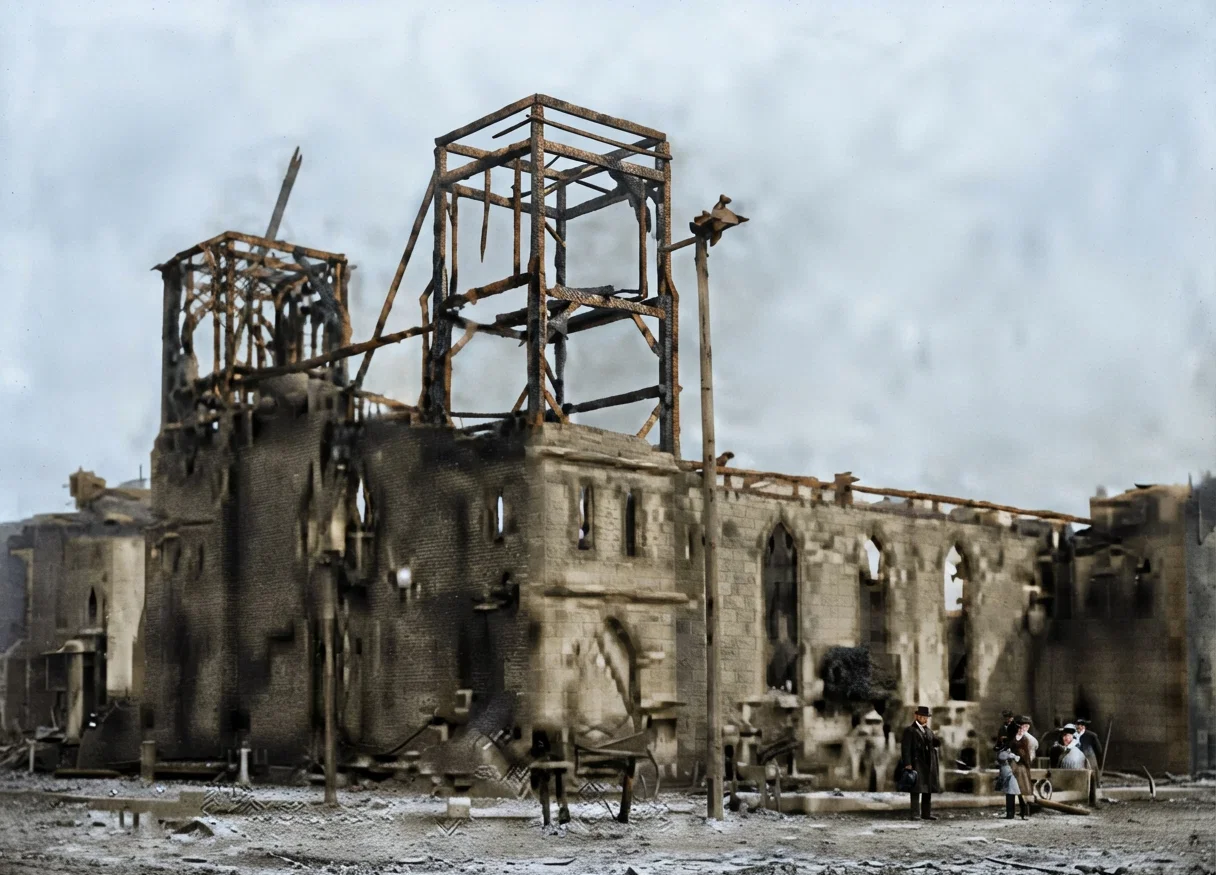
You see, young man, the illustration on this page. It is easily understood. It looks like the remains of a once more or less noble building, and it is.
Just a few hours before the photograph was taken of which this is a reproduction, there stood in the place of these ruins a noble church, a temple of God, dedicated to the work of saving and uplifting humanity. But in the interior, by some carelessness on the part of some one, the fire began, and when it was discovered, it was too late to save the noble structure, and it burned to the condition shown here, a heap of rubbish.
As I looked upon it next morning, I thought how like all that is to many wrecks of humanity. They started in life noble temples of humanity. They might have been used to God's glory and to bless humanity, but they have allowed the fires of sin to burn till the very temples are hopeless wrecks. Such may be seen in the streets of our cities every day, dreaded derelicts on the sea of life, dead in moral power and usefulness, but not buried. They are an offense to every refined sense of humanity which touches them, sight, hearing, smelling. Young men loathe to touch them. They are curses to homes, blots on civilization, burdens on the body politic.
And yet, young man, pause a moment. Do not hurry on. It was not so long ago when that hopeless wreck of humanity was as strong, as fair, as clean, as beautiful, as respectable, as you are now. But he carelessly, selfishly, allowed a fire to burn, a hidden gangrene to corrode. A burning fire must feed on something; a gangrene must eat till all is poisoned.
Are you sure, young man, that you are not in danger? The mug of beer, or the glass of wine, for which you have no particular appetite now, may be the beginning of a fire that will destroy you. The fire which burned the church started once by a little match that a child's breath would have extinguished. The poor wreck of humanity before you had not at one time taken even his first glass.
Your visit to the theater is nothing, you say, but it creates dislike for good things, holy things, and may be the first flame in the fire which will leave your temple of character ruins. The artificial and false of life destroys appetite for the real, as living on pastry and condiments destroys the appetite for that which is good and undefiled.
That "quiet game of cards," a little exciting, made a little more so by a small stake, and a glass of wine, is flame and fuel added to a fire which burns only to destroy.
Once more, young man: Are you yielding to the baser lusts of your nature? Are you indulging in secret sins? You may think them hidden, but they are burning, weakening, destroying the moral and physical fibers of the man. The next thing beyond is to follow the steps of her whose paths lead down to a hell on earth, and to destruction of soul and body, where conscience itself is dead, and the wreck is but a moving semblance of a man.
O, beware the first step in anything which ends in destruction. "Ponder the path of thy feet; let all thy ways be established." "Keep thy heart with all diligence; for out of it are the issues of life." Quench by the living waters of righteousness in Christ Jesus every flame of folly, every burning of lust that may break forth, and live for God and humanity, a noble edifice of character, growing, and helping to build others up into noble temples of God. SUMBOULOS.
SCATTER YOUR FLOWERS AS YOU GO.
By O. S. Marden
(O. S. Marden, in Success.)
THERE is no law by which a man, any more than a rose, can withhold and yet receive. He must give first, and give generously, broadly, magnanimously, if he would develop a magnificent character, if he would accumulate soul-wealth. Give or starve! This is nature's fiat. Give of your sympathy, of your money, of your encouragement, yourself, or starve, mentally, morally.
The man who refuses to give, to share what he has received, is as foolish as the farmer who was so wrought upon by the conviction of a coming season of drought and the probable destruction of crops, that he refused to plant his corn. He said that he would keep it in the crib, that he would not risk putting it into the ground, lest it might rot and be left without provisions for the winter. The drought did not come, however, and the result was that he went hungry, while his neighbors who had planted, generously reaped an abundant harvest.
A great philanthropist said that he had saved only what he had given away, that the rest of his fortune seemed lost. What we give away has a wonderful power of doubling and quadrupling itself on the return bound. It is the greatest investment in the world. It comes back in geometrical progression. Give! give! give! It is the only way to keep from drying up, from becoming like a sucked orange—juiceless, insipid.
Selfishness is self-destruction. The man who never helps anybody, who tightly shuts his purse when there is a request to give, who says that all he can do is to attend to his own affairs, who never gives a thought to his neighbor, who hugs all his resources to himself, who wants to get all and give nothing in return, is the man who shrivels and dries up like the rosebud, who becomes small and mean and contemptible.
We all know those poor, dwarfed souls who never give, who close the petals of their helpfulness, withhold the fragrance of their love and sympathy, and in the end lose all they tried to hoard for themselves. They are cold, lifeless, apathetic; all their sympathies have dried up; they can not enter into the joys and sorrows, the higher and nobler emotions of human life. Their souls have been frozen by selfishness and greed. They have become so narrow and stingy that they fear to give even a kind word or smile lest they may rob themselves of something. They have rendered themselves incapable of radiating sunshine or happiness, and, by the working of an immutable law they receive none.
A strong man, watching one who was delicate and undeveloped exercising in a gymnasium, said to him, "My dear man, how foolish you are to waste your energy on those parallel bars and dumb-bells. You are weak, physically and ought to save that13strength you have for your day's work. You can not afford to squander your vitality that way."
"Oh, but my good sir," replied the other, "you don't see the philosophy underlying the exercise. The only way I can increase my power is by first giving out what I have. I give my strength to this apparatus, but it returns what I give it with compound interest. My muscles grow by giving it out in effort, in exercise."
LABOR.
By Frances S. Osgood
(Frances S. Osgood.)
Labor is rest—from the sorrows that greet us,
Rest from all petty vexations that meet us,
Rest from sin-promptings that ever entreat us,
Rest from the world-sirens that lure us to ill.
Work—and pure slumbers shall wait on thy pillow;
Work—thou shalt ride over care's coming billow;
Lie not down wearied 'neath woe's weeping willow.
Work with a stout heart and resolute will.
Labor is health. Lo, the husbandman reaping,
How through his veins goes the life-current leaping!
How his strong arm, in its stalwart pride sweeping,
Free as a sunbeam the swift sickle guides!
Labor is wealth—in the sea the pearl groweth,
Rich the queen's robe from the frail cocoon floweth,
From the fine acorn the strong forest bloweth,
Temple and statue the marble block hides.
Droop not, tho shame, sin, and anguish are 'round thee;
Bravely fling off the gold chain that hath bound thee;
Look to yon pure heaven smiling beyond thee;
Rest not content in thy darkness—a clod!
Work—for some good, be it ever so slowly;
Cherish some flower, be it ever so lowly;
Labor!—all labor is noble and holy;
Let thy great deeds be thy prayer to thy God.
Pause not to dream of the future before us;
Pause not to weep the wild cares that come o'er us;
Hark, how creation's deep, musical chorus
Unintermitting goes up into heaven!
Never the ocean wave falters in flowing;
Never the little seed stops in its growing;
More and more richly the rose heart keeps glowing,
Till from its nourishing stem it is riven.
"Labor is worship"—the robin is singing;
"Labor is worship," the wild bee is ringing.
Listen! that eloquent whisper upspringing
Speaks to thy soul from out nature's great heart.
From the dark cloud flows the life-giving shower;
From the rough sod blows the soft-breathing flower;
From the small insects, the rich coral bower;
Only man in the plan shrinks from his part.
Labor is life—'tis the still water faileth;
Idleness ever despaireth, bewaileth;
Keep the watch wound, for the dark rust assaileth!
Flowers droop and die in the stillness of noon.
Labor is glory!—the flying cloud lightens;
Only the waving wing changes and brightens;
Idle hearts only the dark future frightens;
Play the sweet keys, wouldst thou keep them in tune.
MAXIMS FOR THE MARRIED.
Since you are married you may as well make the best of it. So make some maxims and try to live up to them.
Never cease to be lovers. If you cease, some one else may begin.
Never both be cross at the same time. Wait your turn.
You were gentleman and lady before you were husband and wife. Don't forget it.
Keep yourself at your best. It is a compliment to your partner.
Keep your ideal high. You may miss it, but it is better to miss a high one than to hit a low one.
Permanent mutual respect is necessary for a permanent mutual love.
The tight cord is the easiest to snap.
Saving and Happiness
By Arthur Conan Doyle
Money is not essential to happiness, but happy people usually have enough. So save some. The easiest way of saving is to do without things.—A. Conan Doyle.
AN INFALLIBLE RECIPE.
By H. A. St. John
All men upon probation,
Differ in their formation,
Differ in their relation,
Differ in their vocation,
Differ in their life-station,
Yet if all of each nation,
And every occupation,
Would seek, through Christ, salvation,
Then each would love his neighbor.
Then Capital and Labor,
Would never come to strife,
Because God's Law of Life,
Would govern every brother.
"BY LOVE SERVE ONE ANOTHER."
H. A. ST. JOHN.
“The Sign of Quality”
STANDS FOR SPEED AND STANDS ALONE
PRICE IS THE SAME
$25 KANSAS CITY (TO CALIFORNIA) CHICAGO $33
OTHER POINTS IN PROPORTION
GOOD UNTIL NOVEMBER 30
ASK SANTA FE AGENTS
MODERN PRINTING STATISTICS.
[From the Scientific American's Special Number on "Modern Aids to Printing."]
THE development of the "art preservative of all arts" has been very rapid during the last decade, and many of the changes have been revolutionary, resulting in enormously increased product, manufactured in quicker time and at a much lower cost. The quality of the work has also improved. The far more general dissemination of intelligence, the rapid and efficient means of intercommunication between all parts of the world, with the cheapening and broadening of educational facilities, constitute one of the most notable features in the progress of the world during the past fifty years; and the one most vitally contributing to all our great industries is the printing press. Some idea of the volume of business may be gained when it is stated that in 1900, the census year, the value of the finished product was $347,055,050. This sum was almost equally divided between newspapers on the one hand and book and job printing on the other. In the United States there are 22,312 establishments, 15,305 of which publish or print newspapers. The total capital invested is $292,517,072. A large clerical force is necessary to transact this amount of business; 37,799 salaried officials, clerks, etc., draw $36,090,719 in salaries, while the actual work is done by 162,992 persons, drawing $84,249,954 in wages. Miscellaneous expenses of these establishments were $55,897,559, and the cost of materials used was $86,856,990.
Of the total value of products, advertising forms 43 per cent, subscriptions and sales 35.8 per cent, and book and job printing, including miscellaneous products, 21.2 per cent. The total circulation of daily papers is enough to supply one for every five inhabitants, and the total circulation per issue of weeklies and monthlies is one to each two inhabitants. Ninety-four per cent of all the publications are printed in the English language. One and a quarter billion pounds of paper were used in the census year. Of this amount 77.6 per cent was consumed for newspapers, and 16.4 per cent for books and periodicals, and only 6 per cent for job printing. On analyzing the total circulation of each State it is found that the ten leading States supply four-fifths of the circulation per issue of all publications, thus indicating the concentration of circulation in certain populous States. Weekly publications are more numerous in proportion to the inhabitants in the West and Northwest. New England ranks high in dailies but low in circulation, suggesting that in that densely-settled region the daily has to some extent supplanted the weekly.
There were 18,226 publications reported to the census authorities, while 3,046 publications failed to report. This would give a remarkable total of 21,272 periodicals, and the aggregate circulation of those reporting was 114,229,334 per issue, while the aggregate number of copies issued during the census year was 8,168,148,749.
THE SHOEMAKER'S DREAM.
GEORGE RENTON was a poor man, and often said "If I were rich, I would show people how to give." In a dream he saw a pyramid of dollars—all new, bright, and beautiful. Just then a voice said to him, "Now is your time; you are rich at last; you now have an opportunity to exercise your generosity." So he arose from his seat and went to the pile to take some money for charitable purposes. But the pyramid was so perfect that he could not bear to break it; he walked all around it, but found no place where he could take a dollar without spoiling the heap. So he decided that the pyramid should not be broken, then awoke to know himself, and to see that he would be generous only while comparatively poor.—Selected.
Work and Money Both saved by using Pearline without
rubbing. Rubbing means unhealthy work; no time to yourself; no comfort in washing. Less rubbing means less wearing, scraping, tearing; fewer clothes to buy; economy. Save your health, your strength; wash in a suitable, womanly way; and while doing this, you're EARNING MONEY
A REMARKABLE LAKE.
By H. H. Baker
[H. H. Baker in Sabbath Recorder.]
ONE of the most remarkable lakes in the world is situated near Obdorsk, Siberia, in the Russian Empire. The lake is seventeen miles long and nine miles in width, and is one of the saltest of salt lakes known. Some time, by the evaporation of the waters in this lake there were left great salt crystals on the surface. In course of time the crystals were so enlarged that they came together and the whole lake was covered with a crust of salt. Originally, evaporation played the most prominent part in forming this coating, but in later years the salt springs that surround the lake are adding constantly to the thickness of the crust, and within the last century the entire lake has been covered with a roof of salt, so that it completely conceals the water. It is a most wonderful sight to behold when the sun is shining on this large field of crystals, the like of which is not to be seen elsewhere, so far as known.
In 1878 an underground outlet for the water was discovered, the water in the lake subsiding and appearing again in the river Obi. Up to the present time the waters have lowered about three feet. The salt crust, however, has become so thick as to sustain its own weight, and retain its old level, thus presenting the spectacle of a lake curiously roofed over with crystals of salt. The many islands with which the lake abounds make sufficient divisions so that the roof is well sustained in its present position.
The flow of salt water over the surface from the surrounding springs is such, that with evaporation alone, it is increasing the thickness of this crust at the rate of six inches per annum.
The covering of this lake is surely one of the most remarkable and wonderful specimens formed by the crystallization of salt collected and manufactured by nature's process.
GOD CONTROLS.
By Whittier
Know well, my soul, God's hand controls
Whate'er thou fearest;
'Round Him in calmest music rolls
Whate'er thou hearest.
What to thee is shadow to Him is day,
And the end He knoweth,
And not on a blind and aimless way
The Spirit goeth.—Whittier.
BEDBUGS AND HEALTH.
DRS. BREMOND AND DE WEVERE have made a careful study of the relation of bedbugs to health, and have shown that this loathsome insect is a menace to health, not only by reason of the loss of sleep, and of blood, directly attributable to its ravages, but also through its becoming the means of transmitting the microbes of tuberculosis. One case is cited in which a communication of disease took place: A young man died of tuberculosis. Shortly afterward, his brother, who occupied his bed, became infected with general tuberculosis. The physician in attendance noticed that he bore marks of many attacks by bedbugs, and, being led to suspect this source of infection, examined the bugs, found that a large portion of them carried tubercular bacilli in their alimentary canals. Rabbits bitten by the same bugs contracted the disease and quickly died of it. An infusion made from the bugs by crushing them was also found to contain the microbes, and when injected into small animals, quickly gave rise to the disease.
TOURIST CARS EAST
VIA
S. P. LINES
Personally ConductedCheapest RatesQuickest Time
Your choice of a dozen routes
Through cars to—
Portland
Omaha
St. Paul
St. Louis
Memphis
Houston
Atlanta
Los Angeles
Denver
Minneapolis
Louisville
El Paso
New Orleans
Washington, D. C.
Salt Lake City
Kansas City
Chicago
Cincinnati
San Antonio
Montgomery
Remember these cars run through to above named cities without a change from Oakland or San Francisco. Our fast limited trains in connection with the above mentioned service. . . .
G. T. FORSYTH
Div. Pass. Agent
12 San Pablo Ave., Oakland, Cal.
PHONE MAIN 543
Seeds
cost more—yield more—save all experimenting—save disappointments. 48 years the Standard Seeds. Sold by all dealers. 1904 Seed Annual postpaid free, to all applicants.
D. M. FERRY & CO., Detroit, Mich.
MACBETH
By Macbeth
Bad grocer confesses his badness by selling bad lamp-chimneys.
MACBETH
You need to know how to manage your lamps to have comfort with them at small cost. Better read my Index; I send it free.