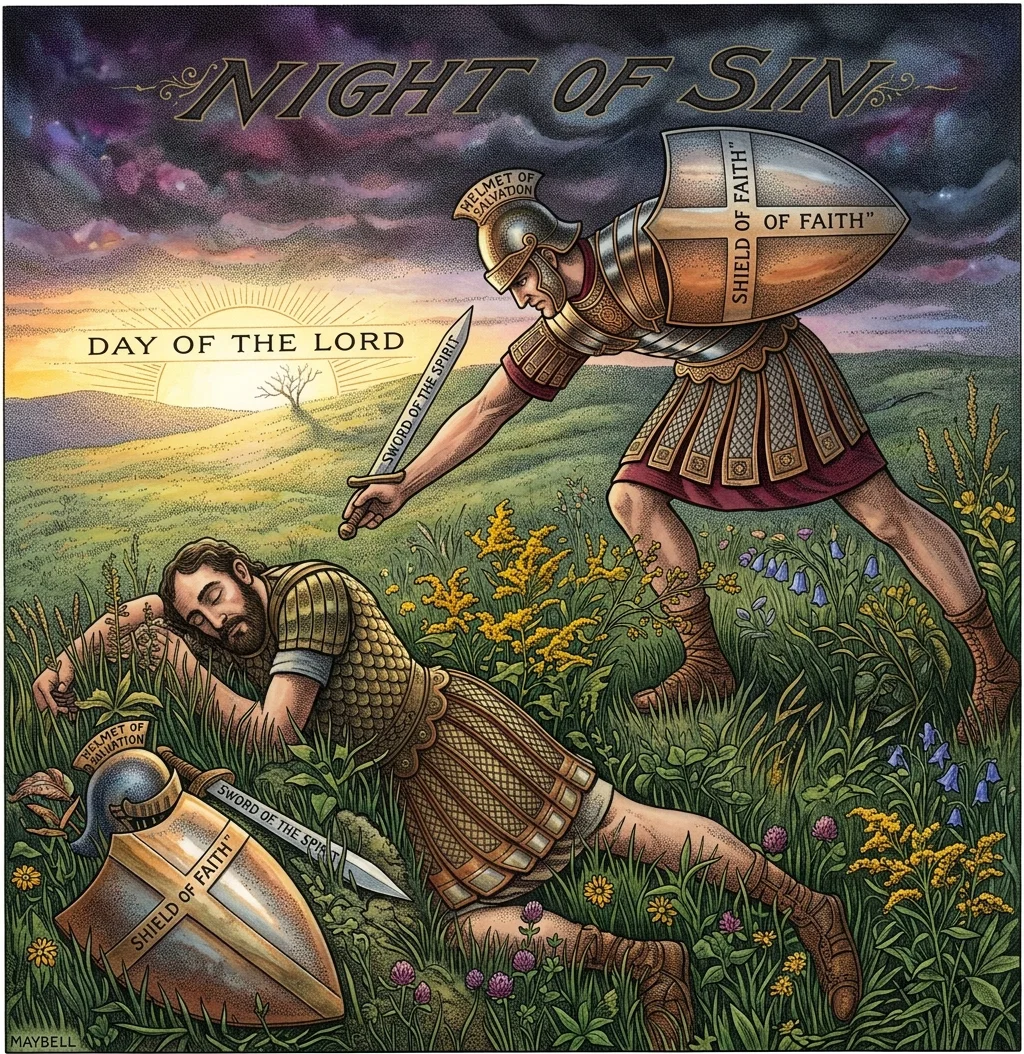
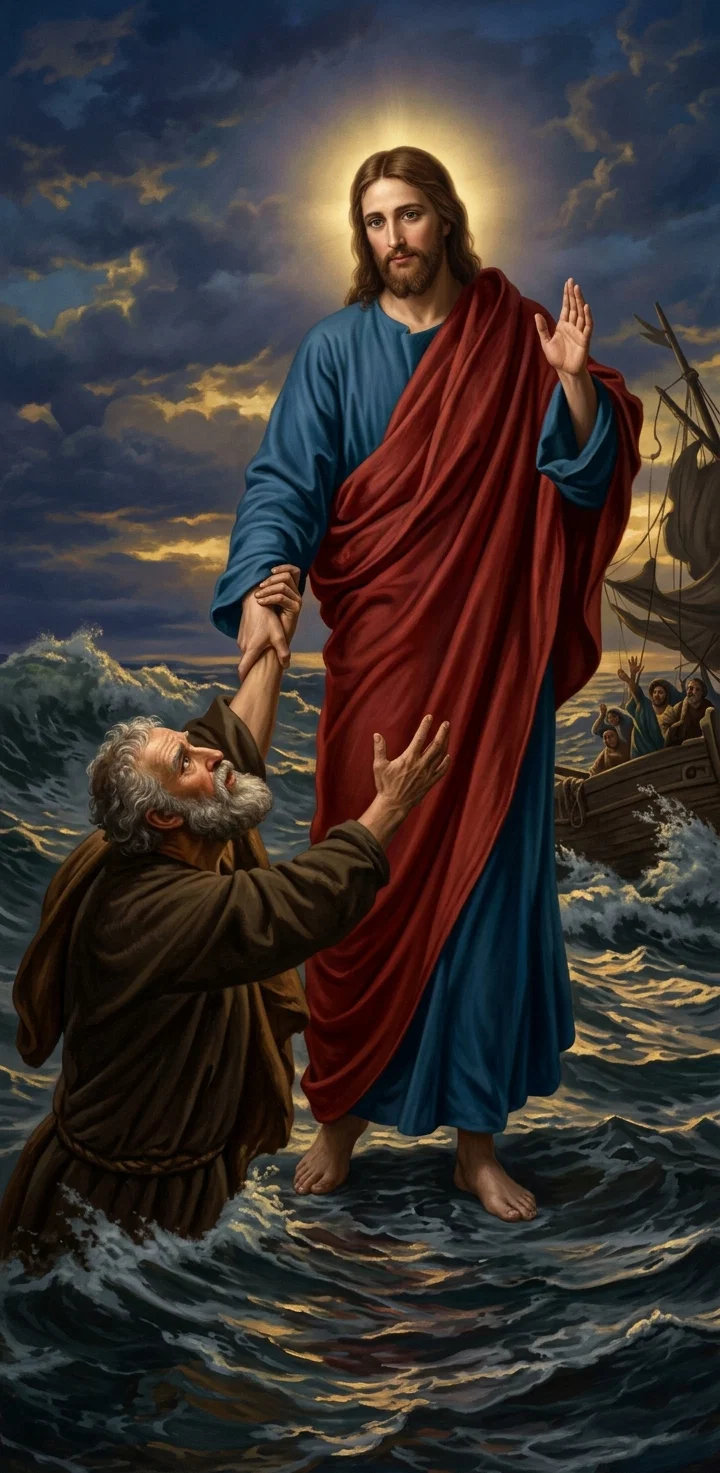
“But concerning the times and the seasons, brethren, ye have no need that aught be written unto you. For yourselves know perfectly that the day of the Lord so cometh as a thief in the night. When THEY are saying, Peace and safety, then sudden destruction cometh upon THEM, as travail upon a woman with child; and they shall in no wise escape. But YE, brethren, are not in darkness, that that day should overtake YOU as a thief: for ye are all sons of light, and sons of the day: we are not of the night, nor of darkness; so then let us not sleep, as do the rest, but let us watch and be sober.” 1 Thess. 5:1-6.
Peace Proclamations Amid Preparations for War
By I.
What hope has the world for a general peace? Certainly there is no very bright prospect before us in that direction. There never were such great preparations for war as now. And no nation is willing to set the example of disarming its army and navy. But rather, the sentiment is constantly gaining ground that the only way to make assured peace is to have such a well-equipped army and such a formidable navy that other nations will be afraid to fight us. And with that sentiment prevailing, every nation is exerting itself to the utmost to keep ahead in the arts of human destruction.
But they all know that it is inconsistent to make the professions of enlightenment and civilization that are made in these days, and still devote so much thought and energy to the preparation of the slaughter of our fellow men. And so some of the foremost manufacturers of armor-plate and other war implements and materials, are the loudest in calling for peace congresses and peace proclamations among the nations. And, judging from the Scriptures, the agitation for peace will continue right in the midst of the prevailing preparations for war, until the great mass of the people will persuade themselves that all is “peace and safety,” regardless of the facts and conditions that actually exist.—I.
Conditions in the Nominal Christian World
By George W. Rice
A Subject of Prophecy
By Prof. George W. Rice
“And he said also to the people, When ye see a cloud rise out of the west, straightway ye say, There cometh a shower; and so it is. And when ye see the south wind blow, ye say, There will be heat; and it cometh to pass. . . . Ye can discern the face of the sky and of the earth; but how is it that ye do not discern THIS time?” Luke 12:54-56.
“And I heard, but I understood not: then said I, O my Lord, what shall be the end of these things? And he said, Go thy way, Daniel; for the words are closed up and sealed till the time of the end. Many shall be purified, and made white, and tried; but the wicked shall do wickedly; and none of the wicked shall understand; but the wise shall understand.” Dan. 12:8-10.
Power and Life
GENUINE Christianity means power—power to reach human hearts and transform and transfigure them into the image of the Christ heart, of the Christ character. The Gospel, which is the power of God to save sinners, is a revolutionary force. Taught and practised in its purity by men who themselves have experienced its saving and transforming power in their lives, the Christian religion inevitably carries conviction to individual souls, and leads them to repentance and moral reformation. Christianity means the religion of Jesus Christ, and to Him was given of God all power in heaven and in earth; and this power, infinite and eternal, is the power of His religion—of Christianity.
We often hear of the power of Pentecostal days, but those were simply the days of pure Christianity—days of its normal manifestation in both precept and practise. Primitive Christianity was a miracle-working power, a revolutionary force, because it had in it the creative power of its Author. Not infrequently, on a single day, through the preaching of one man, this power shivered into atoms the chains that held in moral bondage the souls of thousands of men and women. The bitterest enemies of the Christian religion testified that its power “turned the world upside down.” It was a power before which the pagan world-empire of Rome quailed. It was a power that purged the leper, cast out demons, raised the dead to life; a power that enabled the Christian martyr, wrapped in devouring flame, to expend his expiring breath in songs of praise to his Redeemer.
Is the nominal Christian church to-day, in these opening years of the twentieth century of her history, still in possession of her pristine faith, purity, and consequent power? Does she continue to stir and revolutionize society as she did in the days of Paul and Peter? The answer, No, instinctively leaps to the tongue of every thinking soul. We are to-day confronted with the startling fact that in all parts of Christendom the overwhelming majority of the people are estranged from Christianity as represented by the historic churches.
A Multitude of Witnesses
In Great Britain, seventy-five per cent of the adult population remain permanently out of touch with organized religion. On the continent of Europe this falling away of the people from the churches is far more marked than in England. In December, 1908, that noted journalist, Mr. Ray Stannard Baker, declared that “uncounted Americans whose ancestors looked to the church as the chief inspiration of their daily existence, no longer attend any church. Other thousands, tho still nominally members or attendants, have ceased to admit the church or its ministers as a really vital influence in their lives.” The sumptuously equipped, often lavishly endowed, under the leadership of an educated clergy, the church, taken as a whole, no longer influences the great body of the people.
In one of his last sermons, the late Rev. Dr. George C. Lorimer said: “There is such a thing as a religious crisis in America, however much we may scoff at the idea. Religion is to-day at a very low vitality.” The Rev. Dr. Walter Laidlow, after making extensive sociological and statistical studies of church conditions in this country, estimated that in New York City alone there were, in 1905, 1,071,981 churchless Protestants; that is, adult persons whose antecedents were Protestants. An eminent Presbyterian leader, the Rev. Chas. Stelzle, recently said: “The church to-day seems to have arrived at one of the most crucial periods of her history. . . . No one can successfully deny that the church is slowly but surely losing ground in the city. . . . Within recent years forty Protestant churches moved out of the district below Twentieth Street, in New York City, while 300,000 people moved in. Alarmed for her safety and her very life, the church has sounded a dismal retreat in the face of the greatest opportunity that has ever come to her.” Mr. Stelzle declares that the same shameful movement has been relatively duplicated in every city in America.
“Every one,” says the Rev. Madison C. Peters, “who knows the emptiness of the pews in nearly all the Protestant churches in New York, knows also that so far as Protestants are concerned, New Yorkers have ceased to be a church-going people. The failure of the church to reach the people is not only a numerical failure—for numbers do not always represent power and influence—but it is a failure of quality as well as quantity.”
In a lecture delivered in the last year of his life, Dr. Lorimer said regarding the country churches: “The people are falling away. Even entire churches in New Hampshire, Connecticut, and Massachusetts, have been blotted out, and others have been so reduced in strength as to be slowly perishing. In many instances the preaching has lost the note of authority, and is rarely attractive. Prayer-meetings are poorly sustained; money for the work is not easy to obtain; and interest in evangelism and the salvation of souls is distinctly on the wane.”
This is a serious indictment, but unfortunately it is true. In the London “Commonwealth,” not long ago, a correspondent declared that church attendance in England had fallen off fifty per cent during the last half century. The figures, he avers, are paralleled in other countries. They apply to the rural districts as well as to the cities.
At the great Roman Catholic missionary conference held last spring in Chicago, Archbishop Falconio, apostolic delegate from the pope, said: “In our day a spirit of religious indifference and relaxation of Christian morality is permeating the sanctuary of Christian families. To check this dangerous tendency, we need a revival of the true Christian spirit.”
In the “Arena,” February, 1908, Mr. George Allan England says, “For the present it seems quite within the facts to say that with the sole exception of the Christian Science faith, the church has entered upon a period of marked decadence, and that dogmatic religion in these latter times of ours has fallen on evil days.” Under the caption “Churches Can’t Get Ministers,” the Philadelphia “Press” for Jan. 5, 1907, said: “Sincere alarm is being expressed by religious teachers all over this country and in Europe, at the falling off in the numbers of candidates for the ministry. . . . So marked is this decline that grave fears are held as to the possibility of keeping churches supplied with ministers. . . . It is pointed out that even now the supply does not equal the demands of the churches.”
To say that the Christian church, generally, is spiritually anemic, impotent, and halting, is to utter what has long since become a mere platitude. That she has lost the power and aggressiveness which normally belongs to her, is universally admitted by friends and foes alike. Is there an ascertainable cause for this lamentable status of nominal Christianity?—Most assuredly there is, and we need not look long to descry it.
The divine Founder of the Christian church, in His final and all-inclusive commission, given through His apostles to His messengers throughout the Gospel age, explicitly commanded them to teach all nations to observe all things that He had commanded the apostles to observe. But it has been absolutely impossible for any of the successors of the apostles to know what the Master commanded should be taught and observed except as it is revealed to them through the written Word—the Scriptures. It is through the Bible and the Bible only that the Head of the church has revealed and handed down to us His will—the will of God—concerning us. Hence success in the propagation of the Christian faith can be realized only as we remain unswervingly loyal to the Master’s instructions as enunciated in the Scriptures. “The words that I speak unto you,” He declares, “they are spirit, and they are life.” Again, through His apostle He asserts that “the Word of God is quick and powerful.”
Summary of Results
To repudiate the Word of God, therefore, is to repudiate the Spirit, life, and power of God revealed in Christ. This is precisely what the church, in general, has done. So widely and notoriously patent has this melancholy fact become, that to attempt to prove it would insult the reader’s intelligence. To refresh7our memories and vivify old impressions, I shall venture, however, to state anew that nearly all the scholarly leaders of the Christian churches, those who pose as the sponsors of the Christian faith, as the custodians and interpreters of the Bible, now deny the historicity of the Genesis account of creation, or the fall of man, of the Deluge, of the confounding of tongues at Babel; they scout the idea that the Scriptures are uniformly inerrant; they deny the literal reality of miracles both of Old Testament and New Testament times. Naturally and logically, then, they disclaim faith in the superhuman birth of Jesus, and therefore in the atoning or vicarious nature of His death on the cross; they must therefore, to be consistent, deny that Jesus underwent a physical resurrection, or that He ascended bodily to heaven. Denying the miraculous character of Jesus’ birth, they necessarily toss to the winds the doctrine of His divinity. They declare that the ultimate source of spiritual authority lies in the individual human conscience, rather than in the Scriptures. They hold, of course, that there is a SENSE in which Christ was divine, and that is the sense in which every man is divine. In short, they repudiate everything in the Bible which is humanly incomprehensible, and therefore stigmatize the good old Book as of purely human origin.
“And this, knowing the season, that now it is high time for you to awake out of sleep; for now is our salvation nearer than when we first believed. The night is far spent, and the day is at hand; let us therefore cast off the works of darkness, and let us put on the armor of light.” Rom. 13: 11, 12.
The apostle Peter testifies that it was the Spirit of God that moved upon the hearts of those who wrote the Scriptures and constrained them to write as they did. This being true, it follows inevitably that he who minimizes the Scriptures slights and grieves the divine Spirit. He thus separates himself from the power of God, for His power is imparted through His Spirit, as attested by our Lord when He said to His apostles, “But ye shall receive POWER after that the HOLY SPIRIT is come upon you.” To repudiate the Bible, then, is to repudiate the divine agency through whom alone divine power can be imparted. That the nominal Christian church is languishing, is not at all to be wondered at.
“It begins to look,” wrote the editor of “Harper’s Weekly,” July 3, 1909, “as if the dictionary makers would have to frame a new definition for orthodoxy before long. A few weeks ago the Chicago Baptists refused to turn down Professor Foster in the face of his repudiation of the authority of the Scriptures and his denial of the deity of Christ, and now the Presbytery of New York admits to the pulpit young Mr. Black of Edinburgh, who accepts the story of Adam and Eve ONLY AS A FIGURE, acknowledges the divinity of Christ but not the virgin birth, and does not believe in the story of His bodily resurrection. Substantially, as we make them out, both Professor Foster and Mr. Black subscribe to the Unitarian theory. . . . Whither we are drifting is difficult to determine, but that the current is strong and rapid is certain.”
The Promise
By Iva A. Clute
By Iva A. Clute
We may know that He is coming,
We may analyze earth’s strife;
They who follow have not darkness,
But may have the Light of Life.
Others may grope on in blindness,
Knowing not the day-star bright
Long since started its ascension,
Shedding o’er the world its light.
Ignorance and superstition
Mark this age of unbelief;
And the Saviour, at His coming,
To the world will be a “thief;”
Coming when they least expect Him,
When they “Peace and safety” cry,
Piling up their mass of riches
For the crisis now so nigh.
To the faithful few who know Him,
God’s Word says, “It need not be
That as to the world about you
That bright day to you must be.
“Ye walk not in worldly darkness;”
O’er the earth the heralds sing,
And we hear the joyous message,
“Christ, no longer Priest, but King.”
South Livonia, N. Y.
Foretold Through Prophets
This all-pervading spiritual decadence, in the churches of to-day, was clearly foreseen and declared by the inspired prophets of old. Verses eighteen and nineteen of Isaiah twenty-nine, and verses eighteen and onward of chapter thirty, show unmistakably that the prophetic announcements of these chapters will in an especial sense have their fulfilment in the latter days—in the days when the timeless kingdom of the “last Adam,” of the Christ, is about to supersede the reign of sin on the earth. To the professed ministers of the Word in these last days in which we live, the Lord says:
“Tarry ye and wonder; take your pleasure and be blind; they are drunken, but not with wine; they stagger, but not with strong drink. For Jehovah hath poured out upon you the spirit of deep sleep, and hath closed your eyes, the prophets; and your heads, the seers, hath He covered. And all vision is become unto you as the words of a book that is sealed, which men deliver to one that is learned, saying, Read this, I pray thee; and he saith, I can not, for it is sealed; and the book is delivered to him that is not learned, saying, Read this, I pray thee; and he saith, I am not learned. And the Lord saith, Forasmuch as this people draw nigh unto Me, and with their mouth and with their lips do honor Me, but have removed their heart far from Me, and their fear of Me is a commandment of men which hath been taught them; therefore, behold, I will proceed to do a marvelous work among this people, even a marvelous work and a wonder; and the wisdom of their wise men shall perish, and the understanding of their prudent men shall be hid.” Isa. 29:9-14, A.R.V.
Again, in verses eight to thirteen of chapter thirty, the Lord further testifies respecting the “prophets” (religious teachers) and “seers” of our day:
“Now go, write it before them on a tablet, and inscribe in a book, that it may be for the time to come forever and ever. For it is a rebellious people, lying children, children that will not hear the law of Jehovah; that say to the seers, See not; and to the prophets, Prophecy not unto us right things, speak unto us smooth things, prophesy deceits, get you out of the way, turn aside out of the path, cause the Holy One of Israel to cease from before us. Wherefore thus saith the Holy One of Israel, Because ye despise this word, and trust in oppression and perverseness, and rely thereon; therefore this iniquity shall be to you as a breach ready to fall, swelling out in a high wall, whose breaking cometh suddenly in an instant.”
We must not fail to observe that the nominal spiritual leaders of to-day are charged with treating the Word of God, especially the prophetic portions, as a SEALED book, a book that can not be understood. They express their fear of Jehovah not through His commandments, but in a “commandment of men which hath been taught them.” And, accordingly, as did the priests in the days of Christ, they make void the law of God, by their human traditions. Note further, that they are divinely charged with refusing to “hear the law of Jehovah.” They despise His Word, and trust in “perverseness;” that is, in perverting, distorting, or wresting the Word of God. Is it not true, dear reader, that a very large majority of religious ministers are to-day desperately attempting to argue themselves and the people into believing that the commandments of God are no longer operative, or binding upon the consciences of men? And even they themselves can not deny that they are doing this impossible thing for the very purpose of rendering null and void the claims of the fourth precept of the Decalogue, the commandment enforcing the observance of the Sabbath of the Lord.
In the opening words of the third chapter of 2 Timothy, the inspired apostle Paul preannounces respecting the last days, “that in the last days grievous times shall come. For men shall be lovers of self, lovers of money, . . . holding a form of godliness, but having denied the power thereof.” To hold a form of godliness, is to profess godliness or religion. Now, concerning these professors, it is further stated in verse seven, that they are “ever learning, and never able to come to the knowledge of the truth.” The verity of this prediction is to-day overwhelmingly in evidence. Never before did the leaders of religion apply themselves to study, to the acquisition of knowledge, more ardently and assiduously than do those of our day. The world is flooded with religious journals, brochures, and books. The land is dotted with religious schools and theological seminaries. Can we conceive of a paradox more melancholy than this, that the ministers of the sanctuary are to-day EVER LEARNING, and yet not able to COME TO A KNOWLEDGE of THE TRUTH?
Wisdom in the Scorn of Consequence
“Because right is right, to follow right
Were wisdom in the scorn of consequence.”
Conditions in the Social World
By L. A. Reed
By L. A. Reed
WHOM THE FAITHLESS ARE DENYING
These Last Days and Grievous Times
“But know this, that in the last days grievous times shall come. For men shall be lovers of self, lovers of money, boastful, haughty, railers, disobedient to parents, unthankful, unholy, without natural affection, implacable, slanderers, without self-control, fierce, no lovers of good, traitors, headstrong, puffed up, lovers of pleasure rather than lovers of God; holding a form of godliness, but having denied the power thereof: from these also turn away.” 2 Tim. 3:1-5.
We are living in the last days of this world’s history. Empire has succeeded empire, and civilization has moved westward through the ages, until it has now belted the earth. No new empire or nation can now rise in new territory and dominate and control the old. When the nations now upon the scene of action have run their course, the kingdom of God and of His Christ will be ushered in.
Before the first advent of Christ there was well-nigh universal peace in the earth, a reign of secular law and order, which helped to make that “fulness of time” when God chose to reveal to men His Son. And to-day there is well-nigh universal peace, a token of that new “fulness of time” when God is heralding the news of the soon-coming second revelation of His Son. This time He comes not merely to live as a man, but to execute justice as a God.
Important, then, are these last days; and grievous, too, they are, even as the Holy Book declares. Every feature of these times was foreseen by the seers of old, and they photographed every lineament of our days; and now, as we look at the reality and then at the Scriptural photographic likeness, we see that these are the last days, for no other times fulfil the likeness in all its lines. These are the times the Scriptures plainly portrayed.
Let us compare the times in which we live, and the photographic likeness of them as given in the Word. The logical result will be conclusive.
“Lovers of Self”
“In the last days grievous times shall come. For men shall be lovers of self.” Never was photograph more true to its original than is this scripture true of our times; the times are grievous, for men are lovers of self.
What means the awful beggary of our cities? Why are women beaten down, men murdered, street-cars robbed? What mean these poor, miserable little dives in the working man’s ward, each snatching a starvation living from the poor dwellers of the dozen smoke-befouled tenements? Why, in our cities, is one thief in three set free on a suspended sentence? What is this awful misappropriation of funds, and malfeasance in office? Why is it that criminals and vicious men are placed in positions of trust, to betray and rob and murder those who set them there? Why is crime licensed, and a premium put upon profligacy?
God knows the awful maggot-festering rottenness of hundreds of city holes, and He knows why these grow daily worse and more defiling until they smell in foulness to the heights of the high heavens. God knows this, and He knows the reason of it all. It is because men do not love their fellows; instead, they are “lovers of self.”
“Lovers of Money”
“In the last days grievous times shall come. For men shall be . . . lovers of money.” All too well we know the truth of the prophetic word. We are now in this time, a time of all times when men love self and love money, and run into any excess to grasp money and minister to self.
In the city of Chicago alone there are 7,500 licensed liquor-saloons, besides a thousand other places where liquor is sold—$115,000,000 spent for liquor in that one city. Neither is it the only city of that kind. The great brewery interests have packed our cities with saloons wherever they could possibly crowd one in and make it pay. And the poor vice-bitten liquor-habit victims are confronted with these hellish temptations whenever they step upon the streets.
The multiplication of these dens of iniquity is possible because men love themselves more than their fellows, and love money and love self even to the beggaring and debauching and demoralizing of humanity. They have so pushed their campaign of drunk-education that, reckoning it out by population, every man, woman, and child in Chicago drinks in one year seventy gallons of liquid hell in the form of beer, and four gallons of spirituous—evil spirituous—liquor. Is it any wonder that our cities furnish such a staggering array of savage crime? To put into man that which will make him more merciless than the wild beasts of the jungle, does not come from a love of humanity; it is caused by a love of money that reckons self more valuable than the price of countless souls.
And then less degraded in form, but just as evil, is the awful betrayal of trust in public and private; and this is causing the suffering and sorrow and death of hundreds by a piracy upon the public. Trusts combine to compel money from those who ill can pay the price. Accumulations of capital seek to grasp all national resources and minister them for private profit, regardless of the cost to others.
The “grievous times” have come when men are “lovers of self, lovers of money.”
“Boastful,” “Railers”
“Grievous times. . . . For men shall be . . . boastful, haughty, railers, . . . headstrong, puffed up.” No pleasant picture this, and, worst of all, it is not an imaginary picture, I assure you; it is a photographic likeness of our times, true in every shade and line.
Truly this is an enlightened age, an age named in the prophetic word as “the time of the end,” when “many shall run to and fro, and knowledge shall be increased.” Dan. 12:4. This is an age of increased knowledge above every age of all historic times. But the knowledge has made men, many men, exalted and heady. These have become so wise in their own conceits that they have ceased to be learners of the truth, but essay now to judge the truth.
“Puffed up” with their own accomplishments, they delineate all the past history of the earth, even to the doing away with the records of God, lay down laws for the conduct of man in the present that exalt him to divine peerage, and attempt high-sounding prophecies of the days that are yet to be that annul even the black reign of death.
“Boastful!” with their little yard-stick of “development doctrine,” they pass through the earth rejecting everything that does not conform to their puny measure. Truly has one said, “The skepticism of our day is rather sad than frivolous. It invades the church; and does not stop in the pews, but ascends the pulpit and preaches. The old cosmology has been overthrown in headlong ruin; rituals, creeds, and Scriptures are overhauled. Everything in heaven and earth is called upon to show its credentials.”
“Haughty.” Who can doubt it? As a certain writer has said of the arrogance and assumption of this age: From the “supposition that God has not spoken since the first century of the Christian era, we have reacted to the extreme opposite supposition that God has never spoken until now, and that the compelling spiritual dictates of the age in which we live are the first and only voice of the living God!”
“Boastful, haughty, railers, . . . headstrong, puffed up.” Do you think the delineation true to the times? Is it in harmony with the facts? You know that it is. The Bible is criticized in our times as tho it were of no more authority or sacredness than a last year’s newspaper, and not half so important. And this process of criticism goes on “from Genesis to Revelation,” as says the June “Independent,” “with no fear of the curse at the end of the last chapter.”
“Lovers of Pleasure”
“Grievous times.” “For men shall be . . . lovers of pleasure rather than lovers of God.” The one fact that as a nation we are spending annually $922,803,065 for mere amusements in theaters and resorts and shows, is its own verification of the divine Word. Spending enough for these things alone in thirteen months to pay the entire national debt! Spending almost a billion dollars a year for drunkenness and cigars! Spending $22,000,000 a year to hear the rattle of musketry and to see the glare of fireworks! Yes, it is true that in these days men love pleasure more than they love God; for the people of this country alone spend twenty times as much each year on mere trips of pleasure to Europe as they spend for the salvation of the heathen in all the lands of the earth!
“Form of Godliness,” but No Power
“Holding a form of godliness, but having denied the power thereof.” And right here is the fountain of all the trouble. The church has not been true to her Master. The great impress she should make upon our times, is not made. She has no power for the helping9of the world’s needs. The times are all too unaffected by great tides of virtue which she might pour into the hurt of the earth to the healing of sin’s disease.
Rejecting the message of the great Sabbath truth, she has kicked at the eternal law of the sovereign God. And to free herself from this law she has claimed absolution from its authority through the atonement of Christ. He who averred that He came not to destroy the law, is made the destroyer of the law for all of that. And she sings, in happy forgetfulness of the exacting claims of its righteousness,
“Free from the law — O happy condition!”
Thus rejecting the law and teaching its abolition, the church has opened up the great flood-gates of lawlessness. The church has accepted the tenets of science that do away with all religion save that which is purely natural. The church has stood by and abetted those who break down the authority of the Word. And now the world, robbed of all authority and law, is an authority and law to itself, and does as seems good to it.
And so we have come to the last days and the grievous times.
But there are those who are still true to God and to His Word. The Scriptures give us their portraits also, and with photographic exactness. “Here is the patience of the saints, they that keep the commandments of God, and the faith of Jesus. . . . And I saw . . . a white cloud; and on the cloud I saw one sitting like unto a son of man, having on his head a golden crown, and in his hand a sharp sickle . . . for the hour to reap is come; for the harvest of the earth is ripe. And he . . . cast his sickle upon the earth; and the earth was reaped.” Rev. 14: 12, 14-16.
Yes, there are those who hold to the complete law of God, and who also rely by faith upon the life of Christ that keeps from the law’s transgression. In every clime, in every land; in every church, even in highway and hedge, they may be found. And the Most High, in whose hand are all events and every result, knows infallibly those that are His.
We are in the last days of this world’s history. You can not break the statements of God’s Word. You can not change the facts that verify its truth.
Think about this; pray about it; act upon it. Swing into line with God’s eternal purpose. Keep step with the mighty drum-beats of His invincible providence.