Your ShelfYour Projects

Signs of the Times, Vol. 8, No. 41.

General Articles
Earlier text: The Comet—A Strange Thing

A Timely Correction.

In one of the important commercial cities of North Germany there once lived a merchant named Muller, who, in his walks about the city often encountered a bright-faced, well-dressed young man, who always took off his hat and bowed to him in the most deferential manner.
The young fellow was an entire stranger to the merchant, but the latter always returned his greeting with a friendly nod, supposing himself to be mistaken by the young man for some one whom he probably resembled.
One day Mr. Muller was invited to the country seat of a friend, and, arriving there at the appointed time, he noticed this young man walking up and down the shady paths of the garden, engaged in earnest conversation with the host.
"Now I shall know who this young gentleman is," thought Mr. Muller, and hastily approached them.
"Allow me," said the host, after exchanging greetings with his friend, "to introduce—"
"It is not necessary, I assure you," interrupted the young man, eagerly, "we have known each other for many years."
"You must be mistaken," said Mr. Muller, "for though in answer to your greetings I have repeatedly bowed to you, still you are entirely unknown to me."
"And yet I insist," replied the young man, "that I have been acquainted with you for a long time, and am delighted to have the opportunity of meeting you here, and to present my heartfelt thanks for the service you once did me."
"You speak in riddles," said Mr. Muller; "how can you be under obligations to me when I do not even know you?"
"It does seem a little mysterious," laughingly answered the young man; "but let us sit down here on the piazza while I throw a little light on the statement."
"Seventeen years ago, when I was a lad of nine, I started to school one morning with my books under one arm and my lunch of bread and butter under the other. I was a poor boy with a big appetite. My luncheon never seemed enough for my hungry stomach, and I used often to envy boys whose mothers could afford to give them choice fruit for their dinner."
"This morning I had been especially dissatisfied. 'If I only had an apple pie with my bread how nice it would be.'"
"My way to school was through the market place, and as I arrived there it seemed the fruit had never looked half so beautiful or desirable. I stood there several moments, gazing at the abundant supply, instead of hastening away from the temptation as I should have done.
"Suddenly an old market woman, who superintended large, rosy-streaked apples, turned her back on her wares to gossip with her neighbors.
"'Such lots and lots,' I thought to myself, 'surely one from so many would never be missed, yet would do me so much good.'"
"Quick as a flash I stretched out my hand and was just about to thrust an apple into my pocket, when a sharp box on the ear caused me to drop the fruit in an agony of terror.
"'Youngster,' said an earnest voice close to my ear, 'have you forgotten the ten commandments? Now I hope this is the first time that you have ever stretched out your hand after goods that are not your own; let it be the last time.'"
"I hung down my head for shame, and only for an instant lifted my eyes from the ground to see who my reprover was.
"When I reached school the words heard were still sounding in my ears. My heart was so full I could scarcely keep from crying. 'Let it be the last time also, let it be the last time also,' again and again confronted me. Bowing my head on the desk, I then resolved that it should indeed be the last time, even as it had been the first; that never as long as I lived would I covet what belonged to another, or strive to gain unlawful possession of it.
"After a few years I left school, and became a clerk in my uncle's counting-room. From there, a year or two later, I went to South America. You will readily believe me when I tell you that there the temptations to a young merchant are not few. I repeatedly had opportunities, which acquaintances of mine did not hesitate to improve, to benefit myself at the expense of others; but every time these presented themselves, those words 'Let it be the last time, also,' reminded me of my duty, and helped me to distinguish between right and wrong.
"I have been back in my native country about five months. I have come back possessed of considerable wealth—but money earned squarely and honestly. Never have I knowingly reached out my hand and taken a penny even that did not rightfully belong to me."
The young man remained silent for a few moments, overcome with emotion; then, reaching forth his hand he took that of Mr. Muller, and exclaimed:—
"Allow me to gratefully grasp the hand that once did me such service."
"And permit me," said Mr. Muller, while the tears came into his eyes, "to love the man who is capable of such gratitude, and who, in after life, so faithfully keeps the resolve made in boyhood."

The Puritan Theory of Amusements.

The question of amusements was to the Puritans a representative question, in which was involved the whole spirit of Christian living. They brought to its discussion the whole force of their intense religious nature. In their very make they were intense men. They were anthracite on fire. Without flame, or crackle, or smoke, theirs was solid heat, burning stilly day and night. Such intensity of moral being they brought to all questions of practical life.
Such men felt no need of amusements. How could they? They were not born, as some men appear to be, at hap-hazard, without an aim in living, and with no power to create one. Their happiness did not depend on cat's-cradle and push-pin. They did not know the meaning of the word "ennui." They came into this world as apostles. They came because they were sent. The echo of the voice which created them always sounded in their ears, and heralded their steps. Theirs was a great mission. Their souls were straitened till it was accomplished. When invited, urged, bribed, cajoled, commanded, threatened, browbeaten, to induce them to dance around a May-pole on the village green, they calmly said, "Wist ye not that I must be about my Father's business?"
That which seemed to weaker natures a harmless or needful recreation seemed to them frivolity. When charged with excessive precision, said one of them for answer, "I have a precise God to deal with." They saw no record that Christ danced around poles, or amused himself with a jack-of-spades, or laughed at clowns and harlequins, or figured at masquerade balls. As they read his life, they saw him seeking relief from life's burdens in the companionship of brothers and sisters, in the homes of Bethany, in the society of angels, in communion with God. They saw that to him midnight prayer took the place of midnight revels. They honestly tried to live as Christ lived. Why should they not?
Right or wrong, they believed this to be the true theory of life; and, what is more, they in good measure lived it. They enjoyed it. As a class, they were the happiest of mortals. If ever in this world men enjoyed life, they did, whenever tyranny would let them alone. And, when it would not, they entertained each other with songs in prisons, and broke out with doxologies at the stake.
It may be well enough to revise their theory of amusements for later times and new generations. The Constitutions of States rarely last a century without change; still less should a popular theory of recreations. We may wisely let up somewhat of Puritan pressure upon the modern conscience. We may bid Godspeed to anybody who thinks he can improve in this respect the usages of a Christian people. By all means, let us give him a hearing. Specially may we extend the law of Christian liberty in this thing. We may trustfully leave it to every man's conscience to say what recreations, in themselves innocent (as almost all recreations are), will be a help to him in godly living.
But, after all, who can fail to see that the spirit of Puritans on this subject was the Christian spirit? Who can help seeing that improvement, if it comes, must come from the same spirit? This was the spirit of a live conscience. It was the spirit of humble inquiry; it sought wisdom from God. It was the conservative spirit; it leaned to the safe side of moral questions. It was the profound spirit; it sought happiness in duties rather than in rights.
It is very easy to fling at the Puritans in this matter, but it is very weak. Every dog must have his bay at the moon, but healthy men sleep through it. So disparagement of the Puritans does not disturb sound thinkers. The world has outlived the wit of it. The libel of the "Blue Laws" has ceased to be amusing. If we could stay long enough to answer such disparagement, our answer would be to point to the men whom the Puritans' theories of life created. Not till the improved theories give us better women, can we wisely believe that they are improvements. Not till children trained under such improvements, turn out to be more Christlike men and women, more prayerful, more self-denying, more useful, happier, too, in the profound sense of spiritual joy, can we safely admit that their fathers are wiser than our fathers. For that proof the world must wait awhile,—must wait long enough for us to do some things which the world is in more pressing need of than of an increase of amusements and of idle time.—Prof. Austin Phelps.

The Home Circle.

EVENING TEARS AND MORNING SONGS.

In the evening there is weeping, Lengthening shadows, failing sight, Silent darkness slowly creeping Over all things dear and bright.
In the evening there is weeping, Lasting all the twilight through. Phantom sorrows never sleeping, Wakening slumbers of the true.
In the morning cometh singing, Cometh joy and cometh sight, When the sun ariseth, bringing Healing on his wings of light.
In the evening cometh singing— Songs that ne'er in silence end; Angel minstrels, ever bringing Praises new with thine to blend.
Are the twilight shadows casting Heavy gloom upon thy heart? Soon, in radiance everlasting, Night forever shall depart.
Art thou weeping, sad and lonely, Through the evening of thy days? All thy sighing shall be only Prelude of more perfect praise.
Darkest hour is nearest dawning, Solemn herald of the day; Singing cometh in the morning— God shall wipe thy tears away. —Frances Ridley Havergal.

Obeying Mother Pleasantly.

Harry had seen some older boys fly their kites from the tops of the houses; and he thought it would be nice fun if he could do so too. So he came to his aunt and said, "Aunt Mary, may I go up to the top of the house and fly my kite?"
His aunt wished to do everything to please him; but she thought it very unsafe; so she said, "No, Harry, my boy. I think that is very dangerous sort of play. I'd rather you wouldn't go."
"All right. Then I'll go out on the bridge," said Harry.
His aunt smiled, and said she hoped he would always be as obedient as that.
"Harry, what are you doing?" said his mother one day.
"Spinning my new top, mother."
"Can't you take the baby out to ride? Get out the carriage and I'll bring him down."
"All right," shouted the boy, as he put his top away in his pocket, and hastened to obey his mother.
"Uncle William, may I go over to your shop this morning?" said Harry one day at breakfast. "I want to see those baskets again that I was looking at yesterday."
"Oh yes, Harry," said his uncle, "I shall be very glad to have you."
"But I cannot spare you to-day, Harry," said his mother. "I want you to go out with me. You shall go to the shop another day."
"All right," said Harry, and he went on with his breakfast.
No matter what Harry was asked to do, or what refusal he met with when asking for anything, his constant answer was, "All right." He never stopped to worry or tease; he never asked "Why can't I?" Harry had learned to obey, and to obey in good humor.

Religious Notes.

—Chicago is one of the strongholds of Catholicism in America. That church claims by baptism 312,000 members there, more than one-half the entire population.
—The Occident (Presbyterian) says: “Temperance and the Sabbath [Sunday] have come into politics, and they will stay there until they win a permanent and substantial victory.
—A fund for an American Catholic University has been started in Chicago, and Bishop Spalding has gone to Rome to consult the pope in reference to its establishment in that city. The fund already amounts to $300,000.
—The question of feet-washing as a Christian ordinance is being argued pro and con in the Banner and Gleaner (Baptist). Although the editor does not believe in feet-washing, he admits some articles, which contain sound argument in its favor.
—A minister, in a religious contemporary, recently took it upon himself to criticise Paul. He claims that Paul made a serious “blunder” in his Athens discourse. What a pity that there are not more preachers nowadays who can “blunder” as successfully as Paul did.
—In an interview of New York ministers, on the wants of the churches, the pastor of All Souls Episcopal Church said that there is great danger that the church may find itself wholly on the side of wealth, and the clergy discover that they have accepted retainers from capital.
—It is the complaint of a correspondent of the Western Christian Advocate, that Methodist Sunday-schools are not evangelical, that they excel in reciting orations or dialogues, or in getting up Christmas trees, concerts, and picnics; but that repentance, belief, and conversion, are little thought of.
—A London paper says: “In the United Kingdom of Great Britain and Ireland, there are about 40,000 places of religious worship; while it appears to be a well-ascertained fact that for every 1,000 persons attending the house of God, above 2,000 are to be found on Sunday in the public houses.”
—William Richardson was deacon of a Baptist Church in Brooklyn, N. Y., and is also president of the Atlantic Avenue Railroad. A few months ago, in order to evade an injunction, he had his men lay track on Sunday. After a long trial, he has been excluded from church membership, by a vote of nineteen to twelve.
—The following blunder is credited to an eminent Boston preacher. In the course of a sermon, he said: “The Master whose we are and whom we delight to serve, has said, ‘all that a man hath will he give for his life.’” Should there chance to be any reader of this paragraph who doesn’t see the point, let him read Job 2:4.
—It is stated that “twelve-thirteenths of the membership of the M. E. Church take no interest in the benevolent collections.” That is, out of 1,681,854 members, 1,556,480 are do-nothings. Of those disinterested ones, 875,320 never give anything, and the remainder give an average of ten cents apiece. The Christian at Work well says that “this ten-cent Christianity is indifferent stuff.”
—The San Francisco Monitor (Catholic) is working zealously in favor of the whisky saloons. The Catholics as a body are vigorously opposing prohibition. It shocks our sense of propriety to see a body of men who profess to be religious, openly championing the vile whisky traffic. Still in this the Catholic Church is true to its record. The mystery of iniquity could not consistently favor a righteous cause.
—Dr. Paspate, a learned archaeologist at Constantinople, who is a great authority on modern Greek, claims that the sacred writers wrote in the ordinary colloquial Greek, instead of the classical, and that it differs but little from that spoken at the present day. He suggests that some, at least, of the difficulties with which the revisers had to deal, might have been solved had there been in the company one well acquainted with modern and mediæval, as well as with ancient, Greek.
—The American Baptist Flag tells of a Baptist meeting where the ordinance of feet-washing was attended to, and approvingly says of some Methodist brethren and sisters, who were invited to join, that “they thought too much of themselves to take part in such a union.” This is the trouble with too many; they “think too much of themselves” to follow the example of the meek and lowly Saviour. “Let no man think more highly of himself than he ought to think.”
—A correspondent of the Sabbath Recorder, in an article condemning night work, uses the following language: “When the body is weary, the brain, which is an integral part of the body, and the mind, which is simply brain function, are weary too.” This is a statement of facts which are so simple as to be almost self-evident. The questions then arise, What use can be found for an immaterial soul, when the brain does everything which that nonentity is supposed to do? If the brain does not think, of what possible use is it to a man? and if it does think, as it unquestionably does, why need there be any controversy as to whether God can organize matter to think?
—Here is an item for parents. At the General Conference of Seventh-day Baptists, in the discussion of Sabbath-school work, it was stated as a matter of observation that “those boys who were compelled to go to church and to sit with their parents, when small children, whether they liked it or not, are the young men who to-day are to be found in church and Sabbath-school work; while those who went or not, as they felt like it, are to-day nowhere.” And this testimony will be corroborated by the experience and observation of every thinking Christian. Take the children to church, and teach them how to behave when there. If you do not, the chances are that they will never learn.
—Dr. Lyman Abbott says of the Lord’s Supper: “It is a memorial service; that is clear enough. ‘Do this in remembrance of me,’ was the interpretation which Christ himself gave to it. ‘As often as ye eat this bread and drink this cup, ye do show the Lord’s death till he come,’ is Paul’s interpretation. For this purpose any other memorial might have served as well, nay, might even now serve as well, but for associations’ sake.” We differ. We think the command, “Do this in remembrance of me,” defines just what is to be done. All the apostasy of the Catholic Church, with its false Sabbath, false baptism, etc., arose from persons claiming to know the mind of the Lord so well as to be able to institute laws and ceremonies equal with his. Simple obedience to a commandment of God, because it is a divine command, is getting very rare.
—The detachment of the Salvation Army that went to India, got into trouble. They had their street parade, dressed in fantastic attire, with fife and drum, and were fined on the charge of gathering an unlawful assembly. The magistrate said that in England the people professed one religion, and efforts like those of the Salvationists to reclaim the fallen would meet with universal sympathy; but when they came to India, to convert people from one faith to another, they must avoid noisy and peculiar demonstrations, as these were sure to excite angry feelings and passions, and to provoke counter demonstrations. If the Salvationists desired to preach Christianity, they would be allowed to do so, with perfect freedom, provided they selected some unobjectionable place; but they could not be allowed to parade the streets in such a manner as to excite the religious feelings of other sects, and so bring the people of different creeds into collision.

News and Notes.

—Thursday. November 30, has been set apart by the President as thanksgiving day.
—In one day last week, 4,484 immigrants landed in New York from European ports.
—A wind storm, accompanied by hail and snow, did great damage throughout England, Oct. 24.
—The loss by the burning of the exposition building at Sidney, New South Wales, was $2,500,000.
—It has been found possible to photograph landscapes from the window of a train running at the rate of forty miles an hour.
—There is serious trouble in Afghanistan. The inhabitants in the vicinity of Cabul have revolted and killed their Governor.
—It is stated that the trouble in Soudan, caused by the false prophet, dwarfs Arabi's revolt into insignificance. Already 6,000 Egyptian troops have been massacred by his followers.
—Dr. Oliver Wendell Holmes has resigned his position as Professor of Anatomy at Harvard, which he has held for twenty-five years, in order to give himself wholly to literary pursuits.
—An exchange thinks that Arabi might easily get clear if he would only enter a plea of "emotional insanity." He might if he were in the United States, but that plea doesn't work well across the water.
—The Bey of Tunis has made a treaty with France by which that power assumes the debt of Tunis, organizes the administration of justice, and takes charge of all public property, giving the Bey a retiring allowance.
—Several quite severe shocks of earthquake have been felt in the East within the last few days. This will serve to remind our eastern friends that California is not the only place where the earth does not rest on an immovable foundation.
—The Krupp factories at Essen do the biggest gun business in the world. They use 429 boilers, 453 steam engines, 82 steam hammers, 1,556 furnaces, produce 300,000 tons of steel, and 26,000 tons of iron yearly, and employ a population of 15,700.
—The Pennsylvania Railroad Co. have just satisfactorily tested a system of electric lighting for passenger coaches. A soft, bright, and steady light was obtained, and the experiment pronounced a success by the railroad officials and electricians who were on the train.
—The expectation is entertained that difficulty between France and China will result from the entrance into Annam of troops of both the French Republic and the Chinese Empire. It is regarded as very nearly impossible to prevent a collision between these rival armies.
—From thirty to fifty new cases of yellow fever are reported every day at Pensacola. Up to Oct. 24 there had been 2,058 cases, and 168 deaths. A mere statement of the facts cannot begin to convey any idea of the amount of suffering in the city and surrounding country.
—It was reported that the Egyptian Government was about to abandon the prosecution of Arabi Pasha, on account of the expressed wish of the authorities at Constantinople, but the British Ambassador has informed the Sultan that he would do well to turn his attention to internal reforms.
—By the recent typhoon in the Phillipine Islands, nearly the whole of Manilla was devastated. Most of the buildings were destroyed, and 60,000 families are said to be homeless. All the government offices and factories were destroyed, and all business was stopped. The loss of life is small.
—In Paris, Kentucky, the principal of a private school for boys and young men was shot on the 24th ult., by a lad of fourteen whom the teacher had slightly corrected the day previous. If that youngster is allowed to keep on he will some day be as great a man as Frank James, and all the "honorable" men will be proud to shake his hand.
—Considerable excitement is existing in France over the discovery of the fact that there is a wide spreading conspiracy of nihilists throughout the country. The members of the conspiracy are mostly young men who distribute revolutionary papers. There is a branch in all the towns and manufacturing villages. These are united into groups, and these in turn are united into federations governed by a central committee. The groups pass before the public as trades unions.
—A proposition has been made to employ a lady assistant to the Superintendent of Public Instruction in Brooklyn, N. Y. The Sun says, that "where there are 45,000 children nearly all under ten years of age, most of them being girls, and nearly 700 female school-teachers, all of them being young, and many of them being inexperienced, there seem to be duties that only a woman can properly perform. Such an assistant would be beneficial in many ways, and other cities would do well to adopt the plan.

Obituary.

BUNCH.—Died, in Oakland, Cal., Oct. 11, 1882, Martha Ellen Bunch, wife of John N. Bunch, aged 22 years, 2 months, and 27 days.
Her maiden name was Leaming. She embraced the truth of the Third Angel's Message, and united with the church in Milton, Oregon, in the summer of 1877, since which time her life has been such that her friends can look forward in full hope of her being among the saints in the first resurrection.
She had been some time quite feeble, leaving a babe 24 days old; but the physicians thought she was doing well. About three days before her death she became deeply impressed that something awful was going to happen, and feared she was going to be insane or to die. She spent the whole night of Oct. 8, in prayer, and became fully reconciled to God. From that time much of her time was spent in praise to God for his mercy.
It was thought that a rush of blood to the head caused temporary derangement. At her request her attendant left her room for a while, about noon of Oct. 10, and on returning found that Sr. Bunch had disappeared. The most diligent search failed to find her, and she remained out till 8 o'clock next morning. She had wandered to the foot-hills, and according to appearance had traveled some distance. She was conscious, and realized that she had been out since the previous evening, but could not tell how she came there. She was chilled through, and her sufferings must have been great. She remained conscious about six hours, when she peacefully fell asleep in the Lord.
Funeral services by Eld. W. M. Healey.
Oct. 14, Arthur, infant son of J. N. and Martha E. Bunch, fell asleep, aged 27 days. Words of comfort at the funeral by Dr. E. J. Waggoner.
Bro. Bunch has passed through deep trials and sore afflictions of late. He has the sympathy of many friends, and better than all, is sustained by the "blessed hope" that the Life-giver will soon appear, and he will meet the loved where treasures will be enduring, and life eternal without sickness or parting.

Joanah Goodchild Obituary

GOODCHILD.—Died at her home in Eugene City, Oregon, Sept. 24, 1882, Joanah Goodchild, aged 69 years and 9 months. Sister Goodchild embraced the truth under the labors of the writer, during tent labor in Eugene, the summer of 1878. She was formerly a member of the M. E. Church. She was an earnest, humble, devoted Christian, and we feel that she rests in hope. The little flock at Eugene will miss her much. But the Saviour has said, "Fear not, little flock, for it is your Father’s good pleasure to give you the kingdom." ALONZO T. JONES.

Mary E. Gibson Obituary

GIBSON.—Died, of jaundice and other diseases, at Dayton, W. T., Oct. 15, 1882, Mary E. wife of W. A. Gibson, aged 20 years, 11 months and 15 days. Early in life she made a profession of religion among the German Baptists. Afterwards she united with the S. D. Adventists of Patah Flats, W. T. At death she was a member of a church of the same faith at Dayton. She was an honorable member, as well as a kind and loving wife and mother. In her death we hope.
G. W. Colcord.

A Misapplied Title

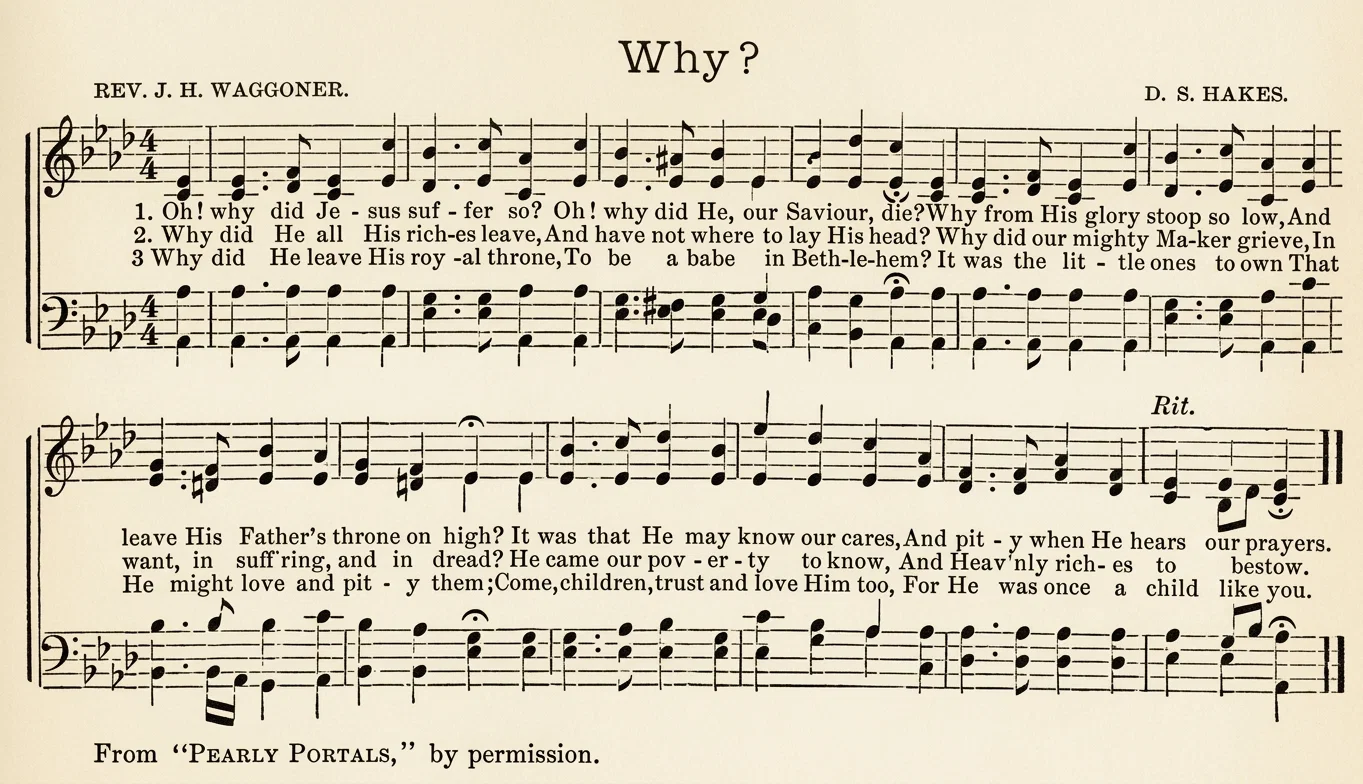
The music on this page is much admired by all our singers in Oakland. Mr. Hakes is peculiarly happy as a composer in giving expression to the words. But the title given us—"Rev."—we never assumed.

May We See It ?

THE report of the committee on Sabbath observance at the late M. E. Conference in Oakland, contained these words:—
“On such foundations as these the State may build a civil Sabbath, but the Christian Sabbath must rest on the authority of God, on the express revelation and positive declaration of the One Lawgiver.”
Sabbath is purely an ecclesiastical term, and “the civil Sabbath” is as great a misnomer as would be “civil baptism.” There is no such thing. Such reckless use of terms by ministers serves to confuse the minds of the people, and they are thereby led to accept as truth that for which there is no warrant in Scripture.
If there is such an institution as the “Christian Sabbath,” we agree with the committee that it must rest on the authority of God, on the express revelation and positive declaration of the One Lawgiver. But that is just what does not exist. For years we have called upon and urged the ministry of the country to point out to us in the Bible, “the express revelation and positive declaration” of God for the institution or the obligation of a Christian Sabbath. But they are d. d.’s after the manner of Isa. 56 : 10, when they are called upon to produce the precept.
There is only one Sabbath Law in the Bible, and that is found in Ex. 20 : 8-10; repeated in other places but it is the same law, referring always to one and the same thing, namely, the Creator’s rest-day, but in it there is no reference to a Christian Sabbath.

A Correction.

WE are always sorry to make a mistake, and doubly so when it does any one injustice. Last week we spoke of the vote of thanks to the San Francisco and N. P. Railroad, passed at our camp-meeting, which was well deserved, and stated that this is the only road in the State which had shown us favors. We are informed by Eld. Israel that we were mistaken in this; that the Southern Pacific carried our freightage free to the Hanford camp-meeting last spring. We are happy to make the correction.

This Week's Signs.

In addition to the usual article on the first page, Sister White gives an account of her recovery at the camp-meeting, of which we made mention. This will be read with interest by all, and many hearts will rejoice with her in the great loving-kindness of our God.
The article on the Advent Near, is from an English author. That on the Resurrection, is a Bible reading by Mr. Moody. We wish all ministers were as truly orthodox as Mr. Moody is on that subject.
Every department is filled with matter of interest and importance.
Some slight changes in the appearance of the Signs, recently made, are receiving commendations from our friends.

Our Special Edition.

WITH great pleasure we learn of the interest which is being taken in the contents of our Special Edition. The influence of these numbers will not cease when we cease to publish the Special. It has been the means of calling the attention of multitudes of people, not only to our rights as a Christian denomination, but, to the truth of God's holy commandment which so many advocates of the Sunday Law seem determined to trample under their feet. We pray that many of those who in this manner first learn of this truth, may be fully converted by it, and prepared "to stand before the Son of man."

Spiritual Wickedness in High Places.

WE have received the following letter from Colorado:—
"EDITOR SIGNS:—Is there anything in the Greek that would convey the idea that the angel who talked with John, Rev. 19: 10, said that he was a blood relation? Elder Todd told me to-day that the Greek properly translated would read thus: ‘I am thy fellow-servant, and of thy brethren, and a blood relation.’ Please give me a correct version of the Greek of the above and greatly oblige. Your brother in Christ. G. W. R."
Although this letter called for and received an answer by letter, we take the liberty to publish it, as a specimen of the methods to which even those who fill offices and have taken vows the most sacred, resort in order to evade and put down the truth. Of course there is no ground whatever for the statement; not even for the barest inference looking in that direction.
All of God's creatures, whether in Heaven or upon earth, are his servants, and of course, fellow-servants one to another. Angels are fellow-servants of the saints “who have the testimony of Jesus.” The ellipsis is so common that it occasions no obscurity in language. Supplied in this text it will read: “I am thy fellow-servant, and the fellow-servant of thy brethren,” etc. He who tries to put any other construction, especially by pretending to gather it from the Greek, inexcusably and wickedly perverts the sacred word. We refer him to chapter 22, verse 18, of the same book.

Sunday in England

SUNDAY IN ENGLAND.—About 200,000 persons, says an exchange, have petitioned the English Parliament in favor of the Sunday-closing law.

The Camp-Meetings.

Eld. Geo. I. Butler, speaking of the camp-meetings of the present year, says thirty-one have been held, of which he has attended fifteen in fourteen different States. He says:—
The attendance at these meetings has been, on the whole, fully up to the standard of past years, and in some cases much greater. Our meeting in Michigan was a very large gathering, those who encamped on the ground, by actual count, numbering about twelve hundred, while many others came in from a radius of miles around. It seemed to me there must have been nearly fifteen hundred of our people present on the Sabbath. We were much surprised at the numbers in attendance, when we remembered that three other camp-meetings had been held in the State previous to this one. We think this was the largest meeting of Sabbath-keepers ever held for centuries in the past; we have no question but Testimony No. 31 had an influence in bringing together this large concourse. The meeting was in many respects an encouraging one.
Personally, I feel to thank God for his goodness to me the past season. Though feeling the effects of wearing labor in a degree, yet I am of good courage to labor on. God has blessed much from time to time, and the comforts of his grace have been bestowed. I thank him for health and strength, and that thus far sickness has been in a great measure spared me. I still feel an earnest desire to labor on in this most blessed cause. The more we work, the more work we see to be done, and the more we desire to share in it. Rest is pleasant, and it seems necessary at times to take it, in order to be better prepared for successful labor in the future.
May God grant that our people may not soon forget their solemn vows to be more earnest in the work of God, made while they were under the sacred influence of the camp-meetings. Let us all carry out these vows by being earnest in the Master's vineyard. Now is the time to prepare for earnest work this fall and winter. Time is short, and we have none to lose.

A MINE OF INFORMATION.

HISTORY OF THE SABBATH AND FIRST DAY OF THE WEEK.

By Eld. J. N. Andrews.
The Bible record of the Sabbath; the secular history concerning it; the successive steps by which the change to the first day was made, and the work of restoration, are given in detail.
EVERY TEXT OF SCRIPTURE concerning the Sabbath is commented on at length; and the COMPLETE TESTIMONY OF THE FATHERS in regard to the Sabbath and first day is given. The comparative merits of the seventh and the first-day Sabbaths are fully shown. A copious Index enables the reader to find any text, or the statement of any historian.
Should be read by everybody. 528 pp. Price, $1.25.
Address, SIGNS OF THE TIMES, Oakland, Cal.

THE TRUTH FOUND.

THE NATURE AND OBLIGATION OF THE SABBATH OF THE FOURTH COMMANDMENT.

By Eld. J. H. Waggoner.
The title of this little book sufficiently explains its character. It contains more Scriptural information in regard to the Sabbath than any other book of twice the size, and yet it is so simplified as to be easily comprehended. The author quotes the opinions of many learned men concerning the Sabbath, and their conflicting theories are strongly contrasted with the clear, straightforward teaching of the Bible.
64 pp. Price, 10 cents.
Address, SIGNS OF THE TIMES, Oakland, Cal.

OUR COUNTRY'S FUTURE FORETOLD.

THE UNITED STATES IN PROPHECY.

By Eld. U. Smith.
This is a full exposition of a portion of prophecy which applies to our own Government, showing the position the United States holds in prophecy, and the part it has to act in the closing scenes of time.

THE SUNDAY MOVEMENT,

Which is now attracting such general attention, is thoroughly canvassed, and abundant testimony is given to prove that it is fast coming to be the ALL-IMPORTANT QUESTION in this country. Facts and statistics are largely presented, showing in the most conclusive manner that this Government is the one pointed out in the prophecy quoted.
200 pp. Bound, 40 cents. Paper covers, 20 cents.
Address, SIGNS OF THE TIMES, Oakland, Cal.
Continue reading: Tracts