Your ShelfYour Projects

Review and Herald, Vol. 88, No. 13.

Good Company
Earlier text: Good Company

Out of the Mouth of Babes

EULALIA SISLEY-RICHARDS, M. D.,
“HELLO, Jim!” said John. “I haven’t seen you since that night nine or ten months ago when we journeyed together from babyland—you to Mrs. Smith’s and I to Mrs. Brown’s. How are you getting on, old fellow?”
“O, just middling, though I like Mrs. Smith better now than I did! I don’t think she knew much about babies when I first came to live with her, though she thought she did, and that was really what made it so hard for me. I hadn’t been with her many minutes before she had the nurse do me up in the tightest, stiffest, most uncomfortable thing imaginable,—a binder I think she called it. Well, I wasn’t used to such things, and of course I didn’t like it. So I cried; I didn’t know what else to do. Nurse began jolting me up and down, said I had colic. I didn’t know then what colic was, but I found out pretty quick; for as I didn’t stop crying, she gave me some brandy and water—such dreadful, burning stuff it was. That gave me a real pain; so I cried and cried until I fell asleep from exhaustion.
“Well, that was just the beginning of my troubles. When nurse went away, mother took charge of me herself; and for a while I thought it was a case of ‘out of the frying-pan into the fire.’ Every time I cried,—which was pretty often, I confess,—mother thought I was hungry, and offered me the breast, even though I had had a good meal just an hour before. So whether I was crying from cold, from colic, or from weariness, the remedy was always the same—the breast. I generally took it,—I was afraid I would hurt her feelings if I refused,—but I can tell you it used to hurt my feelings pretty badly sometimes. My! the pain I have suffered as a result of mother’s policy of ‘warm meals at all hours’ no ten-month-old baby could tell!”
“Then there’s another thing I have always blamed mother for. She never seemed to credit me with having any nerves. The way she used to jolt me up and down every time she thought I had the colic was something cruel. And all the time she was jolting me, she was patting my back vigorously. Why, it’s a wonder that all my vertebræ were not dislocated, and that my spinal cord wasn’t shattered!
“If no one but mother had mistreated me, I wouldn’t have minded it so much. I knew she didn’t know a great deal about babies, and was only practising on me. But the worst part of it was she used to let other people practise on me too. Mother always had lots of visitors, and she used to pass me about, and let all the ladies kiss me and talk nonsense to me, and shake me up generally, when the only thing I wanted was to be let alone.
“But these troubles are pretty well in the past now, or else I am getting tougher, and don’t mind them so much. My chief grievance just at present is this: Mother has the idea that babies don’t need to wear shoes and stockings. I must say I don’t understand her reasoning. It would seem to me that if anybody needed good warm clothing in cold weather, it is just such poor little helpless things as we are. I do know this, that whenever my feet get cold, I have an awful stomach-ache, and my nose gets all stuffed up, too, so that I can’t breathe through it. I don’t suppose that’s right, do you?
“But dear me! I suppose we’ve no business discussing these things. We aren’t supposed to know what is good for us, though sometimes I can’t help thinking we know as much about it as some of the grown folks who have only learned baby-culture by hearsay.
“But say, John, I haven’t given you a chance to say how it’s fared with you, I suppose you’ve had troubles of your own?”
“Well, yes; I did experience some troubles, Jim, though not the same as yours. My mother seemed to know a lot about babies from the very start. Perhaps she had been reading some health books and magazines before I came. Everything went like clockwork, I can tell you. My bath, meals, exercise,and sleep were all timed by the clock. I didn’t like it very well at first, but soon I came to like it immensely; wouldn’t have it any other way, you know.
“But say! I never shall forget one little experience I had. I was only a little chap, and didn’t fancy the idea of being put to bed awake, and being left to go to sleep alone. I had heard that some babies are always rocked to sleep at night, and I thought that would be rather a pleasant arrangement. Mother evidently didn’t think so; for after preparing me as usual for sleep, she put me in my little bed, turned the gas down very low, and then joined father in the sitting-room. I was perfectly comfortable, but quite unhappy; so after considering the matter a few moments, I began to cry lustily. I expected mother would come to see what was the trouble, and so she did. She examined me and my immediate surroundings carefully to see if anything was the matter. Finding that nothing wrong, she at once laid me down gently, tucked me in snugly, and went away again.
“I didn’t intend to be beaten, so I kept on crying and crying as loud as I could. I felt certain that mother would come back again soon; but she didn’t. You can imagine what a shock it was to find that my crying didn’t move her in the least. Well, I kept it up for a time, still hoping feebly that mother would come and take me up again. But hope deferred maketh the heart sick, and I finally gave it up. The next morning mother was just as sweet and loving as ever; in fact, I think a little more so; but I made up my mind it wasn’t worth while trying that trick again—and I didn’t.
“But this experience was only play compared to another one I had a few months later. Mother was called out of town on account of grandmother’s illness; so she left me in charge of a nurse. She was supposed to be what they call a trained nurse; but I am sure her education must have been neglected, for she didn’t even know that babies sometimes get thirsty. She gave me my food regularly, but never a drop of water for days and days. I didn’t miss it much at first (though mother had always given me several drinks every day); but after a while I became terribly thirsty. I fretted and fussed and cried by turns, but nurse didn’t appear to know what was the matter with me; in fact, I heard her tell the maid that she thought I was a very bad-tempered baby. I tried to tell the maid that I thought I had a very stupid nurse, but she didn’t understand me. Well, I suffered on, until one night about a week after mother went away, things reached a climax. I felt I couldn’t stand it any longer; in fact, I was half crazed with thirst. I screamed and screamed and SCREAMED until I drove nurse nearly to distraction. She offered me food; she put a hot-water bottle on my stomach; she did everything that could possibly be done to a baby except to give it a drink of water! Needless to say, I continued crying. Nurse concluded that either I was ill and required a doctor or else I was wicked and required punishment. How the case would have been decided I do not know; for just at this point (about 10 P. M.) mother appeared on the scene. She took me up in her arms while she asked nurse a few direct questions about the state of my health; and then to my infinite relief, she sent for a glass of water, saying, ‘Perhaps the little chap is thirsty.’ I drank what in my eagerness I didn’t spill. Except that nurse looked a bit ashamed, I have no remembrance of anything further; for my head fell over on mother’s shoulder, and I was fast asleep.
“But apart from these two experiences, Jim, I can’t recall any trouble worth mentioning. In fact, I think I am one of the luckiest youngsters in town! And in spite of the bad character nurse gave me, mother declares that I am a wonderfully good baby! I suppose she knows.”
Wahroonga, New South Wales.

The First Singer

We heard a bluebird singing; the song was magic-sweet; He swung upon the lilac, the snow was round his feet, The wind blew roughly o’er him, the sky was steely gray; But yet he perched there singing the chilling gloom away.
Brave traveler from the southland, perhaps you came too soon; For ice still binds the streamlets, the sun is wan at noon; The violets are sleeping close in their earthy bed, And not a greening ’blade of grass has dared to show its head.
But O, we’re glad to greet you, sweet harbinger of spring! No sound was e’er so welcome as your gay caroling, Courageous little songster, upon the leafless spray, A-singing and a-singing our weariness away!
— Farm Journal.

Tom Never Left the Bars Down Again

A STORY comes from a New England home of years ago, told by one of the two boys concerned, grown to manhood.
Once I saved Tom from a promised whipping for leaving down the bars when he went after the cows at milking-time, thus giving the young cattle left in the pasture a chance to get out, which they always improved. If they were at the back of the lot when Tom got the cows, he thought it unnecessary to put up the bars, it would be so short a time before the cows would be driven back.
Father cautioned and reproved him several times, and finally he threatened to whip him if it happened again. Several weeks passed, and he left the bars down again. The young cattle got into the corn, doing much damage.
The next morning father said nothing, but went about his usual work. Tom was gloomy; there was an air of depression in the house, and I was greatly troubled. I couldn't bear to have Tom whipped, nor could I blame father. At last I resolved to go and speak to him.
The sun was shining brightly, and he was opening some tumbles of hay in the east meadow. I approached him slowly, for I did not feel sure of my ground, and stood still without saying a word. He looked up at me, and said: “Well, Joe, what is it?”
“I have come to you to speak about Tom, I don't want him whipped.”
“I don't see how you can help it, my son. I can not have my crops destroyed in this way, and I must keep my word.”
“Father, didn't you read this morning in the lesson: ‘He was wounded for our transgressions, he was bruised for our iniquities; . . . and with his stripes we are healed’?”
“Yes; what a boy you are to remember, Joe.”
“Well, I will take the blows you intend to give Tom.”
“I can't do that, Joe. Tom is the transgressor, not you,” father answered, his face softening. Then looking at me keenly, he asked: “Did Tom send you to me?”
“No; he knows nothing of my coming.”
My father stood leaning on his pitch-fork, looking down on the ground. At length he said: “Go and bring Tom.”
I found him on the front porch with a sober face, trying to study.
“Come with me, Tom; father wants you.”
“I know what he wants,” turning a little pale. After a moment's hesitation he arose, saying: “I might as well go now and have it done with.”
As we walked along, I thought it best to give him a little advice, for he generally did as occasion served him. There was no knowing beforehand what he would do.
“Now, Tom, you mustn't flare up. You must be good, and answer father's questions in a pleasant, kind way. You mustn't talk any; only answer his questions. I don't think he will be hard with you.”
Father stood as I had left him. I can see him now, after the lapse of so many years, with his back to the morning sun, leaning forward a little on the handle of his fork, looking down to the ground, one hand above the other and his chin on his hands, and some hay scattered about him.
He did not seem to see us. He was lost in reverie.
“Father,” I ventured, timidly, “Tom is here.”
He looked up at us quickly, then said: “Tom, do you remember these words in our Scripture reading this morning: ‘He was wounded for our transgressions, he was bruised for our iniquities; . . . and with his stripes we are healed’?”
“Yes, sir,” answered Tom, greatly surprised.
“What do you think these words mean?”
“That Christ suffered for us,” replied Tom, his voice unsteady and his face flushing.
“Well, Joe offers to suffer for you.”
Tom turned to me with a look on his face I shall never forget, and exclaimed: “No, Joe, you shall not do that!”
Then, flinging his arms around my neck, he kissed me, and, as quick as a flash, he stepped up to father, and held out his hand, saying: “The stripes belong to me, father; I am ready.”
Tears were falling down father's face, and for a moment he could not speak. Then he said: “No, Tom, I can not punish any one now. I do not think you'll ever forget this day. If you do, remember Joe's offer holds good. I love my children, and I want to do them all the good I can. But I must be obeyed, and this is one way of doing them good. You may go now.”
Tom did not stir. He was evidentlywaiting for me, and yet, for some reason I could not explain, I hesitated.
Stepping closer, I said: “Father, I want to kiss you.”
He caught me in his arms, saying, “O my boy!” and kissed me. Then taking Tom, he said, “God bless you, dear Tom,” and kissed him, with swimming eyes.
Then with great awe upon us, we went to the house. Tom never left the bars down again. —From “Quiet Talks on Home Ideals.”

South Central China Mission

R. F. COTTRELL
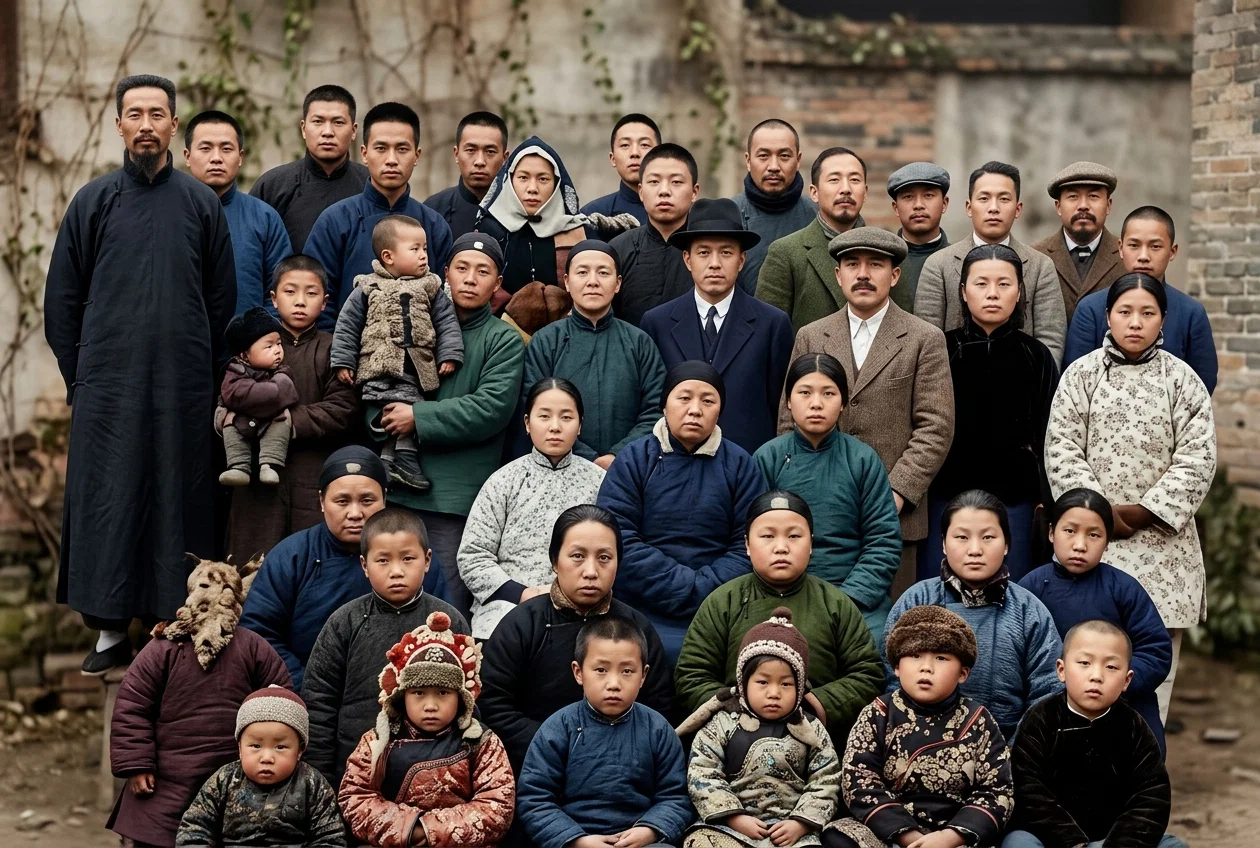
GROUP OF BELIEVERS ATTENDING THE CHANG-SHA BIBLE INSTITUTE. EVANGELIST, AND TEACHER OF GIRLS’ SCHOOL MARKED WITH AN X; CANVASSERS WITH A V
This field, together with the North Central China Mission, formerly composed what was known as the Central China Mission, the four provinces of which support a population of about one hundred ten millions. At a meeting of the China Union Committee held last August, it was decided to make two divisions of this territory, to be known respectively as the North Central China Mission and the South Central China Mission. In mentioning this, we call the reader's attention to the fact that in each of these mission fields there are approximately as many human beings as
there are in the United States east of the Mississippi River. The two provinces composing this field are Hunan and Kiang-si. In the latter province, the only work that has yet been done, to our knowledge, is a few weeks' canvassing by some of our native brethren. In the former, Brother and Sister P. J. Laird were pioneers of the message. For more than three years before the riots last spring, they were busily engaged in sowing the gospel seed, and in ministering to the sick and suffering. Soon after the Chang-sha disturbances, they found it necessary to go to America for rest and recuperation. At the close of the summer season, Brother and Sister C. Sparks, Mrs. Cottrell, and the writer were requested to make this their field of labor. On our arrival here, about October 1, we found that the rubbish had been well cleared away, and the compound partly repaired. To finish repairing the compound and furniture, and to replace that which had been broken, lost, or stolen, were among our first duties.
Although the work had been largely without foreign supervision for about five months, we found that the native evangelist, Brother Huang, and others, had been doing faithful work. Three canvassers were selling our literature, two of whom had had exceptional success. The evangelist's wife, seeing the need of a church-school, had gathered in eight children, mostly from Sabbath-keeping homes, and was teaching them the best she could. About four weeks after our arrival at Chang-sha, Mrs. Cottrell and I, with four of our native brethren, started on a trip by house-boat to visit some of the believers and interested ones farther south in the province. It had been about
a year since Brother Laird had made his last visit to these places, and the little flock had in several instances been severely tested. Hardship, opposition, and persecution had scattered the sheep. Nevertheless, some had remained faithful in their witness, and had encouraged a few of their friends to lay hold of the message. Others, who had given up, had their faith especially blessed. The Lord especially blessed Evangelist Huang in making the truth clear and forceful. The colporteurs, the latter also, had success in disposing of our papers and tracts; and on our return home, we left them in different places to continue their work. Thus, at the close of our visit of two and one-half weeks, it was felt by all that the good hand of our God had guided and prospered us.
December 2-9 had been appointed as the time for the first general meeting of our people in this province. In all, about sixty were in attendance. Aside from prayer and social meetings, women's meetings, and children's meetings, three preaching services were held each day. In these the principal subjects considered were the great pillars of our faith, which were presented in practically the same manner and with the same certain sound that characterize the preaching of the message in the home land.
Following the general meeting, a three weeks' Bible institute was held. Abouttwenty-five were in attendance. The first week of the institute coincided with the week of prayer. This was the first time in the history of our work in China that we had had the readings in time to observe the same season as that set apart in America. As we each day translated these readings to our Chinese brethren and sisters, their hearts were cheered, and their faith was strengthened. At the close of the week of prayer, the native contribution to the annual offering was 11,200 cash, or about four dollars. Considering the circumstances of the believers here, we felt that this was most liberal. If the gifts of our people in more favored lands have been equally generous, there will be no lack of funds in the treasury of the Mission Board for many months to come.
During the institute, the most of our brethren spent some time each day selling papers and tracts. About 39,000 pages of literature were disposed of, and those who took part in the work gained a good experience. At noon on Christmas day our little company gathered on the banks of the Siang River. The day was clear and beautiful. After singing in Chinese, “I Will Follow Thee, My Saviour,” thirteen dear brethren and sisters followed their Lord in baptism. A few weeks previously, four had been baptized. These, together with those baptized a year ago, give our Chang-sha church a native membership of twenty-one. Practically all of these first learned the message either directly or indirectly through the work of Brother and Sister Laird. We have in this province more than thirty children of believers, who are anxious to have a Christian education; and as the customs of the people will not allow boys and girls to study together in the same school, it follows that two schools must be started soon. We are also adding to our force of native evangelists and colporteurs. In a city about one hundred fifty miles from here, our first regular out-station is being established. Hardly a week passes without bringing us good tidings from various other places. Day before yesterday, a man who had bought a tract of one of our canvassers a year ago, called upon us. His home is near the border of the Kiang-si province. He said that ever since reading the tract, he had not been at peace, and that three weeks ago he had begun the observance of the Sabbath. Last week a letter was received from a man who lives in this province, a hundred miles farther south than any Seventh-day Adventist missionary has yet penetrated. The letter said that Sabbath by Sabbath a company of fifteen meet together for the study of the Scriptures. They sent a strong appeal for us to come and start aggressive work in that place. Our mission quarters in Chang-sha demand immediate attention. We have no place in which to start our schools. Our chapel is so small that in order to accommodate those who come, the back end of the building has been removed, and the
adjoining court provided with benches. For the summer months, this plan answers fairly well; but during the cold, damp winter and spring seasons, it is far from comfortable. Many, however, whose hearts are yearning to know of the Saviour, come and shiver through the meetings; while others who have less courage, or possibly less clothing, remain away. When the weather is good, there is barely standing-room for all who come. From this report it will be seen that the third angel's message is winning its way in dark Hunan. But with opening doors, and a conquering message, there is an ever-increasing call for liberality. It is our earnest prayer that the prophetic words of the psalmist, “Thy people shall be willing in the day of thy power,” may be fulfilled in the hearts and lives of all who love the hope of his appearing. Chang-sha, Hunan.

Don't Be a Fretter

THERE is one sin which is everywhere underestimated, and quite too often overlooked in valuation of character. It is the sin of fretting. This sin is as common as air, as speech, so common that unless it rises above its usual monotone, we do not even observe it. Watch any ordinary coming together of people, and see how many minutes it will be before somebody frets; that is, makes more or less complaining statements of something or other which most probably every one in the room, or in the car, or on the street corner, it may be, knew before, and which probably nobody can help. Why say anything about it? It is cold, it is hot, it is dry; somebody has broken an appointment or ill cooked a meal; stupidity or bad faith has resulted in discomfort. There are plenty of things to fret about. It is simply astonishing how much annoyance may be found in the course of every-day living, even at the simplest, if one only keeps a sharp eye out on that side of things. Fretting is all “time wasted on the road.”—Herald of Peace.

Guard Your Weak Points

A good general will discover the weak points in his fortress, and set a double guard to defend them in case of attack. If the enemy can discover these points, he hurls the brunt of his fight against them. This is good tactics for him, and many a fortress has fallen because the weak points were not carefully guarded. This principle is just as true with souls in the battle of life as in an army with the enemy at hand. Every one knows his own weak points, and he is a wise man who sets a double guard over them. He will fail at these if he fails at all. The enemy also knows them, and will make his hardest fight where we are most easily overcome. Let us carefully guard our own weak points.—Sabbath Recorder.

The Body Is the Temple of the Holy Ghost

“Your body is the temple of the Holy Ghost. Return ever to the one great argument. In proportion as you honor the Spirit of the living God, you will come to honor your body. Build high its walls of health. Let them glisten white with purity. Cement them with firmness of will. Found them on obedience to law. Crown them with the pinnacles of a holy ambition.”

West Africa’s Appeal

T. M. FRENCH
For more than five years the Lord has signally blessed our work in West Africa, and it has seemed as if success would at last attend our efforts in this difficult field. The health of our workers has been miraculously preserved by our Heavenly Father. This blessing has resulted in steady progress of various lines of the third angel’s message. Churches have been raised up in Sierra Leone and in the Gold Coast colonies, that reflect the light of this glorious message. Schools have been established, where the young are being trained to bear the banner of Prince Emmanuel. Books and tracts bearing the truth for this time have been scattered here and there. The Lord has signally blessed these means of extending his truth.
Our workers have labored untiringly to further the cause of this last gospel message to a perishing people, little realizing that their energy was almost spent in this unhealthful field. And, too, we have felt that our hands were being upheld by the prayers of our people in the home land, as in the experience of Moses in the wilderness conflict. This thought has encouraged us to press forward. But as I stood beside my dying companion a few days ago, and realized that my own strength was fast failing, in my perplexity my mind turned to my brethren and sisters at home, who have so nobly supported this cause by their prayers and by their means; and the thought came to me, “Have they let go the hands?” And again, as word came to me of our workers being stricken down with sickness in Sierra Leone, the question came forcibly to me, “What can this crisis mean? Have our dear people forgotten to hold up the hands over the armies of Israel?”
We appeal to our people at home to immediately support the languishing hands of our workers in this dark land, where the forces of evil are so strongly entrenched. Gladly would the arch-deceiver again baffle the efforts to plant the banner of Christ in these heathen strongholds. Brethren and sisters, seek God earnestly in behalf of his cause in West Africa.

Evangelization of the Aborigines of South America

DAVID FOSTER WATKINS
The most recent authors on missions show that little has been done to evangelize the native races of South America. The oldest Protestant mission was planted on the eastern side of the continent, and has been nurtured by godly men; but the result of its labor is but a drop in the bucket, compared with the needs of the people and the ocean of opportunities.
Many Protestant Christians living in the Latin republics have neglected the Indians as if they had no claim to the glad tidings intended for all. The Welsh colonists, who went to Patagonia two generations ago to save their language, which they have so far successfully done, have gained the respect and confidence of the Patagonian Indians, because they have always been just and kind in their dealings with them. As a result, not a Welshman has met death at the hands of these Indians, while other nationalities have suffered much.
Protestantism has done little to give the gospel of Jesus Christ to the native races of South America; while that church nominally called Christian has but sent them to lower depths of degradation than they were in before.
What, therefore, can be done to fortify these people against the coming of the whites, who within a few years will be pouring into the marvelously rich country of South America by the tens of thousands?—They must be taught the religion of Jesus Christ. But they can neither read nor write; and only a few of the tribes have a written language. Evidently, the first thing must be to teach them to read and write. It is the purpose of this article to set forth how this may be easily, quickly, and inexpensively done, and mostly by the Indians themselves. It will be a simple matter to teach them the gospel after they know how to read and write. Another difficulty is that they do not all speak one language, but have almost as many languages and dialects as there are tribes. Some missionaries favor teaching them some one language, as Spanish or English, from the start; but Brazil requires that Portuguese be taught, and other republics require Spanish. None, however, would object to their being taught their native language, provided the official language was not entirely neglected.
To teach the Indians another language, for their immediate needs, is out of the question. But if we can teach them to read and write their own language in a short time, the first obstacle to bringing the gospel to them will have been overcome. That this can be done by a few weeks’ study, seems clear to my mind from the following experiment:—About a year ago, on my third trip to Peru, I went inland from the little port of Mollendo, some seven days’ journey, carrying my Blickensderfer, with English and Spanish type-wheels, for the purpose of teaching the Indians to read and write their own language within a few weeks. I had confidence in my ultimate success, though I did not mention my purpose to my friends, lest I fail; for in that case I preferred to carry the burden of my defeat alone. I had been on the banks of the Rio Toro before, and had been much pleased with the people and the country. The Indians spoke Kechua only, and were not able to distinguish one letter of the alphabet from another.
After distributing some handkerchiefs among the older people, and some trinkets among the children, I was served with roasted corn and boiled potatoes, which were thoroughly enjoyed; for I had tasted no food for thirty-six hours. For good reasons, I had refused to sleep in a jacal that had been kindly offered me. By noon of the following day I had built myself a shelter with branches under the shade of a large tree, had fixed my typewriter on props, and was writing in the presence of more than a hundred Indians. Many were the remarks they were making, but I could not understand a word of their language.
One of the aged women spoke to me in broken Spanish; but as my business made it necessary that I should know no language known to them, I made no reply. I heard a man say pirac, and I wrote the word on a piece of paper, and read it over several times. This seemed to please them. There was a woman, apparently thirty-five years of age, standing near by with her child, which was caressing her affectionately, and the mother said to it, “Cuyan hua maque.” These words I also wrote and read several times. An old man present corrected the sound I tried to represent with the letter “q,” for which I smiled my thanks. I learned that the sound I tried to represent by the letter “q” can not be properly represented by any letter in the English or the Spanish alphabet.
The children were talking loudly, I supposed about what was going on, and one little boy about seven years old did his best to recite after me every word I wrote and read to the people. One of the men, probably thinking the child too impertinent, took him by the ear, and said, “Ama rimichucha nihim.” I at once wrote the words, and soon was able to pronounce them correctly, when I found that it was three words and not one, as I had at first written it. After writing the words again on a slip of paper, and pronouncing them, I gave the slip to the little fellow who had been punished, and then the man who had taken him by the ear pushed him forward, motioning that I should give him some more words to be pronounced, which I gladly did. Others of my congregation also gave me words. These I wrote and read; and soon all were clamoring for written words.
I realized that such a hubbub would interfere with my plan; so, to divert their attention, I took up ten pebbles, and counted them in English, loudly enough for all to hear. The little fellow already mentioned, Pisco, pronounced every word after me, and to show my appreciation I gave him a piece of twine out of my saddle-bags, which pleased him highly. I then counted five on the ends of my fingers, and motioned to Pisco to tell me what “one” is in his language; but here he failed me. This seemed to disappoint him very much; but the old man said, “Huc,” and after that all was easy. He then counted my pebbles to ten,—huc, iscay, quisma, tahua, pchca, sokta, kanchis, pusak, iscan, chunca. From these words I took all the different sounds, and added the sounds of “f,” “ll,” and “pas,” as in Spanish, which I had also heard. This gave me the sounds represented by the following letters and combinations: a, e, i, o, u, y, ch, k, ll, m, ny, p, q, r, s, and t. I noticed that c, k, p, m, s, t, and q were sounded at times as if they were doubled; at least it was evident that my English and Spanish wheels could not give characters that would represent all the sounds of the Kechua language.
However, the Spanish letters are sufficient to represent all the sounds in some of the native languages; and when a language is to be taught which has sounds that can not be represented by these letters, other signs may be used. This may be the best way to proceed, since it would aid the people if they ever tried to learn one of the European languages. All the native languages will not contain more than six such sounds, and in no one language will they all be found.
Having isolated these sounds, I determined to make a type-wheel which would have signs on it that would represent these sounds. I took a piece of soft wood and made a wheel, then cut a strip of leather from the top of one of my high boots, and fastened it to the wheel with gum, pins, and thread. This I thinned down, leaving raised signs to represent the sounds.
Having arranged my wheel with euphonious signs, I again wrote hundreds of words for the people, such as the names of birds and animals, and of things both within and without the jacals. Little Pisco was able, after studying the signs one day, to put the sounds together, and read the words slowly. It did not take any of the boys more than a few days to learn to read some words. The next thing was to teach the boys to write on the machine. Pisco was able at once to strike the right key, on which, of course, I had put the new signs, and he wrote correctly word after word which his mother and others gave him. He wrote all the numbers up to ten, and of his own accord the word mapa, which he used when he spoke to an intruder, and which, I believe, means “be careful.”
Never before were the Rio Toro people so rejoiced over the doings of their children as on that day a little over a year ago. I also was happy, because it would have been demonstrated that the Indians could be taught to read and write their own language in a very short time, and that by one who knew nothing about it.
I gave the boys the free use of my machine while I was resting for a few days, preparatory to my trip back to the coast, and a visit to the cannibal Cachivo Indians, of Ecuador, in whom I had been interested for several years. One evening, on retiring, I noticed about a dozen Bolivian Indians enter the village, heavily laden with sacks of salt from the deposits near by. On awakening the following morning, the first thing I noticed was the click of the typewriter; but being indisposed I paid little attention to it. On the second day, being somewhat better of the coast fever with which I was suffering, I got about, and found that one of the Bolivians had stopped, and Pisco was attempting to teach him his native language, the Aymara. I found this Indian working away at the typewriter with the help of Pisco, and this suggested to me the thought that my theory was of much wider application than I had first thought,—that even an Indian, ignorant of the language of another, could teach him to read and write his native tongue.
Then I seemed to hear, as in a dream, the click of the machine among all the Indian tribes on the South American continent. I seemed to see Christian friends in Chile, Brazil, Paraguay, Uruguay, Bolivia, Peru, Ecuador, and in the Central American republics, learning in a few days the new system of teaching, and going forth to teach it among the Indians. Then I seemed to see the more intelligent Indians, having learned, going forth with zeal to teach their fellows. Yes, I was truly happy when Pisco made clear to me that the Indians could thus easily teach one another to read and write.
The day came when I must leave the poor Indians; and when I packed my typewriter, the world had come to an end for some of them, to judge from their weeping and sighs.

Widen Your Interests

WIDEN your interests, my brother, if you would flee the devil. I do not mean a diffused life; concentrate all you please, but concentrate upon the large concerns of the kingdom. Consider the healthfulness that flows from the single interest of missions,—the outlook over all the world, the insight into men and customs, the acquaintance with history, the knowledge of exalted biography, the development of the practical and the ideal, the enlargement of sympathies, the deepening of brotherhood, the verification of faith, the sense of being co-laborers with God. . . . It is a fresh, sweet broom of many fibers, sweeping the hidden corners of the soul.—Wells.

Submission to the Spirit of God

“ONLY by submission to the Spirit of God can you control your own spirit.”

Mastered by the Infinite

“THERE is no mastery for the finite, except as it is mastered by the Infinite.”
Continue reading: One of the Last Things