Your ShelfYour Projects

Review and Herald, Vol. 88, No. 32.

The Power of Prayer

Review and Herald

Aug 10, 1911

Review and Herald Publishing Association · Takoma Park Station, Washington, D. C. · Aug 10, 1911

The Power of Prayer

Lord, what a change within us one short hour Spent in Thy presence will prevail to make! What heavy burdens from our bosoms take! What parched grounds refresh as with a shower!
We kneel—and all around us seems to lower; We rise—and all, the distant and the near, Stands forth in sunny outline brave and clear. We kneel—how weak! we rise—how full of power!
Why, therefore, should we do ourselves this wrong, Or others, that we are not always strong; That we are ever overborne with care; That we should ever weak or heartless be, Anxious or troubled, while with us is prayer, And joy and strength and courage are with Thee? —Archbishop Trench.

Five Questions Answered

In the August-to-October Protestant Magazine

JUST ISSUED

These five, and twenty-one other great and important questions relative to the conflict between true Protestantism and Roman Catholicism, are answered in this number:—
QUESTION ONE.—What is the significance of the public celebration on Sunday, May 28, 1911, “for the first time in American history,” of the “sacrifice of the mass” upon government ground in Washington, D. C.?
QUESTION TWO.—What is the significance of the unusual honor bestowed upon Cardinal Gibbons, in Baltimore, Md., on June 6, 1911, by the political leaders of America?
QUESTION THREE.—What did a noted Roman Catholic diplomat in Europe confide to the American ambassador to the court of Germany, as his own views of the claim that the Pope of Rome is, and has been, “the world’s greatest peacemaker”?
QUESTION FOUR.—Did Peter have a primacy of authority over the other apostles? What say the Bible and church history on this great question underlying the claims of the Pope to apostolic authority?
QUESTION FIVE.—Why was Baroness von Zedwitz, one of the founders of the Catholic University of America in Washington, D. C., compelled to repudiate Roman Catholicism, and espouse Protestantism anew?

Contents of This Number

COVER PAGES.—The Original Principle of the Protestant Reformation—Our Theses—The Principle of Catholicism and the Protest Against It—The Demand of the Present Hour.
DOUBLE FRONTISPIECE.—Two full-page photographs showing the priests and political leaders who attended the Roman Catholic field mass on the Washington Monument grounds, Sunday, May 28, 1911.
EDITORIALS.—A Form of Godliness—Difference Between Religion and Theology—Mystery, Not Mysticism—Revelation or Evolution—Making America Catholic (full account of the Catholic field mass in Washington, D. C.)—The “I-Am-It” Theology, an Illustration—Saved by Believing—An Ecclesiastical Thunderbolt (punishing American Catholic citizens by the Roman “interdict” in Portland, Me.)—Is the Papacy a Peacemaker? (views of a Roman Catholic diplomat).
GENERAL ARTICLES.—Growth of the Roman Church—The Dignity of the Priest (by Rev. P. Millet, a Jesuit)—The Privilege of Peter (second article by R. F. Littlejohn, LL. D., completely upsetting the Roman Catholic claims)—“The Double Doctrine of the Church of Rome” (why Baroness von Zedwitz left the Catholic Church—My Experience With Higher Criticism (by Prof. J. J. Reeve, of the Southwestern Baptist Theological Seminary).
NOTES AND EXTRACTS.—Rome “the Sole Support of Law and Order”—“Free Government” of the Papal States—Establishment of International Catholic Press Agency—Misrepresentations of Protestantism in Catholic Books—Misrepresenting Protestantism in the Philippines—Catholic Excuses for the Decay of Catholic Nations—“Leaders of the Nation Honor Prince of the Church” (account of the Baltimore celebration in honor of Cardinal Gibbons)—The Catholic Church as a Saver of Souls—Absolute Domination of the Pope Over Catholics.

“Protestant Magazine” Agents Wanted

Nearly 500 agents are now handling this magazine. They sell it with good success to Catholics as well as Protestants. Some buy from curiosity, others from devotion to the Protestant cause. Its large type appeals to the old as well as the young. Its artistic cover and make-up make it a welcome visitor to people of good taste. It attacks only the Catholic SYSTEM, not individuals of any communion.
Send $1.00 for 20—To get money back, sell 10—Profit on 20, $1.00
Send $2.00 for 50—To get money back, sell 20—Profit on 50, $3.00
Send $4.00 for 100—To get money back, sell 40—Profit on 100, $6.00
Yearly subscription, 25 cents; single copy, 10 cents; 5 to 40 copies, 5 cents a copy; 50 or more copies, 4 cents a copy

SEND ORDERS THROUGH YOUR CONFERENCE TRACT SOCIETY
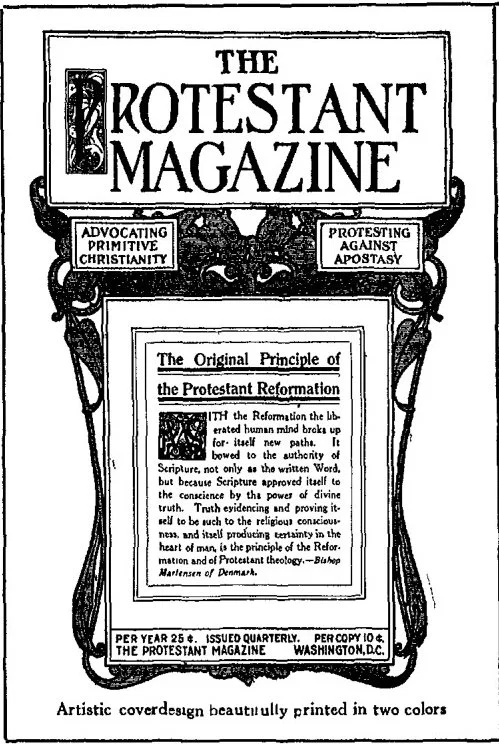
Artistic cover design beautifully printed in two colors
Help us to reach 19,977,820 public-school pupils and college students through their 534,450 teachers and instructors. Send $1.50 for mailing the “Protestant” for one year to 10 of these teachers. Single copies mailed to 5 or more addresses, 5 cents each.

“They Remembered Not His Hand”

ALEXANDER RITCHIE
My God, how glad thou makest me, Whene’er thy Holy Word I take, To learn of earth’s nativity, The story true thy Spirit spake!
I see the mighty orb of day Rejoice each morn to run his race; The moon, that nightly wends its way, Across the trackless realms of space.
I see the stars, whose diamond rays Bedeck the sable crown of night; The clouds, that sail their windy ways, And meteors flashing fiery light.
I hear the thunder’s solemn peal, When lightnings give the signal flash; The earthquake makes the earth to reel, And seashores feel the ocean’s lash.
And as I look and hear and feel, I long to read the mystery, To know the “cause”—undo the seal That holds the cosmic history.
I search the scrolls of ancient lore, The treasures of the Magian days, To find among their classic store The origin of nature’s ways.
I urge my quest through endless rows Of volumes modern, up-to-date; I scan their theoretic prose, But still an explanation wait.
And then, awearyed with my quest Among the myriad words of men, I fly, like Noah’s dove, to rest Within the Ark of Truth again,—
Thy Holy Word,—which safely keeps Its tenants in thy perfect peace While tossing on life’s stormy deeps; ’Tis there my doubts and wanderings cease.
There, by the light of heavenly rays Which shine divinely clear and fair, In David’s God-breathed roundelays I find the wondrous secret—there.
’Twas not by “means” of men’s design That sun and moon and stars appeared; But earth and sea, with plant and vine, Were by a glorious hand upreared.
His hand spread out the molten sky, His fingers wove Orion’s bands, His fists the mightiest winds defy, And oceans lie within his hands.
And yet, though vast his heavenly dower Of might, and skill, and wisdom be, His love’s as great as all his power, And brought him down to Calvary.
Those glorious hands that made the sun, The moon, the stars, the ground I tread, When sin had left me lost, undone, Were bruised and mangled in my stead.
O wondrous thought, beyond our ken! The Lord of hosts by “dogs” assailed; O love beyond both tongue and pen! The hands that guide the planets—nailed.
But now those hands, which then were tied, Are stronger than they were before; For Christ the Lord is glorified; He lives to taste of death no more!
And on those wounded, tender palms Are graven deep the names of those Who seek from sin and its alarms, Within the Saviour’s arms, repose.
And when the tempted saint would drown, And feels he can not longer stand, He is “not utterly cast down;” The Lord upholds him with his hand.
And when affliction dims my sight, And I am nearing Death’s dark land, “The entrance of thy Word gives light,” For all “my times are in thy hand.”
O Lord, upon my sinful heart Display thy fingers’ matchless skill, Of thine own nature make me part, And in me all thy law fulfil.
Then when thy perfect church shall be “A crown of glory in thy hand,” “A royal diadem” for thee, O, may I then before thee stand!

Divine Wisdom

(Concluded)
MRS. E. G. WHITE
It is the humble in heart who receive the enlightenment of heaven, which is more precious than the boasted wisdom of the world. By faith in the Son of God a transformation takes place in the character. The child of wrath becomes the child of God. He passes from death unto life. The infinite sacrifice of the Son of God is a propitiation for the transgressions of the repenting sinner. He becomes spiritual, and discerns spiritual things. The wisdom of God enlightens his mind, and he beholds wondrous things out of God's law. This salvation which offers pardon to the transgressor, presents to him the righteousness that will bear the scrutiny of the omniscient One, gives victory over the powerful enemy of God and man, provides eternal life and joy for its receiver, and may well be a theme of rejoicing to the humble who hear thereof and are glad.
It is the completeness of salvation that gives it its greatness. No man can measure or understand it by worldly wisdom. It may be contemplated with the most profound and concentrated study, but the mind loses itself in the untraceable majesty of its Author. The soul united with God in meditation of his unfathomable riches, is expanded, and becomes more capable of comprehending to a greater depth and height the glories of the plan of salvation. As the heart is converted to the truth, the work of transformation goes on. From day to day the Christian has an increased measure of understanding. In becoming a man of obedience to the word and will of God, his abilities develop and strengthen to comprehend, and to do, with increased skill and wisdom, the requirements of God. The mind devoted unreservedly to God, under the guidance of the divine Spirit develops generally and harmoniously. The weak, vacillating character becomes changed through the power of God to one of strength and steadfastness. Continual devotion and piety establish so close a relation between Jesus and his disciple that the Christian becomes like him in mind and character. After association with theSon of God, the humble follower of Christ is found to be a person of sound principle, clear perception, and reliable judgment. He has a connection with God, the source of light and understanding. He who longed to be of service to the cause of Christ, has been so quickened by the life-giving rays of the Sun of Righteousness that he has been enabled to bear much fruit to the glory of God.
Men of the highest education and accomplishments have learned the most precious lessons from the precept and example of the humble follower of Christ, who is designated as “unlearned” by the world. But could men look with deeper insight, they would see that these humble men had obtained an education in the highest of all schools, even in the school of the divine Teacher, who spake as never man spake. Those who desire to be all that God intended man should be in this life, should enter the school of Christ, and learn of him who is meek and lowly of heart.
But let no one imagine that we would discourage education, or put a low estimate upon the value of mental culture and discipline. God would have us students as long as we remain in this world, ever learning and bearing responsibility. We should be diligent and apt, and ready to teach others by precept and example that which we have learned; but no one should set himself as a critic to measure the usefulness and influence of his brother, who has had few advantages in obtaining book knowledge. He may be rich in a rare wisdom. He may have a practical education in the knowledge of the truth. The psalmist says, “The entrance of thy words giveth light; it giveth understanding unto the simple.”
It is not the mere reading of the Word, not a theoretical knowledge of the Scriptures, that gives this light and understanding to the simple. Had this been the case, Jesus would not have said to the Jews, “Ye know not the Scriptures, neither the power of God.” The wisdom spoken of by the psalmist is that which is attained when the truth is opened to the mind and applied to the heart by the Spirit of God; when its principles are wrought into the character by a life of practical godliness.
Through a connection with God the Christian will have clearer and broader views, unbiased by his own preconceived opinions. His discernment will be more penetrative, his judgment more balanced and far-seeing. His understanding, summoned to effort, has been exercised in contemplating exalted truths; and as he obtains heavenly knowledge, he better understands his own weakness, and grows in humility and faith.
It is the Spirit of God that quickens the lifeless faculties of the soul to appreciate heavenly things, and attracts the affections toward God and the truth. Without the presence of Jesus in the heart, religious service is only dead, cold formalism. The longing desire for communion with God soon ceases when the Spirit of God is grieved from us; but when Christ is in us the hope of glory, we are constantly directed to think and act in reference to the glory of God. The questions will arise, Will this do honor to Jesus? Will this be approved by him? Shall I be able to maintain my integrity if I enter into this arrangement? God will be made the counselor of the soul, and we shall be led into safe paths, and the will of God will be made the supreme guide of our lives. This is heavenly wisdom, imparted to the soul by the Father of light, and it makes the Christian, however humble, the light of the world.

Restoring the Erring

T. E. BOWEN
SINCE the Christian church began, difficulties have arisen among members, and trials have come in through some who were unconsecrated. Before Pentecost was really over, “there arose a murmuring of the Grecians [believers] against the Hebrews, because their widows were neglected in the daily ministration.” As it was then, so it is now. In the daily ministrations of the church to-day, some one may unintentionally be neglected. Again, in their daily association, occasions often arise for little jars and misunderstandings to creep in between members, and these sometimes grow until serious trouble, causing real alienation and trial in the church, come of them.
In attempting to heal these difficulties, perplexity is often experienced in locating the wrong. If it be of long standing, usually both parties are implicated; for before a controversy progresses to any great length, each of the persons concerned is very likely to sin with his lips. Yet usually there is a wrong, a real offense, lying like an old ulcer at the root of a tooth, that is causing the difficulty.
In his last discourse, Stephen, relating the experience of Moses when a young man in Egypt, gives us a little light as to who usually is at fault in matters of this kind. He says: “The next day he [Moses] showed himself unto them [two Israelites] as they strove, and would have set them at one again, saying, Sirs, and ye are brethren; why do ye wrong one to another? But he that did his neighbor wrong thrust him away, saying, Who made thee a ruler and a judge over us? Wilt thou kill me, as thou didst the Egyptian yesterday?” Acts 7:26-28.
Here Moses was seeking, as a disinterested friend and brother, to bring reconciliation between two of his brethren. Very likely neither sought his help; but the inspired narrative says that the one who “did his neighbor wrong,” thrust Moses away. In this instance, at least, the person unwilling to adjust the difficulty, and who thrust Moses away, was the one in the wrong; and usually this rule holds good.
But it should be understood that it is not in pressing the accusation, however plain the fault is found to be, that real reconciliation is effected. That comes in another way. It is by humble seeking of God and by personal confession of sin, that the real core of the difficulty is reached, and the breach is healed. This is the only road to permanent relief. Prayer, humble and sincere, will accomplish more than can be gained by seeking to point out the faults of the guilty one, and arraigning him in the name of justice before others. To expose the offender was Christ’s last resort, and was done only after every other means had been exhausted and had failed. Remember his treatment of Judas the betrayer.
Nearly always the one offended against must be the one to go to the offender. And, too, Christ taught that he should go to him alone. Matt. 18:15. Do not think that by going once, your duty is done. Alone you may go again and again. It is only when he will not hear you that you are at liberty to open up the subject at all to another, if it be a personal matter.
The effort is to gain your brother, to rescue him from his wrong. Be ready all the way to acknowledge that you, too, may have erred. It is the wrongdoing, the sin, that each should seek to put away. Pray much in secret; also pray together. Magnify your own failings rather than those of your brother. Forgive freely whenever confession is made. Count every confession sincere, and hold it sacred. When this is done, God has opportunity to bring about glorious victories.
It is worth something to gain a brother, and it also costs something. This is why it is so valuable an acquirement. It can not be accomplished without real sacrifice. But it pays. One thus gained will cause your heart much joy; and the reconciliation will bring great joy to the hearts of the angels.
It may be you will have, to gain some such converts within your own church before God will entrust you with the responsibility of gaining those without the church. Let each ask himself, “Am I ready to go to my brother, that this difficulty may be healed? Or, am I in a position to thrust away him who comes to me seeking reconciliation?” Unless you occupy this position of being ready and willing to adjust any matter involvingthe experience of another member, can you really say that your heart is right toward God?
“Brethren, if a man be overtaken in a fault, ye which are spiritual, restore such an one in the spirit of meekness; considering thyself, lest thou also be tempted. Bear ye one another’s burdens, and so fulfil the law of Christ.”
Takoma Park, D. C.

Saved to Serve

WORTHIE HARRIS HOLDEN
RESCUED from the foaming wave? Rescued when a captive slave? Rescued from the culprit's death,— Pardon read with bated breath? These and more did Christ for me,— Pardoned, saved, and set me free!
Saved to seek some sinking soul, Saved to tell “Christ makes me whole,” Saved to live eternally For the One who died for me! Word or deed can ne’er repay What I owe to Christ for aye.
O, ’tis joy with Christ to live! Naught of bliss hath earth to give. Love unbounded, life, and light ’Midst the world’s cold, cheerless night,— More than these is Christ to me Now and to eternity!
Portland, Ore.

The Practical Life

G. W. WHITE
“Go home to thy friends, and tell them how great things the Lord hath done for thee.” Mark 5:19.
These are simple words, but they become wonderfully remarkable when we consider the circumstances in which they were spoken. The one to whom they were spoken was a man who had been exceeding fierce, and “had his dwelling among the tombs,” “neither could any man tame him.” His cure was as remarkable as his malady. Jesus passed by; and with one irresistible word the devils were cast out, and the man was healed.
Now, surely, we might reason thus: “The Lord will make much of this case. He will label this man as proof of his mighty power, convert him into a living witness, and take him with him wherever he goes.” The man himself seems to have thought so; for he prayed that he might be permitted to remain with Jesus. He seems to have thought that his experience had lifted him out of the plane of the common life. But instead, the Lord met him with the words: “Go home to thy friends, and tell them how great things the Lord hath done for thee.”
Underlying this simple and direct command is a divine philosophy. In our daily life, we are vitally joined to our fellow men; and if we are to do them any good by the experience of conversion, it must be at the point where we meet them in actual, practical life. This is our place and our opportunity to make our lives tell for God and for our fellows.
We can easily see that some of the early Christians thought that following their conversion something marvelous would occur—that they expected to have a complete translation from their practical life. But the great apostle meets them with these forceful words: “Let every man, wherein he is called, therein abide with God.” 1 Cor. 7:24. Your relation to your fellow beings, whether in the shop, in the market, in the home, or in the state, is the very point at which your new life is to gain access to the life of this great world; therefore, “go home to thy friends,” and “let every man, wherein he is called, therein abide with God.”

Multitudes To-day Are Puzzled

concerning the boundaries of the religious and the practical life. They are asking: “What is the due proportion of time and thought and affection to give to each? How shall the duties of these separate lives be regulated? If I give myself to the secular life, how will it affect the spiritual, and vice versa? Have I time for both? or must one be given up in proportion as I devote myself to the other? If I am to exert spiritual power upon my fellow men, can I do so and remain in the midst of the activities and interests of practical life?” Now, the fountain from which all such questions spring is a total misunderstanding of our life.

We Have Not Two Lives, but One

Neither have we two sides to our life any more than a ray of light or a current of electricity has two sides. We live; that is all. But multitudes are saying, in act if not in word, My secular life lies yonder in the world. I go down there among earthly things and worldly men, and do about as everybody else does. I adopt the same principles and conduct, the same methods of work and business, and expect the same results. But when I want to be spiritual, when I want to make my spiritual life tell, I withdraw from the world, read my Bible, go to church, and pray and sing hymns. They expect no spiritual results from that secular life in the practical world, but look for large spiritual results from those who are retired, who read, pray, sing, and go to church. One might as well say, I do not expect to accomplish much for my fellow men by my waking, active life, but I do expect to make a tremendous stir by my dreams.

What Is the World to You and to Me?

Is it some great, vague realm of sin outside our own life and experience, where we may go and be worldly, and come up again religious?—No, indeed. The world to you and me, so far as our actual life is concerned, is just our own small circle of daily life. Now, that small circle is our point of contact with the great, busy, bustling world; and so far as you and I are concerned, we must operate upon the world at that point. If we succeed here, we succeed altogether; if we fail here, we fail altogether.
To illustrate: here is a humble, honorable carpenter. Now, the average Christian carpenter says to himself, “My secular life is yonder in my shop. There I work, and make and sell about as others, and follow the same principles and practises as the world. But my spiritual life lies in another place. I must go apart to do my praying, and to receive or impart spiritual nourishment.” So we find him in church, in Sabbath-school, and in prayer-meeting looking after his spiritual interests; then he goes to his so-called other world, and there works, and makes, and sells as other men do, no better and no worse. But the Lord Jesus Christ meets this man in his so-called spiritual realm, and orders him off, saying: “Go home to thy friends,” and Paul follows with the injunction, “Let every man, wherein he is called, therein abide with God.”

You Are Joined to the Great World

at the point of your daily life. The principal part of your thought, time, and labor is expended at that one point; and if you are not spiritual there, if you fail to tell for God and righteousness there, you are a failure. There, in your daily occupation, you meet your fellow men, you have opportunity to speak the kind, helpful word, to give the warm, sincere hand-clasp, to extend brotherly sympathy and encouragement, or, it may be, to lend financial aid; and if you fail there, in these things, you fail altogether, and any fine talk you may bring to your fellow men about praying and reading and churchgoing, will be to them as chaff and dust. They will say: “Away with your religion! I needed a kind word, and you had none to give. I needed sympathy and encouragement, and you locked it in your stony heart. I needed a strong arm to lean upon for a little time, but yours was so full of selfishness as to have no place for me. I needed a friend, but with your cloak of self-righteousness drawn closely about you, you shunned me. I needed money with which to buy bread for my little ones, but you had none for me. I needed you. I had a right to expect and to demand help of you at the point where your life touched mine; but at that point you proved false, and you have lost your chance with me.”
And in losing that chance, you lose the opportunity of making a spiritual impression upon, and of wielding a godly influence over, the world.
O, be careful when your life touches another! Be kind, be true-hearted, be Christlike; for as God is true, he will not suffer spiritual power to pass over anything less than that. It was in the practical life that the power of Christ was felt. He never touched a man except to do him good. No one ever appealed to him in vain. His arm of helpfulness never fails.
O, let us faithfully represent Jesus to the world! “Wherever we may be, Christ bids us take up the duty that presents itself. If this is in the home, work willingly and earnestly to make home a pleasant place. If you are a mother, train your children for Christ. This is as verily a work for God as is that of the minister in the pulpit. If your duty is in the kitchen, seek to be a perfect cook. If it is your work to till the soil, or to engage in any other trade or occupation, make a success of the present duty. Let God’s people ‘put on Christ,’ and ‘let every man, wherein he is called, therein abide with God.’”
Omaha, Neb.

Its Caricature in the Christian Age

Tracings of the Prophetic Gift—No. 14

Its Caricature in the Christian Age

J. O. CORLISS
PAUL (the little) was a prophet after the ancient order. He spoke by authority, given through visions of revelation from God. Gal. 1:12. By virtue of these he could confidently predict that from among the elders, or leaders of thechurch, men would arise and speak of church relations in a distorted fashion, in order to draw disciples to themselves. Acts 20:28-30. Under the same inspired direction, the semi-apostasy of the church was foretold, which was to open the door for a “man of sin” to assume the place of God to the dark-minded religionists of the time.
It will be remembered that in previous studies, men were found upon whom God bestowed the prophetic gift, to fit them to unveil his shrouded will to benighted minds. These were men of God’s own choice, and were daily prompted in their duties by the indwelling of God’s representative, the Holy Spirit.
But the individual introduced in the prophecy under consideration, is a “man of sin,” rather than a “man of God,” as were the prophets of old, and is said to exalt himself to that pinnacle where he can represent himself to be God. More than this, the “Wicked” one here presented comes to the front, only after the removal of a hindering cause known as the “mystery of iniquity.” Call the latter what we will, it was a form of iniquitous religion in the first century, out of which was to emerge the “embezzler of power,” called the man of sin. It is well known that the popular form of false religion in the first century was paganism.
As stated in a former study on this subject, during the last half of the second century, as the church relaxed its guiding hold upon prophetic teaching, the prophetic gift was shortly replaced by the episcopal order, under which government the attempt was made to suppress the many schisms then troubling the church. But the first Jerome was careful to say that “the bishops would do well to bear in mind that their office, with its involved authority over presbyters, was to be regarded rather as the result of custom and tradition than of divine appointment.”
In another place, however, Jerome recognizes for the church the expediency and value of a central supreme authority, vested in a single individual. This expressed opinion evidently had much influence to shape future affairs.
After the fall of Jerusalem in A. D. 70, much of the high regard for religious ceremonies which had belonged to Jerusalem was transferred to Rome. Here the episcopal functions underwent a gradual change, until everything yielded to the suggestion of Jerome, just referred to. Perhaps that which did the most to hasten the final result was the creation in the church of the office of metropolitan. This dignity was destined to lift Christianity above the station of an obscure sect, where it rested under the suspicion of political disaffection, and by political affiliation with the empire give it wide-spread recognition.
The metropolies, or chief cities of the Roman provinces, were Antioch, Corinth, Ephesus, and Thessalonica, and these were chosen as the seats of the principal Christian churches outside of Rome itself. By this move Syria, Achaia, Asia, and Macedonia became chief ecclesiastical centers. Later, when Constantine and his successors distributed the civil authority among the four patriarchates, subdivided into twelve “dioceses,” the church at once modified its organization to correspond with the civil arrangement.
The Roman bishop thus was enabled to assume the authority of a metropolitan within his jurisdiction, as early as the first half of the third century, and that of a patriarch early in the fourth century. The removal of the imperial court from Rome to Constantinople, in a way constituted the former city “Nova Roma,” that is, New Rome, and resulted in the exaltation of its patriarch. Imperial power having been removed, it was but a step to make the now ecclesiastical city the center of orthodoxy. The Arian controversy added its influence to the positive trend, and gave the bishop of Rome boldness to assume the proud position of protector of the orthodox faith.
Athanasius having been officially vindicated in his controversy with Arius, he visited Rome, where he remained for three years. His presence and exhortations, it is said, confirmed the pontiff still further in his policy, and from that time he assumed the right to define doctrine, as well as the functions of maintaining the true standard of faith against all abounding heresies. This, of course, established the canonical method, which required that the Roman See (one who sees, as the ancient seer) should be consulted in all cases of ecclesiastical procedure.
This was the establishment of papal supremacy. But in order universally to maintain this position, another official decision was necessary. To give authority to papal edicts rendered, it must be made to appear that the occupant of the papal chair holds his position as the vicar, or substitute, of Christ on the earth. Many years, and even centuries, were employed in perfecting this belief generally, but at the council of Florence, in the early part of the fifteenth century (1439), the question was settled once and for all in these words: “We define the holy apostolic see and the Roman pontiff to have primacy over the whole earth, and the Roman pontiff to be himself the successor of the blessed Peter, chief of the apostles, and the true vicar of Christ, and to exist as head of the whole church, and father and teacher of all Christians; and that to him, in the blessed Peter, our Lord Jesus Christ has committed full power of feeding, governing, and directing the universal church, even as is (also) contained both in the acts of the ecumenical councils and in the sacred canons.”
There is the acknowledged authority of the Roman See—all the authority it can claim. Its sole authority rests on a human definition rendered in a subservient council held under the auspices of a Roman Pope, and doubtless for the very purpose mentioned at the council, and the ambition of the Papacy to maintain that authority was well known. Each Pope, too, while claiming the prerogative voted to him by human assent, receives it, not by a special call from God, as did the seers and prophets of old, who stood as God’s mouthpiece to men, but is chosen in secret conclave by men, largely actuated by political considerations.
But do the doctrines of the Papacy really put the head of that organization in the place of God to men? Are the adherents of that faith taught that the Pope is so certainly in the place of God that he does not err in doctrine? Are they not taught that it is a sin to question any doctrine or syllabus sent out from the head of their church? If so, may we not conclude that this power has taken advantage of the error of the early church in slighting the prophetic gift, and has assumed to fill the place that inspiration teaches should be held in the Christian church? We reserve the evidence on this point for the subject-matter of our next study.
Mountain View, Cal.

A Tragedy in Russia

A. SMITH
MANY years ago a nobleman in Russia was traveling with his family in winter. Part of the way the road lay through a dense, extensive forest, soon after entering which the distant howl of a wolf was heard, then another, and another, from different directions. Soon the howls became more numerous and nearer.
The horses were urged to their utmost speed; but still the wolves gained on them, and soon could be seen following the sleigh. Article after article of wrappings was thrown out, each serving to check the wolves for a moment while they quarreled and fought over it.
Soon the ferocious animals drew very near, and it was seen that they were making an attempt to flank the horses, succeeding in which, all would have been lost. Quickly taking in the situation, the faithful driver handed the reins to his master, saying, “Take care of my wife and children,” and plunged off the sleigh into the snow. While the wolves were fighting over and devouring his body, the team succeeded in reaching a farmhouse, and the family was saved.
Saved—but at what cost! Ever afterward that Russian lord, his wife, and his children owed, under God, every breath they drew, every blessing and joy of life, to the driver who had given his life to savage beasts for them.
Even so in Christ “we live, and move, and have our being.” Acts 17:28. “God commendeth his love toward us, in that while we were yet sinners, Christ died for us.” Rom. 5:8. “He died for all, that they which live should not henceforth live unto themselves, but unto him which died for them, and rose again.” 2 Cor. 5:15.
Grandville, Mich.

Malice Bars Heaven

“No man with malice in his heart can enter the kingdom of heaven.”
Continue reading: True Foods and Emergency Foods