Signs of the Times, Vol. 43, No. 31.

War Dogs Gone Mad

Signs of the Times

Aug 8, 1916

Pacific Press Publishing Association · Mountain View, California · Aug 8, 1916

War Dogs Gone Mad

Will the World Yet Be Converted?
By E. E. ANDROSS
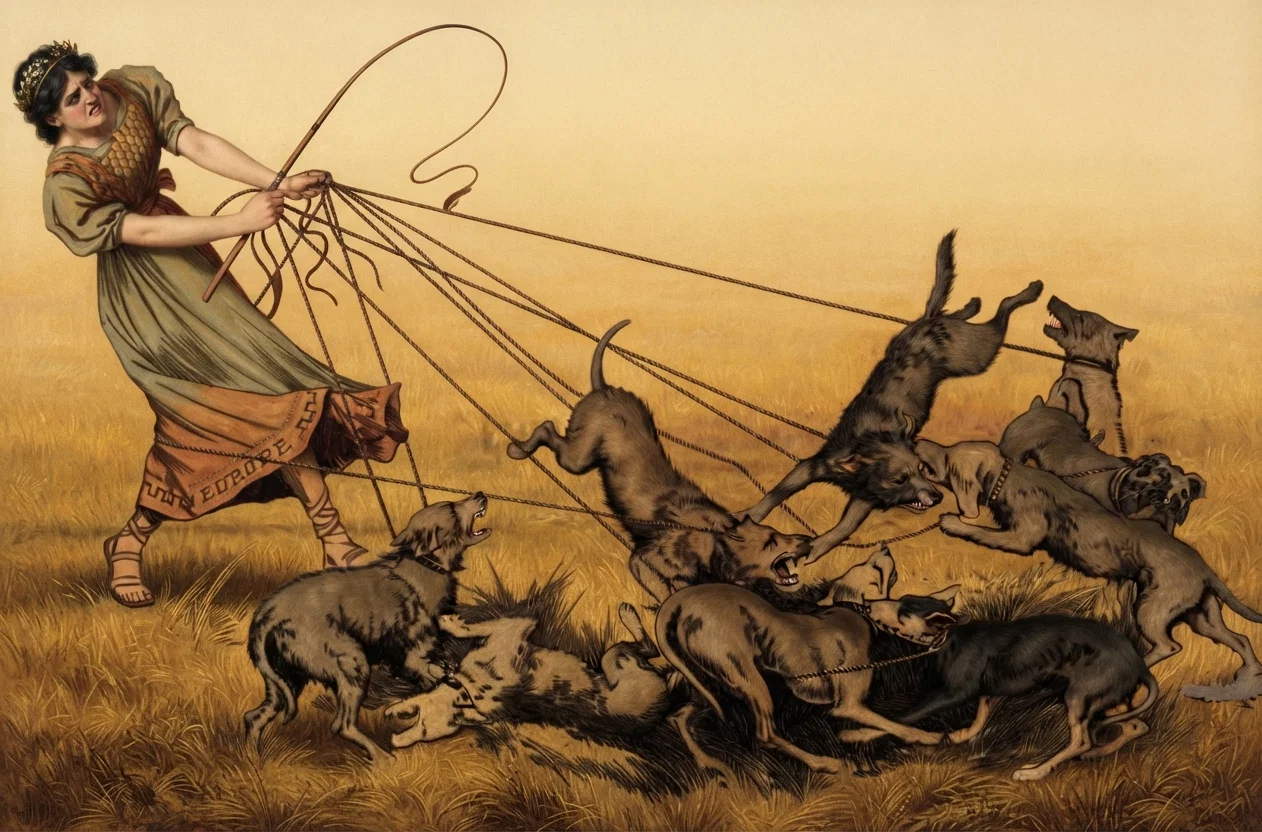
WRITING of the beginning of the present great world war, Mr. W. Morgan Shuster said: "In the hot days of August, dogs go mad. Thus is it now written in history that in August, 1914, Europe's dogs of war went completely mad. None of the familiar symptoms of the malady was lacking. Kings, emperors, czars, councilors, and blood relatives first snarled and growled, with bristling necks and gleaming teeth, then launched whole nations upon one another in barbarous fury. Not content with this, they slashed and tore every living thing in sight.
Blind madness mounted upon rage until even those of the same pack fell upon one another. Innocent babes were no safer than full-armed soldiers; indeed, much less so. Neither women, sick, nor aged were spared. All laws, precedents, treaties, oaths, pretensions, decencies, and even God, were forgotten. His name served but to adorn the specious appeals for aid which were put forth by earthly rulers."—Century Magazine, February, 1915, pages 503, 504.
It was not supposed that such scenes as are described in the foregoing quotation, and as are to-day enacted in Europe and Asia, ever could occur in this enlightened age. But now we are told that "all the accumulated mass of knowledge, the slow-won mastery of natural forces and materials, the skill, the craftsmanship, the cunning manipulation of tools, the huge apparatus of world-wide transport by land and sea—all the means which man has in the lapse of ages gradually made his own, and applied to maintain life, increase comfort, and serve daily needs in countless ways—all these are suddenly turned to purely destructive purposes, with an order and energy unknown to civil life."—Dr. A. Shadwell, Edinburgh Review, copied in American Review of Reviews, page 356.
Speaking of the influence of war upon the fighting man, Mr. Hereward Carrington says: "All the centuries of intervening civilization are swept away in an instant; and we see before us, not the cultured gentleman of yesterday, but a primitive brute beast, fighting for his existence and his life in precisely the same way that his ancestors fought—and with no other, higher ideals in mind. That, perhaps, is the most instructive item of all. It shows us at once and graphically the effects upon the mind of war—and proves to us that it leads not only to material destruction, and to mental and moral deterioration, but also to the very extinction of the spirit of man itself—in the almost instant reversion of civilized man to savagery."—The Forum, quoted in the American Review of Reviews, page 235.
By multitudes, the questions are asked: "What will the end be? What do these things mean? Can they mean that the nations, through this experience, will learn to abhor war, and will turn from it, converting their implements of war into implements of agriculture? Will there be awakened in the hearts of all men a desire to find God, and so all men be converted? Or is this all merely the legitimate and inevitable fruitage of sin, the result of following the leadership of the arch-rebel? Is it the fulfillment of the sure word of prophecy, revealing the approach of the day when the Prince of peace will begin His eternal reign of righteousness?"
From the beginning, the work of Satan has been to pervert. Once he bore the name of Lucifer—day-star; but when he fell into sin, and, having stubbornly persisted in rebellion, was cast out of heaven, his name was changed to "the devil, and Satan, which deceiveth the whole world." Isa. 14: 12-17; Rev. 12: 7-9. His character from the beginning of his rebellion has been that of a destroyer. It is said of him, "Is this the man that made the earth to tremble, that did shake kingdoms; that made the world as a wilderness, and destroyed the cities thereof?"
The Saviour, in speaking of him, said: "He was a murderer from the beginning, and abode not in the truth, because there is no truth in him. When he speaketh a lie, he speaketh of his own: for he is a liar, and the father of it." John 8: 44.
His followers partake of the same characteristics, hence in the world there has been almost continuous war and strife.
"From whence come wars and fightings among you?" asks James; "come they not hence, even of your lusts that war in your members?" James 4: 1.War originated with the devil, and he has been responsible for the destruction wrought by war ever since. The last supreme effort of the devil in his work of rebellion will be to lead his followers against the city of God at the end of the thousand years. Rev. 20: 1-11. The wicked dead, having been raised from their graves, are led to believe that they can take the city of God, the heavenly Jerusalem, that will come down to earth from God out of heaven. Rev. 21: 2, 3, 10.
Led by the great deceiver, the myriad hosts of the wicked surround the holy city. Lifted up above its jasper walls, seated on a glorious white throne, surrounded by the redeemed of all ages, the Saviour appears before that vast throng. With inexpressible anguish, the wicked behold what they have lost. They see Abraham, Isaac, and Jacob in the kingdom, but themselves thrust out.
They think once more of the time when they were almost persuaded to give their hearts to God, but listened instead to the voice of the tempter. They remember the prayers of father, mother, sister, wife, or other loved one, as they plead in their behalf before the throne. They recall the pale, upturned face and the last words of mother as she pleads with them to meet her around the throne. They remember the awful moment when the decision that determined their eternal destiny was made. With anguish of heart such as none but the lost can ever know, and with insatiable hatred for the one who deceived them, they turn in wrath and indignation upon their leader.

The Great Controversy Closes

ONCE more, and for the last time, fire is employed in battle as an element of destruction. A "curtain of fire" "came down from God out of heaven, and devoured them. And the devil that deceived them was cast into the lake of fire and brimstone." Rev. 20: 7-10.
Thus ends the great internecine conflict extending through the ages, but reaching its climax in the scene just described. Today the enemy is preparing the hearts of men for his final deception. He is making the world mad.
One of the signs heralding the approach of the great day of God, as given by the Revelator, is, "And the nations were angry." Rev. 11: 18. Jeremiah, writing of this same time, said: "Take the wine cup of this fury at My hand, and cause all the nations, to whom I send thee, to drink it. And they shall drink, and be moved, and be mad because of the sword that I will send among them." "Thus saith the Lord of hosts, Behold, evil shall go forth from nation to nation, and a great whirlwind shall be raised up from the coasts of the earth. And the slain of the Lord shall be at that day from one end of the earth even unto the other end of the earth." Jer. 25: 15, 16, 32, 33.

A Strange Breath Blowing

A CANKER has long eaten at the heart of the world — the canker of suspicion, envy, jealousy, rancor, of insatiable hatred. A strange breath has blown upon the world. Evil spirits seem to be walking abroad. The great destroyer is marshaling his host for "the war of the great day of God." "These shall make war with the Lamb, and the Lamb shall overcome them: for He is Lord of lords, and King of kings: and they that are with Him are called, and chosen, and faithful." Rev. 17: 14.
"The kingdom and dominion, and the greatness of the kingdom under the whole heaven, shall be given to the people of the saints of the Most High, whose kingdom is an everlasting kingdom, and all dominions shall serve and obey Him." Dan. 7: 27.## WAR DOGS GONE MAD (Continued from page 2)
We may not possess much of this world's goods; but we shall discover, in that day, that God has "chosen the poor of this world rich in faith, and heirs of the kingdom which He hath promised to them that love Him." James 2: 5.
"Wherefore the rather, brethren, give diligence to make your calling and election sure: for if ye do these things, ye shall never fall: for so an entrance shall be ministered unto you abundantly into the everlasting kingdom of our Lord and Saviour Jesus Christ." 2 Peter 1: 10, 11.
"Blessed be the God and Father of our Lord Jesus Christ, which according to His abundant mercy hath begotten us again unto a lively hope by the resurrection of Jesus Christ from the dead, to an inheritance incorruptible, and undefiled, and that fadeth not away, reserved in heaven for you, who are kept by the power of God through faith unto salvation ready to be revealed in the last time." 1 Peter 1: 3-5.

World's Conversion Not in Sight

WE can discover no sign of the world's conversion to Christianity; but instead, there are many indications that it is under the spell of evil spirits. When the Saviour comes, comparatively few will be ready to meet Him. He speaks of this company as a "little flock," saying, "Fear not, little flock; for it is your Father's good pleasure to give you the kingdom." Luke 12: 32.
But of the world it is written: "And the kings of the earth, and the great men, and the rich men, and the chief captains, and the mighty men, and every bondman, and every freeman, hid themselves in the dens and in the rocks of the mountains; and said to the mountains and rocks, Fall on us, and hide us from the face of Him that sitteth on the throne, and from the wrath of the Lamb: for the great day of His wrath is come; and who shall be able to stand?" Rev. 6: 15-17.
The time is surely approaching, and that very rapidly, when those who destroy the earth will themselves be destroyed.

When Was the Atonement Made?

By Louis H. Christian
CHURCH history warrants us in stating that at least ninety per cent of all theological discussions have been a mere wrangle about words. Often the parties debating used the very same word in a different sense, and thus never came to any agreement. "Gentlemen, define your terms," said an old judge to two young lawyers who thought they disagreed when they didn't. It would be well if preachers too would define their own phrases.
In answering the question, "When was the atonement made?" we must consider what the term "atonement" signifies. If by the atonement we mean the entire plan of redemption, we will have to say that the time of the atonement is at least as long as probationary time. If we consider the term to mean the ransom price for sinners, given in the death of Christ, then the atonement was made and completed on the cross. If we use the word to designate the mediatorial work of our Saviour, then the atonement was not made on the cross, but is going on now in the heavenly sanctuary.
To atone is "to set at one," "to reconcile," "to expiate"; and the noun "atonement" is defined as "satisfaction or reparation made by giving an equivalent for an injury." The word "atonement" occurs but once in our New Testament, and then with a marginal correction; but in the Old Testament, it is found over fifty times. In the Greek, the same verb is rendered, in our Bible, "to make an atonement" and "to make a reconciliation."
Jesus Christ gave His life as a ransom for the whole human family. Matt. 28:20. The death of Christ on the cross is the price by which we are redeemed; and that price is full and complete for every man. If any one chooses to call the death of Christ, and this only, the atonement, then this atonement was of course made and finished on the cross. As the death of Christ is the foundation of the whole plan of redemption, to speak of this event as the atonement is proper.
However, the Bible uses the word "atonement" to designate the mediatorial work of Christ as our High Priest in heaven, and this is the most common use of the term in the Scriptures. Any one who will look up the word "atonement" as it occurs in the divine Word, will agree with us in this statement.

Made in the Sanctuary

IN the Jewish sanctuary, there was a daily and a yearly service for sin. When a man had transgressed against the words of God, he brought a sin offering to the sanctuary. He himself placed his hands on the head of the animal to be sacrificed, and slew it. The priest took the blood, and sprinkled it upon the altar, and in so doing, made an atonement for sin. Over and over again in Leviticus, chapters four and five, we read, "The priest shall make an atonement for him." The priest did not slay the sacrifice, and surely he himself was not the sin offering; but he took the blood of the offering, and with it he made an atonement in the sanctuary. If this is a type of the work of Christ, it proves very conclusively that Christ makes the atonement for sin, not by dying as the sin offering, but in His office as Priest in the heavenly sanctuary.
This point becomes even clearer when we consider the annual services in the typical sanctuary on the day of atonement. A sin offering was slain, and its blood was carried into the most holy by the high priest. The high priest made an atonement with this blood. He made this atonement not by slaying the sin offering, but with the blood in the most holy place. "And there shall be no man in the tabernacle of the congregation when he goeth in to make an atonement in the holy place, until he come out, and have made an atonement for himself, and for his household, and for all the congregation of Israel." Lev. 16:17.
Notice carefully that the high priest made an atonement in the most holy place of the sanctuary. This day was called the day of atonement, and is the type of the great antitypical day of atonement in the heavenly sanctuary. In harmony with this, we read: "Wherefore in all things it behooved Him to be made like unto His brethren, that He might be a merciful and faithful High Priest in things pertaining to God, to make reconciliation for the sins of the people." Heb. 2:17. The word which in the foregoing verse is translated "reconciliation," is the same that is so often rendered "atonement" in other scriptures. This verse states that Christ was to make reconciliation, or atonement, not in His death, but as our merciful and faithful Priest. Jesus was not a priest on earth, but in heaven. Consequently He makes the atonement in the sanctuary.

Priesthood Belittled by Many

WE would not diminish the merits of the death of Christ; but we are convinced that His work as High Priest is misunderstood and even belittled by many. Without His work as our Mediator, His sufferings as our Sin-bearer would have been in vain. We are "saved by His life," and there would be no forgiveness of sins for us if we had no Advocate with the Father. We need to look to Christ as our High Priest, and have a living and daily communion with Him. He pleads our cases before His Father, and He is our peace. His work of atonement for His people will cease when this work in the heavenly temple ends. At that time, and not until then, will the atonement be finished.

The Bible and the Koran

By Kay M. Adams

The Origin of Islamic Religious Beliefs — Remarkable Parallels to Bible Statements
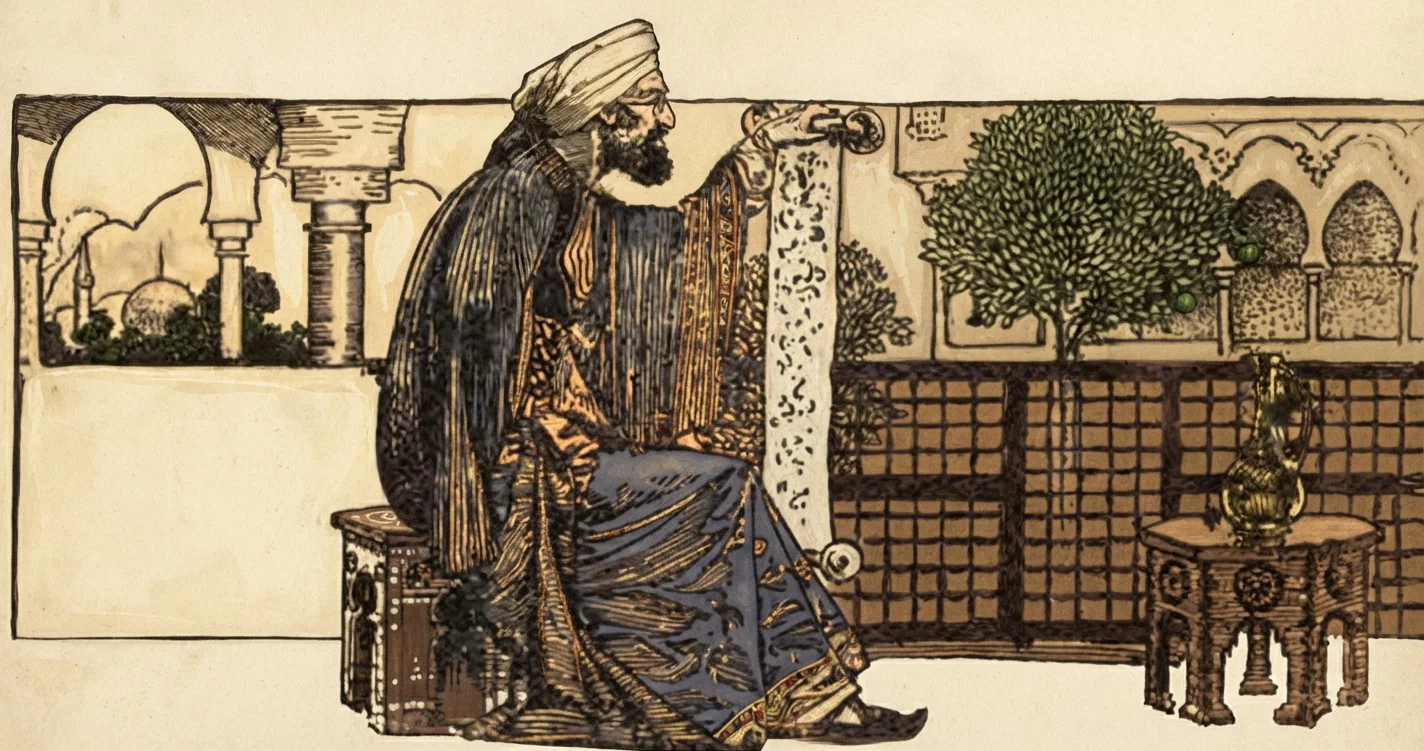
NOTE.— The quotations from the Koran that appear in this article are taken from George Sale's translation. No verse of the chapter is given, as no form of versification has been agreed upon by the various translators.
WHEN the average Christian hears Mohammedanism mentioned, he immediately thinks of it as being in everything opposed to Christianity and the teachings of the Bible. But that is far from the truth. Mohammedanism, or Islam, as it is called by Mohammedans, is in many doctrines in harmony with the teachings of the Bible.
Mohammed saw the divided state of the Arab tribes of his day, and the weakness that resulted from this condition. He knew that Arabs were deeply religious by nature; so he examined Judaism and Christianity by turn, but thought that it would be lowering for his countrymen to follow another race in religion, hence he decided to unify his people by originating a new religion. But Islam is a new religion in name only. It is composed of parts of the beliefs of the Jews, and some of the Christian doctrines. Mohammed himself claimed that Islam was the first religion, the religion of Adam and Enoch and Abraham.

The Rallying Cry of Islam

ISLAM'S central theme is the unity of God. The Arabs were in practice idolaters in Mohammed's time; but in the spread of his teaching, all this was changed. "There is no God but Allah, and Mohammed is His prophet," is the great rallying cry of this belief.
Mohammedans believe that God created the earth, and that He created man out of clay. "We created man of dried clay, of black mud, formed into shape." (Koran 15.) They believe in angels, as angels are mentioned many times in the Koran. "When the two angels deputed to take account of a man's behavior, take account thereof, one sitting on the right hand, and the other on the left, he uttereth not a word, but there is with him a watcher, ready to note it." (Koran 50.)
Mohammedans forbid gambling and drinking strong drink. "They will ask thee concerning wine and lots. Answer, In both there is great sin." (Koran 2. Compare Prov. 23: 31, 32.) Divinations also are forbidden. "O true believers, surely wine and lots, and images, and divining arrows, are an abomination of the work of Satan; therefore avoid them." (Koran 5. Compare Deut. 18: 10.) The Mohammedan is forbidden to marry an unbeliever. "Marry not women who are idolaters; . . . and give not women who believe, in marriage to the idolaters." (Koran 2. Compare 2 Cor. 6: 14.)
Mohammedans are forbidden to eat certain things, as follows: "Ye are forbidden to eat that which dieth of itself, and blood, and swine's flesh, and that on which the name of any besides God hath been invocated; and that which hath been strangled, . . . and that which hath been sacrificed to idols." (Koran 5. Compare Acts 15: 29; Lev. 11: 7.)

Seventh Hell for Hypocrites

MANY people believe that Islamites teach that women have no soul, and cannot go to heaven. Here is what the Koran says: "I will not suffer the work of him among you who worketh to be lost, whether he be male or female." (Koran 3.) "But whoso doth good works, whether he be male or female, and is a true believer, they shall be admitted into Paradise, and shall not in the least be unjustly dealt with." (Koran 4.)
The Mohammedans believe in seven heavens and seven hells. "And we have created over you seven heavens." (Koran 23.) Concerning the Mohammedan belief in hell, George Sale says: "As to the punishment of the wicked, the Mohammedans are taught that hell is divided into seven stories, . . . one below another. . . . The first will be the receptacle of wicked Mohammedans, the second they assign to the Jews, the third to the Christians, the fourth to the Sabians, the fifth to the Magians, the sixth to idolaters, the seventh to hypocrites." ("Preliminary Discourse.")
Books of records are kept, which shall judge men in the last day. "The fate of every man have we bound about his neck; and we will produce unto him on the day of resurrection a book wherein his actions shall be recorded. It shall be offered him open, and the angels shall say: 'Read this book. Thine own soul will be a sufficient accountant against thee this day.'" (Koran 17.) The Bible says on this point: "And I saw the dead, small and great, stand before God; and the books were opened: and another book was opened, which is the book of life: and the dead were judged out of those things which were written in the books, according to their works." Rev. 20: 12.

Precedes the First Blast

THE Mohammedans believe in a resurrection. "So shall be the coming forth of the dead from their graves." (Koran 50.) "On that day shall God call you forth from your sepulchers." (Koran 17.) This resurrection will take place at the great and terrible day of the Lord. It is the time when the Judgment will be held, and the sentences meted out to mankind.
George Sale, in his book, "The Preliminary Discourse," quotes from Dr. Pocock's "Specimen Historiae Arabum," as follows, concerning the Mohammedan beliefs of the signs of the last day:
"The lesser signs are, the decay of faith among men, the advancing of the meanest persons to eminent dignity, . . . tumults and seditions, a war with the Turks, great distress in the world." "The greater signs are, . . . war with the Greeks, and the taking of Constantinople, the coming of antichrist, the descent of Jesus on earth ('Jesus shall be a sign of the approach of the last hour.'—Koran 43), war with the Jews, the eruption of Gog and Magog, a smoke which shall fill the whole earth, an eclipse of the moon. These are the greater signs which, according to their doctrines, are to precede the resurrection. . . . The immediate signs of its being come will be the first blast of the trumpet, which they believe will be sounded three times. ('On that day the trumpet shall be sounded.'—Koran 28.) The first, they call the blast of consternation, at the hearing ofwhich all creatures will be struck with terror, except those whom God shall please to exempt from it. The effects attributed to this first sound of the trumpet are very wonderful; for they say the earth will be shaken, and not only all buildings, but the very mountains, leveled; that the heavens shall melt, the sun be darkened, the stars fall."
God only knows the day of Judgment. "They shall ask thee concerning the last hour. . . . Answer, Verily the knowledge thereof is with God alone." (Koran 8.) The length of the Judgment will be one thousand years.

A Surprising Agreement

WHEN one compares these beliefs with the statements of the Bible regarding the end of the world and the second coming of Christ, the agreement is surprising. Let us read a few texts from God's holy Book on this great subject: "Now the Spirit speaketh expressly, that in the latter times some shall depart from the faith." 1 Tim. 4: 1. "And ye shall hear of wars and rumors of wars. . . . For nation shall rise against nation, and kingdom against kingdom: and there shall be famines, and pestilences, and earthquakes, in divers places." Matt. 24: 6, 7. It is evident that these statements of the Bible are similar to the lesser signs which the Mohammedans look for.
Now for Bible parallels to the greater signs mentioned in Islam: "Little children, it is the last time: and as ye have heard that antichrist shall come, even now are there many antichrists; whereby we know that it is the last time." 1 John 2: 18. "This same Jesus, which is taken up from you into heaven, shall so come in like manner as ye have seen Him go into heaven." Acts 1: 11. "For the trumpet shall sound, and the dead shall be raised incorruptible." 1 Cor. 15: 52. "And the heaven departed as a scroll when it is rolled together; and every mountain and island were moved out of their places. And the kings of the earth, and the great men, and the rich men, and the chief captains, and the mighty men, and every bondman, and every freeman, hid themselves in the dens and in the rocks of the mountains; and said to the mountains and rocks, Fall on us, and hide us from the face of Him that sitteth on the throne." Rev. 6: 14-16. "But the day of the Lord will come as a thief in the night; in the which the heavens shall pass away with a great noise, and the elements shall melt with fervent heat, the earth also and the works that are therein shall be burned up." 2 Peter 3: 10. "Immediately after the tribulation of those days shall the sun be darkened, and the moon shall not give her light, and the stars shall fall from heaven, and the powers of the heavens shall be shaken." "But of that day and hour knoweth no man, no, not the angels of heaven, but My Father only." Matt. 24: 29, 36.
From these comparisons, we see that the Mohammedan beliefs of the signs of the day of Judgment correspond closely with the Bible account. The Mohammedans believe that Moses, David, and Jesus were prophets. They say that Mohammed was the last and the greatest, and that after him there will be no others. The Mohammedans believe in the Pentateuch, the Psalms, and the four Gospels, but they say that the copies now held by Jews and Christians have been so corrupted that no trust can be placed in them.
The believers of Islam repudiate the idea that Jesus is the Son of God. They say that there is only one God, that He was not begotten, nor does He beget. They believe that Jesus was only a prophet. They are firm haters of idolatry. It is told of one Mohammedan conqueror who had subdued an idolatrous nation, that over one million dollars was offered him if he would not destroy their chief idol. As much as he wanted the money, he refused the offer.
Mohammedanism has a wonderful grip on its followers. There are fewer converts to Christianity from this belief than from any other form of religion. Thousands of the inhabitants of India, millions of those who live in the islands of the sea, are disciples of Islam. One wonders why they cannot be shown how the Bible teaches many things that the Koran teaches, and in this way their respect be won for God's holy Book.
If missionaries that work among this class of people, would dwell upon the resurrection and the Judgment, calling their attention to the teachings of their own religion, might not many be turned to the true worship of God? Let all Christians pray and work that these benighted souls may learn the true way.

His Greatest Argument

By the late Mrs. E. G. White
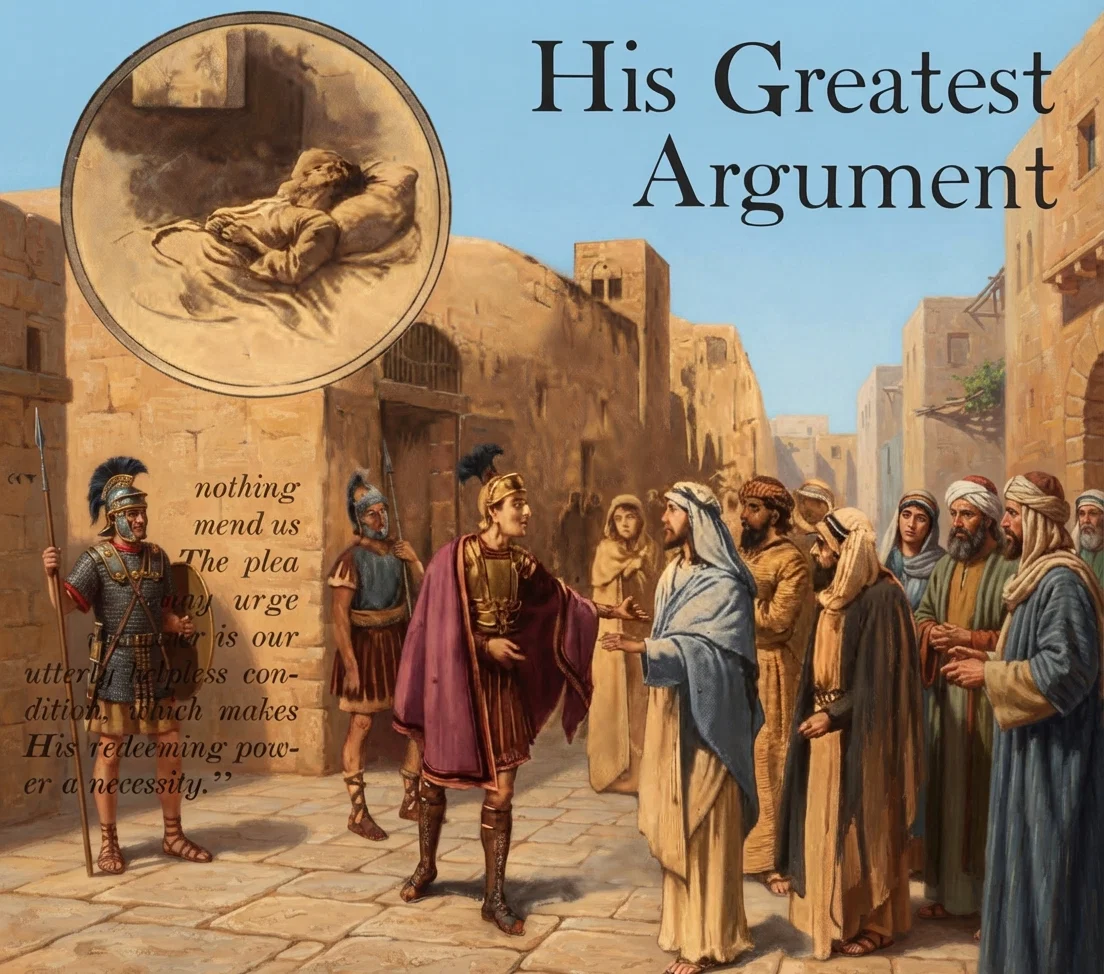
"WE have nothing to recommend us to God. The plea that we may urge now and ever is our utterly helpless condition, which makes His redeeming power a necessity."
A CENTURION'S servant was lying sick of the palsy. Among the Romans, the servants were slaves, bought and sold in the market places, and often treated with abuse and cruelty; but the centurion was tenderly attached to his servant, and greatly desired his recovery. He believed that Jesus could heal him. He had not seen the Saviour, but the reports he had heard inspired him with faith.
Notwithstanding the formalism of the Jews, this Roman was convinced that their religion was superior to his own. Already he had broken through the barriers of national prejudice and hatred that separated the conquerors from the conquered people. He had manifested respect for the service of God, and had shown kindness to the Jews as His worshipers. In the teaching of Christ, as it had been reported to him, he found that which met the need of the soul. All that was spiritual within him responded to the Saviour's words. But he thought himself unworthy to approach Jesus, and he appealed to the Jewish elders to make request for his servant's healing.

Worthy, or Not Worthy?

THE elders present the case to Jesus, urging that "he was worthy for whom He should do this: for he loveth our nation, and he hath built us a synagogue."
But on the way to the centurion's home, Jesus receives a message from the officer himself, "Lord, trouble not Thyself: for I am not worthy that Thou shouldest enter under my roof."
Still the Saviour keeps on His way, and the centurion comes in person to complete the message, saying: "Neither thought I myself worthy to come unto Thee;" "but speak the word only, and my servant shall be healed. For I am a man under authority, having soldiers under me: and I say to this man, Go, and he goeth; and to another, Come, and he cometh; and to my servant, Do this, and he doeth it."
"I represent the power of Rome, and my soldiers recognize my authority as supreme. So dost Thou represent the power of the infinite God, and all created things obey Thy word. Thou canst command the disease to depart, and it shall obey Thee. Speak but the word, and my servant shall be healed."
"As thou hast believed," Christ said, "so be it done unto thee. And his servant was healed in the selfsame hour."
The Jewish elders had commended the centurion to Christ because of the favor he had shown to "our nation." "He is worthy," they said, "for he hath built us a synagogue." But the centurion said of himself, "I am not worthy." Yet he did not fear to ask help from Jesus. Not to his own goodness did he trust, but to the Saviour's mercy. His only argument was his great need.

Connects Us with Heaven

IN the same way, every human being can come to Christ. "Not by works of righteousness which we have done, but according to His mercy He saved us." Do you feel that because you are a sinner, you cannot hope to receive blessing from God? Remember that Christ came into the world to save sinners.
We have nothing to recommend us to God. The plea that we may urge now and ever is our utterly helpless condition, which makes His redeeming power a necessity. Renouncing all self-dependence, we may look to the cross of Calvary, and say,—
"In my hand no price I bring; Simply to Thy cross I cling."
"If thou canst believe, all things are possible to him that believeth." It is faith that connects us with heaven, and brings us strength for coping with the powers of darkness. In Christ, God has provided means for subduing every evil trait, and resisting every temptation, however strong. But many feel that they lack faith, and therefore they remain away from Christ. Let these souls, in their helpless unworthiness, cast themselves upon the mercy of their compassionate Saviour.

The Same Mighty Redeemer

LOOK not to self, but to Christ. He who healed the sick and cast out demons when He walked among men, is still the same mighty Redeemer. Then grasp His promises as leaves from the tree of life. "Him that cometh to Me I will in no wise cast out." As you come to Him, believe that He accepts you, because He has promised. You can never perish while you do this — never.
"God commendeth His love toward us, in that, while we were yet sinners, Christ died for us."
And "if God be for us, who can be against us? He that spared not His own Son, but delivered Him up for us all, how shall He not with Him also freely give us all things?"
"I am persuaded, that neither death, nor life, nor angels, nor principalities, nor things present, nor things to come, nor powers, nor height, nor depth, nor any other creation, shall be able to separate us from the love of God, which is in Christ Jesus our Lord."

Find Rest in Him

JESUS looked upon the distressed and heart-burdened, those whose hopes were blighted, and who with earthly joys were seeking to quiet the longing of the soul, and He invited all to find rest in Him.
Tenderly He bade the toiling people, "Take My yoke upon you, and learn of Me; for I am meek and lowly in heart: and ye shall find rest unto your souls."
In these words, Christ was speaking to every human being. Whether they know it or not, all are weary and heavy-laden. All are weighed down with burdens that only Christ can remove. The heaviest burden that we bear is the burden of sin. If we were left to bear this burden, it would crush us. But the Sinless One has taken our place. "The Lord hath laid on Him the iniquity of us all."

The Best Kind of Criticism

SELF-CRITICISM is the best kind; and if it were properly practiced by all, there would be little or no occasion for criticism from others. The more we criticize our own faults, the better. If each one would lay upon himself the responsibility for all blunders and mistakes with which he has any connection, there would be no sharp words or quarrels. Excuse much in others; excuse nothing in self. B. P. F.
Continue reading: The Mistress of Empires