WHEN the iron monarchy of pagan Rome went to pieces, it was the destruction of Satan's most colossal success in world empire building. Rome was the embodiment of the devil's scheme of a universal empire. He had but one fell purpose in it all — the enslaving of the souls and bodies of mankind. Through it to persecute to the death the Lord Jesus Christ and His followers through all the ages, and to blot from the earth the knowledge of God, was his supreme ambition, his soul-inspiring passion.
When the year A. D. 476 arrived, the empire of Rome perished. Henceforth there was naught of the pagan Roman Empire but a memory and a name. In its place were ten kingdoms, all young and aggressive. World empire of the old sort was obviously out of the question, for the present at any rate.
Were Satan human, he must needs have been abashed, confused, and utterly disconcerted. As it was, the Scriptures say, "He took his stand on the seashore." (See Twentieth Century New Testament, Rev. 12: 17; Rotherham's New Testament, id.; Syriac New Testament, id.) In utter despair, because his idol empire was broken in pieces, he took his stand upon the seashore, and may be pictured as saying to himself, "What now can I use, what now can I use?" He took his stand upon the seashore, and waited to see what new form of world-wide, centralized power could be made to arise.
Usurps the Power of the Almighty
NOR did he have to tarry long, for soon there was seen "a beast of prey" coming up from the sea. Here is the record: "And I saw a beast of prey come up from the sea, having ten horns, and seven heads; and upon his horns ten diadems, and upon his heads names of blasphemy. And the beast of prey which I saw, was like a leopard; and his feet like those of a wolf, and his mouth like those of lions; and the dragon gave him his own power and his throne and great authority. And one of his heads was wounded as it were to death; and his deadly wound was healed. And all the earth wondered after the beast of prey. And they worshiped the dragon, because he had given authority to the beast of prey; and they said, Who can make war upon him? And there was given to him a mouth speaking great things, and blasphemies: and authority was given him to operate forty and two months. And he opened his mouth in blasphemy toward God, to blaspheme His name and His tabernacle, and them who dwell in heaven. And authority was given him over every tribe and people and tongue and nation: and it was given him to wage war with the saints, and to overcome them." Rev. 13: 1-7, Syriac New Testament.
Here now was a new power — a power which seeks to destroy everything that antagonizes it, for it is "a beast of prey." It does its will through many agencies, governments, and nations, for it had "ten horns and seven heads." It entered the realms of the spiritual, it commanded the soul, it invaded the sanctuary of the conscience, which belongs to God alone. Thus did it usurp the power of the Almighty. It did this through the powers of earth that it compelled to do its bidding: for "upon his horns" were "ten diadems, and upon his heads names of blasphemy."
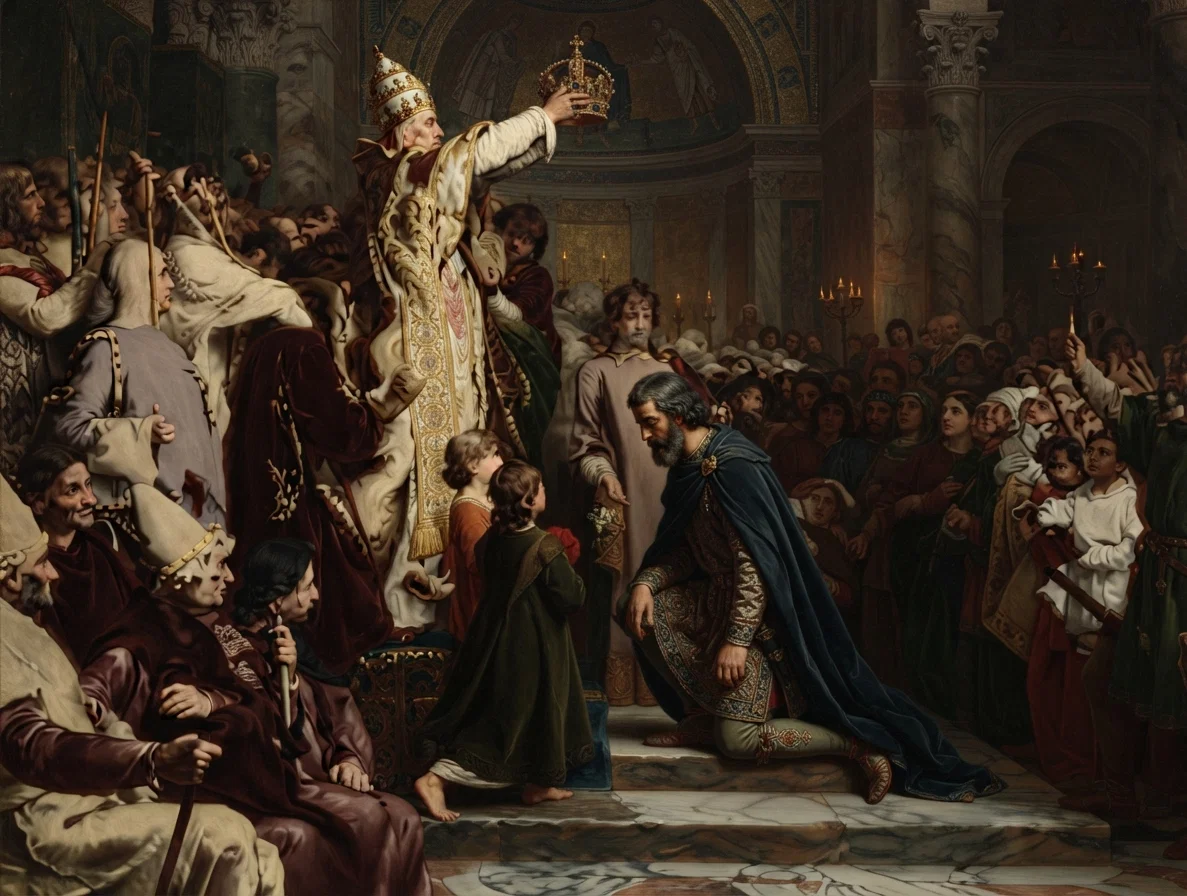
POPE LEO III CROWNING CHARLEMAGNE AT ROME IN 800 A. D.
It was so swift to strike that it was "like a leopard"; so cunning and so stealthy in its movements that its feet were "like those of a wolf," or of a bear. Its mouth was "like those of lions," strong and greedy to tear and devour.
This is the description of the beast of which it is further written that "the dragon gave him his own power and his throne and great authority." Moreover, he was a world power; for "authority was given him over every tribe and people and tongue and nation." Yet again he was an antichristian power; for "it was given him to wage war with the saints, and to overcome them," and "to operate forty and two months."
Crush Him at One Blow
HENCE this was a new universal power, a world church instead of a world empire, a church holding universal sway, and commanding submission to itself, and making war against the saints of God.
Which then is this church? The one which rose at about that time, and operated forty and two prophetic months, or one thousand two hundred sixty years (538-1798), was the papacy. She calls herself the "Holy Catholic Church." The word "Catholic" signifies universal. Hence the Roman Catholic Church is simply the Roman Universal Church. And in this it was simply the application in a different form of the principle which Satan desired to carry into effect, first at Babel, on the plain of Shinar, and later in the Babylonish, Medo-Persian, and Roman empires. It was so that whenever and in whatever clime a man should arise, and, inspired by the living God, should preach the gospel of Christ in deed and in truth, this all-powerful, universal church should crush him at a blow; and because of her power over kings and kingdoms, no land on earth should afford him sanctuary, asylum, or refuge.
Drunken with Blood
JOHN the revelator says: "I saw a woman sit upon a scarlet colored beast, full of names of blasphemy, having seven heads and ten horns. . . . And upon her forehead was a name written, MYSTERY, BABYLON THE GREAT, THE MOTHER OF HARLOTS AND ABOMINATIONS OF THE EARTH. And I saw the woman drunken with the blood of the saints, and with the blood of the martyrs of Jesus." Rev. 17: 3-6.
There can be no question but that in the past, Rome has been drunken with the blood of the saints and with the blood of the martyrs of Jesus. At the present time, Roman Catholicism is regarded by non-Catholics with much more favor than in years gone by. Outwardly Rome is taking a more conciliatory course, but at heart she still holds that she did right when she persecuted heretics.
If only the restraint now imposed by the secular arm were removed, and Rome reinstated in her former power, she would be obliged to persecute and tyrannize as in days of old. And this is what is certain to follow if she has her way to the full in the settling up of the great war, and in the re-establishment of her own temporal power. In that day, the nations that did not come under her sway in religious matters, she plucked up by the roots. Three of them, the Heruli, the Vandals, and the Ostrogoths, perished because of this.
When this was done, the bishop of Rome asserted his sole authority over the estates of the church. The territory surrounding Rome was created into the Roman duchy, and the bishops of Rome claimed sole jurisdiction over it.
The pope was then not only a pope, but also a king. He had a definite territory over which he ruled, to a certain extent at least, in things temporal as well as spiritual. Later he received a letter from the emperor Justinian confirming him in his position. By this letter and the overthrow of the Ostrogoths, the last of the Arian kingdoms, the temporal authority of the papacy was established.
Then began that "fatal policy of the Roman see," herself now a world power, possessing territory over which she exercised temporal dominion, and by virtue of which she could contend with other kingdoms, and upon the same level. "Henceforth kings and emperors were her tools, and often her playthings; and kingdoms and empires her conquests, and often only her traffic."
In the prophecy of the seven churches in the book of Revelation are seven letters addressed by the Lord to His own church in the seven phases of the complete cycle of her experience, from the first advent of our Lord to His coming again in the clouds of heaven.
The Keystone of the System
IN the letter to the church in the third phase of her experience, there is given the keystone of the whole papal system as a world power. There is here mentioned with commendation by the Head of the church, Christ Jesus the Lord, the fact that His church had held fast His name, and had not denied His faith, "even in those days wherein Antipas was My faithful martyr."
Now the word "Antipas" is not the name of a person. It designates rather a condition of the times. It is made up of two words, anti and pappas. "Anti" means against, and "pappas" means papa. This word papa is simply the word pa repeated, and is the origin of the word "pope."
And so it comes about that "Antipas"—"against 'pas' or 'papas'"—denominates6those who opposed the arrogance and usurpation of the bishop of Rome. It is evident from the Scripture, and history substantiates it, that many were put to death for their opposition to this monarchial power and world-wide church.
Thus over a bloody path bestrewn with the ruin and wreck of kings and kingdoms, reeking in the blood of martyrs, came the papacy to be established as a world power. Well indeed has a great philosopher said: 'No one can study the development of the Italian ecclesiastical power without discovering how completely it depended upon human agencies, too often on human passion and intrigues; how completely wanting it was of any mark of the divine construction and care—the offspring of man, not of God, and therefore bearing upon it the lineaments of human passions, human virtues, and human sins.' (Schaff.)
Paul—
By Carlyle B. Haynes
"The introduction of Sunday observance into the Christian church is of later origin than the times of the apostles, and authority for it cannot be found in the Bible."
Paul—
the Sabbath Keeper
By CARLYLE B. HAYNES
WHILE considering the attitude of the apostles toward the Sabbath, it will be interesting to notice that they were accustomed constantly to preach on that day, to congregations sometimes of Jews, and sometimes of gentiles. One such instance is given in the book of Acts:
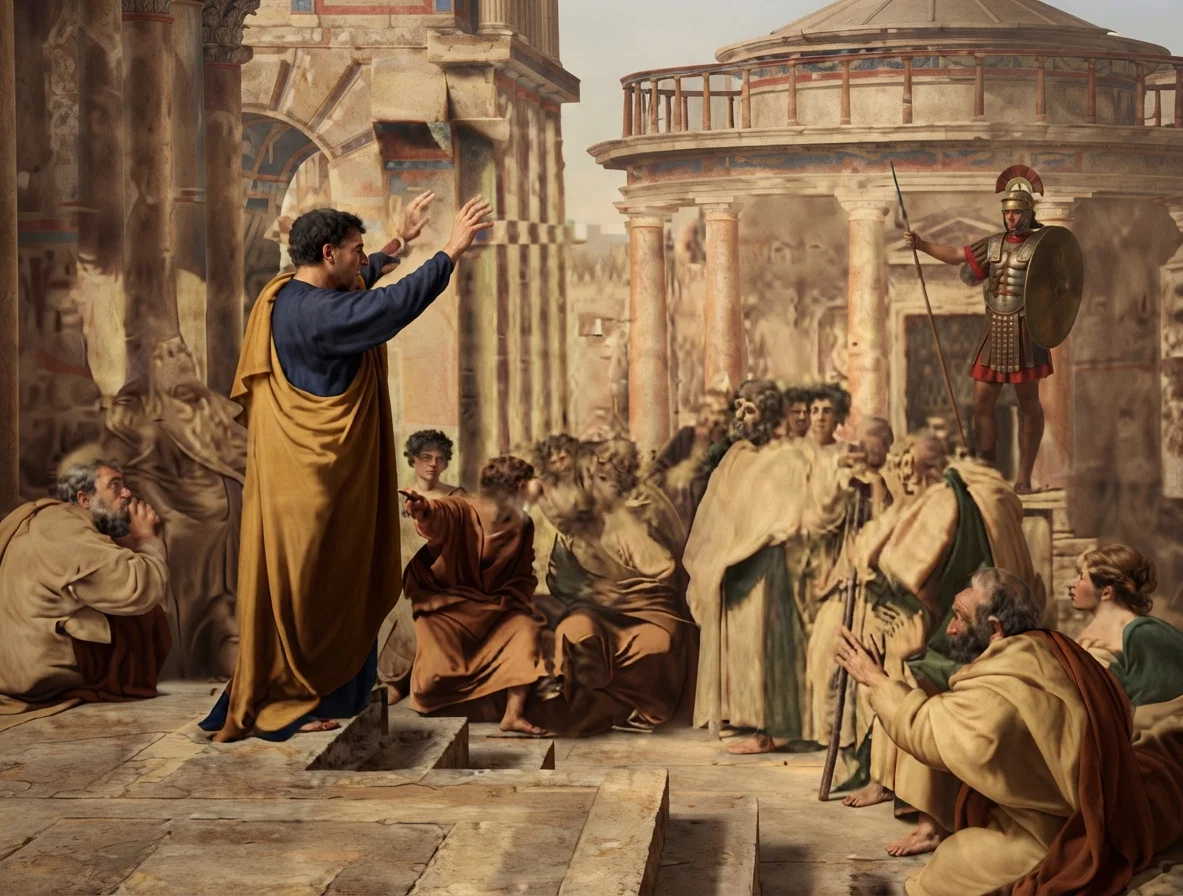
"But when they departed from Perga, they came to Antioch in Pisidia, and went into the synagogue on the Sabbath day, and sat down. And after the reading of the law and the prophets the rulers of the synagogue sent unto them, saying, Ye men and brethren, if ye have any word of exhortation for the people, say on. Then Paul stood up, and beckoning with his hand said, Men of Israel, and ye that fear God, give audience." Acts 13: 14-16.
Then Paul's sermon on this Sabbath day is recorded, being contained in verses 17 to 41. The assertion has been made, that the only reason for Paul's holding these synagogue meetings on the Sabbath was the opportunity thus afforded him of reaching the Jews with the gospel, and that he was not observing the seventh day.
Preached to Gentiles Sabbaths
THIS is a mistake. Paul preached to gentiles on the Sabbath, as well as to the Jews. Of this very occasion, we have the statement that "when the Jews were gone out of the synagogue, the gentiles besought that these words might be preached to them the next Sabbath." Acts 13: 42.
Here was an exceptional opportunity for Paul to explain to these gentiles that the seventh day was not the Sabbath for the gentiles, but the first day was. How easy it would have been for him, and what a splendid opening this was, to inform these gentiles that while he found it necessary to meet with Jews on their Sabbath, in order to bring them the gospel, yet as Christ had abolished the old Sabbath, and instituted a new one to take its place, gentiles ought now to keep that new Sabbath, which was the first day of the week, and therefore he would preach to them the next day instead of waiting for the next Sabbath!
Why did Paul not tell these gentiles this? — The main reason is, because it was not true. "And the next Sabbath day came almost the whole city together to hear the word of God." Acts 13: 44.
So here is mention of at least two Sabbaths on which Paul conducted religious services, and not at all exclusively for the Jews.
Additional Apostolic Sabbath Observance
ANOTHER Sabbath observed by Paul and his companions will be found in the following scripture: "Therefore loosing from Troas, we came with a straight course to Samothracia, and the next day to Neapolis; and from thence to Philippi, which is the chief city of that part of Macedonia, and a colony: and we were in that city abiding certain days. And on the Sabbath we went out of the city by a riverside, where prayer was wont to be made; and we sat down, and spake unto the women which resorted thither." Acts 16: 11-13.
Additional apostolic Sabbath observance is noted in the following passage: "Now when they had passed through Amphipolis and Apollonia, they came to Thessalonica, where was a synagogue of the Jews: and Paul, as his manner was, went in unto them, and three Sabbath days reasoned with them out of the Scriptures, opening and alleging, that Christ must needs have suffered, and risen again from the dead; and that this Jesus, whom I preach unto you, is Christ." Acts 17: 1-3.
Paul preached to gentiles on the Sabbath, as well as to the Jews.
It begins to seem very clear that instead of observing the first day of the week, the apostles were consistent observers of the seventh day, the Sabbath of the Lord.
Preached Every Sabbath
NOR are these passages the only ones we have that tell of the observance of the Sabbath by the apostles. We are informed that when Paul went to Corinth, "he reasoned in the synagogue every Sabbath, and persuaded the Jews and the Greeks. And when Silas and Timotheus were come from Macedonia, Paul was pressed in the spirit, and testified to the Jews that Jesus was Christ. . . . And he continued there a year and six months, teaching the word of God among them." Acts 18: 4, 5, 11.
How many Sabbaths he conducted services in the synagogue in Corinth, it is impossible to say, as in the course of the year and a half, he left the synagogue, and opened services in a private home near the synagogue; but be that as it may, this passage is a report of faithful Sabbath observance.
Thus the New Testament reveals that it was the custom of both Christ and His apostles to observe the seventh day as the Sabbath, while it contains not one single intimation that they ever observed Sunday.
"On the Lord's Day"
IT is claimed, by some, that Rev. 1: 10 affords evidence of Sunday sacredness. The verse reads, "I was in the Spirit on the Lord's day, and heard behind me a great voice, as of a trumpet."
The expression "the Lord's day" is thought to refer to Sunday. This is an assumption which it is easier to make twice than to prove once. The verse says nothing as to which day of the week is meant by "the Lord's day." Therefore we must go to other parts of the Bible to learn what day the Lord claims as His own.
We are told by Christ that "the Son of man is Lord also of the Sabbath." Mark 2: 28. From this, it seems plain that if Christ is Lord of the Sabbath, then the Sabbath is "the Lord's day."
Again we read, in the Lord's message to Isaiah: "If thou turn away thy foot from the Sabbath, from doing thy pleasure on My holy day; and call the Sabbath a delight, the holy of the Lord, honorable; and shalt honor Him, not doing thine own ways, nor finding thine own pleasure, nor speaking thine own words: then shalt thou delight thyself in the Lord; and I will cause thee to ride upon the high places of the earth, and feed thee with the heritage of Jacob thy father: for the mouth of the Lord hath spoken it." Isa. 58: 13, 14.
Notice that God calls the Sabbath "My holy day." Therefore the Sabbath, which is the seventh day, is clearly "the Lord's day."
But all doubt about it is cleared away by the Sabbath commandment itself: "Remember the Sabbath day, to keep it holy. Six days shalt thou labor, and do all thy work: but the seventh day is the Sabbath of the Lord thy God: in it thou shalt not do any work." Ex. 20: 8-10.
If, as the commandment says, "the seventh day is the Sabbath of the Lord thy God," there need be no difficulty in discovering what day is "the Lord's day." The Lord's day is not Sunday; it is the Sabbath, the seventh day, "My holy day," the day of which Christ is Lord.
Sunday of Later Origin
IN giving His disciples instruction concerning the destruction of Jerusalem, which took place about forty years after the crucifixion of Christ, the Lord said, "But pray ye that your flight be not in the winter, neither on the Sabbath day." Matt. 24: 20.
So far, then, from the Sabbath's being abolished by Christ, He gives instruction to His disciples to pray that they may be able to keep it forty years after His resurrection, even in the troublous times of the downfall of the Jewish nation.
It will be seen that there is much evidence in the New Testament for the observance of the seventh day, and absolutely no evidence for the observance of the first day. The introduction of Sunday observance into the Christian church is of later origin than the times of the apostles, and authority for it cannot be found in the Bible.
Confession, Repentance, and Reformation
“CONFESSION will not be acceptable to God without sincere repentance and reformation. There must be decided changes in the life; everything offensive to God must be put away.”
Guilty of Robbing God
By E. K. Slade
*The sin of robbing a fellow man is bad enough.
How much greater is the wrong of robbing our Maker!*
By E. K. SLADE
COVETOUSNESS has led mankind to ignore the claims of God in all ages. Yet every good and perfect gift is provided by Him. The gold and the silver and all the wealth of the world belong to Him, and the power that men have to search out and accumulate wealth is given of God. He is not in need, nor is He dependent upon our charity or liberality. "I will take no bullock out of thy house, nor he-goats out of thy folds. For every beast of the forest is Mine, and the cattle upon a thousand hills. I know all the fowls of the mountains: and the wild beasts of the field are Mine. If I were hungry, I would not tell thee: for the world is Mine, and the fullness thereof." Ps. 50: 9-12.
Man even in his fallen condition has free use of God's bounties. In this arrangement, there is a marvelous manifestation of divine love. An infinite price was paid that the fallen race might be placed on probation, and have earth's bounties continued. The gift, and the love prompting it, are even greater than when Adam first received dominion over the earth; for our present estate is provided through the purchase of the cross, the greatest possible revelation of divine love. We should see the stamp of the cross upon all nature and all the bounties of God to-day. Yet men freely and greedily use the things of God, without recognizing His ownership or appreciating His love.
In Malachi, it is pointed out how men have departed from God in this respect: "Even from the days of your fathers ye are gone away from Mine ordinances, and have not kept them. Return unto Me, and I will return unto you, saith the Lord of hosts. But ye said, Wherein shall we return? Will a man rob God? Yet ye have robbed Me. But ye say, Wherein have we robbed Thee? In tithes and offerings. Ye are cursed with a curse: for ye have robbed Me, even this whole nation. Bring ye all the tithes into the storehouse, that there may be meat in Mine house, and prove Me now herewith, saith the Lord of hosts, if I will not open you the windows of heaven, and pour you out a blessing, that there shall not be room enough to receive it." Mal. 3: 7-10.
Punishment Certain, Though Deferred
THE sin of a man's robbing his neighbor is bad enough; but the question, "Will a man rob God?" is intended to point out the gravity of the greater wrong of a man's robbing his Maker and Benefactor. The opposite view is taken by man; for he will rob God continually, while he would not think of stealing from his neighbor.
Though long deferred, punishment for this common sin of robbing God will be full and certain. The wealth of the world is largely in the hands of those who will have to give account to the Owner of all some day for their sin in this matter; and sad to say, great numbers of professedly Christian people are guilty of the same sin.
The common practice of one who fears not God, is to ignore God's claims, disregard His requirements, and desecrate that which He has sanctified. The seriousness of such a course can be understood only as we understand the difference between the common and the sacred, and by what means and for what purpose the sanctification exists. Throughout the history of the world, God has ever kept before the human race the opportunity of distinguishing between the sacred and the common.
God has given to man, for his use and his pleasure, all that he can ever need. In His wisdom, He has seen fit to sanctify, or make sacred, certain portions of these bounties. The sanctuary serves as an example. It was set apart for God's service. It was made sacred by His presence, and thus became a holy place, to be distinguished from all common properties. In this act, man was not deprived of any blessing; but on the contrary, this sacred structure was designed of God as a means of bringing to humanity untold blessings.
When the law was given from Mount Sinai, that portion of the earth's surface was designated as sacred ground, and a line was drawn between the sacred and the common. At the burning bush, Moses was warned to recognize the sacredness of the place God had chosen for His use at that particular time. The ark of the covenant was a piece of property unlike an ordinary box, or chest, in that God had designed it for His service, and thus it became sacred.
One Seventh of Time Sacred
ONE of the gifts bestowed upon man is time. This the Lord gives freely, with the exception of one seventh part. He made the week of seven days, and drew a line about one day, saying, This I set apart for My use. This portion of time is thus made sacred, or holy, and He calls it "My holy day." Man was required to recognize a difference between it and the remaining days of the week, which were common time.
To fail to distinguish between the common and the sacred is not a light offense. On one occasion, two of the servants of God, in a partially intoxicated condition, found it more convenient and more suited to their taste to use in connection with the sanctuary service, fire which they had kindled, instead of that which God had provided and sanctified for that service. Doubtless to the intemperate priests, all fire seemed alike. The account of their punishment (Leviticus 10) is placed on record that we may know that God is particular, and that He counts it a serious sin for man to treat as common that which He has made sacred.
A tenth of the income of every man is sacred, and God claims it as His own. Though few recognize His claim, this does not alter the obligation, nor lessen the offense of disregarding it.
To use as common that which God has set apart as sacred is sacrilege to-day, just as much as in ancient times. His tithe cannot rightfully be treated by us as common, nor [[FIGURE]] be used by us as we may properly use the remaining nine tenths. We are just as much required to distinguish between the sacred and the common in this as in any other thing, place, or time that God has sanctified.
The punishment of Nadab and Abihu serves to reveal the nature of the offense; but we are not to conclude that the absence of such punishments now indicates that the desecration of that which God has sanctified has ceased to be an offense. That punishment indicates the final fate of those who treat with disrespect God's sacred things. "All the tithe of the land, whether of the seed of the land, or of the fruit of the tree, is the Lord's: it is holy unto the Lord." Lev. 27: 30.
Long before this command was given by the Lord from Sinai to be observed by the church during the Levitical priesthood, tithing was practiced by ancient men of God. "And Melchizedek king of Salem brought forth bread and wine: and he was the priest of the most high God. And he blessed him, and said, Blessed be Abram of the most high God, possessor of heaven and earth: and blessed be the most high God, which hath delivered thine enemies into thy hand. And he gave him tithes of all." Gen. 14: 18-20.
Jacob, when at Bethel, an exile and a wanderer, promised the Lord, "Of all that Thou shalt give me I will surely give the tenth unto Thee." Gen. 28: 22. Melchizedek was "priest of the most high God." From the days of Adam, this had been the order of priesthood. By two notable examples, we find that tithing was required and practiced under the Melchizedek priesthood. From scriptures already considered, it is made clear that the tithing system was the plan for the support of the gospel work during the Levitical priesthood, though not originating then.
Binding in Every Dispensation
THIS covers two great epochs. The Melchizedek priesthood covered the period from Adam to Moses. Following this, we have the Levitical priesthood extending to the time of Christ. We are especially interested in the epoch from the end of the typical dispensation to the close of the gospel plan. Evidently the Melchizedek order runs through to the end; for of Christ it is said, "Thou art a priest forever after the order of Melchizedek." Ps. 110: 4. He is the great High Priest in the gospel plan in all ages. His approval or disapproval of the tithing system should settle it for us in this our age; though had He said nothing about it, it was already sufficiently set forth as God's plan of gospel finance. Christ's testimony is not lacking in positiveness regarding this requirement. He did not commend the Jewish people for their cold formality and their shortcomings in judgment, mercy, and faith; but He did say that the payment of tithe, even on the herbs of slight value, was required. "Ye pay tithe of mint and anise and488cummin, and have omitted the weightier matters of the law, judgment, mercy, and faith: these ought ye to have done, and not to leave the other undone." Matt. 23: 23. Nowhere in the New Testament or elsewhere do we find a word annulling or discontinuing this plan.
It has been taught, required, and practiced under the ancient Melchizedek priesthood, under the Levitical priesthood, and by Christ Himself under the modern Melchizedek priesthood; and the binding obligation upon mankind remains and will continue to the close of Christ's ministry as our great High Priest.
Testing the Candidates
BEFORE the dominion of the earth can be restored to man as it was originally possessed by Adam, he will be required to prove true to a test as to his fitness for such ownership and a part in the commonwealth of God. Adam failed by taking to himself the fruit of the tree that God had seen fit to withhold from him. This was a vital test to Adam. The selfishness and disobedience revealed in his fall wholly unfitted him for ownership in God's kingdom. From the time of his sad failure down to our day, the history of the race reveals an unbroken record of selfishness and greed, wholly foreign to the nature of God, and vastly different from the unselfish character required to make a commonwealth possible.
God looks with strong disapproval upon the selfishness of mankind. He takes full account of the wealth and wantonness in the one class, and of the painful poverty experienced by others. He observes that the service of self has led to conditions diametrically opposed to the commonwealth idea, and that without a complete change of nature, no man is fitted for a part in the eternal commonwealth of His kingdom. The greed of this world will not be taken into the new earth.
Every candidate for the kingdom of God will have had a preparation for his future heirship. He will have stood the test. One of God's tests is the requirement of tithes and offerings. It is not a needless burden that our Maker has imposed upon us, but it is a blessed means of grace. It is one of God's ways to rebuke covetousness in the human heart, and to establish in mankind a fitness for true riches, and for the state of unselfishness that will make common ownership possible.