Cannon Farrar, D. D., in his recent address entitled, "Temperance and Legislation," just published by the National Temperance Society, referring to the cry so often made, that "You cannot make people sober by act of Parliament," says, "Gentlemen, it is not true that you cannot, to an immense extent, make people sober by act of Parliament. You can; it has been done over vast tracts of America. It is being done in wide areas of our colonies. It is done in hundreds of our English parishes where the land-owner has the wisdom to shelter his people from crime and pauperism by the simple rule which he, on his single authority, can make, and make unquestioned, but which hundreds of poor men and poor women and poor children on his estate cannot make, however passionately they desire it, and however deeply it affects their social, moral and religious welfare—namely, that there shall not be a single liquor-shop on his estate. Not make people sober by act of Parliament! Why, at this very moment, to their own immense benefit, you are making 20,000 people, among whom are the very worst drunkards in England, not only sober by act of Parliament, but absolutely teetotalers by act of Parliament. Who are those? Why, they are the poor prisoners now in our prisons, not one of whom from the day he enters prison is allowed to touch a drop of alcohol, and who, in consequence of this restriction, are as a class, in spite of all their other disadvantages, so completely the healthiest class of people in England that there is a lower rate of mortality among prisoners than there is among professional men, and that as the death-rate stands highest of all among publicans who sell alcohol, it stands lowest of all among prisoners, who are absolutely deprived of every drop of it."
Temperance.
LINES.
Written on seeing a young lady, an intimate friend, partake of the sparkling wine—that "destroyer of souls."
DASH from thy lips that sparkling glass!
As thou would'st spurn the blackest sin;
Though nought its beauty can surpass,
Yet dire destruction lurks within.
Oh! dash away that liquid flame!
Nor let it taint thy youthful breath;
For in it lurk the seeds of shame,
And anguish, poverty, and death.
What, though the wine-cup, sparkling bright,
Can quiet all thy rising fears;
'Twill prove thy soul's eternal blight,
And whelm thee in remorse and tears.
Oh! could that glowing wine-cup tell
The woes its liquid fire has wrought,
'Twould but unfold the scenes of hell,
With darkest shades of horror fraught.
'Twould tell the wreck of god-like mind;
Life's fondest joys to ruin driven—
Of anguish deepest—most refined—
The loss of peace—of life—of heaven!
Then dash away that sparkling glass!
As thou would'st spurn the blackest sin;
Though naught its beauty can surpass,
Yet dire destruction lurks within.
—Golden Censer.
HEALTH AND TEMPERANCE PUBLICATIONS.
Uses of Water in Health and Disease.—A book for every physician and every family. Careful explanations and instruction are given respecting the uses of water as a preventive of disease, and as a valuable remedy in nearly all classes of maladies. In cloth, 166 pp., 60 cts.; paper covers, 136 pp. 25 cts.
The Household Manual.—A book that everybody wants. It is brim full of information on a hundred useful topics. Tells how to treat most common diseases successfully with simple remedies, how to disinfect and ventilate, what to do in case of accidents, how to resuscitate the drowned, and gives much other equally important information. 20,000 sold in less than two years. Bound, 172 pp. 75 cts.
Plain facts about Sexual Life.—The most complete and interesting book for the general public yet published on the anatomy and physiology of reproduction. The Boston Journal says of it, "A book so intelligently written should not lack for readers." Handsomely bound in cloth, 416 pp., $2.00; abbreviated, in flexible covers. $1.00.
Diphtheria.—A concise account of the nature, cause, modes of prevention, and most successful modes of treatment, of this prevalent and fatal malady. It should be in every household, as its instructions, if faithfully carried out, will save many a precious life. 25 cts.
IN PAPER COVERS.
Alcoholic Poisons.—Or, the Physical, Moral, and Social Effects of Alcohol as a Beverage, and as a Medicine. This pamphlet is the best compendium of the temperance question published. The scientific part of the argument is particularly full. Its statements are brief, concise, and to the point. Every temperance worker ought to have it. Paper covers, 128 pp. 25 cts.
Healthful Cookery.—A Hand-Book of Food and Diet; or, What to Eat, When to Eat, and How to Eat. It contains a large number of recipes for the preparation of wholesome and palatable food without condiments. Every dyspeptic ought to have it. Enamel paper covers, 128 pp. 25c.
Proper Diet for Man.—A scientific discussion of the question of vegetable versus animal food, together with a consideration of the relation of salt to the human system. Ultra notions are avoided, and the subjects treated are handled with candor. 15 cts.
Dyspepsia.—A concise account of the nature and causes of this almost universal disease, with directions for its cure. Thousands have been cured by attention to the suggestions contained in this little work. 25 cts.
Evils of Fashionable Dress, and How to Dress Healthfully.—This little work considers the subject of fashionable dress from a medical standpoint, and thoroughly exposes its evils. It does not stop here, but points out an easy and acceptable remedy. Ultra and peculiar notions of a character obnoxious to good taste find no place in this work. If every lady in the country would follow its common-sense teachings, the greatest share of the peculiar maladies from which so many ladies suffer would be prevented. Enamel covers, 40 pp. 10 cts.
HEALTH AND TEMPERANCE TRACTS.
Wine and the Bible.—A candid consideration of the Bible view of the wine question, in which it is shown conclusively that the Bible affords no support to the use of intoxicating drinks as a beverage. 24 pp. 3 cts.
Principles of Health Reform.—A brief resumé of the principles which underlie the teaching of health reform. 16 pp. 2 cts.
Tea and Coffee.—In this tract are given the principal objections to the use of these popular beverages. Many persons have been convinced of their injurious qualities by its perusal. 32 pp. 4 cts.
Pork.—In this tract many startling facts with which the public are generally unacquainted are brought out in a comprehensible manner. No lover of swine's flesh can read it without losing his relish for that kind of food. The tract contains an engraving of the terrible trichina worm, together with a full description of the parasite. 16 pp. 2 cts.
The Drunkard's Arguments Answered.—Leaves no excuse for tipplers, either moderate drinkers or habitual drunkards. 16 pp. 2 cts.
Alcoholic Medication.—A protest against the wholesale employment of alcoholic compounds in the form of bitters, tonics, blood-purifiers, etc. 16 pp. 2 cts.
Causes and Cure of Intemperance.—The real causes of drunkenness are pointed out where they are least likely to be suspected. The evil is traced to its true source, and the only remedy pointed out. 8 pp. 1 ct.
Moral and Social Effects of Alcohol.—A forcible statement of facts and statistics. 8 pp. 1 ct.
True Temperance.—This tract views intemperance as a far-reaching evil which includes every form of artificial stimulation, as well as alcoholic intoxication. 4 pp. ½ ct.
Alcohol: What Is It?—An explanation of the nature of alcohol and its mode of production. 4 pp. ½ ct.
ALCOHOLIC POISON. 8 pp. 1 ct.
EVIL EFFECTS OF TEA AND COFFEE.—A clear and forcible statement of the evil effects of using tea and coffee. 8 pp 1 ct.
TEN ARGUMENTS ANSWERED.—A brief review of ten principal arguments for the use of tea and coffee. 8pp. 1 ct.
TOBACCO POISONING.—In this attention is called to startling facts about the poisonous effects of tobacco. 8pp. 1 ct.
TOBACCO USING A CAUSE OF DISEASE. Seven principal diseases are traced to tobacco as a principal cause. 8 pp. 1 ct.
A RELIC OF BARBARISM.—Tobacco using proved to be a relic of barbarism.
These Tracts will be furnished, postage paid, at the rate of 800 pages for $1.00 and 1,600 pages, by freight, for $1.00 in large quantities for gratuitous distribution.
Address, PACIFIC PRESS, OAKLAND, CAL.
THE POWER OF CLOTHES.
By T. De Witt Talmage
ONE cannot always tell by a man's coat what kind of a heart he has under it; still, his dress is apt to be the out-blossoming of his character, and is not to be disregarded.
We make no indiscriminate onslaught upon customs of dress. Why did God put spots on the pansy, or etch the fern leaf? And what are china-asters good for if style and color are of no importance?
The realm is as wide as the world, and as far-reaching as all the generations over which Fashion hath extended her scepter. For thousands of years she hath sat queen over all the earth, and the revolutions that rock down all other thrones have not in the slightest affected her domination. Other constitutions have been torn, and other laws trampled; but to her decrees conquerors have bowed their plumes, and kings have uncovered. Victoria is not Queen of England; Napoleon was not Emperor of France; Isabella was not Queen of Spain. Fashion has been regent over all the earth; and lords and dukes, kings and queens, have been the subjects of her realm.
She arranged the mantle of the patriarch, and the toga of the Roman; the small shoe of the Chinese women, and the turban of the Turk; the furs of the Laplander, and the calumet of the Indian chieftain. Hottentot and Siberian obey the mandate, as well as Englishman and American. Her laws are written on parchment and palm-leaf, on broken arch and cathedral tracery. She arranged how the Egyptian mummy should be wound, and how Cæsar should ride, and how the Athenians should speak, and how through the Venetian canals the gondoliers should row their pleasure-boat. Her hand hath hung the pillars with embroidery, and strewn the floor with plush. Her loom hath woven fabrics graceful as the snow and pure as the light. Her voice is heard in the gold mart, in the roar of the street, in the shuffle of the crowded bazaars, in the rattle of the steam presses, and in the songs of the churches.
You have limited your observation of the sway of fashion if you have considered it only as it decides national or individual costumes. It makes the rules of behavior. It wields an influence in artistic spheres—often deciding what pictures shall hang in the house, what music shall be played, what ornaments shall stand upon the mantle.
Fashion helps to make up religious belief. It often decides to what church we shall go, and what religious tenets we shall adopt. It goes into the pulpit, and decides the gown, the surplice, and the style of rhetoric.
It goes into literature and arranges the binding, the type, the illustrations of the book, and oftentimes the sentiments expressed and the theories evolved.
Men the most independent in feeling are by it compelled to submit to social customs. And before I stop I want to show you that fashion has been one of the most potent of reformers, and one of the vilest of usurpers. Sometimes it has been an angel from heaven, and at others it has been the mother of harlots.
Excessive fashion is productive of a most ruinous strife. The expenditure of many households is adjusted by what their neighbors have, not by what they themselves can afford to have; and the great anxiety is as to who shall have the finest house and the most costly equipage. The weapons used in the warfare of social life are not Minie rifles, and Dahlgren guns, and Hotchkiss shells, but chairs, and mirrors, and vases, and Gobelins, and Axminsters. Many household establishments are like racing steamboats, propelled at the utmost strain and risk, and just coming to a terrific explosion. "Who cares," say they, "if we only come out ahead?"
There is no cause to-day of more financial embarrassment, and of more dishonesties, than this determination, at all hazards, to live as well as or better than other people. There are persons who will risk their eternity on one fine looking-glass, or who will dash out the splendors of Heaven to get another trinket.
"My house is too small." "But," says some one, "you cannot pay for a larger." "Never mind that; my friends have a better residence, and so will I." "A dress of that pattern I must have. I cannot afford it by a great deal; but who cares for that? My neighbor had one from that pattern, and I must have one." There are scores of men in the dungeons of the penitentiary, who risked honor, business,—everything, in the effort to shine like others. Though the heavens fall, they must be "in the fashion."
The most famous frauds of the day have resulted from this feeling. It keeps hundreds of men struggling for their commercial existence. The trouble is that some are caught and incarcerated, if their larceny be small. If it be great, they escape, and build their castle on the Rhine. Men go into jail, not because they steal, but because they did not steal enough.
Again: excessive fashion makes people unnatural and untrue. It is a factory from which has come forth more hollow pretences, and unmeaning flatteries, and hypocrisies, than the Lowell Mills ever turned out shawls and garments.
Fashion is the greatest of all liars. It has made society insincere. You know not what to believe. When people ask you to come, you do not know whether or not they want you to come. When they send their regards, you do not know whether it is an expression of the heart, or an external civility. We have learned to take almost everything at a discount. Word is sent, "Not at home," when they are only too lazy to dress themselves. They say, "The furnace has just gone out," when in truth they had no fire in it all winter. They apologize for the unusual barrenness of their table, when they never live any better. They decry their most luxurious entertainments, to win a shower of approval. They apologize for their appearance, as though it were unusual, when at home they look just so. They would make you believe that some nice sketch on the wall was the work of a master painter. "It was an heir-loom, and once hung on the walls of a castle; and a duke gave it to their grand-father." People who will lie about nothing else, will lie about a picture. On a small income we must make the world believe that we are affluent, and our life becomes a cheat, a counterfeit, and a sham.
Few persons are really natural. When I say this, I do not mean to slur cultured manners. It is right that we should have more admiration for the sculptured marble than for the unhewn block of the quarry. From many circles in life, fashion has driven out vivacity and enthusiasm. A frozen dignity instead floats about the room, and grinds against iceberg. You must not laugh outright: it is vulgar. You must smile. You must not dash rapidly across the room: you must glide. There is a round of bows, and grins, and flatteries, and oh's! and ah's! and simperings, and namby-pambyism—a world of which is not worth one the good, round, honest peal of laughter. From such a hollow round the tortured guest retires at the close of the evening, and assures his host that he has enjoyed himself.
Thus social life has been contorted and deformed, until, in some mountain cabin, where rustics gather to the quilting or the apple-paring, there is more good cheer than in all the frescoed ice-houses of the metropolis.
We want, in all the higher circles of society, more warmth of heart and naturalness of behavior, and not so many refrigerators.
Again: inordinate fashion is incompatible with happiness. Those who depend for their comfort upon the admiration of others are subject to frequent disappointment. Somebody will criticise their appearance or surpass them in brilliancy, or will receive more attention. Oh! the jealousy, and detractions, and heart burnings of those who move in this bewildered maze!
The clock strikes one, and the company begins to disperse. The host has done everything to make all his guests happy; but now that they are on the street, hear the criticisms of everybody and everything. "Did you see her in such and such apparel?" "Wasn't she a perfect fright!" "What a pity that such an one is so awkward and uncouth!" "Well, really,—I would rather never be spoken to than be seen with such a man as that!"
Poor butterflies! Bright wings do not always bring happiness. "She that liveth in pleasure is dead while she liveth." The revelations of high life that come to the challenge and the fight are only the occasional croppings out of disquietudes that are, underneath, like the stars of heaven for multitude, but like the demons of the pit for hate. The misery that to-night in the cellar cuddles up in the straw is not so utter as the princely disquietude which stalks through splendid drawing-rooms, brooding over the slights and offences of high life. The bitterness of trouble seems not so unfitting, when drunk out of a pewter mug, as when it pours from the chased lips of a golden chalice. In the sharp crack of the voluptuary's pistol, putting an end to his earthly misery, I hear the confirmation that in a hollow, fastidious life there is no peace.
Fashion is the world's undertaker, and drives thousands of hearses to Laurel Hill and Greenwood.
But, worse than that, this folly is an intellectual depletion. This endless study of proprieties and etiquette, patterns and styles, is bedwarfing to the intellect.
Worse than all, this folly is not satisfied until it has extirpated every moral sentiment, and blasted the soul. A wardrobe is the rock upon which many a soul has been riven. The excitement of a luxurious life has been the vortex that has swallowed up more souls than the Maelstrom off Norway ever devoured ships. What room for elevating themes in a heart filled with the trivial and unreal? Who can wonder in this haste for sun-gilded bawbles and winged thistle-down, men should tumble into ruin? The travelers to destruction are not all clothed in rags. On that road chariot jostles against chariot; and behind steeds in harness golden-plated and glittering, they go down, coach and four, herald and postilion, racketing on the hot pavements of hell. Clear the track! Bazaars hang out their colors over the road; and trees of tropical fruitfulness overbranch the way. No sound of woe disturbs the air; but all is light and song, and wine and gorgeousness. The world comes out to greet the dazzling procession with Hurrah! and Hurrah! But, suddenly, there is a halt and an outcry of dismay, and an overthrow worse than the Red Sea tumbling upon the Egyptians. Shadow of grave-stones upon finest silk! Wormwood squeezed into impearled goblets! Death, with one cold breath, withering the leaves and freezing the fountains.
In the wild tumult of the last day,—the mountains falling, the heavens flying, the thrones uprising, the universe assembling; amid the boom of the last great thunder-peal, and under the crackling of a burning world,—what will become of the fop and the dandy?—Rev. T. De Witt Talmage.
A WIFE'S POWER.
A good wife is to a man, wisdom, strength, and courage; a bad one is confusion, weakness and despair. No condition is hopeless to a man where the wife possesses firmness, decision, and economy. There is no outward propriety which can counteract indolence, extravagance, and folly at home. No spirit can long endure bad influence. Man is strong but his heart is not adamant. He needs a tranquil mind, and especially if he is an intelligent man, with a whole head, he needs its moral force in the conflict of life. To recover his composure,527home must be a place of peace and comfort. There his spirit renews its strength and goes forth with renewed vigor to encounter the labor and troubles of life. But if at home he finds no rest, and there is met with bad temper, jealousy, and gloom, or assailed with complaints and censure, hope vanishes and he sinks into despair.
The Home Circle.
NEIGHBOR JONES.
I'm thinking, wife, of neighbor Jones, the man with a stalwart arm—
He lives in peace and plenty on a forty-acre farm,
When men are all around us, with hearts and hands a-sore,
Who own two hundred acres, and still are wanting more.
He has a pretty little farm, a pretty little house;
He has a loving wife within as quiet as a mouse;
His children play around the door, their father's heart to charm,
And just as neat and tidy as the tidy little farm.
No weeds are in the corn-field, no thistles in the oats,
The horses show good keeping by their fine and glossy coats;
The cows within the meadow, resting 'neath the beachen shade,
Learn all their gentle manners from a gentle milking-maid.
He never had a lawsuit to take him to the town,
For the very simple reason there are no fences down;
The bar-room in the village for him has not a charm;
I can always find my neighbor on his forty-acre farm.
His acres are so few that he plows them very deep;
'Tis his own hands that turn the sod; 'tis his own hands that reap;
He has a place for everything, and everything in place;
The sunshine smiles upon his fields, contentment on his face
May we not learn a lesson, wife, from the prudent neighbor Jones,
And not sigh for what we haven't got—give vent to sighs and groans?
The rich aren't always happy, nor free from life's alarms;
But blest are those who live content, though small may be their farms.
—Atlanta Constitution.
ITEMS OF NEWS.
—General Garfield has started for Washington.
—Two Nihilists were hung in St. Petersburg the 16th.
—The land agitation continues to spread in Ireland.
—The first rain of the season in Oakland fell last Monday night.
—Bret Harte is reported seriously ill at Newstead Abbey in England.
—Eight hundred and fifty Chinese sailed from this port on the Oceanic last week.
—Harper & Brothers announce their intention of establishing a branch house in London.
—The activity of Mount Vesuvius increases. Lava flows abundantly on the side toward Naples.
—British Parliament has been called for the first month in January, one month earlier than usual.
—The M. E. church and its branches will hold an ecumenical council in London, in September, 1881.
—A society of ladies has been organized in San Francisco, having for its object the promotion of silk culture in the State.
—A decree has been issued by the Czar for the construction of a railroad across Siberia to the Pacific, a distance of about 2800 miles.
—An explosion of fire-damp occurred in a coal pit near Mons, Belgium, the 19th. Twenty-seven men were in the pit at the time, of whom fifteen have been rescued, more or less injured.
—It is reported from China via London, New York, and Washington, that a treaty has been concluded between the United States and China. The terms of the treaty have not yet come to hand.
—Cardinal Manning does not fancy the influx of French Jesuits into England. He has written to the Pope protesting against their proposed purchase of Monseigneur Capal's mansion at Kensington. Even the majority of Catholics will be apt to sympathize with the Cardinal.
—It is proposed to build a ship canal from Chicago to the Mississippi, widening the Illinois and Michigan Canal to La Salle, and improving the Illinois river.
—The experiments of cotton-raising in Kern Co., Cal., have proved a success; the fiber produced is said to rival in quality the best upland growth of the South. Haggin and Carr have determined to plant a thousand acres next season.
—The Baptist pastors' Conference of New York City has passed a resolution protesting against the appearance of the Passion Play in that city. It is said that the play is looked upon with disfavor by nearly all the clergymen.
—A French editor has been sentenced to three months' imprisonment and a fine of 2,000 francs for insulting President Grevy. If American journalists were punished in like manner for similar offenses, about half the papers would have to be edited in jail.
—The steamer Oceanic which sailed for China last week carried two more Baptist missionaries for that field. This makes thirty-eight Baptist ministers, ordained and unordained, now at work in China. There are also several belonging to the Seventh-day Baptist mission there.
—Bishop Samuel Crowther, of Africa, in 1821, was captured by a slaver, but was rescued by the English, placed in the mission school at Freetown, and afterward became a missionary. At one of his preaching stations he discovered his mother, brother, and two sisters in slavery, and redeemed them.
—Abraham Lincoln's widow has returned to this country after a quiet residence of about three years in Europe. She was met at New York by their only surviving son Robert, and will spend a portion of the winter in Florida. Her mind has not been quite clear for many years, but her health is reported to be pretty good.
—The Porte has prepared a reply to the note of the Powers demanding the execution of the assassin of Comeroff, a Russian officer, in which he declares that every sovereign has a right to extend clemency to his own subjects, and states that the assassin having asked of the Porte, the sentence has been commuted to penal servitude for life.
—The French government is not only executing the decree authorizing the expulsion of Religious Orders from that country, but it is also prosecuting the vendors of obscene literature. Seven publishers have been tried and condemned. Paris has led the world in obscenity; and the world has been willing to follow. Will it be as willing to follow in reform?
—Here is an interesting item for butter-lovers. It has been discovered that there are fifteen factories in Chicago where so-called butter is manufactured from a variety of materials, among which may be reckoned soapstone, lard, tallow, and other fatty substances, sometimes the most unwholesome. It is estimated that about thirty thousand pounds of this horrible compound are made daily.
—The recent cold weather has extended over a wide range of country and far southward. At Denver the mercury fell 14 degrees below zero, and in the mountains from 25 to 29 degrees, with heavy snow. At Chicago the mercury was near zero, nearly as cold as the coldest winter weather; and the center of the snow, mercury below the freezing point; an inch of snow at Little Rock, an unprecedented event there.
—On the night of the 15th a large part of the insane asylum at St. Paul, Minn., was destroyed by fire. The building contained at the time about 600 inmates. The scene is described as heart-rending. Many of the patients ran screaming up and down the stairs, but could not be persuaded to leave the building, and perished in the flames; while others, half-clad, rushed out into the biting cold, flying in wild fright from those who attempted to save them. Thirty-two bodies have been found in the ruins, and several of those who escaped have not yet been found.
—A New York Herald's dispatch states that a large number of Nihilist placards have just appeared upon the walls of St. Petersburg, proclaiming in flaming characters the beginning of a fresh revolutionary movement. The ominous warning is given that the throne of Alexander will be vacant before the dawn of another year. Vigilant search has been made by the police authorities to discover the source of these placards, and many houses thought to contain secret printing establishments have been visited. Several arrests have taken place and more are expected. The people live in constant fear of falling under the ban of suspicion, and between the plots of the Nihilists and the descents of the police, they are in a state of exaggerated terror.
—On the 15th of June, 35 Buddhist priests were initiated at the Kushan Monastery. There were 300 priests in attendance. The "ordination" service was conducted by the Abbot, a solemn-visaged, but by no means unprepossessing, old gentleman. The principal feature of the ceremony consisted in burning several small holes varying from three to nine in number on the clean-shaven cranium of each of the candidates. Some of the novices winced, but the most of them submitted without any outward show of repugnance. One of the "newly ordained" monks, the top of whose skull was a mass of fresh-burned sores, explained that if the heart were only true, Buddha would protect from acute pain, but that bad men could not endure the torture.
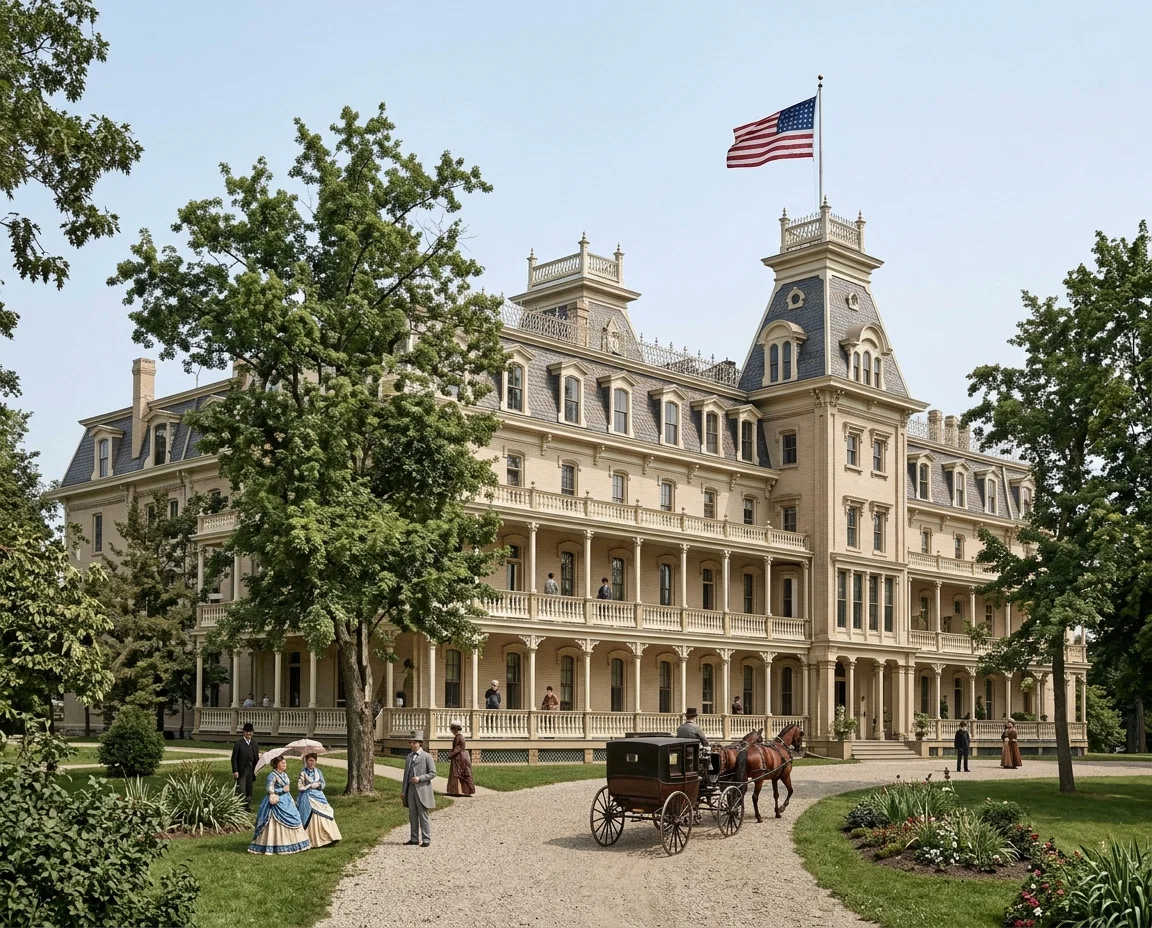
MEDICAL AND SURGICAL SANITARIUM,
By John Harvey Kellogg
Battle Creek, Michigan.
This institution, beautifully located in one of the most healthful cities of Michigan, is everywhere recognized as the
GREAT SANITARIUM OF THE WEST.
More than 4,000 patients successfully treated. The erection of new buildings and the addition of all the most approved remedial appliances known to the profession, have made it The Most Complete Institution of the Kind in America. All modern hotel conveniences furnished. Terms very reasonable.
J. H. KELLOGG, M. D., Medical Superintendent.
Address, SANITARIUM, Battle Creek, Mich.
GIVE THE BOYS TOOLS.
ALMOST all boys are naturally mechanics. The constructive and imitative faculties are developed, in part, at a very early age. All boys are not capable of being developed into good, practical, working mechanics, but most of them show their bent that way. There are a few cases in which the boy has no competent idea of the production of a fabricated result from inorganic material, but such cases are rare. Given the proper encouragement and the means, and many boys whose mechanical aptness is allowed to run to waste, or is diverted from its natural course, would become good workmen, useful, producing members of the industrial community. The mechanical boy ought to have a shop of his own. Let it be the attic, or an unused room, or a place in the barn or woodshed. Give him a place and tools. Let him have a good pocket-knife, gimlets, chisels, gouges, planes, cutting nippers, saws, a foot rule and material to work. Let the boy have a chance. If he is a mechanic it will come out, and he will do himself credit. If he fails, he is to follow some calling that does not demand mechanical skill.
HOME HAND-BOOK
-OF-
Domestic Hygiene and Rational Medicine.
THE MOST COMPLETE of any popular treatise on the subjects of ANATOMY and PHYSIOLOGY, HYGIENE and DOMESTIC MEDICAL PRACTICE.
Among the topics embraced in the Table of Contents may be mentioned the following, in addition to Anatomy and Physiology, and General Hygiene:—Hygiene of the Air, Ventilation, Hygiene of Food, Dietetics, Adulteration of Food, Examination of Drinking Water, Gymnastic Exercises, Swedish Movements, Remedies for Disease, Hydro-therapy, Miscellaneous Non-medicinal Remedies, Medicinal Remedies, Disease and its Treatment, and Diseases of Women and Children. THE WORK WILL BE ILLUSTRATED WITH OVER
Five Hundred Engravings, and Twenty Full-Page Colored Plates,
And will contain over ONE THOUSAND pages, royal octavo size. It will be bound in two styles—Muslin, $6.50; Sheep, $7.50. Agents wanted to sell this work by subscription. A good commission given. Orders for the book should be addressed,
PACIFIC PRESS, Oakland, Cal.
TEMPERANCE AND GOSPEL SONGS.
By J. E. White
By J. E. WHITE
BOTH the Words and Music are ENTIRELY NEW except a few choice selections of the most popular pieces. The Temperance music is not only new but varied, including ANTHEMS, GLEES AND QUARTETTES.
Price, in Board Covers, 30 Cts. Per Hundred, $25.
Sample pages free. Address,
J. E. WHITE, Battle Creek, Mich.
Or PACIFIC PRESS, Oakland, Cal.
HEALTH BOOKS IN PACKAGES.
By Editor
WE have just put up in packages three different assortments of our health and temperance works.
TEN CENT PACKAGE.
The smallest package, costing at retail 10 cents, contains 100 pages in eleven tracts as follows:—
Alcohol, What is it?
True Temperance.
Tobacco-Poisoning.
Tobacco-Using a Cause of Disease.
Tobacco-Using a Relic of Barbarism.
Evil Effects of Tea and Coffee.
Ten Arguments for Tea and Coffee Answered.
The Cause and Cure of Intemperance.
The Drunkard's Arguments Answered.
Alcoholic Medication.
Principles of Health Reform.
TWENTY-FIVE CENT PACKAGE.
The second package, costing 25 cents, contains 248 pages in eighteen tracts. In addition to the above eleven, it has the following seven which are larger:—
Wine and the Bible.
Alcoholic Poison.
Moral and Social Effects of Alcohol.
Pork; the Dangers of its Use.
Tea and Coffee.
Healthful Clothing.
Dyspepsia.
ONE DOLLAR PACKAGE.
The third package, costing $1.00, contains in addition to the above the following books and pamphlets:—
Diphtheria. Price, 25 cts.
Healthful Cookery. 25 cts.
Proper Diet for Man. 15 cts.
Uses of Water. 25 cts.
The object of arranging the above packages is to get them in more convenient form for sale, and for selection by those who do not exactly know what they need. Temperance workers who have not examined all of them, would do well to order a package at once.
Address, PACIFIC PRESS, Oakland, Cal.
DOES HER OWN WORK
“Does she? What of it? Is it any disgrace? Whose work should she do? Is she any less a true woman, less worthy of respect than she who sits in silk and satins, and is proud of fingers that never labor? We have listened to this sneer, and it betokens narrow, ignoble minds. Honorable work is one of the chief corner-stones of all civilization and refinement. It is the basis of all true society, true womanhood, and genuine nobility. The rank which a certain class are trying to establish—caste, whose sole foundation is money—is the meanest kind of rank known to civilization. Mind, manners, morals, all that enters into a good character, are of no account with these social snobs; position in their motley ranks is bought with gold, and each additional dollar is another round in the ladder by which elevation is gained.” By and by that ladder breaks down, and then the woman who sneers at the idea of doing her own work is glad to do work for others, rather than steal or starve. The Lord has ordained that people shall work, and so long as he rules the universe lazy folks are likely to have a hard time of it, whether clad in rags or robed in satin.—Exchange