Your ShelfYour Projects

Review and Herald, Vol. 89, No. 26.

He Knows

Review and Herald

Jun 27, 1912

Review and Herald Publishing Association · Takoma Park, Washington, D. C. · Jun 27, 1912

He Knows

HE knows the bitter, weary way; He knows the endless striving day by day; The souls that weep, the souls that pray, He knows.
He knows how hard the fight has been; The clouds that come our lives between, The wounds the world hath never seen, He knows.
He knows when faint and worn we sink; How deep the pain, how near the brink Of dark despair we pause and shrink, He knows.
He knows! O, thought so full of bliss! For though our joys on earth we miss, We still can bear it, feeling this, He knows. — Selected.

Rome and Marriage Number

Two editions of the "Rome and Marriage" number of the PROTESTANT MAGAZINE were quickly sold, hundreds of additional orders having to be refused. We gladly refer these customers to the "James Madison" and "Religious Garb" number of LIBERTY, which describes more of these "Rome and Marriage" cases (with illustrations) than did the PROTESTANT MAGAZINE, now out of print.

Special Religious Liberty Number

Send $1.00 for 20, or $2.00 for 50 copies of the "James Madison," "Rome and Marriage," "Religious Garb," and "Governor Foss Versus Cardinal O'Connell" number of LIBERTY. This might also be called a special "Religious Liberty in California" number. Other features: "Rome and Religious Liberty in Portugal," "Why the Jew Hates Christianity," and "Religious Liberty in Mexico."

A GOOD PROPOSITION FOR AGENTS!

PRICES: $1.00 a year, 10 cents a copy; 5 to 40 copies, 5 cents each; 50 or more copies, 4 cents each. Send 10 cents for sample copy. Better still, send $1.00 for 20, or $2.00 for 50. Discount to agents on yearly subscriptions.
A few of the following bound volumes are for sale: Vols. I and II (1909-10), in one, cloth covers only, each, $1.75; Vol. II (1910), paper covers only, each, 50 cents; Vol. III (1911), cloth, 90 cents, paper, 50 cents. All post-paid.
Cover Design in Two Colors

The "President's Letter" and "Vatican Influence" Number

Commencing with the next, or October number, this magazine will be issued every month. Price, $1.00 a year
America now faces a great Protestant revival. Bible Protestants everywhere are looking to this magazine for their weapons in this spiritual warfare.
A letter from Rome to the New York Sun, July 11, 1892, reveals the plan of the Papacy for America: "What the church has done in the past for others, SHE WILL NOW DO FOR THE UNITED STATES."

A FEW FEATURES

  • Double Frontispiece — Photographs of "The White House and the American Cardinals" and "Governor Taft's Mission to the Vatican."
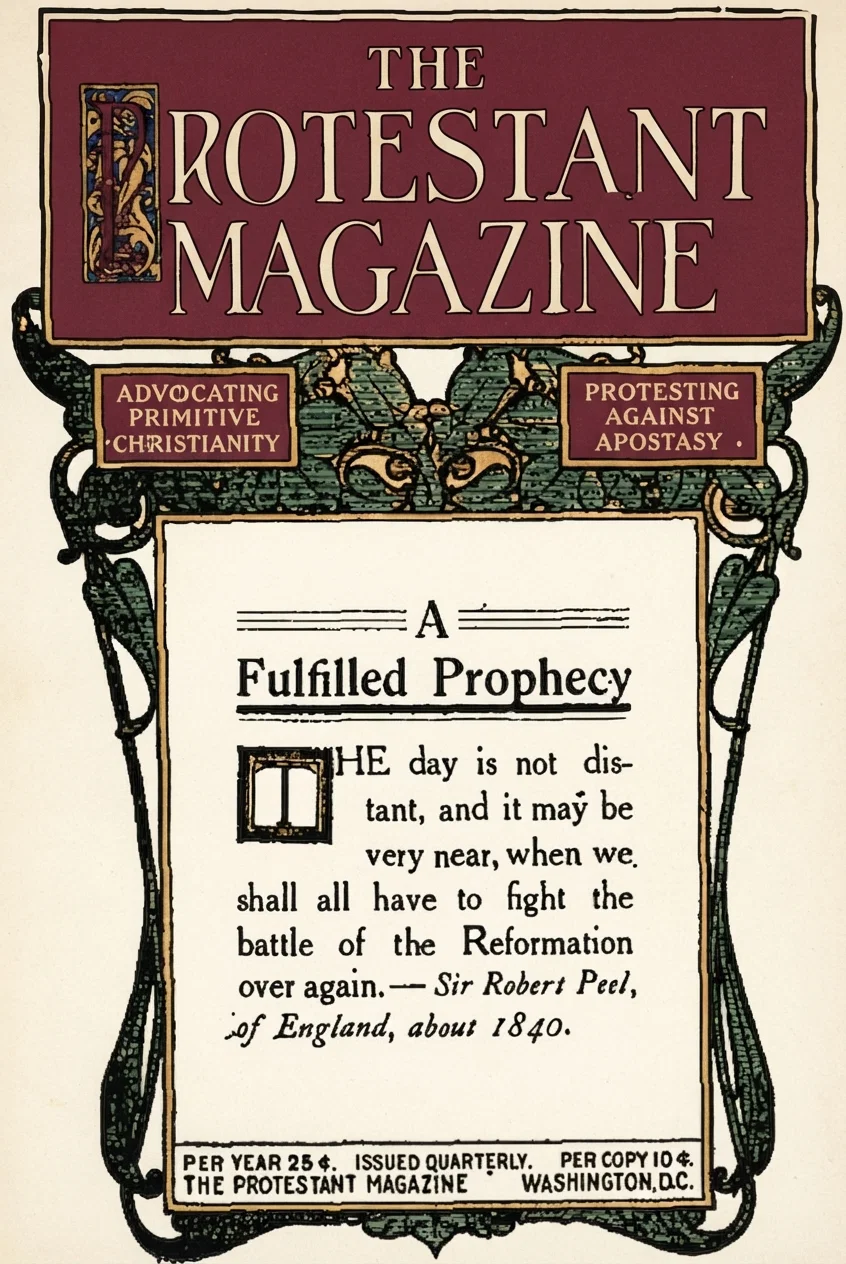
  • Sir Robert Peel's Prophecy Fulfilled (Cover).
  • President Taft's Letter.
  • The Mediation of Christ.
  • The Awakening of Protestantism.
  • Rome's Methods in Protestant Lands.
  • Rome's Growth and Power in Germany.
  • Trial and Self-Conviction of Leo XIII.
  • The Final Call Out of "Babylon."
  • Bishop Burt on the Reformation.
  • Singer on "The Future of the Papacy."
  • Catholic Population in Twenty-Five States.
  • Rome's Boast of Control of Massachusetts.
  • Rome and the American Flag, and Other Articles.

SPECIAL OFFER ON FIVE, ONE YEAR

Five copies, one year, to one address or to 5 separate addresses, only $3.00, or 60 cents each. Sender may include his own name. Or, send $1.50 for ten copies, six months. This number should be placed in the hands of every editor, attorney, clergyman, city and county official, and public-school teacher. We can furnish names and addresses.

ORDER THROUGH YOUR TRACT SOCIETY

If you do not know your Tract Society address, send to "The Protestant," Washington, D. C.

PRICES

EARN YOUR OWN SUBSCRIPTION
EARN YOUR OWN SUBSCRIPTION By sending us two new subscriptions at $1.00 each, you may earn your own yearly subscription.
Send $2.00 for 50 copies; sell 20 to get your money back; then sell or give away the other 30 copies in the interests of true health reform.

PRICES

$1.00 a year, 10 cents a copy; 5 to 40 copies, 5 cents each; 50 or more copies, 4 cents each.

The July Number

FEATURES: "Safe Fourth," "Headache Powders," "Inspected Meats," "Tuberculosis," "Vivisection," "Tobacco," and "Cure Frauds."

"SAFE AND SANE FOURTH" COVER, IN THREE COLORS

JUNE EDITION EXHAUSTED BEFORE JUNE 1
Seventy-five Articles, Well Illustrated.
A Practical, Beautiful, and Instructive Number.
Questions and Answers.—In this new and popular department the editor replies to questions asked by subscribers. SUBSCRIBE NOW. Send $3.00 for 5 years; $2.00 for 3 years; or $1.00 for one year.

A FEW ARTICLES

Frontispiece, "A Victim of the Fourth." Death to the Fly. What to do for That Headache. Lax Meat Inspection Worse Than Loss of "Titanic." Congressman Nelson on "U. S. Inspected and Passed" Meats. Fourth of July Casualties From 1903 to 1912. How to Cure Consumption. Consumption Cure Frauds Exposed (Illustrated). International Antituberculosis Congress. Is Vivisection Justifiable? A Model Fourth of July City Ordinance (Double-page Feature). Is Tobacco Injurious? School Records of Boys Who Smoke. Healthful Cookery. Relaxation and Sleep. On Reducing Fat. Questions and Answers (14 Questions Answered). Forty-six Other Important Articles and Items. Single Bound Volumes 1908-11, Half Leather Each, Post-paid, $1.75

Send All Orders Through Your Tract Society

If you don't know your Tract Society address, ask "Life and Health," Washington, D. C.

Rome Attacks the Sanctity of the Home

For photographic and other proofs of Rome's insult to America's marriage laws in Perth Amboy and Trenton, N. J., and elsewhere, see article "Rome Attacks the Sanctity of the Home" (with baptism certificates), in the current issue of LIBERTY.

The Training of Workers in the Field

MRS. E. G. WHITE
THERE has been a failure to call into exercise talent which should be employed, but which needs development and cultivation. We have had but few ministers and but few men to bear responsibilities, because we have had so few educators. We have lost much because we have not had those who were apt to teach, and who could conduct a training-school for the inexperienced, and press them into service.
The real workers in this cause are few, yet the work covers much ground; and it is often impossible for the laborers to look after the interest awakened. They fail to discern that they must enlist the lay members of the church, and teach them to work, that they may hold all that has been gained, and continue to advance. The plan of labor has been such as to lead the people to feel that they could do very little themselves, and if anything was to be accomplished they must have a minister.
Faith is the assent of man's understanding to God's words, and binds the heart to God's service. And whose is man's understanding, if it be not God's? Whose the heart, if it be not God's? To have faith is to render to God the intellect, the energy, that we have received from him; therefore, those who exercise faith do not themselves deserve any credit. Those who believe so firmly in a Heavenly Father that they can trust him with unlimited confidence, those who by faith can reach beyond the grave to the eternal realities, must pour forth to their Maker the confession, "All things come of thee, and of thine own have we given thee."
Every man, everything, is the property of the Lord. All that man receives from the bounty of heaven is still the Lord's. Whatever knowledge he has that in any way helps him to be an intelligent workman in God's cause is from the Lord, and should be imparted by him to his fellow men, in order that they, too, may become valuable workmen. He to whom God has entrusted unusual gifts should return to the Lord's storehouse that which he has received, by freely giving to others the benefit of his blessing. Thus God will be honored and glorified.
In all departments of the Lord's work, every laborer is to help his fellow laborer. The workers who have had many advantages are to take no credit to themselves, nor are they to think that they deserve praise for using in the service of Christ the talents that he has entrusted to them. They should realize that the non-employment of these capabilities would place upon them a burden of guilt, making them deserving of God's just displeasure and severest judgments.
Heaven-bestowed capabilities should not be made to serve selfish ends. Every energy, every endowment, is a talent that should contribute to God's glory by being used in his service. His gifts are to be put out to the exchangers, that he may receive his own with usury. The talents that fit a man for service are entrusted to him, not only that he may be an acceptable worker himself, but that he may also be enabled to teach others who in some respects are deficient.
If in their ministry those whom we teach develop an energy and an intelligence even superior to that which we possess, we should rejoice over the privilege of having a part in the work of training them. But there is danger that some in positions of responsibility as teachers and leaders will act as if talent and ability have been given to them only, and that they must do all the work in order to make sure that it is done right. They are liable to find fault with everything not originated by themselves. A great amount of talent is lost to the cause of God because many laborers, desiring to be first, are willing to lead, but never to follow.
To those upon whom God has bestowed many talents I am instructed to say:
Help the inexperienced; discourage them not. Take them into your confidence; give them fatherly counsel, teaching them as you would teach students in a school. Watch not for their mistakes, but recognize their undeveloped talent, and train them to make a right use of these powers. Instruct them with all patience, encouraging them to go forward and to do an important work. Instead of keeping them engaged in doing things of minor importance, give them an opportunity to obtain an experience by which they may develop into trustworthy workers. Much will thus be gained for the cause of God.
Those placed in positions of responsibility should seek to make others familiar with all parts of the work. This will reveal that they do not desire to be first, but that they are glad to have others become acquainted with details, and to become as efficient as they are. Those who faithfully fulfil their duty in this respect will, in time, have standing by their side a large number of intelligent workers; whereas, should they shape matters in accordance with narrow, selfish conceptions, they would stand alone.
Look for the conversion of a large number from the highways and the byways. Unexpected talent will be developed in those in the common walks of life. If men and women can have the message of truth brought to them, many who hear will receive it. Some who are regarded as uneducated will be called to the service of the Master, even as the humble, unlearned fishermen were called by the Saviour. Men will be called from the plow as was Elisha, and will take up the work that God has appointed them. They will begin to labor in simplicity and quietness, reading and explaining the Scriptures to others. Their simple efforts will be successful.
House-to-house work will be done by men and women who realize that they can labor for the Lord because he has put his Spirit upon them. As they go forth in humble faith, Christ will impart to them grace, which they will impart to others. The Lord will give them the same love for perishing souls that he gave to the disciples of old. Christ will be with these workers; angels of heaven will respond to the self-sacrificing efforts they put forth. By the power of the Holy Spirit, Jesus will move upon hearts. God will work miracles in the conversion of sinners, and the workers will be filled with joy as they see souls converted.There are men who will spend and be spent to win souls to Christ. In obedience to the great commission, many will go forth to work for the Master. Under the ministration of angels, common men will be moved upon by the Spirit of God and led to warn the people in the highways and byways. These workers are to be strengthened and encouraged, and as fast as possible prepared for labor, that success may crown their efforts. They harmonize with unseen, heavenly instrumentalities. They are workers together with God, and their brethren should wish them Godspeed and pray for them as they labor in Christ's name.
None who catch the divine rays from the Sun of Righteousness will lack for fitting words. It will not be oratory, as the world counts oratory, but heavenly eloquence; they will speak words that will go direct to minds, awakening conviction, and causing their hearers to ask, What is truth? Let men with the love of Jesus in their hearts go forth to give the invitation, "Take my yoke upon you, and learn of me; for I am meek and lowly in heart: and ye shall find rest unto your souls."
There are lay members who are fitted to bear responsibilities, and who would do so if there were some one with patience, kindness, and forbearance, who would teach them how to work. Ministers should show a real earnestness in helping such persons to succeed, and should put forth persevering effort to develop talent. The inexperienced are in need of wise generals who by prayer and personal effort will encourage and help them to become perfect in Christ Jesus. This is the work which every gospel minister should endeavor to do.
Men of varied talents and superior ability will unite with us in the work of giving the last message of mercy to a perishing world. My brethren, learn to recognize ability and talent in others besides yourselves. Be examples to the flock. Give to others the benefit of all the knowledge that the Lord has given to you. He has entrusted you with this knowledge that you may impart it. With the same liberality and freedom that the Master teaches you, teach others, binding them to your heart by love and tenderness.
A great work is to be done in America and other lands. The most important duty before those who have been sent out into the fields at home and abroad as missionaries, is to combine the forces and strength of all whom they can possibly enlist as helpers. Thus they can make mighty strokes for their Master. God will do a great work in every part of the field if, with willing hearts, his servants put self out of sight, and labor only for his glory.

The Sin-Offering

IN no other type was the individual worshiper brought in so close touch with the sanctuary as in the sin-offering. There is no other part of religious worship that brings the individual worshiper in such close touch with the Lord as confessing his sins at the Saviour's feet, knowing the strength of the promise, "If we confess our sins, he is faithful and just to forgive us our sins, and to cleanse us from all unrighteousness." It is then the sinner touches the hem of his Saviour's garment and receives his healing power in the soul.
Sin is a transgression of the law of God; and the one who had "done somewhat against any of the commandments of the Lord" was guilty of sin; and in order to be free from sin, he was to bring an offering, that by seeing the innocent victim die for his sins, he might more fully comprehend how the innocent Lamb of God could offer his life for the sins of the world. If he was a priest, filling that holy office where the influence of his wrong course would cause many others to stumble, then he was to bring a bullock, an expensive animal, as a sin-offering; but if the sinner was one of the common people, he could bring a kid or a lamb. The value of the animal required to be offered was determined by the position held by the transgressor.
The sin-offering was brought into the court of the sanctuary to the door of the tabernacle of the congregation. The sinner, with his hands laid upon the head of the lamb, confessed over it all his sins, and then with his own hand killed the offering. Sometimes the blood was taken into the first apartment of the sanctuary by the officiating priest, who dipped his fingers in the blood and sprinkled it before the Lord. The horns of the golden altar, the altar of incense, were also touched with the blood. The priest then came out into the court and poured all the blood at the base of the altar of burnt offering in the court.
The bodies of the animals whose blood was taken into the sanctuary were burned without the camp. "Wherefore Jesus also, that he might sanctify the people with his own blood, suffered without the gate." Heb. 13:12. The sinner, by confessing his sins over the lamb, in type and shadow transferred them to the lamb. The life of the lamb was then taken instead of the life of the sinner, typifying how the Lamb of God would offer his life for the sins of the world. The blood of the animal was powerless to remove sin; but by shedding its blood the penitent revealed his faith in the divine offering of the Son of God. Every sin-offering was to be without blemish, thus typifying the sacrifice of Christ.
In some offerings the blood was not taken into the sanctuary, but in every sin-offering all the blood was poured out at the base of the altar of burnt offering in the court. When the blood was not taken into the first apartment of the sanctuary, a portion of the flesh of the sin-offering was always eaten by the priest in the holy place, or first apartment of the sanctuary. This was a beautiful type. The priest who performed the work of the sanctuary, assimilated the flesh of the sin-offering,—it became a part of his own body,—thus beautifully typifying how Christ "bare our sins in his own body," and then entered the heavenly sanctuary with that same body to appear in the presence of God for us.
The priest ate the flesh of the sin-offering only when the blood was not taken within the sanctuary. The command in regard to this was very plain. "No sin-offering, whereof any of the blood is brought into the tabernacle of the congregation to reconcile withal in the holy place, shall be eaten: it shall be burned in the fire." Lev. 6:30. To violate this command would ignore the significance of the type. The priest's entering into the sanctuary to present the blood of the sin-offering before the Lord was a forcible symbol of Christ, who, by his own blood having obtained eternal redemption for us, entered into the heavenly sanctuary. Heb. 9:11, 12. By the blood and by the flesh the confessed sins of the sinner were in type and shadow transferred to the sanctuary. They were hidden from view, for no human eyes except the eyes of those who officiated as priests gazed within the sanctuary.The type was beautiful, but how much more beautiful the antitype! When the sinner lays his sins on Christ, "the Lamb of God, which taketh away the sin of the world," those sins are hidden, covered by the blood of Christ. They are all recorded in the books in heaven; but the blood of Christ covers them. If the penitent and forgiven sinner is faithful, his sins will never be revealed, but will be finally destroyed in the fires of the last day. The most wonderful part of it all is that God himself says he will cast them behind his back, and will remember them no more. Why need any one carry the burden of sins when we have such a wonderful Saviour waiting to receive them?
In every sin-offering two things were essential on the part of the sinner: First, to realize his own sinfulness before God, and prize pardon sufficiently to make a sacrifice to obtain it; second, by faith to see, beyond his offering, the Son of God, through whom he is to receive his pardon; "for it is not possible that the blood of bulls and of goats should take away sins." Heb. 10:4. The blood of Christ alone can atone for sin.
After the blood was presented before the Lord, there was yet an important work for the sinner to perform. With his own hands he was to remove all the fat from the different organs of the animal offered as a sin-offering, and give it to the priest, who burned it upon the brazen altar. At first thought, this seems a strange ceremony; but when we remember that the fat represented sin (Ps. 37:20; Isa. 43:23, 24), it has a beautiful significance. Evidently it was viewing this service in the sanctuary that saved David from backsliding. He had beheld the prosperity of the wicked, and was envious of them until his "steps had well-nigh slipped" (Ps. 73:2-18), but when he went into the sanctuary, then he understood the end of the wicked. We can imagine him watching the sinner separate the fat, and the priest place it upon the great altar. Presently nothing remains but ashes. In that ceremony he saw ashes as the end of all who would not separate from sin; for if the sin was a part of themselves when all sin was burned, they would be burned with the sin. The only reason God will ever destroy a sinner is because the sinner keeps sin in his own character, and will not separate from it.
It was a beautiful type, the priest standing waiting for the sinner to separate the fat from the offering, ready to take it any time he offered it to him. So Christ, our great High Priest, is waiting for each sinner to confess his sins and give them to him, that he in return may clothe the sinner with a robe of righteousness (Isa. 61:10), and consume his sins in the fires of the last day. Paul evidently refers to this part of the sanctuary service in Heb. 4:12.
The burning of the fat was "a sweet savor unto the Lord." There are few odors more disagreeable than that of burning fat, and yet "it is a sweet savor unto the Lord," for it typifies the sin consumed and the sinner saved. God takes no pleasure in the death of the wicked; but he delights in the destruction of sin separated from the sinner. When the redeemed of the Lord, from within the shelter of the New Jerusalem, behold the fires of the last day consuming all the sins they have committed, it will be indeed a sweet savor to them. Rev. 20:8, 9.
An individual that was too poor to offer a lamb for a sin-offering, could bring two pigeons. If he was so poor that he did not possess two pigeons, then he could catch two of the wild turtle-doves and offer them for a sin-offering; but if he was too feeble to capture the wild doves, the Lord made ample provision by allowing him to bring a small portion of fine flour, and the priest presented the crushed grain as a type of the broken body of the Saviour. Of this one's sin it was said, "It shall be forgiven him." He stands then in just the same relation to God as does the one who was able to bring a bullock. A handful of the flour was burned, corresponding to the burning of the fat, typifying the final destruction of sin; and the remainder was eaten by the priest; thus typifying the bearing of our sins by the Saviour.
In all sin-offerings where animals or birds were offered, the blood was all poured out at the base of the altar of burnt offering in the court of the sanctuary. When we remember how particular the Lord was that everything about the camp should be kept in a sanitary condition, we can see at a glance that to keep it thus, must have required much work; therefore the Lord would not have directed all the blood to be poured on the ground at the base of the altar if that act had not contained a very important lesson.
The first sin ever committed in the earth affected the earth as well as the sinner. The Lord said to Adam, "Cursed is the ground for thy sake." Gen. 3:17. When the first murder was committed, the Lord said to Cain, "Now art thou cursed from the earth." He also said that from that time the earth would not always yield her increase, there would be failure of crops and barrenness. The curse of sin rests heavier and heavier upon the earth. Isa. 24:5, 6. There is only one thing in all the universe of God that can remove this curse. "The land can not be cleansed of the blood that is shed therein but by the blood of him that shed it." Num. 35:33. It must be by one belonging to the human race, a member of the same family that shed the blood. Hence Christ took on himself human nature, became our elder brother, that he might remove the curse of sin from the earth as well as from the sinner. Christ purchased the earth by his death upon Calvary, and redeemed it as well as its inhabitants. Eph. 1:14. It is the sins of mankind that defile the earth. Therefore whenever an offering had been made for a sinner, the remainder of the blood was poured out on the ground at the base of the brazen altar in the court as a type of the precious blood of Christ, which would remove every taint of sin from this earth, and clothe it in Eden beauty.
"Behold the Lamb of God, which taketh away the sin of the world." John 1:29.
Type Antitype
Lev. 4:3, 23, 28. The animal to be without blemish. 1 Peter 1:9. Christ was "without blemish and without spot."
Lev. 4:4. The offering was to be brought before the Lord at the door of the sanctuary. Heb. 4:15, 16. "Let us therefore come boldly unto the throne of grace, that we may obtain mercy, and find grace to help in time of need."
Lev. 4:4. The sinner laid his hands on the head of the offering, thus acknowledging his sins. 1 John 1:9. "If we confess our sins, he is faithful and just to forgive us our sins."
Lev. 4:29. The sinner slew the sin-offering. Isa. 53:10. Christ's soul was made an offering for sin. Criminals often lived for days upon the cross; the sins of the world slew Christ.
Lev. 4:5-7, 17, 18. In some offerings the blood was taken into the sanctuary and sprinkled before the Lord. Heb. 9:12. "By his own blood he [Christ] entered in once into the holy place, having obtained eternal redemption for us."
Lev. 10:16-18. When the blood was not taken into the sanctuary, a portion of the flesh was eaten by the priest in the sanctuary; thus in type the priest bore "the iniquity of the congregation, to make atonement for them before the Lord." 1 Peter 2:24. This was a type of the One "who his own self bare our sins in his own body on the tree, that we, being dead to sins, should live unto righteousness: by whose stripes ye were healed."
Lev. 4:31; 7:30. The sinner with his own hands was to separate all the fat from the sin-offering, the fat typifying sin. Ps. 37:20. Isa. 1:16. We are not only to confess past sins, but we are to examine our own hearts and put away evil habits. "Cease to do evil."
Lev. 4:31. The fat is all burned to ashes in the court of the sanctuary. Mal. 4:1-3. All sin and sinners will be burned to ashes in the earth.
Lev. 4:7, 18, 25, 30, 34. The blood of every sin-offering was poured on the ground at the bottom of the brazen altar in the court. Eph. 1:14. Christ purchased the earth as well as the inhabitants by his death on the cross.
Portland, Maine.

Reunion of Christ's Family

THAT day is soon to come when, gathered home, God all his faithful, loving friends will see; In each dear, love-lit face, all sin o'er-come, Sweet proof of Christlike character will be!
First, there Immanuel, God's holy Son, Enthroned in glory, beautiful and bright, Well satisfied with fruits his love has won, Will comprehend the grand and joyful sight.
Myriads of angels, excellent in power, That true to Jesus stood when Satan fell, Exultant see the Saviour's worship-tower In company of souls they served so well.
Earth's ransomed ones, his saints, immortal now, Long-parted dear ones meet, love satisfied! Beauty and joy bright beaming from each brow,— O how they now bless Jesus glorified!
Each one is crowned Jehovah's loving son, No more to sin, no pain nor grief to feel; Each servant true will hear Christ's sweet "Well done!" So, brethren, woe is soon to end in weal!
Caney, Kans.

The Pure in Heart

It is only the pure in heart who may see God; then we must abhor sin and keep on abhorring it; we must not only be hearers of his word, but doers of his will. The active Christian is alone the happy one.—E. A. Elliott.

The Gold of Bible Truth

"THE truths of the Bible are like gold in the soil. Whole generations walk over it, and know not what treasures are hidden beneath. So centuries of men pass over the Scriptures, and know not what riches lie under the feet of their interpretation. Sometimes, when they discover them, they call them new truths. One might as well call gold, newly dug, new gold."

Jesus Enthroned in Glory

"JESUS, hail, enthroned in glory, There forever to abide; All the heavenly hosts adore thee, Seated at thy Father's side. There for sinners thou art pleading; There thou dost our place prepare; Ever for us interceding, Till in glory we appear."
Continue reading: Editorial