WHEN the Jews rejected the Word of life, Paul and Barnabas said, “Lo, we turn to the Gentiles. For so hath the Lord commanded us, saying, I have set thee to be a light of the Gentiles, that thou shouldest be for salvation unto the ends of the earth.”
This is quoted from the forty-ninth chapter of Isaiah. It is evident from the connection there, that Christ is directly referred to, and thus we learn that whatever is said to him applies equally to us. Christ is for salvation from God, to the ends of the earth; but as he is sent into the world, even so are we; and we are likewise set for salvation to the world. Whoever receives the Word of life, has it not merely for his own salvation, but for the salvation of others. We are saved by the life that is given, and the life is the light; but “none of us liveth to himself,” and so whoever is saved will necessarily be a savior of others.
It was necessary that this Word of salvation by the light of life should first be preached to the Jews, for in the portion of Scripture which Paul quoted it is written: “Thou art my servant, O Israel, in whom I will be glorified.” Christ is thus addressed as Israel, for he is God’s Son, even his firstborn; but he is “the firstborn among many brethren,” and therefore all believers are Israel. The lineal descendants of Abraham, Isaac, and Jacob had by virtue of the faithfulness of their fathers the right to lead out in the ministry of salvation; for God chose Israel, not merely for the purpose of saving them, but that they should be his salvation unto the ends of the earth. Of course in order to carry it to others they must have it themselves; but when they not only refused to carry the light of life to others, but were made angry when others ran to it and accepted it, they put it away from themselves.
From this we learn that no one can be saved alone. Whoever is saved must be a savior, not by virtue of what he does, but of what he is. He is saved by the life of Christ within him, and that life is light, and the light shines in the darkness and cannot be hid. Whenever anybody, in any nation or at any time, recognizes the light, and lays hold of the life, he is then “a light of the Gentiles,” to be the salvation of God to other men.
Do you think that you are too poor and weak and sinful and insignificant to be saved? Then think so no longer. Are you not alive? Do you not breathe? Is not the Spirit of God in your nostrils? Well, know that you breathe only the breath which Christ “breathes out.” There is no life except that which flows from his wounded side. The fact that you live is the assurance that God has already given you salvation. Your part is to believe, not in something that God will do, but in what he has already done; for Christ on the cross said, “It is finished.”
But this is not all. God’s salvation is so marvelously abundant that it reaches out far and wide. Like Jordan at the time of harvest, the river of life “overfloweth all his banks.” God speaks “to him whom man despiseth,” no matter what for, nor how justly; no matter how despicable he may be; “to him whom the nation abhorreth, to a servant of rulers,” even to the one who is trodden underfoot, and says: “In an acceptable time have I heard thee, and in a day of salvation have I helped thee; and I will preserve thee, and give thee for a covenant of the people, to establish the earth, to cause to inherit the desolate heritages; that thou mayest say to the prisoners, Go forth; to them that are in darkness, Show yourselves.” Isa. 49:7, 8. How can there be any question whether God can and will save you, when he has chosen you to be salvation to others? Is not this wonderful salvation? “Thanks be unto God for his unspeakable gift.” — Present Truth.
Eating for Strength
By John Harvey Kellogg
J. H. KELLOGG, M. D.
It requires a great deal of iron to construct a locomotive, but after it is finished, but little iron is required to keep it in repair; likewise, albumen is the food element necessary for the building up of the muscles; it is to the muscles just what the iron is to the locomotive. Therefore, food containing albumen is very necessary for the growing boy, but after the boy gets to be a man, and his muscles are developed, but little albumen is required to keep them intact. Iron is necessary to repair the locomotive, but the locomotive must also have fuel; and so starch, sugar, and fat are to the muscles what coal is to the locomotive, and are, therefore, necessary for muscular strength. The oxygen contained in the air which we breathe goes into the muscles and burns up our carbon in the form of sugar and fat, and makes muscular power. Thus it is necessary that the air which we breathe should be pure. Otherwise we become stupefied by the poisons which accumulate in the body, just as the fire in the locomotive is put out by the smoke from too much coal.
If too much starch, sugar, and fat are taken into the system, it may not hurt us to-day, but it will not be burned up, and by and by the body will be filled with poisons and unoxidized substances, and the vital processes of the body will be interfered with. But if too much albumen is eaten, exactly the same thing happens as if we should put some bolts, nuts, screws, iron bars, etc., into a locomotive for fuel,—the guards would be clogged, the draft lessened, the fire would go down, and the power of the locomotive would be lessened. So it is with the body. Meat cannot be oxidized perfectly, and so it is converted into uric acid. When too much albumen, in the form of peas and beans, nuts, meat, and other substances, is taken into the body, the result is that it cannot be perfectly burned; that means uric acid; and that means that the whole body is poisoned, the brain is irritated, and the foundation is laid for meningitis and locomotor ataxia and other similar maladies. These poisons permeate the whole body, and often produce neurasthenia. If they accumulate in the kidneys, we may get kidney stone; if in the bladder, then bladder stone is the result, thus making a surgical operation necessary.
Thus is shown the necessity of having the right kind of food and the proper amount,—in other words, the diet should be regulated by a daily ration. We have verified the daily ration by experiment. During a period of one month we had a hundred men and a hundred women making this experiment. They were weighed, and careful note was made of all they ate, and of all that was left over; a careful estimate for the entire month was taken, and we found the amount eaten to be almost exactly twenty-one ounces by a man and twenty ounces by a woman, in a day, the average being about twenty and one-half ounces a day. This was a daily ration of the different elements,—sixteen ounces of starch, three ounces of albumen, and an ounce and a half of fat. This is the normal daily ration. These persons were all in health and strength, and they increased in weight and strength on that dietary, thus showing that this is a sufficient dietary. The probability is that they ate more than was necessary; I have never eaten so much as that in a day.
It is not necessary to eat flesh in order to gain strength. Dr. Bayles, of Tokyo, Japan, traveled for two or three days by the aid of coolies, who had nothing but rice and beans to eat. He tried to persuade them to eat beefsteak, but they were satisfied with their simple fare, and wanted nothing more. The feeling of strength that comes from eating beefsteak is not real; the same sensation is experienced when one has been drinking beef tea or whisky. I once gave two young men two ounces of whisky, and I found that their total lifting capacity was fifty per cent less than it was before drinking the whisky. The reason we do not give meat to our patients is because it produces uric acid, and uric acid gives the sensation of weakness and fatigue.
A Mother's Reasoning
I miss the little laughing baby faces,
The loving eyes that always turned to me;
I miss the roguish ways and elfish graces
Of little forms that clustered at my knee,
Of rosy lips that left such happy kisses
Upon my ever-willing cheek and brow,
And, O! the thousand nameless joys and blisses
That once I had, but only dream of now!
And yet I know full well if Time could bear me
Back to the days of proud young motherhood,
I'd miss the gentle presence ever near me
Of those who as my grown-up babies stood.
To be without my boy's strong reassurance,
To be without my girl's sweet sympathy,
Would go beyond my heart's most firm endurance,
E'en though my babies clung again to me!
Well, mother-like, I miss the bonny tresses
That lay upon my breast in tangled curl;
Yet I would die to lose the love that blesses
My whole life, in my grown-up boy and girl.
— New Orleans Times-Democrat.
The Possibilities of Life
By Ellet Joseph Waggoner
E. J. WAGGONER
Moses did not commit suicide, neither did God kill him; yet he died in the full strength of manhood, with no trace of disease upon him. At the command of the Lord, because he had been unfaithful in a single instance, he laid his life down, just as he would compose himself to sleep. A single failure to acknowledge and honor God before the people, on the part of a man in the position of Moses, meant much more than a failure in duty would on the part of an ordinary person; and for that reason Moses could not be the complete type of Christ, by taking the children of Israel into the promised land. But God’s refusal to allow him to do this, and his command to Moses to die, was not an arbitrary punishment; it grew out of the very nature of the case. Moses had broken the connection,—had turned aside the stream of life from its proper channel,—and having denied it once, he was obliged to lay it down. It was but a temporary break; but the people had to learn that it is not a light thing to be out of harmony with God.
But let us from the case of Moses consider a little more closely some of the possibilities of life. God is no respecter of persons, and what he did for Moses we may be sure he will do for any who will use life as faithfully as Moses did. By using it faithfully I do not mean merely what is called “improving the time,” but recognizing God’s ways, and learning how he lives, so as to know how to conform to the laws of life. God “made known his ways unto Moses” (Ps. 103:7); and the same psalm that tells us this, tells us to bless his holy name, “and forget not all his benefits: who forgiveth all thine iniquities; who healeth all thy diseases; who redeemeth thy life from destruction; who crowneth thee with loving-kindness and tender mercies; who satisfieth thy mouth with good things; so that thy youth is renewed like the eagle’s.”
Note that it is when our mouth is satisfied with good things that our youth is renewed like the eagle’s. Thus it was with Moses. Others complained of the simple food that God gave them,—bread from heaven,—but Moses did not. How can people be so blind to the influence of diet upon their life, when they know full well that they live by eating? God told the Israelites in the beginning of their sojourning in the wilderness: “Ye shall serve the Lord your God, and he shall bless thy bread, and thy water; and I will take sickness away from the midst of thee.” Ex. 23:25. In Moses this was fulfilled, and so it might have been in all the rest.13
Do not misunderstand. The idea is not that the fountain of eternal youth is in eating and drinking. Far from it. But the truth intended to be conveyed is that God, “the fountain of living waters,” with whom is “the fountain of life,” is for that very reason the fountain of eternal youth, and that by learning his way of living, and adopting it,—living by perfect and intelligent faith in him, we can preserve in ourselves the youthfulness of the ancient days. Our food and drink come from God, and are the visible means of the communication of God’s life to us, but not the only means. By eating and drinking, as well as doing all other things, to the glory of God, we not only get fresh life from him, but we put no obstruction in the way of his life, and so by faith we get the “more abundant” life that is greater than all the visible things in the universe. To know God’s ways, should be the one study of mankind.
How to Take a Cold Bath Comfortably
No one who has experienced the delightfully refreshing effects of a cold bath, and who appreciates the value of the tonic influence of this bath when taken regularly, will be willing to forego his morning cold bath even if it does require some little fortitude. Nobody enjoys the first sensation produced by immersion in a tub full of water at a temperature of sixty or seventy degrees. One is strongly inclined to make his stay in the bath as short as possible, and thus may lose some of the good effect which might otherwise be obtained. When the bath is taken simply for the tonic effect, the momentary contact of cold water with the skin is quite sufficient; but when it is desired to obtain strong alterative effects,—that is, if one is suffering from obesity or diabetes, and wishes to encourage the combustion processes by which fat or sugar are burned up, and thus the disease combated,—the good effects obtained depend upon the duration of the bath. The longer one remains in the bath, the greater the effects produced, as the bath abstracts heat, and thus stimulates combustion. By constantly rubbing the surface while the skin is in contact with the cold water, vigorous circulation may be maintained, and the sensation of chilliness greatly lessened. The effect of the bath is also accelerated by bringing a large quantity of blood to the surface to be cooled. Cold contracts the vessels, while rubbing dilates them; thus the effect of the cold is antagonized by the rubbing, and the free circulation of blood is maintained at the surface.
The most disagreeable element of the cold bath is the intense impression made upon the temperature nerves when one first enters the bath. For many persons who are sensible to cold, the contact with cold water is not merely disagreeable, it is really distressing and painful, often giving rise to involuntary exclamations of distress. With persons who have strong powers of reaction this sensation quickly disappears, but with those in whom reaction is slow, most intensely disagreeable sensations continue during the whole period of the bath. There is no means by which the first impression of cold can be obviated; but by a very simple procedure the duration of this impression may be very greatly shortened. Here is the method:—
Draw into the bath tub the amount of water required for the bath, making the temperature from seventy to seventy-five degrees. Persons who are not accustomed to cold bathing may use a little higher temperature at first, say from eighty to eighty-five degrees. If a shower bath is available, let the bather now stand in the bath tub, having previously wet the head, face, and neck with the coldest water obtainable, and expose the whole surface of the body for six or eight seconds to a cold shower at a temperature of fifty or sixty degrees, or pipe-water temperature, whatever it may be. After this short cold shower, the bather at once submerges himself in the tub, and to his delight he will find that the water feels warm instead of cold. If the surface is a little cold, so that the contact with the cold water of the shower is dreaded, a very hot shower may be taken for fifteen or twenty seconds before the cold shower.
If the shower bath is not accessible, two pails of water should be prepared, one containing water at a temperature of from one hundred and four to one hundred and eight degrees, the other containing water as it runs from the cold-water faucet. While standing in the bath tub, first the hot water and then the cold water is poured over the body as quickly as possible. This will greatly lessen the discomfort of the cold bath.
A cold bath taken every morning is one of the best means of fortifying the body against the depressing effects of heat, and preventing the loss of appetite, which, with many persons, especially those whose employment is sedentary, is one of the inconveniences of the warm season. The loss of appetite must necessarily follow the loss of energy. This indeed is an indication of a lowering of the vital powers, and should not be regarded as a trivial circumstance. A cold bath taken immediately on rising, followed by a brisk walk of fifteen or twenty minutes in the early morning air, is a better means of inducing appetite and good digestion than any or all of the drugs known to materia medica. Try it if you have never done so, and you will certainly be pleased with the result.—Good Health.
What the Plodders Accomplish
If we were to examine a list of the men who have left their mark on the world, we should find that, as a rule, it is not composed of those who were brilliant in youth, or who gave great promise at the outset of their careers, but rather of the plodding young men who, if they have not dazzled by their brilliancy, have had the power of a day's work in them; who could stay by a task until it was done, and well done; who have had grit, persistence, common sense, and honesty.
It is the steady exercise of these ordinary, homely virtues, united with average ability, rather than a deceptive display of more showy qualities in youth, that enables a man to achieve greatly and honorably. So, if we were to attempt to make a forecast of the successful men of the future, we should not look for them among the ranks of the “smart” boys, those who think they “know it all,” and are anxious to win by a short route.—Success.
Short Horizons
It is a blessed secret, this of living by the day. Any one can carry his burden, however heavy, till nightfall. Any one can do his work, however hard, for one day. Any one can live sweetly, patiently, lovingly, and purely till the sun goes down. And this is all that life ever really means to us,—just one little day. Do to-day's duty, fight to-day's temptations, and do not weaken and distract yourself by looking forward to things you cannot see, and could not understand if you saw them. God gives nights to shut down the curtain of darkness on our little days. We cannot see beyond. Short horizons make life easier, and give us one of the blessed secrets of brave, true, holy living.—Christian Work.
The Grandmother's Place
SHE was a dear, white-haired old lady, the very ideal of a grandmother, and she sat by the fireside rocking slowly, but with a sad look on her gentle face.
“No, dearie, I’m not sick, but I do feel lonely sometimes.”
But why should she be lonely? She was in a family of well-bred young people—son and daughter, and grandchildren of various ages.
She loved the young people. She would have liked to join in their merriment; but they, in their thoughtlessness, never imagined that grandmother cared for such things, and so they sat talking over their plans, telling merry tales, but leaving grandmother out of the conversation altogether.
They were never unkind to her. She had the best room in the house. Her bodily comfort was attended to first, her wishes were immediately carried out. But she would gladly have given up all this to have had one of those bright-faced boys or girls for a companion. If they would only have sat down and told her some of their stories and plans, how glad she would have been; and she had pleasant stories to tell, too, if there was some one to listen and care.
But she sat by the fire with a shadow on her lovely old face, and said: “I am so lonely sometimes.” I wish they all could have heard it, and understood the pathos of it. It will not be long till grandmother’s chair will be vacant. She has spent her life in ministry for others. Common gratitude would demand that her last days should not be lonely and companionless. Love the grandmother; give her a place in your heart as well as your home, and make her closing hours her happiest.—Selected.
A Pioneer Trip in Japan
By F. W. FIELD
F. W. FIELD
As reported in the REVIEW of July 22, two of our Japanese workers, Brethren Kuniya and Matsukura, made quite an extended trip this summer, doing general missionary and colporteur work in the field.
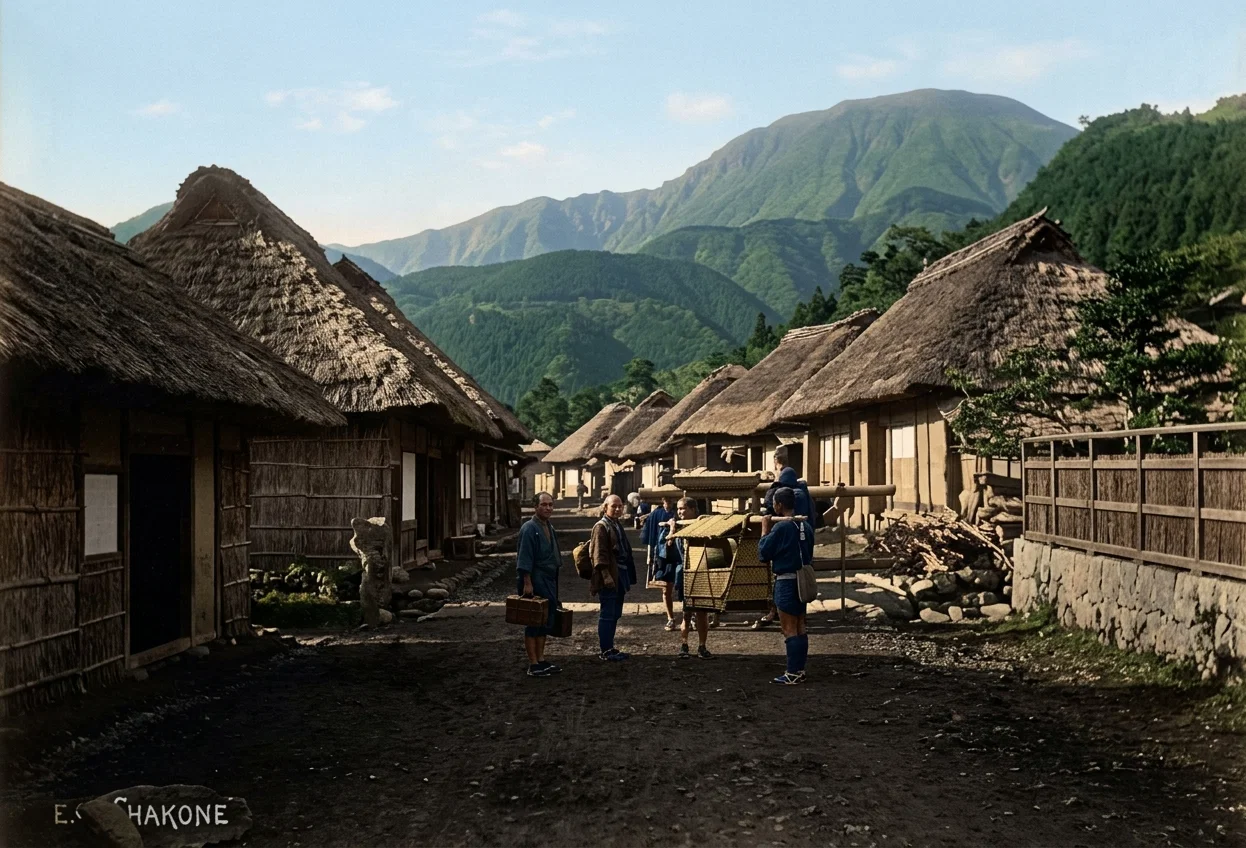
A VIEW IN JAPAN
They left Tokyo, May 14, with the colporteur wagon well stocked with papers, pamphlets, and Bibles. The first Sabbath was spent in Yokohama with a brother living there. Passing on to the southwest, they soon experienced much difficulty in drawing the wagon over the steep roads among the Hakone Mountains The accompanying cut gives a view among these mountains, and shows the method of transporting travelers over the roads where the jinrikisha could not go. The first range was finally passed without mishap; but other difficulties lay before them. At two different towns they were refused lodging. This will give some idea of the prejudice against Christianity in some parts of Japan. After hours of weary ascent and dangerous descent, in which the wagon was more than once overturned, they reached Mishima. Here they visited among the native Christians, some of whom received them kindly, while others seemed prejudiced.
As still more difficult roads lay before them, it was at last decided to return the wagon to Tokyo by express. From this time they carried what books they could on their backs, and fresh supplies were sent them from time to time. We have not abandoned the wagon, but still believe that it will serve a good purpose on short trips, and in more level country.
At the next town, they visited the native Methodist minister, who seemed much interested in their work. They were invited to preach in his church, and a good interest was shown. Here they were kindly entertained.
At Toyohashi they visited three churches, by invitation preaching in the Episcopal church on the second advent of Christ. Thus the way was opened for the sale of "His Glorious Appearing" during the three days they remained there.
At Nishio the Methodist minister was interested in the nature of man, and was thankful for the light received.
Nagoya is a city of some importance, and is a center for Christian work. Here our brethren remained eight days, preaching in the Episcopal church, and selling about fifty books.
At Owashi there are no Christians, and our workers were warned that much prejudice existed. No place seemed open for meetings, so a street meeting was held. Many people were attracted by the singing, and listened with good interest to the preaching. A place for meetings was soon found, and the work continued. Many confessed that their prejudice was unfounded, and heartily invited the workers to come again.
The last place visited was Kobe. From here Brother Kuniya was called home by the illness of a relative. Brother Matsukura remained several days, and had good success in selling "Steps to Christ" and "His Glorious Appearing."
Thus closed a campaign of over two months of hardship and earnest work. Hearts have been touched; and seed has been sown, which will doubtless bear fruit in its season. The brethren rejoice that they have the privilege of entering into the experience of the Lord in his work on earth.
Tokyo.
HENRY WILLIAMS
By Henry Williams
Hayti
HENRY WILLIAMS
‘The republic of Hayti lies in the western, or French, part of the island of the same name. The old Caribbean meaning of the word is “mountainous.” It was the second place which Columbus visited in America, and the site of the first European colony, which was called, in honor of the Spanish queen, Isabella. The first negro slaves were brought here in 1522. The native Indian population had dwindled from two million to twenty-one thousand in 1711, and it is doubtful if any of their descendants now exist. The French came in 1630, and grew so rapidly that their settlement was formed into an independent department in 1714. The Spaniards tried in vain to drive them from the island, and by the treaty of Ryswick, France held the western part of the island, but the boundary was not definitely fixed until 1777.
The free colored population demanded to be put on an equal footing with the whites in 1790, and organized an army to enforce their demands. The whites defeated them, and put their leader to death; but in 1791 the assembly granted the demand, and order was apparently restored. The same year, however, the slaves rose in insurrection, and the colony was rent by civil war. The Spaniards and the English interfered, and the French commissioners, in retaliation, declared all the population free and equal. They appointed Toussaint Louverture commander of the black army. The English and the Spanish were driven out, and by the treaty of Basel in 1795 the Spanish part of the island was ceded to France.
Louverture restored order and prosperity, but was treacherously captured and sent to Paris by order of Napoleon, who sent a fleet under General Leclerc to restore slavery to St. Domingo. The gallant captive died a prisoner soon after. Dessalines, who succeeded Louverture as leader, was also a vigorous and sagacious man. The French were compelled to give up their attempt, and capitulated to the English fleet, Jan. 1, 1804. St. Domingo declared itself a free and independent republic, and Dessalines was chosen governor for life. But October 8 he violated his oath, and proclaimed himself emperor of Hayti. He was assassinated in 1806. The eastern part of the island was given back to Spain, and the western portion, or Hayti, was left at the mercy of rival factions for several years.
In 1822 Boyer united the whole island in one government, and France acknowledged its independence in 1825. In 1842 Boyer was expelled, and the east set up a republic by itself, and Hayti was left to factional feuds. Soulouque was elected president of Hayti in 1847, assumed the title of emperor two years, and was deposed and exiled in 1858, when a republic was again established. Two presidents were expelled in turn, but the third, Nisage Saget, restored peace and order. General Salomon was elected in 1879 for seven years. He put down an attempted rebellion, and was15re-elected for seven years more, June 2, 1888. President Salomon expelled two of his generals, Manigat and Legitime. This was followed by a general uprising, and the president abdicated, and left the country for France, where he died. Then a rival contest between General Hyppolyte and General Legitime continued, in which the latter was brought into conflict with the United States, on account of the seizure of an American vessel, and the provisional president, Legitime, had to recede from his position, Aug. 22, 1889. He abandoned Hayti, and left his rival, Gen. Flovil Hyppolite, as president, who died suddenly in 1896. Gen. T. R. S. Sam was immediately elected to the presidency, on the thirty-first of March of the same year.
Up to the present time the republic of Hayti has been ruled by seventeen chiefs, of whom two were emperors, one king, and the rest presidents.
Cape Haytien, Hayti.
Mission Notes
AN Episcopalian, who does not wish his name mentioned, has given one hundred thousand dollars for a church building in Manila.
THERE are now at work, it is estimated, six hundred and eighty medical missionaries, and of this number two hundred and ten are women.
THE following brief note from a missionary in China, written to the editor of the Baptist Missionary Magazine, gives a faint idea of the present condition in China, and the need of entering that field now with a strong missionary force: “There is a tremendous movement on foot all over the country toward Christianity as represented by Protestants. Cities and towns and villages are calling for leaders. The great question of the hour is, ‘How can these mighty forces that are launching themselves out from the depths of heathenism into the current of the Christian faith, be marshaled for the Lord and his kingdom?’ The demand for Western learning is overwhelming. It is almost pathetic to see the hundreds and hundreds of students that are absolutely helpless—no one to help them but the missionary, and he is overcrowded with other duties that demand his attention. We cannot afford to evade this question, but must do something.” The magazine adds: “Men and brethren, these burdens should not be those of our missionaries alone; they are ours, they are our Lord’s. Let us begin in earnest to be religious co-laborers with him, and send the gospel to China.”
THE great scheme of the late Mr. Cecil Rhodes, the Cape to Cairo Railway, is being pushed forward with all possible celerity. The road has been surveyed as far as the Zambesi River, which is to be crossed by a great steel bridge, having one span of five hundred feet, at the Victoria Falls. The whole section from Buluwayo to the Zambesi, two hundred and seventy-five miles in length, is to be opened next year. Locomotives for contractors’ purposes are now running on it for a short distance north of the present terminus, and a railway exploration party has been dispatched over the railway route beyond Victoria Falls as far as Lake Tanganyika. For forty miles north of Buluwayo the embankment of track is more or less complete, bridging work on the Victoria Falls section is in progress, and about five miles of the line is finished. The work of connecting the Buluwayo and Salisbury sections is also progressing rapidly, and rails are already laid from Salisbury to Sebakwe, a distance of sixty miles. From the Buluwayo end of this line the railroad has reached the Arguza River, so that when this gap is filled and the line completed, as it is hoped that it will be by the end of the present year, trains will be able to run from Cape Town to Beira, via Buluwayo, Salisbury, and Umtala.
The Land of Dawn Beauty
By Mrs. S. Roxana Wince
THE “Land of Dawn Beauty” is a name sometimes applied to Korea, that little peninsula that lies west of the Japan Sea, about which China and Japan were fighting such a short time ago. The name seems most appropriate just now, for the dawn of a glorious morning has indeed come to Korea. The Bible has reached her shores, and its divine rays are illuminating the minds of her people. It is but sixteen years since the first missions were established there, and now the churches and communities where some knowledge of the holy Word exists, can be counted by the thousands.
The Koreans, from what C. C. Vinton, M. D., says in the Assembly Herald, seem to have practically no religious belief of their own “to be cast out before Christianity can enter.” And besides, unlike the Chinese, they are ready to welcome foreigners, and to adopt foreign customs as superior to their own. If to a village comes a Bible, or a New Testament, or a Christian book, or even a leaflet, or some native who has learned a little of the story of Jesus, the liveliest interest is at once awakened, a school of inquiry is started, and soon a little band is found meeting together for worship and study; and when a clearer knowledge is obtained, they send out messengers to carry the glad tidings of a Saviour’s love to other towns. It is marvelous. It is more like apostolic times, Mr. Vinton says, than anything the world has ever seen.
If a little community is not satisfied with what it can learn from the means at hand, it sends messengers to the missionaries, though they must travel on foot a weary journey of many days’ duration. If no one can go back with these messengers, they remain until the truth can be learned. If a man is found who can return and become their teacher, they obligate themselves to support and “to obey all his instructions.” Every Korean convert is expected to be able to tell the truth to others.
They do not wait for outside help or outside means. They build their own churches, support their own pastors,—where they have any,—and send out their own evangelists.—Mrs. S. Roxana Wince.
Perils and Progress in China
Perils, martyrdom, and opposition have proved but fire to the progress of the kingdom of Christ in China. It is noteworthy that new missionaries are presenting themselves for asking to be sent to China in all the boards.
Chinese Charity
The almost painful cleanliness in a Japanese house is a never-ending subject of comment by foreigners, and the heartiness with which the maids of all work rub and scrub and deluge with water every available bit of woodwork is a real revelation of the innate cleanliness of the “little brown man” and of all his belongings. The result of all this persistent cleaning, writes Commander Webster, U. S. N., in the National Geographical Magazine, is that throughout the empire not an evil smell or a filthy spot can be found.
With the Chinamen all this is almost completely reversed. A Chinese house is built in the most substantial manner, of stone or tiles. It is, in fact, according to a trite proverb, intended to last forever, and its condition, while neat, is not especially clean. The condition of the streets in a Chinese city literally staggers belief. The villainous smells rising from the nameless filth of a street in a populous city cannot be adequately described.
The charitable organizations among the dwellers in the Celestial Empire are the wonders of the Western observer. The altruism born of countless centuries of civilization finds expression in charity as comprehensive in its methods as it is universal in its expression. In China there is scarcely a type of misery, of poverty, of sickness, of distress, without its corresponding charity among the more fortunate classes.
Not only are the distressed and sick assisted, but the cooly, the laborer on the bund, the bearer of burdens, is the object of care and charity, and close beside the streets crowded with porters, “pole coolies,” and wheelbarrow carriers, huge earthenware jars of tea are set out, furnished with cups, for the use of those who have no season of rest save on completion of the task in hand. It is a pleasant sight to see the smile with which a well-dressed Chinaman will hand a cup of tea to his ragged, sweating brother, burdened almost to exhaustion and parched with thirst.
In these charities, as in all other things, the Chinaman is practical, and fine-spun theories give way to the actualities of every-day life.
In the eyes of the Chinaman the soldier is a man defiled with blood, and in the social scale the fighter finds a place in popular estimation with the butcher, the tanner, and the preparer of the dead for burial. It follows from this that the dependence of the empire for its defense is now, and has been for many centuries, the arts of the diplomat rather than the generalship of the soldier.
Redeeming the Time
By H. Bonar
The time is short—
If thou wouldst work for God, it must be now;
If thou wouldst win the garlands for thy brow,
Redeem the time.
I sometimes feel the thread of life is slender,
And soon with me the labor will be wrought;
Then grows my heart to other hearts more tender;
The time is short!
—H. Bonar.