At the hearing of the appealed case of Pastor Holser, of Basel, before the Federal Court,—the Swiss court of last resort,—the appeal was denied and the penalty of fine and imprisonment for Sunday labor in the publishing house under his charge, affixed by the Basel court, left in full force.
The factory law under which Pastor Holser was arrested and convicted is a federal law, and it appears that the Federal Court has no power to construe a federal law, or to decide upon its constitutionality or unconstitutionality. That rests alone with the body that made the law,—the Federal Council. Therefore the result which has been had was a foregone conclusion from the first, there being really no judicial body having authority to revise the decision of the Basel Police Court on the important questions involved in this case, and really no body with authority to open the case at all after its decision by the Police Court, short of the Federal Council which made the law under which the action was brought. Then, however, a wrong which had been done, as in this case, could not be righted. The only thing possible now is for the Federal Council to interpret or repeal the defective law, that no one else may suffer injustice from it. Clearly, therefore, in cases brought before it involving the constitutionality of federal laws—not only those in reference to Sunday labor in factories, but all federal laws—the Police Court is actually the court of last resort.
Nevertheless, the matter was given some attention by the federal judges. The sympathies of several of the judges were evidently with the appellant. At least one plainly saw the injustice worked by the law, and, had it been possible, would gladly have put himself on record on the side of justice. His voice was heard on the side of right, though he could do no more. There was a full bench, and all, except the president of the court, expressed their opinions and views on the subject, briefly.
Judge Blaesi, of Solothurn, to whom the case had been referred, presented the matter before the court, reading some extracts from the text of the appeal, and giving a synopsis of the remainder. He said that Pastor Holser was not convicted because he was an Adventist, but because he had transgressed the Sunday law. A previous case, decided last summer, had made a precedent, and, according to that case, the court must refuse to hear the appeal. The fact that there is a federal Sunday law shows that Sunday laws are permissible under the Swiss constitution, and so not contrary to its provisions. A clause in the very article 49, which Mr. Holser claimed the Sunday violated, could be used to condemn him, for it was there declared that "religious belief could not free anyone from the performance of civil duties." (This clause was quoted in the appeal, and it was there shown that the observance of a religious rest day was not a civil duty. But of that point the judge made no mention.) The judge then moved that the decision of the Basel Police Court be sustained.
Judge Cornaz, of Neufchatel, said that it could not be denied that the Sunday clause of the factory law rested on a religious basis. He argued that the State itself did not rest on Sunday, for it had its military exercises—more than that, much Sunday labor was performed by restaurants, stores, railways, etc., and hunting on Sunday was practiced in many cantons. In principle the Adventists were right, and were it possible to decide this case in their favor, that would be his vote. In view of the fact that all work does not cease on Sunday, that so much work is done, and that they are an orderly people, and in reality meet the intent of the law, the Basel police ought to have known how to have shut one eye in their case. He approved of the factory law in France, which left the rest day optional. But as it was not in the province of this court to remedy the case, the only recourse being to the Federal Council, he sustained the motion to reject the appeal.
Judge Bezzola, of Graubuenden, could not agree with Judge Cornaz that Sunday rest stood on a religious basis; its foundation was politico-social, its object being to secure the workingman a rest day.
The factory law designates Sunday because, as everybody rests on that day, it is better for the workingman that he should rest at the same time with all the others. We now have Sunday laws everywhere, and Sabbatarians must, "in God's name," accommodate themselves to the European social custom of resting on Sunday, according to the old saying:—
"Schick dich in die Welt hinein;
Denn dein Kopf ist viel zu klein
Dass die Welt sich schickt hinein."
(This triplet might be rendered thus: "Fit yourself into the world, for your head is much too small for the world to fit into it.")
In concluding he called attention to the fact that Sunday hunting was already forbidden in several cantons, and said there would yet be a federal law on the subject.
Judge Clausen, of canton Wallis, replied to the characterization of article 14 of the factory law as religious, by Judge Cornaz, saying that when the factory law was enacted both religious and politico-social factors were united, and he thought they could still continue to be united; that when the present state of the confederacy was considered, it must be admitted that the church still had something to say. It was not here as in some parts of France, yet even there they had to bow to the demands of Sunday.
Judge Stamm, of Schaffhausen, said that his reason for supporting the motion to reject the appeal was that the Federal Court could only follow unconditionally the letter of the federal laws, and it was not within its jurisdiction, however desirable it might be, to consider whether a law is constitutional or not, and the court has nothing to do with the question of the violation of article 49 of the constitution; it is sufficient for it to know that article 14 of the factory law has been violated.
Judge Morel, of St. Gallen, declared that it had never occurred to anyone to introduce a Sunday of the English or Puritan pattern into Switzerland; there was, therefore, no law or practice to show that there should be no Sunday work at all, but that the custom prevailed; that, as far as possible, there should be a common rest day. That which was of importance in this case, however, was that the appellant had violated the factory law, and in so doing had also violated the Sunday law of the Baselstadt, which was quite strict. He considered the sentence of the Basel court constitutional, and upheld its decision.
Judge Blaesi stated, in addition, that he would have dismissed the case from consideration entirely, for the reasons suggested by Judge Stamm, but he considered "the case one that should be more deeply probed, as it concerned important questions of freedom of conscience, which were set forth in a pamphlet recently circulated in large numbers in all parts of the land."
From the thoughts and views offered by the judges in the main, it can be seen that instead of probing the subject deeply the attention given it was so superficial as rather to deserve the name of scarifying than probing. It cannot be doubted, however, that when presented to the Federal Council the question will really be opened and its principles discussed.
The court rejected the appeal without a dissenting voice.
At this time Pastor Holser was making a circuit of the churches under his charge. When his appointments had been met he returned to his office in the publishing house at Basel, and to his regular duties there. He was there unmolested for five days, preaching on the Sabbath according to his usual custom, and going about the city in the pursuance of his ordinary duties. On the morning of the sixth day a notice was sent him from the police department requiring him to present himself at police headquarters, there being a clause in the order which stated that if voluntary compliance was not rendered the order would be enforced. To this order Pastor Holser replied in these words:—
To the Police Department, Basel—
Your order to present myself October 23, 9 A.M., to begin three weeks' imprisonment, is at hand. In response I can only say that I am engaged in the service of the Lord and cannot leave his work without his order. This imprisonment is prescribed in consequence of my keeping the commandments of God as he has given them in his word. In doing this I have wronged no one, and have done nothing worthy of imprisonment. Were it for having committed an unjust act, I would present myself on an order to do so; but I cannot lay down the work of the Lord at the command of men for the misdemeanor (?) of having kept the ten commandments.
Respectfully, HENRY P. HOLSER.
During the day the public collector called to collect the fine, but he was told very plainly and simply that a fine for keeping the commandments of God could not be paid.
And now comes the answer to the question before written, in the title to this article, "Will Switzerland imprison Pastor Holser?" Just as I write this closing paragraph Pastor Holser comes to the door, in the charge of two officers, for a parting word and shake of the hand before he goes behind the bars of the city prison of Basel. No amount of superficial leniency in the way of non-interference while his case went to the Court of Appeals and to the Federal Court, nor any degree of personal consideration shown him in the manner of his arrest, can be pleaded in extenuation. The fact remains, which cannot be explained away: Switzerland has imprisoned Pastor Holser for keeping the commandments of God.
Basel, October 23.
EVERY YEAR.
So THE purer life grows nigher every year,
And its morning star climbs higher every year;
And earth's hold on us grows slighter,
And the heavy burdens lighter,
And the dawn immortal brighter,
Every year.
—Selected.
PERIODICALS WANTED.
By Editor
Any of our periodicals are solicited for missionary work by the brethren at Dryad, Lewis County, Wash. Address, postpaid, Daniel Hollinger.
Late clean copies of the Signs and American Sentinel, also tracts, are solicited for missionary work by Permelia J. Campbell, Rocklin, Placer County, Cal. Send postpaid.
Back numbers of the Signs will be used in missionary work if sent postpaid to H. J. Eggers, Fairhaven, Wash.
Take the
"Sunset Limited"
THE NEW TRANSCONTINENTAL FLYER
—OF THE—
SOUTHERN PACIFIC COMPANY
—COMMENCING—
Thursday, Nov. 1, 1894
—AND—
Running Every Thursday Until Further Notice
—BETWEEN—
SAN FRANCISCO AND
79
HOURS NEW ORLEANS
—OVER THE POPULAR—
SUNSET ROUTE
The Favorite Route of America for Winter Travel
A SUPERBLY EQUIPPED
Solid Vestibuled Train
—CONSISTING OF—
Pullman Palace Double Drawing-room Sleeping Cars, Dining Cars and Composite Cars, with Buffet, Smoking-room, Bath-room and Barber Shop
BRILLIANTLY LIGHTED BY PINTSCH GAS
NO EXTRA CHARGE
All First-class Tickets, Local and Through, Honored for Passage. Sleeping Car Berths at Regular Rates
Dining Car Service Best Obtainable. Meals a la Carte
Immediate Connections at New Orleans with trains for Chicago, St. Louis, Cincinnati, Louisville and Memphis;
also, with LIMITED TRAINS of the
Piedmont + Air + Line
—FOR—
Atlanta, Charlotte, Danville, Washington, Philadelphia, New York, Boston and Other Eastern Points
THROUGH SCHEDULE:
Leave SAN FRANCISCO, 10:30 A. M. Thursday
" LOS ANGELES, 4:00 " Friday
Arrive EL PASO, 5:30 " Saturday
" NEW ORLEANS, 7:40 P. M. Sunday
" NEW YORK, 1:25 " Tuesday
Through Time to NEW YORK CITY . . . . 119 Hours
Passengers from Los Angeles will take Berths in Special Sleeping Car Thursday Evening
For Further Information, Inquire of any Agent of the
SOUTHERN PACIFIC COMPANY
RICHARD GRAY
Gen. Traffic Manager
T. H. GOODMAN
Gen. Pass Agent
NOTICE.—After November 13, 1894, my post office address will no longer be in care of Pacific Press Publishing Co., Oakland, Cal., but Bogota, U. S. of Columbia, South America, care of John T. Abbott, U. S. Minister. Postage on letters, 5 cents for each one-half ounce. Papers and other printed matter, 1 cent for each 2 ounces or fraction thereof. This must be fully prepaid.
TEACHER'S BIBLES
GENUINE OXFORD EDITIONS
From $1.25 to $20.00 in price. Send for price list.
PACIFIC PRESS PUBLISHING CO., . . . OAKLAND, CAL.
MAN'S NATURE AND DESTINY.—Assorted tract package No. 5. Six subjects or chapters in one; price, 10 cents. Address, Pacific Press, Oakland, Cal.
VEST POCKET MAPS.
. . UP TO DATE. . .
"They give all there is—
What more do you want?"
These Maps show all Counties, in seven colors, all Railroads, Post Offices (and many towns not given in the Postal Guide), all Rivers, Lakes, and Mountains, with Index and Population of Counties, Cities, and Towns.
INDEX OF COUNTIES AND TOWNS.—Printed on the back of the Map instead of in a cumbersome book, too big to carry. Places are indexed as located in the small squares made by the parallels and meridians.
POPULATIONS.—It does not pretend to give "official" returns where the Government does not; but it gives all official returns—no list can give more—and also private reports from the best local authorities, but marks them as unofficial.
THE ONLY INDEXED CITY MAPS.—The City Maps are in three colors, and upon the backs are printed Indexes to Streets, Railroads, Depots, Hotels, Prominent Institutions, etc. Something new and popular in the map line.
THE SIZE.—It is for the Vest Pocket, not the Coat Pocket, and weighs about one-half ounce, instead of four to eight ounces, as most other maps do. This is to be carried with you; these are only fit to be left at home. "A Map in the hand is worth an Encyclopedia in the bush."
PRINTED FROM TYPE.—Every word is printed from types specially selected for their heavy faces, and, therefore, though sometimes smaller, the names are more legible than on larger-surfaced Maps where no two letters are alike, because of being engraved by hand.
STYLE AND QUALITY.—Not bound in a homely manilla, but in a brilliant red, which will not fade, and made of imported cloth fiber stock, lined with cover paper in itself nearly as durable as the cheap covers of other maps. The Map is printed on Linen Map-Bond Paper, which is tough and durable, and can be folded and refolded, and will not wear out.
We can furnish any of the following postpaid at the prices given.
Special rates by the dozen to those who buy to sell again.
LIST AND PRICES
Of Indexed Vest Pocket Maps.
State Series. 44 Maps.
Alabama...15c | California, Nevada, Alaska, and Hawaiian Islands...25c
Arkansas...15c | Idaho, Montana, and Wyoming...20c
Colorado...15c | Kentucky...20c
Connecticut...15c | Maryland, Delaware, and District of Columbia...25c
Florida...25c | Massachusetts...20c
Georgia...25c | Mississippi...15c
Idaho...20c | North and South Carolina...25c
Illinois...20c | North Dakota...20c
Indiana...20c | New Mexico and Arizona...20c
Iowa...20c | Oregon and Washington...20c
Kansas...20c | Pennsylvania...20c
Louisiana...15c | Rhode Island...15c
Maine...15c | South Dakota...20c
Michigan...25c | Tennessee...20c
Minnesota...25c | Texas, Indian, and Oklahoma Ter's...25c
Missouri...25c | Vermont and New Hampshire...20c
Montana...20c | Washington...20c
Nebraska...20c | Wisconsin...20c
New Jersey...15c | Wyoming...20c
New York...25c
Ohio...20c
Utah...15c
Virginia...20c
West Virginia...15c
United States (in one map)...20c
Chief City Series.
Index to all Streets, Depots, Hotels, Theaters, Churches, Public Buildings, Parks, etc.
Boston...15c | Baltimore...15c
Buffalo...15c | Cincinnati...15c
Chicago...20c | Milwaukee...15c
Cleveland...15c | Minneapolis...15c
Detroit...15c | New Orleans...15c
New York...20c | Niagara Falls...15c
Pittsburg...15c | Philadelphia...20c
St. Louis...15c | San Francisco...15c
St. Paul...15c | Washington...15c
State Maps vary in size, being 11x17 inches, 13x21 inches, and 17x21 inches; but when folded they are vest pocket size, 2 3/4 x 5 1/4 inches; weight, 1/2 oz.
Mailed on receipt of price in stamps or coin.
Address, Pacific Press Publishing Co.,
OAKLAND, CAL.
International S. S. Lessons.
"So they read in the book in the law of God distinctly, and gave the sense, and caused them to understand the reading." —Neh. 8:8
LESSON IX.—SUNDAY, DECEMBER 2, 1894.
CHRIST'S TESTIMONY TO JOHN.
(NOTE.—The questions which follow are merely suggestive for the student on the leading points of the lesson; it is presumed that the thorough student will think of many more as he studies the subject. References, where verses alone are given, always refer to the lesson scripture printed above. All other references are given in book, chapter, and verse. The text printed is that of the Revised Version, not because it is especially preferred, but because it is not found in every family, as is the common version.)
24. AND when the messengers of John were departed, He began to say unto the multitudes concerning John, What went ye out into the wilderness to behold? a reed shaken with the wind?
25. But what went ye out to see? a man clothed in soft raiment? Behold, they which are gorgeously appareled, and live delicately, are in kings' courts.
26. But what went ye out to see? a prophet? Yea, I say unto you, and much more than a prophet.
27. This is he of whom it is written,
Behold, I send my messenger before thy face,
Who shall prepare thy way before thee.
28. I say unto you, Among them that are born of women there is none greater than John; yet he that is but little in the kingdom of God is greater than he.
29. And all the people when they heard, and the publicans, justified God, being baptized with the baptism of John.
30. But the Pharisees and the lawyers rejected for themselves the counsel of God, being not baptized of him.
31. Whereunto then shall I liken the men of this generation, and to what are they like?
32. They are like unto children that sit in the market place, and call one to another; which say, We piped unto you, and ye did not dance; we wailed, and ye did not weep.
33. For John the Baptist is come eating no bread nor drinking wine; and ye say, He hath a devil.
34. The Son of Man is come eating and drinking; and ye say, Behold, a gluttonous man, and a winebibber, a friend of publicans and sinners!
35. And wisdom is justified of all her children.
Golden Text: "Behold, I send my messenger before thy face." Luke 7:27.
NOTE.—A scripture which will throw light on this lesson, and should be read in connection with it, is Matt. 11:2-19. During the time when Jesus was teaching in Galilee John was in prison. This imprisonment seems to have brought discouragement to the bold prophet, even as to his prototype of old, Elijah. His life had been one of constant out-of-door exercise. Here he was confined in a damp and dreary dungeon, and no doubt this had much to do with his discouragement. His disciples came to him and told him of the work of Jesus. No doubt among these testimonies were those which were adverse; but John, to settle the question, sent two of his disciples to Jesus to ask him, "Art thou he that should come? or look we for another?" Jesus did not answer in so many words. He wrought many miracles while John's disciples were there, and he simply tells the two disciples to go and tell John the things they had seen and heard. Jesus of Nazareth was fulfilling the very prediction which had been given of the Messiah, and he, therefore, was the one foretold by the prophets.
When the messengers of John had departed, what questions did Jesus ask the people? Verses 24, 25.
What did he say of John's greatness? Verse 26.
Among all of the prophets, what had John the honor to be? Verse 27.
What comparison did Jesus make of John? Verse 28.
Yet what did he say of the least in the kingdom of God? Note 1.
What did Jesus say of the people and the publicans and their relation to John? Note 2.
What did he say of the Pharisees and lawyers? Verse 30.
What question did he ask concerning that generation? Verse 31.
What did he say they were like? Verse 32. Note 3.
What did they say of John the Baptist? Verse 33.
What did they say of Christ, of whom John bore witness? Verse 34.
What does Jesus say of the wisdom of God? Verse 35.
NOTES.
1. OUR Lord did not mean by this that the least in the kingdom of God, or he that is but little in the kingdom of God, was greater in the work that he did than was John the Baptist, but that his privileges were greater. He had just told us that among those that were born of women there was none greater than John. That is, none had a greater mission, and certainly we have no record that any showed more of the Spirit of the Master in the fulfillment of that mission than did the forerunner of Christ. He was great because he was the one who went before the "Royal Majesty of heaven" to prepare his way; and yet he died in prison before our Lord had finished his mission, and had very little privilege indeed of knowing of the power which attended Christ's ministry. Therefore, great as he was, his privileges were less than even the humblest disciple who stood at Christ's feet and drank in of his gracious words.
2. "They justified God, being baptized with the baptism of John."—God sends his messengers always to save men, and the fact that the publicans received John's message and were baptized, showed that John's message was sufficient to save them, and, therefore, their reception of that message was a justification of God in sending it as a judgment; for, if it saved one of the publicans, it would save all men, for a publican was a man; but the Pharisees and lawyers rejected the counsel of God for themselves. That is, the very thing which God designed should save them they rejected.
3. WHAT a striking contrast our Lord draws between the children of that generation and John the Baptist. He was not a reed shaken in the wind, nor one who lived in palaces. He was not one who could be moved by any of the temptations of Satan or by the desires and flatteries of the people. He was one who stood for God, let come what would; and, in fact, he gave his life for his mission to a people who were like children playing in the market place. One company calls to another, and they say, "We piped and ye did not dance; we mourned and ye did not weep." That is, they were dissatisfied and uncertain as regards any belief in God. They had not the spirit to discern his messengers. John came and they said that he had a devil, because he was temperate in his eating and drinking. Jesus ate and drank as did other men, and they said that he was a winebibber and a friend of publicans and sinners. Thus it has always been, and thus it is in these days, in an aggravated sense.
AND Pilate called together the chief priests and the rulers and the people, and said unto them,
Ye brought unto me this man, as one that perverteth the people; and behold, I, having examined him before you, found no fault in this man touching those things whereof ye accuse him;
No, nor yet Herod; for he sent him back unto us; and behold, nothing worthy of death hath been done by him.
I will therefore chastise him, and release him.
Now he must needs release unto them at the feast one prisoner a.
But they cried out all together, saying, Away with this man, and release unto us Barabbas;
One who for a certain insurrection made in the city, and for murder, was cast into prison.
And Pilate spake unto them again, desiring to release Jesus;
But they shouted, saying, Crucify, crucify him.
And he said unto them the third time, Why, what evil hath this man done? I have found no cause of death in him; I will therefore chastise him and release him.
But they were instant with loud voices, asking that he might be crucified. And their voices prevailed.
And Pilate gave sentence that what they asked for should be done.
And he released him that for insurrection and murder had been cast into prison, whom they asked for; but Jesus he delivered up to their will.
And when they led him away, they laid hold upon one Simon of Cyrene, coming from the country, and laid on him the cross, to bear it after Jesus.
And there followed him a great multitude of the people, and of women who bewailed and lamented him.
But Jesus turning unto them said, Daughters of Jerusalem, weep not for me, but weep for yourselves, and for your children.
For behold, the days are coming, in which they shall say, Blessed are the barren, and the wombs that never bare, and the breasts that never gave suck.
Then shall they begin to say to the mountains, Fall on us; and to the hills, Cover us.
For if they do these things in the green tree, what shall be done to the dry?
THIS portion of the book needs the most careful study, as the things related are of infinite importance. It is not vague, dreamy meditation that does us good. We are to meditate upon the sufferings of Christ for us; but this means more than that we are to think in a general way that he was betrayed and condemned and crucified. We should read and reread the story of his betrayal, his suffering in the garden, the reproaches that were heaped upon him, his crucifixion and resurrection, until every event becomes a living reality to us, and we can see him set forth evidently crucified among us. Then as, tracing the narrative through in our meditation, we see what it all meant, we may be able to say, "I am crucified with Christ; nevertheless I live; yet not I, but Christ liveth in me; and the life which I now live in the flesh I live by the faith of the Son of God, who loved me, and gave himself for me." Gal. 2:20. Nothing can give this vivid conception except the very words of the Scripture; therefore study them above all things. REVIEW, REVIEW, REVIEW. "Give thyself wholly to them."
When Jesus was seized, where was he first taken?
To whom was he next taken?
Before whom was he next sent?
What was next done with him?
What did Pilate do when Jesus was sent back to him?
What did he say to the priests and rulers?
What testimony did he bear concerning Jesus?
Yet what did he propose to do to him?
What did they all cry out at the proposal to release Jesus?
Whom did they desire to have released in his stead?
To Pilate's further proposal to release Jesus, what did they cry?
What effort did Pilate make the third time?
How was it received?
What did Pilate then do?
Whom did he release to them?
To what did he deliver Jesus?
Whom did they compel to bear his cross?
Who followed Jesus to the place of crucifixion?
What did Jesus say to them?
Why should they weep for themselves and their children, rather than for him?
NOTE.
THREE times Pilate bore witness to the innocence of Jesus, but as soon as he began to parley with the people, he lost all influence with them. When he gave sentence, it was that it should be "as they required." He simply delivered up Jesus to a mob, in order to save himself. If he had utterly refused to deliver Jesus to their will, he would, no doubt, have been accused to the emperor, and have been deposed, which was what actually took place, after all. Every man is to some extent in the same position that Pilate was. "What shall I do then with Jesus, which is called Christ?" is a question which comes to everyone. Selfish interest clamors that he be given up. If he be kept, loss of position, of business, or of friends, may be the result. And so too often Christ is delivered up, and in doing so, in order to save their life, they lose it, for he is the only one who can bestow life. There is no one who is in a position to condemn either Peter or Pilate. Our fear and selfishness have often caused us to deny Jesus, or to pursue a vacillating course that ended in defeat. And yet he abides faithful.
Arctic Expeditions
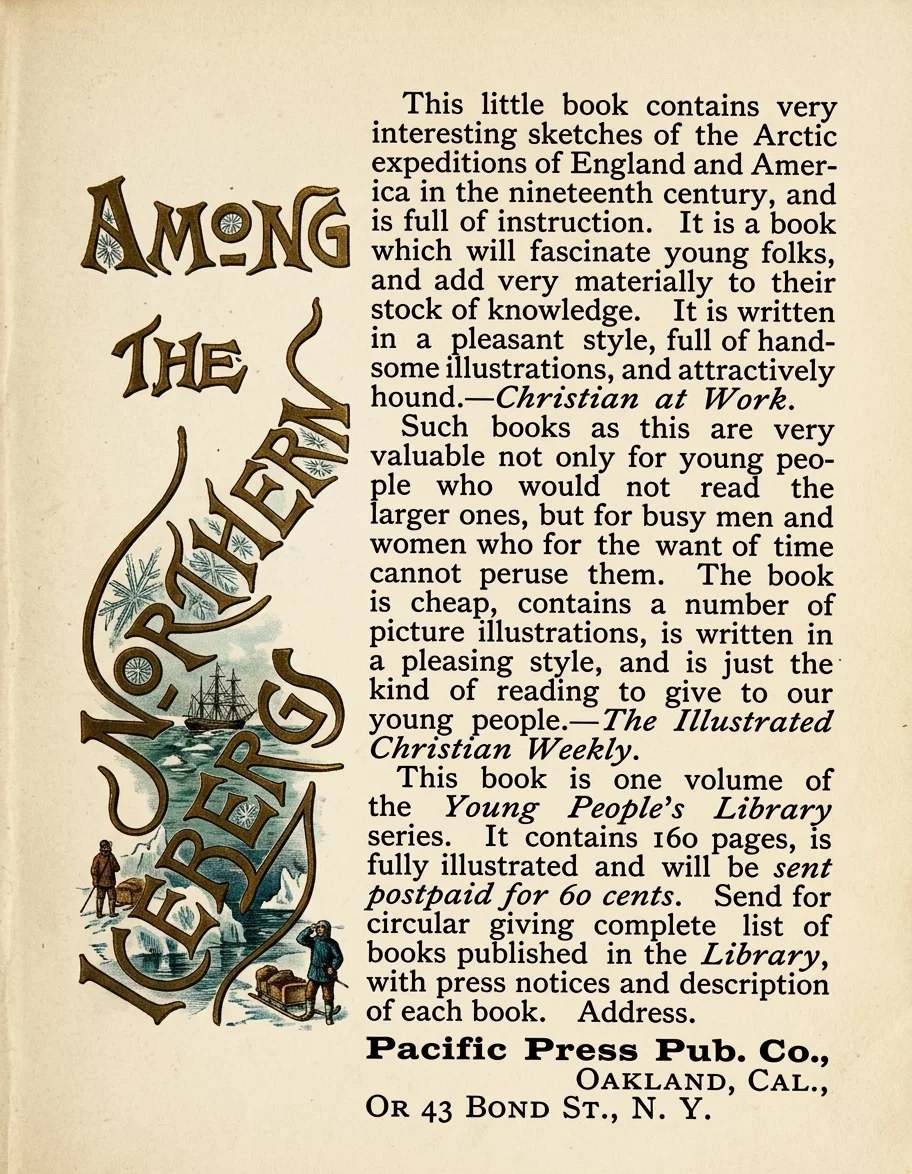
THIS little book contains very interesting sketches of the Arctic expeditions of England and America in the nineteenth century, and is full of instruction. It is a book which will fascinate young folks, and will very materially add to their stock of knowledge. It is written in a pleasant style, full of handsome illustrations, and attractively bound.—Christian at Work.
Such books as this are very valuable not only for young people who would not read the larger ones, but for busy men and women who for the want of time cannot peruse them. The book is cheap, contains a number of picture illustrations, is written in a pleasing style, and is just the kind of reading to give to our young people.—The Illustrated Christian Weekly.
This book is one volume of the Young People's Library series. It contains 260 pages, is fully illustrated, and will be sent postpaid for 60 cents. Send for circular giving complete list of books published in the Library, with press notices and description of each book. Address,
Pacific Press Pub. Co., Oakland, Cal., Or 43 Bond St., N. Y.