SOME twelve years ago, when the little daughter of the household was seated upon the horse block in front of our humble residence, a small dog came to her and jumped upon her lap. He was gaunt, and there were cruel marks upon his side; but his whole conduct seemed to intimate that he had been the pet of someone. At first she tried to drive him away, but he persisted in his loving demonstrations, until the good mother of the house was appealed to that he might be kept until some owner should appear.
He soon made himself at home, but his attachment for the little girl was apparently greater than for any other. The master of the house, in going to his daily business, would not allow the dog to follow him at all; but on Sunday mornings, when he was accustomed to go for his mail, he would permit the dog to accompany him. Hardly four months had elapsed when that dog seemed to have learned the days of the week, and, while he would never offer to accompany his master on any of the secular days, he was anxious and ready every Sunday morning for his trip to the post office. How did he keep the record? No bells had sounded up to the time we left; he simply knew it was his day.
He had been with us some three years when some miscreant poisoned some very valuable dogs in our immediate neighborhood. In discussing this event at our home one evening, I said I wished Jip would stay at home for a while, and not go off the premises. At the time of the discussion the dog was lying upon a rug, with his intelligent eyes wide open, and for over three weeks he neglected his trips to the post office. Believing that he had understood what had been said—and I did and do believe it—I said one morning at breakfast, "Now, Jip, don't you eat a piece of meat or anything else unless you get it at home." His little paws came up by way of acknowledgment, and I resolved to try him. Contrary to my rule, I took him with me, and at the butcher's shop I told the butcher to give him a little piece of raw meat. He was willing, of course, and, cutting a nice piece of beef, extended it to him, but the dog paid no more attention to it than if it had been a stone. Was that instinct or recollection? At any rate it showed understanding.
So for all these years he has seemed to improve in knowledge. He has been in the habit, in the evening, when the family were together, of sleeping upon a rug near the stove until bedtime, and when the family were ready to retire, he would be told to go to his bed, and would leave the room. In order to test his memory, as we sat around the table, I said, "We will see if he does understand that it is bedtime." The words had scarcely escaped me when he got up and started for his sleeping place. Did he not understand?
These isolated instances, and many others which might be given you, have convinced me that a dog, kindly treated (and who has had no different treatment), does really understand what is said to him, although it is not spoken in stern tones of command, and also that he listens to and appreciates what is said before him. I am no psychologist. I cannot account for these things. I only give them to you as they are. They show at least the power of kindness to make a friend even of a dog.—Our Animal Friends.
FAST TRAVELING.
The Lucania last Friday came into port at the close of a trip on which she averaged 21.81 knots an hour, the best previous record being her own, namely, 21.74 knots an hour. Her time for the trip was 5 days 7 hours 23 minutes, being 25 minutes less than the record. Two days before, J. S. Johnson rode a mile in Buffalo on a bicycle in 1 minute 35.4 seconds, which is 14 seconds less than the previous best bicycle record, and is one-tenth second less than the best record made by a running horse, Salvator holding that record. In fact, this speed on the bicycle has not been equaled by that attained in any other form of progression by man, except by a locomotive or perhaps an iceboat. The10fastest time by a locomotive was that made by 999, of the New York Central, last year—32 seconds. Next comes Johnson's bicycle record, a mile in 1:35.4. Then comes Salvator's running record of 1.35½. Then Robert J.'s pacing record of 2.01½. Then Alix's trotting record, 2.03¾. Then comes the record, probably, of one of the fast steam yachts, like the Vamoose or the Now-Then. Then the skating record, held by J. S. Johnson also, of 2.45¾. Thus in five different ways—by locomotive, by bicycle, by horse, by boat, by skates—man has succeeded in covering a mile in less than three minutes, and of covering it in three different ways in less than two minutes.—N. Y. Voice, November 1.
POISONING INSTEAD OF RESTING.
By Dr. C. W. Lyman
BY DR. C. W. LYMAN.
THE body when more or less exhausted can be whipped into smart action for a time by introducing certain stimuli, which excite at the same time that they exhaust the nerves—as long as the vitality of these nerves holds out in resistance to the noxious assailant.
These poisons—some of them carry other and deceptive names, being termed tonics and stimulants—are said to be refreshing, or to sustain or to expel fatigue. One of the most efficient of these, and reaching deepest in its havoc and ruin, is opium, now known pretty generally for what it really is. The alcoholics and tobacco are sufficiently understood by most persons of sense capable of observing effects in themselves or others. Tea and coffee are not so well appreciated in their true character. Coca, cocaine, and "the incomparable Vin Mariani," in which this drug masquerades, also various "tonics" containing wine, beef extracts, bitter vegetable extracts, and stimulant principles (including strychnine and quinine), also containing arsenic and iron—these preparations still address claims to the public as substitutes for rest and recuperation.
It is not possible that anything should be that. We must calculate for the long run, not for the short run and a virtual suicide. Stimulants taken when tired seem to strike at the very texture of the metal upon which the spring and tenacity of the bodily machine depends.
It is amazing what labor, strain, and vicissitude can fall harmlessly on a healthy body, if supplied with reasonable food and not poisoned. If a chance for recuperation is given soon enough, all is rapidly recovered. But stimuli kill the capacity for rest and ruin the repairing processes. They also create a special liability to the invasion of infectious diseases, such as cold, pneumonia, and typhoid fever, by lessening the resistance of the tissues. They hasten the appearance of every defect or weakness which an untapped vitality would otherwise be able to bridge over, if not fill in.—N. Y. Voice.
CORRECT BREATHING A CURE FOR CONSUMPTION.
It is a curious fact that consumption, the scourge of civilization, is not found within the Arctic or Antarctic circles. The women of those regions breathe zero air, which contains no dust and probably few consumption germs. It is probable, however, that their immunity from consumption is in large part due to the fact that their clothing is so constructed that it does not restrict the movements of the body in the slightest degree, and gives an opportunity for the freest activity of the chest in breathing.
One of the greatest advantages of a residence in an elevated climate is the increase of lung activity induced by the rarity of the air. Nearly the same advantages may be obtained by proper attention to lung gymnastics, or to exercises such as rowing, chopping, and other active exercises which induce the full activity of the respiratory organs.—Good Health.
Zeal Without Knowledge
ZEAL without knowledge is like haste to a man who is walking in the dark.—John Newton.
THE PILGRIM FATHERS OF ALASKA.
By Emma Hildreth Adams
I.
ONE day in 1851 a staunch English ship, called the Satellite, might have been seen plowing her way through the Strait of Juan de Fuca, toward Victoria, Vancouver Island, then a mere frontier village containing one hundred and fifty inhabitants, and important only as a post of the Hudson Bay Company. On the deck of the Satellite, as she passed to her moorings at the town, stood a young Englishman, a native of Yorkshire, not yet twenty-two, his alert eye taking in every feature of the infant city and the diversified landscape beyond it. To him Victoria was the beginning of the end of a six months' voyage, during which he had found plenty of time to reflect upon the object which had brought him to the American northwest coast.
If one may judge from his appearance today, the young man must have been of medium height, well built, with blue eyes, light hair, ruddy complexion, animated countenance, and a certain expression of features which denoted unflinching purpose.
Some time prior to that date the commander of an English war ship, sent out to protect national interests on the coast of British Columbia, became deeply impressed by the depraved condition of the natives in the vicinity of Fort Simpson. They were cannibals, men tortured by frightful beliefs in evil spirits. They were fiendish, cruel, abject, and as dangerous as men ever become. Returning to England, the compassionate captain laid their case before the Church Missionary Society of London. To some of the members of that society William Duncan was known, not only as a young man of rare good sense, but also as a soldier of the cross who was ready to do duty in perilous places. The condition of these most unfortunate beings was made known to him, and he was asked to undertake the hazardous task of carrying the gospel to them. Mr. Duncan assented, and in less than fourteen days was on the sea, westward bound.
Upon the arrival of the Satellite at Victoria, Sir James Douglas, then governor of British Columbia, courteously invited her captain and Mr. Duncan to his residence. Upon learning the object of his young guest's long voyage, Sir James strongly protested against its completion, asserting that only at the risk of the young man's life could he attempt to teach the barbarous Tsimpseans. Mr. Duncan was, however, not to be deterred by considerations so entirely personal. Perceiving this, the governor said no more, except to remark curtly, "The ferocious natives will certainly kill you."
Transportation to Fort Simpson was rather infrequent in that early day, and not until the 1st of October did Mr. Duncan find himself at that point. Fort Simpson, a trading post of the Hudson Bay Company, was then inclosed by a close stockade over thirty feet in height, defended by cannon at every corner, and guarded by twenty-two well-armed men. The commandant of the place was hardly more sanguine of the young man's success than was Sir James Douglas. Indeed, both he and his assistants assured him that "the heathen would surely make away with him."
"I was not long in perceiving," remarked Mr. Duncan to the writer, during a visit to New Metlakahtha, last July, "that a knowledge of their language was indispensable to my success with the wild Tsimpseans. As a first step, therefore, I devoted several months to acquiring their sweet-sounding tongue."
Meantime from the high gallery inside the stockade the young missionary studied, daily, the life and customs of the savage race, and, as words were gained, he made brief sorties to their quarters, to make their acquaintance.
At first Mr. Duncan was regarded by the Tsimpseans as a medical man of the white race, notwithstanding his youthful appearance seemed to render such a conclusion somewhat problematical, for their own shamen (medicine men) were all men of years, men of experience, before beginning the practice of their rude and weird art.
Step by step Mr. Duncan won the confidence of the untutored natives, and finally astounded the occupants of the fort by taking up his abode among them. This act awakened in the minds of his countrymen rather lively anticipations of a cannibal feast, at which the rash youth would hardly figure as a guest. So far from this being the case, a step scarcely less impressive soon followed. This was the actual reduction of the height of the stockade.
For months succeeding his change of abode the missionary's career was marked by various thrilling incidents. Some of these, related to the writer, will long be remembered for their exciting character. There were times when the benighted beings sought his life. On other occasions, in a frenzy of anger, they destroyed valuable property which had been accumulated especially for their benefit.
One intensely dark evening Mr. Duncan was hastening to the fort, after a day spent in their village, when he became aware that some person was following him. Instantly divining who was his pursuer and what was his purpose, and knowing him to be one of the most dangerous men of his tribe, Mr. Duncan realized that escape was impossible. He therefore stopped, awaited the man's approach, and addressed him in kindly terms, exhibiting no signs of fear.
The native, taken completely by surprise, appeared to relent, did nothing, and, after some gentle counsel from the missionary, turned and retraced his steps, as if impelled by an unseen power. If I am correct—I am writing from memory—the man afterward became one of Mr. Duncan's most faithful helpers.
It has been said that, during the interval which Mr. Duncan devoted to the study of their language, so hostile sometimes became the demonstrations of the natives that the strength of the fort had to be increased on all sides by strong barricades. Many times fires were extinguished by night, lest, aided by their light, the foe should pick off the occupants by firing between the palisades. At the fort unremitting watch was kept day and night.
For arms the natives possessed knives, swords, and rifles, which they sometimes flourished, to the dismay of the white men. A case somewhat in point is this: On one occasion a stalwart Tsimpsean urged his way within the stockade, and strode furiously about, brandishing his sword in the manner of a madman. His insolent march was soon cut short by the commandant, who, at an859opportune moment, sagaciously stepped behind him and threw over his shoulders a bright new blanket. Stopping quickly, the savage looked at it, grew pleased, remarked in Tsimpsean, "It is nice," and ceased his raging.
While dwelling within the fort, Mr. Duncan witnessed several revolting instances of cannibalism among the people. Whatever happened to be the occasion, slaves were always the victims. He asserts, however, that only their shamen actually partook of the flesh. Two objects were supposed to be gained thereby,—the favor and influence of their deities was secured, and their own personal strength and bravery were increased. He mentions the putting to death for such purposes of an infant boy, a young girl, and, if the writer mistake not, a woman of maturer years. At the ceremonies the Tsimpseans, naked, and excited to a condition of frenzy, danced about like crazed fiends, while the shamen were transformed into wild beasts by their desire for the coveted food.
Happily, to all such harrowing scenes there came an end. The horrors he witnessed but doubled Mr. Duncan's diligence in study, and the moment he could make himself understood, he began to tell the people the simple, effective story of Christ's life, teachings, and death. He arranged for them easy text-books in their own language, the structure, wealth and scope of which enable one to express therewith not only the profoundest truths of the Christian religion, but the richest thoughts of the human mind. Soon, then, the rude people were learning to read, to write, to think about truth, and to engage in steady occupations.
Sadly enough, not long was it before this gratifying condition of things aroused the antagonism of the Hudson Bay Company. The new ideas were seriously affecting its profitable trade with the natives. The company could no longer deal with them as with ignorant savages.
Having now been at Fort Simpson about five years, Mr. Duncan began to consider seriously the subject of removing his people beyond the deleterious influences of the post, and with them founding a new community, in which all who chose to break away from their old barbarous life might be built up into a civilized and Christian society. To this end the missionary selected a location covered with heavy forest and lying some twenty miles south of the fort. Here, immediately, he began preliminary work. The music of saw, ax, and hammer rang through the woods daily. With incredible speed the ground was cleared, and soon the town, now famous as Old Metlakahtha, began to arise on the spot. In 1862 Mr. Duncan removed thither, accompanied by as many Tsimpseans as chose to rally around his standard.
His outgoing to a better life was bitterly opposed, it has been said, by the officers of the fort, who refused the parties transportation for even the most urgent necessities. Nevertheless, there was no abandonment of purpose on Mr. Duncan's part, and in a few years there existed at Metlakahtha a prosperous, self-sustaining community of twelve hundred Tsimpseans and other natives gathered from thirteen surrounding tribes. In fine, Metlakahtha was an Arcadian village, wherein reigned good order, industry, peace, and contentment.
As speedily as possible provision was made for the varied wants of such an assemblage of improving people. A church, schoolhouse, and store were first erected. Then followed buildings for trades and industries, such as carpentry, weaving, cabinet work, soap making, brick making, salmon canning, sawing lumber, and others—all established through the enterprise of the indefatigable leader, through his talent for planning, and his remarkable genius for teaching, supplemented by the blessing of God, whom he delighted to serve and honor.
Mr. Duncan himself first acquired a knowledge of all these pursuits, and then instructed his people therein, until, unaided by him, they were able to conduct them successfully, and to maintain profitable trading relations with the surrounding country.
Upon becoming a resident of the place every adult was required to subscribe to the following
"DECLARATION."
I solemnly declare that, so long as I live at Metlakahtha, I adopt as my rule of faith the evangelical Christianity, which is based exclusively upon the teachings of the Bible. I also adopt the residents of Metlakahtha as my brethren. I choose to be governed by the laws of the queen of England, and I will dutifully submit to the by-laws imposed by the Native Council of the settlement.
I also declare that I will neither do, nor allow to be done by those under my control, anything by which the church at Metlakahtha would become divided, and its peace be disturbed, nor anything that is opposed to the welfare and good morals of the village. I will do my utmost to promote the temporal and spiritual prosperity of my home.
Each settler was also required to sign a card on which were recorded his name, the name of the tribe to which he belonged, and the date of his joining the settlement. This card furnished convenient reference when questions of priority or obligations to service sprung up.
Not many years elapsed before the condition of affairs at Metlakahtha attracted attention in England. Although a member of the Church of England, Mr. Duncan had from the beginning conducted religious services for his people with the simplest possible rites, discarding entirely sacerdotal vestments and the ritualistic forms of the church, deeming a simpler mode of worship better adapted to the child-like minds of the natives.
But to this course the church now objected, insisting that her prescribed forms should be employed. The missionary protested, as did the most devoted of his flock. Thereupon the church sent to them a clergyman to properly conduct the services. He presented himself one Sunday morning, clad in surplice and stole. But, being unable to speak the language of the worshipers, they by no means appeared to be edified. Noting this, the man wisely exchanged the pulpit for the pew, leaving the true pastor to speak to them of the truths by which they had been set free. A few similar unavailing attempts sufficed, and the little company in the wilderness was left to the guiding of the Chief Shepherd and their wise under leader.
Not long prior to, or after, this time—I have not the exact date—the Metlakahthans became seriously disaffected toward the Canadian Government. With their growth in other directions they had acquired not a little knowledge of civil affairs and some important ideas concerning ownership of property. This led them to desire titles to the land on which they were living. The government refused to grant this, for, according to the Indian Act of Canada, all such inhabitants were to be kept on reservations.
The application of the Metlakahthans for title was followed by certain negotiations which entirely failed. Thereupon, putting together the attempt of the church to interfere with their mode of worship, and the government's prohibition of their children's right of inheritance in British Columbia, they were moved to abandon their native land en masse, and to found new homes somewhere under the flag of the United States.
Twenty-five years had passed since the hegira of the Tsimpseans from Fort Simpson. In that time they had developed remarkably in civilization and character. Permanent dwellings had replaced the hasty shanties they first set up. Their public buildings were a credit to the thriving town. There were centered the industries by which they gained support. There they had acquired the ideas of civil and religious liberty now so precious to them. There their children had been born. There their dead were buried. From all these strong ties it was no light thing to break away and begin life anew in a foreign land. Yet this the Tsimpseans finally did, with the full approval, sympathy, and aid of their leader.
In looking around for a location on which to begin their new home building, choice was made of the island of Annette, anchored in the southern part of the Alexander Archipelago, some sixty miles north of the southern boundary line of Alaska. The important question was, "Would the Government of the United States secure the island to them?"
To assure themselves on this point, Mr. Duncan went to Washington and laid the case of his people before the proper authorities. The speedy result was a gift of the island to him and his followers forever, with permission to settle thereupon immediately. The presentation of the land was made during the first administration of President Cleveland; the patent therefor was, however, issued not until some two or three years afterward.
Returning from the East, Mr. Duncan proceeded directly to the island of Annette, where a small advance guard of the Metlakahthans had preceded him. An eyewitness has described the meeting between the devoted leader and his people as extremely affecting. Men, women, and children gathered round him, "weeping, while their hearts were full of joy and gladness."
A few weeks subsequently Mr. Duncan and this little party were reinforced by about eight hundred of their brethren and friends from Metlakahtha, forty canoes, laden with the people and their effects, arriving on one day, and seventy on the next. The length of the voyage was eighty miles. Time had now brought the August of 1887.
BEER DRINKING ABROAD.
GERMANY leads the list of beer-producing countries, according to the trade report for 1893, just published, with 1,202,132,074 gallons, an increase of over 34,000,000 gallons over 1892; 33½ gallons a head was the average for the empire, the product ranging from 62 gallons in Bavaria to 12 in Alsace-Lorraine. Great Britain was a good second, with 1,164,752,952 gallons of malt liquor, over 30 gallons a head. America (including South America) came next, with 1,084,433,460 gallons, 16 gallons a head. Then come Austria, with 385,257,168 gallons; Belgium, with 209,856,174; France, with 196,630,500 gallons; Russia, with 98,638,892 gallons; Denmark brewed 45,000,000 gallons; Holland, 33,000,000; Sweden, 28,333,333½; Switzerland, 28,666,666½ gallons. The other countries for which statistics are given all produced less than 29,000,000 gallons apiece. The total output of malt liquors in Europe and America was 4,500,000,000 gallons, in making which 7,270,000 tons of malt and 82,000 tons of hops were used.—Selected.
THE NEED OF ADVERSITY.
By John Greenleaf Whittier
The clouds which rise with thunder, slake
Our thirsty souls with rain;
The blow most dreadful falls to break
From off our limbs a chain;
And wrongs of man to man but make
The love of God more plain,
As through the shadowy lens of even
The eye looks farthest into heaven,
On gleams of star and depths of blue
The glaring sunshine never knew.
—J. G. Whittier.
The Son of Man Cometh
“In such an hour as ye think not the Son of Man cometh.”
Kindness to the Animal Kingdom
By Butterworth
Kindness to the animal kingdom is the first, or a first, principle in the growth of true philanthropy. Young Lincoln once waded across a half-frozen river to rescue a dog, and stopped in a walk with a statesman to put back a bird that had fallen out of its nest. Such a heart was trained to be a leader of men, and to be crucified for a cause. The conscience that runs to the call of an animal in distress is girding itself with power to do manly work in the world.—Butterworth.
LARGEST FLOWER IN THE WORLD.
The Rafflesia Arnoldi is a strange plant; it grows in Sumatra, and derives its name from Sir Stamford Raffles, governor of Sumatra at one time, and his friend, the naturalist Dr. Arnold. They were the first white men to discover this wonderful plant. It is said to be the largest and most magnificent flower in the world. It is composed of five roundish petals, each a foot across, and of a brick red color, covered with numerous irregular yellowish-white swellings; the petals surround a cup nearly a foot wide, the margin of which bears stamens. This cup is filled with a fleshy disc, the upper surface of which is everywhere covered with projections, like miniature cows' horns. The cup, when free from its contents, would hold about twelve pints of water. The flower weighs fifteen pounds; it is very thick, the petals being from three-quarters to an inch in thickness. With its beauty one is led to expect sweetness; but, alas! its odor is that of tainted beef; and Dr. Arnold supposed that even the flies were deceived by the smell and were depositing their eggs in the thick disc, taking it for a piece of carrion.—N. Y. World.
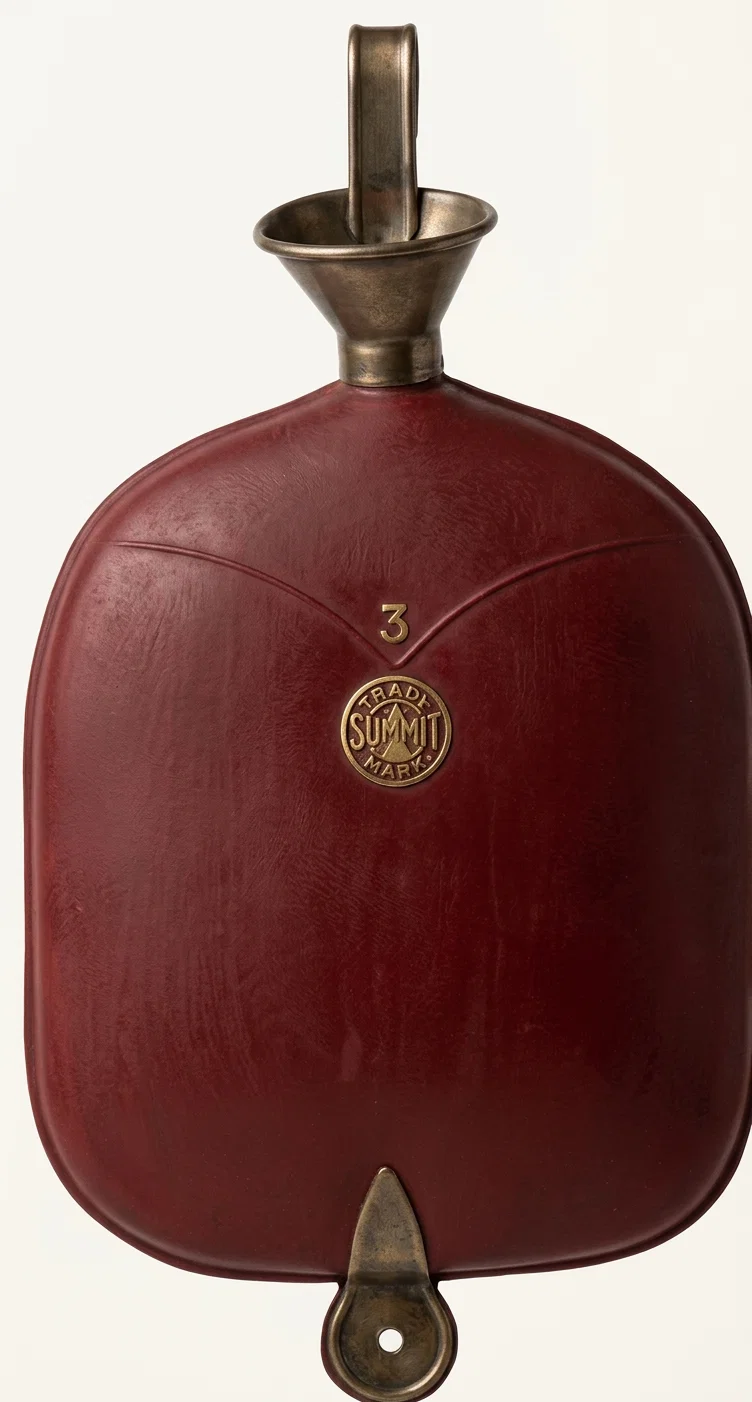
HOT WATER BOTTLES
These Bottles are made of the best material, and are strong and substantial.
THEY ARE INDISPENSABLE IN THE SICK ROOM
There are cheaper goods than these, but the cheap ones will not be found durable or satisfactory.
THE TALENTS. By M. C. Wilcox. A brief essay on "The Parable of the Talents," showing that the talents represent the various gifts of the Spirit which God bestows as he will upon those who are consecrated to him, with the duties and blessed privileges involved therein. Bible Students' Library, No. 77; 16 pp., price 2 cents.
DANISH AND SWEDISH EARLY WRITINGS.—Plain at $1.00, red edge at 1.25. For sale by the Pacific Press, Oakland, Cal. Please call the attention of the S. D. A. brethren and sisters of those nationalities to this book printed in their language.
FIELD NOTES.
THE Australian Conference is composed of 11 churches, having a membership of 781.
ELDER A. J. OSBORNE, president of the California S.S. Association, is visiting among the schools in Los Angeles County.
BROTHER W. H. THURSTON, a colporter, has found a favorable location in Rio Janeiro, but is in great need of Portuguese publications.
IN a certain territory in South Carolina, 18x22 miles in extent, Brother Charles Kellen has placed 260 copies of "Bible Readings." These books ought to give instruction to a large number of people.
ELDER W. T. KNOX reports the baptism of four persons at San Bernardino, Cal. From there he went to Pomona, where two were added to the church, and money was raised to purchase a lot for a house of worship.
ELDER H. F. COURTER arrived in this city from Selma, Cal., on the 6th inst. He reports the baptism of six persons at Selma. It is expected that he will remain in Oakland during the winter. Address, care of Pacific Press.
On the work in Mason City, W. Va., Brother F. M. Gardner says: "The people who are coming out to keep the Sabbath are among the best people of the town. These are the ones who have read, and it is not very hard to convince them of the truth."
DR. MAXSON, of the Rural Health Retreat, near St. Helena, Cal., says: "Our new building, including Swedish movement and class rooms, and five sleeping apartments for help, is nearly completed, and will be the means of sheltering some of our helpers who are now in tents." The new cottage erected last year has been of great utility, and still another is demanded by the increasing patronage.861
AT Portland, Oregon, a workers' class is being conducted, in which there are over fifty in attendance. Bible study, Christian help work, and hygienic cooking are the leading features of the school, and a large number of those who attend expect to devote themselves to work in the cause.
REFERRING to the work in the North Pacific Conference, Elder W. M. Healey notes the organization of a Sabbath school at Seattle, Wash., by Elder D. T. Fero. It is located several miles from the church in Seattle, and was the result of following up the camp meeting interest by earnest labor.
ELDER J. M. WILLOUGHBY reports the baptism of two persons at Salt Lake City, one of whom is over 80 years old and a pioneer of the Territory. He also states that Elder Gardner has located at Ogden for the winter, and, in connection with Elder J. H. Morrison, had been holding meetings in the country near that place.
AT Plano, Ill., where Elder J. W. Scoles continued meetings after the camp meeting, a Sabbath school of forty members was recently organized. The use of a hall for meetings was donated for one year. Elder Scoles and wife have gone to Battle Creek to attend the Bible school, and Elder W. D. Curtis continues the work at Plano.
FROM the Review we learn that the charges against Brethren A. J. Howard and H. O. Bullen, of laboring on Sunday, have been dismissed by the Circuit Court of Annapolis, Md., on the ground that the complaints were too indefinite. Also that Brother D. C. Plumb, a student in the academy at Graysville, Tenn., has been sentenced to twenty-seven days' imprisonment for cutting wood on Sunday; and that a brother named E. W. Remminger is under arrest in Pennsylvania on a like charge.
FROM a private letter from Elder W. C. Grainger, who is laboring in the vicinity of Crow's Landing, in Stanislaus County, Cal., we learn that there is a good interest manifested in the reading matter distributed, but many are kept away from preaching services through the influence of opposition. This is an obstacle that will grow as time passes. With all the boasted independence of our countrymen, the majority of people are actually afraid to brook the opposition that comes to those who would adhere to the plain word of God. And, strange as it may seem, the bitterest opposition in this respect comes from those who profess to be followers of Christ. In the days of Christ and his apostles the most persistent persecution came from those who claimed to be the conservators of God's word. Yet those who would stand by that word in preference to the traditions of the elders, met the enmity of the elders, and in consequence many feared to follow their own convictions of duty. It is so to-day; the traditions of the popular churches are held up in lieu of the word of God, and anathema and contumely deter many from laying hold of the truth. It is as much of a cross to follow Christ to-day, in the face of apostate churches and the jeers of a sinful world, as it ever was. The truth never was and never will be popular; and all who will receive it will do so through the ordeal of persecution.