Many well-meaning people think that striking the Sunday saloon is a great stroke of temperance policy. But a great deal of earnest energy is wasted in such a crusade, because it is based on a false theory. It supposes that a bad thing is worse on Sunday than it is on any other day; and this is what leads multitudes of people to think that they can violate the law of God in ordinary life six days in the week and atone for it by a formal cessation of activity on Sunday. And the majority of religious people (Sunday observers) act as if they accepted the atonement. This principle operates in every other line of secular life as well as in the saloon business; and it is at the bottom of every law designed to enforce any degree of Sunday observance.
There is no such thing as temperance in sin; for sin is sin, wherever and whenever committed. Saloon-keeping is a sin, for the Lord has pronounced a wo against it. Hab. 2:15. Then the special appeal to have it stopped on Sunday, is a logical concession that it is legitimate on the other six days of the week, and is a practical indulgence to the rumseller to sin on all days except Sunday.
The saloon is uncivil, a menace to the good order and safety of the community. It is a constant allurement from a state of sobriety to a condition that incites crime. It is the direct cause of more than three-fourths of all the expense of the police force and the police court. As a source of public revenue, it costs, directly and indirectly, many times more than it contributes. The revenue of iniquity is as much a curse to the municipality as it is to the individual. “Wo to him that buildeth a town with blood, and establisheth a city by iniquity.”
When the saloons are closed on Sunday, the crusade against them as a general evil is apt to stop. Then the saloon-keepers, in their imputed virtue (the real revenge), set up a crusade against the marts of legitimate business, and the temperance effort is turned into a campaign for enforced Sunday observance. The advocates of mere Sunday closing of the saloon have the cart before the horse. If they will labor to annihilate the institution altogether, the Sunday saloon will fall with the rest. Prohibition—not regulation by legal acknowledgement of respectability—is the only consistent warfare against the saloon evil. To compromise with sin is sin; to make terms with incivility is uncivil. Why do otherwise good temperance workers propose compromises with that which is evil and only evil? G.
THE COMING CONFLICT.
By Robert Hare
[Robert Hare, in Australasian Signs of the Times.]
A CABLE despatch from London, October 17, says:—
Mr. Herbert Spencer, the veteran evolutionist philosopher, predicts that the financial tyranny of the trusts will result in a civil war, accompanied by immense bloodshed, and eventually in the establishment of a severe military despotism.
Many of Spencer’s theories may be mere guesswork, but his prediction respecting the result of the great trust struggle is not far from truth. Similar predictions were made by Bible writers centuries ago, but, strange to relate, these prophecies have not been noticed by many of the world’s great scholars. Spencer looks at the converging lines of greed and selfishness and predicts certain results; but the humblest Bible student in the world can know the same thing from the “more sure Word of prophecy.”
James speaks of the time when the rich men shall “weep and howl,” for the miseries that shall come because of the heaping up of their rusting treasures wrung from the labors of their unpaid and underpaid servants. James 5:1–7.
Amos speaks of the financial powers as selling the poor for a pair of shoes, and of hunting after the very dust upon the heads of the poor. Amos 2:6–8.
Habakkuk gives a vivid picture of the financial struggle that will end in the great uncivil war of the last days, in which the treasures of the rich and great are to become booties (spoils) to the lawless and the needy. Hab. 2:1–13.
PROGRESS OF TEMPERANCE IN SOUTH.
LOCAL option, or country prohibition, has made great gains in the Southern States. It is surprising, as it is gratifying, to read that in Kentucky, the great whisky State, 47 counties now have total prohibition, 54 have partial prohibition, and only 18 have license. In Texas more than half the counties have prohibition; in Texas liquor can be sold legally in only 12 of the 96 counties; in Arkansas 44 of the 71 counties have undertaken to prohibit the sale of liquor by the local option plan; in Mississippi 65 of the 75 counties have total prohibition, and in Georgia 103 counties out of 137.
This encouraging state of affairs, taken in connection with the aggressive temperance work carried on throughout the country, explains why the brewers and liquor dealers in their recent conventions have expressed great alarm and have set aside large sums of money for literature to show the American people the folly of local and national prohibition.
We ought to work for a good cause whether the outlook for success is bright or not; but it certainly is easier to work when we see that something is actually being accomplished.
It is pleasant to know that in the Northwestern States the Scandinavians are foremost in temperance work. There is not much shouting about their methods, but they are a people who, when convinced that a cause is just, buckle down to solid, steady, continuous work; and that's what counts in the long run.—Northland Weekly.
Where the Loss Fell Heavier.
—From the Springfield, Mass., Republican we take this significant item:—
The strike of textile workers in Philadelphia, which began in June, has ended in failure, and with losses estimated at $12,000,000 for the employers and $8,000,000 for the employees. Of the 112,000 men who went out, all have gone back save about 1,000. The business of the mills affected for the fall and winter trade has been injured greatly, and thus the effects of the strike will continue to be felt for some time. Another consequence to the employees has been the incentive given to the devising or introduction of new labor-saving machinery, which has been successful in two or three operations—particularly the cotton-mercerizing process, where the new machines each displace five or six skilled men. Whatever gain grew out of the strike went elsewhere than to the strikers.
Canal Improvements and Recent Disasters
New York State has decided to expend $100,000,000 in the work of improving the Erie Canal and other artificial waterways in the State. This move is said to be due to the high price charged by the railroads for the transportation of grain.
Casualties.—Since the 13th of October the following notable disasters have occurred: The American whaler, Joseph Manta, was wrecked in the Azores on October 13, and her entire crew of 15 men was lost. The steamer On Hing capsized on the Lai Chow River, in South China, and more than 100 persons were drowned. Fifteen persons were killed and 40 injured in a railway collision on the Pennsylvania Railroad in New Jersey on October 17. About 350 lives were lost and many persons were injured in an earthquake recently at Turshez, Persia. Thirteen villages were destroyed, and 5,000 persons were left homeless. The ship Milton Park is reported lost with her crew of 24 men. The French bark Savoyard was wrecked near Brest, France, on October 27, carrying down 39 persons. Two steamers, a Russian and a Japanese, collided in a fog off the Japanese coast on October 29, and 44 persons are reported lost. Fifteen persons were killed and over fifty injured in a railway collision at Indianapolis, Indiana, on October 31. Twenty-five persons lost their lives in a tenement-house fire in New York on November 1. Eight miners lost their lives in a mine fire at Virginia City, Montana, on November 6.
France is viewing with alarm the decrease of 34,000 in the number of recruits for the army for the present year. Therefore an extra parliamentary commission is advocating reforms calculated to lighten the burdens of the parents of large families, such as the improvement of sanitation in order to reduce infant mortality, and the diminishing of the portion of estates left to an only child, together with moral suasion and a propaganda to deter the peasantry from flocking to the cities. France fears that the decrease in the number of recruits for her army will put her at the mercy of Germany.
Another brutal college hazing has ended in murder. Two students of the Maryland University were so terribly beaten by the initiators in a college secret society that one has died and the other is, perhaps, fatally injured. The leader of the secret society has been arrested, and a large number of the members of the society are summoned to give testimony. It will doubtless develop that there were no witnesses of the cruel barbarism, no one will be punished, and this uncivilized appendage of modern education will continue its wicked work.
A wonderful petrified forest has been discovered in Montana. The curator of the geology department of the National Museum has returned from its inspection. In this forest trees and logs have been changed to opal, making a peculiar and ornamental stone. This is the only known forest of opalized wood in the world. The opal is of a variety of colors.
The great oil trust has advanced the price of coal-oil two cents a gallon in less than a month. Statisticians who have been figuring on what this means to the trust state that it gives an annual added increase of $30,000,000 to the income of the trust magnates, and means an additional tax on the people to that amount.
The doctrine of Christian Science is said to be making rapid headway in England. Many people throughout the country are said to have embraced the doctrine, and plans are already laid for a magnificent temple in London. Funds are being liberally subscribed for the propagation of the new religion.
The largest meteor ever found in the United States, and one of the largest ever found in the world, was recently discovered in the State of Oregon. It is estimated to weigh between ten and twenty tons. Appearances would indicate that it had been buried for centuries in the hill where it was unearthed.
It is reported that half of the Georgia negroes who went to the west coast of Africa last January to experiment there with cotton-growing have died, and that the others are now on their way back to this country. They declare that the colonization of American negroes in West Africa is a failure.
Macedonian refugees to the number of 60,000 are said to be now suffering for clothing and the necessaries of life along the Bulgarian-Turkish frontier. It is expected that great multitudes of these will perish during the winter unless relief can reach them.
Two massacres of German garrisons in Southwest Africa are reported from Cape Town, one a police post at Usibis, and the other a regular garrison at Warmbad. The trouble arose over the natives resisting certain regulations of the German officials.
The reform element in New York, tho defeated by the Tammany forces in the recent election, are planning to do everything in their power to frustrate the plans of the Tammany leaders for making New York a “wide-open” town.
A destructive fire occurred in the Vatican at Rome on November 1, ruining several of the rooms of that historic building with their contents.
COURT DECISIONS.
MORMONS—SEALING ORDINANCES AND CHURCH DIVORCE.—The sealing ordinance of the Mormon Church, founded on “Revelations on the Eternity of the Marriage Covenant,” contained in the Book of Doctrines and Covenants of the Mormon Church (as practised by the Mormon people), is a marriage ceremony, contemplating marriage for time and for eternity, and not for either time or eternity alone. The Supreme Court of Utah, in Hilton v. Roylance, 69 Pacific Reporter, 660, holds that the sealing ceremony, whereby the contracting parties agree and are declared by a duly authorized church official to be married for time and eternity, creates a valid and common-law marriage between parties believing and in good faith participating therein, the part relating to eternity being mere surplusage; and this is true, tho the sealing ceremony was performed at a time when the wife was on her supposed deathbed, and after the husband had been assured that she would die, and the sealing was performed under the belief that they would thereby be husband and wife after death, and in performance of the said tenet of the church only. But the church divorce of the Mormon Church, whereby parties who have been sealed as husband and wife under the Mormon sealing ordinance agree, under the authority and with the consent of the church, to dissolve their marital relations, is not a valid divorce, tho the parties to it believe it to be valid and thereafter go through a marriage ceremony with other persons.
BOOTBLACK STAND AS A “PUBLIC ACCOMMODATION.”—A decent, reputable and respected colored citizen of the City of Rochester applied to the operator of a bootblack stand for a shine, tendering at the same time, the customary dime in payment therefor. The operator refused to undertake the task, however, for the sole reason that he did not shine the shoes of colored men. Action was commenced as a result to recover the penalty for this refusal, on the ground that it was a violation of the New York law which provides that all persons shall be entitled to full and equal accommodations, etc., of inns, restaurants, hotels, eating houses, bath houses, barber shops, . . . and all other places of public accommodation or amusement. Upon appeal, the Supreme Court, Appellate Division, Fourth Department, in Burks v. Bosso, 81 New York Supplement, 384, held that as the policy of the law is against extending the prohibition to the civil rights of the colored man, a liberal rather than a narrow interpretation should be given to such enactments, and that the plaintiff should recover.
THE EVILS OF CONVENTS AND ROMANISM.
By William Lloyd Clark
[William Lloyd Clark, in Our True Friend.]
CONVENTS have been driven from Mexico, the land of bull fights. They took refuge in this country, and we send our girls behind their steel doors and grated windows.
If convents are all right, why build stone walls around them, make doors of steel, and bar the windows with iron? The thing stands condemned in the judgment of every sane person.
The danger to be apprehended from the landing upon our shores of large numbers of nuns is very apparent. In so-called “Roman Catholic” countries convents are being closed by government officials, as being a positive evil. In Protestant countries alone, notably in the United States and England, are they fostered and encouraged. If Mexico and Portugal and Italy and France consider it absolutely necessary to close the convents, why should not the United States see a still greater necessity for doing so, as it professes to sustain the utmost freedom of action for all good citizens? Are nunneries less harmful here than in France or other lands?
The Italian Government suppressed the convents over a quarter of a century ago. The convents in this country are as criminal as the ones suppressed in Italy; yet they receive the patronage of ignorant Protestants.
During the census of 1900, the convents in all large cities refused the census-takers the right to enter. This is anarchy of the rankest kind. The politicians allowed the convents to have their way.
Romanism never gained a majority in any country in the world, but it shed the blood of its enemies. Those who pander to Rome and assist her in gaining power may be preparing conditions for the bloodiest revolution the world has ever known.
ANOTHER NEW REPUBLIC.
THERE is another new republic below the Gulf of Mexico, the Republic of Panama, comprising simply what was formerly the State of Panama, belonging to the Republic of Colombia. This new republic is about the size of Guatemala or Costa Rica, and the latest available statistics give it a population of less than 300,000.
When the leading spirits in the revolution had secured the government offices and declared the independence of Panama, application was at once made to the Government of the United States for its recognition, and this was given on November 6, both Colombia and Panama being notified of the recognition of the new republic. The officer in charge of the Colombian troops at Colon, seeing that he would be overpowered, sailed away with his troops on November 5, while the government troops stationed at Penonome joined the revolutionary movement. Only two lives, so far, have been lost as a result of the revolution, and these were Chinese who were killed by the Colombian gunboat Bogota, which shelled the city of Panama without giving the usual notice. The President of the United States has advised the two republics to settle their difficulties without a resort to bloodshed, and under the treaty by which the United States is given the right to preserve neutrality along the Panama Railroad, Colombia will probably be prevented by the United States from landing troops on the Isthmus. Colombia has protested to the United States against the recognition of the new republic.
The other nations of the world seem to be willing to leave the United States to deal with matters on the isthmus. It is stated that Italy, Great Britain, and France will soon recognize the independence of Panama. To them one republic more or less in that unsettled part of the world is not a matter of great moment.
Advices from Washington state that as soon as a regular established government takes the place of the present junta which is conducting Panama’s affairs now, negotiations will be entered into for the construction of the Panama Canal. It is quite evident that the Panama Canal is the cause of the Panama Republic.
ANOTHER GREAT STRIKE.
A GENERAL strike has been declared by the union of Bridge and Structural Iron Workers. The total number of iron workers involved is about 170,000, and by their cessation of work, more than 800,000 other mechanics in the building trades will be thrown out of work by the discontinuance of the iron construction. Concerning this the San Francisco Chronicle says: “Sam Parks is languishing in the Sing Sing Penitentiary, but his soul goes marching on. The union of which he was so active a member has done precisely what he would have desired it to do had he continued to lead it in the flesh. What the strike is about does not clearly appear. The question at issue should be very serious to warrant a strike just as winter is coming on. Should a million men be thrown out of employment, it would involve the feeding of two or three million people in the winter, a drain which no strike fund can long endure. It is a very serious situation, and the iron workers must have great faith either in the justice of their cause or the endurance of their funds to enter upon such a strike at such a time, and at this season of the year.” Speaking of the fact that the members of the union have received an increase in the rate of wages, yet they find their wages in the aggregate smaller than formerly because of expenses in the union, the Chronicle says: “They have lost their personal liberty and made no personal gain.”
MISS BARBARA'S RASPBERRIES.
By Jessie L. Britton
[Jessie L. Britton, in Presbyterian Banner.]
“I do hope that boy at the next house won't be troublesome,” Miss Barbara murmured, as she and Miss Julia carefully carried in the parlor lamp. “I just can't have him running in and out here half a dozen times a day, tracking in dirt.”
Miss Julia's words and tones were assuring. “If we don't take any notice of him whatever, I don't believe he'll trouble us.”
So Robbie watched and waited in vain for an opportunity to make the acquaintance of his new neighbors.
When the goods were unloaded, the truckman went away with his span of white horses and big wagon. Miss Barbara and Miss Julia went into the house and shut the door, and the boy who had been standing on the steps of the next house went in to talk with his mother.
“They don't look half so nice as Mrs. Royce,” he told her.
“But you can not always tell how good and kind a woman is by her looks,” his mother counseled.
“Who do you suppose will have the raspberries now?” Robbie asked, after a pause.
“I think the new neighbors will want the berries themselves,” his mother replied.
Down on the bank at the back of the house where Mrs. Royce had lived was a thrifty black raspberry bush; and as Mr. and Mrs. Royce did not care for the berries, Mrs. Royce had given Robbie leave to pick them whenever he liked, which was a privilege that he greatly appreciated.
Brother and papa were talking about Godfrey de Bouillon, about whom Roger had been reading, and Robbie's attention was attracted, for he always liked to hear about great men.
Robbie and mama talked together about Godfrey de Bouillon when papa and Roger had gone down-town. Robbie asked a good many questions about the great Crusader.
“I think it's almost as hard to forgive people when they treat you badly as it is to fight battles,” Robbie said, thoughtfully.
Robbie spent the morning working in his flower beds at the back of the house. There was a little strip of land at the back of Robbie's house and the house where Mrs. Royce had lived, where flowers grew luxuriantly. Mrs. Royce gave Robbie a little set of gardener's tools, divided her packages of flower seeds with him and taught him to plant the seeds the first year that she lived in the cottage; and since that time he had been an enthusiastic gardener. In the afternoon he thought he would go on the bank just to see if the raspberries were ready to be picked. As Robbie stood looking at them he wondered if the new neighbors had noticed that the berries needed picking. Then he picked one and ate it; it was delicious. He picked another and ate that, and then another; and then—then some dreadful cold thing came dashing with such force as almost to knock him down. He screamed and turned to meet Miss Barbara, with an empty water pail in her hand.
“Why are you here?” Miss Barbara asked in well-feigned surprise. “You had better keep away from this raspberry bush, for I'm going to take the best care of it. I presume I shall wet it every day this warm weather, and you'll be liable to get wet again if you're over here.”
Robbie did not wait to hear more. He ran as tho for his life for home. When he reached his mother's arms he cried as he had not cried for a long time, and between his sobs his mother could distinguish these words: “I hate the stingy old thing! Yes, I do!”
Miss Julia met Miss Barbara as she came in at the back door.
“What did he say? I saw you gave him a good wetting.”
“He didn't say anything, but he made tracks for home, and I think he will stay there now.”
“But don't you suppose his folks will be dreadfully put out about it?” Miss Julia asked apprehensively.
“If they keep on their land I shan't bother them; but, just as long as we pay our rent here, we're going to have what belongs to us, and we're not going to be troubled by boys, either,” Miss Barbara replied in a very decided tone.
Somewhat later the two ladies were greatly surprised to see the “troublesome boy” coming up the front walk.
“What on earth can he want now!” Miss Barbara ejaculated.
There was a timid knock at the door, and Miss Barbara answered the summons. There were still traces of tears on Robbie's face, but he spoke bravely.
“I didn't pick but just three of your berries; but of course I hadn't any right to touch one. Mrs. Royce didn't care for black raspberries and she always gave them to me, so I guess I was so used to picking them that I didn't think; but I won't ever do it again. I thought you would be real busy, seeing you've just moved in; and won't you please let me pick the rest of them for you to make up for what I ate? I won't eat one single one of them,” he added impressively.
Miss Barbara stared in astonishment.
“We are pretty busy, but I guess we can find time to pick them ourselves,” she said hesitatingly.
“But I want to make it right, and I can't think of any other way, and I wish you'd let me do it,” Robbie pleaded.
And Miss Barbara surprised herself and sister by saying, “Well, if you want to so bad, you may.”
Then she brought a bright tin dish from her pantry for Robbie to pick the berries in. After Robbie left the house the sisters looked wonderingly at each other. Then Miss Julia broke the silence.
“He's a perfect little gentleman! But I shouldn't think he would have dared to come over here again. Don't you suppose he hated to?”
“I don't believe he enjoyed it very much,” Miss Barbara said meditatively.
O Miss Barbara, you never dreamed how hard it was to come!
When Robbie came in the dish was heaping full of berries. “I picked every one that was ripe,” he said, smilingly.
“I think you must have,” Miss Barbara replied. “I want you to take some of them home, for you have more than paid for the few you ate.”
“O, I don't want to, indeed I don't!” Robbie protested earnestly.
Miss Barbara could see that he meant what he said, so she forbore to urge the matter; but as Robbie was about to go home she said apologetically—it was a very unusual thing for Miss Barbara to apologize—“I guess you are a real good boy after all, and I am afraid I was too hard on you; but I think we shall be friends hereafter.”
“Here comes a conqueror, I am sure,” mama said, with one of her brightest smiles, as she opened the door for Robbie when he returned.
“Yes, I conquered. It was awfully hard to do, almost as hard as some of Godfrey de Bouillon's battles, I guess; but I am so glad I did it, for she says we are going to be friends now.”
THE LIGHT THAT IS FELT.
By Whittier
A tender child of summers three,
Seeking her little bed at night,
Paused on the dark stair timidly—
“O, mother, take my hand,” said she,
“And then the dark will all be light.”
We older children grope our way
From dark behind to dark before,
And only when our hands we lay,
Dear Lord, in Thine, the night is day,
And there is darkness nevermore.
Reach downward to the sunless deep,
Wherein are guides as blind as we,
And Faith is small and Hope delays;
Take thou the hands of prayer we raise,
And let us feel the light of Thee!
—Whittier.
TWO THINGS WE NEED.
By Anna Woodward
[Anna Woodward, in Chicago News.]
THERE are two points worthy of your consideration.
The first is that thoroughness is the secret of success—is a much more important factor in getting on in the world than either opportunity or cleverness. Do not, as the habit is, carry your skimping into your daily life or business.
To the student of sociology it is one of the amazing facts of life that so few people take the trouble to understand their business.
Women become mothers without the least knowledge of the science which should guide them in the rearing of their young and in the intellectual development of children. They undertake housekeeping without a rudimentary knowledge of sanitation, of the laws of hygiene, of any system of account-keeping or domestic economy, and, nowadays, it is rare to find a woman who understands the art of cooking.
Men engaged in this or that business all their lives you will find content to know “enough to get along.” The habit of skimping sticks to them in all that they turn their hands to. They are thorough neither in knowledge nor in method.
But on your part, wherever you raise your banner, whether above some little home, some dingy office, some throbbing store or roaring factory, see to it that on the silken folds of your ambition is inscribed in letters of gold purpose, this one word, Thoroughness.
You are told that this is an age of specialists, or people who are thorough, and it is true.
Perhaps your work is to stand behind some counter and retail strips of ribbon and lengths of silk. It seems to you that, besides being industrious and honest, there is no more that you can do. Well, if I were in your place I would make a study of silks. When, without giving offense, it is possible, I would ask from those who knew more than myself all the questions I could about those soft and dazzling goods. And I would read all I could on the subject. I would find out the best books to study on the silk-worm industry, on the manufacture of silk, and kindred matters. Such books, if you could not buy, you could borrow or obtain from the library. By degrees you would begin to feel new confidence in yourself and command new confidence from others, and very quickly fresh channels of usefulness and advancement would open before you.
The world wants experts.
And then there is a second point I would like you to consider.
Outside your business, or main occupation of life, there should be at least one other subject on which it shall be your privilege and pleasure to be thorough.
If possible, make the second interest tributary to your first interest, but let it be sufficiently apart to afford you change and recreation. Become an expert on any subject, and this acquisition shall be a backbone of steel to your character.
Avoid Reading Facing a Strong Light
DON’T face a strong electric light when reading. This is carelessly done by many people, and is the cause of much trouble with the eyes. A wealthy friend of mine has a thirty-two candle power electric light in his study. Becoming deeply interested in a novel, he read for several hours with the light shining squarely into his eyes and upon the printed page. The next day his eyes were terribly inflamed and swollen. An oculist of high repute was called in and found both eyes in a most serious condition, complete blindness being threatened. After a course of several weeks’ treatment in a darkened room my friend’s eyes were partly restored to health, but will never again be as good as before.—Good House-keeping.
THE ART OF GETTING TO SLEEP.
ALL the conditions must be favorable to sleep. The bedroom should be quiet, dark, and airy. In winter it is better to have the window away up than to shut it so that a knife-edged draught shall chill an exposed shoulder. The temperature of the bed should be agreeable. Getting to sleep when the feet are cold is as slow a job as getting to sleep when hungry. A hot-water bottle in one case and a piece of bread and butter in the other will help things. I leave it to you to decide which is for which. A warm bed in winter is easily got, but a cool bed in summer is not so simple a proposition. However, a sheet made of straw matting, interposed between the regular sheet and the mattress, will be found to mitigate sensibly the horrors of a hot night. It preserves the softness and springiness of the bed, and yet is pleasantly cool, without being too cool. Personally, I find that sleep comes soonest when I have no pillows at all.
The next thing is to relax utterly. Remember that the corner of the jaw is the citadel of tension. While that is clinched no sleep can come. But most important of all is the disposition of the mind so that sleep can come. The reason why we fail in this is the same as the reason why we fail in other things—we do not very genuinely want to succeed. As we lie stretched out after a busy day there are so many thoughts that we want to chase after that we drop the notion of sleep, tho we know that to-morrow is another day on which we can think. It is all very well to say, “Dismiss these thoughts.” How to dismiss them is the problem that each must solve. —Everybody’s Magazine.
HOLMAN QUARTO BIBLES
are the recognized standards everywhere. FAMILY AND PULPIT EDITIONS IN English, German, Danish, Swedish, Norwegian, Dutch, and Finnish. Substantial binding. Rich cover designs. Send for descriptive price-list. A. J. HOLMAN & CO., Philadelphia, Pa.
HOW WILL WAS CURED.
“I don’t know what to do with my little boy,” said Willie’s mother. “He hasn’t been well, and the doctor told me to take him to the seashore, and let him play all day in the sand. But how am I going to make him play when he does not feel like it? He hides from the merry children, and sits and mopes by himself.”
“I know a prescription much better than your doctor’s,” said a strange lady sitting by.
“What is it?” asked Will’s mother.
“Call him, and let me try it,” said the stranger.
“Will! come here a minute,” called his mother.
Will got up slowly, leaving his bucket and spade in the sand.
“They’re just going to tease me about not playing,” he grumbled to himself. “I wish everybody would let me alone.”
But they didn’t say a word to him about playing.
“Will,” said the strange lady, brightly, “if you are not too busy, I wish you would help me a little.”
Will pricked up his ears. It had been a long time since he had been allowed to help anybody but himself.
“You see that little yellow cottage away off there?” asked the lady. “It is about a mile up the beach. There is a lame boy in that cottage, and I want to send him an orange; will you take it?”
“Yes, ma’am, certainly,” said the boy.
“And, Will,” she continued, “if you can do anything to amuse, or cheer him, it would be a good thing, you know; he can’t get out of the house by himself, but he might with you to help him.”
Will was done moping now. He forgot all about himself in doing things for lame Lucien. That strange lady’s prescription worked wonders. If you ever feel dull, little readers, I advise you to try it.—The Sunbeam.
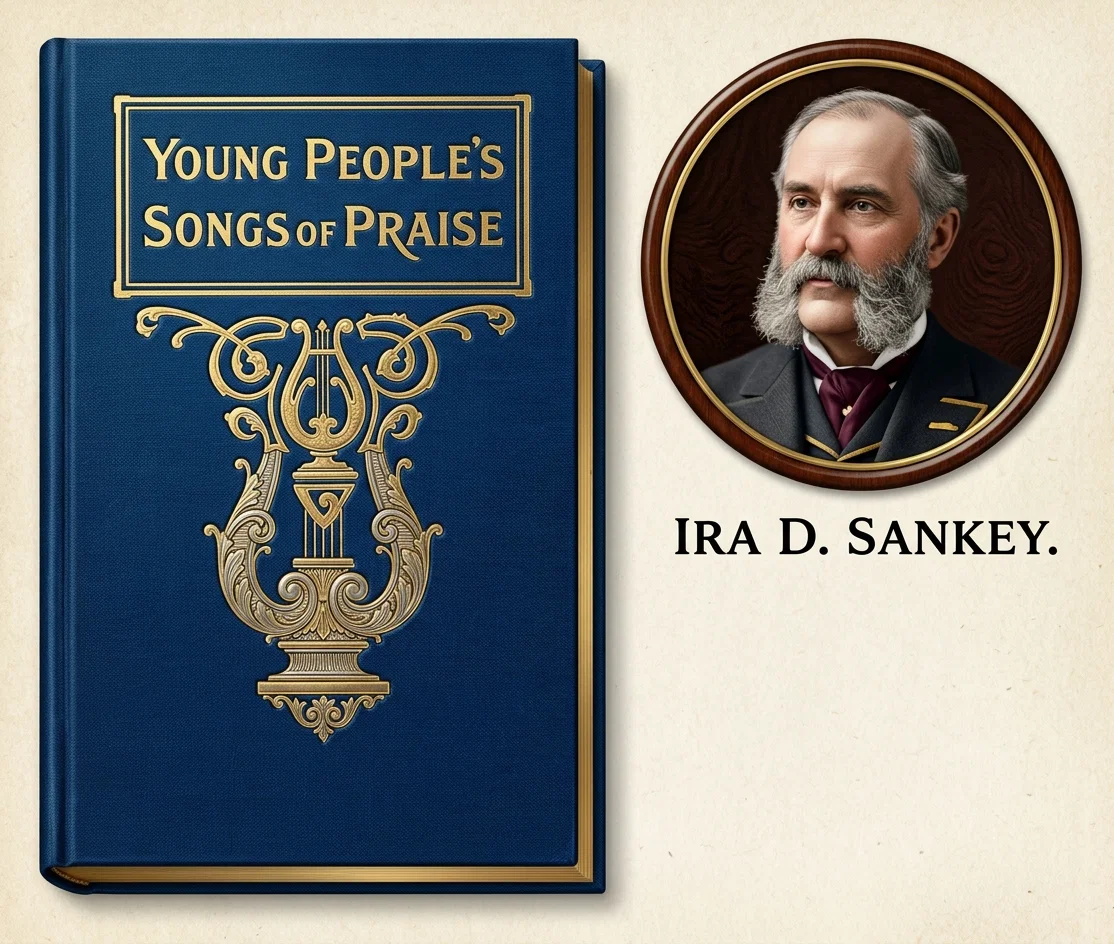
By IRA D. SANKEY.
The Inspired History of the Nations, Past and Future
By G. G. Rupert
BY G. G. RUPERT
Just from the press. The most extended line of thought on prophecy in print. Three thousand full verse quotations of scripture. Should go into the hands of kings and rulers, ministers and people. A most timely book. Notice the chapter titles.
Creation, The Temptation and Fall, Abrahamic and Mosaic Covenants, The Theocracy of Israel, Principles of Government, Joshua, Judges, Samuel, A King, David Anointed King, Solomon, Israel Divided, Judah, Another Opportunity, Ezra’s Return, Babylon, Medo-Persia, Grecia, Rome, Rome’s Decline and Fall, The Seven Seals and the Seven Churches, The Three Divisions of the World—Europe, Asia and Africa—Western Europe, Preparation of the Nations, False and True Teachers, Rules Governing the Study of Prophecy, Russia—or the Northern Power, The Yellow Peril—or the Kings of the East, Concluding Evidences, The Gathering of Israel, A Movement Among the Gentiles, The Location from Which the Messages Arise, The Time of Judgment, The Prophetic Church, The Heavenly Wedding, The Time of Jacob’s Trouble, The Great Typical Feasts, The Last Call and the Latter Rain, The Millennium and the Judgment of the Wicked, The Destiny of the Wicked, Israel’s Return to Their Own Land.
750 pages, beautifully bound in Cloth, Library, and Morocco, prices $2.25, $3.25, and $4.50.
The above-named book is divided into three pamphlets with titles and prices as follows: The Theocracy of Israel, 35 cents, The Gathering of the Nations to Armageddon, 40 cents, and the Gathering of Israel into Their Own Land, 30 cents.
Address the Union Publishing Company, Oklahoma City, O. T., for full description of the book and testimonials, and order of the above or of the Pacific Press Publishing Co., Oakland, Cal.
CHOOSE THE GOOD.
“What will it matter in a little while
That for a day
We met and gave a word, a touch, a smile,
Upon the way?
These trifles! Can they make or mar
Human life?
Are souls as lightly swayed as rushes are
By love or strife?
Yea, yea, a look the fainting heart may break,
Or make it whole,
And just one word, if said for love’s sweet sake,
May save a soul.”