Your ShelfYour Projects

Review and Herald, Vol. 86, No. 19.

THE WORK — AND — THE WORKERS

Review and Herald

May 13, 1909

Review and Herald Publishing Association · Tacoma Park Station, Washington, D. C. · May 13, 1909

THE WORK — AND — THE WORKERS
Every Seventh-day Adventist who wishes to keep up-to-date in the message needs the Year Book. Have you one? 25 cents, post-paid.
“The four of us sold over 200 copies of Life and Health yesterday,” writes one of our Baltimore, Md., agents. They have ordered 1,000 copies for two-weeks’ work in that city.
The entire edition of the May Life and Health (40,000 copies) was exhausted May 6. We are now filling orders with the June number, 50,000 copies of which we are printing as a first edition.
South Lancaster (Mass.) Academy will furnish a large company of student canvassers this season. In addition to the regular book canvassers a large number are planning to earn scholarships through the sale of our ten-cent magazines.
If you are one of the scores of new periodical agents just entering the field, you will surely want to read our two little folders entitled “How to Earn a Scholarship Through the Sale of Four Magazines” and “How to Sell Our Magazines.” They are free for the asking, and will show you actual sales records besides.
Step by step is the way children learn to walk. The Christian learns in much the same way to walk the heavenly path. “Steps to Christ” is designed to help those who are “just learning to walk,” or who would learn to walk better. The old, old story is told as only one who has been over the road can tell it. The cloth gift binding makes an excellent gift book; price, $1. Cloth, plain, 60 cents; paper, 35 cents.
Some of our good friends are sending in their applications for two-year and three-year subscriptions for the Protestant Magazine at the special fifteen-cent-a-year rate. We are sorry to disappoint these, but this special rate was made for the sole purpose of building up a large initial subscription list. Not less than five copies must be ordered to secure this rate of fifteen cents a year.
The Missionary Volunteer secretary of the Virginia Conference writes: “In behalf of the Missionary Volunteer department of Virginia, and on my own account, accept my hearty thanks for a work that is just what is needed, and is put in such form that every Seventh-day Adventist should possess a copy.” What is the book?—Why, “Great Second Advent Movement,” of course. It is a complete history of the rise of the Seventh-day Adventist denomination. The price is within the reach of all. Paper, 50 cents; cloth, $1.25.
Agents do well with the “R. and H.” clear-type Bible. Write for prices and terms. Remember there are three reasons why the “R. and H.” Bible satisfies,—Clear Type, Light Weight, Serviceable Binding.
“Find $3 money-order enclosed, for which please send twenty copies of the new Protestant Magazine for one year, to my address,” writes a sister from Portland, Ore. Is your list made up yet? The leading people of your town should have this live magazine to read next year.
Brother L. C. Mitchell, secretary of the Ohio Tract Society, sends us thirty-five yearly subscriptions for the Protestant Magazine. Among the names sent we note that of a probate judge of that State. Your leading townspeople, judges, attorneys, physicians, and others should have this magazine for one year. Send $1.50 with ten names, or seventy-five cents with five addresses. Make up your list to-day.
LET THE CHILDREN BUILD THE LESSON
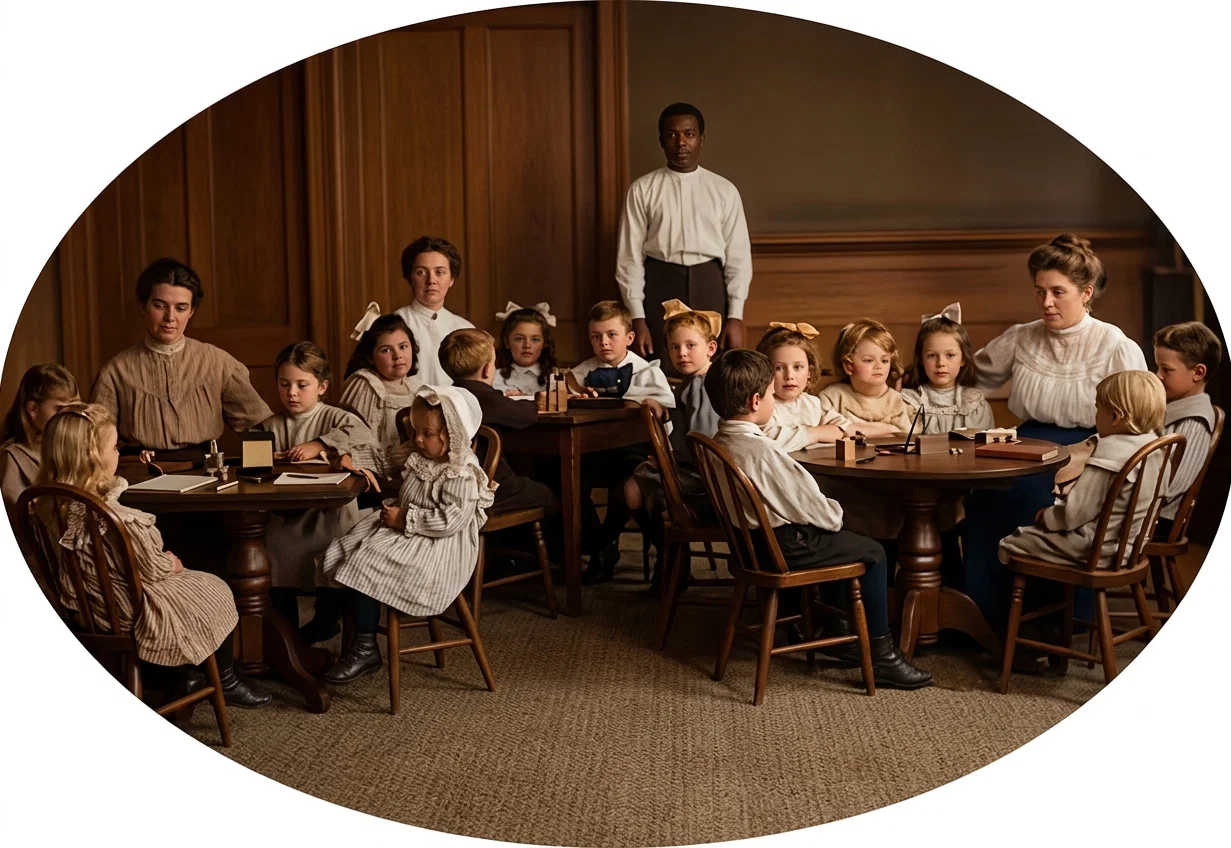
We can fit out your kindergarten division in the Sabbath-school with 1 Round Table, 1 set of Kindergarten Material, 1 copy of “Bible Object Lessons,” 1 copy “Blackboard Sketches,” 6 Little Red Chairs, 1 Teacher’s Chair, for only $12.50. A successful kindergarten is certainly worth more than 25 cents a week. Give the children a chance. Let them exert their energy where it will bring results. Let them build the lesson and tell the story as they build. Full description will be sent to any address on request.
You can begin giving Bible readings right now. If you feel unfamiliar with the subjects you would like to present, order a set of the Family Bible Teacher (twenty-eight numbers). Each number is a complete Bible reading in itself; all you have to do is to hand it to the person to whom you wish to give the Bible reading. The printed page has the advantage of the spoken word in that it does not argue; it simply states the fact. Any one can use the Family Bible Teacher. It provides a means whereby you may bring the truth before your friends and neighbors. One set, twenty-eight numbers, 10 cents; complete set, bound in paper covers, 20 cents.
The Northern Illinois Tract Society has just telegraphed for 1,000 copies of the May Life and Health. This is their second order for 1,000 copies of this issue.
“Change of the Sabbath,” by G. I. Butler, is an excellent presentation of this subject. The author shows very plainly that the Sabbath was really never changed, but that the supposed change is only man’s substitution for the genuine. Paper covers, 25 cents; cloth, 50 cents.
“In making fifteen calls I sold ten copies,” writes one of our Nebraska agents who is selling the Temperance number of the Youth’s Instructor. She adds: “Where they do not buy, I leave the little tract, ‘Drunkenness and Crime.’ I am sure I can dispose of as many more, though I do not live in a thickly settled country.”
When the birds begin to come back, the children will want to know their names. “Garden Neighbors” tells how to cultivate the acquaintance of our feathered friends, how to tell what kind of birds they are, and how to attract them to our dooryard. The book is only $1. It contains 256 pages, and is profusely illustrated. Bound in pretty blue cloth, and stamped in black and white. Do not delay placing your order.
Many of the young people in our schools and institutions are starting classes in pronunciation and enunciation. They use as a text-book “The Speaker’s Manual of Pronunciation.” This little book lists over 2,000 words commonly mispronounced. Every minister, teacher, student, in fact every one who speaks the English language, should have a copy of this book. Price, cloth, 25 cents; leather, 50 cents.
One by one our schools are writing us of their acceptance of the magazine scholarship plan. The following institutions have agreed to give the ten-per-cent discount to our periodical agents who secure scholarships this summer through the sale of the ten-cent magazines: South Lancaster (Mass.) Academy; Emmanuel Missionary College, Berrien Springs, Mich.; Mount Vernon (Ohio) College; Southern Training-school, Graysville, Tenn.; Bethel (Wis.) Academy; Beechwood Manual Training Academy, Fairland, Ind.; Strode Industrial School, Oswego, Kan.; and Eufoia Academy of Industrial Mechanics, Eufoia, N. C. The business managers of some of the schools inform us that thus far their boards have not been able to meet to take action regarding the matter. Further lists of the schools that accept the plan, will be published from time to time. In the meantime write to the principal of the school you wish to attend next year, and secure calendar and other information necessary. The sooner you get to work with the magazines, the quicker your scholarship will be earned. This plan provides a way whereby you may secure an education.

Never Alone

Editorial

The one who enters heaven at last must live in the spirit of heaven while on the earth. The coming of the Lord in the clouds of heaven, or the resurrection at the last day, will work no change in character. The transformation in the character must be wrought through divine grace working in the heart and life. Moment by moment, by the power of the Spirit, the life may be molded after the divine similitude.

Never Alone

The child of God is never alone. He may be cut off from human companionship, and be far from the habitations of men; but the blessed Presence is with him. The promise is, “Lo, I am with you alway, even unto the end of the world.” No distance can divide, no circumstances separate, the disciple from his Master. He may travel by land or sea to earth’s remotest bounds, he may look into strange faces, and listen to the confused accents of unknown tongues; he may be surrounded by conditions which none of his fellows may understand or appreciate, but Christ is ever by his side. Even more than this, he shares our experiences. He enters into our sorrows and our joys; his great heart of love is touched with all the feeling of our infirmities. His sensitive nature feels alike the thrills of pain and pleasure felt by his children. He sees all, feels all, knows all. Realizing this companionship with his infinite and compassionate Saviour, the disciple may go forth bravely and hopefully to do and dare for his divine Lord.

Two Great Crises: The End of the Jewish Nation and the End of the World

The Downfall of Jerusalem

AFTER the unexpected and seemingly unexplainable withdrawal of Cestius from Jerusalem, and the apparent triumph of the Jews over the invaders, the emperor Nero appointed Vespasian, “grown an old man already in the camp,” as the new leader of the Roman army. “So Vespasian sent his son Titus from Achaia, where he had been with Nero, to Alexandria, to bring back with him from thence the fifth and the tenth legions: while himself, when he had passed over the Hellespont, came by land into Syria; where he gathered together the Roman forces; with a considerable number of auxiliaries from the kings in that neighborhood.”—“Wars of the Jews,” Book 3, chap. 1, par. 3.
The Jews, after the defeat of Cestius, “were so much elevated with their unexpected success, that they could not govern their zeal.” They therefore attempted to resist the progress toward Jerusalem of Vespasian’s army, which was later increased by the arrival of his son Titus with large re-enforcements. The advance of the Roman army toward Jerusalem was marked by the capture of one city after another, resulting in the slaughter of many thousands of Jews. In the course of time, “when Vespasian had overthrown all the places that were near to Jerusalem,” he learned of political changes at Rome, and that Vitellius had now become emperor. The soldiers, however, declared Vespasian emperor, and later he went to Rome to look after his political fortunes, but “he sent his son Titus, with a select part of his army, to destroy Jerusalem.”
The Roman forces were first set in order at Cæsarea, from which place Titus marched against Jerusalem. Locating his camp on the same side of the city as was occupied by Cestius, but nearer to the wall, he entered in earnest upon his effort to capture the doomed city. On the fifteenth day of the siege the Romans got possession of the first wall, and five days later they took the second wall. It seemed to be the desire of Titus to secure the surrender of the city without destroying it, and so repeated efforts were made to secure submission on the part of the Jews. For this reason the siege was relaxed for a time, but all such efforts having failed, the attacks upon the city were renewed.
And now was fulfilled in a remarkable way this prophecy uttered by Jesus concerning the holy city:—
“For the days shall come upon thee, that thine enemies shall cast a trench about thee, and compass thee round, and keep thee in on every side, and shall lay thee even with the ground, and thy children within thee; and they shall not leave in thee one stone upon another; because thou knewest not the time of thy visitation.” Luke 19: 43, 44.
The record of the historical event answering to this prediction is given by Josephus in the following language:—
Now did Titus consult with his commanders what was to be done. . . . He also showed them how impracticable it was to cast up any more banks, for want of materials; and to guard against the Jews’ coming out still more impracticable. As also that to encompass the whole city round with his army, was not very easy, by reason of its magnitude, and the difficulty of the situation: and on other accounts dangerous, upon the sallies the Jews might make out of the city. . . . That, therefore, his opinion was, that if they aimed at quickness, joined with security, they must build a wall round about the whole city: which was, he thought, the only way to prevent the Jews from coming out any way. And that then they would either entirely despair of saving the city, and so would surrender it up to him; or be still the more easily conquered when the famine had farther weakened them. . . .
These arguments prevailed with the commanders. So Titus gave orders that the army should be distributed to their several shares of this work. . . . Now its [the wall’s] length was thirty-nine furlongs; and at this wall without were erected thirteen places to keep garrisons in, whose circumferences, put together, amounted to ten furlongs. The whole was completed in three days. So that what would naturally have required some months was done in so short an interval as is incredible.—“Wars of the Jews,” Book 5, chap. 12, pars. 1, 2.
The unfortunate Jews, being cut off from any possibility of supplies from without, soon consumed the now scanty amount of food left in the city, and to the ordinary horrors of war were added the sufferings from famine. Many pages could be filled with a description of the miseries endured during the time which intervened between the blockade and the fall of the city. Before introducing any historical testimony, however, we call attention to the latter portion of the prophecy uttered by Moses:—
“And thou shalt eat the fruit of thine own body, the flesh of thy sons and of thy daughters, which the Lord thy God hath given thee, in the siege, and in the straitness, wherewith thine enemies shalldistress thee: so that the man that is tender among you, and very delicate, his eye shall be evil toward his brother, and toward the wife of his bosom, and toward the remnant of his children which he shall leave: so that he will not give to any of them of the flesh of his children whom he shall eat: because he hath nothing left him in the siege, and in the straitness, wherewith thine enemies shall distress thee in all thy gates. The tender and delicate woman among you, which would not adventure to set the sole of her foot upon the ground for delicateness and tenderness, her eye shall be evil toward the husband of her bosom, and toward her son, and toward her daughter, and toward her young one that cometh out from between her feet, and toward her children which she shall bear: for she shall eat them for want of all things secretly in the siege and straitness, wherewith thine enemies shall distress thee in thy gates.” Deut. 28: 53-57.
These predictions were literally fulfilled in all their horrible details. We quote some testimony to show this:—
But the famine was too hard for all other passions: and it is destructive to nothing so much as to modesty; for what was otherwise worthy of reverence, was in this case despised. Insomuch that children pulled the very morsels that their fathers were eating out of their mouths; and, what was still more to be pitied, so did the mothers do as to their infants. And when those that were most dear were perishing under their hands, they were not ashamed to take from them the very last drops that might preserve their lives. And while they ate after this manner, yet were they not concealed in so doing. But the seditious everywhere came upon them immediately, and snatched away from them what they had gotten from others. For when they saw any house shut up, this was to them a signal that the people within had gotten some food: whereupon they brake open the doors, and run in, and took pieces of what they were eating almost out of their very throats, and this by force. The old men, who held their food fast, were beaten: and if the women hid what they had within their hands, their hair was torn for so doing. Nor was there any commiseration shown either to the aged, or to the infants: but they lifted up children from the ground, as they hung upon the morsels they had gotten, and shook them down upon the floor. But still were they more barbarously cruel to those that had prevented their coming in, and had actually swallowed down what they were going to seize upon, as if they had been unjustly defrauded of their right. . . .
All hope of escaping being now cut off from the Jews, together with their liberty of going out of the city, the famine began to extend its progress, and devour the people by whole houses and families. The upper rooms were full of women and children that were dying by famine; and the lanes of the city were full of the dead bodies of the aged. The children also, and the young men, wandered about the market-places like shadows, all swelled with the famine, and fell down dead, wheresoever their misery seized them. As for burying them, those that were sick were not able, and those that were well were deterred from doing it by the great multitude of those
dead bodies, and by the uncertainty there was how soon they should die themselves. For many died as they were burying others; and many went to their coffins before that fatal hour was come. Nor was there any lamentation made under these calamities; nor were heard any mournful complaints. But the famine confounded all natural passions. For those who were just going to die looked upon those that were gone to their rest before them with dry eyes, and open mouths. A deep silence also, and a kind of deadly gloom, had seized upon the city.—“Wars of the Jews,” Book 5, chap. 10, par. 3; chap. 12, par. 3.
Now of those that perished by famine in the city the number was prodigious; and the miseries they underwent were unspeakable. For if so much as the shadow of any kind of food did anywhere appear, a war was presently commenced; and the dearest friends began fighting about it: snatching from each other the most miserable supports of life. Nor would men believe that those who were dying had no food; but the robbers would search them when they were expiring; lest any one should have concealed food in their bosoms, and counterfeited dying. Nay, these robbers gaped for want, and ran about stumbling and staggering along, like mad dogs; and reeling against the doors of the houses, like drunken men. They would also, in the great distress they were in, rush into the very same houses, two or three times in the same day. Moreover their hunger was so intolerable, that it obliged them to chew everything; while they gathered and ate such things as the most sordid animals would not touch: nor did they at length abstain from girdles and shoes; and the very leather which belonged to their shields they pulled off and gnawed. Even wisps of old hay became food to some, and some gathered up fibers, and sold a very small weight of them for four Attic drachms [one shekel]. But why do I describe the shameless impudence that the famine brought on men in their eating inanimate things? While I am going to relate a fact, which has no parallel in history, either among the Greeks or barbarians. I had, indeed, willingly omitted this calamity of ours, that I might not seem to deliver what is so portentous to posterity: but that I have innumerable witnesses to it in my own age. And besides, my country would have had little reason to thank me for suppressing the miseries that she underwent at this time.
There was a certain woman named Mary, that dwelt beyond Jordan; her father was Eleazer, of the village of Bethezob; which signifies the house of hyssop. She was eminent for her family, and her wealth; and had fled away to Jerusalem with the rest of the multitude, and was with them besieged therein at this time. The other effects of this woman had been already seized upon; such I mean as she had brought with her out of Perea, and removed to the city. What she had treasured up besides, as also what food she had contrived to save, had been also carried off by the rapacious guards, who came every day running into her house for that purpose. This put the poor woman into a very great passion; and by the frequent reproaches and imprecations she cast at these rapacious villains, she had provoked them to anger against her. But
none of them, either out of the indignation she had raised against herself, or out of commiseration of her case, would take away her life. And if she found any food, she perceived her labors were for others, and not for herself: and it was now become impossible for her any way to find any more food, while the famine pierced through her very bowels, and marrow. When also her passion was fired to a degree beyond the famine itself, she consulted with nothing but with her passion, and the necessity she was in. She then attempted a most unnatural thing: and snatching up her son, which was sucking at her breast, she said, “O thou miserable infant! for whom shall I preserve thee, in this war, this famine, and this sedition? As to the war with the Romans, if they preserve our lives, we must be slaves. This famine also will destroy us, even before that slavery comes upon us. Yet are these seditious rogues more terrible than both the other. Therefore, be thou my food; and be thou a fury to those seditious varlets, and a by-word to the world; which is all that is now wanting to complete the calamities of us Jews.” As soon as she had said this, she slew her son, and roasted him, and ate the one half of him, and kept the other half concealed. Upon this the seditious came in presently: and smelling the scent of this food, they threatened that they would cut her throat immediately, if she did not show them what food she had gotten ready. She replied that she had saved a very fine portion of it for them: and at the same time uncovered what was left of her son. Hereupon they were seized with horror and amazement; and stood astonished at the sight: when she said to them, “This is my own son: and what hath been done was my own doing. Come, eat of this food; for I have eaten of it myself. Do not you pretend to be either more tender than a woman, or more compassionate than a mother. But if you be so scrupulous, and abominate this my sacrifice; as I have eaten one half, let the rest be reserved for me also.” At these words the men went out trembling; being never so much affrighted at anything as they were at this; and with some difficulty they left the rest of that meat to the mother. Upon which the whole city was full of this horrid action immediately; and while everybody laid this miserable case before their own eyes, they trembled, as if this unheard-of action had been done by themselves. So those that were thus distressed by the famine, were very desirous to die: and those already dead were esteemed happy; because they had not lived long enough to see such miseries.—Id., Book 6, chap. 3, pars. 3, 4.
These details of almost inconceivable misery are so revolting as to make unpleasant reading, and yet they constitute reliable testimony to the complete fulfilment of the prophecy made many centuries before the Roman nation came upon the stage of action. They show the terrible consequences which follow the rejection of light from heaven, and mark the wide difference between the fortunes of the people whose God is the Lord and that same people when they have wilfully and persistently transgressed the counsel of God.
When the popularity of Jesus with the people was at its height, and many were apparently accepting his teaching, the chief priests and the scribes, who were more deeply exercised over the political future of the Jewish nation than over the spiritual experience of the people, in council assembled, made this declaration:—
“What do we? for this man doeth many miracles. If we let him thus alone, all men will believe on him: and the Romans shall come and take away both our place and nation.” John 11: 47, 48.
Jesus taught the people submission to properly constituted authority, and did not substitute social reform for the gospel of personal salvation. On the other hand, the priests and Pharisees were the political agitators of their time, and sought to keep alive in the minds of the people the hope that the expected Messiah would be a temporal king under whose leadership the Jewish nation would regain its independence and again enjoy its old-time prestige. To whatever extent therefore the people accepted the gospel as preached by Jesus and his disciples, to the same extent were the prospects of success for the Pharisees darkened. They therefore willingly listened to the counsel of Caiaphas, the high priest:—
“Ye know nothing at all, nor consider that it is expedient for us, that one man should die for the people, and that the whole nation perish not.” John 11: 49, 50.
Through the machinations of the priests and Pharisees, and with the hope of thus bettering their political prospects, Jesus was put to death. But the result was the very reverse of that which was anticipated. They did not let this man thus alone, and as the direct consequence of the treatment which they accorded to him, the Romans came and took away both their place and their nation, and since that time the chosen people have been wanderers upon the face of the earth. Terrible are the consequences of rejecting the counsel of God.
Knowing full well the nature and extent of the calamities which would come upon the generation then living, in the fulfilment of the sevenfold woe which he had pronounced upon it, Jesus said to his disciples:—
Matt. 24: 19, 20: “And woe unto them that are with child, and to them that give suck in those days! But pray ye that your flight be not in the winter, neither on the Sabbath day.”
Several conclusions may properly be drawn from this instruction:—
1. The only hope of the believers would be in flight. It would be impossible for them to attempt to ward off the impending troubles.
2. So terrible would be the experiences that those who were childless (a condition greatly depreciated among the Jews) would be counted fortunate.
3. Even the Christians would be exposed to such hardships that they might fittingly pray that their flight might be made in a favorable season of the year.
4. Jesus distinctly recognized that the Sabbath which he himself and his disciples had observed, in common with all the people, would remain without change after his death and resurrection, and therefore taught the believers to keep the Sabbath in mind when praying for their deliverance, thus emphasizing the command given at Sinai, “Remember the Sabbath day, to keep it holy.”
When the victorious Roman army, under the command of Titus, completed their siege of Jerusalem in A. D. 70, and gained possession of the city, the scenes of pillage and destruction which followed were almost without a parallel in history. The city and the temple which had been the pride of the Jewish nation for many centuries, were given up to the sword and the fire, and many of those who had escaped the horrors of the famine became the victims of the now almost insane soldiers, while others were taken to Rome to grace the public triumph accorded to Titus. A triumphal arch was erected in the eternal city, on which were shown the unfortunate Jews in the train of the conqueror, bearing the seven-branched candlestick and other pieces of furniture taken as trophies from the temple. Still others were sold as slaves throughout other countries, and thus were fulfilled the words spoken through Luke: “They shall fall by the edge of the sword, and shall be led away captive into all nations.”
In the effort to set forth the completeness of the destruction of Jerusalem, Josephus puts into the mouth of one, Eleazar, these words:—
And where is now that great city, the metropolis of the Jewish nation; which was fortified by so many walls round about; which had so many fortresses, and large towers to defend it; which could hardly contain the instruments prepared for the war; and which had so many thousands of men to fight for it? Where is this city that was believed to have God himself inhabiting therein? It is now demolished to the very foundations: and hath nothing but that monument of it preserved; I mean the camp of those that have destroyed it; which still stands upon its ruins. Some unfortunate old men also lie upon the ashes of the temple; and a few women are there preserved alive by the enemy, for our bitter shame and reproach. Now who is there that revolves these things in his mind, and yet is able to bear the sight of the sun, though he might live out of danger? Who is there so much his country’s enemy, or so unmanly, and so desirous of living, as not to repent that he is still alive? And I can not but wish that we had all died before we had seen that holy city demolished by the hands of our enemies; or the foundations
of our holy temple dug up after so profane a manner.—“Wars of the Jews,” Book 7, chap. 8, last paragraph.
The great crisis had come. The end of the Jewish nation, the inevitable consequence of their apostasy from God and their refusal to fill the place assigned to them by the providence of God for the enlightenment of the world, was now an accomplished fact, and the kingdom of God was taken from these rejecters of his grace to be given to those who would bring forth the fruits thereof. And this whole experience was included in that statement made by Jesus, “All these things shall come upon this generation;” and just so surely will similar experiences befall the last generation which rejects the message of the second advent of our Lord.
Continue reading: Blasting at the Rock of Ages