Your ShelfYour Projects

Review and Herald, Vol. 86, No. 19.

THE WORK — AND — THE WORKERS
Earlier text: Review of the World-Wide Field

The Huntsville School

WITH Elder C. F. McVagh I spent Sabbath, January 30, at the Oakwood Manual Training-school for colored students, near Huntsville, Ala. This is the school usually known as the Huntsville school.
Shortly after the beginning of the Sabbath, Friday night, the students and teachers all assembled in the commodious chapel in the study hall. There were about one hundred persons present,—eighty-five students and fifteen or more teachers and visitors. After I had given a short Scripture lesson, there was an experience meeting held, in which nearly all took part. The testimonies borne gave evidence of conflicts endured and victories gained.
Among the students there were a few whom I had met in former years, but only a few. Many of those who were there two years ago are out in the field, and those now in attendance have been gathered in recently.
After the meeting I spoke to each student, and learned from which State each one came, and in some cases the field of labor held in view. Nearly all the Southern States were well represented, and quite equally. Florida and Texas have as many workers in training as some of the States nearer by.
Sabbath was a day of many blessings. The two services were well attended; and in the afternoon the practical discourse from Elder McVagh was followed by another experience meeting.
After the Sabbath the brethren took lanterns, and showed us the improvements that had been made on the place during 1908. First we visited the boys' hall. This was enclosed and partly finished a year ago; since then it has been completed and furnished, and is occupied by about thirty-six students. Its utmost capacity is forty-two. It was built by the students, and cost less than four thousand dollars complete.
We next visited the new cannery. It is a model of simplicity and economy, and yet solidly built, convenient, and clean.
The sweet-potato house is near the cannery, and is built to hold one thousand bushels. It keeps the potatoes in an even temperature, which is favorable to their preservation. On the ground floor there were about three hundred bushels of excellent sweet potatoes, which in January were worth one dollar a bushel; also large heaps of seed potatoes. In the loft of the potato house were wagon-loads of canned tomatoes, and half a car-load of empty cans, ready for use next year.
I asked Brother Boyd, the farm manager, how he would dispose of these products, and was told that the best prices could be obtained in the spring, but that the school itself was consuming large quantities, and that its needs must be considered first. The students are credited only about seven cents an hour for labor, and therefore the boarding club was charged only fifty cents a bushel for potatoes.
Next we visited the horse barns, the dairy, and the new silo. In the horse barns we saw a fine lot of colts, and in the dairy a large number of young cattle. In the silo there were still about twelve tons of ensilage.
By the ordinary methods of farming, where corn and cotton are raised andsold off the place, the land is constantly impoverished; but by the scientific methods advocated by Brother Boyd—recently made possible of being carried out, by the liberalities of our people—the productiveness of the place can be greatly improved. Very little cotton will be grown. A large tract will be devoted to the raising of hay and corn, which will be consumed on the place. And the very best of the land will be fertilized, and devoted to the growing of sweet potatoes, tomatoes, and other vegetables for the market and for the cannery.
Last summer there was a long drought, and only the early crops did well. Yet the success of the early planting was sufficient to enable the school to show a gain of three hundred dollars in its workings, and to encourage the farm manager and the students to undertake larger planting this year.

The Sanitarium

The most noticeable improvement undertaken during 1908 was the eighteen-room sanitarium, beautifully located between the study hall and the cedar grove. It is on a gentle slope facing the south, and overlooks the garden grounds of the farm. The building is not large, but it is well planned and well built. We found it enclosed and plastered, and ready for finishing. The treatment-rooms are in the basement, also the furnace and storerooms. The ground floor has the doctor's offices, the parlor, dining-room, kitchen, and one room for patients. In the second story there are seven or eight rooms for patients.
As I saw the progress made toward sanitarium work in connection with this school, I recalled the following Testimony, given some years ago, regarding this work:—

“Medical Missionary Work

“In no place is there greater need of genuine gospel medical missionary work than among the colored people in the South. Had such a work been done for them immediately after the proclamation of freedom, their condition to-day would have been very different. Medical missionary work must be carried forward for the colored people. Sanitariums and treatment-rooms should be established in many places. These will open doors for the entrance of Bible truth.”
“This work will require devoted men and means, and much wise planning. Years ago we should have been training colored men and women to care for the sick. Plans should now be made to do a quick work. Let promising colored youth—young men and young women of good Christian character—be given a thorough training for this line of service. . . . Huntsville has been especially pointed out as a school in connection with which there should be facilities for thoroughly training consecrated colored youth who desire to become competent nurses and hygienic cooks. . . .”

“Redeeming the Time

“Let us now arise, and redeem the time. Everything in the universe calls upon those who know the truth to consecrate themselves unreservedly to the proclamation of the truth as it has been made known to them in the third angel's message. That which we see of the needs of the millions of colored people in the South, calls us to our duty. We are not to become dispirited and disheartened over the outlook. The Lord lives and reigns. And he expects us to do our part by training for service and by sustaining in the field those who are best fitted to labor for the colored people.”
“The workers in the school at Huntsville are to have our tender sympathy and our practical aid. Do not let them suffer for the lack of facilities, for they are trying to educate the colored people. This school is in positive need of our care and our donations.”

Waiting

The work on the sanitarium building was at a standstill when I was there, waiting for funds to finish and furnish it.
There are among us faithful colored preachers who have broken down in health by their arduous labors and privations who need the advantages of the sanitarium.
There are teachers, worn and sick, because of privations and hard work in our mission schools, who need treatment at this institution.
There are scores of well-to-do invalids among the colored people generally, who know the advantages of sanitarium methods, and are waiting for the opening of places where they will be welcome.
There are scores of young men and women waiting for the work and training which our sanitariums for the colored people will provide for them.
There are hundreds of those who have given of their means for the establishment of the Huntsville Sanitarium, who desire to see it finished, furnished, and opened for service.
All these are waiting, waiting, waiting for a call and a response that will complete the unfinished work, and open the institution, and support the enterprise until it gets upon a solid working basis.
W. C. WHITE.

Algiers, North Africa

THIS is the fourth year of our work here; and we are glad to say that the Lord has been with us and blessed our efforts. It was rather hard to gain an entrance; but, nevertheless, the Lord soon opened a few doors for us, and we have had the pleasure of seeing several take their stand for the truth,—some remaining here, others going to other places. The second year two were baptized; and the following year four, who had already received baptism, accepted the message. One of these died soon after he had accepted the Sabbath, and another died just before we came back last fall. It was sad to lose these dear friends, especially as our number was small; but they were both sick and suffering, and we could only thank God that he had laid them to rest, confident also that when the Life-giver comes, we shall meet them again; not as members of a small, feeble, and despised company, but as numbered with the great throng standing on the sea of glass, having the harps of God.
This year an attempt was made to hold public meetings in two different places, but at one of the halls the attendance was so small that the meetings had to be discontinued. At the other hall conditions were a little better, and several of those who had attended the meetings the year before, continued to come. Three of them, together with one who had become interested this year, were baptized last Sabbath. This was a good day for all of us. We first gathered in our little meeting hall for a study of the Word of God, and for the usual preliminaries; then we went down to the Mediterranean, where these four dear souls were buried with their Saviour in the watery grave. These four persons represented four different nationalities: one being of Danish origin, one French, one Spanish, and the fourth, a lady of seventy-three years, was a German. It is gratifying to see how the Lord unites young and old, and gathers a people to himself from different nations and tongues, and makes them all one in him. May they also prove faithful unto the end, and be a blessing to their fellow men.
We praise the Lord for what he has done; and we know that if his servants are humble before him, he will do greater things for them, and draw many souls to himself, even from among the Mohammedans, who constitute the greatest number of this country's population. God is good and mighty, and to him be all the glory.
S. JESPERSON.

Southern India

Since our general meeting, we have been very busy getting settled in our work among the Tamil people. We had been absent about six months, and we were as happy to get back as the people were to have us back.
The Lord opened the way for us to occupy better quarters this year than we had last. We are living in Nazareth, a strong mission station of the S. P. G., just one mile from the center of our work. The house we have rented belongs to a teacher under the employ of that society. To get back and forth in our work we must either walk through the heavy sand or hire a bandy, which is not always obtainable when wanted.
Many of the Tamil Sabbath-keepers are scattered in other villages within a radius of twelve or fifteen miles of our mission property. When our work becomes better established, these villages should be visited regularly, and the people instructed.
Shortly after our return it seemed necessary for us to begin some aid for the sick and afflicted. For a dispensary we were granted the free use of half the building we occupied last year as a dwelling-house. At present we find it difficult to care for all who come, owing to the lack of trained native help and of facilities for work.
The average number who receive help of one kind or another is seventy-five. These come from all classes and creeds. We have taken a girl of sixteen years, also a young man of twenty years, to train for helping us in this work. Both seem very bright, and willing to work as they are directed. Our hours for work at present are from 9 to 11 A. M. We hope to have our dispensary better equipped in the near future.
The middle of February we were visited by Elder J. L. Shaw and Dr. H. C. Menkel, whose counsel and help were much appreciated. Their visit helped to strengthen and encourage the people in their determination to go forward with our work and fully establishour mission. Plans for building were approved, which are now being carried out. At this writing, a large well is nearly half completed. The trenches for the foundation of the bungalow are dug, and stone is rapidly arriving for the same.
The stone-masons will begin work at once. Contracts have been given for burning brick, cutting palmyra timber, and making the doors and windows. By the Lord's blessing and help, we hope to have a suitable building to live in before the year is ended. We shall report more as the work progresses.
In the villages near where we are building, a general feeling of satisfaction prevails. Among the Christian communities a more friendly spirit is manifest, and we are now able to move freely in many of their social gatherings and outdoor recreations. We have felt the presence of the Lord with us in a special manner as we endeavored to carry forward this work. We are of good courage. Daily we remember all the workers in our prayers, and we feel that we are remembered in theirs.
MR. AND MRS. J. S. JAMES, MISS BELLE SHRYOCK.

J. T. BOETTCHER

Russia

At our union conference council held in Moscow, March 18-29, changes were made affecting all of our work in this field. The government sent a high officer from St. Petersburg to attend our meetings and to watch all of our proceedings; so we held our committee meetings at night in our own private rooms. The Russian Union Conference was again divided, and the Central Asian and the Little Russian mission fields formed. Most of the leading workers in the union conference exchanged conferences. Some had been for years at work in the same field, and it was thought that a change would advance the work. Elder Carl Reifschneider, from Siberia, will take the presidency of the Caucasian Conference; Elder H. K. Loebsack will go to Siberia; Elder H. J. Loebsack takes the West Russian Mission; and Elder D. P. Gaede the East Russian Mission; Elder J. Perk, the Little Russian Mission; and Elder J. Ebel, the Central Asian Mission.
Thus we have at present three conferences, three organized mission fields, and three unorganized fields. The unorganized fields are under the direction of the union conference. In this way the responsibility is divided, and the brethren are enabled to reach their work without traveling such long distances.
Word has come to us from Siberia that a man traveled two thousand miles in order to find one of our ministers. [See picture in next column.] He came from the city of Tobolsk, and is a Siberian by birth. After having found the one he sought, he was instructed in the truths of the third angel's message, ordered our Russian paper, and went on his way rejoicing. At his home he has given the truth to his family and friends, who have also accepted it. Thus the Lord has opened the way for work in that far northern country. (Please look it up on the map.) We are indeed a people of prophecy, and are seeing it fulfilled in the very midst of us.
E. ILJETSCH, TOBOLSK, SIBERIA
On April 8 we baptized twenty-six new converts in Riga. It was a blessed occasion. A Polish lady, who had screamed with displeasure at the previous baptism while her brother was being immersed, was herself among the candidates this time. Also a Greek Catholic and his wife were baptized. It is truly wonderful what this truth does for every kindred and people. Our church in Riga now numbers two hundred twenty-two.
One of our young men, who came from our school in Germany, went into a little country town to teach the truth. The people became interested, which made Satan angry. The authorities were informed that a strange kind of man had come to their town, with a new doctrine. They took our brother and put him in prison. He was then sent on foot a distance of sixty miles to the place where he was to have his trial. Before he reached the end of the journey, however, our brother had so won the heart of his escorting officer that he permitted him to ride with him in his wagon. After the hearing he was declared free; but, as he had not been prepared for the journey, and did not have sufficiently warm clothing, he took cold; at the same time he came down with smallpox. However, the Lord did not permit his servant to succumb to that dread disease. He was sick for a number of weeks, but is now at work again, desiring to be more faithful than ever to his Lord and Master, who has done so much for him.

J. T. BOETTCHER

British Guiana

Although the enemy has to some extent been very active in trying to oppose the work of the third angel's message in this colony, we can still praise the Lord for the measure of success that has attended the labors of the workers during the past year. From the front comes the cheering news of victory in every quarter. The reports at the last session of our conference, which convened in Georgetown, Dec. 25-30, 1908, showed a marked increase in membership and finances; and the outlook for the present year seems prosperous. Several new interests have been awakened here and there throughout the field, which we hope to see develop into active working companies. The interest in the Georgetown church, which is under the care of Elder E. C. Ridgery, is increasing, and it is difficult on Sunday nights to procure enough seats to accommodate the visitors from other denominations. We are glad to welcome to the colony Dr. H. N. Greaves and family. We feel sure that his stay among us will be a real blessing to all classes in the community. A medical missionary association has been organized, with a strong membership. Our president, Elder O. E. Davis, is going to the States to attend the General Conference, and may be away for some time.
The following officers were elected for the conference year: President and treasurer, Elder O. E. Davis; secretary, T. J. Kennedy; executive committee: O. E. Davis, T. L. M. Spencer, T. J. Kennedy, H. Beck, H. J. Bowen; Sabbath-school and young people's department, Mrs. C. E. Davis; secretary tract society, Mrs. A. Sampson.
At times the battle rages sore; but we know that victory is sure. Pray for the work and workers in this hard and needy field.
T. J. KENNEDY.

Ecuador

AMBATO.— We know that there will be some for the harvest even from Ecuador. God has promised that his word shall not return unto him void. We shall do our best to fill the country with printed matter.
As a whole, the people of Ecuador are much given to the use of liquor. But just recently a temperance society has been organized in Quito. Now we wish we had some temperance literature in Spanish. We would like to help them get hold of the foundation principles of true temperance. Nothing is more needed in this country than health work and all that pertains to it. A merchant who travels in many places where none of our workers have been takes the Señales with him, and distributes them. A grandson of one of the former presidents comes here quite often for papers. He is temperate, not even using tobacco, which is an unusual thing here. He is a bright young man.
Three times since we have been here we have been asked to start a school for children; this by some of the first people of the place. It is desired that the teaching be in both Spanish and English. I feel sure that if we had a capable person to give his time to that work, much good would be done. It does seem to me that such a school should be started. It seems best to get hold of the people in every way possible. The person starting the school should not be one who wants to be a foreign missionary because he finds no good openings at home, but one of education and successful experience. Since Brethren Casebeer, Davis, and Buckner has done much to help in getting hold of the people. There are other openings where the right persons could do well teaching, with the object of breaking the crust for mission work.
How we wish we had an active, practical doctor here—one who knew how to build up from a small beginning. Nothing is more needed here than our health and temperance work. What isthe meaning of the expression “entering wedge,” as applied by the spirit of prophecy to medical missionary work—something to be used ten years afterward, or in the first place? Find us a practical medical missionary man.
Our colporteur, Brother Octavio Navarette, does not always have an easy and pleasant time. A little while ago he had to put spurs to his horse, and flee from a mob who were stoning him. Some of his books and papers were stolen, and that evening the priest and others made a bonfire of them in the public plaza. A man of some influence, hearing the commotion, hastened to the plaza, and was able to secure part of one of the papers. He brought it here to compare with ours, to be sure it was ours. He says he will see that the burned books and papers are paid for.
Wm. W. WHEELER.

France

I began a series of meetings Nov. 13, 1908, in the city of Lyons. For a few weeks Brother J. P. Badaut helped me, but he was obliged to go to St. Etienne to continue the work which Brother Jules Rey from failing health was obliged to drop.
The Lord helped me in presenting the great truths of the message to interested audiences. Sister Jeanne Bourquin rendered valuable help in Bible work in the homes of the people. It takes us longer to hold a series of lectures in France than in the States. Instead of six or seven evening meetings a week, we can get the people out to only three. On April 17 we had the joy of baptizing into the likeness of Christ’s death eight converted souls. Five of these had been Roman Catholics. Men who had used tobacco and wine gave up their cherished idols. One of the candidates was twelve years old, a German girl who had heard the truth in Germany.
Our winter’s experience in the city of Lyons has given us much confidence and courage for the work in our large cities.
I spent March 26-29 with the believers in the departments of the Doubs, baptizing three souls at the city of Besancon and one at Valentigney; these persons were brought to the light of present truth by the labors of Brother Cæsar Guenin, who has recently been called to labor in the northern France mission field. He will doubtless begin an effort in the city center of Rouen. I was with the churches and isolated believers in southern France from April 1-12. There are two nurses working at Marseilles with whom I spent one day, but nothing yet has been done to present the message in this great metropolis. Missions and gospel halls opened by other denominations are well attended, and at an early date our work must be started in this city of over five hundred thousand inhabitants. A ship missionary would here find a vast field of activity; for into this port come ships from many nations.
Two days were spent with the three believers at the beautiful city of Nice, situated near the Italian frontier. Three years previous I had visited these isolated believers for the first time. They appealed to me to come to their city to open up the work; but we could give no definite answer to their earnest call.
I held a meeting and visited the believers at each of the following places: Nimes, Montpellier, Cette, Brignon, La Salle. At the last-named place we held a general meeting of the believers from Anduze, St. Jean-du-Gard, and St. Hippolyte-du-Fort. I baptized one sister and held the ordinances.
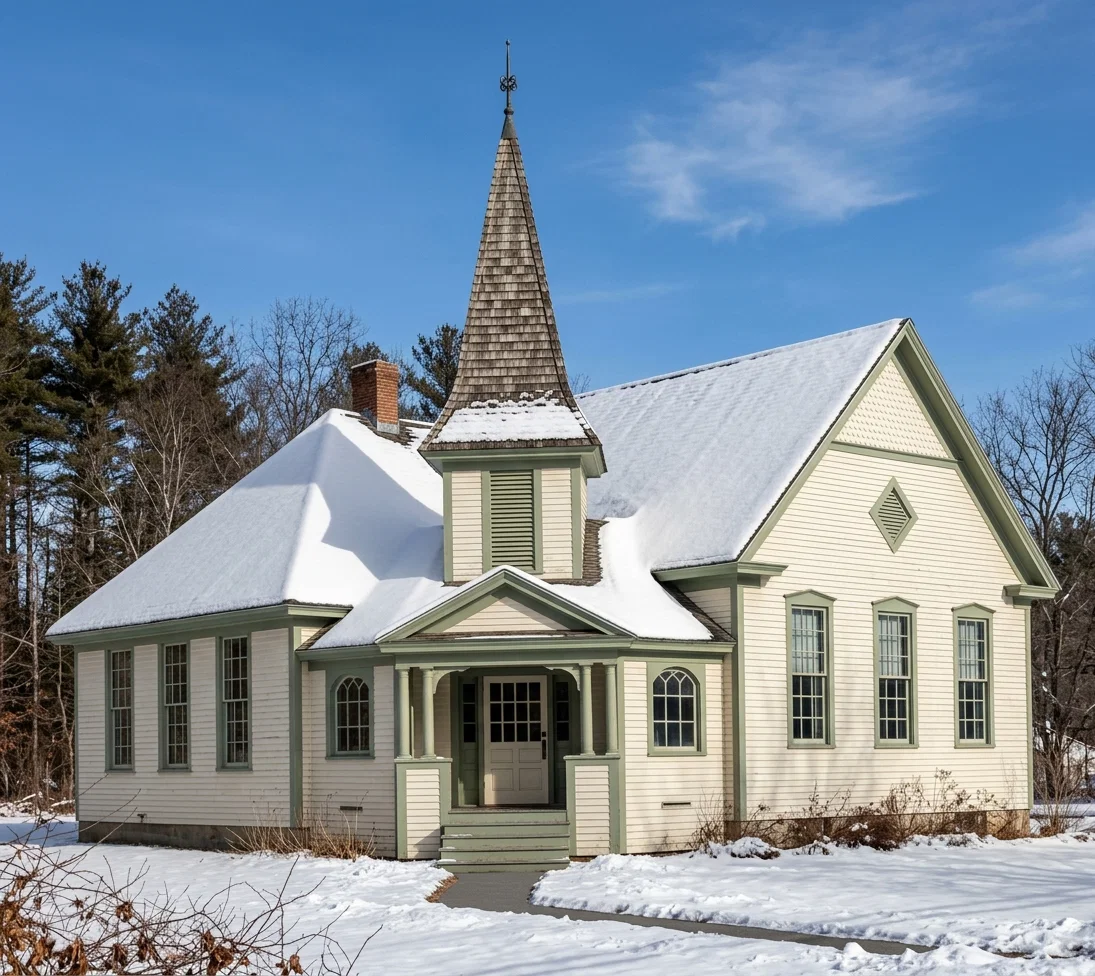
SEVENTH-DAY ADVENTIST CHURCH RECENTLY DEDICATED AT KEENE, N. H.
The work in France would make encouraging progress if we had a few more experienced laborers. We have twelve workers in all for our large field, seven of these are young men and women who have been in the field only a short time. May the Lord make them successful workers in his vineyard.
France has given two of its best men to the Latin Union Conference for the Algerian field. Brother U. Augsbourger, whose labors in Paris were crowned with success, finds the work in the city of Algiers less encouraging, though lately he baptized four new converts.
I left Lyons April 18 for Paris, on my way to the General Conference. I was glad to speak Sunday night to a hall crowded with attentive hearers. Present truth has gained a firm foothold in the capital city. The church, numbering fifty members, has lately moved into its newly rented hall in an entirely Catholic quarter of the city. It looked good to see across the broad front of the hall the words, “Adventistes du Septieme Jour” [Seventh-day Adventists].
Elder Paul Badaut is the only worker in Paris, but is soon to be assisted by a young man from our Gland school.
Below is a translation of a card, thousands of which are distributed on the crowded thoroughfares:—
“The Seventh-day Adventists
“WHAT THEY ANNOUNCE
“The Seventh-day Adventists are Christians who have returned to all the practises of the primitive faith. The Bible is their creed. From the prophecies of this Holy Book they teach to the world the fulfilment of the signs of the last days, as also the soon return of our Lord Jesus Christ. Meetings are held on these important subjects, at 11 rue Coettegon. A cordial invitation extended to all.” H. H. DEXTER.

Chile

ANTOFAGASTA.—Lately I have been quite busy instructing the canvassers along the west coast field. Quite a number of able young men have left this line of work, for lack of instruction as to how to take orders for large books. They would be filled with enthusiasm and then sent out with a lot of books. They could not sell as many as they expected, and consequently were discouraged. Of course we can hardly blame them or the leaders.
I am now well started in the work with the native help we have. They are generally willing to learn, and several have adopted the plan of taking orders for our large books before attempting to sell the books outright. I have just come up from Taltal, a thriving port town, and am much pleased with the work of a native brother who is canvassing there. After being out with me a little while, he started to take orders for “Coming King,” and surprised himself by taking five in four and one-half hours. While there, my average was four and one-half orders an hour for large books. One day I took twenty-eight orders in five hours, valued at two hundred fifty-two dollars, Chilean. Here in this town I am taking over twenty orders a day. My plan is to instruct the colporteurs, and go out with them, that they may get an idea of how to operate the subscription plan.
Here on the coast of Chile four capable American young men are needed to energetically work the large cities, which have been almost neglected so far. They could support themselves by selling English books while they learn the language, as the towns are full of English-speaking people. These American laborers would be a sort of backbone to the canvassing work here. I think we have one of the easiest fields in the world in which to sell books; and if the workers are self-supporting, it will be a blessing to the conference.
At the Pua school, in August, I held an institute. It was rather trying at first to know how to handle the canvassers; but now things have taken a turn for the better.
From here I expect to go on north to Iquique, then to Peru, where Brother A. N. Allen is holding an institute for canvassers. I expect to be there at least a month. My health is not any too good; but the Lord makes up the lack by blessing me more than I can expect. THOS. H. DAVIS.

Huntsville Sanatorium

  1. Patient's room ............ $ 90.00
  2. Patient's room ............ 75.00
  3. Patient's room ............ 75.00
  4. Patient's room ............ 70.00
  5. Patient's room ............ 70.00
  6. Patient's room ............ 70.00
  7. Patient's room ............ 70.00
  8. Patient's room ............ 70.00
  9. Dining-room furniture ..... 50.00
  10. Kitchen furniture ........ 60.00
  11. Dishes, tableware, and linen 50.00
  12. Halls, stairs, and clock ..... 30.00
  13. Doctor's office furniture ... 30.00
  14. Office and parlor chairs .... 25.00
  15. Wheel-chair ................ 24.00
  16. Piano ........................ ....
  17. Surrey ...................... 95.00
  18. Double harness .............. 25.00
  19. Horses ....................... ....
  20. Doctor's instruments ........ 500.00
  21. Books for library ........... ....
  22. Parlor furnishings .......... 90.00
  23. Bath-room furnishings ....... 100.00
  24. Water-heater ................ 100.00

Rock City Sanatorium

  1. Bath-room furnishings ....... $ 50.00
  2. Dressing- and massage-rooms . 50.00
  3. Operating-room .............. 100.00
  4. Instruments .................. 250.00
  5. Patient's ward ............... 50.00
  6. Patient's room ............... 80.00
  7. Patient's room ............... 70.00
  8. Patient's room, part ......... 30.00
  9. Patient's room, part ......... 30.00
  10. Patient's room, part ........ 30.00
  11. Patient's room, part ........ 20.00
  12. Patient's room, part ........ 20.00
  13. Parlor ....................... 90.00
  14. Dining-room, part ........... 40.00
  15. Kitchen, part ............... 25.00
  16. Dishes, tableware, and linen 40.00
  17. Halls, stairs, etc. ......... 25.00
  1. Clock ....................... $ 5.00
  2. Wheel-chairs ................ 40.00
  3. Books for library ........... ....
  4. Support of evangelist nurse,
one month ................... 25.00
  1. Same as above ............... 25.00
  2. Same as above ............... 25.00
  3. Support of assistant nurse,
one month ................... 20.00
  1. Same as above ............... 20.00
  2. Same as above ............... 20.00

Atlanta Sanatorium

  1. Plumbing of bath-rooms ..... ....
  2. Bath-room furnishings ....... ....
  3. Waiting- and massage-rooms .. ....
  4. Patient's room .............. $ 70.00
  5. Patient's room .............. 70.00
  6. Patient's room .............. 70.00
  7. Patient's room .............. 60.00
  8. Patient's room .............. 60.00
  9. Support of evangelist nurse,
one month ................... 25.00
  1. Same as above .............. 25.00
  2. Support of assistant nurse,
one month .................. 20.00 12. Same as above .............. 20.00

Huntsville School

  1. Kitchen range .............. $ 75.00
  2. Sewing-machine ............. 25.00
  3. Sewing-machine ............. 25.00
  4. Sewing-machine ............. 30.00
  5. Double buggy ............... 60.00
  6. Double harness ............. 30.00
  7. Organ for boys' home ....... 75.00
  8. Organ for girls' home ...... 75.00
  9. Organ for church-school .... 60.00
  10. Wagon for truck peddling .. 80.00
  11. Books for library .......... ....
  12. Scholarships ............... ....

Current Mention

— The first wireless message ever transmitted between Chicago and New York was received at the latter place on May 2 from the manager of the United Wireless Telegraph Company in Chicago.
— Mr. Oscar S. Straus, former Secretary of Commerce and Labor, has been appointed by President Taft to the position of ambassador to Turkey. Mr. Straus has held this position before, giving the utmost satisfaction.
— Diplomatic relations between the United States and Venezuela, which were broken off more than a year ago, were resumed on May 4, when Señor Don Pedro Rojas, the new minister from Venezuela, was presented to President Taft by Secretary Knox.
— Extensive plans are being drawn up for a mimic war between the American fleet and the forts of the Atlantic coast. The work planned for the fleet will be the technical capture of some of the fortified ports. The forts are supposed to prevent the capture, but none save the officers of the fleet will know which ports are to be “captured.”
— Lassa, the capital of Tibet, so long forbidden to foreigners and foreign influence of every kind, appears to be assuming a less rigid and illiberal spirit. A Calcutta newspaper states that a commission from that city has received from a large convent in Lassa an order for numerous objects of European manufacture, including one hundred brass musical instruments.
— It is felt throughout France that a crisis is rapidly approaching in the relations between the government and the trades-unions. The result of the last encounter between the government and the unions is regarded as a victory for the unions, and the government seems to feel much chagrined over the outcome, and is preparing now to take a firm stand against the unions. On the other hand the members of the various unions are preparing to resist any move of the government calculated to interfere with their purposes.
— The recent display of military strength and aggressiveness by Austria and Germany has caused Russia to greatly modify her plans of defense. That portion of her territory known as Poland, which projects as a sort of wedge between German and Austrian territory, and would be exposed on three sides to the attacks of these powers in case of war, is to have all its fortifications abandoned, dismantled, and destroyed. In case of war, mobilization of troops would be carried on behind a chain of fortifications nearer on a line with Russia’s ancient frontier.
— A report from Evansville, Ind., states that a young man of that city has invented a very powerful explosive, which he is able to set off by means of a wireless apparatus operated at a distance from the explosive. A small quantity of this explosive, located in the top of a tree three miles from Evansville, was set off by this apparatus operated in the city. It is stated that the blast of three ounces at that distance shook the city. Such an invention as this in the hands of irresponsible parties or the maliciously inclined can not be contemplated without grave concern, and its destructive possibilities in military operations is readily conceded.
— On May 2 the garrison of marines at Constantinople refused to embark for distribution to various ports to which they had been assigned, and acquiesced only when General Schefket planted batteries commanding the barracks, and gave them the choice of obedience or death. On the following day thirteen civilians and officers implicated in the uprising were hanged in Constantinople. Documentary evidence has been found which shows that the massacres in Asia Minor were planned at Constantinople. Uncensored reports state that many of the Armenian villages have been entirely wiped out, the inhabitants having been either killed or driven out and the buildings reduced to ashes. Great misery is reported from all the affected districts. In some places the survivors of the massacres are living on grass. The arrival of the constitutional troops is putting an end to the massacres, but they can not do much to relieve the terrible conditions prevalent. The secret vault of the deposed sultan has been found in the Yildiz palace. It is reported to contain $2,500,000 in gold and $5,000,000 in negotiable securities. It has also been discovered that the sultan has deposited in Germany, France, England, and the United States upward of $15,000,000. The new government has taken possession of the gold and securities found in the sultan’s palace, but has not yet decided upon what course it will pursue with reference to the deposits made in foreign countries.

Medical Missionary Department

Conducted by the Medical Department of the General Conference
W. A. GEORGE, M. D.    . . .    Chairman
W. A. RUBLE, M. D.    . . .    Secretary

Further Details Regarding Sanitariums for the Colored People

The Medical Department of the General Conference is making a strong attempt at present to assist the efforts of our brethren in the South to provide appropriate sanitariums for the colored people. Several articles have appeared in these columns of late in regard to this matter. More definite information as to just what is needed is at hand, and is given below. Our institutions throughout the United States are taking up this matter for the purpose of securing means to aid these worthy enterprises. We are in hopes that our people at large will take a sufficient interest in this, and forward means to the treasurer of the General Conference to be used in fitting up these new sanitariums. The accompanying list will give information as to just what is needed for these various institutions. We ask our people everywhere to join us in helping to raise these various amounts.
W. A. RUBLE, D. H. KREES, G. H. HEALD.
Continue reading: Business Notices