Your ShelfYour Projects

Signs of the Times, Vol. 30, No. 33.

BEHOLD THE MAN!

Signs of the Times

Aug 17, 1904

Pacific Press Publishing Company · Oakland, California · Aug 17, 1904

“BEHOLD THE MAN!”
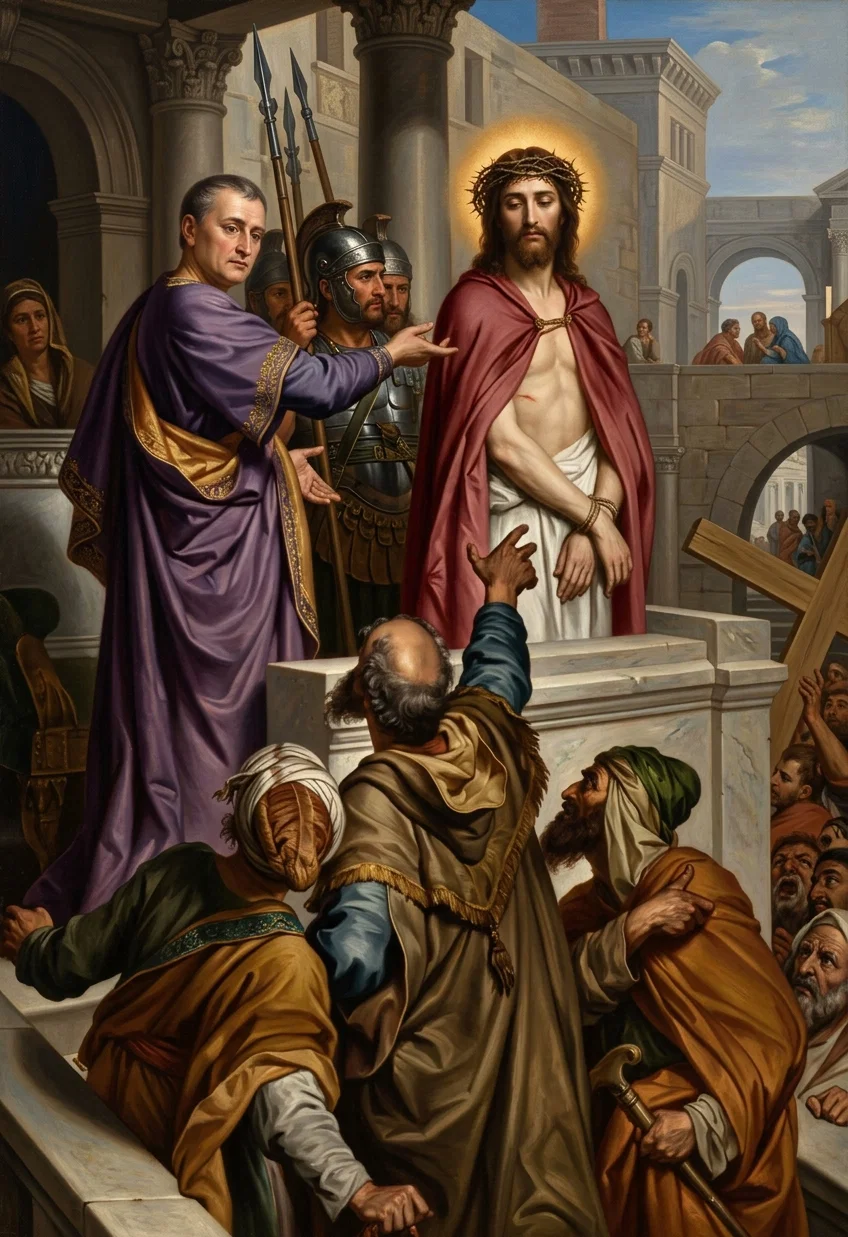
AFTER an examination of Jesus on the charges brought against Him by the Jewish council, Pilate, the governor of Judea, publicly declared, “I find in Him no fault at all.” But he virtually conceded a condemnation, thinking to release Jesus through a pardon. It had been a custom of the governors to release some Jewish prisoner at the Passover. When the people were gathered from all parts of the province to celebrate their principal festal occasion, it was deemed good policy to please them by releasing one of their number who had been condemned by the Roman law. It also added to their pleasure to be allowed to choose the one who should be released. So, taking advantage of this custom, Pilate thought to make the condition such that the people would choose Jesus. He knew that the chief priests had delivered Him because of their envy, but he still had some confidence that the people could be moved in the interest of justice.
THERE was in prison a man named Barabbas, who had been convicted of insurrection and murder and robbery. Pilate thought that by giving the people a choice between such a desperado and the harmless Jesus, whom they had so highly honored but a few days before, they surely would choose the innocent One. But when he asked them which of the two they would choose, “the chief priests and elders persuaded the multitude that they should ask Barabbas, and destroy Jesus.” So they cried out, “Not this man, but Barabbas.” Pilate asked, “What shall I do then with Jesus which is called Christ?” and they answered, “Let Him be crucified.”
“WHEN Pilate saw that he could prevail nothing, but that rather a tumult was made, he took water, and washed his hands before the multitude, saying, I am innocent of the blood of this just person; see ye to it.” Then the people answered, and said, “His blood be on us, and on our children.” But Pilate was terribly mistaken; he could not wash away responsibility in that manner. Therefore he was guilty of the blood which alone could wash away his sin. No judge could be innocent in giving over for execution a prisoner whom he had thrice pronounced innocent; nor could the assumption of responsibility by others take away his responsibility, or cleanse his hands.
BUT before finally giving Jesus into the hands of His enemies, Pilate resorted to another ruse, which really accentuated his cowardice before the multitude. He voluntarily took Jesus, and had Him “scourged.” The Roman scourge was a whip with numerous lashes, and each lash was set with sharp bits of iron; so when the scourge was applied the skin and flesh were cruelly lacerated. And in addition to this torture, the governor permitted the whole band of soldiers to make the prisoner an object of sport for a while. “They clothed Him with purple, and platted a crown of thorns, and put it about His head, and began to salute Him, Hail, King of the Jews! And they smote Him on the head with a reed, and did spit upon Him, and bowing their knees worshiped Him.”
THE scourging and the further abuse and insult by the soldiers had been permitted by Pilate with the evident purpose of exciting pity and sympathy in the hearts of the people. So, in this bleeding, suffering condition, in this altogether pitiable plight, Pilate brought Him before the multitude, and said, “Behold the Man!” the Man in whose praise they had so recently sung “Hosanna to the Son of David; blessed is He that cometh in the name of the Lord!” the Man who had gone throughout their land proclaiming only good tidings, and doing only good works; the Man in whom there was no guile, stood before them—Himself a mute appeal for humane consideration and simple justice. But hearts that had rejected the Gospel could not long retain even a semblance of regard for Him whom the Gospel message would make known.
WHEN He was expected to take the throne of government, and give the people immediate promotion in a political way, they could throng the streets in efforts to honor Him; but in the hour of disgrace and apparent defeat, there was no more appreciation of all that He had done for them. “He is despised and rejected of men; a man of sorrows, and acquainted with grief; and we hid as it were our faces from Him; He was despised, and we esteemed Him not. Surely He hath borne our griefs and carried our sorrows; yet we did esteem Him stricken, smitten of God, and afflicted. But He was wounded for our transgressions, He was bruised for our iniquities; the chastisement of our peace was upon Him; and with His stripes we are healed.”
BUT the church of to-day can not sit in judgment upon the church of that day. The rejection of His plain teachings in the church to-day; the disregard of the Golden Rule, the ignoring of the commandments of God, and the substitution of human tradition to-day, are just as much a rejection of Christ as in the day of His formal condemnation. It is clearly a “falling away,” and those who maintain such a position in the more resplendent light of His Word, “crucify to themselves the Son of God afresh, and put Him to an open shame.” Heb. 6:6. “Therefore thou art inexcusable, O man; whosoever thou art that judgest; for wherein thou judgest another, thou condemnest thyself; for thou that judgest doest the same things.” Rom. 2:1.
WE of to-day will do well often to “behold the Man” as He stood in His dignified humility, weakened by fatigue and torture, the subject of public insult, “a reproach of men, and despised of the people,” the victim of envy and of false accusation, and, above all, His heart bleeding with sorrow and pity for those who were rejecting their only hope of salvation from sin. It is just as true of us as of those of old, that “all we like sheep have gone astray; we have turned every one to his own way; and the Lord hath laid on Him the iniquity of us all.” The Lord can say also of us to-day, “For the transgression of My people was He stricken.”
BUT, praise His holy name, He has given us another view—only to be seen, however, from the standpoint of repentance and faith. “Hear, ye that are far off, what I have done; and, ye that are near, acknowledge My might. He that walketh righteously, and speaketh uprightly; he that despiseth the gain of oppressions, that shaketh his hands from holding of bribes, that stoppeth his ears from hearing of blood, and shutteth his eyes from seeing evil; he shall dwell on high; his place of defense shall be the munitions of rocks; bread shall be given him; his waters shall be sure. Thine eyes shall see the King in His beauty; they shall behold the land that is very far off.” Isa. 33:13–17. “Beloved, now are we the sons of God, and it doth not yet appear what we shall be; but we know that, when He shall appear, we shall be like Him; for we shall see Him as He is.” 1 John 3:2. “Behold the Man,” and lay hold of eternal life.”
By first taking an appreciative view of Him in His humility, and accepting His great sacrifice for our sins, we may—by faith now, and by actual experience hereafter—be enabled to see Him in His glory, and to be made partaker of it. 1 Peter. This is the desire and prayer of the Master; shall it not be our earnest purpose in life?

THE STANDARD OF THE JUDGMENT.

BY CHARLES THOMPSON.
INSPIRATION has recorded the solemn fact that God will judge the world. Acts 17:31. Every man, after reaching the years of accountability, has behind him the record of his life, and before him the searching test of the judgment; and upon the decision of that hour, so his destiny will be; for it is written, “Whatsoever a man soweth, that shall he also reap.” Gal. 6:7. Hence we all, by our actions, are daily deciding our destiny. The Lord has declared that by Him actions are weighed. 1 Sam. 2:3. Also that He “shall bring every work into judgment, with every secret thing, whether it be good, or whether it be evil.” Eccl. 12:14.
This being true, God must have a great moral standard to regulate the lives of His created intelligences. The standard of the judgment must of necessity be the standard of living. God would not give one standard to live by, and have another to judge us by, and then declare that “we would be judged by our works.” This would be folly and unjust. So, if we can find the standard of the judgment, we have the rule of life, and vice versa.
We read in Rom. 2:12, 13. “As many as have sinned in the law shall be judged by the law; for not the hearers of the law are just before God, but the doers of the law shall be justified.” These Scriptures are pointed and explicit. We are to be judged by the law which we are required to do in this life. Solomon, summing up our duties, says, “Fear God, and keep His commandments; for this is the whole duty of man. For God shall bring every work into judgment.” Eccl. 12:13, 14. Here the wise man places in juxtaposition the same standard for our present lives, as for the future judgment. It is man’s whole duty to keep the commandments, because God is going to bring his works into judgment; and He could not conceive of a judgment that would justify a man doing less than his duty. Hence it will be necessary for us to keep all the commandments of God. This harmonizes with the words of Christ, as He sent forth His apostles to preach the Gospel. He said, “Teaching them to observe all things whatsoever I have commanded.”
We are not left in any cloud of uncertainty as to what law or code of commandments is referred to in these scriptures. James, speaking on the same point, admonishes us to “so speak, and so do, as they that shall be judged by the law of liberty.” James 2:12. Then in the preceding verses he definitely mentions what law he refers to. He says, That law which says, Do not kill; and Do not commit adultery; and, Thou shalt love thy neighbor as thyself, plainly showing that the law that should govern our words and actions, and by which we are to be judged, is none other than the Ten Commandments. Then, with these unequivocal statements before us, the apostle adds,“Whosoever shall keep the whole law, and yet offend in one point, is guilty of all.” Verse 10.
Therefore, he who knowingly transgresses one of the Ten Commandments in this life, will be found guilty in the judgment and come short of entering into the City; for it is written, “Blessed are they that do His commandments, that they may have right to the tree of life, and may enter in through the gates into the city.” Rev. 22:14.
Now, dear reader, look the commandments over carefully, and see if your daily life is in perfect harmony with their requirements. For it will be a fearful loss to be “weighed in the balances,” and “found wanting.”
Stewardson, Ill.

EXPECT CONVERSION.

HE who preaches the Gospel as God has given it, and where God has sent him and bidden him to preach it, expecting and working for the conversion of men, is not likely to be disappointed; and he who works in his own way, and seeks his own pleasure, and does not expect conversion, is not often disappointed in his expectations. If men lose sight of the great object of Christian labor; if they cease to hold direct communion with God, and hold their commission from men and not from Him; if they devote themselves to literary discussions, doctrinal disputes and theories and measures, what wonder if they in the harvest day come empty-handed even from fertile fields.
Souls are perishing, and a thousand million of the children of Adam have never heard that Christ died for them. Time is short, and the petty separations and divisions among Christians are not worthy to be named in comparison with the vast interests and mighty responsibilities that rest upon the church of God. Let Christians awake, and put forth their efforts for lost men; let their souls feel the burden of the dying multitudes around them, and let them go forth bearing precious seed with tears, and a prayer-hearing God will bless the seed sown; and the faithful stewards of the Lord will be co-workers, and help forward the work to its consummation.—Selected.

I KNOW HE CARES FOR ME.

BY E. G. MORGAN.
I sit and ponder o'er my way, As sinks the sunlight in the west; As dark and dreary grows the day, Till shades of night bring peaceful rest. I often reel beneath the load, And oft my way I can not see; Tho storm-clouds lower o'er my road, Still do I know He cares for me.
When grief and pain have torn my heart, When deepest sorrows bear me down; When all my earthly friends depart, And all my earthly hopes have flown, I still can trust His tender love. E'en tho the way I can not see; I know He marks my every move, And I am sure He cares for me.
When darkness dense my way obscures, And shuts out every ray of light, He comes, and my sad heart assures That “sunny day” succeeds the night. So, as I follow, He will lead, While I from sin and darkness flee; He satisfies my every need, And I am sure He cares for me.
Tho hard the path, tho rough the way, Tho footsore here my path I tread; He will not let me go astray So long as by His hand I'm led. Still does He give these trials here, That I may all my weakness see; And tho the trials be severe, I know my Saviour cares for me.
Tho in the furnace He may prove, And purge from me the dross and tin, He only does His work in love,— 'Tis all to cleanse me from my sin. My Saviour loves me, this I know, And seeks from sin to set me free; He died His wondrous love to show— Praise God!—I know He cares for me.
Philadelphia, Penn.

EZRA

BY F. D. STARR.
A HAPPY change in the affairs of the Israelitish nation is introduced in this book—deliverance from captivity, and restoration to their own land. “When the Lord turned again the captivity of Zion, we were like them that dream. Then was our mouth filled with laughter, and our tongue with singing; then said they among the heathen, The Lord hath done great things for them.” Ps. 126:1, 2.
It will be a pleasure to read about these great things as we find them recorded in this book, and, indeed, a mention is made of this good fortune to God’s people in the last chapter of the preceding book, for it will be noticed that the last two verses of 2 Chronicles 36, and the first two or three verses of Ezra 1 are the same. Cyrus, king of Persia, was a chosen instrument in God’s hands to bring deliverance to Israel. We see by Isaiah 45:1, that the Lord calls him His anointed, and this mention of this renowned man was made more than a century before his birth. We can but contrast the liberal dealings of this monarch with those of the king of Egypt nearly a thousand years before. When the Lord wanted Pharaoh to let Israel go to their own land, he manifested the most stubborn opposition to the divine command, determined to retain that people in his domain, and when forced to relinquish his grasp upon them, he thrust them out altogether. But when Cyrus is called upon to do a like act he makes the most liberal provision for the return of these exiles to their country; and instead of hindering them he makes every possible provision for their assistance in this undertaking.
Pharaoh was raised up for the very purpose that God might show His power in him. Rom. 9:17. Cyrus was raised up for this same purpose. Both had a like task assigned to them, to release their captive subjects that they might return to the land of their fathers; and the names of these monarchs were to be handed down in history as men through whom God worked in a special manner. Cyrus yielded himself to God to accomplish His pleasure in accelerating the movements of the exiled Israelites in their exodus from a foreign country, and thus he has become favorably renowned in all ages, and the honor and power of God was manifested in his rulership. Pharaoh might have gotten the same kind of renown in the same way, if he had been willing to submit himself to God, and permit God to manifest His power through him in the way that Cyrus did; but he chose the course of rebellion, and consequently God’s power was manifested in him in his destruction, for he who causes the obedience of man to praise Him, also causes the wrath of man to praise Him. Thus Pharaoh became renowned as a great rebel against God, and his name is handed down to posterity covered with ignominy and contempt; but the cause of God against which he lifted his puny arm is greatly exalted thereby.
In which way will we let God manifest His power in us, in making us vessels of wrath, fitted to destruction, or vessels of mercy, fitted to salvation? The choice remains with us. Shall we imitate Cyrus or Pharaoh? The first named surely.
Notice the difference between the numbers that left Egypt in the days of Moses to go into Canaan, and those who returned to the same country in the days of Ezra. There were over 600,000 in the former instance, and less than 50,000 in the latter; less than one-twelfth. It seems that the seventy years’ residence in a foreign country had severed their attachment to the home land to a large degree. It would be a new generation upon the stage of action, a generation born in Babylon and other foreign lands.
How much like home would Europe seem to those whose ancestors came to the United States seventy years ago? So those Jews who were getting along well financially in the land of their dispersion would not be much inclined to exchange their residence in the country of their nativity for the land of their forefathers, which land they had never seen. It was only the spiritually-minded who would be disposed to migrate.
It is interesting to note that it was in the same region from which Abraham was called to go out that these Hebrews were now called to depart, and it must have been an encouragement to them to think that they were called literally to “walk in the steps of that faith of our father Abraham,” when he obeyed the call of God to go into the land of promise. They were following an illustrious example indeed. We are to show a like faith.
A good illustration of the use of the term forever is found in Ezra 4:15, 19. “They have moved sedition within the same of old time;” “This city of old time hath made insurrection against kings.” In the Septuagint these passages read: “From the days of forever movers of sedition are found there;” “That city since the days of forever rebels against kings.” So the term forever simply signifies a remote period or a long time though a limited time. When we come to consider the use of the term forever in the original, we find that the commonly accepted idea of its meaning will have to be somewhat modified.
We find the term church (ἐκκλησία) occurring repeatedly in this book, as for instance in ch. 2:64, showing the existence of this organization in the work of God in those ancient times.
This book contains a very important key; that key is found in chapter seven. The information there found is indispensable to a correct solution of the prophetic periods of Daniel, eighth and ninth chapters. The year B.C., 457 given in the margin of Ezra 7 is the starting point from which the 2300 days (years) are to be reckoned. The going forth of the decree to restore and rebuild Jerusalem is of itself an event that marks an epoch in this world’s history, and makes the book one of absorbing interest worthy of deep study.

INFANCY OF JESUS.

BY L. H. HUNTING.
EVERY truth, however unimportant it may seem, is so connected with other truths that a mistake in regard to the lesser may lead to a serious mistake in regard to the greater. Every incident and every note of time in the Bible is, or has been, or will be, important to some persons at some time, nearly all to us now. The Holy Spirit has not caused the recording of anything unimportant.
So what the Scriptures may teach us of the infancy of Jesus is, all of it, important. An error here may lead to a greater and more serious error in matters of great consequence.
In what follows we shall take for granted that there were four Passovers in Christ’s public ministry; not attempting to prove it at this time. This has to do with some matters of the chronology of the truth.
Jesus seems to have been born in the autumn of B.C. 4. The place of his birth was Bethlehem. Matt. 2:1; Luke 2:4–7. There the shepherds, directed by the angels, found Him in a manger. Luke 2:16. That the shepherds were abiding in the fields keeping watch over their flocks by night would indicate that it was before the November rains set in.
At eight days of age He was circumcised. Luke 2:21.
Joseph and Mary appear to have remained near Jerusalem, probably at Bethlehem, for over a month. Then He was carried to the temple, forty days after His birth, and ransomed according to the law (Ex. 13:13–15), at the time of Mary’s offering for her purification. Lev. 12:2–8. This accomplished, the family returned home to Nazareth, three days’ journey northerly from the city. Luke 2:39. The child was about six weeks old when they arrived at their old home on the hill.
How long they continued in Nazareth we do not know. We next find them at Bethlehem. Matt. 2:1–8. Here they evidently intended to make their new home. Why they removed from Nazareth to Bethlehem we can only conjecture. We know that Bethlehem was the city of David (Luke 2:4), and the place where, in the providence of God, this Heir of David’s throne had been born, and where it might seem appropriate that He should be brought up. Nazareth had a bad reputation as to its moral and religious character (John 1:46; Luke 4:28, 29); but Bethlehem had no such record. Here, within two hours’ walk of the temple, with its constant worship for religious culture, and the best schools for education, the young Prince would have the best advantages. Here, too, Joseph might hope to have more constant and remunerative employment at his business. Herod was engaged in his building operations both at Jerusalem to the north, and at other places east and south. Joseph would be between, and near to busy points.
Whatever may have been their reasons for leaving the old home, they had moved; for on the arrival of the Magi from the east, they were at Bethlehem. Matt. 2:8, 9.
How long had Joseph and Mary been at Bethlehem? How old was Jesus at this time? How many wise men were there? We do not know, and can not positively answer. The Holy Spirit has not seen fit to have it recorded how long it was from their return to Nazareth before they removed to Bethlehem; how long they had been in their new home before the wise men came; nor just how many wise men there were. There were more than one, there may have been a dozen. But we do know that Herod inquired of the wise men the exact time of the appearing of the star (Matt. 2:7, R. V., in the Greek) which marked the birth of Jesus, and then slew all the male children not over two years old according to that time. Verse 16, R. V. This might indicate that Jesus was more than a year old, perhaps a year and a half. Another indication of His age at that time is found in the wise men’s visit. The star had appeared. They had taken time to study its appearance, and what it meant; had of course consulted together, arranged for a visit, prepared for a journey, and then come from “the east,” Persia, the home of the wise men, as much as 750 miles. All this might have taken anywhere from a few months to more than a year.
Now here, as on our fixing on B.C. 4 as the date of the birth of Jesus, we are met with the objection that Herod died in the spring of B.C. 4. On this see Geikie’s life of Christ. He shows that we have the best of reasons for believing on the authority of an old Jewish writing that Herod did not die until in January nearly three years later.
The Magi have come. They find Him in a house (Matt. 2:11), not in a manger. They offer their gifts. Joseph has the needed money to flee into Egypt. Warned by an angel, he goes there. The mother and child have sufficient strength to start by night, and take the long, hard journey. Verses 14, 15. Quite likely, as Geikie says, they may have gone to Alexandria; many Jews were there. Then, after the death of Herod, warned by an angel, they return into the land of Israel. Verse 21. But, hearing that Archelaus, who resembled his father Herod in cruelty and craftiness, reigned in Judea, they left Bethlehem, probably to their right, and went north to their former home in Nazareth. Verses 22, 23.
Here in that wicked place of ill repute, Jesus was brought up. We hear no more of Him in detail (Luke 2:40), until at twelve years of age He goes up to the temple, probably for the first time. He is found listening to the doctors of the law, and asking them questions. Verses 41–50. Going home with Joseph and Mary He seems to have remained at Nazareth where he was subject to them, until He entered upon His public works at the age of thirty. Verse 51.
Thus He demonstrated the possibility of living a holy life under the most unfavorable surroundings. Henceforward there can be no reasonable excuse for failure in the parents for sin in the child.
Silver Creek, Wash.
Continue reading: The Industrial Conflict in the Light of Revelation