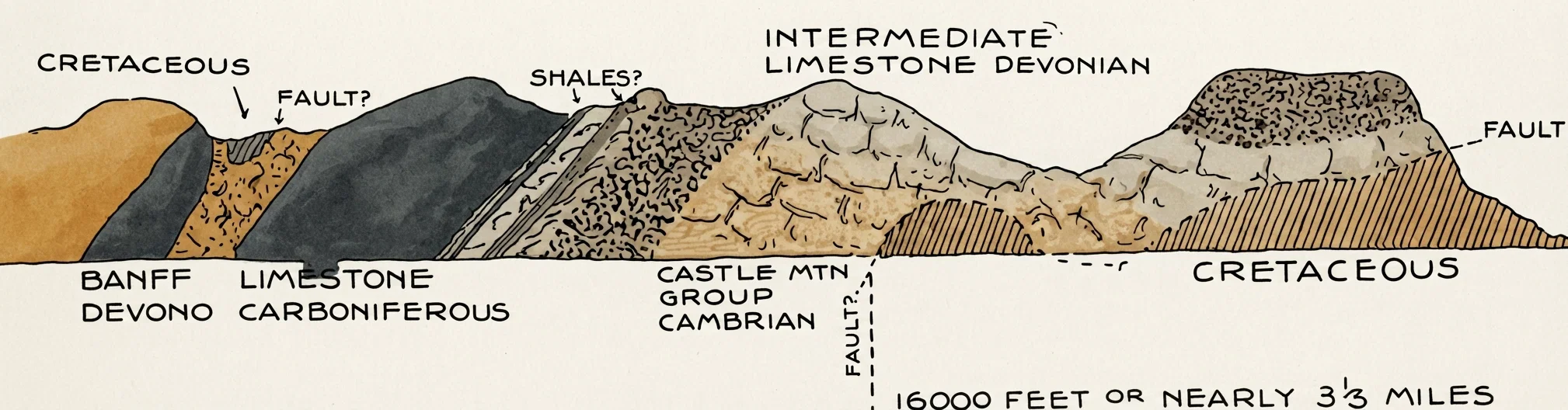
BUT let us proceed. There is another way of testing the rationality of this life-succession idea. If certain fossils are not necessarily "older" than certain others, one might reasonably expect that we would now and then find them reversed as to position, i. e. with the "younger" below and the "older" above. Accordingly we have the following very necessary caution from Prof. H. Alleyne Nicholson:
It may even be said that in any case where there should appear to be a clear and decisive discordance between the physical and the "paleontological [fossil] evidence as to the age of a given series of beds, it is the former that is to be distrusted rather than the latter."—"Ancient Life History of the Earth," page 40.
"Pioneer Colonies," "Faults," etc.
To meet all ordinary cases of this character, where the differences involve only a few formations representing only a few "ages" or a few million years, the period of pioneer "colonies" was invented by Barrande in 1852. But for extreme cases, say where Silurian or Cambrian fossils occur above Jurassic or Cretaceous, there is in such a predicament always an anxious search made for faults and displacements; or gigantic "thrust faults" are described, many miles in horizontal displacement, and it may be one or two miles in vertical displacement—inventions which, as I have already suggested, deserve
to rank with the famous "epicycles" of Ptolemy, and will do so some day.
One or two examples are as good as a dozen. In the part of Alberta east of the Rockies already referred to, is a large portion of country of about fourteen square miles at least—and we know not how much more—where Cambrian fossils are found above Cretaceous, and the inevitable "thrust fault" is thus described by R. G. McConnell—one of the officers of the Canadian Geological Survey. He has just been speaking of "a series" of these "gigantic thrust faults"—
One of the largest and most important of these occurs along the eastern base of the chain, and brings the Cambrian limestones of the Castle Mountain group over the Cretaceous of the foot-hills. This fault has a vertical displacement of more than 15,000 feet [three miles?], and an estimated horizontal displacement of the Cambrian beds of about seven miles in an easterly section. The actually observed overlap as shown on section D-C (fig. 1.) amounts to nearly two miles. The angle of inclination of its plane to the horizon is very low, and in consequence of this its outcrop follows a very sinuous line along the base of the mountains, and acts exactly like the line of contact of two nearly horizontal formations.
The best places for examining this fault are at the gaps of Bow [river] and of the south fork of the
Ghost River. At the former place the cretaceous shales form the floor of the bay which the Bow has cut in the eastern wall of the range, and rise to a considerable height in the surrounding slopes. Their line of contact with the massive gray limestones of the overlying Castle Mountain group is well seen near the entrance of the gap in the hills to the north. The fault plane here is nearly horizontal, and the two formations, viewed from the valley, appear to succeed one another conformably. The line of junction can be traced westward for about half a mile, but toward the upper part of the gap becomes concealed, and soon afterward the Cretaceous rocks bend down and are carried below the surface by a westerly dip. This undulation in the fault plane must indicate a period of disturbance subsequent to that in which the main faulting was produced.
The Cretaceous shales are bent sharply toward the east in a number of places, but with this exception have suffered little by the sliding of the limestone over them, and their comparatively undisturbed condition seems hardly compatible with the extreme faulting which was necessary to bring them into their present inferior position. They are, however, very soft, and doubtless owe their immunity to this fact. It is otherwise with the overlying limestones, which have been strongly corrugated in many places, and are often whitened and cracked in the vicinity of the fault plane, the cracks having been subsequently filled with calc-spar. Enclosed argillaceous beds have also been turned into schists, and the banded appearance of much of the limestone is, no doubt, due to the shearing caused by the thrust.
The Banff Limestone, Devono-carboniferous, ought to be above the Intermediate Limestone, and both of them above the Castle Mountain and Bow River groups; that is, the whole arrangement is upside down, according to the theory.
At the gap of the south fork of the Ghost River, where the fault was next examined, the Cretaceous shales, after dipping below the surface, rise again about a mile further up the valley, and remain exposed for some distance before they finally disappear. The Castle Mountain group here is reduced to a mere tongue, only a few hundred feet thick, separating the Intermediate Limestone from the Cretaceous, but as it thickens out greatly when traced westwards, its faulted character is very evident. The section at this point has a further interest in the fact that a number of Benton fossils [characteristic of middle Cretaceous] were found in the shales directly under the limestone, while a couple of miles north, along the strike of the beds, the overlying limestone yielded Cambrian fossils. [Italics supplied.]—"Annual Report," New Series, Vol. II., Part D. pp. 33, 34.
I have quoted this description at length that no one may charge me with perverting the facts. The accompanying illustrations are taken from the beautifully drawn and colored sections which accompany the report. But it will, I think, be perfectly clear to most of my readers that there is nothing here at all to indicate a real "fault" save that some poor "Benton fossils" (cretaceous) happened to be deposited here over several miles of country
before others classed as "Cambrian;" but as almost the entire geological series and untold millions of years lie in between the Cambrian and the middle Cretaceous, such a state precluded the idea of pioneer "colonies" of the latter in the former, or any similar explanation, and the invention of this incredible "thrust fault" was the only remaining alternative, for their venerable theory could not possibly be wrong.
Similar Structures.
This author quotes Professor Salford's "Geology of Tennessee" (page 190), to show that in the eastern part of that state the Appalachian Chain "presents an almost identical structure;" and he also refers to a similar state of things in the Highlands of Scotland. Dana, in the last edition of his "Manual," (page 359), refers to this report of Mr. McConnell and reproduces his figures; and, on another page, in speaking of this similar example in the Scottish Highlands, says that "a mass of the oldest crystalline rocks, many miles in length from north to south, was thrust at least ten miles westward over younger rocks, part of the latter fossiliferous;" and further declares that "the thrust planes look like planes of bedding, and were long so considered."—"Manual," pp. 111, 534.
Mountains along South Fork of Ghost River.
In addition I find something from the Alps on the same subject. Some three years ago, Dr. M. Ogilvie-Gordon, herself a noted geologist, gave in Nature a review of the two books then recently issued by Prof. A. Rothpletz on the problems presented in these mountains, and she quotes him as describing several gigantic "over-thrusts" from the district about Glarus. Of one of these she says he "concludes from his observations that the whole of this 'Glarus thrust-mass' had traveled from east to west, a distance of about twenty-five miles from the Rhine Valley to the Linth."—Nature, Jan. 24, 1901, p. 294.
Of another example she says: "Professor Rothpletz proves that the rocks of the Rhätikon Chain rest on a basal mass which is the natural continuation of the Glarus thrust-mass eastward, and he concludes that the Rhätikon Mountain mass traveled from Montafon Valley to the Rhine Valley, about nineteen miles from east to west."—Id.
Now while this outline in Nature does not give us positive proof that these truly awful "thrust-masses" are necessitated by and described from fossil evidence only, yet I feel sure that such is the case; for we can imagine no physical evidence competent to form a foundation for such ideas, nor do I know of anything save their precious scheme of life-succession for which geologists will thus freely sacrifice their common sense. Of course there are such things as faults, perhaps even "thrust-faults" in a small way; but I decline to believe such incredible fairy tales as these are shown to be without more substantial9evidence than the exigencies of an out-of-date theory.
Story of the Rivers.
The last point which I need to make in this connection to illustrate the antagonism between the facts of the rocks and this theory of life-succession, is that rivers, in cutting across the country, act in precisely such a manner as if they knew nothing of the varying ages of the rocks, but on the contrary treat them all alike as if they were of the same age, and as if they began sawing at them all at the same time. Of course it is, evidently, in only a few cases where we can get at such facts, that is, in the case of rivers with steep rocky gorges, or those that cut through mountain ranges; but there are several such rivers in the world, and they all seem to tell the same story.
The famous Colorado River is a good example. It flows from "younger" strata into "older" in its deep cutting across the Arizona plateau. Its companion, the Green River, saws through the Uinta Range in the same manner. Similar conditions are said to occur on the Danube, and in the river-courses of the Himalayas and elsewhere. I regret that I have not the details at hand, and Zittel's "History of Geology" (pp. 210, 211), from which I get these outline facts, is very tantalizing in its completeness. The general fact however, is evident enough, viz., that they pass "from younger strata into older," and thus treat all as if they were of the same age, and as if their work of erosion was begun on all at the same time. In the case of the Colorado, Zittel says that—
Powell's explanation of the apparent enigma is that after the river had eroded its channel rocks were uplifted at one portion of its course, but so slow was the rate of uplift that the river was enabled to deepen its channel, either proportionately or more rapidly, so that it was never diverted from its former course.—"Hist. of Geol.," etc., pp. 210, 211.
I think I have now produced evidence to absolutely demonstrate several very remarkable principles about the rocks, and I think that this is the first time that these facts have ever been brought together in this way. I repeat the two given in last week's article:
The "broad fact" as stated by Zittel that any kind of rocks, whatever, i. e., containing any kinds of fossils, may rest on the Archaean, and may themselves be metamorphosed and crystalline.
That any kind of beds may rest in such perfect conformability on any other so-called "older" beds over vast stretches of country that, "were it not for fossil evidence, one would naturally suppose that a single formation was being dealt with," while "the vast interval of time intervening is unrepresented either by deposition or erosion."
That in very many cases, and over many square miles of country these conditions are exactly reversed, and such very "ancient" rocks as Cambrian limestones are on top of the comparatively "young" Cretaceous, while the line between them "acts exactly like the line of contact of two nearly horizontal formations," and in a natural section made by a river the two "appear to succeed one another conformably."
That the rivers of the world, in cutting across the country, completely ignore the varying ages of the rocks in the different parts of their channels, and act precisely as if they began sawing at them all at the same time.
Now I know not what single additional fact can be demanded or imagined to complete the demonstration that this succession-of-life idea is a most monstrous, unscientific assumption, invented a hundred years or so ago in a little corner of Europe to explain some local phenomena, and in ignorance, or at least insular disregard of the strata of the rest of the world, and now followed out to the bitter end in spite of its being at war with a thousand facts.
COURAGE IN THE LORD.
By Ellen G. White
BY MRS. E. G. WHITE.
WELL may our hearts turn to our Redeemer with the most perfect trust, when we think of what He has done for us, even when we were sinners. Through faith we may rest in His love. "Him that cometh to Me," He says, "I will in nowise cast out." It would be a terrible thing to stand before God clothed in sinful garments, with His eye reading every secret of our lives. But through the efficacy of Christ’s sacrifice we may stand before God pure and spotless, our sins atoned for and pardoned. "If we confess our sins, He is faithful and just to forgive us our sins, and to cleanse us from all unrighteousness." The redeemed sinner, clothed in the robes of Christ’s righteousness, may stand in the presence of a sin-hating God, made perfect by the merits of the Saviour. "As many as received Him," the promise is, "to them gave He power to become the sons of God."
Christ has given us no assurance that to attain to perfection of character is an easy matter. It is a conflict, a battle and a march, day by day. It is through much tribulation that we enter the kingdom of heaven. In order to share with Christ in His glory we must share in His suffering. "It became Him, for whom are all things, and by whom are all things, in bringing many sons unto glory, to make the Captain of their salvation perfect through sufferings." "Tho He were a son, yet learned He obedience by the things which He suffered." He has overcome for us. Shall we then, be timid and cowardly because of the trials that we meet as we advance? Shall we not meet them without repining and complaining?
When we have a deeper appreciation of the mercy and loving-kindness of God, we shall praise Him, instead of complaining. We shall talk of the loving watchcare of the Lord, of the tender compassion of the good Shepherd. The language of the heart will not be selfish murmuring and repining. Praise, like a clear, flowing stream, will come from God’s truly believing ones. They will say,
"Goodness and mercy shall follow me all the days of my life; and I will dwell in the house of the Lord forever." "Thou shalt guide me with Thy counsel, and afterward receive me to glory. Whom have I in heaven but Thee? and there is none upon earth that I desire beside Thee."
Why not awake the voice of spiritual song in the days of our pilgrimage? Why not return to our life of fervor? We need to study God’s Word, to meditate and pray. Then we shall have spiritual eyesight to discern the inner courts of the celestial temple. We shall catch the notes of thanksgiving sung by the heavenly choir around the throne. When Zion shall arise and shine, her light will be most penetrating, and songs of praise and thanksgiving will be heard in the assembly of the saints. Little disappointments and difficulties will be lost sight of.
The Lord is our Helper. He will guide us in all matters, if we will trust Him. One thing is certain, we must have faith in God,—faith that He will arrange matters in a way that will enable us to work successfully. No one ever trusted God in vain. He never disappoints those who put their dependence on Him. If we would only do the work that the Lord would have us do, walking in the footsteps of Jesus, our hearts would become sacred harps, every chord of which would send forth praise and thanksgiving to the One sent by God to take away the sin of the world.
"Jehosaphat stood and said, Hear me, O Judah, and ye inhabitants of Jerusalem: Believe in the Lord your God, so shall ye be established; believe His prophets, so shall ye prosper. And when he had consulted with the people, he appointed singers unto the Lord, and that should praise the beauty of holiness, as they went out before the army, and to say, Praise the Lord; for His mercy endureth forever." They praised God for the victory, and four days thereafter the army returned to Jerusalem, laden with the spoils of their enemies, singing praise for the victory won.
Do you not think that if more of this were done now, our hope and courage and faith would be revived? Would not the hands of the soldiers who are standing in defense of the truth be strengthened? If there were much more praising the Lord, and far less doleful recitation of discouragement, many more victories would be gained.
God is the eternal, uncreated Fountain of all good. All who trust in Him will find Him to be this. To those who serve Him, looking to Him as their heavenly Father, He gives the assurance that He will fulfil His promises. His joy will be in their hearts, and their joy will be full.
It is our privilege to open our hearts, and let the sunshine of Christ’s presence in. My brother, my sister, face the light. Come into actual, personal contact with Christ, that you may exert an influence that is uplifting and reviving. Let your faith be strong and pure and steadfast. Let gratitude to God fill your hearts. When you rise in the morning, kneel at your bedside, and ask God to give you strength to fulfil the duties of the day, and to meet its temptations. Ask Him to help you to bring into your work Christ’s sweetness of character. Ask Him to help you to speak words that will inspire those around you with hope and courage, and draw you nearer to the Saviour.
I AM SATISFIED TO KNOW THAT JESUS KNOWS.
By Gertrude Phebe Doerr
I do not know the path that lies before me,
If on it springs the thorn, or buds the rose;
But God's protecting care is ever with me,
And I am satisfied to know that Jesus knows.
I do not know what trials and temptations,
Around me like a threatening cloud may close;
Nor how my weakness can resist the danger,
But I'm satisfied to know that Jesus knows.
I do not know; but trusting in His mercy
Who never failed me, safely I repose.
All shall be well, for even so 'tis written,
And I'm satisfied to know that Jesus knows.
—Gertrude Phebe Doerr.
THE SABBATH
By L. A. Phippeny
BY L. A. PHIPPENY
APOSTASY AND SABBATH REFORM. NO. I.
What We Have Learned.
A REFLECTION on the studies thus far brings to mind the following, among other essential facts, regarding the seventh-day Sabbath.
The Sabbath is the memorial or sign of Creation.
The Sabbath is the sign of sanctification,—the sign of redemption.
From the foregoing fundamental facts note the following:
The Sabbath is an essential part of the everlasting covenant, which, in all its details, was forever established by the death of Jesus the Testator.
It is the only part of the everlasting covenant, or law of God, which definitely tells who the true God is,—the Maker of heaven and earth, and sea, and all that in them is.
It is a knowledge of the true God and Jesus Christ who, representing the Godhead, came to save sinners, that constitutes life eternal for the believer.
The blessings of life eternal through the Gospel were prepared from the foundation of the world—for this world—and from eternity for all worlds. The possession of life eternal means everlasting rest—the keeping of a continual Sabbath in Christ. Hence, the Sabbath is the sign of redemption.
The Gospel of Christ is the Gospel of supreme love. Hence, the Sabbath as a sign of redemption through the Gospel is the sign of the reception by faith of the love of God in Christ. God is love. The Sabbath therefore signifies love and joy and delight in the Lord, as opposed to ceremonialism and restricted freedom. It signifies the liberty wherewith Christ has made us free.
Result of Losing Sight of Truth.
Just to the extent that these positive truths have been lost sight of in any age of the world has darkness and error found a foothold. This was primarily true in the beginnings of sin, whether in Lucifer in heaven or in Adam in this earth. Sin was a departure from right and life, and God in Jesus Christ was and is the origin and the sum and substance of right and life. To depart from life means death. Jesus Christ is the only way of life. There is another way, but it is the way of death. Then when another way was chosen by Lucifer or by Adam, it was not God's way. It was the way of another, and it was the way that led to ruin and death. In Lucifer's case it was his own way; in Adam's case it was Lucifer's way in him. In either case it was the choosing of another god than the God who created heaven and earth, the sea, and all that in them is; and the other god could neither give nor sustain life.
Then whenever another god, or a multitude of gods or idols are chosen instead of the true God, what can result but a departure from right precepts and principles, and the introduction of false doctrines and the worship of some strange god? How essential, then, that the facts respecting the true God, the great Creator of all things, should be kept always in mind. This the Sabbath was and is designed to do. Especially is there necessity of this in a world in which sin has found a foothold.
And so the Lord said to Israel: "I am the Lord your God; walk in My statutes, and keep My judgments and do them; and hallow My Sabbaths; and they shall be a sign between Me and you, that ye may know that I am the Lord your God." And again: "Moreover, also, I gave them My Sabbaths, to be a sign between Me and them, that they might know that I am the Lord that sanctify them." Eze. 20:19, 20, 12. Just so long as the people would see God through the Sabbath and would rely upon His power to enable them to keep His statutes and judgments, so long would they be kept from sin and from departing from Him. Then they would be His people, and He would be their God, and do through them all that He wished to do.
But they did not remain faithful. "They despised My judgments, and walked not in My statutes, but polluted My Sabbaths; for their heart went after their idols." Eze. 20:16. Four times in this chapter is this reason given for their departure from God, and the statement made that in backsliding they polluted the Lord's Sabbaths. This would necessarily be so if they forsook Him to go after other gods, for they would either wholly disregard the Sabbath or make a pretense of honoring it while their hearts were going after other gods. Either would be pollution of the Sabbath, for its true signification would be perverted. Over and again Israel was led into the idolatry of the nations around them. In speaking of their departures from Him the Lord has recorded such expressions as the following, in harmony with the foregoing: "They kept not the covenant of God, and refused to walk in His law; and forgat His works, and His wonders that He had showed them;" "They believed not in God, and trusted not in His salvation;" "Their heart was not right with Him, neither were they steadfast in His covenant." Ps. 78:10, 11, 22, 37.
Of Universal Application.
These truths respecting apostasy are applicable in every age. For if the knowledge of God is dimmed through sin, His laws are disregarded. And it is fundamentally true that the sign of the true God, the Sabbath, which tells who He is, also passes from men's minds, is disregarded as to its intrinsic importance, and hence, in the definition indicated by the Lord Himself, is polluted. Between the foregoing facts and principles and Sunday observance there is a very close relation. It is not asserted at all in these studies advocating the seventh-day Sabbath that every observer of Sunday is an apostate from God. Attention is merely called to the principles involved, with an earnest hope that the truth may appear so clear and desirable that error shall be gladly abandoned when it is pointed out and shown to be error.
CHRISTIAN DEVELOPMENT UNDER GOD'S LAST WARNING MESSAGE.
By B. Franklin Richards
BY B. FRANKLIN RICHARDS.
IN all ages of the past the Lord has given ample warning to the people before the occurrence of any great event. Since the creation there has been nothing of greater importance to the world than the second coming of Christ, since it marks the cessation of the world's activity, and the end of the age.
The last warning message of God to the world is recorded in Rev. 14:9-11: "And the third angel followed them, saying with a loud voice, If any man worship the beast and his image, and receive his mark in his forehead, or in his hand, the same shall drink of the wine of the wrath of God, which is poured out without mixture into the cup of his indignation; and he shall be tormented with fire and brimstone in the presence of the holy angels, and in the presence of the Lamb; and the smoke of their torment ascendeth up forever and ever; and they have no rest day nor night, who worship the beast and his image, and whosoever receiveth the mark of his name."
In all the Bible there is no denunciation as fearful as this. It is a special message of God's special warning to the people of the earth against receiving the "mark of the beast" or worshiping either the beast or his image. So somewhere in the Word there must be a record of a power which compels the people to do this very thing. Such a record is found in Rev. 13:11-17: "And I beheld another beast, . . . and he exerciseth all the power of the first beast before him, and causeth the earth and them which dwell therein to worship the first beast, . . . and he doeth great wonders, . . . and deceiveth them that dwell on the earth by the means of those miracles which he had power to do in the sight of the beast; saying to them that dwell on the earth, that they should make an image to the beast; . . . and he had power to give life unto the image of the beast, that the image of the beast should both speak, and cause that as many as would not worship the image of the beast should be killed. And he causeth all, both small and great, rich and poor, free and bond, to receive a mark in their right hand, or in their foreheads; and that no man might buy or sell save he that had the mark, or the name of the beast, or the number of his name."
A Courageous People.
The reader can see that the person who, in the face of this cruel power, will remain loyal to God, must be a Christian of undoubted courage. He will also be a reader of the Bible and acquainted with God. He must know that God is talking directly to him when He says, "Be strong and of a good courage; be not afraid, neither be thou dismayed; for the Lord thy God is with thee whithersoever thou goest." Joshua 1:9. This will make him a true worshiper; for he will be depending each moment on God for protection and support. He will be
A Member of the True Church
also, for he will heed the command of the Lord to come out of any church that has become "the habitation of devils, and the hold of every foul spirit, and a cage of every unclean and hateful bird." Rev. 18:1-5.
Commandment-keepers.
The distinctive feature of the Christian developed under this last warning message11will be the keeping the commandments of God; for while this last message is sounding, and the compelling power of the "beast" is enforcing its worship by the death penalty, there will be a people, the true church of God, who are described by the angel thus: "Here is the patience of the saints; here are they that keep the commandments of God, and the faith of Jesus." Rev. 14:12.
A Healthy People.
Because of their strict obedience to the commands of the Lord, none of the diseases or plagues, that will afflict the people of the world will come upon them. "If thou wilt diligently harken to the voice of the Lord thy God, and wilt do that which is right in His sight, and wilt give ear to His commandments, and keep all His statutes, I will put none of these diseases upon thee, which I have brought upon the Egyptians; for I am the Lord that healeth thee." Ex. 15:26. "Because thou hast made the Lord, which is my refuge, even the Most High, thy habitation; there shall no evil befall thee, neither shall any plague come nigh thy dwelling. For He shall give His angels charge over thee, to keep thee in all thy ways." Ps. 91:9-11. While they themselves are living in accordance with the laws of health, it is reasonable to conclude that they will be teaching to other people proper ways of living.
Students of the Bible.
Because of their desire to know the mind of God the people of the true church will so earnestly apply their minds to the study of the Bible that they will become skilled in explaining the Scriptures. "Study to show thyself approved unto God, a workman that needeth not to be ashamed, rightly dividing the word of truth." 2 Tim. 2:15.
A Thoughtful and Careful People.
This message will develop a people who will call into activity every power of their being in consecrating themselves for the salvation of souls. They will obey the injunction: "Meditate upon these things; give thyself wholly to them, that thy profiting may appear to all. Take heed unto thyself, and unto the doctrine; continue in them; for in doing this thou shalt both save thyself, and them that hear thee." 1 Tim. 4:15, 16.
Adventists.
Because of the fearful persecutions of the beast power, the extreme wickedness of the times, the people of God who are giving this last message are waiting anxiously for their coming Lord, and with this desire uppermost in their minds, it becomes the theme of their conversation. "And it shall be said in that day, Lo, this is our God; we have waited for Him, and He will save us; this is the Lord; we have waited for Him, we will be glad and rejoice in His salvation." Isa. 25:9.
Seventh-day Adventists.
We have seen by the last quoted text that God's special and "peculiar" people under the last message are Adventists because they are proclaiming His second coming and are looking for Him. They also "keep the commandments of God" (Rev. 14:12), and since the fourth is one of the ten, and enjoins the keeping of the seventh-day Sabbath, they become Seventh-day Adventists by its observance.
The experience through which that people have passed and the character which they have developed under this message in standing loyalty for God in spite of the tyrannical persecution of the beast power, enable them at last to join in that triumphal chorus before the throne of God. "And I saw as it were a sea of glass mingled with fire; and them that had gotten the victory over the beast, and over his image, and over his mark and over the number of his name, stand on the sea of glass, having the harps of God. And they sing the song of Moses the servant of God, and the song of the Lamb." Rev. 15:2-4.
Sabbath-keepers Forever.
Their lives measure now with the life of God. Eternity is before them; they keep the Sabbath holy. "And it shall come to pass, that from one new moon to another, and from one Sabbath to another, shall all flesh come to worship before Me, saith the Lord." Isa. 66:23.
Faith Through Adversity
"LIKE Peter on Galilee's troubled bosom, men walk the waves of adversity in perfect safety while they look alone to Christ in faith; but when, like him, they look away to the waves, they sink in the surf of trouble, and are soon swallowed up."
“I’M TOO BUSY.”
A MERCHANT sat at his office desk. Various letters were spread before him. His whole being was absorbed in the intricacies of his business. A zealous friend of religion entered the office.
“I want to interest you a little in a new effort for the cause of Jesus Christ,” said the good man.
“Sir, you must excuse me,” replied the merchant. “I am too busy to attend to that subject now.”
“But, sir, inquiry is on the increase among us,” said his friend.
“Is it? I’m sorry, but I’m too busy at present to do anything.”
“When shall I call again, sir?”
“I can not tell; I’m very busy. I’m busy every day. Excuse me, sir; I wish you a good morning.”
Then bowing the intruder out of his office, he resumed the study of his papers.
The merchant had frequently repulsed the friends of humanity in this manner. No matter what the object, he was always too busy to listen to their claims. He had even told his minister that he was too busy to do anything but to make money.
But one morning a disagreeable stranger stepped very softly to his side, laying a cold, moist hand upon his brow, and saying, “Go home with me!”
The merchant laid down his pen, his head grew dizzy; his stomach felt faint and sick; he left the counting-room, went home, and retired to his bedchamber.
His unwelcome visitor had followed him, and now took his place by his bedside, whispering ever and anon, “You must go with me.”
A cold chill settled on the merchant’s heart; specters of ships, notes, houses and lands flitted before his excited mind. Still his pulse beat slower, his heart heaved heavily, thick films gathered over his eyes, his tongue refused to speak. Then the merchant knew that the name of his visitor was Death.
Humanity, mercy, and religion had alike begged his influence, means, and attention in vain; but when death came he was powerless—he was compelled to have leisure to die.
Let us beware how we make ourselves too busy to secure life’s great end. When the excuse rises to our lips, and we are about to say we are too busy to do good, let us remember we can not be too busy to die. “Prepare to meet thy God.”—Selected.