Your ShelfYour Projects

Signs of the Times, Vol. 40, No. 42.

My Best-Beloved

Signs of the Times

Oct 28, 1913

Pacific Press Publishing Association · Mountain View, California · Oct 28, 1913

My Best-Beloved

BY WORTHIE HARRIS HOLDEN
Sing to me of Sharon's roses Redolent of perfume sweet; Sing the lily's famed glory, Purity and beauty meet; Waft, ye winds with incense laden, Myrrh and spices from afar; Shine, O sparkling gem of morning, Heaven's radiant earnest-star;
Gather from the land and ocean All its teeming treasure rare, But earth's fulness rich can never With my Best-beloved compare. O the priceless wealth-bestowal On the people of His choice: Wake, my soul, to laud His praises; Sing, ye saved, with heart and voice.

Our Bible Band

Since there will be no paper next week, we give the “Bible Band” lessons for two weeks in this issue.

Schedule for the Week Ending November 1, 1913

Day Date Reading
Sunday October 26 Luke 20
Monday “ 27 “ 21
Tuesday “ 28 “ 22
Wednesday “ 29 “ 23
Thursday “ 30 “ 24
Friday “ 31 1 Corinthians 1; Psalm 73
Sabbath November 1 “ 2; “ 74
Our readings finish Luke, the last five chapters, and include 1 Corinthians 1, 2, and Psalms 73, 74. Of wonderful interest and import are the readings of this week. We have the efforts of the scribes and the Pharisees to entrap our Saviour, His great discourse on His second coming and the signs which shall precede, the betrayal by Judas, the institution of the Lord’s Supper, the trial before the Sanhedrin, the crucifixion, that remarkable first day in which our Lord made Himself known to His disciples, and His ascension.
Our next book is 1 Corinthians. We omit this year, as we read last year, Acts, Thessalonians, Ephesians, and Hebrews. In this week’s lesson are included the first two chapters of 1 Corinthians, Paul’s letter to the church he had raised up in the city of Corinth, in Southern Greece, about forty miles southwest of Athens. It was destroyed by the Romans in 146 B.C., but rebuilt by Julius Caesar in 46 B.C., one hundred years later. It was peopled by a colony of veteran soldiers and others. It became the metropolis of the Roman province of Achaia, and the meeting place of all the social forces of the age. Noted for its licentiousness, it was the shame of all the region. It was from this city and from the wicked of this city that the Corinthian church was gathered, as we will learn by perusing the epistle. On account of various ones that labored there, the church itself seems to have become more or less divided into factions. Paul writes his epistle to correct these things.

Schedule for the Week Ending November 8, 1913

Day Date Reading
Sunday November 2 1 Corinthians 3; Ps. 75, 76
Monday “ 3 “ 4; “ 77
Tuesday “ 4 “ 5, 6; “ 79
Wednesday “ 5 “ 7, 8; “ 80
Thursday “ 6 “ 9; “ 81
Friday “ 7 “ 10; “ 83, 84
Sabbath “ 8 “ 11; “ 82
In our week’s reading come chapters 3-11 inclusive of 1 Corinthians, and Psalms 75-77, 79-84. We need not take time or space in explaining any of these scriptures. The meaning stands out quite readily. The practical lessons ought to be taken home to the heart.

Question Corner

"IF YE WILL INQUIRE, INQUIRE YE."
This Inquirer's Department is conducted for the purpose of helping those who are studying the Bible. The answers are oftentimes only suggestive. They are never to be considered infallible, only as they agree with the infallible Word. The writer who may answer these questions does not consider that his opinion is infallible. He will simply give the best that he has, and plead with the inquirer to search the Word. Such questions only will be answered as, to the editors, seem to minister to the good of the readers and to the mission of the paper. We can not answer repeatedly in the same volume questions upon the same subject. The name and address must accompany questions, not for publication, but as an evidence of good faith, and that answer may be made by letter if deemed advisable. No letters are answered which do not contain the name of the writer. It is well always to enclose stamp for reply.

4209 — Catholic Version of the Bible

I would like to know where a person can get hold of the “Vatican version” of the Bible, or how a person can find out what it says on certain scriptures. I would like especially to know how it translates Matt. 28:19. A. D. F.
There were numerous Latin versions of the Scriptures in the early centuries, and some of them were not considered satisfactory reproductions of the original text; so in the latter part of the fourth century and the first part of the fifth, Jerome, who was reckoned as an accomplished scholar, undertook the careful translation of the Scriptures into the Latin. His first translations of the Old Testament were from the Septuagint; but these met with criticism, and he finally undertook the work of making a careful translation into the Latin from the original Hebrew Scriptures. Jerome's Vulgate translation came to be the standard of the Catholic Church, having been finally adopted by the Council of Trent. Some of the earliest English translations were made from this Latin text. When the Reformation was at its height, the Catholic Church concluded that it was necessary for them to make a translation of the Scriptures into the English. This was begun at the college in Douai, in Flanders. The college for a time was driven from Douai to Reims, and while at Reims the New Testament was published; hence the name, “the Reims New Testament.” The college finally returned to Douai, and the complete Bible was published. The Douai is the authoritative Catholic version of the English Bible. It may be purchased at almost any large bookstore. The copy that we have is published with the approbation of James Cardinal Gibbons, by John Murphy Company, Baltimore and New York.
In the Douai Version, Matt. 28:19 reads: “Going, therefore, teach ye all nations, baptizing them in the name of the Father, and of the Son, and of the Holy Ghost.” It will be seen that that text does not materially differ from the translation in our authorized version; and the same is true, in the main, throughout the Bible.

4210 — The Bride of Christ and His Body

There are people in our neighborhood who say that there is a difference between the bride of Christ and His body. They teach that the bride is taken away first, and that the world at large will not see it. Among the texts they quote is Luke 17:34-36. A. D. F.
This text reads: “I tell you, in that night there shall be two men in one bed: the one shall be taken, and the other shall be left. Two women shall be grinding together; the one shall be taken, and the other left. Two men shall be in the field; the one shall be taken, and the other left.”
There is nothing difficult about this scripture when we come to understand the subject of the judgment as it is clearly taught in the Bible. To give a setting forth of the doctrine of the judgment would require much more space than we can give in this department. The inquirer is invited to consult our books on the subject. But, briefly stated, the doctrine is this: The judgment of the righteous takes place before the first resurrection. Paul says that “there shall be a resurrection of the dead, both of the just and unjust.” Acts 24:15. Revelation 20 shows in very plain language that the blessed and holy have part in the first resurrection, and they live and reign with Christ a thousand years; but the rest of the dead, or the wicked, “lived not again until the thousand years were finished.” The judgment of the righteous must precede their resurrection, and that work is carried on in the sanctuary in heaven. The prophecy of the eighth chapter of Daniel shows that this mighty judgment work began at the end of the two thousand three hundred prophetic days, in 1844. The voice of prophecy is clear in showing that this judgment work is now going on. But that work is in heaven, entirely removed from the eyes of men, so that they are unable to see the work as it is progressing. Only by faith in the prophetic Word can they know that the great court presided over by the Judge of the universe is now in session. That judgment work would naturally take up the cases of the first righteous persons that ever lived upon the earth. It would come down through the centuries, and finally reach those who are living; and when it comes to those who are living, they will be carrying on their ordinary occupations in life. As the text in Luke says, there will be two in one bed: one will be taken, and the other left. Two will be grinding together: one will be taken, and the other left. Two will be in the field together: one will be taken, and the other left. But they are not taken away from this earth at that time; they are chosen for immortality and eternal life.
The theory that individuals will be mysteriously taken away from this earth, one after another, before Christ comes, is not only unscriptural, but there is no case on record of any such thing having been done. No one pretends to offer satisfactory or conclusive evidence for any such cases. If men were willing to study the Bible as a whole, and to see its harmonious, consistent teachings, they would be saved from many of their difficulties.

4211 — The Number 24

“Four and twenty” seems to be a great number in the Bible. It is used in Haggai and many places with only a literal meaning. There are twenty-four hours in a day, and it is twice the number of the disciples; the six wings on the beast of Revelation 4 make twenty-four. This number “four and twenty” is found in a great many more texts. Will you please look them up for me and send a list of the places, and tell what you think of them? O. H. A.
Bible studies of this kind are almost wholly speculative. The individual is following his fancy, and not following the teaching of what the Word says. There have been a great many fanciful interpretations of the Bible based upon such methods. Following methods of this sort, definite time, again and again during recent years, has been set for the coming of the Lord. True Bible study consists of taking God's words as they read, and placing upon those words no interpretation that can not be read from the words themselves. We have no right from God to get any fanciful meaning from the number 24, or from any other number. If His direct Word places a meaning in a number, it is there because He says it, and not because we find it out by some fancy. There is so much in the Word itself to be studied and known, that we should not take our time for these fanciful interpretations.

4212 — The “Middle Wall” and the “Enmity”

Please explain Eph. 2:14, 15. The “middle wall of partition” was between whom? What is meant by the “enmity”? B. W.
The selfishness of the carnally minded in the Jewish nation built up a strong barrier between the Jew and the Gentile race. Paul shows that everything that had been done to make these distinctions was broken down in Christ, but the individual must actually possess Christ and have an experience in His plan of salvation in order for these barriers and partition walls to be broken down. Through Him, we both, Jew and Gentile, “have access by one Spirit unto the Father,” and are therefore “no more strangers and foreigners, but fellow citizens with the saints, and of the household of God,” being “built upon the foundation of the apostles and prophets, Jesus Christ Himself being the chief corner-stone.” The eleventh verse of this chapter shows that Paul was talking to those who had been brought into the Christian faith from the Gentile world, and he was showing them that they were brought into all of the fullness of the promises of God. Everything that had ever been given by the divine Father was their inheritance and for them to enjoy. God had given laws concerning ordinances and sacrifices that pointed forward to Christ. These were designed to teach the true faith in Him, to surround His church with a protection against the wickedness of the heathen world. But His church then, as now, was to stand as a light, and to draw others into His fold and give them the blessings of the promises of God. But instead of following this divine plan, and allowing God's ordinances to shine as a light to draw the Gentiles, their carnal minds had built these things into a wall of partition to separate the Jews from the Gentile world; but now everything of that character is swept away, because the Christ Himself has come and has put an end to all of those sacrifices and ordinances, and the middle wall of partition is entirely gone with those who accept Christ and His fulness. But if we do not accept Christ in His fulness, we may still manufacture separating partition walls.

4213 — Preachers Playing Games

Is it right for ministers of the gospel to play games, such as chess, checkers, and the like? G. W. S.
There is so much that needs to be known of the word of God, and the subjects with which it deals, and there is so much work to be done for dying humanity, that the true minister of the gospel who has a keen, realizing sense of the importance of the work in which he is engaged, will feel the necessity of using his time in more profitable ways.

Peter’s Confession of Christ

By Mrs. E. G. White
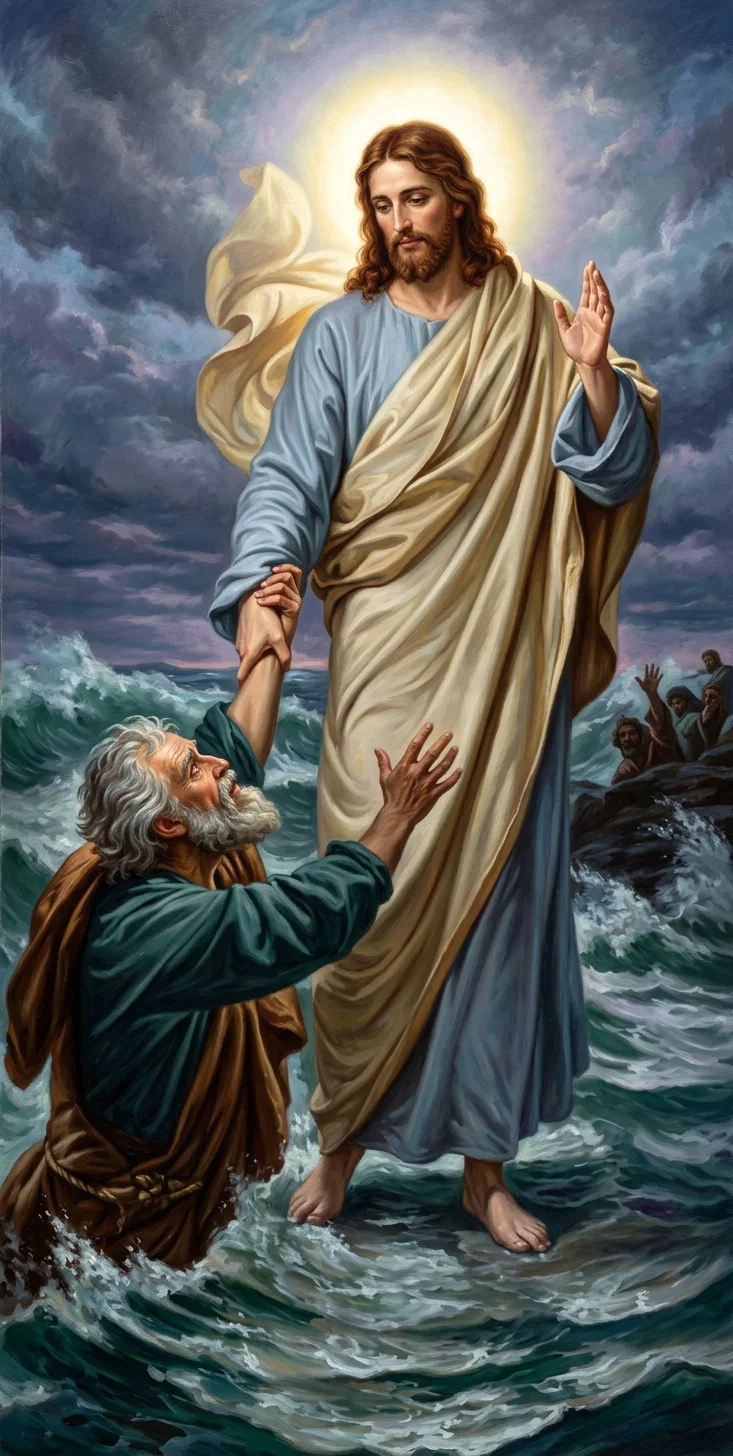
Peter has no preeminence over the rest of fallen humanity. He, too, must cry out, “Lord, save me.”
BEFORE His crucifixion, Jesus made use of the few hours of seclusion with His disciples in praying with them, and teaching them more definitely concerning the nature of His kingdom. He saw that in their human weakness, they were inclined to desire that His reign should be a temporal one. Their earthly ambition had caused them to become confused as to the real mission of Christ. He now reproved them for their misconception, and taught them that instead of worldly honor, it was shame that awaited Him, and instead of a throne, the pitiless cross. He taught them that for His sake, and to win salvation, they must also be willing to endure reproach and contumely.
The time drew near when Jesus was to die, and leave His disciples to face the cold and cruel world alone. He knew how bitter hate and unbelief would persecute them, and He wished to encourage and strengthen them for their trials. He accordingly went away by Himself and prayed for them, interceding with the Father, that in the time of that fearful test which awaited them, their faith would prove steadfast, and His sufferings and death might not utterly overwhelm them with despair. What tender love was this, that, in view of His own approaching agony, reached forward to shield His companions from danger!
When He again joined His disciples, He asked them: “Whom do men say that I the Son of Man am? And they said, Some say that Thou art John the Baptist: some, Elias; and others, Jeremias, or one of the prophets.” Questioning still closer, He inquired, “But whom say ye that I am?” Peter, ever ready to speak, answered for himself and his brethren: “Thou art the Christ, the Son of the living God. And Jesus answered and said unto him, Blessed art thou, Simon Bar-jona: for flesh and blood hath not revealed it unto thee, but My Father which is in heaven.”
Notwithstanding the faith of many had utterly failed, and the power of the priests and rulers was mighty against them, the brave disciple thus boldly declared his belief. Jesus saw, in this acknowledgment, the living principle that would animate the hearts of His believers in coming ages. It is the mysterious working of God’s Spirit upon the human heart, that elevates the humblest mind to a knowledge above all earthly wisdom, and acquaintance with the sacred truths of God. Ah, indeed, “Blessed art thou, Simon Bar-jona: for flesh and blood hath not revealed it unto thee.”
Jesus continued: “And I say also unto thee, That thou art Peter, and upon this rock I will build My church; and the gates of hell shall not prevail against it.”
The word “Peter” signifies a loose stone. Christ did not refer to Peter as being the rock upon which He would found His church. His expression “this rock,” applied to Himself as the foundation of the Christian church. In Isa. 28:16 the same reference is made: “Therefore thus saith the Lord God, Behold, I lay in Zion for a foundation a stone, a tried stone, a precious corner-stone, a sure foundation.” It is the same stone to which reference is made in Luke 20:17, 18: “And He beheld them, and said, What is this then that is written, The stone which the builders rejected, the same is become the head of the corner? Whosoever shall fall upon that stone shall be broken; but on whomsoever it shall fall, it will grind him to powder.” Also in Mark 12:10, 11: “And have ye not read this scripture; The stone which the builders rejected is become the head of the corner: this was the Lord’s doing, and it is marvelous in our eyes?”
These texts prove conclusively that Christ is the rock upon which the church is built, and in His address to Peter, He referred to Himself as the rock which is the foundation of the church. He continues: “And I will give unto thee the keys of the kingdom of heaven: and whatsoever thou shalt bind on earth shall be bound in heaven: and whatsoever thou shalt loose on earth shall be loosed in heaven.”
The Roman church makes a wrong application of these words of Christ. They claim that He addressed them specially to Peter. Hence he is represented in works of art as carrying a bunch of keys, which is a symbol of trust and authority given to ambassadors and others in high positions. The words of Christ, “I will give unto thee the keys of the kingdom of heaven,” were not addressed to Peter alone, but to the disciples, including those who compose the Christian church in all ages. Peter was given no preference nor power above that of the other disciples. Had Jesus delegated any special authority to one of them, we would not find them so frequently contending among themselves as to who should be greatest. They would have at once submitted to the wish of their Master, and paid honor to the one whom He had selected as their head.
But the Roman Catholic Church claims Christ invested Peter with supreme power over the Christian church, and that his successors are divinely authorized to rule the Christian world. In still another place, Jesus acknowledges the same power to exist in all the church, that is claimed to have been given to Peter alone, upon the authority of the text previously quoted: “Verily I say unto you, Whatsoever ye shall bind on earth shall be bound in heaven: and whatsoever ye shall loose on earth shall be loosed in heaven.”

The Conquest of Self

EVERY one who enters the pearly gates of the city of God will enter there as a conqueror, and his greatest conquest will have been the conquest of self.— E. G. W.

Quality of Truth

By L. A. Reed
In the Word are plain statements of truth. The language is so clear and simple that even a schoolboy can understand it. But men modify these plain statements, robbing them of their clearness and force, and making them teach error.
God has promised to supply all our need according to His riches in glory by Christ Jesus. He says that His word is able to make the man of God perfect, thoroly furnished to all good works. And when Christians are approached with these words of God, they answer, “Yes, but—,” and then add explanations and interpretations, until, if what they say be true, it is only particular, circumscribed truths that are revealed in the Word, and for all others we must go elsewhere.
Out on such philosophy! It is the old doctrine started in the Garden of Eden,—“Yea, it may be that God hath said thus and so, but God doth know,” etc. Bound for the eternal judgment, facing our everlasting destiny, can we afford to borrow the devil’s method of dealing with God’s truth? Is it not better to believe and receive what God says? From what we know of Him, can we not give Him credit for knowing what He means to say, and saying precisely what He means?
There are many who believe and teach that the Bible does not deal with the truths of science,—that the Bible and science have separate fields, utterly distinct and isolated from one another. They rest their argument on the statement that the Bible contains only “saving truths.” And never was there a greater truth than this one just stated. The Bible does contain only saving truths. That is an undisputable truth, a truth solid as the eternal rock.
“But,” says one, “if you admit their premises, you must admit their conclusion,—that the Bible does not deal with the truths of science.” Not so! Admitting that the Bible reveals only saving truth, and building with it a right syllogism, we come to another conclusion entirely, from which there is no escape.
It is everlastingly true that the Bible reveals only saving truth; but the reason for this lies in the very quality of truth itself.
All truth is saving truth. The quality of truth is saving power, and the great end of every truth and of all truth is to save. It can do naught else but save, for truth is the character of God.
A revelation, therefore, of truth is a revelation of God. A view of truth is a view of God.
But to see and know God is eternal life, which is salvation. Truth saves.
Truth is the statement of facts concerning that which exists. But only that which God ordains really exists. The whole truth is the full expression of all that God has established or ordained. It is correspondence with and conformity to environment, as the scientists say of life. But eternally to conform to and correspond with what God has ordained, is to conform to and correspond forever with God; and how can this be anything else than salvation? Truth saves.
“And ye shall know the truth, and the truth shall make you free.” John 8:32. Man is bound by sin. He can not conform to the principles of life. He does things which are utterly destructive to himself. But truth brings him into conformity with all the powers and existences that God has placed in the universe. And living thus, he is free. Truth saves.
If geometry, or algebra, or any science, is truth, that truth is saving truth. But truth must be apprehended, it must be known, in order to save. And to know truth, more is necessary than the hearing of the ears. To know a thing fully is to know it with every sense and organ and power of the being. It must be lived. Unless truth is known, it can not save. “And ye shall know the truth, and the truth shall make you free.”
Science indisputably contains truth, and hence saving truth; and if the truths of science have not been aids to man’s salvation, the fault must lie in the way in which they have been known. They have not been properly taught or studied, they have not been known aright; for to know them aright is to know God, is to have eternal life, is to be saved.
Perhaps just here some would like to lodge an objection, and say that the fact that there is one God is not a saving truth; for James says (chapter 2:19) that the devils believe this truth, and tremble, but it does not save them. True; but the fault is not in the truth, it is in the way it is received. The devil does not know at all times and in all places that there is one God. He has a fond and lingering hope that he himself is God, or ought to be God.
Wherever he has opportunity, he “as God sitteth in the temple of God, showing himself that he is God.” He fell upon this very point. He meant to be God. He said in his heart, “I will be like the Most High.” If the devil or any creature comes to the point where he knows the truth that there is one true God, he must, in doing so, give up self. He is saved. Truth—any truth—is saving truth. All truth saves.
We repeat that the truth of geometry, of algebra, or of any other science, is saving truth. One may say: “I do not see it. How can the truths of mathematics be aids to man’s salvation?” But we were not discussing the question of how this is so. We were simply accepting the words of God that it is so. The first thing for us is to decide that it is so; the seeing, or understanding, comes afterward. If mathematics is to be an aid to our salvation, the first thing is to determine the fact. The next thing is to understand how it is so, and begin to study and to teach it in this right way.
It is so customary to consider the truth of mathematics as wholly independent of Bible truth, that it is difficult for us to receive such statements as the foregoing. But we have God’s word for it. We are sure of what He says. In the Word is all truth, and all truth includes the truth of mathematics. But truth saves, and hence the truth of mathematics is saving truth.
I inquired not long ago for a book entitled “Geometry and Faith.” The salesman looked incredulous, and exclaimed, “Geometry and Faith!” The idea of connecting the two had never entered his head. He thought I must be mistaken. But there is such a book; and more, there is such a combination as mathematics and faith. God joined them. Man has sought to divorce them, and that, too, in the face of the divine command, “What therefore God hath joined together, let not man put asunder.”
Mathematics can minister to a man’s faith. Rightly studied, the science of mathematics will increase one’s faith. It will be impossible, in this brief treatise, to give extended illustrations of the fact. But let it suffice to know that mathematical truth is calculated to show us, more certainly than is any other truth, that God can not make a mistake with anything, and therefore can make no mistake with us; that He is always exact; that everything He does is timed to the second.
In a thousand ways mathematical truth appeals to us, and bids us have confidence in God. This is its ultimate object. It shows us that our lives and all the providences of our lives are arranged according to the most delicate adjustment, and that there is no mistake in all God’s doings—no, not by the one hundred-millionth of a fraction of a second, or the one ten-billionth of a line.

On Business Principles

WHEN we are advised to secure any certain article, divers questions arise; as: Do we need it? What would be the advantages in having it? Can it be obtained? How can we get it? Shall we have it?
Letting the indefinite “it” in the foregoing sentences refer to the Spirit of God, how shall we answer the question, “Do we need it?” This question is already answered in John 15:5, where Christ is quoted as saying, “Without Me ye can do nothing.” For “Me” we may substitute “the Holy Spirit,” for “the Holy Spirit is Christ’s representative.”
Giving the same meaning to the pronoun in the second question as in the first, we have the query, “What would be the advantages in having the Holy Spirit?” One answer is found in Phil. 4:13: “I can do all things through Christ which strengtheneth me.” A great advantage that surely is. Others equally — that is, infinitely — great are mentioned in John 14:26, 27. Read the statements made therein; also, as a climax, John 8:12; and, incidentally, Matt. 6:33.
After receiving such assurances as these, any sane person, it would seem, must feel impelled to inquire, “Can it be obtained?” One who is fully qualified to answer, has done so in the words of Luke 11:13: “If ye then, being evil, know how to give good gifts unto your children, how much more shall your heavenly Father give the Holy Spirit to them that ask Him?”
Next we wish to learn whether so desirable an object is within our reach. The terms are given in Isa. 55:1; and certainly they are most favorable. No one is so poor as to be unable to meet them; and yet, the richest man must give his all, but that is an extraordinarilysmall amount compared with the value of the thing to be procured.
The final question is, “Shall we get it?” Perhaps no one would wittingly forfeit such an opportunity; yet by procrastination many lose it. Sound business policy would prompt one to seize it promptly. “Now is the accepted time.”
ADELADE D. WELLMAN.

“There Shall Be No More Curse”

By J. O. Corliss
It is worthy of repetition that a curseless age, when the whole earth shall abide in perpetual freshness, like a well-watered garden, has been the ambition and expectation of many generations. The Noachic Deluge witnessed a heavenly effort to destroy evidences of the original curse, under which every wicked son of man perished, and the face of old earth met a change which forever veiled the iniquity it had sustained, and for a time uprooted the “thorns and thistles” of its former ingatherings.
But sin again quickly developed, and Flood descendants repeated in a measure the history of the antediluvians, returning upon themselves the original curse which God had endeavored to cancel. God, however, again sought to establish His government in the earth through the calling of Abraham; but instead of destroying all except Abraham’s family, as in Noah’s case, the chosen one was removed into a favored land, where, by himself, his environments would be quite favorable to success in the work to which he was called.
Upon his arrival at the selected spot, the heavenly voice said to the patriarch: “Lift up now thine eyes, and look from the place where thou art northward, and southward, and eastward, and westward; for all the land which thou seest, to thee will I give it, and to thy seed forever. And I will make thy seed as the dust of the earth.” Gen. 13: 14-16. This was a most comprehensive promise, including far more than the limited boundaries of Palestine, or the literal seed of Abraham’s person. It meant infinitely more than that; it was the appointment of Abraham to become the father of all spiritual believers, and to declare him and his ideal offspring heirs of the world. Rom. 4: 11-13.
The method by which this result was to be attained, is graphically revealed by this same apostle. He says that Christ was made a curse for us, in order to redeem us from the curse which God’s law put on us on account of our sins, and also to let the blessing of Abraham be inherited by the Gentiles through Jesus Christ. Gal. 3: 13, 14. This conclusion is fully justified by a further unfolding of the point, which immediately follows. Thus he says, “Now to Abraham and his seed were the promises made.” He said not, to seeds, as the speaking of many, but as of only one, “thy seed, which is Christ.”

The Heirs of That Blessed Condition

This inspired view of the subject constitutes Christ Himself the Seed of the promise to Abraham. It also corroborates the near Pentecostal saying that “there is none other name under heaven given among men, whereby we must be saved.” Acts 4: 12. It is therefore true that even the natural seed of Abraham could not be saved, or for that matter, receive a single promise, except through the Lord Jesus. Christ evidently had reference to this very fact when He said to the Jews about Him, “Your father Abraham rejoiced to see My day: and he saw it, and was glad.” John 8: 56. Thus no heaven-born promise discriminates between Jew and Greek; for all are “one in Christ Jesus. And if ye be Christ’s, then are ye Abraham’s seed, and heirs according to the promise.” Gal. 3: 28, 29.
There is no question, then, about the heirship of Christ to the promise of God to Abraham that his seed should inherit the earth. Matt. 5: 5. This being true, every son of Adam having the witness of the Spirit that he is a child of God, becomes an heir of God, and therefore a joint heir with Christ. Rom. 8: 16, 17. Hence there is “no difference between the Jew and the Greek: for the same Lord over all is rich unto all that call upon Him.” Rom. 10: 12.
As surely as Christ is heir of the world, at the proper time the seventh angel will sound (Rev. 11: 15), and the kingdoms of this world will be proclaimed the kingdoms of our Lord and of His Christ, and He will reign forever. On that account, all nations will be summoned before Him to receive their final award. As the separation of the righteous from the wicked among these nations assigns the accepted ones to the place of honor, then will be heard the delightful words of grace from the world’s Redeemer, “Come, ye blessed of My Father, inherit the kingdom prepared for you from the foundation of the world.” Matt. 25: 31-34.

New Heavens and a New Earth

This kingdom prepared for God’s people from the foundation of the world, can not possibly be the earth in its present state, defiled as it is by the iniquitous intrigues of Satan and the wiles of cunning men. No, indeed; for when the day of the Lord arrives, the elements composing the earth in its present environments will pass away, and its wicked works will be burned up. 2 Peter 3: 10. “Nevertheless,” adds the inspired watcher, “we, according to His promise, look for new heavens and a new earth, wherein dwelleth righteousness.”
This is just what every weary, sighing pilgrim longs for. Then for the promise let us look. Here it is, in the very words of Jehovah, as delivered by His prophetic mouthpiece: “Behold, I create new heavens and a new earth: and the former shall not be remembered, nor come into mind.” Isa. 65: 17. Ah, yes! from the dead ashes of the old shall spring living beauties of the new, the glories of which will so entrance beholders as to blot from their minds all thought of the dismal past. And that will be an eternal state (Isa. 66: 22); for nothing shall enter its precincts which can possibly defile, or work an abhorrence. Rev. 21: 27.
How true that the things which God has prepared for them that love Him are beyond full realization! 1 Cor. 2: 9. Yet an attempted description of this new order of things, as contrasted with the old, has been recorded for our contemplation as far as we are able. It is probable that the prophet referring to these things had viewed them, as had the apostle Paul, who said he saw and heard in vision things that man could not utter. But he has spoken as nearly as possible to human capacity. After pointing out briefly the eternity of bliss to be enjoyed by the saved, the prophet says: “The wilderness and the solitary place shall be glad for them; and the desert shall rejoice, and blossom as the rose. . . . Then the eyes of the blind shall be opened, and the ears of the deaf shall be unstopped. Then shall the lame man leap as an hart, and the tongue of the dumb sing. . . . And the ransomed of the Lord shall return, and come to Zion with songs and everlasting joy upon their heads: they shall obtain joy and gladness, and sorrow and sighing shall flee away.” Isaiah 35.
What a contrast! Here hearts are laden with sorrow, amid the toils and hardships of an entangled life experience. Blind, deaf, and lame, only the faintest shadow of gladness is known. But in that state, all the elements of discontent and uneasiness from anticipated misfortune have forever vanished. Nothing but peace and joy will then be known. The life-giving water from God’s throne will freely flow for every one. The tree of life, with its monthly rotation of savory fruits, will be in easy reach. All this, too, without a single tinge of the curse of sin; for “there shall be no more curse: but the throne of God and of the Lamb shall be in it,” and all will see His face. Rev. 22: 1-4. Unspeakable blessing of grace, thus to be permitted to bask forever in the sunshine of eternal glory! Come, Lord Jesus, and come quickly.

The Sabbath

F. Adelia Reynolds
Holy Sabbath! Day of rest! By our great Creator blessed! Sweet its quiet hours of peace, Types of Sabbath ne'er to cease!
He who made the earth and sea, Who created you and me, Who devised salvation's plan— He the Sabbath made for man.
“Call the Sabbath a delight,” Spend its precious moments right, Then shalt prosper, He hath spoken— He whose word can ne'er be broken.
Lord, we thank Thee, and adore Thy rich mercy more and more, Make our Sabbaths a delight, Rightly spent, as in Thy sight.

A Live Wire for God

A TELEPHONE wire was hanging down in the way of the heads of passers-by on the sidewalk. Was it a live wire? No one knew, until a gentleman ventured to touch it. It was harmless — no current in it. Passing on, I thought: “There are many professed Christians just like that wire. They look like Christians, they pass as such; and yet after all, the human touch reveals that there is no divine current passing through them, over which God can send messages of hope and cheer and salvation to those farther on in the gloom of earth’s dense darkness.” There is truly such a thing as being “a live wire for God.” T. E. BOWEN.
Continue reading: Man in Life and Death