Your ShelfYour Projects

Signs of the Times, Vol. 40, No. 42.

My Best-Beloved
Earlier text: Man in Life and Death

Agencies Which Will Produce Armageddon

By G. W. Reaser
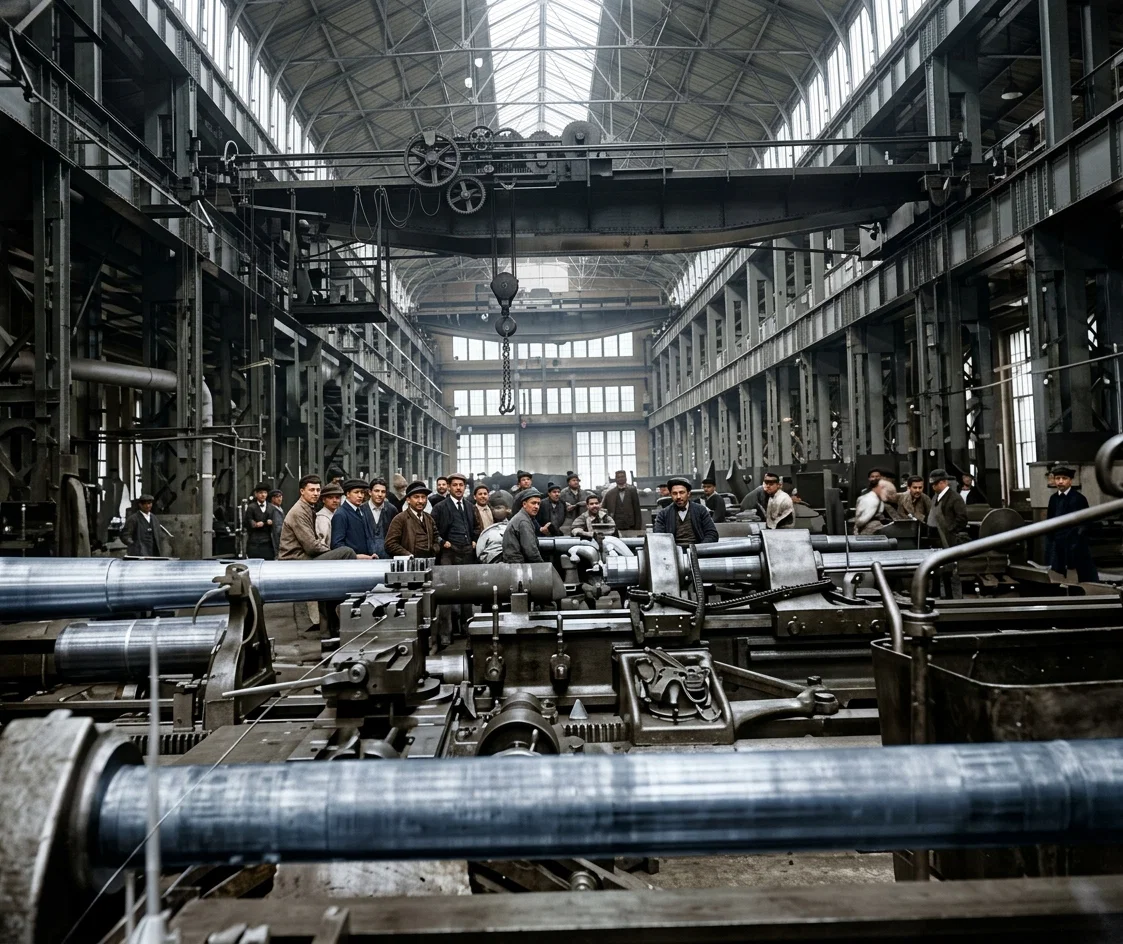
A modern gun shop where great weapons of destruction are prepared
THAT the greatest battle of the world's entire history is still future, is evident to the student of the “sure word of prophecy.” “The kings of the earth and of the whole world” will yet engage in deadly conflict. Rev. 16: 13-16. The time prophetically fixed for this battle is immediately before the second coming of our Lord. This battle is usually called “Armageddon”; and when it is fought, the Valley of Megiddo, which is situated north of Jerusalem, will flow with human blood.
While natural causes for the battle exist even now, still the combatants will be held in restraint by angels of God, until a certain gospel work is accomplished (Rev. 7: 1-3); and then “the kings of the earth and of the whole world” will be urged on to participate in the battle, by the miracle-working power of “three unclean spirits,” or “spirits of devils,” which proceed “out of the mouth of the dragon, and out of the mouth of the beast, and out of the mouth of the false prophet.”
When Armageddon is finally fought, the so-called “yellow peril” will have enlarged into the brown and black peril as well. There now exist definite and paramount reasons which will presently demand that the nations of Europe—where “the beast” power of the prophecy has its “seat”—shall measure their military strength not only with the yellow men of Eastern Asia, but with the brown men of India, and Arabia, and also with the legions of black men from the continent of Africa; but the battle will be fought on Asiatic soil, not in America or Europe. America, both North and South, as allies of the beast power, will contribute their contingent of armed forces for the struggle, for the battle must involve “the kings of the earth and of the whole world.”
The late King Leopold, by his heartless cruelties in the Kongo for commercial gain, was a factor in creating a deadly hatred, in the hearts of millions of black men, toward Europeans. The record of France in Madagascar and in continental Africa is almost as blood-stained as that of Belgium in the Kongo; while Germany and Portugal in reality grasp and hold their large African possessions for the sordid purpose of exploiting the natives, and thereby do they foster hatred for the white race.
Altho the rule of Great Britain is less objectionable to the African, yet even she is compelled to prohibit, by rigid laws, the ever-murmuring popular voice of her native subjects, which otherwise would be speedily lifted, in all of her African possessions, in the cry, “Africa for the African, and not for exploitation by the white race.”
No race, either black, brown, yellow, or white, can fail to cherish a constant rankling in their inmost souls at the thought of being vassals of a foreign power, a hated race; nor is forced acquiescence a surety of lasting peace. African missionaries, noting indications of the smoldering fire, sometimes anticipate a general massacre of all white missionaries in the continent; and non-missionary Europeans in Africa, nearly to a man, knowing that education will prepare the native for independence and the assertion of his rights, decry the education of the natives by the missionaries.

Britain's Great Problem

But Britain's most colossal and danger-fraught problem is the government of approximately four hundred millions of brown people in India, with only about forty millions of British subjects in the home land to maintain the supremacy of her royal scepter in all of her colonial possessions. India has been on the verge of revolt for years; and when she does revolt, soon all Asia will follow her example, and the field will be Armageddon. The banner of India and of Asia then will not be the British “Union Jack.”
The recent leap of Japan into the lime-light as a mighty military power to be reckoned with in world issues, and the current phrase, “the awakening of China,” as well as “India's unrest,” answer the question, briefly but forcefully, definitely. And all these are “dragon” powers. Who would be better adapted to lead the nations of Asia in this movement for the expulsion of European nations, “beast” powers, from Asiatic soil, than modern Japan, the Great Britain of the Orient?

Land Hunger an Incentive

Germany, in her land hunger, and eagerness to get her “camel's nose” into the great prospective cotton-field of Mesopotamia, has recently, through her emperor, basely stooped to offer the tribute of flattery to Islam. As a “beast” power, she will ere long, with the idea of the division of the spoils as a partial motive, contribute her quota of generals and soldiers for Armageddon. There may be significance in the fact that a German officer was commander-in-chief of the armies of the great powers when, during the “Boxer” uprising, they sent contingents to China. And inasmuch as she has recently expressed a desire for it, will not the prospect of securing the splendid prize of the valley of the Euphrates be strong inducement for the German eagle to fly to the conflict?
How eagerly, too, would Russia join in the campaign to crush Islam, with the long deferred hope of getting her coveted prize, namely, an unrestricted outlet through the Bosporus, the Sea of Marmora, and the Dardanelles, to the Mediterranean! Russia also is a “beast” power.
But as yet, we have only considered secondary causes for Armageddon. While racial hatred and land hunger will give zest to certain of the combatants in sharpening their swords for the conflict, yet the primal cause for this death struggle, denominated by Inspiration “the battle of that great day of God almighty,” will be to settle the question of religious supremacy. That each of the three combatants is a false religious system is clear when we grasp the meaning of each of the three terms by which they are designated, and connect these definitions with the fact that each of the designated powers is inspired for the battle by the spirit of a devil, working miracles.
If the incentive for Armageddon on the part of two of the contending forces can be traced backward over the centuries as an undying hatred, an unsettled strife, and then the same incentive demonstrated to be a live issue at the present time, and if both prophecy and current history prove that the issue of vital difference between the two must be fought to a finish in the land where the field of Armageddon is located, such evidence ought to convince even the skeptical that this prophetic battle is a possibility.

Islam and Her Empire

Nearly twelve centuries ago, or exactly one hundred years after the death of Mohammed, Islam, the greatest “false prophet system” of all history, had acquired, by the sword, a greater extent of territory in Asia and Europe than any “empire of antiquity.” But finally, on the plain of Tours (France), “the Cross triumphed over the Crescent, and Europe was saved.” But while this decisive battle held Mohammedanism in check, it still left “theHoly Land” and “the Holy City” in possession of Islam. And while a French general dealt the blow (his name was Martel, which means “the hammer”) at Tours, it remained for a French monk to light the fire of the Crusades, which precipitated perhaps the most prolonged, the most fanatical, and the most bloody religious war of the world's history. This movement was inaugurated to rescue the Holy City from the Moslems. The exact period of its continuance, with some intervals of respite, was almost two full centuries. The termination of this struggle left Jerusalem and Acre—the latter “the last Christian stronghold in Palestine”—still in possession of Islam.
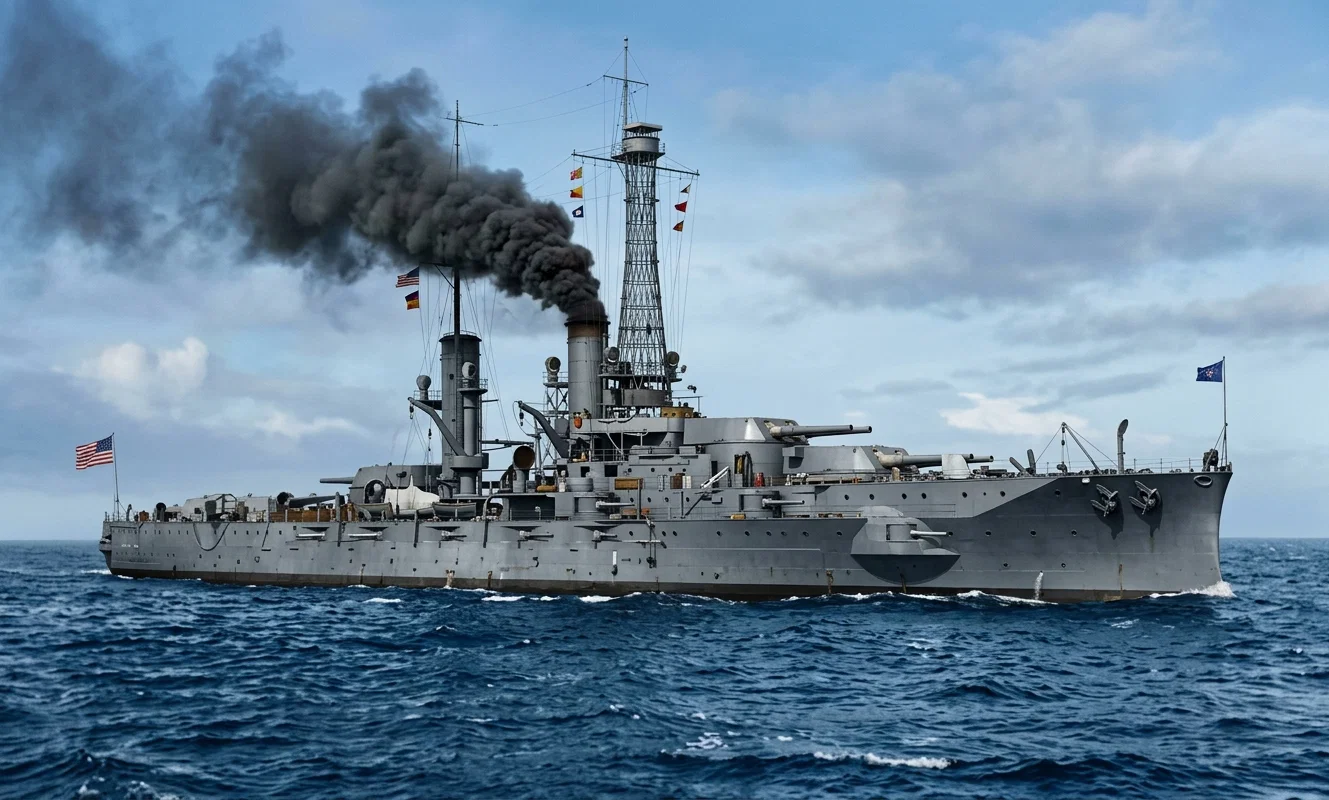
A type of the destructive Dreadnoughts with which the navies of the world are working with intensity to equip themselves
The centuries roll on, but “Rome never changes.” Now if, after the passing of eight full centuries since the beginning of the Crusades, it can be demonstrated that the same issue which inspired that great religious war, is still aflame in the hearts of the beast system, and with the working of miracles by a spirit proceeding out of the mouth of the beast, fanatical zeal can be instilled into the hearts of the devotees of the system, then, aside from faith in the prophecy, it is simply a matter of logic to admit the possibility of a death struggle upon the same soil where the blood of the crusaders freely flowed, which is the field designated in prophecy as “Armageddon.”
Surely the following extracts will be convincing that the incentive for the Crusades is still burning in the hearts of the beast system, and that when combined with the agency mentioned in the above paragraph, it will furnish ample fuel for Armageddon.
From Rome, January 7, 1913, under the head-lines, “The Pope Asks the Powers to Save the Holy Grail,” comes the following Associated Press despatch: “Pope Pius to-day sent a note to the German ambassador at London, asking the powers to remove Palestine from the control of the Turks, and thus save the Holy Grail, or take such measures as will in future protect pilgrims to the Holy Land from Moslem outrages. The pope asked that the note be read in an ambassadorial conference.”
Again, a missionary writing from Constantinople during the recent war waged against Moslem Turkey by the Balkan States, gives the very motive of the Crusades as the mainspring of the war. He says in part: “This war has been called a crusade made by the four combined kingdoms, or a continuation of the Middle-Age campaigns of Occidental knights toward the east. As a support of these campaigns, there is the same power which proclaimed the Crusades against the heretics, namely, the Papacy.”
Compelled to wait impatiently, by force of circumstances, the beast system is all too eager to be supported by the powers in crossing swords with Islam, doubtless all unconscious that the field where the religious supremacy of “the Holy Land” will be finally tested, prior to the setting up of “the everlasting kingdom of our Lord and Saviour Jesus Christ,” will be the Armageddon of prophecy.
Much proof might be produced to show that Islam is likewise eager for the fray, but the space of this article will not permit.

The World Almost Ready for the Battle

The writer will not attempt to describe the modern agencies of destruction adopted by the armies and navies of the nations, nor to draw a pen picture of the appalling slaughter which might result from their use in a single engagement. Every one knows that there never was a time in the history of the human family when, so far as the engines of war are concerned, “the kings of the earth and of the whole world” were prepared as now for battle. Nor was there ever a time when facilities existed for the transportation of men and munitions of war to a central battle-ground as now. In addition to the great navies, all the modern passenger steamers could be requisitioned and employed as transports to hasten soldiers and supplies to the world's prophetic battle-field.
When all things are ready for Armageddon, the sealing of “the servants of our God”—the making up of the subjects of Christ's kingdom—will have been completed, and the angels will cease to restrain the winds of war. Rev. 7: 1-3.
The writer is as anxious for universal peace as are the most ardent of the present peace prophets. At the same time, he has more confidence in “the sure word of prophecy” than in fickle, unstable humanity, and therefore does not expect a reign of universal peace until the Prince of Peace establishes His everlasting kingdom in this world, and that upon the ruins of all earthly kingdoms. In this event is the only hope of peace; and to be prepared for citizenship in His kingdom, we must permit Him first to rule in our hearts, and therein subdue all hatred, enmity, malice, murder,—in short all that pertains to the war spirit,—and implant instead that Spirit that will enable us to love our enemies as ourselves.
Let us remember that a few peace treaties have not accomplished that which only the gospel of Christ can do; namely, eradicate the war spirit from the hearts of men. “The causes which are rushing the world on to Armageddon outweigh all the efforts of men for peace.”

Napoleon and Prophecy

It is not a pleasant thing to blight the hopes of men, but hopes not established upon the prophetic word of God are without solid foundation. The mighty Napoleon, prompted by personal ambition, once tried to break one line of God's prophetic word. That small por- tion of the Word which he unconsciously tried to break, reads thus: “Iron is not mixed with clay” (Dan. 2: 43)—which, as explained in the prophecy, means that the nations of Europe can not be welded together into one nation. The result of his misguided, abortive effort brought two new metaphorical words into the language of civilized nations, namely, “Waterloo” and “St. Helena,” which signify defeat and despair.
Eternal defeat and despair is the doom of all who oppose God's prophetic word. Were it not for the sure word of prophecy concerning Armageddon, and our belief that the only hope of universal peace is the sublime event of our Lord's second coming, we might fall in line with the peace advocates. But when “the Lord hath spoken, who can but prophesy?” Not a single detail of God's prophetic word has ever failed. Therefore Armageddon is as sure to come as is the sun to continue to shine; and we humbly believe that in our effort to center the hopes of men in the coming of Jesus Christ, for universal peace, we are on the optimistic side of the question.
In conclusion, we say that Armageddon will not be the result of a sudden impulse. Sentiments, religious, racial, and national, which have been growing and strengthening in the hearts of men for generations, will, ignited by demon-wrought miracles, reach their explosive point in that prophetic battle.

The Banner of Safety and of Triumph

There is one religious body in the world, scattered abroad among all nations, proclaiming a gospel message, preparatory to the home-gathering to take place just beyond Armageddon. They are not included in the prophecy as combatants, for they do not belong to either “the dragon,” the “beast,” or the “false prophet” system. Their inspiration comes, primarily, from the commission of their Leader, which reads, “Go ye into all the world, and preach the gospel to every creature.” They have a significant banner—not a physical cross of wood or gold, elevated upon church spire, or worn outwardly upon the bosom; and yet, as expressed in the inscription written upon their banner, they have living faith in the efficacy of the one great Sacrifice, offered upon a Roman cross. Their trust is founded in a crucified and risen Saviour, rather than upon a superstition centering in the instrument of wood upon which He was crucified.
They have not created the inscription written upon their banner, but rather have chosen it because of their desire to be loyal to Heaven. The inscription was designed by their Captain over eighteen hundred years ago. It reads, “The commandments of God, and the faith of Jesus.” Rev. 14: 12.
To fortify the hearts of His people for the events coincident with the world battle, when men's hearts will utterly fail them for fear, Jesus has sent this message: “And when these things begin to come to pass, then look up, and lift up your heads; for your redemption draweth nigh.” Luke 21: 28.
The fact that all of the natural causes now exist to produce Armageddon, and that allphysical preparations therefore are rapidly progressing, ought mightily to strengthen the faith of God's people in the early fulfilment of the prophecy, and stir their hearts anew to do their appointed work in heralding “this gospel of the kingdom,” “to every nation, and kindred, and tongue, and people” ere the curtain finally drops upon the history of the human race in the glorious event of our Lord's return.
“In the power and light of His sure word of prophecy it is possible, nay, it is easy, to withdraw our affection from the world and from the things that are in the world. In that light we may view with perfect tranquillity the disintegration of all that is connected with this present visible order of things; for tho' the world passeth away, and the lust thereof, nevertheless we who believe the word of God, ‘look for new heavens and a new earth, wherein dwelleth righteousness.’ 2 Peter 3:13.”

Bryan’s Stand for Temperance

At a state function on September 22, Mr. Bryan was toasting some French commissioners. Supposing that unfermented wine had been given him, he raised the glass toward his lips, when he discovered that it contained the usual fermented champagne. He lowered his glass, and the French envoys did likewise. They made no comment, and Mr. Bryan shortly left the dinner table. Some of the papers are making a great deal of sport of our secretary of state because he has backbone enough to stand in the face of the whole world as an advocate of temperance. So far as Mr. Bryan's policies of state are concerned, they are not in the purview of the discussions of this paper; but his stand upon the question of temperance is one of the best examples the young men of this nation, and for that matter of the world, have ever had. Such manliness can well afford to brave the cowardly sneers of those who are making light of it.

Socialism and Prophecy

The reports have been claiming that the great Socialist leader August Bebel, who recently died, was a millionaire, but it is now claimed that more accurate accounts of his estate show him not to have been worth more than a hundred thousand dollars. But regardless of what men may be saying concerning Mr. Bebel's estate, he helped forward a mighty movement, and was quite liberal toward that movement in his will. The work of the Socialist is interesting to the student of prophecy, because Socialism is an organized expression of the strong discontent there is in this world. While men who are working in the movement fondly hope that they will bring about a peaceful solution of the problems confronting us, yet we know, from the scriptures that speak of these times, that revolution, anarchy, and violence will prevail until the mighty power displayed in the personal coming of Christ will bring it to an end. Such sentiments as we are expressing may not be popular, but we ask you to observe the unfolding of events, and see if they are not in harmony with fact, regardless of their popularity.

Greater Reformation to Come

Our fathers did in their due time acknowledge there were many defects and imperfections in our way, and yet we believe they did as much as could be expected from learned and godly men in their circumstances, and we, their successors, are far short of them in many respects. . . . And yet in the multitude of our thoughts and fears the consolations of God refresh our souls, that all those that in simplicity and godly sincerity do serve the Lord and His people in their generation (tho they should miss it in some things), they shall deliver their own souls, they are accepted of the Lord, and their reward is with Him; and in the approaching days of a better reformation, the sincere, tho weak, endeavors of the servants of God who went before them, will be also accepted of the saints in those times of greater light and holiness that are to come.—Mather, in his “Magnalia,” volume 1.

Ohio Valley Floods and Their Meaning

The Department of the Interior of our general government, through the director of its Geological Survey, has issued a very important document in regard to the floods in the Ohio Valley. It is published as “Water Supply Paper 334,” and may be secured by addressing that department, Washington, D. C. The document shows that the flood of 1913 was the most destructive that has ever visited the Ohio Valley, the estimated property damage being over $200,000,000, besides the loss of life. It reports also that the Ohio Valley has not escaped having floods since 1873. In some years as high as five have occurred. Exhaustive study and research is being made with a view to preventing these disasters. The principal means proposed are an increase of the levees and the provision of large reservoirs into which the water can be turned. All such efforts to save life and property are commendable, and should be encouraged; but at the same time, we should bear in mind that floods and disasters will continually increase, and there are no devisings of men that can avert them. They are one of the signs of the times in which we are living. The stormy wind is fulfilling His word; and through these calamities that are baffling the efforts of men, and which are causing such great destruction, He is seeking to lead men to think and to study His word. And as that word is studied, the significance of all the startling events of this time becomes perfectly apparent.

Sunday and the California Federation of Labor

The California state Federation of Labor closed its fourteenth annual session on October 11, at Fresno. The state barbers’ organization had been working for a Sunday rest measure, but the “canvassing board” showed that the measure was defeated 15,770 to 11,143. “The report of the majority committees advocating one day of rest in seven, but not specifying Sunday, was endorsed.”
Those who are working for a Sunday rest law, and who, without any exception so far as we are able to learn, are representatives of some religious body, have been claiming that the labor organizations were on their side, that labor was demanding Sunday rest laws. But whenever the exact facts are produced, they quite invariably show that the laboring portion of the country are in favor of a holiday one day in the week, but that they do not desire that this holiday shall be a specific “sacred” or “holy day.”
It is certainly the right of any laboring man, under the constitution, and the laws, and the practice of our entire government, to have one day’s rest in seven, and to have any day in the week that he chooses. There is no law prohibiting this, and he can have it if he demands it. This is very clearly shown by the fact that there are thousands of seventh-day observers throughout the nation (and the number is constantly increasing), who religiously observe Saturday. This throws them out of joint with the rest of the world; and it is a much harder day, from the standpoint of business and occupation, for them to keep than Sunday. And yet they observe that day in almost every community in the nation, and none of them have met any difficulties that conscientious determination has not been able to overcome. This is a fact that can not be set aside, and it shows unmistakably that Sunday laws are not a necessity in order to give the conscientious man his day of rest.
Now if the laboring men as a whole desire to have a holiday, they can demand it and get it, just as the labor-unions are demanding and getting higher wages, and other recognitions from the employers. But whenever the religious element steps in and undertakes to secure laws making Sunday a rest day, they are introducing a compulsory religious feature into the matter, and that is always fraught with danger. Men may talk very fluently about a civil Sunday; but Sunday, nevertheless, is the rival institution of the Lord’s Sabbath, and all legislation in its favor is bound to be religious legislation, even tho the men who are advocating it may not know of or understand the disguise.
Let the fact again be emphasized that if the laboring men of California desire a Sunday rest law, they have not so expressed it in their properly constituted assemblies; and when they do finally come to take their stand in favor of such a law, it will be because they have been educated to that point by men who are working for such a measure from the religious standpoint. If left to themselves, labor would by a large majority prefer simply a holiday on which they might do as they please. They do not want a “holy day,” on which the way they shall occupy their time shall be prescribed to them.

Signs of Society’s Decay

A young man in New York City a few days ago deliberately shot a young girl who was standing in the entrance of a moving picture house. He said he didn't know why he shot this particular girl, but claimed that he had a dislike for all girls. He confessed that he killed another girl in Missouri thirteen years ago, and in 1907 stabbed and killed a man. About the same time that this was occurring in New York, a fiend was apprehended in Chicago who had killed a woman, and who confessed to the murder of thirteen other victims. These are abnormal cases, it is true. Both of these men were doubtless in some way mentally deranged; but our modern civilization is developing more and more of that class of people. Such conditions are significant. They show that the foundations of society are breaking up.

The Syracuse School Strike

A short time ago, 1,000 high school pupils in Syracuse, New York, were reported to have gone out on strike, as a protest against a change in the hours of study. Many of the strikers were girls. They escaped from the schoolhouses through windows and side doors, paraded the business streets, and held indignation meetings. The strike idea seems to be very deeply rooted in our “modern civilization,” and incidentally, it shows how much society lacks in self-control. A few leading spirits will begin an agitation and make a start in some given direction, and then the rest follow in a general mob, hardly knowing whither they are going.

War Scares in Europe and Japan

France's activity in purchasing war supplies during the last two months is causing “suspicion” and anxiety in Germany; and Japan is renewing her demands for a treaty that will settle satisfactorily to her the question of her subjects’ holding land in California. There are newspaper articles being written in Japan upon the subject, and some enthusiastic and largely attended meetings being held for the purpose of creating sentiment that will demand certain things from the United States, with the alternative of war. Despite all the efforts in the opposite direction, the war scares will not down.

Anti-Saloon League Year Book

We have received the Anti-Saloon League Year Book for 1913. It is “an encyclopedia of facts and figures dealing with the liquor traffic and the temperance reform.” The facts contained in this volume are invaluable, not only to temperance workers, but to all who are interested in social problems that are related to the liquor traffic. These year books, as they appear from year to year, are a very important part of a good, up-to-date library. Bound in manila, 25 cents; in cloth, 50 cents. Published by the Anti-Saloon League of America, Westerville, Ohio.

Earthquake Shock in Messina

Messina, Sicily, was visited by another earthquake shock, lasting for ten seconds, on October 12. It caused considerable alarm, but no damage.

“The End of the Way”

By Clara Edna Rosecrans
“The toils of the road will seem nothing when we get to the end of the way.”
THE hot, sultry day is almost at an end. All day we have pursued our way,—sometimes over rough, hilly roads; sometimes down green slopes, bordered on either hand by rolling tracts of pasturelands; now beside a still, quiet lake, where the willows bend to kiss the clear waters, and the sun smiles back at his own image; again through the bustle of a city’s streets, where the clang and whir of a millionfold activity made us long for the peace and rest of the country again.
All day the sun has beaten down with fervid heat, and we are glad when the lengthening shadows tell that evening draws on. Our feet are very weary, but we see on either hand things that look familiar. We are drawing near the place where our childhood days were passed. The sun drops down. A cool breeze springs up and fans our cheeks. We trill a happy song; and our feet, so tired and sore an hour ago, seem to have received new life. We are almost home. One by one familiar landmarks come into view. Already in anticipation we see the dear old place. The sun sinks below the farthest range of the blue hills, tinging the clouds to the westward with indescribable hues of crimson, rose, and gold. Our feet are directed steadily toward the sunset, and its last rays shoot athwart our path, giving it an almost unearthly glory. In the hedges by the roadside the crickets wake up and begin to chirp, and here and there a katydid sends forth its sharp, shrill cry. The stars peep out one by one, while over in the valley to the right the lamps of the village gleam forth like beacons. As we note this, our footsteps quicken; for is it not just beyond those lights that the old home nestles?
“Home!” Our hearts throb tumultuously as the dear faces of loved ones come up before us. And we shall see them so soon—“when we get to the end of the way”!
Dear reader, is this not a good illustration of the journey that we are all making? At one stage or another we are all passing over the same road. To some it is early morning-time. The birds sing, the flowers bloom, the sun has not yet dried the dewdrops from the grass at our feet. Life goes on like a gay panorama of entrancing beauty. There seems but little sorrow in the world, because Jesus has forgiven our sins. We are so happy in His service, that we hope for nothing—want nothing but to feel His love in our hearts.
The sun rises higher, the dewdrops one by one disappear, the jubilant chorus of bird-songs that greeted the morning has died away into silence. Then it is that we begin to turn our thought away from the wondrous beauty of the outward scene, and to think about our journey—where we are going, what commissions our King has given us to discharge on the way; and our feet hasten, for the sun is now at its meridian.
This is the work-time of our lives. The world with its sin and sorrow is all about us. We find by the wayside fallen ones who must be lifted and cared for, heavy-laden ones whose burdens must be carried; and by and by we find ourselves so burdened down with cares, that we almost forget whither we are going—almost forget the One who sent us forth with such joy in the bright morning-time. But as the life-sun nears its setting, our hearts begin to yearn for “home.” We are thankful for the quiet and rest that come with growing age, and Jesus grows even more precious than He was when first we started in the way. And now comes the blessedness of the thought that home and heaven are near. In the beginning of our Christian experience, we did not think much of these things. Heaven was to us a far-away, beautiful place that we hoped to reach some day. Now the scenes of earth grow far away, and heaven intensely real—the one reality that will survive the disillusionment which comes with the growing years. Ah, we must keep close to the path now, for dangers and difficulties beset us of which we little dreamed when we first started!
But “the end of the way” is near. The lights gleam out from the city of the “many mansions.” Rest, home, eternal blessedness—all will find their glad fruition there.

Like Father, Like Son; Like Mother, Like Daughter

When the father was a baby, he tormented the kitten; as a boy, he abused the dog; as larger boy, he bullied the smaller one; and as husband and father, he tyrannizes over wife and children. He has never learned to control his temper; he has never known what it was to protect the weak; he has never learned to regard the feelings of others. What can you expect of him now?
The child’s sense of justice is keen, and he knows when he is punished simply because father or mother is in a temper and must vent it upon something. Is it any wonder, then, that the child grows surly and resentful, that he learns readily to deceive, and the life of the father is repeated in the child?
Many a mother all unconsciously gives to her child his first lesson in cruelty. Baby is seated upon the rocking-horse, a whip placed in his little hands, and he is told, “Whip the old horse, and make him go.”
Katie is teasing the cat, and making her cry; and the mother says, “Don’t pull the pussy; she will scratch you.”
Tommy is pinching the dog to see him squirm; and mother says, “Don’t hurt Rover, Tommy; he might bite you.”
O, mother, do you realize that you are teaching your child that there is no harm in inflicting suffering upon anything provided he is not himself hurt by it?
Johnny starts to run across the room, trips over a chair, and bumps his nose on the floor. Johnny cries, and his mother says: “Naughty chair, to make Johnny hurt himself! Beat the old chair!” And she immediately proceeds to administer condign punishment to the unoffending chair. She is teaching the child that instead of controlling his temper, he must give full vent to it, and that if he is hurt, instead of bearing it like a man, he must revenge himself upon something, whether innocent or guilty. What will be the result of such a training?
A little four-year-old toddler was pulling at his mother’s skirts and teasing her to play with him. “O, don’t bother me now,” said the mother; “run away and chase the old lame hen round the garden.” And the little one ran off eagerly at the prospect of his fun.
Fifteen years later, when this same mother was enfeebled from sickness, she was bemoaning with wonder why it was possible that her boy, for whom she had done and sacrificed so much, should be so unfeeling in his treatment of her.
The seed she herself had planted and watered had sprung up and was bearing abundant fruit, and she did not even recognize that it was from her own sowing.— Western Humane Press Committee.

Our Happy Home

By Mrs. M. C. Sellers
Where sins are all pardoned, blotted out, and forgiven, No more separations, no more heart-strings riven; Reunited again with the friends we love dear, No more solemn partings — no, never a fear; As free as the birds in their innocent play, As happy, as songful, as fearless as they; No more feeble forms bowing low o’er the staff; No sad, solemn faces which nevermore laugh; No funeral trains, with their slow, solemn tread, Bearing loved ones away to the home of the dead; No widows arrayed in their robes of despair; No little ones robbed of a fond parent’s care; No long, weary waitings, and watchings in vain, For loved ones who go, but return not again. The trail of the serpent is nevermore seen. ’Tis the home of the pure, and a universe clean. The long, weary marches and warfare are done; The battle is fought, the victory won.

An Ideal of Goodness

JUST to be good, to keep life pure from degrading elements, to make it constantly helpful in little ways to those who are touched by it, to keep one's spirit always sweet, and avoid all manner of petty anger and irritability—that is an ideal as noble as it is difficult.— Edward Howard Griggs.

The Direction of Your Thoughts

OBSERVE what direction your thoughts and feelings most readily take when you are alone, and you will then form a tolerably correct opinion of yourself.— Bengel.

“Where Am I Going?”

One summer evening, as the sun was going down, a man was seen trying to make his way through the lanes and cross-roads that led to his village home. His unsteady, swaggering way of walking showed that he had been drinking; and tho he had lived in that village more than thirty years, he was now so drunk that it was impossible for him to find his way home.
Quite unable to tell where he was, at last he uttered a dreadful oath, and said to a person going by: “I’ve lost my way. Where am I going?”
The man thus addressed was an earnest Christian. He knew the poor drunkard very well, and pitied him greatly. When he heard the inquiry, “Where am I going?” in a quiet, sad, solemn way he answered, “To ruin!”
The poor staggering man stared at him wildly for a moment, and then murmured with a groan, “That’s so.”
“Come with me,” said the other kindly, “and I’ll take you home.”
The next day came. The effect of the drink had passed away, but those two little words, tenderly and lovingly spoken to him, did not pass away. “To ruin! to ruin!” he kept whispering to himself. “It’s true. I’m going to ruin! O God, help me, save me!”
Thus he was stopped on his way to ruin. By earnest prayer to God he sought the grace which made him a true Christian. His feet were established on the Rock. It was a Rock broad enough to reach that poor, miserable drunkard, and it lifted him up from his wretchedness, and made a useful, happy man of him.—Children’s Paper.
Continue reading: An Invaluable Library