Your ShelfYour Projects

Review and Herald, Vol. 93, No. 53.

Eternal Life
Earlier text: Devotional Services Without a Preacher

The Cause of God

O. B. KUHN
The plan of redemption has a broader and a deeper meaning than man’s salvation. Its breadth and depth comprehend the vindication and justification of God’s character. In the lives of men and women the principles of the divine government are to be revealed.
God is love. Love does not seek its own. It denies self for the good and happiness of others. The cause of God is the cause of love. His work always has and always will bring healing to suffering, afflicted sinners. God and the angels rejoice more over one sinner who repents than over ninety-nine just persons who need no repentance.
Thorough organization of the church, the successful operation of institutions, individual conformity to certain forms of worship and religious obligations are required, and are a part of the service and worship toward God, but in themselves they are not the cause of God. These may perish or be discontinued when the church militant becomes the church triumphant.
After rebellion and sin entered, God’s character was questioned. Uncertain and vacillating service and worship were rendered. God might have destroyed all whom he had created, and have brought other beings into existence; but because of his love he would not destroy. He would save. He would win the hearts and minds of all who honestly trusted in him.
Jesus Christ,—the Son of God,—God in human form,—by courteously and lovingly ministering to afflicted sinners, revealed the attributes of God’s character. In relieving pain, healing disease, raising the dead, freeing the captives, removing the burden of guilt, teaching right principles, and imparting motive powers of life, faith, hope, courage, andlove, he manifested to men the mind of God toward them.
The first object of his mission was to reveal to sinners the love of God for them. The second was to justify the divine requirements regarding obedience to the law, thus declaring that God did not ask of any, even the weakest of his creatures, an impossibility, nor make requirements which he himself was not willing to obey. The principles of God’s government are an outgrowth of his own nature.
When sending out the twelve disciples, the Lord said: “As ye go, preach, saying, The kingdom of heaven is at hand.” “Heal the sick, cleanse the lepers, raise the dead, cast out devils.” Thus they demonstrated to the people of their time that the kingdom of heaven was at hand, and this practical work constituted the greater part of their ministry. They preached but little, and the preaching they did was but an introduction to, a spiritual interpretation of, their practical labor for the people.
The church, as an agent of the Lord, is to witness for him, and to train men and women to be a blessing to the world. The great and ever-increasing needs of sick and suffering humanity cry out for the ministry of love. “The greatest want of the world is the want of men,—men who are true and honest in their inmost souls; men who cannot be bought nor sold; men who will call sin by its right name; men who will stand for right though the heavens fall.”
Teachers are needed who will not be content with imparting mere technical knowledge, but who will inspire their students with principles of truth and right,—teachers who will not be satisfied with developing merely clever accountants, skilful artisans, successful tradesmen, or men of mere professional ability; but teachers who are constrained to develop men who will keep in touch with practical life and meet the real needs of humanity.
In addition to literary qualifications and a working knowledge of some profession or trade, a knowledge of health principles is necessary, if one is to be fitted to meet the responsibilities of his own life; much more those of a school, institution, or mission field. Workers are needed who know how to care for their own health and the health of others, workers who can give the simple treatments that do so much to relieve pain and remove disease. “Whether in foreign missions or in the home fields, all missionaries, both men and women, will gain much more ready access to the people, and will find their usefulness greatly increased, if they are able to minister to the sick.”—“Ministry of Healing,” pp. 145, 146. Workers are needed who can heal the sick as well as preach the word.
An unselfish life of earnest service to our fellows, having in view their temporal and eternal good and happiness, is the truest witness and most acceptable worship of God. It is the clearest exposition of the cause of God.
Shanghai, China.

The Beginning of Subscription Book Work in China
H. M. BLUNDEN
At the general meeting held in Shanghai, in 1915, the following action was taken:—
“WHEREAS, an urgent necessity exists for small subscription books to enable this field to enter upon self-supporting work with our literature; therefore,— “We recommend,” That immediate steps be taken to produce the necessary literature to build up a subscription book business.”
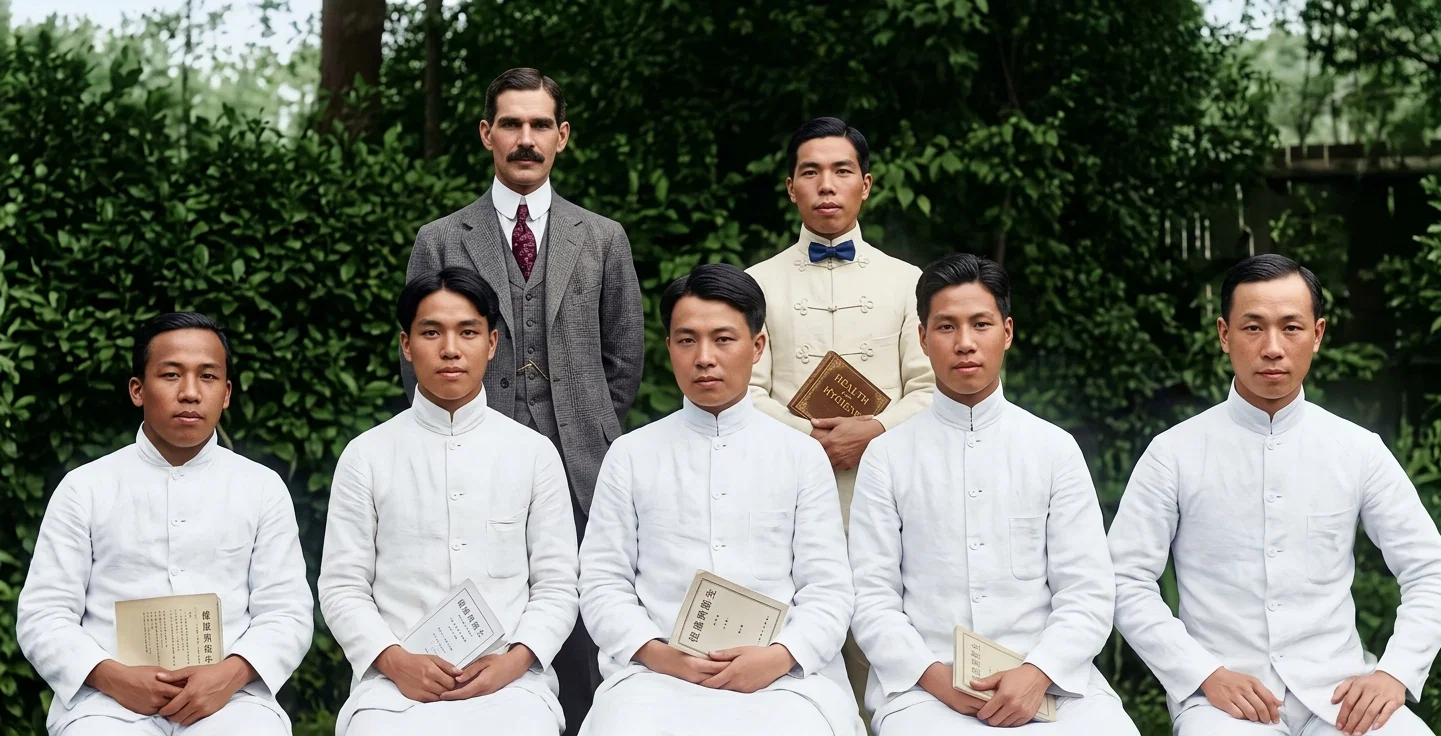
FIRST GROUP OF BOOK WORKERS IN CHINA
In harmony with this recommendation, Dr. A. C. Selmon was asked to prepare the manuscript for a small book, “Health and Hygiene,” to be our entering wedge in beginning this work. During the summer of last year Dr. Selmon worked hard to get this little book ready for the field as early as possible, and we certainly owe him a debt of gratitude for his earnest efforts in responding to this invitation. The first copies of this book came from the press about the middle of last June, when we were conducting a colporteurs’ institute in the school at Shanghai.
Six young men were selected to begin our campaign with books. Two of these had had excellent success with our magazine, and four of them had had no experience as colporteurs. A special class was conducted for these six men, and we were greatly encouraged by the enthusiasm they manifested.
The book sells for 75 cents in paper, $1 in board, and $1.25 in cloth binding. In China it is quite customary for one making a contract with another to pay what they call “ding chien,” or deposit money. We have taken advantage of this custom to make our work sure; so when an order is given, a deposit of 25 cents is made.
During the past two weeks we have been receiving our first reports from these boys, and it looks as if our first edition of three thousand will soon have to be duplicated. We are starting on a very conservative basis, until we know what we can do in book selling in China. It may be that later we can run editions of tens of thousands of our subscription books. We are fully expecting to do so.
Two of the colporteurs went into Che-kiang Province, beginning their work in the capital. In a little more than ten days they took over two hundred orders for the book, the majority in the best binding. They began with the highest officials, securing thirty-seven orders the first day, twenty of these being from the governor of the province. Their latest reports show them still doing excellent work.
One young man went to the city of Nanking, the capital of Kiang-su Province. He decided to secure the very best names in the city to head his list, and so started at the governor’s palace. This governor is one of the best-known men in China, and figured very prominently in the recent negotiations over the proposed enthronement of Yuan Shikai. He is now named as a probable candidate for the vice presidency. It was before this man that our colporteur gave his first exhibition, and as in the case of the governor of Che-kiang, it resulted in an order for twenty copies in the cloth binding, with a 25-cent deposit on each book.
Governor Feng then demanded that the colporteur leave with him the copy he was carrying. It was explained that this was a sample copy that the agent depended on to pursue his business, but it was no use to protest, and our canvasser had to part with his book, and wait several days till he could secure another copy.
For the first canvass given after securing his second prospectus, ten orders were taken, and for the first five days’ work this young man took sixty-threeorders, sixty of which are for the best binding.
Two other young men without any former experience went to the province of Shantung, and during the first week secured about seventy orders, nearly all of which are for the cloth binding.
In central China one young man is at work in the province of Kiang-si. He began his work in the city of Kin-kiang, giving his first canvass to the president of the business men’s club of that city, and secured from him an order for four copies in the best binding. This young man is averaging about seven orders a day.
If this beginning can be taken as evidence of what can be done with subscription books in China, we surely have a promising future before our book business in this vast country. What an army of book canvassers we can keep going if only we can develop them! We are careful in our selection, believing that the Lord requires a high standard of character of the men in this important branch of his work.
These books are being sold at a good profit to the publishing house, so that the development of this work will solve the question of self-support in our publishing work in this field.
Brethren, pray for the colporteurs in China. These young men face great dangers in carrying forward their work in this country, and should be constantly remembered before the throne of grace, that God’s protecting care may be over them. We are thankful indeed for a part in this grand work.

MRS. W. R. SMITH

Korea

MRS. W. R. SMITH

At the last spring council it was decided that we should leave Wonsan, and settle in Keizan, where Brother and Sister R. C. Wangerin have labored the past six years. We were to leave July 25, so on the twenty-third the Wonsan church had a farewell picnic in a grove by the sea.
The outing was made more enjoyable by the presence of a number of our foreign workers. Pastor and Sister C. L. Butterfield with their two children, Pastor and Sister H. A. Oberg, and Sister May Scott, who were having their vacation at Wonsan, spent the day with us.
Several extemporaneous speeches were made, lunch was served, and all expressed themselves as having had a pleasant time. They said they wished to give us a present, but did not have it prepared. The next evening a committee of three of the brethren brought it to our house. It was a silver watch charmin the shape of a Maltese cross with the Korean emblem in the center, and Chinese characters engraved on the ends of the cross. This was for my husband. My present was like it, only it was made into a brooch.
It was with no little feeling of sadness that we left the eastern coast where we had labored for seven years, and had learned to love the believers, not only of the Wonsan church, but all the companies scattered throughout that district.

Our First Visiting Experiences

Pioneering Experiences in the Solomon Islands — No. 6

Our First Visiting Experiences

G. F. JONES
LEAVING the pretty Rovian Lagoon and all its treacherous reefs and narrow, winding channels, we sailed once more into the open sea, and felt relieved from the constant strain of watching lest we at any moment run onto a reef or crash against a rock. Once outside, we relaxed, and watched with pleasure the lofty mountains of other islands, whither we were steering. We wondered what kind of people we should meet next. The flying fish flew away from us in confusion, and the porpoises seemed to play hide and seek with the ship, or to race with her. What a pity that the majestic scenery before us should be so marred with deeds of unrighteousness! The speed at which we were traveling soon brought us close to the land, and we entered a pretty harbor quite shut in from the open sea.
We could see no crowd of natives waiting either to welcome us or to kill us. As a rule, when they do not know the visitors, they are shy and stay back in the bush. That is just what they did this time. After a while, however, a shaggy, dirty-looking native came aboard, and we were able through our boys, who knew a little pidgin English, to ask where the chief and others were. They feared that ours was a government vessel, so had scampered away. The native said they had gone hunting opossums. One by one they assembled on the beach when they learned we were missionaries, but the chief did not appear until the next day.
THESE ARE THE KIND OF CHIEFS WE MUST FIRST WIN BEFORE WE CAN PLANT OUR MISSIONS AMONG THEM
When he came, we met a sullen, forbidding savage. All the natives looked much like others we had seen, with long slit ears and scowling faces. We talked to them a long time, being unwilling to pass them by. When we finished and were ready to leave, they were not willing to allow us to do so, but the chief was still sullen and would not decide on our settling there. So I said that we would go away, and some day would return. At the time of this visit these people were just discarding their savage practices through fear of the government, the last in that district to yield.
The sequel to this visit occurred a few weeks ago, just two years afterward. A bright, intelligent police boy came up to me at the government station and said in pidgin English, “My father say you come be mission now.” I replied, “All right, Nomani, I’ll be there.” In a few days we reached the place once more, and met the people we had met two years before. But what a different meeting! They looked so happy and pleasant! Their minds were made up, and they were looking forward to a mission and a school and a missionary. They had it all planned. “This is where your house is to be,” they said. “This is where the school is to be.” We began looking at the places they pointed out, and stood with our arms around them, regardless of their skin diseases. They laughed and joked and called me, “Jouse.” “You must come back at once,” they said. I was very sorry to have to disappoint these dear savage friends of mine. I could not be there for three months at least, for I was obliged to go to Australia, and I had no one to send to them. So we parted with some sadness, but they were hopeful. Now I am on the steamer going to New Guinea, thence to Australia. Is it not sad that we cannot fill these openings? On account of the war our young people cannot leave Australia. What is to be done? Every day of delay makes it more dangerous to travel. Obstacles of international strife may have come to stay, or to block up the way of freedom. The signal to advance now can be clearly read. The only possible safe place is somewhere in God’s work. “Haste thee, escape thither; for I cannot do anything till thou be come thither.”

Teaching the Children to Help

MRS. B. P. FOOTE
It has been said, and truthfully, too, that during the first four years of a child's life, it learns more than during any succeeding four years. Therefore to commence the early domestic training of the little ones is of great importance.
As soon as the baby can walk, or even creep, it can be taught to do little errands, such as picking up things that have fallen on the floor, closing doors, and carrying small objects from one room to another.
True, the first time or two much patience will be required; for a child of that age does not understand readily. Some say, “Oh, but I can do it so much quicker myself!” Yes, certainly, you can do it quicker and much better; but where is the child's domestic training to come in, if you do all the household tasks yourself? Is it to be postponed until he has come to feel that all his time must be spent in play?
The habit of helpfulness is most easily cultivated at an early age; for very young children are usually more willing to help than are those who are older. Therefore it is essential that they be taught to enjoy their work, and that the habit grow with them.
In order to get the best results, it is necessary to cause the children, little or big, old or young, to feel that they are helping because they want to, and not because they are compelled to do so. Suggestions frequently bring better results than commands. Then, too, it is well to begin early to develop initiative. This will come only with knowledge and the feeling of responsibility.
Here is a somewhat incomplete record of the work of one seventeen-months-old baby for one day: Got up at seven o'clock; mamma dressed her. Had breakfast at eight o'clock. When sister got up, baby brought her shoes and dress. When baby came in from her daily outing, she closed the front door, and hung up her coat, sweater, and hood on her own low hooks. After her nap, she picked up soiled clothes after they had been sorted, and put them into the tub. Picked up the broom that had fallen on the floor, and put it where it belonged. Put the mending pieces into the box for mamma. Brought mamma's new shoes out of the bedroom. Picked up a spoon that had fallen on the floor. Brought the dog's dish in for his dinner. Shut the kitchen door. Got the hammer for mamma, and then put it back in place again. After having her hands washed, she carried some of the dishes from the pantry to the dining table. Got out the fresh fruit for dinner. Helped to carry a chair into the sitting-room; also ran several little errands to and from the other rooms. Had another outing in the afternoon, and hung her wraps up as usual when she came in. Went to bed at 6:30.
Do you wonder that when the mother of this child is sick, she wants her baby with her? Does it pay to spend a little time each day teaching the baby to help?
One little girl always wanted to “help;” and when she was only a year and a half old, she was allowed to wipe the spoons, knives, and forks, even though mamma had to wipe them after her. It was not long before she was able to wash and wipe the dishes very nicely. At the age of six she could do this work almost as well as any one, although of course not very rapidly.
A mother taught her child to help by making her feel that it was a privilege, a treat, to help mamma. When the child had been unusually good, she was told that she might set the table or wash the dishes, or do some other light work.
It will do no harm for little boys to learn to do housework, also, as there are sure to be times when such knowledge will be of great benefit.
Stories may be told which will help the children to understand how to work, and how to perform small tasks correctly. For instance, one child was somewhat careless about wiping the dishes; but after being shown the “tears” on the dishes that hadn't been wiped dry, she was very careful.
Instead of putting everything out of the children's reach, it is better to put things where they can reach them easily. Have hooks set low, so the shortest arms can reach them. It will take much time to teach the little ones when to touch some things, and when to refrain; but it will pay in the end. When mamma isn't feeling well, it will be very convenient if the children know how and where to get a clean towel or apron or dress, and are able to reach and put on their own wraps.
Encourage the children to dress themselves, and to do it quickly and neatly, by having a pleasant “surprise” for them occasionally when they do extra well.
A little special thought and attention given to teaching the children to help will reveal many ways in which they may be taught to enjoy helping, so that they may be a blessing to themselves and to others.

“Sir, if You Help Us, Then We Shall Be Saved; Otherwise Not”

L. J. BURGESS
CHOURKHULI is a large village in East Bengal, about twelve miles from our mission station at Gopalgunj. In that village there is a large Hindu school taught by two Hindu teachers. One of the teachers has had some instruction from our workers in times past, and the seed sown has not been entirely fruitless. We were pleased to receive a letter from him recently, in which he tells of the society he has formed for the benefit of the boys of the school. The following is a copy of his letter:—
“DEAR SIR: It is four or five months ago I write you describing our Namashudra Youth’s Moral Reform Society. Also you show kindness by giving answer of our humble letter. We the members of our society were exceedingly glad to receive your hopeful letter.
“Nowadays we are very sorry, because we have fallen in great danger, and there is no one to help us. Some of our villagers have stood against us, and they frighten us that they would burn our society house where we meet and pray to God to save our society. Now they wish to boycott us. We are only boys; what can we do?
“Sir, if you help us, then we shall be saved; otherwise not. We know there is no one to save us but Saviour.
“Your brother in God,
“M. C. BISWAS.”
We expect to visit this village in a few days and establish an outstation there.
Calcutta.

Home Life

Conducted by Mrs. I. H. Evans, Takoma Park, Washington D. C.
Assisted by Miss Lora E. Clement
Through the columns of this department, hints will be given on all matters pertaining to the home life. Short articles and letters are solicited from home makers, telling of their everyday experiences,—their joys and sorrows, their failures and successes.

Jesus Knows

I do not think that I could bear My daily weight of woman's care If it were not for this: That Jesus seemeth always near, Unseen, but whispering in my ear Some tender word of love and cheer To fill my soul with bliss.
There are so many trivial cares That no one knows and no one shares, Too small for me to tell; Things e'en my husband cannot see, Nor his dear love uplift from me,— Each hour's unnamed perplexity, That mothers know so well,—
The failure of some household scheme, The ending of some pleasant dream Deep hidden in my breast; The weariness of children's noise, The yearning for that subtle poise That turneth duties into joys, And giveth inner rest.
These secret things, however small, Are known to Jesus, each and all, And this thought brings me peace. I do not need to say one word, He knows what thought my heart hath stirred, And by divine caress my Lord Makes all its throbbings cease. — Selected.

Working for a Young Couple’s Family

PASTOR G. L. STERLING writes from Mauki, Cook Islands: “A young couple here are attending all the meetings regularly, and showing much interest in the truth. . . . The father of the young man is also favorable, and expresses himself as quite willing that his son and daughter-in-law should unite with us, though he himself seems fearful of what others will say of him if he joins us. We are still working for him.”

God’s Way Leads Into Trial

“God’s way leads always into trial so far as sight and sense are concerned. Nature always will be tried in God’s way.”

Christian Dress

MRS. M. T. POSTON
In love for his people, the Lord has given them much light in regard to plain dress and what it is; but how much we appreciate and love that light is shown by our faithfulness in walking in it.
It is a principle of truth that as light is followed it becomes precious; while on the other hand, light rejected or neglected not only becomes darkness, but also an annoyance and a vexation whenever very much is said about it.
It is a sad fact that Seventh-day Adventists are departing from the simplicity and plainness of dress which characterized them formerly. Recently one of another denomination visited our church, and remarked afterward to our pastor's wife, “I attended your church last Sabbath. Your people do not dress so plainly as they used to; they dress now like the people of other churches.”
In view of this condition, which is not limited to any one church, we may profitably ask, What do I need at this time—more light on how to dress plainly, or more willingness to walk in the light I already have?
One who has been long in our work was once asked why he did not do certain things. His reply was, “Because I love the Lord;” and this is the best reason in the world for wearing plain dress—because we love the Lord. When we love the Lord better than we love the world, shall we not love the kind of dress the Lord asks us to wear, rather than the foolish fashions of the world?
The requirement for plainness and simplicity of apparel, found in the Bible and often mentioned in the Testimonies, is not an arbitrary matter on the part of our heavenly Father; the instruction given is not merely for the exercise of authority, but to hedge against danger. For as surely as the love of money is the root of all evil, just so surely the love of dress works shipwreck to eternal interests; and as truly as covetousness is idolatry, so truly the excessive love of dress is idolatry.
Some mothers dress plainly themselves, but apparently feel that plain dress is not necessary for their children. The idea seems to prevail that the pure, straight principles of God's righteousness need modification according to some worldly standard before they are given to children. Such ideas should have no place in our lives.
An earnest sister, new in the faith and in her first love for God and his Word and the testimony of his Spirit, dressed herself plainly and began to dress her six-months-old baby so, but was led away by the example of other mothers, and soon had her clothed in the fashionable apparel of the world. Naturally, when the little girl was older, she loved dress, and later she chose a husband of the world, and became lost to the truth we love.
How early do children learn to love the adornments of worldly dress?—Almost from the cradle. “Give me the first seven years of the child's life, and you may have it after that,” say some educators. These are the years when the most lasting impressions are made. Begin early and begin right to train the child in these impressionable and quickly passing days.
The mother who adorns the dress of her child in infancy is forming a habit she will hardly break away from in dressing it later, and is training into her child that which only God can take out, and that which, unless removed, means ruin to her loved one. “It is our duty to dress ourselves plainly, and to clothe our children neatly, without useless ornamentation, embroidery, or display, taking care not to foster in them a love of dress that will prove their ruin.”

MARTHA E. WARNER

Smiling

MARTHA E. WARNER

I ONCE knew a girl who wore a smile upon all occasions; it was “perpetual.” Her mother spoke of it as “Maud’s sunny smile,” but the neighbors called it “Maud’s perpetual grin.” Really, the girl looked silly.
One day, hearing a remark to that effect, she began to study how she could look happy, and not smile. In her study, she came across this from Henry Ward Beecher:—“A smile is a light in the windows of the face, by which the heart signifies it is at home and waiting. Laughter is day, sobriety is night, and a smile is the twilight that hovers gently between both—more bewitching than either.”
Today it is a pleasure to see the smile that lights the windows of that young girl's face. So I would say to the young, If you want the corners of your mouth to incline up instead of down, cultivate a pleasant expression, have happy thoughts. Don’t grin.
Clintonville, Conn.

The Heart of a Queen

QUEEN VICTORIA was once visiting one of the large cities of England, where a choir of three or four thousand boys and girls was gathered on a great wooden platform to sing a song of welcome. The next morning after the queen had returned to her palace, she ordered a telegram sent to the mayor of the city. It had no reference to the civic formalities or public functions of her visit, but read: “The queen wishes to know, Did the children all get home safely?” No more momentous question can be asked by monarch, by nation, or by parents: Will the children reach home safely?—W. N. Hartshorn.

Don't Let the New Baby Cry

It is hard to realize that the tiny baby, lying all day long in its crib, and hardly able to lift its head from the pillow, is really doing more “work” than the mother who cares for it, or the father who toils long hours over his desk. Yet this is the fact. The baby's heart beats nearly twice as fast as an adult's; its lungs pump to correspond. Both, when the infant lies asleep, are working as rapidly as those of a grown person quite out of breath with running. All the little one's bodily processes go on at the same high speed.
The result is that while an ordinary adult, toiling at some sedentary vocation, does sixteen or seventeen calories of work each day for each pound of his weight, all normal infants do thirty. Some go as high as forty-five. They work, then, two or three times as hard as most of their elders.
One of the latest studies at the nutrition laboratory which the Carnegie Institute maintains in Boston, has shown that no small part of the baby's work is done in crying. An unhappy baby, wailing and tossing restlessly, may add as much as a fifth to the work which a contented child would do.
All this is sheer waste. Whatever energy the child expends in crying is just so much lost for growth. The food that he uses up in discomfort will never be used for anything else.
This matter is especially important during the first few days of life. Rarely during this period does any baby get enough food to keep him going. He has, therefore, to live in part on his own tissues, like a starving man. This is bad enough at best, but how much worse to let the newborn babe exhaust his little body still more by the hard labor of crying! By and by he may have to be let cry for the good of his soul; but for the beginning, “anything for comfort,” lest the slender forces that should be getting the first grip on life be spent in useless pain.—American Motherhood.

Camp Meetings for the Colored People in the South

The South Carolina Mission camp meeting was held in Sumter, August 17-27. A very suitable location was secured in a prominent part of the city. There were about one hundred in attendance. The interest among those not of our faith was good, and frequently at the evening services the tent was crowded. A considerable number accepted the truth and were baptized. The meetings were deeply spiritual, and proved a great blessing to all who were present.
A spirit of harmony prevailed in all the deliberations. The report showed a splendid increase in tithes and offerings, and also in membership. Three new churches were received into the conference, with an aggregate membership of seventy-five.
Besides the local conference workers, Elders W. H. Branson and G. E. Peters, Sister Anna Knight, and the writer assisted in the services.
The Alabama camp meeting was held in Montgomery, August 24 to September 2. This was also quite well attended by the constituency, with an unusual attendance from those not of our faith. I was told there were twelve public-school teachers present at one of the evening services.
Progress was indicated by the reports of the departmental secretaries. Practically the same plans and resolutions that were discussed and passed in the conference were brought into the camp meeting, with such additions as were necessary to meet conditions peculiar to the mission. There was unity in all the business proceedings.
The president of the conference and the men in his department attended nearly every meeting. Elder T. B. Buckner and his coworkers are united in earnest efforts to build up the work in Alabama.
The Cumberland Conference Mission camp meeting was held in the historic city of Chattanooga, Tenn., September 7-17. Before the time of the camp meeting Elder H. N. Gemon conducted a course of lectures, creating quite an interest in the message. Elder R. W. Parmele, president of the conference, Elder G. E. Peters, Miss Anna Knight, and the local conference workers assisted in this meeting. There were about one hundred in attendance the last Sabbath. Donations to missions in the Sabbath offerings amounted to $55. This was given in cash.
The camp was composed of twenty tents. The cafeteria tent was as nicely arranged as any I have seen. It was perfectly screened.
The regular business of the mission was conducted harmoniously. This was the first regular mission camp meeting held in this conference. All seemed very much pleased and benefited. It was indeed a training for better service. I am sure such meetings serve as a great unifying factor. Earnest talks were given on general missionary work, on organization, etc., in all these meetings. Resolutions were passed pledging loyalty to the organization, and looking with disfavor upon any movement that tends to divide the body. All were convinced that the third angel's message is a divinely organized gospel movement; therefore to break with the organization is to disconnect from the message.
The last Sabbath will long be remembered in the Cumberland Mission. The entire congregation came forward to renew their consecration to God. Some who had withstood the truth for years testified that they could resist the Spirit of the Lord no longer, and surrendered to God.
Twenty-three united with the churches represented. Sunday morning nineteen were baptized in the Tennessee River, at a point almost directly under Lookout Mountain. This was a very solemn occasion.
Departmental reports showed an addition of one new church. In all, about fifty members, including those who joined at camp meeting, were received into church fellowship.
Mission camp meetings were held in North Carolina and in Mississippi. Good reports come from these meetings also. No doubt others will report them. With the Florida camp meeting, the series of camp meetings for the summer closed. We are thankful to our heavenly Father for what he has done for his people in all of these meetings, and trust that all will prepare to make the camp meetings of next year occasions of even greater blessing. Surely these meetings are ordained of God as one of the strong factors to unify, edify, and build up his people spiritually, and thus prepare them for what is coming upon the earth.
C. B. STEPHENSON.
Continue reading: The Central Union Conference