Your ShelfYour Projects

Review and Herald, Vol. 89, No. 27.

NIGHT

Review and Herald

Jul 4, 1912

Review and Herald Publishing Association · Takoma Park Station, Washington, D. C. · Jul 4, 1912

NIGHT
MRS. M. ELIZABETH BURNS-HOWELL
O, the rare enchantment like the mystery of dreams, When the moon is shining silver, with her pure and placid beams; When the air is heavy-freighted with the scent of fragrant blooms! O, 'tis then that rest aboundeth, and a sweet refreshing comes!
It is then that peace surpassing settles down upon the soul, And we feel beyond our striving and our strife a higher goal; For the eye with wider vision looks enraptured on the sight As it sees in faith a future like the holy hush of night.
Cometh now a sense of safety, and a calm serene enthralls With the joy of trust unfailing, e'en when seeming ill befalls; For the Hand that stills the tumult and bestows the balm of night Holds the suns and all their systems, and will shape our course aright.
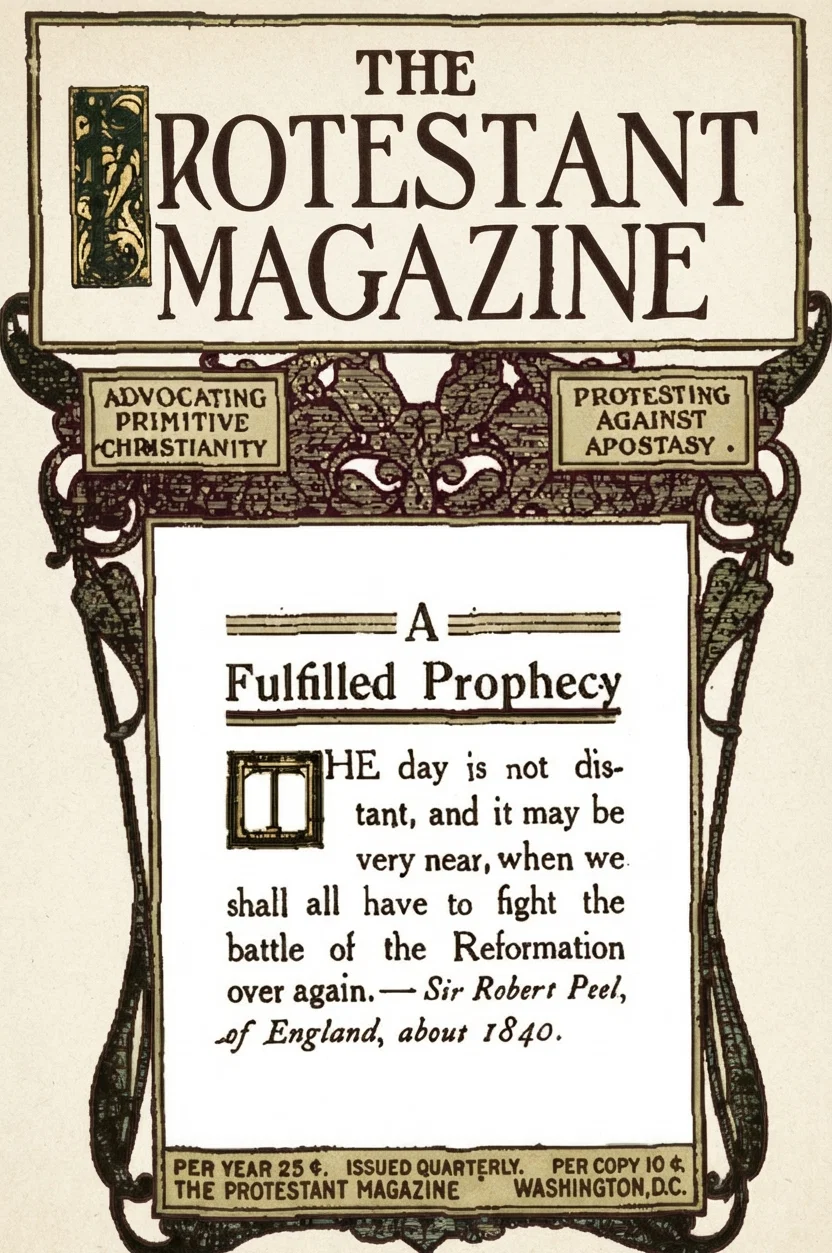
Cover Design in Two Colors

The "President's Letter" and "Vatican Influence" Number

Commencing with the next, or October number, this magazine will be issued every month. Price, $1.00 a year
America now faces a great Protestant revival. Bible Protestants everywhere are looking to this magazine for their weapons in this spiritual warfare.
A letter from Rome to the New York Sun, July 11, 1892, reveals the plan of the Papacy for America: "What the church has done in the past for others, SHE WILL NOW DO FOR THE UNITED STATES."

A FEW FEATURES

Double Frontispiece — Photographs of "The White House and the American Cardinals" and "Governor Taft's Mission to the Vatican." Sir Robert Peel's Prophecy Fulfilled (Cover). President Taft's Letter. The Mediation of Christ. The Awakening of Protestantism. Rome's Methods in Protestant Lands. Rome's Growth and Power in Germany. Trial and Self-Conviction of Leo XIII. The Final Call Out of "Babylon." Bishop Burt on the Reformation. Singer on "The Future of the Papacy." Catholic Population in Twenty-Five States. Rome's Boast of Control of Massachusetts. Rome and the American Flag, and Other Articles.

SPECIAL OFFER ON FIVE, ONE YEAR

Five copies, one year, to one address or to 5 separate addresses, only $1.00, or 60 cents each. Sender may include his own name. Or, send $1.50 for ten copies, six months. This number should be placed in the hands of every editor, attorney, clergyman, city and county official, and public-school teacher. We can furnish names and addresses.

ORDER THROUGH YOUR TRACT SOCIETY

If you do not know your Tract Society address, send to "The Protestant," Washington, D. C.

"God's Two Books;

OR

Plain Facts About Evolution, Geology, and the Bible"

Just issued. By George McCready Price, professor of Geology and Physics, Loma Linda (Cal.) Medical College, author of "Illogical Geology," etc.
Not long ago a clergyman in Wisconsin wrote to us in a taunting way, "Do you know of any college, or even high school, that amounts to anything, which is not teaching the doctrine of evolution?"
In our own minds we had to sadly confess that this teaching has become well-nigh universal throughout the civilized world. While not all teach the evolution of man from the lower animals, there are comparatively few to-day who doubt or question the long, successive ages of the modern evolutionary geology. The truth about geology is vital, and should be understood by all.
In a recent number of "Nature" (Jan. 19, 1911), the foremost botanist of England says that the modern evolutionary theory "had its roots in Lyell," the founder of modern geology; and he quotes another leading scientist to the effect that had it not been for Lyell and his theories of geology, "we should never have had the 'Origin of Species.'"
The present volume gives a summary, in easy, readable language, of the wonderful discoveries that have recently been made in the rocks of Europe and America, which have done so much to confirm the Bible record. To give but one instance: Just east of the Rocky Mountains, extending over one hundred miles in the southern part of Alberta, and running nearly another hundred miles down into Montana, is a tract of country, now known to be over a thousand square miles in area, where what are called pretty nearly the "youngest" rocks are underneath, and almost the very "oldest" are on top, and yet these rocks have every physical appearance of having been deposited just as we find them. But if they were really deposited in this order, the writings of Darwin and all his followers are only so much waste paper, and the evolution theory becomes a piece of elaborate nonsense. This is only one of the many modern discoveries mentioned in this book,—discoveries which are compelling some of the best scholars of our time to acknowledge that there must be something radically wrong with this system of geology that has so long been contradicting the first chapters of the Bible.
"GOD'S TWO BOOKS" is well illustrated, giving the portraits of most of the scientists mentioned in the book, with diagrams, pictures of fossils, etc. 184 pages; cloth, $1.
Address Your Tract Society or the Review & Herald Pub. Assn., Takoma Park, Washington, D. C.

The Gospel of Salvation

"How beautiful are the feet of them that preach the gospel of peace, and bring glad tidings of good things." Rom. 10:15.
HERALDS of mercy, to you will be given Life that is rich with the blessings of home, Life that's for love in the gladness of heaven; Sweet is your resting when labor is done. God's faithful heralds to sinners are calling, "Jesus is pleading; come, open the door." Come; for the moments like rose-leaves are falling; Enter his fold, and be safe evermore.
How the great years with their seasons are speeding, Bearing us down to eternity's side. Souls may be lost while the Master is pleading,— Souls in their sins, for whom Jesus has died. Tell of his love while the hours are flying; Tell of his prayer, as he hung on the cross; Tell how on Calvary Jesus was dying, He who has counted all earth gains but loss.
Tell of his tears in Gethsemane's garden; Tell how he suffered for you and for me; How by his death he has purchased our pardon; How by his merits the captive is free. List, while his tones on your senses are falling; Christ for the fallen the wine-press has trod. Haste, for the Saviour to sinners is calling, Pardoning Saviour, compassionate God.
Beautiful feet, in the city of splendor, Sweet be your rest, with the journeying o'er, Glad harps will thrill, with their melodies tender, Welcoming on to the evergreen shore. Far were your journeyings, dark o'er the mountains, Preaching unto sinners "the gospel of peace;" Now, mid the murmur of soft-flowing fountains, Rest is forever; all wanderings cease.
Moline, Ill.

An All-Sufficient Saviour

MRS. E. G. WHITE
CHRIST came to this world to live a life of perfect obedience to the laws of God's kingdom. He came to uplift and ennoble human beings, to work out an enduring righteousness for them. He came as a medium through which truth was to be imparted. In him are found all the excellencies necessary to absolute perfection of character. To those who receive him, he gives power to become the sons of God. "The word was made flesh, and dwelt among us, . . . full of grace and truth. . . . And of his fulness have all we received, and grace for grace. For the law was given by Moses, but grace and truth came by Jesus Christ."
In Christ "we have redemption through his blood, even the forgiveness of sins." He is "the image of the invisible God, the first-born of every creature." "By him were all things created, that are in heaven, and that are in earth, visible and invisible, whether they be thrones, or dominions, or principalities, or powers: all things were created by him, and for him: and he is before all things, and by him all things consist. And he is the head of the body, the church: who is the beginning, the first-born from the dead; that in all things he might have the preeminence. For it pleased the Father that in him should all fulness dwell; and, having made peace through the blood of his cross, by him to reconcile all things unto himself; by him, I say, whether they be things in earth, or things in heaven.
"And you, that were sometime alienated and enemies in your mind by wicked works, yet now hath he reconciled in the body of his flesh through death, to present you holy and unblamable and unreprovable in his sight: if ye continue in the faith grounded and settled, and be not moved away from the hope of the gospel, which ye have heard, and which was preached to every creature which is under heaven."Christ gave up his high command in the heavenly courts, and laying aside his royal robe and kingly crown, he clothed his divinity with humanity. For our sake he became poor in earthly riches and advantages, that human beings might be rich in the eternal weight of glory. He took his place at the head of the human family, and consented to endure in our behalf the trials and temptations that sin has brought. He might have come in power and great glory, escorted by a multitude of heavenly angels. But no; he came in humility, of lowly parentage. He was brought up in an obscure and despised village. He lived a life of poverty, and suffered often with privation and hunger. This he did to show that earthly riches and high rank do not increase the value of souls in the sight of God. He has given us no encouragement to think that riches make men worthy of eternal life. Those church-members who, when a brother becomes poor, treat him as if he were unworthy of their notice certainly did not learn this from Christ. To one who, during the Saviour's ministry, offered to follow him as his disciple, Jesus said, "The foxes have holes, and the birds of the air have nests; but the Son of man hath not where to lay his head." Those who follow him must share his poverty. "If any man will come after me," he declares, "let him deny himself, and take up his cross, and follow me." "So shall ye be my disciples."
It is submission to sin that brings the great unhappiness of the soul. It is not poverty, but disobedience, that lessens man's hope of gaining eternal life, which the Saviour came to bring him. True riches, true peace, true content, enduring happiness,—these are found only in entire surrender to God, in perfect reconciliation to his will.
Christ came to our world to live a life of stainless purity, thus to show sinners that in his strength they, too, can obey God's holy precepts, the laws of his kingdom. He came to magnify the law and make it honorable by his perfect conformity to its principles. He united humanity and divinity, that fallen human beings might become partakers of the divine nature, and thus escape the corruption that is in the world through lust.
It was from the Father that Christ constantly drew the power that enabled him to keep his life free from spot or stain of sin. It was this power that enabled him to resist temptation.

The Chinese Revolution

J. N. ANDERSON
THE surpassing significance of the recent Chinese upheaval is more clearly seen when it is remembered that it was not the rising of a class of Chinese against the existing political order, but a race movement in which the entire Chinese world, almost to a unit, in China and out of China, swept away the Manchu dynasty (its rule began in 1644), and established a republic. The decree of abdication recognized this fact in the following utterance: "The whole country is tending toward a republican form of government. It is the will of Heaven, and it is certain that we could not reject the people's desire for the sake of one family's honor and glory." "The people" are the whole Chinese race, counting over four hundred millions; "the family" is the Manchu clan, numbering probably not over four millions. Racially and numerically, the contest was overwhelmingly with "the people;" but what was still more vital to the issue, the alien Manchu clan stood for non-progress, misrule, and despotism, while the Chinese stood for human progress, modern ideas, and the rights of the people.

The Occasion of the Revolution

The occasion of this race revolt was the attempt on the part of the Peking government to nationalize the railways, which hitherto had been constructed and controlled by the provinces. Foreign influence played a part in this scheme. The profits, legitimate or otherwise, accruing from an investment that meant the railroading of a country as vast as China, could not fail to tempt the cupidity of European and American financiers, being in turn abetted by their own governments, which were not slow to see that it would be vastly to their advantage to have China's steel roads under the control of a few Peking officials dependent on foreign capital and readily swayed by diplomatic influence.
The provinces protested for several reasons. Traditionally, the central government had for a long time committed all local interests to the provinces. In practise, the doctrine of states' rights had been carried to its logical end, and the provinces were not willing to give it up. The local officials were not willing to surrender the financial gains to the corrupt Peking Manchus. But the provinces still more objected to the floating of loans by the Peking government which the revenues of the provinces were pledged under mortgage to secure to money kings of Europe and America. The crisis was precipitated when Sheng Kung Pao, minister of imperial posts and communications, undertook to carry out the wish of the imperial court. This was in the province of Sze-chuan, where most of the landed gentry had subscribed to a joint-stock railway company with a capital of eight millions. "The government ordered the dissolution of the company, took possession of its properties, and paid the stockholders $5,350,000 in bonds, part of which carried no guaranteed interest, and most of which the unhappy subscribers regarded as worthless."
The minds of the people were still further excited by fearful calamities, such as the plague, the terrible, devastating floods, and the resulting famines and pestilence. These, with the superstitious fear of the gods, and the callous indifference of the government, whose officials were living in luxury with little concern for the sufferings of the people, were the occasions of the Chinese upheaval.
This spirit of discontent and hatred of the ruling clan, the foreign Manchu, had already become incarnate in a large class of intensely active revolutionary leaders, who had for years laid broad plans for the overturning of the galling Tartar rule. They saw the time was ripe, but they wished to win over the army and the navy, and hence would have postponed the uprising until 1913. But the revolutionary tide had set in with such force that nothing could stay it. The accidental explosion of a bomb in the Russian settlement in Hankow, Oct. 9, 1911, led to a thorough search of a house in which were found not only bombs, but revolutionary documents, including lists of names of revolutionists. Their choice lay between striking hard and quick, and sitting still and having their heads cut off and their cause at least temporarily lost. They chose to show their colors and strike. The province of Sze-chuan rose almost en masse, and a short work was made of the imperial officials and their underlings. Next the revolutionary current set toward the three contiguous cities of Hankow, Wu-chang, and Han-yang, all of which fell into their hands after some brisk fighting. Almost at once the greater part of central and southern China was in a state of active rebellion. Despite some very stubborn resistance on the part of the imperial government, the revolutionary tide swept the whole country, and it soon became apparent that "Heaven" had elected to give China to the Chinese, and to retire the antiquated and useless Manchus.
Such, in a word, was the passing of the Manchu supremacy and the setting up of the Chinese republic. But this is only a surface view. Back of and beneath all this overturning in the old Middle Kingdom, were those mighty undercurrents that are always present as the active forces in national, racial, and world convulsions.

The Underlying Causes of the Revolution

What, then, were the underlying causes that forced these tremendous changes? The spirit of the times is working to this end. A new spirit is abroad, recasting or overturning ancient institutions and hoary customs. Political and social changes of the first magnitude have recently swept through Turkey, Persia, Portugal, and Mexico. The masses of India and Russia are seething with this spirit of unrest and change. The most stupendous exhibition of the force and direction of this revolutionary spirit is the Chinese revolution, which came with such swiftness and decisiveness as fairly to daze the whole world. But true as all this is, it does not suffice to explain the race upheaval; for the question still remains, Whence came this spirit of irreconcilable antagonism to the old order? What was it that fired the Chinese race to the point of unseating the Manchus, and overturning many of their own ancient institutions? In the last analysis, it was and continues to be a conflict between light and darkness; and, viewed in that light, the active and primary cause was the invisible influence of Christianity. In this sense Robert Morrison was the first revolutionist when he began the translation of the Bible into Chinese, and the Chinese revolution thus began about one hundred years ago.
This spectacular and sweeping overturning of the existing order of affairs in China is but the outward expression of a no less radical change in the mind, the heart, the thought of the Chinese people. A multitude of secondary causes have operated to bring about this changed inward state, but primarily Christianity is the spring of it all. It is God moving in history to accomplish his eternal purpose for man. Western civilization and influence, trade, commerce, modern mechanical inventions, education, international law,—all these are not of the essence of Christianity, but results or concomitants, and have been powerful factors in the uplift of China. They have set new standards, and given China a new vision of her defects and her possibilities. But China's awakening must, after all, be attributed to the active Christian agencies.
The educational work of foreign missions in China is to-day represented by 2,029 elementary schools, and 1,116 academies, colleges, and normal, medical, theological, and industrial schools. Missionary activity along these lines has compelled the Chinese government to found modern schools, or lose their children to the mission school. To-day the schools of all grades under the Imperial Bureau of Education number 42,000, with 64,000 instructors and 875,000 pupils. The present aim of the Chinese government is to provide accommodation within the next ten years for the instruction of 45,000,000 children. Scores of old examination halls, with their thousands of cells, have been pulled down to make room for these new schools. In the meantime thousands of the brightest Chinese youths have gone abroad to be educated in European, Japanese, and American educational institutions.
Every book, every class recitation, every school, contributed directly to the awakening of the Chinese race that issued in the recent upheaval. Nor were the women of the Middle Kingdom left out of the count. "Many schools for girls have been established in China. The late empress dowager ordered a large lama convent turned into a school for girls, and directed the imperial high commissioners who were sent out in 1906 to study American institutions to give special attention to the institutions for the education of women."
Washington, D. C. (To be concluded)

The Message for This Time

G. A. IRWIN
IN the messages given by the apostle John to the seven churches, as recorded in the opening chapters of the book of Revelation, we have a condensed history of the church from its organization by the ordination of the twelve apostles until the end of probation and the return of our Lord to take his faithful ones home to glory. In each of the periods named in this history, a crisis confronted the church, and in each of them a separate and distinct promise was made to the church and the individual overcomer, any one of which would of itself be a sufficient stimulus to cause one to strive for the victory.
The foe in each instance has been the same; so if we can find out what caused individuals to triumph in the Ephesian age, we have the secret of success in each of the ages, the Laodicean, in which we live, included. The apostle John, through whom the Revelation was given, lived from the beginning to the close of the Ephesian age, and perhaps he, as no one else of his time, was acquainted with the bitter hatred manifested toward God's people by those in authority, in both church and state, and the influence and effect that the world in general had upon those endeavoring to live a Christian life.
Much of John's time in later life was spent in the city of Ephesus, whence he directed the churches in Asia Minor. Ephesus was the center of heathen worship, for the temple of Diana was located in that city. In looking through the epistles of John, written just prior to his banishment to the isle of Patmos, at a time when persecution was most severe, we find what is undoubtedly the secret of the overcoming life: "This is the victory that overcometh the world, even our faith." There is no other one thing pointed out in the Bible which will bring the overcomer's reward.
The faith that brings victory is the faith that centers in Jesus Christ, and brings justification to the repentant sinner. The note sounded by the apostle John in the time of crisis has been the key-note of victory in every age. "The just shall live by his faith" was the key-note of the Reformation of the sixteenth century, and the message that broke the power of the Papacy and sent her into captivity.
Neither the Lord nor the Papacy has changed. The principle implanted in the minds of men by Satan in the beginning, that man can save himself by his own works, has been the foundation of all heathen religions, and is the principle of the Papacy still; and wherever and whenever it is held, men have no barrier against sin. Opposed to this principle and doctrine is the teaching of Paul, the great exponent of the glorious and victorious doctrine of justification by faith. "By grace are ye saved through faith; and that not of yourselves: it is the gift of God," was the message preached by the great apostle from the time of his conversion till the time of his departure in that gloomy dungeon in the city of Rome when he gave his dying testimony so full of sublime faith and courage: "I am now ready to be offered, and the time of my departure is at hand. I have fought a good fight, I have finished my course, I have kept the faith: henceforth there is laid up for me a crown of righteousness, which the Lord, the righteous Judge, shall give me at that day: and not to me only, but to all them also that love his appearing."
Justification by faith is a message from God; it bears the divine credentials, for its fruit is unto holiness. The thought that the righteousness of Christ is imputed to us, not because of any merit on our part but as a free gift from God, is a precious thought which comes to the burdened soul as water to the thirsty traveler.
It was the preaching of justification by faith that marked the beginning of the loud cry of the third angel's message, as evinced by the following statement found in the first-page article of the Review and Herald of Nov. 22, 1892:—
"The time of test is just upon us, for the loud cry of the third angel has already begun in the revelation of the righteousness of Christ, the sin-pardoning Redeemer. This is the beginning of the light of the angel whose glory shall fill the whole earth."
If the preaching of righteousness by faith as a special message in this denomination was the beginning of the loud cry, and of the "light of the angel whose glory shall fill the whole earth," God evidently did not intend that this message should cease until the whole earth was lightened with the glory of the Lord.
That the message did not go as designed is evident from the following statements by the Lord's servant: "The churches are lukewarm. They have listened to doctrinal discourses, but they have not been instructed concerning the simple art of believing. . . . Shall we not give light to the souls that are groping in darkness? Shall we not seek to save them from perdition and build them up in the most holy faith, ever keeping before them the righteousness of Christ? . . . The doctrine of justification by faith has been lost sight of by many who have professed to believe the third angel's message."
The question will doubtless arise in the mind of the reader why a message of such vital importance to individuals, a message that was the beginning of the loud cry, should be lost sight of. The answer to this question is found in the following statement by the same writer: "The enemy of man and God is not willing that this truth should be clearly presented; for he knows that if the people receive it fully, his power will be broken. If he can control minds so that doubt and unbelief and darkness shall compose the experience of those who claim to be the children of God, he can overcome them with temptation."
When the message of justification by faith (which the servant of the Lord said "is the third angel's message in verity") began to be preached in this denomination, the enemy was deeply stirred, and made a strong effort to stop its spread. Failing in this, he changed his plan of opposition to a method that promised greater success. This plan was so to fasten the minds of the people upon the instruments that the Lord had called to promulgate the message, that these men would come to be regarded as the oracles of God, and the people's faith would become centered in them, rather than upon Jesus Christ, the author of the message. It was reckoned by the enemy that the praise and flattery of the people would so inflate these men that they would come to feel that their opinions and judgment must prevail in all matters pertaining both to the Scriptures and to the management of the Lord's work in the earth.
How well the enemy succeeded in this latter plan is well known to us as a people; but what we have lost by allowing him to succeed, only eternity will reveal. It is perfectly safe, however, to say that we are years behind where we might have been and ought to have been in the progress of this work. We are rapidly coming to the time when the miracle-working power of the arch-deceiver will be more decidedly revealed. Soon the powers of earth will seek not only to compel God's people to keep the first day of the week as the Sabbath, but will try to compel them to renounce their obedience to God's law by working on his holy day. This will be the time that will try men's souls; and when I read that only "those who are clothed with Christ's righteousness will in that day stand firm to truth and duty," and that "all those who have trusted in their own righteousness will be ranged under the black banner of the prince of darkness," I am persuaded that the time has fully come for the message of justification by faith to become again a prominent message in this denomination. The same faith that nerved Luther to stand alone so fearlessly against the combined power and influence of the Papacy, is needed now in the conflict with the combined powers of darkness. In this very connection, the spirit of prophecy has said, "If you would stand through the time of trouble, you must know Christ, and appropriate the gift of his righteousness which he imparts to the repentant sinner."
Loma Linda, Cal.

Godless Faith Healing

THE ninth chapter of John contains the account of the healing of a man who had been born blind. In the thirty-fifth and thirty-sixth verses we notice a most remarkable phase of human credulity. Jesus had found the man after he had been cast out, and inquired of him, "Dost thou believe on the Son of God?" The answer came quickly, "Who is he, Lord, that I might believe on him?" Here is a most eager readiness manifested to believe on anybody or in anything about whom his healer might tell him.
That characteristic in human nature is being exploited to-day by those who are working the law of rest to heal the sick. It is called Christian metaphysics or some such name. By playing upon the credulity of the healed ones, their adherence to the new doctrine is secured.
The extent to which these methods are employed was emphasized in an article in a popular magazine recently, in which it was shown that about a score of systems of mind-cure in the United States are exploiting, or attempting for money to exploit, devout, credulous humanity with their assured divine method of healing. The article was well-entitled "Trading in the Holy Spirit."
A large proportion of human ills is due to such adverse mental causes as doubt, fear, hatred, anger, wrath, evil surmising, envy, jealousy, malice, worry, care, anxiety, sorrow, despair, and mental agony. These wear out and exhaust the energies of the body, and it becomes a prey to a multitude of diseases that can be produced in no other way. Different organs fail in their functions because there is not energy enough left in the body to carry on its work properly. These adverse mental causes tend to produce anything but peace, rest, and life.
Now it is self-evident that if want of peace and rest will produce sickness and disease, any means that is conducive to peace and rest may be used with more or less success in the treatment of such diseases. Human assurances that bring confidence, hope, and courage will be sure to work curatively in these cases. Anything that humanity can conjure up to change mental moods and conditions will help, but all partial remedies can bring only partial healing. He who would have the highest success must surely appreciate the truth that the law of rest in its fulness should be applied by coming in right relation with the Author of life himself.
The blessed assurances of his Word are all-sufficient. This Word is the encyclopedia of assurance and comforting promises: "Come unto me, all ye that labor and are heavy-laden, and I will give you rest. Take my yoke upon you, and learn of me; for I am meek and lowly in heart: and ye shall find rest unto your souls. For my yoke is easy, and my burden is light." Matt. 11:28-30. "Thou wilt keep him in perfect peace, whose mind is stayed on thee: because he trusteth in thee." Isa. 26:3. "Lord, thou wilt ordain peace for us: for thou also hast wrought all our works in us." Verse 12. "Commit thy way unto the Lord; trust also in him; and he shall bring it to pass." Ps. 37:5. "Casting all your care upon him; for he careth for you." 1 Peter 5:7. "I create the fruit of the lips; Peace, peace to him that is far off, and to him that is near, saith the Lord; and I will heal him." Isa. 57:19. "O that thou hadst harkened to my commandments! then had thy peace been as a river, and thy righteousness as the waves of the sea." Isa. 48:18. "Therefore being justified by faith, we have peace with God through our Lord Jesus Christ." Rom. 5:1. This latter scripture furnishes the key to this whole question of peace and rest.
He who studies carefully these expressions we have quoted will be led far on the way toward confidence in God; and when the state of complete trust is reached, the man will have developed a love for God and his ways that will wean him from his own ways. This will bring forgiveness, full and free, and "perfect peace," or "the peace of God, which passeth all understanding." Phil. 4:7.
Such a state of mind may be enjoyed by every Christian, and this peace and the rest that accompanies it are the antidotes for every adverse mental poison. Hence this peace and rest are the cure for every malady due to adverse mental cause, except where the danger is so great that nature alone can not restore. Here is the heaven-sent remedy for earthly ills, so infinitely valuable, and yet so little appreciated. How few indeed have learned to "rest in the Lord, and wait patiently for him." And here is where the godless systems of healing come in with human assurances and the workings of natural law, and produce a measure of natural mental peace and rest, and bring about a certain degree of healing, which in many cases seems very remarkable because no visible means are used to accomplish the results.
Systems of mental diversion of varying value are employed. Curiosity, expectation, and even occultism are made to serve the purpose of changing the mind from its old moods. Hope and cheerfulness are brought in through the abundant promises of cure, and many times bed-ridden invalids or those who have been prostrated by grief, disappointment, or anxiety, are made to forget their troubles, just through the human application of the natural law of rest. Music and mirthfulness may be used successfully, and in many cases the body rallies from its illness, and health returns.
The system of denial used by Christian Science interprets the Bible until it means all the way from nothing up to just the opposite of what it says, and denies the evidence of the senses and the validity of all the natural physical laws of life, until a muddled fascination seizes upon the fervent disciple, which ends in a state of mind so like the ancient enchantment that it is impossible to discern the difference. Of course, all the old frets and worries and anxieties and many of the other adverse mental conditions must be dissipated by such a complete revolution in the mind. The fear of a future judgment, which robs many a soul of all peace and comfort, is swept into the land of oblivion through the wonderful power of this new philosophy. How can the body help rallying when the burdens are removed that have cost it so much vital energy?
If this system were miraculous, as its advocates claim, why should they not conquer all disease? But they miserably fail when they step beyond the limits of simple mind-cure. Mental causes can suddenly prostrate the human body, and mental causes can suddenly remove the burdens and liberate the nervous system from its unnecessary load, and thus let the body go free from what seemed a serious disease. Of course, Christian Science denies all physical causation and the existence of disease. Diseases are only "errors of mortal mind," "old beliefs" which must pass away when attacked by this amplified system of negation. The things which cause unrest Christian Scientists attempt to sweep away with their great bosom of denial. They succeed quite well with a large share of ailments resulting from mental causes; but they are helpless in their failures to relieve blood-poisoning, and severe difficulties due to other than mental cause. They account for their lack of success on the ground that the patient failed to grasp the principles of healing.
It may be possible to get up enough excitement to cause one to forget a toothache for a time, or the pain of a bee sting; perhaps the cry, "The house is on fire!" would do it. But no amount of mental philosophy can divert the physical system from the consciousness that a cancer is gnawing at the vitals, or that blood-poison is raging through the system.
(To be concluded)

Faint Not

WALTER J. PAULSON
O CHRISTIAN, watch! The darkness soon is o'er, Soon morning light will shine, and never-more Will night invade our shore.
O Christian, look! See yonder myriads fall; A heathen host has gone beyond recall. Is that the fate of all That vast confluence spread before thy ken?
O, blow thy bugle! sound with voice and pen The danger great! And when Thou hast, O watchman, faithful warning given, This night of sin with radiance will be riven, And earth shall be a heaven.
O gird thy loins! and strike with vigorous blow The e'er-assailing, fast-increasing foe, And thou relief shalt know.
So hope and watch; O watchman, weary not! Eternal day at last shall be thy lot, With ills and cares forgot.
South Bend, Ind.

Editorial

The beauteous vision that enraptured John on the isle of Patmos is a vision that awaits in real substance the sight of every true child of God. "And I saw the holy city, New Jerusalem, coming down out of heaven from God, made ready as a bride adorned for her husband. And I heard a great voice out of the throne saying, Behold, the tabernacle of God is with men, and he shall dwell with them, and they shall be his peoples, and God himself shall be with them, and be their God: and he shall wipe away every tear from their eyes; and death shall be no more; neither shall there be mourning, nor crying, nor pain, any more: the first things are passed away. And he that sitteth on the throne said, Behold, I make all things new. And he saith, Write: for these words are faithful and true. And he said unto me, They are come to pass. I am the Alpha and the Omega, the beginning and the end. I will give unto him that is athirst of the fountain of the water of life freely. He that overcometh shall inherit these things; and I will be his God, and he shall be my son." When the vision of that beautiful city of the redeemed greets the eyes of the ransomed people of God, the vision of John will have become substance, and the hopes, the yearnings, and the fond expectations of God's sons and daughters will be swallowed up in blessed reality. Toward that consummation we look in steadfast faith, knowing that the time is not distant when John's vision will be our reality, when the kingdom of righteousness shall displace the anarchy of sin, and when no dimming veil nor gulf of disobedience shall separate between God, our Father, and his blood-bought children. Then it is that "the righteous shall inherit the earth, and shall delight themselves in the abundance of peace." Then it is that righteousness and truth shall kiss each other, and the habitation of the Infinite be the home of his children, once estranged but now reconciled through the life and sacrifice of the Son of God.
In that kingdom where sin can never come, where affliction can never rise up again, where everything that could bring trouble, or disappointment, or sorrow is forever removed, it is still the privilege of every son and daughter of Adam to have a part. Who would wish to forfeit that opportunity for a few days' or even years' indulgence in the best that this world has to offer?
Continue reading: Our Mission