The great country of Nippon has many interesting features. Its inhabitants number more than forty-five million. On the whole, the people are very industrious and provident. In whatever phase of life you meet the Japanese, they are always courteous and agreeable. Their politeness, in fact, is too profuse. Upon first impression it seems laughable. At a railway station, when a train departs, almost all the people spend the last few minutes in bowing to their departing friends. When a servant answers your call, he—more usually she—humbly bows, and even touches the floor with the forehead. People have told me that it is all superficial. Perhaps that is so, but the probability is there are exceptions. In any case, it is not at all an unpleasant experience. It is much better than the stoicism that prevails in some Western countries. In this respect Japan is somewhat similar to her neighboring empire of Celestials; in fact, possibly, the high-class Chinese are more deliberate in saluting and farewelling their friends. The agreeableness, and the apparent patience of the Japanese on the whole, are very striking. Slowness to take offense, or to express themselves as offended, is16very strongly developed.
Quarrels are almost unknown, or at least are seldom encountered. Of course they have trouble and domestic unhappiness, which at times terminate fatally.
The marriage ceremony is cold and soulless. The affair is arranged by a go-between, when the parties concerned are deemed of age. This friend is one who inquires into the social standing and monetary position of the families on both sides, and when the match is completed, naturally is remunerated. The friends gather together on this event, and perhaps for the first time the couple meet, at least for conversation and acquaintance. A number of rounds of the favorite and inebriating saki, or rice wine, and the ceremony is over. It is finally reported to the local authorities, and is then binding—till the head of the house decrees otherwise, when his wishes are carried out.
The people are not very religiously inclined. Many of them have the forms of some of the different sects of Buddhism, but it is in many cases because of custom. Of late years the idea of Christianity has been, taking hold of them to a great extent. Whether they realize what it really means to them, only time will determine. It has been stated that one reason for their acceptance of Christianity is commercial advantages. Undoubtedly this is true in many cases; but is this unlike many people of your acquaintance in more favored Christian lands? That is something to be encountered the world over.
Numerically the Protestant societies have something to show for their efforts. The Salvation Army has been at work a little over a decade, and thus far has a corps of about two thousand. The martial arrangements of their followers are very attractive to the patriotic, aggressive Japanese.
Along the lines of industry the Japanese rank very high. It is impressive to note that their large towns are given over to factories. This indicates that commercially this country will in the near future be a strong competitor for trade in this far Eastern world. But for some time to come, strenuous efforts will be required to develop and build up its recent possessions. One of the methods used to provide revenue for the island of Formosa is a monthly lottery, the first prize of which represents twenty-five thousand dollars.
One of the largest enterprises is the handling of ships in the Kobe dockyards, which provides employment for more than six thousand men. In the vicinity of this town is a large manufacturing city of upward of a million inhabitants. Situated on a river, hundreds of bridges are required for the passing traffic. These are all fairly substantially built. In the town there are a museum and library, the latter containing many books in the English language. The electric street-cars and the steam railway are not feeble by any means. A fast service, at frequent intervals, is well patronized; for the Japanese are very fond of traveling and sightseeing. The railways are numerous, and have a total mileage of almost five thousand miles. They have all been controlled and operated by natives, but are gradually coming under government control. It is well known that the government manifests a fatherly interest in the welfare of all industries, especially when the financial returns are satisfactory. Many of the trades are exclusively in its hands, and entirely monopolized. The rate of duty on practically all goods is enormous, and is almost prohibitive to foreign merchants.
As regards cheap labor, this country can take the lead. The highest rate for skilled labor is one shilling and twopence—about thirty cents gold—a day; while ordinary laborers receive as little as sixpence—twelve cents—a day.
Very few of the women have adopted Western customs, but among the men it is becoming very common. Many can be seen who have adopted some foreign item of clothing, the more common being footwear and hats.
The people are by no means good musicians, though under good training they can do creditably. Only a few evenings ago it was my privilege to hear the naval band discourse some excellent pieces, which were well rendered. On Sabbath the members of our little church make a noble effort to carry the singing, believing in that scripture which says “singing and making melody in your heart to the Lord.”
The capital of Japan is an excellent place for mission work. Among the eighty thousand students are about ten thousand from China, many from the higher class. A few well-behaved and attractive boys attend the English Bible class every evening. And it is good to hear, as I did on more than one occasion, the voice of prayer ascending to the true God in several different languages. The missionary meetings are much the same as in the home land. Papers are wrapped and sent out, prayer is offered on behalf of these silent messengers, and experiences are related, and donations received for aggressive work.
The Japanese are all anxious to learn English; and while waiting at the depot, or traveling in the train, one will approach you, and expect you to correct his composition or help him with his reading lesson. Even one of the servant class, while waiting on you, will inquire the name of articles, and make reference to a note-book, which is his constant companion.
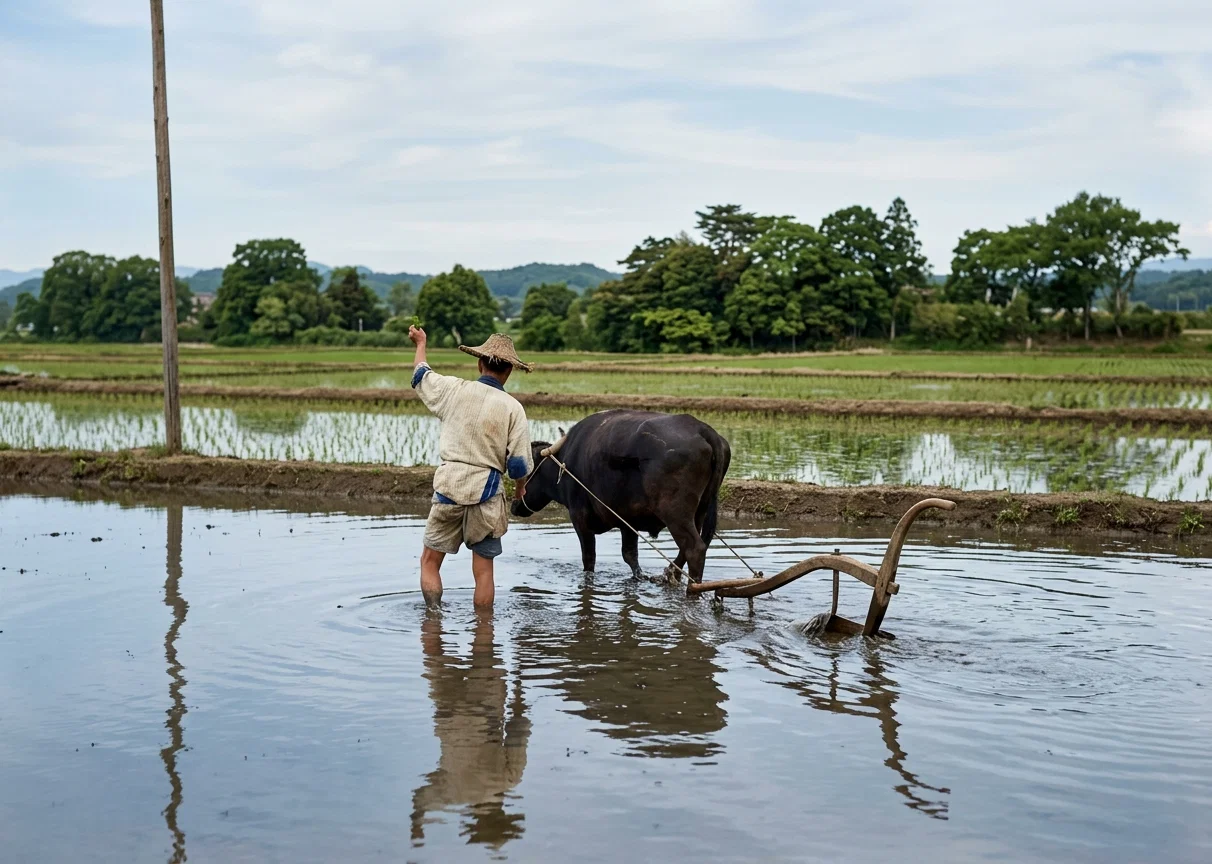
The country has many attractions. It is very mountainous, and the surrounding plains are well populated with agriculturists, or, rather, gardeners. It somewhat resembles a great patchwork quilt. The shapes and designs of the various plots of the different products under cultivation form a pleasing scene. Plots of the tobacco plant and peanuts, and here and there a patch of tea plants, as well as many different vegetables, not, of course, excluding the inevitable rice (the accompanying cut shows how the rice-field is prepared for sowing), with larger fields of the mulberry shrubs for the benefit of the silkworm, form an interesting sight. The world-famed lotus plant, found in every pond, with its beautiful and exquisite blossom, is indeed pleasing to the eye.
One attraction is mountain climbing. This was enjoyed by the writer, with a party of three, during the past summer. Securing two coolies to carry our blankets and provisions, and a pair of ponies to carry us over a portion of the journey, we set off in the rain. By nightfall we were at a high elevation, and had just passed a few patches of snow in some of the valleys. The surface of the mountain was strictly volcanic. As we ascended, the vegetation decreased, until it was entirely absent. A few hundred people were on the path, most of them on the return trip. This is to many a sacred mount, and as many as ten thousand had already made the ascent during the summer.
The accommodation house, or shed, consists of one room. There we were packed like sardines—forty of us—only one other foreigner being among the number. In the morning another two miles remained before reaching the summit. A dense fog obscured everything, and rendered the atmosphere damp. As we neared the top, a little snow was under foot, and by the time we shouted “Banzai,” it was about two inches deep. There we were, twelve thousand feet above sea-level, in the stillness of the early morning, with the throat of the yawning giant at our feet. We could indeed feel our nothingness. It was an experience long to be remembered. The descent was made in a driving rain-storm.17
Earthquakes are of very common occurrence. Almost every week one is felt. A few weeks ago we had a tremor that lasted four minutes. These tremors have been going on for years, and rarely anything approaching seriousness has occurred. It all reminds one of the uncertainty of things earthly, and calls us to build on the sure foundation, so that when the mountains shall “be carried into the midst of the sea,” we shall not fear, nor be ashamed.
Tokyo.
PREPARING RICE-FIELD FOR PLANTING
The Seventh Annual Meeting in the Caucasian Conference
By Guy Dail
GUY DAIL
TO-DAY the best session this conference ever had has been closed. Sixty delegates from the twenty-three churches and companies of the Caucasian field have been abundantly blessed in their deliberations concerning the well-being of the cause of God in this part of Europe and Asia. From the beginning of the meeting (the conference was held October 16-20), about three hundred of our own people were in attendance. Of these one hundred were native Russians—nearly four times as many as when we visited this place four years ago.
The conference was held in the new hall erected by the Alexandrodar Music Society. The Bible studies and the business sessions were conducted in German and Russian. There were no dry or formal business meetings, for the reports rendered and the subject-matter considered in the resolutions were of such a practical nature that all felt a deep concern in what was before the house. It was reported that in one neighborhood as many as fifty Molocaners (a Russian sect numbering thousands, whose motto is, “Love, Unity, Freedom, and Equality”) are keeping the Sabbath, and ask that one of our workers be sent to instruct them. In other places there are inquiries for the message God has given us. Although we have been operating in this part of the country for about twenty years, still there are German colonies that we have as yet not entered, notwithstanding the fact that our chief efforts have been put forth among the German-speaking people. We have also done very little for the cities. It is felt that a change must be inaugurated. This winter it is planned to enter Tiflis, the “Hot Town,” so called because of the sulphur springs near by. This is an important city, with a population of 161,000; it is located at the southern terminus of the great post and military road passing through Dariel Pass from Vladikavkaz. Dr. V. Pampaian will extend the sphere of his influence by entering one or two of the larger towns within easy reach of Erivan, where he is now laboring among the Armenians. Other cities should be opened, as Baku, of 112,000 inhabitants, the most important commercial center on the Caspian Sea. It is in this neighborhood that the more than seven hundred oil-wells are playing such an important rôle in the production of Russian petroleum. Then we should not forget Batum, Poti, Kars, Jekatorinodar, Alexandropol, and Stavropol, some of which have been well-known to history.
As to territory, this conference embraces Ciscaucasia and Transcaucasia. It is probable that nowhere else in all the world are there so many different races, speaking such a variety of languages. Indeed, the Persians have dubbed this “the Mountain of Tongues.” Such peoples they are, too—these hardy mountaineers, who resisted the Russian arms for nearly a century. Some say that there are no less than one hundred fifty peoples scattered among the 11,759,600 inhabitants of these regions, and that there are as many as seventy languages represented by them. The Georgians and the Circassians, famed for their personal beauty; the isolated, half-savage Svans, or Svanithians, who, although they number only 14,000, yet, aided by the almost inaccessible glacier-crowned ridges that surround their Upper Inghur Valley, have successfully withstood every attempt Russia has made to collect taxes from them; the hardy Lesghians, “one of the finest races in Caucasia;” the Armenians; the Kurds; the Mingrelians,—these, and many other nationalities are to be found here. Then, too, of course we are not to forget the Russians and the Germans, whose influence will help us to gain access to these various peoples; nor should we omit the Kalmucks, through whose steppes we passed on our way down from Saratof. The Kalmucks have strong Mongolian features. Many of them are large landowners, and wealthy stock-raisers. One of our brethren has been holding Bible readings with an educated Kalmuck, who hears the message gladly, and spreads it among his fellow countrymen wherever he has opportunity.
Jan. 1, 1907, the Caucasian Conference transferred about three hundred of its members to the East Russian Mission. During the past three quarters, sixty-three new converts have been received, raising the Caucasian membership to 706; the tithe for this time has been $1,412. Heretofore, some erroneous ideas have been abroad in Caucasia, as to the manner in which the accounts of the workers are audited. Near the close of the business session, a number of the newly elected auditing committee (after they had gone over the time and expenses of the laborers) made a voluntary statement to all the delegates as to just how this work is done—that the ministers and workers do not set their own wage, but that all is determined by the committee, the large majority of whom are composed of lay members not in conference employ. They vouched for the justice of what is done, and earnestly requested all our people to be true to God in bringing the tithes and offerings into his storehouse, especially in view of the great amount of work yet to be accomplished, and the need of more laborers to proclaim this message.
The educational problem, the work of the Sabbath-school and tract departments, the care of the poor, the importance of the canvassing work, church order and organization, the circulation of “Ministry of Healing,” and the strengthening of the material fund (toward which they gave $675)—these and kindred topics were thoroughly and conscientiously considered in the resolutions brought before the brethren. Everything was done in brotherly love and a spirit of union, without friction of any kind.
The Lord showered down upon us a rich blessing on the Sabbath. Elder L. R. Conradi spoke freely in the forenoon, and the word of God met response on the part of the hearers; both the Russians and the Germans gained new experiences, and received rich blessings from the Lord. The afternoon social meeting was in charge of Elder J. T. Boettcher; and the testimonies given showed great appreciation of the blessings the conference had brought to all. Dr. V. Pampaian and Elder H. K. Loebsack, as well as all the local workers, also rejoiced for the privileges of the meeting. Eleven were baptized Sunday afternoon.
Elder H. J. Loebsack was again unanimously chosen president of the Caucasian Conference. He will be assisted the coming year by one ordained minister, three Bible workers, one medical missionary, and three colporteurs.
We wish for them all God's Spirit and power, as they have a field that is in many ways truly a difficult one. We believe every Seventh-day Adventist will remember them in prayer, that God may go before them, and open up the way.
Alexandrodar.
Native Foods in Tropical Climates
A SEVENTH-DAY ADVENTIST missionary of long experience in a tropical climate, who has been able to preserve good health while working hard, says: “We have never had the idea that the foods which are grown in the islands [tropical] were not so wholesome as those of temperate climes; but, on the contrary, we consider them to be just the food best adapted for this climate, with the addition of bread, which to those who have always had it, seems indispensable. Our diet is composed principally of yams, taro, breadfruit, sweet potatoes, bananas, mummy-apples, mangoes, oranges, the cocoanut, rice, and bread. When we have been compelled by circumstances to use much imported foods, we have not enjoyed as good health as when we were living mostly on the native foods. Our systems do not require so much food in a warm climate as where it is cold; for when it is cold, more food must be burned in the body to keep us warm; and when we come to a hot climate, if we do not cut down our rations, we are more liable to feel weak and feverish, and be troubled with colds and other unpleasant symptoms.”
Another Union Conference Organized
By W. J. Fitzgerald
The Grand Council of the General Conference recommended various changes in the territorial lines in North America. One of these recommendations was that the Atlantic Union Conference be divided, so that a new union might be formed of the States of Pennsylvania, New Jersey, Delaware, Maryland, Virginia, West Virginia, and Ohio. The council advised that the last-named State be released by the Lake Union, to form a part of the new union.
The way being fully prepared by actions of the Atlantic and Lake Unions, in harmony with the recommendations of the General Conference Council, the new union was organized at a meeting held in Philadelphia, Pa., at 3 P. M., November 17. Each conference was represented by a full delegation. Elder C. F. McVagh was chosen temporary chairman; and Elder Geo. W. Spies secretary pro tem. It was voted that the new organization should be known as the Columbia Union Conference. At this first meeting of the Columbia Union, Elder A. G. Daniells and others expressed earnest desires that this union should, in the very beginning of its existence, make full provision for well-organized and effective departments to promote every phase of the great work committed to us.
The following standing committees were selected to report matters to the session for consideration and action: A joint committee to adjust financial and other relations between the Atlantic and Columbia Unions; a committee on constitution and by-laws; on plans and recommendations; on licenses and credentials; on nominations; and on distribution of labor.
Recommendations and resolutions were adopted as follows:—
“Whereas, The blessing of God has attended the work of the various conferences in our field during the past biennial term, so that marked advancement has been made in carrying the message to the people of the great cities in this field, therefore,—
“1. Resolved, That we express our gratitude to our Heavenly Father for his blessings that have attended our work, and reconsecrate ourselves to service, and implore his blessings upon us during the coming term.
“Whereas, The territory of the Atlantic Union States has been divided into two unions, Ohio joining the new Columbia Union, in order to bring greater efficiency in administering and developing the cause of the message in these populous fields, therefore,—
“2. Resolved, That we as a union and as conferences represented, call for the consecration of every resource to service, and that we will earnestly press our work into unentered portions of our field and in the great centers of population, in order that the warning of the Lord’s soon coming may reach every community in our union.
“3. Resolved, That we arrange for a view to the full departmental organization of our work, making provision for publishing, educational, medical missionary, religious liberty, and young people’s missionary volunteer departments, and that persons be chosen to the oversight of these departments.”
Arrangements were made for strengthening and building up the distributing agencies of the Publishing Department. To this end it is proposed to enlist the entire rank and file of the believers in this message in active missionary work. Each conference will have its field missionary secretary, who will have entire charge of this work in his conference. A general missionary secretary, supported jointly by the Columbia Union Conference and the wholesale house, will have the general supervision of this work throughout the union conference.
A committee was appointed to bring about a uniform system of accounting throughout the union.
Recommendations were also adopted pledging the new union conference to the work of assisting the mission work among the Jews and Italians. It is proposed to take up systematic correspondence missionary work among the better class of Jews, also to do all in our power to counteract the work of that class among the Jews who are advocating the abandonment of the true Sabbath and the keeping of Sunday. As far as possible the magazine Liberty, with other literature, will be placed in the hands of Jewish lawyers, doctors, and judges.
In view of the need among church officers of instruction in regard to their duties, a recommendation was passed to the effect that we encourage the conferences of this union to hold institutes for church elders and deacons, to instruct them more fully in their important work.
Recognizing that “much has been lost to the cause of God by lack of attention to the young,” it was voted that more vigorous and systematic efforts than ever before should be put forth through our newly organized Missionary Volunteer Department to enlist our youth in the service of God where they are, and to encourage all our young people to obtain a preparation in our schools for some branch of the work.
Realizing that something should be done to assist our sanitariums in securing a better patronage, it was recommended that we call the attention of those in need of medical help to these institutions.
The new union took action definitely pledging itself to labor earnestly to increase very materially the contributions to foreign mission work. To bring this about, it is proposed to raise an amount equal to ten cents a member each week to be used in the foreign fields. Besides this, every conference in the union will be urged to make an earnest effort to secure the payment of a full tithe in every church.
The executive committee of the union was asked to advise with the executive committee of the Ohio Conference, with a view to making the Welcome Visitor the official organ of the Columbia Union Conference, and that the operating expenses of the paper be mutually shared by the several conferences in the union.
It was also recommended that the Mount Vernon College be made the training-school for this union, and that the young people of this territory be encouraged to avail themselves of the privileges offered by this institution.
The conference adopted the usual constitution and by-laws.
The officers elected for the biennial term are: President, W. J. Fitzgerald; Vice-President, H. H. Burkholder; Secretary and Treasurer, E. R. Brown; Auditor, E. R. Brown. The other members of the executive committee elected are J. B. Clymer, D. W. Reavis, G. W. Bailey, M. D., and A. C. Shannon. One place was left vacant to be filled by the committee.
The report of the joint committee, which was unanimously adopted, reads in part as follows:—
1. That the division of territorial lines as adopted at this session take effect Jan. 1, 1908.
2. That officers and employees who have heretofore been under the direction of the Atlantic Union Conference continue the service as heretofore until the above date.
3. That the president of the Columbia Union Conference be, from this date of division until Jan. 1, 1908, paid from the funds of the Atlantic Union Conference.
4. That all tithe received by the conferences of the old Atlantic Union Conference up to and including Dec. 31, 1907, be considered as undivided assets of the old Atlantic Union Conference, and shall be promptly forwarded on Jan. 1, 1908, to the Atlantic Union Conference treasury.
5. That all unpaid tithes owing to the old Atlantic Union Conference by local conferences be considered as a valid asset, and be paid before Dec. 31, 1907.
6. That all money not paid out in the settlement for salaries and legitimate expense for work during 1907, be divided upon a pro rata basis. [Sixty-two per cent to the Atlantic Union Conference, and thirty-eight per cent to the Columbia Union Conference.]
7. That the institution known as the South Lancaster Academy remain under the control of the Atlantic Union Conference constituency, the said constituency to finance the enterprise.
Enthusiasm and courage were very manifest in the introductory session of the Columbia Union. The spirit which is guiding this great movement ever forward possessed the hearts of the delegates. May the progress of the work in this territory during the ensuing term prove the wisdom of the severing of long-existing territorial relations, and the forming of new conference ties.
During the session considerable time was devoted to Bible study. Elder Daniels, Professor Prescott, and others gave instruction which all considered to be meat in due season. This instruction aided greatly in making the conference session a spiritual refreshing.
The officers of the Columbia Union earnestly solicit the prayers of devoted lovers of the message, that the union may do its appointed work and accomplish the purpose of its existence.
W. J. FITZGERALD.
Danish West Indies
By H. C. J. Walleker
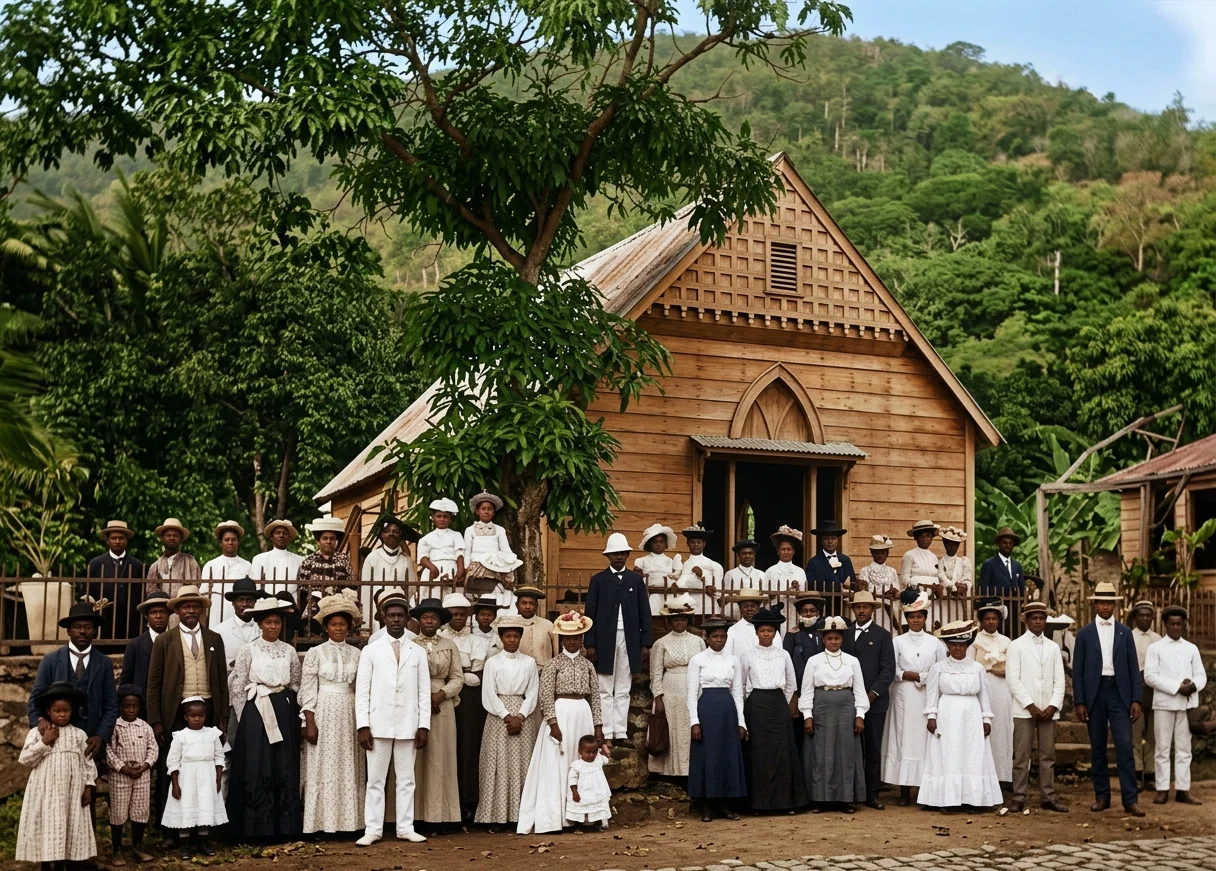
ST. THOMAS.—Since my last report to the REVIEW our meetings have continued three times a week, with a good attendance. Some have taken their stand fully for the message. We have baptized ten since coming to this field three months ago, and we feel to praise God for this manifestation of his saving power.
Our little church building, which is not yet finished, is far too small for our work in this place. Sunday night it will not accommodate half of those who come. This badly cripples our work, and we feel that the building must be enlarged at once.
CHURCH AT ST. THOMAS, DANISH WEST INDIES
It is also important that we have a place for a school, for the question of education is a serious problem to us here. The law demands that children attend public school six days in the week. This compels them to attend upon the Sabbath. Up to the time we came here, our people had been sending their children to school on the Sabbath, but when we presented the matter to them in its true light, they refused to send them longer. Then they paid a few fines, but upon seeing the principle involved in this, they refused to pay fines, and were about to be imprisoned. Denmark has a law exempting the children of Seventh-day Adventist parents from school on the Sabbath, but that law does not help us here. I appealed to the judge in their behalf, and he let them go until further notice. I have laid the matter before the school director and the governor, but do not know what the outcome will be. The governor stated, when I laid the situation before him, that he would be glad to see us open a school here. The fact is, there are no good schools on the island. All admit that the public schools are poor, and none of the better class attend them. We believe that if we had a good school here, it could be made self-supporting almost from the first.
We have no teacher in view, but are praying that God will impress some one to come. If possible, we want one who speaks the Danish language. Of course English is the prevailing language, but as all the officials and many of the leading men are Danes, it will do much toward reaching them if our teacher can speak Danish. I find that it makes a great difference in my work to be able to use the mother tongue. Any one who has a burden for the work of teaching here will please correspond with Prof. Frederick Griggs, chairman Educational Department of the General Conference. I am sure it is a good opening for the right person.
In regard to raising money to build an addition to our church, we can expect but little financial aid from the brethren here, as nearly all are very poor, so we shall be obliged to appeal to our brethren in America. We feel sure that many will be glad to aid this needy field. If so, send the money through the regular channel to the General Conference, stating what it is for.
St. Thomas is an important business center, not only for the Danish islands, but for many other islands near; and we wish to have our work well established in this place, so that we can better reach other places. Some of the best people here are deeply interested at present.
The climate is delightful, not too warm, but just pleasant, and it is practically the same the year round. So in that respect one could hardly find a more agreeable field. Brethren, remember the work here in your prayers. Address me at St. Thomas, Danish West Indies. Letters require a five-cent postage-stamp for each ounce or fraction thereof.
H. C. J. WALLEKER.
British Columbia
By J. L. Wilson
VANCOUVER.—While looking over the reports from the different parts of the field, I thought some of the brethren might like to hear from British Columbia. We have no word of discouragement to offer. It is very encouraging to see how the message is spreading over the earth. The earth is surely being lighted with the glory of God.
We are glad to say that the work here in Vancouver is moving forward encouragingly. We have just finished a series of meetings, at the close of which fourteen were added to the Vancouver church. Seven are heads of families, and seven are young people ranging in age from twelve to fifteen years. We are glad to say that the interest is still good. One young man, a native of New South Wales, who has been laboring in the Methodist printing-office at Fiji, came to Vancouver a few weeks ago, attended our meetings, received the third angel’s message, and now he returns home to carry it to his father’s house. So the good work goes on. We are expecting another good addition to our church in the near future. Pray for us. J. L. WILSON.
Michigan
By M. N. Campbell
BATTLE CREEK.—Thinking our people would be pleased to learn how the work is progressing at the former headquarters of the denomination, we furnish the following report:—
The week of prayer has been a season of unmeasured blessing to the church. The writer conducted three services each day: one at 9 A. M. with the academy students, one at 3 P. M., and another at 7:30 in the evening. All these services were characterized by the presence of the Holy Spirit. Many who had been cold and backslidden renewed their vows of consecration to God, and quite a number made their first start to serve the Lord.
During the past nine months seventy-six persons have been baptized and received into the church. The attendance at the Tabernacle varies from seven hundred to a thousand each Sabbath. Nine district missionary societies are carrying forward the missionary interests of the church, and each reports excellent progress during the past year.
The Battle Creek Industrial Academy has an enrolment of one hundred twenty-five students in all the grades from the first up to the tenth. Five teachers are employed. We are operating the academy as a free school this year, and the finances are in an excellent condition. The Lord is certainly blessing our educational work.
The canvassing is not neglected. One would naturally suppose that Battle Creek would be a rather unpromising field for the sale of our publications, in view of the fact that the message has been established and taught here for so many years. However, that is not the case. During the past seven weeks one brother has sold three hundred fifty dollars’ worth of our denominational books. Another brother sold eighty dollars’ worth of “Bible Readings for the Home Circle” in one week. Thus the work goes steadily forward.
Quite a large number of our true-hearted people have removed from the city during the year, and many more plan to do so in the immediate future as the way opens for them.
The Battle Creek church has taken a decided stand for the old-fashioned third angel’s message, and it is uncompromisingly opposed to the interpretations of the message which have been presented to the people of late. It is a subject for profound thankfulness that this people alone of all Protestant denominations, has had sufficient spiritual vitality to cast off the pantheistic delusions which are taking the world captive at this time.
The Battle Creek church has been20compelled to withdraw the hand of fellowship from quite a number who formerly stood high in the councils of this denomination. One of these, who once shone as a bright light in the medical branch of our work, was disfellowshipped from the church, and has since sent out a letter to many of our ministers, in which he claims that his faith has not materially changed in the last thirty years. This letter is designed to reflect on the Battle Creek church for disciplining him. Its contents are in plain contradiction to the statements of the Testimonies and the experience of the Battle Creek church. The fact that the vote for his expulsion was absolutely unanimous, indicates what those who know him best think of his faith in this message. The business meeting at which this action was taken, was an exceptionally large one, nearly four hundred members of the church being present.
In the trying times through which we have been passing, we have sought to move very carefully in the fear of the Lord. Our motives have been systematically misrepresented by our foes both in public and in private. However, this is no more than we should expect, as many years ago we were told, through the spirit of prophecy, that those who would leave the ranks would become our bitterest enemies, and would not hesitate to resort to any scheme to injure their former brethren.
Lately the press of the country has been publishing a report to the effect that the writer called a secret meeting of the church, and read a Testimony which urged our people to flee from Battle Creek by the first fast train in order to escape destruction which was to fall on the town. This report was a pure fabrication, which originated in the fertile brain of a local reporter who cared more for sensation than for truth. For some reason one of our local papers has prostituted its columns to the most unjust and vicious attacks upon our church. These attacks are greedily seized upon by a sensational outside press and reprinted, and thus these false reports are being scattered to the four winds.
These experiences, however, are serving to draw our people closer to one another and to God and we believe they are having a strengthening influence upon the loyal ones.
The apostate element located in this city is now sending forth publications in the form of booklets and tracts, attacking the Testimonies, the sanctuary, and various other leading points of our faith. These attacks are cunningly written in an apparently candid spirit, and make a show of fairness, but they constitute the “cunning craftiness, whereby they lie in wait to deceive.” Eph. 4:14. A thorough understanding of the Scriptural foundations of our faith is a certain specific for these quibbles, and now is the time for our people to search the Scriptures and become rooted and grounded in the message, else the fierce blowing winds of false doctrine and deception will blow them off their feet.
Dear brethren, we solicit your earnest prayers that we who must constantly face the trying situation in this place, may have grace and strength to stem the tide and give the trumpet a certain sound. M. N. CAMPBELL.