Your ShelfYour Projects

Review and Herald, Vol. 82, No. 40.

The Jordan
Earlier text: Victories by One

Mission Work in Madagascar

PROTESTANT missions in Madagascar date from the year 1818, at the close of which year the first missionaries of the London Missionary Society landed at Tamatave, the chief port of the east coast. Interrupted for some months by the death of most of that pioneer party, the mission was reopened in the year 1820, in the capital city, Antananarivo, in the interior highland, and was carried on with much success until the year 1835, when the persecuting queen, Ranavalona I, began severe measures against Christianity, and all the missionaries were compelled to leave the island. During that period of fifteen years of steady labor, the native language was reduced to a written form, the whole Bible was translated into the Malagasy tongue, a school system was established in the central province of Imerina, many thousands of children were instructed, and two small churches were formed. About two hundred Malagasy were believed to have become sincere Christians, while several thousands of young people had received instruction in the elementary facts and truths of Christianity. That was the period of planting in Madagascar.
The second period in the history of Malagasy Christianity was that of persecution, and continued for twenty-six years (1835-61), during which period persistent efforts were made to root out the hated foreign religion. But the number of the “praying people” steadily increased, and although about two hundred of them were put to death in various ways, the Christians multiplied about tenfold during that terrible time of trial.
In 1862 the mission of the London Missionary Society was re-established, and then began the third period in the religious history of the country, emphatically that of progress. From that date Christianity has steadily grown in influence, so that in 1895 about 1,400 congregations and more than 280,000 people were under the influence of its missionaries. These churches and adherents were found to some extent in all parts of the island, but were chiefly massed in the central provinces of Imerina and Betsileo.
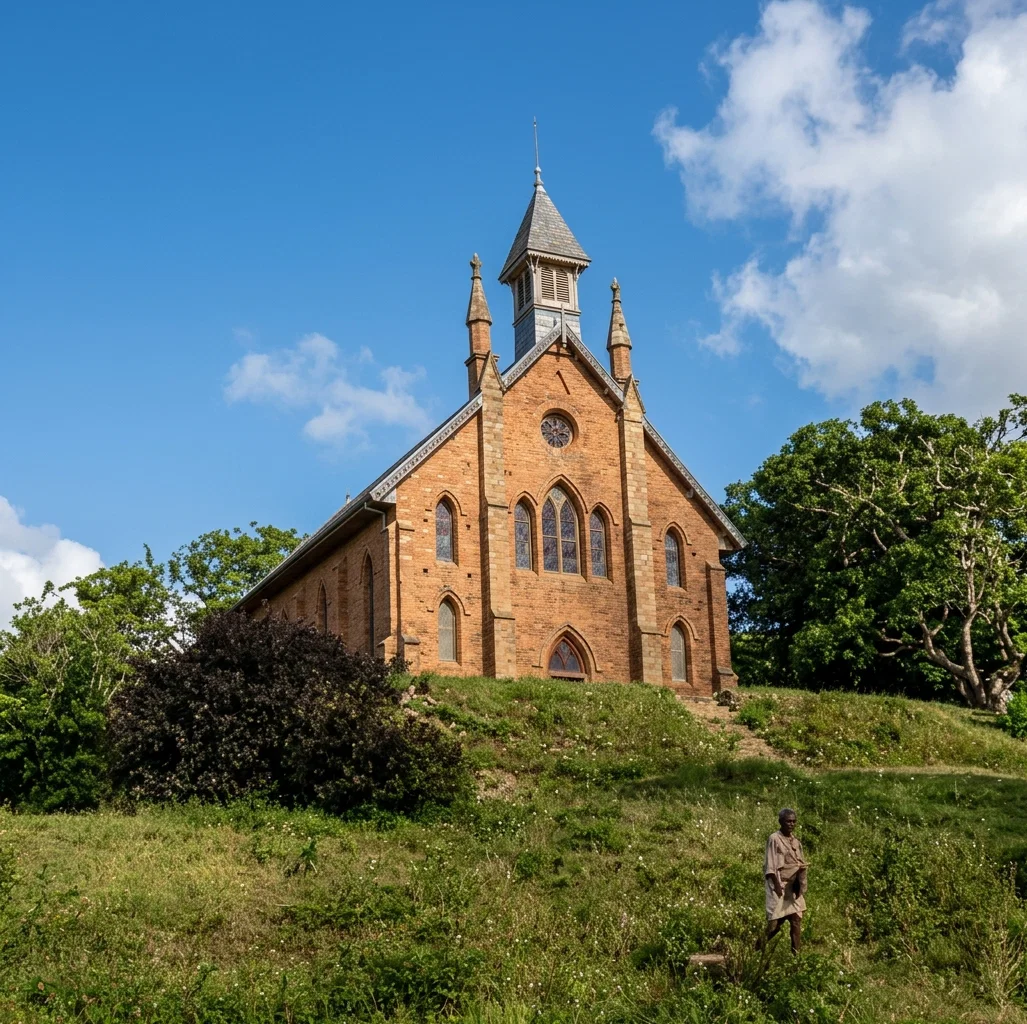
A VILLAGE CHURCH IN THE ISLAND OF MADAGASCAR
A great outward impetus was given to the spread of Christianity in the early part of 1869 by the baptism of Queen Ranavalona II and her prime minister, and the subsequent destruction of the idols of the central provinces, and still more by the personal influence of the sovereign in favor of the Christian religion.
In the year 1864 missions were begun on the eastern coast, both by the Society for the Propagation of the Gospel (Anglican) and the Church Missionary Society (Evangelical). The latter of these was eventually withdrawn (in 1874); and in the year 1872 the former society began work in the capital, and subsequently appointed a bishop to superintend its mission, its chief field, however, being still on the eastern coast.
Two years later (1866) the evangelical section of the Lutheran Church of Norway also began a mission in Madagascar, which was gradually increased, so that they have had no fewer than sixty missionaries, including ladies, in the country.
The last Protestant society to undertake work in Madagascar was that of the Friends (the Friends’ Foreign Mission Association). This was begun in the year 1867, and differs from the others in having formed no new church organization but in working in close connection and harmony with the London Missionary Society. To the Friends’ Mission is mainly due the support of the large medical mission of the two societies, with its spacious hospital, medical and nursing staff, numerous students, and dispensaries.
It will be seen from what has been already stated, that the London Missionary Society, to which the planting of Christianity in Madagascar is due, had previous to the French occupancy by far the largest number of adherents of any Protestant (or other) mission in the country; and it has naturally had the greatest influence upon the religious and social life of the Malagasy. But this large following has brought its difficulties and disadvantages; and the progress made has been greatly hindered by the large number of congregations under the nominal charge of one missionary, and the impossibility of exercising sufficient influence, in the way of leading and guiding large masses of ignorant people.
For many years the London Missionary Society has maintained a staff of from thirty-five to forty missionaries, including ladies, but not including missionaries’ wives. Of these, twenty were stationed in and around Antananarivo, ten in the Betsileo province, and the others in the Antsihanaka district, and on the eastern coast. And when it is remembered that most of these missionaries had on an average from fifty to sixty congregations to look after, and that many of these churches were scattered over a large extent of country, some at distances of three days’ journey from the station, and in a country where no wheeled vehicles were available, it will be seen how difficult it was to give these numerous congregations the help and guidance they so much needed.
To supply as far as possible the lack of European teaching, a college for training native evangelists was carried on for more than twenty-five years; and from this institution nearly three hundred men have been sent out, after receiving from three to four years’ training, including, in later years, a little medical instruction.
High schools, both for boys and for girls, have also been conducted for many years, and in the former of these, lads receive three years’ training as teachers, in order to supply the needs of the country schools, numbering many hundreds.
But it will probably be asked, Whatare the spiritual and moral results of the work of so many missionaries laboring for so many years past? These are more difficult to gauge aright, and it is not easy to give a satisfactory answer to such a question. So much, however, may be fairly said: The idolatry of the central provinces, as regards any open practise of it, has been swept away, although it is quite true that at times of epidemic disease or any other calamity, there is tendency on the part of the more ignorant people to practise heathen customs more or less secretly, although all such are prohibited by the native laws. There is a vast advance in education and enlightenment. Probably not less than one hundred and fifty thousand people are able to read, and have acquired some familiarity with the main facts and truths of Christianity. Several editions of the whole Bible, besides large numbers of the New Testament, have been put into circulation, as well as a considerable amount of literature in the Malagasy language. Many hundreds of congregations have been formed, and meet regularly for worship, and while in all of these a considerable proportion are merely hearers, in almost every case probably there are a few earnest and sincere Christian people, and in the longer established churches these form a much larger proportion of the whole number of attendants.
A missionary spirit is being gradually aroused in the Malagasy churches, and from both the central provinces a number of men have been sent to the outlying heathen tribes as native missionaries. Every year more and more money is being raised for religious and benevolent objects, and considerable sums have been expended in erecting substantial (sometimes handsome) church buildings; and funds are not wanting to carry on orphanages, auxiliary Bible, tract, and temperance societies, as well as associations for supplying preachers to destitute and ignorant congregations. A number of young men have also received systematic training as doctors, and have obtained diplomas, and a number of young women have been taught scientific nursing of the sick. It has always been the aim of our missionaries to develop the self-help of the Malagasy Christians, and to train them to carry on their own church organization and work. For many years past the churches, both of the Imerina and Betsileo provinces, have been banded together in two strong and influential unions for the discussion of church matters, discipline, teaching, etc., and these larger unions, as well as the smaller organizations—a kind of presbytery—have gradually trained the Malagasy Christians to think and act for themselves.
Such are some of the many cheering features of our work, on account of which we have to thank God and take courage.—James Sibree, Missionary of the London Missionary Society, and Senior Tutor of its College, Antananarivo, Madagascar, in Missionary Review of the World.

The Western Washington Camp-Meeting

THIS was the largest and one of the best camp-meetings ever held in this conference. Its results will reach into eternity. It was located in Seattle, and the grounds and weather were ideal. Some interest was aroused among the people of the city. From eight to twelve asked for Bible readings at the close of the meeting.
Plans were laid and movements set on foot which will bring forth fruit in the kingdom of God. Our workers were offered to the Mission Board, and their support pledged. The educational work as the solution of the question, What shall we do for our children and youth? was the leading issue in the meeting.
Our Forest Home Academy proved so successful last year that it was decided to open another school this fall in the southern part of the conference. Three thousand dollars was voted, and nearly half the amount was raised in cash and pledges for placing these two schools in successful operation. Brother Van De Mark will be placed in the field at once to secure the remainder. There was an earnest seeking after God, and many precious victories were obtained on the ground. Thirty-three souls were baptized at the close of the meeting. A number of these, however, were rebaptisms. We hope to see the work progress in this conference during this year.
E. L. STEWART.

The Detroit (Minn.) Camp-Meeting

THIS meeting began September 12, and closed the 17th. Three English and two Scandinavian services were held each day. Sister Merickel held children's meetings, and Brethren Babcock and Olson held young people's meetings. Fifty-two persons camped on the grounds. A good interest was taken in the Sabbath-school work, also in the missionary campaign work. Sister Merickel led out in these lines of work. Different brethren took part in the deliberations, and these meetings were profitable to us all. A preaching service was held each afternoon, in English. Brother A. V. Olson conducted the Scandinavian services until Friday, then Elder John Anderson took charge of them. Brother C. M. Everest came Thursday, with a good supply of books, many of which he sold. Elder Shaw came Friday in time to take charge of the Sabbath service. Elder C. M. Babcock and the writer conducted the preaching service each evening, presenting some phase of present truth. The instruction given was blessed of God to the good of souls. The outside attendance was good at these evening services.
Fifteen persons have begun the observance of the Lord's Sabbath as the result of the tent effort, and others are much interested. Twelve souls were buried with their Lord in baptism; $47.25 was raised for the Maple Wood dormitory; ten orders were taken for Lifeand Health; five yearly subscriptions, one six-months' subscription, and one three-months' subscription were taken for the REVIEW AND HERALD, six subscriptions were secured for the Sabbath School Worker; two for the Youth's Instructor; five renewals and three new orders for the Minnesota Worker.
This meeting was a real blessing to all who attended, and was a help to the interest in this place, for which we praise the Lord, and labor on in faith. We desire the prayers of God's people.
ANDREW MEAD, C. M. BABCOCK.

Virginia

EMPORIA.—I have been here with my tent about four weeks. We have from thirty to fifty present in our meetings; Sunday nights about one hundred. Four are keeping the Sabbath, and I hope that others will take hold soon. I am of good courage in the Lord's work. C. B. RULE.

West Indies

KINGSTON, JAMAICA.—We have decided to send one of our natives, Brother Frank Hall and his wife, to the Cayman Islands. He has been in the work longer than any other of the natives. He is a teacher and house-to-house worker. His wife is a trained nurse. We will keep Brother Hall on our pay-roll, and look after him. I think this will stimulate the missionary spirit among our people. I believe our tithes will increase more, as they are doing nicely now.
The Cayman Islands are dependencies of Jamaica, lying from one hundred and fifty to one hundred and seventy-eight miles from the west end of this island.
J. B. BECKNER.

Chile

IQUIQUE.—I shall return to Valparaiso soon, and then visit Los Andes and Santiago and Rengo, and some of the other places.
We now have six canvassers in the northern part of Chile, having secured four new ones. We shall soon have one worker in Bolivia—really two, for Sister Caspedes will work there, as she expects to canvass, also.
We have organized two new churches this year. They are small, but we find that the one in Antofagasta is already growing, for two new ones are beginning to keep the Sabbath. We are glad to see this. If a church is growing, and not dead, its numbers will soon increase. F. H. WESTPHAL.

Burma

INSEIN.—I am anxious to see our workers penetrate the country between here and our Chinese missions. For purposes of trade, roads and steamboat lines are penetrating to the Chinese border. It is now possible to make a quick and easy journey from Rangoon up the Irrawaddy River, and then by government road right into China.
Mrs. Votaw is having good studies with the native servants. God is blessing. One man has left off painting his forehead. He has learned all about creation; and when calling upon a neighbor recently, we were much surprised to learn that he had told the lady’s servants all the things he had learned. God only knows which seed will be fruitful.
H. H. VOTAW.

Central America

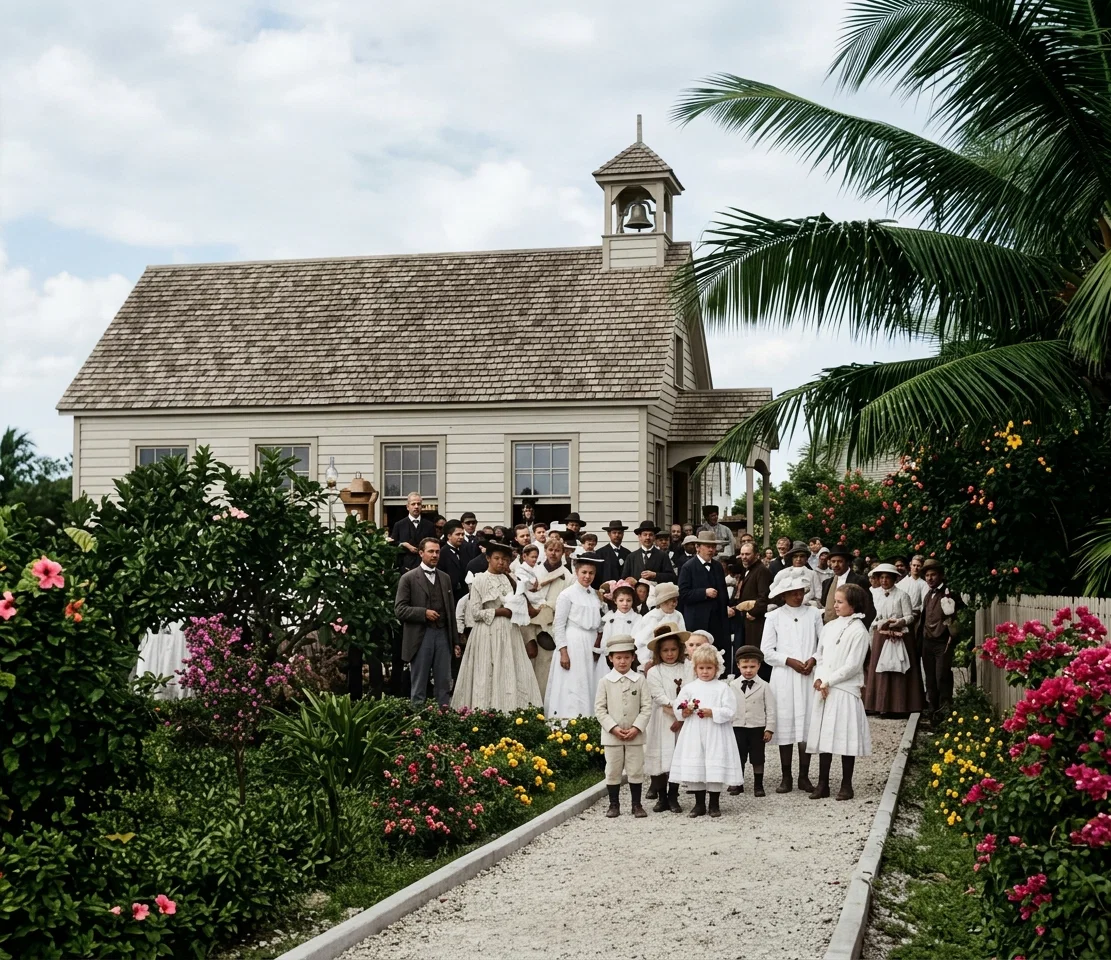
I CAME to French Harbor July 6, to attend the dedication of the new church. The company here is small, numbering only fifteen; but with the help of many friends who are not yet members, they have erected a very neat little building, sixteen by twenty-eight feet, furnished with lamps, bell, and an excellent organ, dedicated free from debt. It is located on the same ground where Elder F. J. Hutchins pitched his tent eleven years ago; and although at that time not one accepted the truth to obey it, many of those who now accept it date the beginning of their experience back to that time.
Since the dedication, we have continued the meetings in the church, and at this writing eleven more are keeping the Sabbath. We can only praise the dear Lord for his tender mercy and his power to save. How wonderful is his long-suffering in keeping us alive, that now we may give our hearts to him! We pray that others who are yet halting may soon be led to yield all to their Redeemer.
The French Harbor church is very anxious to have a church-school, where the Bible can become one of the text-books. Not only in words is this desire expressed, but the members have already subscribed a liberal support for the teacher. A lady would find here a pleasant, healthful home, among a people who are all united and ready to work, and who would appreciate very much a Christian school. One brother has three bright children, ten, twelve, and fourteen years old, deaf from birth. He is very anxious that these should learn to read and write, and he would contribute liberally to the teacher's salary. We are very desirous also that this teacher be able to give instruction in music. There is no teacher here for this people, and our hands are reaching out to our brethren in the more favored parts of the world for help. The burden of prayer in several families in this place of is, Send us a teacher for our children and youth.
If some family reading these lines has one in its number who could take up church-school work, I would say there are openings here for farming operations, also for a good blacksmith. There is a shipyard here, also one at Coxen Hole, eight miles west, and another at Oak Ridge, eight miles east, with no blacksmith at either place. A small schooner is being built here now, which has waited for more than a month for irons to be made in Truxillo, forty miles across to the mainland, and when they arrived a few days ago, they were not right. I consider this a good opening for blacksmith work, as well as church-school work. The two combined, or the school work and farming, would make this a good opening for a man and his wife.
CHURCH BUILDING AT FRENCH HARBOR
In this connection we must not fail to mention Utilla also, another of the Bay Islands, as a good location for a teacher. Here the citizens have contributed the means to build an addition to the church, eighteen by thirty feet, for a schoolroom, but for nearly a year now there has been no school. Three times our Mission Board has sent a teacher to this place; but for various causes the mission so far has not been a success. Utilla is a pretty place, with a nice class of people, but our membership is very small. Here also a music teacher would find plenty to do.
There is no physician on the island, and to call one from the coast is very expensive, costing forty dollars gold for every day he is absent from his office. And there is no baker here. Could a man and his wife combine teaching and medical work, or teaching and farming, or teaching and nursing or baking, this could easily become a self-supporting work. We anxiously look forward to the time when some of our own number shall be able to take hold of this work; but till that time comes, we pray that some one may be inclined to come and help us.
We are now holding meetings at French Key, a beautiful little island about one mile from this village, where there is an interest to hear the word of truth.
H. C. GOODRICH.

The Opening of Union College

THE enrolment is two hundred and twelve before the close of the first week. Students will be coming for several weeks yet. So far as the total enrolment is concerned, it is a little larger than last year, but there is a marked increase in the number of students in the Home. Last year at this time we had only ten or eleven tables. Now we have sixteen.
Our enrolment at the Home is one hundred and eleven.
As for the character of the pupils, I think I have never seen a more earnest class of students together. One marked feature of the opening is the small number of seventh-grade pupils. Last year the grammar and arithmetic classes in this grade were large, and had to be divided at the beginning of the second term. This year we have seventh-grade classes only in the grammar and arithmetic, and there are only five or six pupils in these. I believe by another year we can, in our announcement, eliminate the seventh grade entirely.
The organization of the school was effected easily and quickly. We gained a day's time over last year, being ready to take up regular recitations on Friday, instead of on Monday as we did last year.
One hundred and twenty-six persons have enrolled in the different Bible classes. Most of the remainder of the students have either completed the Bible work or else have some excellent reason for not taking Bible study this year. There are only a few who do not wish
to take Bible study. No special effort was made to induce them to choose Bible studies, but nearly all seemed glad to do so. The enrolment in industrial studies and trades is also encouraging. Sixty-six is the number at present. The industrial studies come at three o'clock in the afternoon, and many of our students desire to work in the afternoon to help meet their expenses. If it were not for this fact, there would be many more in the industrial classes, but we feel gratified that the number is so large.
An excellent spirit pervades the school. This is especially noticeable in the Home. Although circumstances beyond our control have made it impossible to have the Home in perfect readiness for the students, yet there has been heard no murmuring or complaining. At the social meeting in the Home parlor at the beginning of the Sabbath, it was evident that the Spirit of the Lord was present in a marked degree. A large number of cheerful testimonies were borne in quick succession, and it seemed as if the work was beginning where it left off last year. The same was true in the social meeting in the chapel Sabbath afternoon. We are encouraged to believe that the blessing of the Lord will rest upon the work at the college in a larger measure even than it did last year, and the teachers and students enter upon the work with hearts full of courage and good cheer.
C. C. LEWIS.

East Jordan (Mich.) Camp-Meeting

The evening after the Sabbath, September 2, I left the Hutchinson (Kan.) camp-ground for East Jordan, Mich., to attend the North Michigan camp-meeting and conference.
I stopped in Kansas City, Sunday, September 3, and spent a day with Elder E. A. Merrill and family, who had formerly labored in the Pennsylvania Conference, where I also spent several years in the work. I spoke that evening for Elder Merrill at his tent on the subject of the millennium, to a tent well filled with earnest listeners. Monday forenoon Elder G. B. Thompson joined me in Kansas City, and we journeyed on to Chicago together.
From there he went to attend the Wisconsin Conference, and I went on to East Jordan. I found on my arrival that Brethren A. Moon, W. D. Curtis, J. B. Blosser, and F. C. Gilbert had left, but was pleased to find Brother Luther Warren and his wife there; also Brother S. M. Butler, the principal of the Cedar Lake Academy, and Brother A. W. Spaulding, of Berrien Springs.
Brother Warren thinks he has improved physically during the summer, although, in harmony with the instructions of his physicians, he is not engaging actively in preaching as heretofore. He spoke once at the camp-meeting with great freedom, and rendered valuable assistance in the other services of the conference.
This meeting was attended by a marked manifestation of the Holy Spirit's presence from the beginning to its close. As a result of the different revival services which were held from time to time during the meeting, every one upon the grounds, with the exception of three or four persons, responded to the earnest calls to repentance.
Although the attendance was not large, yet there was a most liberal spirit manifested toward the different calls for funds.
The outside attendance was excellent at the evening services at nearly every meeting. At the last service the tent was filled, and many people stood outside.
The location of the tent was ideal, within easy walking distance of the beautiful town.
We believe that those who obtained a new experience at this meeting will find great enjoyment in living out the truth as they return to their homes, and they will also be a blessing to their families, and to the neighbors where they reside.
Elder S. E. Wight was unanimously re-elected as president of the conference. Great harmony prevailed in all the business deliberations. In short, everything bespeaks prosperity for the work in the North Michigan Conference.
K. C. RUSSELL.

The Work in Nashville, Tenn.

According to the light given us, Nashville is an important center for the colored work as well as for the white work. In this city are located several important colored schools, and a very intelligent class of colored people are brought together in consequence.
NASHVILLE CHURCH FOR THE COLORED PEOPLE
We have felt that a strong effort should be made this season to interest the colored people. While Elders Haskell and Butler were carrying forward a tent-meeting in one part of the city, it was felt that it was very important that a similar effort for the colored people should be carried forward in some other locality favorable to such work. The Southern Missionary Society had a new tent fifty by seventy-five feet, and for speakers it had two among its corps of teachers who were well qualified for this work. One was M. C. Strachan, principal of our colored school in Jackson, Miss., and the other was N. B. King, principal of the colored school at Vicksburg. Hence during their vacation they were called to Nashville, the tent was pitched, and a series of meetings has been going forward in it for about two months.
The attendance has not been large at any time, but the audiences have been composed of the thinking class, and these have come quite regularly to the meetings. We are glad to report that although the meetings will probably continue in the tent until the weather makes it advisable to close them, already seven have taken their stand for the truth, and we hope for quite a number more to decide for the truth before the course of lectures shall close.
More than this, we are glad that these school-teachers could have the experience of a work of this kind where they could receive help from those who have had more experience in such work. They will return to their school work this fall better qualified for their duties than ever before.
The illustration given on this page represents the rear and one side of the colored school and church property at Nashville. Of course the street runs by the front of the church. It will be seen that the lot slopes strongly to the rear, and when the church was built, it was raised high enough in front to allow the finishing of the basement for a schoolroom. The work is now progressing on this very rapidly, and this illustration shows something of the appearance of the building when this work shall be finished. There is one exception, however, and that is the windows. On each side of the building are two double windows and one single window, thus giving a room which is lighted better than most schoolrooms which we have ever seen. This schoolroom will be finished, ready for occupancy, this fall.
The action of the Southern Missionary Society in fitting up this building has been influenced largely by the work of Sister Anna M. Nicholas in carrying forward a mission school last winter in a private house within a stone's throw of this church. In regard to the situation as she found it, we quote the following:—
“Only two or three of those thirty or more children whose names are on the register of that ‘slum’ school of mine, knew who Jesus Christ was—and that within a stone's throw of the Seventh-day Adventist colored church. They have no church connections, and attend no Sunday-schools; hence the soil is purely virgin. They believed implicitly all I taught them, and were eager for more Bible stories. Beginning with the creation, our Bible work ran down past the flood. The last fortnight I took up the law of the ten commandments, which they learned to repeat. I was explaining the fourth one day when a boy said, ‘Them folks up at that church keeps Saturday for Sunday.’”
Under circumstances of this nature we felt that there was no better thing to do than for our Society to take the gospel to those people surrounding our church, through the influence of the mission school. Certainly if Nashville has been pointed out as a center where a special work should be done for the colored people, our school work should form as important a factor in our efforts in this place as it has in other places where it is being carried forward so successfully.
The work of fitting up the basement of this building for school purposes can not cost less than four hundred and fifty dollars. A fund has been started for this purpose, and over two hundred dollars of the amount has been already raised. It will require two hundred and fifty dollars more to complete this schoolroom ready for occupancy. We ask our friends to assist us in raising a fund for this work. In July the few office employees connected with the Southern Missionary Society raised $16.50 for this purpose. Who will join us in making up the remainder of the sum so that the schoolroom can be occupied free of debt, and without being a burden to the Society. J. E. WHITE.

Removing Hindrances to God’s Work

God is willing to do for any man or woman all that he ever did for any one. If there is not a mighty work of God in us, it is our own fault. Find out what these hindrances are, and put them away.
—R. A. Torrey.

Help for India

To be a co-worker with the Lord is the greatest privilege ever conferred upon mankind. “We then, as workers together with Him.” 2 Cor. 6:1. If we are not co-workers, we have received the grace of God in vain. The apostle then quotes from Isa. 49:8-11. Most wonderful words are addressed to those who co-operate with the Lord in giving light to those who are in darkness. Now is an acceptable time with the Lord; it is a day of salvation for his people. He gives those who co-operate with him as a covenant, to inherit desolate places; to say to the prisoners, Go forth; to those who sit in darkness, Show yourselves. He promises that all such shall neither hunger nor thirst; neither shall the heat nor the sun smite them. He will lead them to the springs of water. The mountains of difficulties will become a path for them; and as a result they will see souls gathered from afar.
This scripture contains wonderful promises for the one who will co-operate with the Lord and be his helping hand in giving the truth to those who sit in darkness.
It is a golden opportunity to move when the Lord moves, to work in harmony with him. There are special seasons and special occasions when God calls upon his people to act; and to act promptly at such times brings great results. No one has a monopoly of God's providences. There is nothing arbitrary in the matter. When we voluntarily accept and consider it a privilege to step into the work of God, then comes the promise: “In an acceptable time have I heard thee, and in a day of salvation I have helped thee.” It is the day of salvation; so he says, “I will preserve thee.” Then we can say to the prisoners, “Go forth; to them that are in darkness, Show yourselves.” Then even all the mountains of difficulties will become a way, “and my highways shall be exalted.” Can any one fail to praise God for such a privilege?
Less than three months ago Sister Burgess expressed her desire to enter India and open the work among the eighty million Hindustani-speaking people. But she was informed that there were no funds to open a new mission. The Mission Board can scarcely keep up the present work in India. But among the millions of the Hindustani-speaking people there is not a single Seventh-day Adventist worker. They are an intelligent people; and when some of them personally appealed to Sister Burgess to give them the waters of life also, while she was giving out publications to the Bengali-speaking people, her heart was stirred. She and her husband learned the Hindustani language. She has spent nine years in India, and while many have gone to India and returned with broken health, her health is good; but she came to this country on account of her husband's failing health. His health is improved; and the burden of their hearts is to return to the people of their choice.
They proposed to enter the field as private canvassers and sell twenty thousand copies of the Bible Training School, and earn the money to return. Sister Burgess began to invite her acquaintances to take the paper at the retail price, ten cents each, and give all the profit to India. She found many others anxious to co-operate in the good work. She has visited a few camp-meetings with success. And now in less than three months, thirteen thousand of the “Help for India” Special have been ordered. Donations of from one dollar to one hundred have also come in for the enterprise. Seven thousand more of the Bible Training School are to be sold; and a thousand dollars more is needed to furnish them means to return, build a mission home, and establish the work among the Hindustani-speaking people. They wish to leave in October. A few weeks remain to co-operate with the Lord in this enterprise.
We believe there are many who will gladly take hold of this work, and sell the remaining seven thousand papers, so that Brother and Sister Burgess can soon be on their way, and reach India early in the season, and get their work started before the intense heat comes on.
This work has a threefold blessing in it. There is a blessing to the one who helps. The “Help for India” Special contains the simple truths of the third angel's message, and will be a blessing to those to whom it is sold; and the money received from the sale will send light and blessing to those in darkened India.
This is not to take the place of other enterprises; for it requires only ten cents for one paper, or ten dollars for a hundred. The work will help to carry the light of truth to more people than there are in the United States. Who will help close up this enterprise?
Send all orders to L. G. Burgess, South Lancaster, Mass., or to the Bible Training School, South Lancaster, Mass. In sending orders state plainly that you wish the “Help for India” Special.
S. N. HASKELL.
Continue reading: An Unfinished Work