Your ShelfYour Projects

Signs of the Times, Vol. 37, No. 18.

Question Corner

Signs of the Times

May 10, 1910

Pacific Press Publishing Association · Mountain View, California · May 10, 1910

Question Corner

“IF YE WILL INQUIRE, INQUIRE YE.”
This Inquirers’ Department is conducted for the purpose of helping those who are studying the Bible. The answers are oftentimes only suggestive. They are never to be considered infallible, only as they agree with the infallible Word. The writer who may answer them does not consider that his opinion is infallible. He will simply give the best that he has, and plead with the inquirer to search the Word. Such questions only will be answered as, to the editors, seem to minister to the good of the readers and to the mission of the paper. We can not answer repeatedly in the same volume questions upon the same scripture. The name and address must accompany question, not for publication, but as an evidence of good faith, and that answer may be made by letter if deemed advisable. No letters are answered which do not contain the name of the writer. It is well always to enclose stamp for reply.

3119.—Reading the Bible

Please tell me how to read the Bible understandingly. I know it is the door to eternal life, but after it is opened I wish help in searching it, exhaustively and not at random. W. R.
The true way to the understanding of the Scriptures, to knowing God’s will, is fear, or reverence, and humility before God. “The secret of the Lord is with them that fear Him; and He will show them His covenant,” or as the margin reads, “The secret of the Lord is with them that fear Him, and His covenant to make them know it.” Ps. 25:14; also the promise of the 9th verse, “The meek will He guide in judgment; and the meek will He teach His way.” Connect that with John 7:17, “If any man will do His will, he shall know of the doctrine.” There must be the disposition not simply to know God’s will, to understand His Word, but above all things else to know that Word in order to do it. Therefore the Bible should be read prayerfully, with the highest petition of all that we might know God’s Word in order to do His will.
Secondly, it should be read single-heartedly. Turn away from thoughts of other things, and place the whole thought upon the Scripture, with the mind open and the heart softened to receive God’s Word.
Thirdly, study it intelligently. First, by reading it through by course, thinking over the ground covered, that one may get the scope of the book, the object of God in giving it. Note the great central thoughts, and others revolving around them. Study it by subjects and concordance. That also is helpful. In reading it by course one will come to some particular thing which he may specially desire more light upon, as for instance in the first chapters of Genesis he will read about the Seed, the promise of the Seed of the Woman. While a concordance is not always the surest, safest guide, it will help very materially. We prefer sometimes a good Bible index. Studying that subject he will find that the Seed is the great thought center all through God’s promises to and leading of the children of Israel until all centers in Christ Jesus. In that same lesson he may learn something about the Sabbath, just a little of its origin. He can trace that all through the Scriptures in the same way. It is impossible to point out to any one just how he should study the Bible. True methods grow. Some would get more light in studying it one way; some in another. But we are sure that these suggestions which we have given our querist will prove of great help to him if he will carry them out. Take that Word as the Word of life, place no absolute finality upon any human understanding. We may understand the truth of the light and know that it is true, but that truth may have very much more light than we at first see. Hold the soul open continually for greater illumination. “The path of the just is as the shining light, that shineth more and more unto the perfect day.”

3120.—Who Wrote the Ten Commandments?

Ex. 34:27, 28 seems to teach that Moses wrote the Ten Commandments. Is that so? W. P. M. L.
No, Moses did not write the Ten Commandments, only as he copied them in a book. He did not write them upon tables of stone. What the Lord told Moses to write was all that was at this time given him in the covenant with Israel; but the third pronoun “he” in the 28th verse refers not to Moses but to the Lord. Sometimes the antecedent is understood rather than expressed. As to whom this “he” refers to, see Deut. 10:1-4, in which the Lord expressly says in the second verse, “I will write on the tables the words that were in the first tables which thou breakest;” and the fourth verse declares, “And He (God) wrote on the tables, according to the first writing, the Ten Commandments.” It seems to us there can be no question at all as to who wrote the Ten Commandments on the tables of stone, both in the first and the second instance.

3121.—The Waldenses

Can you tell me the origin and give me a short description of the Waldenses? A. L. O.
Almost any cyclopedia will give an account of the Waldenses. They are a Christian sect dwelling formerly in the Italian, Swiss, and French Alpine regions. The origin of their name is traced to Peter Waldus, or Waldo, a rich citizen of Lyons who in 1170, from reading the Bible and some passages from the fathers of the church, determined to imitate the mode of life of the apostles and primitive Christians, gave his goods to the poor, and began preaching. He gathered to himself numerous followers; some were called Lyonists, from the place of their birth; some of them Sabotati, on account of their wooden shoes or sandals. Some of them were called Humiliatists, on account of their humility. They were excommunicated by the Papacy as early as 1184, and yet they seemed in a way to have been connected with the church later than that. The great objection to them seems to have been that they were preachers, and their contempt for the mendicant friars led them into more or less opposition to the regular rules of the church. When they held that a bad priest could not validly administer the sacrament, and rejected confession, of course persecution began. The French Waldenses were stamped out by persecution. Then they fled to other places, notably the Piedmont valleys. In these persecutions they were scattered everywhere, and mingled with other sects, losing in some cases their identity. They use now the French language in their services. Each congregation is governed by a council consisting of the elders and deacons under the presidency of the pastor. They are noted for their pure morals and diligent industry. At the time of the Reformation they found themselves in harmony with many of the principles of Protestantism, and have so been considered ever since. Sometimes it is said that they descended from apostolic times, but the true history of the church shows that this is not the case. The larger numbers are now found in Northern Italy.

3122.—The Beginning of the Day

When was the counting of time changed from sundown to sundown, or however it was reckoned, to the way we have it now, midnight to midnight? W. AND K.
The beginning of the day at evening and the closing at evening is indicated in Genesis 1, and was a Bible custom throughout. That really is the natural day, “the evening and the morning.” Consequently we have the compound evening-mornings to indicate days. See Dan. 8:14. The 2,300 days are literally 2,300 evening-mornings. We have also a Greek compound indicating the same. Hesiod, the Greek poet, refers to the occultation of the Pleiades as lasting forty nights and days; that is, calendar days. Sometimes just the night itself was referred to, as the English se’nnight, or seven days; and fortnight, or fourteen days. The sacred record is verified by earliest tradition. Overall’s “Dictionary of Chronology,” under “Day,” says: “The Roman began at midnight; the Italian from sunset to sunset; the Chinese day had twelve parts of two hours each; the English civil day, like the Roman, began at midnight. The astronomical day begins at noon.” As to the time when the change occurred, the Encyclopedia Britannica says: “The subdivision of the day into twenty-four hours has prevailed since the remotest ages, the different nations have not agreed either with respect to the epoch of its commencement, or the manner of distributing the hours. Europeans, in general, like the ancient Egyptians, place the commencement of the civil day at midnight. Astronomers, after the example of Ptolemy, regard the day as commencing with the sun’s culmination or noon. Some nations, as the ancient Chaldeans and the modern Greeks, have chosen sunrise for the commencement of the day. In the early ages of Rome and even down to the middle of the fifth century after the foundation of the city, no other divisions of the day were known than sunrise, sunset, and midday.”
So that the time when men began to reckon the day at midnight is not known. The oldest beginning we have is of course the natural beginning at the sunset. All later beginnings are artificial.

3123.—Reuel or Jethro

Was Moses’ father-in-law’s name Reuel, as termed in Ex. 2:18, or Jethro, as called in Ex. 3:1? W. P. M. L.
There are two ways by which the passage may be understood. One, is that the same man had two names. That is not an uncommon thing, as, for instance, Jacob and Israel, sometimes called by the one name, and sometimes by the other. However, Boothroyd translates Ex. 2:18, “And when they came to Raguel [Reuel] their grandfather, he said, How is it that ye are come so soon to-day?” He makes Raguel the father of Jethro; Jethro, Moses’ father-in-law; and Hobab, Moses’ brother-in-law. The word “father” is sometimes used for a remote ancestor.

3124.—H. K. W.—Luke 12:4, 5.—

The expression in Luke 12:4, 5 is understood in two ways, as referring both to Christ and to Satan. Those who think that it refers to Christ, declare, of course, that He has all power, not only in the life which now is, but the life which is hereafter. Those who refer it to Satan, while they freely admit, of course, that Christ has all power, also contend that it is the purpose of Christ to kill or to cast into Gehenna, but it is Satan’s object to destroy. To us it would seem to depend upon the meaning we will place upon “fear.” If “fear” is used in the sense of loving reverence, it would refer to God. Fear Him. “The fear of the Lord is the beginning of wisdom.” If it is in the sense of fear akin to terror, it would apply to Satan. Therefore we should shun him, have naught to do with him. To us it seems the better application to apply it to Satan himself. We read in Heb. 2:14 that he has the power of death. This does not mean that we should fear him in the sense of feeling that he has all power, but fear him in the sense that we should have nothing to do with him.

3125.—Gathering Sticks on the Sabbath

Why is it said that the man who gathered sticks as recorded in Num. 15:32 was gathering them to build a fire? Is there anything to indicate that? M. L. B.
No, there is not in the context. As our correspondent remarks, he may have been gathering them to build a booth or for some other purpose. Of course one of the natural purposes for which one might gather sticks is for building a fire, and that may have been the case, and probably was. The tree branches would probably have been used if he were gathering them for the purpose of building a booth, and yet this is only reasonable conjecture. The definite purpose for which he was gathering sticks is not stated. The context shows, however, that his course was presumptuous sin against God.

Principles of Service

By Mrs. E. G. White
Copyright, 1898, by Pacific Press Publishing Co.
SUCCESS in the work of God is not the result of chance, of accident, or of destiny, but the outworking of God’s providence, the award of faith and discretion, of virtue and persevering labor. It is the practise of truth that brings success and strength of moral power. The bright rays of the Sun of Righteousness are to be welcomed as the light of the mind; the principles of the character of Christ are to be made the principles of the human character. All of man’s attainments, all his capabilities, are to be laid at the foot of the cross of Calvary. His own righteousness is to be surrendered. Counting all things but loss for the excellency of the knowledge of Christ Jesus the Lord, and with the meekness and humility of a little child, he is to receive the engrafted Word, which is able to save the soul.
The life of the soul depends upon spiritual conformity to the life of Christ. The winding paths that self may choose will lead away from Christ. Self must be humbled before God; every obstacle to service be removed. When the human life is in communion with the life of Christ, then it is sanctified through the truth, and the prayer of Christ is answered: “Sanctify them through Thy truth: Thy Word is truth. As Thou hast sent Me into the world, even so have I also sent them into the world. And for their sakes I sanctify Myself, that they also might be sanctified through the truth. Neither pray I for these alone, but for them also which shall believe on Me through their word.”
“God so loved the world, that He gave His only-begotten Son, that whosoever believeth in Him should not perish, but have everlasting life.” This is the love that is the fulfilling of the law. Only he whose heart is filled with compassion for fallen man, who loves to a purpose, revealing that love by the performance of Christlike deeds, will be able to endure the seeing of Him who is invisible. He who loves not those for whom the Father has done so much, knows not God.

True Christianity All-Embracing

Theology is valueless unless it is saturated with the love of Christ. True Christianity diffuses love through the whole being. It touches every vital part,—the brain, the heart, the helping hands, the feet,—enabling men to stand firmly where God requires them to stand, lest the lame be turned out of the way. The burning, consuming love of Christ for perishing souls is the life of the whole system of Christianity.
The worker for God needs spiritual life. This life will give vigor to soul and body. Spiritual life yields to its possessor that which all the world is seeking, but which can never be obtained without an entire surrender to God. The contemplation of Him who loved us and gave Himself for us, will make our lives sweet and fragrant, and give us power to perfect a Christian experience.
Laborer for God, the work given you is to represent Christ. He came to this world to shed upon you His own brightness and peace. Close the windows of your heart against the atmosphere of unbelief, and open them heavenward. It is your privilege to face the light, to talk faith and life. Let your countenance reflect the joy of the Lord. Speak of His goodness, tell of His power. Then your light will shine more and more distinctly. Above your trials and disappointments will be revealed the reflection of a pure, healthy, religious life. In the outworking of the inner life, there will be a wonderful peace and joy. You may reflect the beauty of the character of your risen Lord, who, tho He was rich, yet for our sakes became poor, that we through His poverty might be rich in the grace of heaven.

The Greatest Science

We can, we can reveal the likeness of ourdivine Lord. We can know the science of spiritual life. We can glorify God in our body and in our spirit, which are His. O, what an illustrious example we have in the life that Christ lived on this earth! He has shown us what we can accomplish through cooperation with Him. We are to seek for union with Him. “Abide in Me,” He says, “and I in you.” This union is deeper, stronger, truer than any other union. The heart must be filled with the grace of Christ. His will must control us, moving us by His love to suffer with those who suffer, to rejoice with those who rejoice, to feel a deep tenderness for every soul in weakness, sorrow, or distress.
Being partakers of the divine nature, we shall reach forth a helping hand to those in need of relief. Christ’s heart was ever touched with pity at the sight of woe. He died on the cross of Calvary to lift from man the penalty of transgression. He came to our world to make it possible for sinful human beings to obtain salvation. He wept over the sorrow and suffering He saw on every hand. But He would not fail nor be discouraged. He must believe and press forward in order to make it possible for the fallen race to gain life eternal. Christ’s life on earth is a perfect reflection of the divine law. In Him is life and hope and light. Behold Him, and you will be changed into the same likeness, from character to character.
Christ has laid out in figures the plans we are to study and upon which we are to act. The fifth chapter of Matthew is full of precious instruction. Read this chapter, and write it upon the tablets of the soul. The Saviour declares, “Ye are the light of the world. . . . Let your light so shine before men, that they may see your good works, and glorify your Father which is in heaven.” “Ye are the salt of the earth: but if the salt have lost his savor, wherewith shall it be salted? it is thenceforth good for nothing, but to be cast out, and to be trodden under foot of men.” If the character is not under the molding influence of the Spirit of God, if we have not the faith that works by love and purifies the soul from all objectionable tendencies, hereditary and cultivated, what does our profession avail? Where there should be seen the sweetness of humility, combined with firmness and solidity of character, there is seen a hard spirit, which is not a savor of life unto life, but of death unto death.

God’s Will the Channel of Life

The life of the soul can not be sustained unless it is brought into subjection to the will of God. Every energy is to be exercised in doing the divine will. Our thoughts, if stayed upon God, will be guided by divine love and power.
Those who proclaim the third angel’s message, must put on the whole armor of God, that they may stand boldly at their post in the face of detraction and falsehood, fighting the good fight of faith. They are to resist the enemy with the word, “It is written.” They are to keep themselves where the three great powers of heaven — the Father, the Son, and the Holy Spirit — can be their efficiency. These powers work with the one who gives himself unreservedly to God. The strength of heaven is at the command of God’s believing ones. The man who makes God his trust is barricaded by an impregnable wall.
We lose many precious blessings by failing to bring our needs and cares and sorrows to our Saviour. He is the wonderful Counselor. He looks upon His church with intense interest and with tender sympathy. He enters into the depths of our necessities. But our ways are not always His ways. He sees the result of every action, and He asks us to trust patiently in His wisdom, not in the supposedly wise plans of our own making.
Cease not to pray. If the answer tarry, wait for it. Lay all your plans at the feet of your Redeemer. Let your importunate prayers ascend to God. If it be for His name’s glory, the soothing words will be spoken, “Be it unto thee according to thy word.”
“All things, whatsoever ye shall ask in prayer, believing, ye shall receive.” The words are a pledge that all that an omnipotent Saviour can bestow will be given to those who trust in Him. As stewards of the grace of heaven, we are to ask in faith, and then wait trustingly for the salvation of God. We are not to step in before Him, trying in our own strength to bring about that which we desire. In His name we are to ask, and then act as tho we believed in His efficiency to send the answer.

IV. Office Work of the Holy Spirit

By John Orr Corliss
In the last paper before this, allusion was made to the text, “Our God is a consuming fire;” and the mind was called, in its connection, to the prophetic promise that Christ would baptize men with the Holy Spirit and with fire. Inasmuch as God operates among men through His Spirit, this agency must act in conformity with the nature of the Being whom it represents. But there are some elements that even “consuming fire” does not destroy, among which are gold, silver, and precious stones. Some of these may be melted and purified by the process of fire, but not consumed.
So it is with man’s life-work. Every item of it, we are told, shall be exhibited in its true light, because of having been uncovered by fire, which will test every man’s doings. 1 Cor. 3:12-15. That is to say, if in one’s life appears material unfit for a Godlike character, worthy only to be compared with wood, hay, and stubble, it must be burned away, and so separated from any precious substance beneath it. But if in the ordeal no solid foundation appears, the loss will be complete and without remedy.
God does not desire the death, or total loss, of the wicked; and so His flaming Messenger, the Holy Spirit, comes to men with the offer to relieve their character of every unholy thing. If any submit to the process, he is cleansed and purified; if the sacrifice is considered too great by any one, he is left to pass under the final burning reserved for those who “know not God, and that obey not the Gospel of our Lord Jesus Christ.” 2 Thess. 1:8.

Conviction of Sin

So the first direct work of the Spirit for one, must be to show him the faulty — combustible — elements in his nature. The man must therefore have his sins pointed out, first of all, and their heinousness made to stand out fully before him. John 16:8. They must appear so hateful to him as to create a desire to be rid of them. He must see his own helplessness, and be made to appeal for help to the Mighty One. In this appeal, confession of sin must be included; iniquity must not be hidden.
If one does not know how, under the circumstances, to pray as he ought, the Spirit is present to help his infirmity. Just then the Spirit will make intercession for the repentant one, with unutterable groanings. The Spirit’s pleadings for a human soul will always be heard and respected in heaven; because He, being one with God, knows the mind of God, and so pleads the case according to God’s will in the matter. Rom. 8:26, 27.
Being thus assured that a petition reaches the throne of heaven, “according to His will,” we may know that the “God of Israel will not forsake” the one sending it forward through the Spirit, but will grant the petition desired. Isa. 41:17; 1 John 5:14, 15. So then, “if we confess our sins, He is faithful and just to forgive us our sins, and to cleanse us from all unrighteousness.” 1 John 1:9. Yes, our sins are “blotted out,” removed from us “as far as the east is from the west.” The sin thus pardoned, if sought for, “shall not be found” (Jer. 50:20), because the Spirit’s fire of the heavenly Refiner has been present to purge away all dross, as from gold or silver, in preparation for the day of the Lord’s coming. Mal. 3:2, 3.

Kept—Established

But the Lord’s Messenger does not cease His effort at this juncture. When one’s sins have been thus removed, and he is restored from death to life (Eph. 2:1), it is important for him to know how to be preserved from returning to his former condition. The Spirit therefore continues its process by revealing to its possessor the true basis of continued right-being. This is done by calling to his mind the words of Christ, according to His promise in John 14:26. But let no one mistake on this point; for the words of Christ here referred to include all that has been written in the Bible, bothin the Old and the New Testament. We are told that the Spirit of Christ inspired the writings of the holy prophets (1 Peter 1:10-12), so that their statements are really the words of Christ. The apostle Paul assures us that in his epistles, he also spoke by the Spirit of God. 1 Cor. 7:40.
The importance of permitting the Spirit to impress upon our minds the Word of God, is made apparent when we remember that this is the living “Seed” of God, from which must grow the plant of holy character in the heart cleansed from sin. 1 Peter 1:23. To neglect this is to omit the cultivation of God’s saving grace, by which we grow into His image. 2 Cor. 3:18. More than this, unless this “Seed” of life remains in one by constant reference, he has no defense against sin and death. 1 John 3:9. On the other hand, in hiding or concealing God’s Word in the heart, one is always shielded from the power of temptation (Ps. 119:11), because his mind is so preoccupied with heavenly things that those of an earthly nature do not strongly influence him.
Another point of importance was mentioned by Christ as the result of the Spirit’s teaching; namely, the judgment. This would be necessary to relieve one when discouraged through temptation. The fact that the Son of God came to earth to destroy the works of the devil, and that Satan has been already judged, and his rule over man annulled through the cross and resurrection of Christ (Col. 2:15), gives assurance that Christ can and will deliver the trusting soul from the hands of him — Satan — with whom before was the “power of death.” Heb. 2:14, 15.
It is not strange that with all this instruction the Saviour paused to say, “I have yet many things to say unto you, but ye can not bear them now.” John 16:12. “Howbeit,” said He, “when He, the Spirit of truth, is come, He will guide you into all truth; . . . and He will show you things to come.” Doubtless the Prince of Peace had in mind the union of God in Christ, the power of miracles, such as healing, and the gift of tongues, the gift of prophecy, and of the ministry, with many other revelations mentioned later. But these we must be content to study by themselves in subsequent papers.

Out of Babylon to Zion

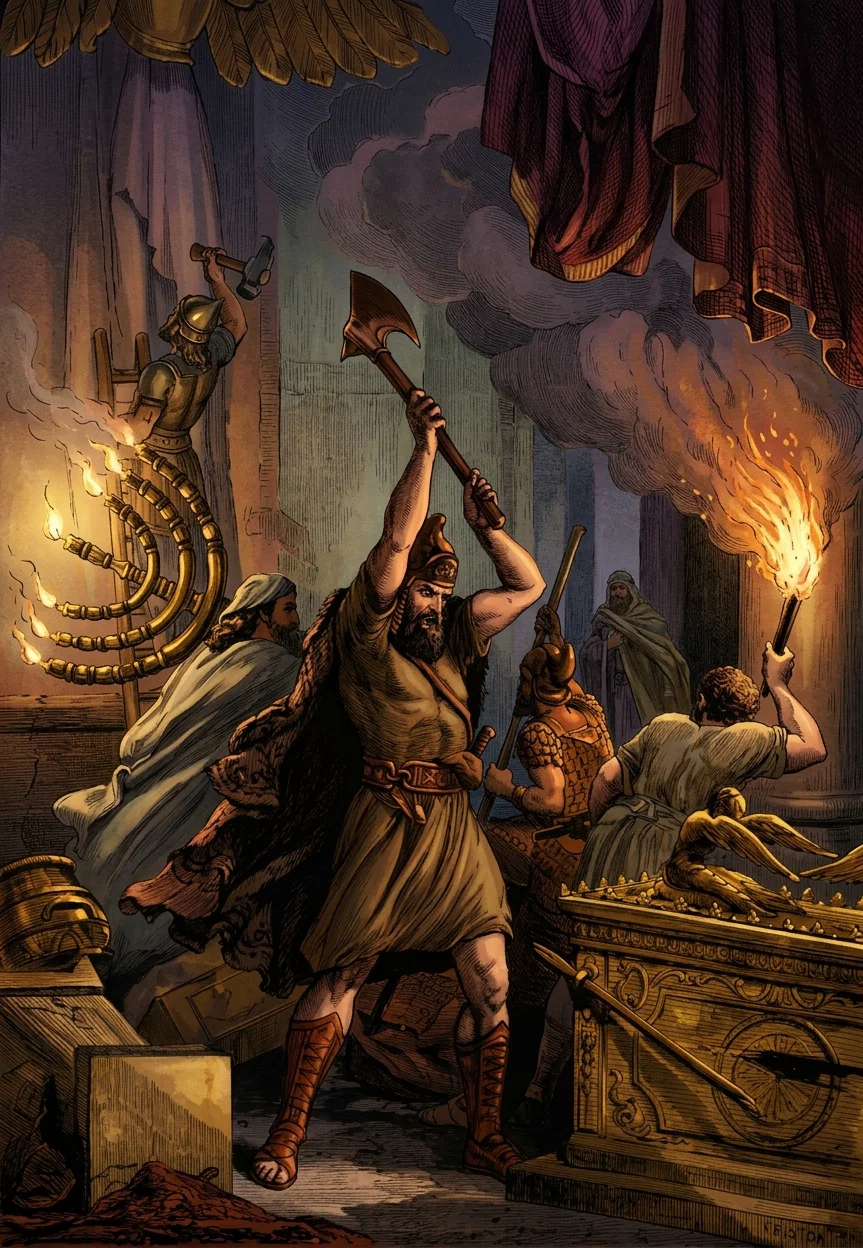
The Destruction of Solomon’s Temple. See 2 Chron. 36:17-19.

V. Returned to Jerusalem

The children of Israel returned to their country and to their former places of residence. We find that in seven months from the time of their going forth from Babylon, they are in their cities, settled in the home land. When some of those who claimed to be Levites desired to join the priests in their work, they could not prove their lineage. These sought to register among those that were reckoned by genealogy, but they were not found. There was the possibility that they were not priests at all. What should be done about There was only one thing to do. If those who were responsible for the purity of the priesthood and the service of the sanctuary should allow those who could not prove their genealogy to act as priests, there was risk that they were not qualified to be priests. On the other hand, if these were really of the right lineage, to repel them was to hold that those who so far as descent was concerned had a right to serve in the temple. The matter was therefore left until such a time as a priest should appear who had the divine gift of urim and thummim. Inquiry from such a priest would determine whether these candidates for priestly service were entitled to do such work or not.
The fact that there was no priest with the urim and thummim, is a comment of itself upon the condition of God’s people at this time. This divine method of knowing God’s will, had fallen into disuse. The expression “till there stood up a priest with urim and thummim,” shows that the practice had fallen into disuse. We notice the matter at this time merely to show how careful God’s people were lest the service could be contaminated by the work of those who were not appointed to the priesthood.

Care in God’s Service

Another incident shows us how careful God’s people were with reference to the sacrificial service. In the opening verses of the third chapter of Ezra is recorded the fact that the altar of burnt offering was set up, and they were offering “burnt offerings thereon unto the Lord, even burnt offerings morning and evening.” The phrase “as it is written in the law of Moses the man of God,” shows that they were carefully following the Word of God; and this outward absolute conformity to the law becomes more and more a distinguishing feature of the work of the Jews from this time onward. Their many experiences in captivity, and the many hard and severe experiences which they were now to undergo, gave them increasingly a conviction that their success as a nation, and therefore their temporal success, depended upon absolute conformity to the law of God. In the scripture which speaks of their carefulness in setting up the altar of burnt offerings, we read: “And they set the altar upon his bases; for fear was upon them because of the people of those countries.” It is evident that they were fearful of trouble and even of calamities, and therefore were very precise in obeying God.

Form Alone Valueless

This was all perfectly proper; that is, if there was joined with it the same carefulness of personal relationship with God. But we are sorry to see that gradually it came to be about the only thing in the religion of the Jews; for when Christ appeared, we find the only religion that the majority of God’s professed people had was an outward conformity to the law of God, and that even this outward conformity was very imperfect, having been changed by traditions and exactions which made void obedience to the literal Word of God.
In beginning the work of restoration, God’s people not only set up the altar of burnt offering, but we read that they also kept the Feast of Tabernacles “as it is written,” and we find them also offering “daily burnt offerings by number, according to the custom, as the duty of every day required.” We find that they also observed all set feasts, and thus began their work by perfect obedience to all the requirements of the ritualistic law. This was all quite right, and we wish to throw no discredit upon it, but to point out the fact that it gradually, as the years passed, became the only conformity that God’s people gave to His great demands.
Continue reading: Remember May 19